

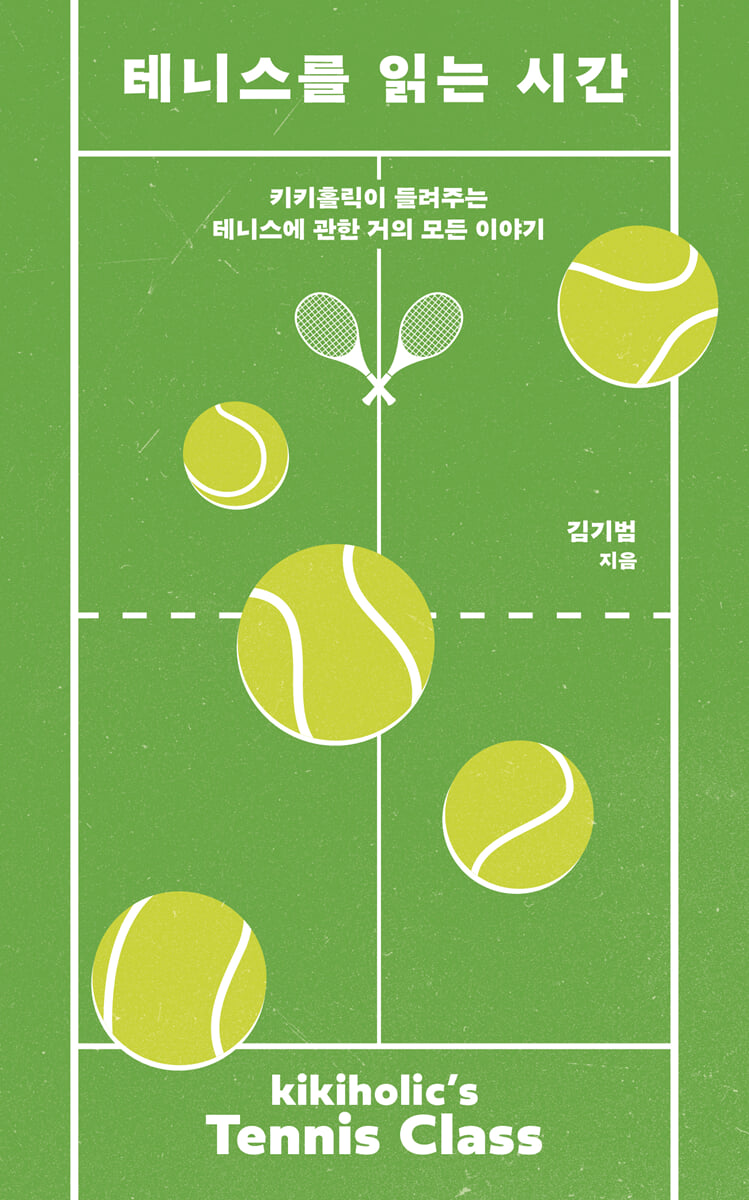
Time to read tennis
 |
Description
Book Introduction
The first introductory tennis book in essay format has been published in the domestic publishing industry.
This is "Time to Read Tennis," written by Ki-beom Kim, aka "Kikiholic," a former captain of a university tennis club, a sports reporter for a public broadcasting station, and a YouTuber and blogger, who has a 30-year relationship with tennis, compiled with in-depth information and refined sentences.
This is "Time to Read Tennis," written by Ki-beom Kim, aka "Kikiholic," a former captain of a university tennis club, a sports reporter for a public broadcasting station, and a YouTuber and blogger, who has a 30-year relationship with tennis, compiled with in-depth information and refined sentences.
- You can preview some of the book's contents.
Preview
index
Introduction
technology
Forehand | Backhand | Volley | Serve | Return | Mental | Singles | Doubles |
game
Love | Racket | Grass, Clay, Hard | Lacoste and Fred Perry | Break Point | Tie Break | Hawk-Eye | Awards Ceremony
rally
Wimbledon 1877 | US Open 1881 | French Open 1891 | Australian Open 1905 | Davis Cup 1900 | Olympics 1988
star
Rod Laver | Billie Jean King | John McEnroe | Martina Navratilova | Ivan Lendl | Steffi Graf | Pete Sampras | Martina Hingis | Roger Federer | Serena Williams | Rafael Nadal | Maria Sharapova | Novak Djokovic
technology
Forehand | Backhand | Volley | Serve | Return | Mental | Singles | Doubles |
game
Love | Racket | Grass, Clay, Hard | Lacoste and Fred Perry | Break Point | Tie Break | Hawk-Eye | Awards Ceremony
rally
Wimbledon 1877 | US Open 1881 | French Open 1891 | Australian Open 1905 | Davis Cup 1900 | Olympics 1988
star
Rod Laver | Billie Jean King | John McEnroe | Martina Navratilova | Ivan Lendl | Steffi Graf | Pete Sampras | Martina Hingis | Roger Federer | Serena Williams | Rafael Nadal | Maria Sharapova | Novak Djokovic
Into the book
Why is the forehand both easy and difficult?
I focus on the 'degree of freedom', one of the characteristics of the forehand technique, as the main reason.
The degree of autonomy granted.
In other words, unlike the backhand or serve, the forehand is relatively easier to change freely than being restricted to a fixed posture.
There are two technical elements that describe the freedom of the forehand.
One is the grip, which is the way you hold the racket handle, and the other is the stance, which determines the position of your feet when hitting the ball.
These two elements are particularly varied in their forms on the forehand.
--- p.15
There is another reason why backhand skills develop more slowly than forehand skills at the amateur level.
The theory of 'use and disuse'.
Because if you don't use it often, it will deteriorate.
Unlike foreign countries, most Korean amateurs prefer doubles.
No, rather than preferring it, it's more likely that the environment has made it that way.
There are many people who want to play tennis, but there is a shortage of courts, so doubles, which allows four people to use the court at once, naturally became the trend.
However, in doubles, one player only needs to cover half of the court.
If you do this, you can turn the ball coming towards your backhand and handle it with your forehand if you move around a little more diligently.
Moreover, there is an unspoken agreement between the two that balls coming to the center are almost always handled by the person on the left with a forehand.
If you rarely use your backhand like this, you will inevitably give yourself less opportunity to improve your skills.
--- p.33
Another key reason tennis is such a high-level psychological game is the frequent pauses in play.
In an actual match, the amount of time spent swinging a tennis racket and exchanging strokes is surprisingly small.
For example, the 2012 Australian Open final between Djokovic and Nadal lasted a whopping 5 hours and 57 minutes, but the two players actually ran around the court and engaged in fierce rallies for less than half that amount of time.
The 26-ball rally, hailed as one of the most intense and beautiful in history, took place in the eighth game of the final fifth set between Nadal and Federer at the 2017 Australian Open.
This luxurious rally, which required both strong physical strength and delicate technique, took just 32 seconds.
How long did it take for the next play to proceed after that shot that was awarded to Federer?
It was 47 seconds, 15 seconds longer than that.
For 47 seconds, Nadal and Federer caught their breath as the crowd gave them a standing ovation, received towels from the ball kids to wipe off the sweat, and prepared themselves physically and mentally for the next serve.
--- p.89
So what goes on in the minds of players during their downtime?
This is the battlefield where fierce psychological warfare takes place.
Anyone who has ever played a game will know.
The most tense, anxious, and psychologically stressful moments are not during intense play, but rather in the quiet moments before and after.
So, players have their own routine movements when preparing to serve to build up their mental strength.
Before serving, Rafael Nadal pulls up the back of his shorts, wipes his nose and strokes the side of his hair.
Novak Djokovic sometimes bounces the ball over 20 times before serving.
All these routines are a process of preparing the mind, not the body.
To calm your breathing, clear your mind of distracting thoughts, and focus only on this point.
--- p.90~91
In tennis, concentration means the ability to stay in the present.
Let's say that at the point just before, your forehand attack unfortunately went 1cm outside the line and you lost the point.
So the game score became 15-30.
If you're thinking about the regret of your forehand 10 seconds ago while preparing for your next serve, you've already lost focus.
And it's the same thing if you lose one more point at 15-30, you might be pushed to break point.
Concentration in tennis means being completely immersed in one point, in the moment you are facing right now.
This is the essence of tennis concentration: being faithful to the present, not the past or the future.
--- p.92
For intermediate players, the most preferred shot option in competitive situations is to hit it down the middle.
This is a basic principle that applies whether both opponents are backed off the baseline or dominate the net.
If you attack the space between two people standing together, you can see two major effects.
If you send it to the middle, the two players will momentarily confuse each other as they wonder who will hit, and the chances of a strong counterattack are low.
Another important effect is that it can limit the relative shot angle.
If you hit the ball that goes left or right, there is a possibility that you will be counterattacked at a deeper angle, but if you hit the ball to the middle of the court, it will be difficult for the opponent to find an angle, so you will not lose the initiative in the next rally.
--- p.112
Tennis has a unique tradition that cannot be found in other sports.
This is the runner-up's awards ceremony speech.
In every tournament, including the Grand Slams, both finalists are given the opportunity to speak in front of the crowd.
It's a rare sight in other sports.
Let's imagine this.
If Argentina's Lionel Messi had been speaking at the stadium after his team's loss to Germany in the 2014 World Cup final, what would he have said? Asking a player who was shedding bitter tears over the pain of defeat to share his thoughts might be a bit too harsh.
Nevertheless, tennis has steadfastly maintained this 'harsh tradition'.
--- p.188
What impressed me most was Lee Hyung-taek's attitude.
Even though it was difficult to expect a victory based on objective statistics, he was truly convinced that he could defeat the powerhouse Germany and advance to the quarterfinals, and he entered the match with a fervent heart.
Despite suffering severe blisters on the soles of his feet from a close full-set match with Mayer on the first day, he showed his fighting spirit by winning a set against Kohlschreiber in the final ace singles match on the third day.
At the time, Kohlschreiber was a young German ace on a meteoric rise, having upset the lightning-fast server Andy Roddick at the Australian Open a week earlier.
Meanwhile, veteran Lee Hyung-taek, who was approaching his mid-30s, ended Korea's Davis Cup journey with tears in his eyes, wondering what would have happened if he hadn't suffered blisters.
What did those tears mean?
As I covered the event on-site, I was able to experience that this Davis Cup, where I represented my country, was a competition on a completely different level from the regular tour tournaments.
I focus on the 'degree of freedom', one of the characteristics of the forehand technique, as the main reason.
The degree of autonomy granted.
In other words, unlike the backhand or serve, the forehand is relatively easier to change freely than being restricted to a fixed posture.
There are two technical elements that describe the freedom of the forehand.
One is the grip, which is the way you hold the racket handle, and the other is the stance, which determines the position of your feet when hitting the ball.
These two elements are particularly varied in their forms on the forehand.
--- p.15
There is another reason why backhand skills develop more slowly than forehand skills at the amateur level.
The theory of 'use and disuse'.
Because if you don't use it often, it will deteriorate.
Unlike foreign countries, most Korean amateurs prefer doubles.
No, rather than preferring it, it's more likely that the environment has made it that way.
There are many people who want to play tennis, but there is a shortage of courts, so doubles, which allows four people to use the court at once, naturally became the trend.
However, in doubles, one player only needs to cover half of the court.
If you do this, you can turn the ball coming towards your backhand and handle it with your forehand if you move around a little more diligently.
Moreover, there is an unspoken agreement between the two that balls coming to the center are almost always handled by the person on the left with a forehand.
If you rarely use your backhand like this, you will inevitably give yourself less opportunity to improve your skills.
--- p.33
Another key reason tennis is such a high-level psychological game is the frequent pauses in play.
In an actual match, the amount of time spent swinging a tennis racket and exchanging strokes is surprisingly small.
For example, the 2012 Australian Open final between Djokovic and Nadal lasted a whopping 5 hours and 57 minutes, but the two players actually ran around the court and engaged in fierce rallies for less than half that amount of time.
The 26-ball rally, hailed as one of the most intense and beautiful in history, took place in the eighth game of the final fifth set between Nadal and Federer at the 2017 Australian Open.
This luxurious rally, which required both strong physical strength and delicate technique, took just 32 seconds.
How long did it take for the next play to proceed after that shot that was awarded to Federer?
It was 47 seconds, 15 seconds longer than that.
For 47 seconds, Nadal and Federer caught their breath as the crowd gave them a standing ovation, received towels from the ball kids to wipe off the sweat, and prepared themselves physically and mentally for the next serve.
--- p.89
So what goes on in the minds of players during their downtime?
This is the battlefield where fierce psychological warfare takes place.
Anyone who has ever played a game will know.
The most tense, anxious, and psychologically stressful moments are not during intense play, but rather in the quiet moments before and after.
So, players have their own routine movements when preparing to serve to build up their mental strength.
Before serving, Rafael Nadal pulls up the back of his shorts, wipes his nose and strokes the side of his hair.
Novak Djokovic sometimes bounces the ball over 20 times before serving.
All these routines are a process of preparing the mind, not the body.
To calm your breathing, clear your mind of distracting thoughts, and focus only on this point.
--- p.90~91
In tennis, concentration means the ability to stay in the present.
Let's say that at the point just before, your forehand attack unfortunately went 1cm outside the line and you lost the point.
So the game score became 15-30.
If you're thinking about the regret of your forehand 10 seconds ago while preparing for your next serve, you've already lost focus.
And it's the same thing if you lose one more point at 15-30, you might be pushed to break point.
Concentration in tennis means being completely immersed in one point, in the moment you are facing right now.
This is the essence of tennis concentration: being faithful to the present, not the past or the future.
--- p.92
For intermediate players, the most preferred shot option in competitive situations is to hit it down the middle.
This is a basic principle that applies whether both opponents are backed off the baseline or dominate the net.
If you attack the space between two people standing together, you can see two major effects.
If you send it to the middle, the two players will momentarily confuse each other as they wonder who will hit, and the chances of a strong counterattack are low.
Another important effect is that it can limit the relative shot angle.
If you hit the ball that goes left or right, there is a possibility that you will be counterattacked at a deeper angle, but if you hit the ball to the middle of the court, it will be difficult for the opponent to find an angle, so you will not lose the initiative in the next rally.
--- p.112
Tennis has a unique tradition that cannot be found in other sports.
This is the runner-up's awards ceremony speech.
In every tournament, including the Grand Slams, both finalists are given the opportunity to speak in front of the crowd.
It's a rare sight in other sports.
Let's imagine this.
If Argentina's Lionel Messi had been speaking at the stadium after his team's loss to Germany in the 2014 World Cup final, what would he have said? Asking a player who was shedding bitter tears over the pain of defeat to share his thoughts might be a bit too harsh.
Nevertheless, tennis has steadfastly maintained this 'harsh tradition'.
--- p.188
What impressed me most was Lee Hyung-taek's attitude.
Even though it was difficult to expect a victory based on objective statistics, he was truly convinced that he could defeat the powerhouse Germany and advance to the quarterfinals, and he entered the match with a fervent heart.
Despite suffering severe blisters on the soles of his feet from a close full-set match with Mayer on the first day, he showed his fighting spirit by winning a set against Kohlschreiber in the final ace singles match on the third day.
At the time, Kohlschreiber was a young German ace on a meteoric rise, having upset the lightning-fast server Andy Roddick at the Australian Open a week earlier.
Meanwhile, veteran Lee Hyung-taek, who was approaching his mid-30s, ended Korea's Davis Cup journey with tears in his eyes, wondering what would have happened if he hadn't suffered blisters.
What did those tears mean?
As I covered the event on-site, I was able to experience that this Davis Cup, where I represented my country, was a competition on a completely different level from the regular tour tournaments.
--- p.250
Publisher's Review
From how to hit a good forehand to Djokovic's record for most Grand Slam wins.
A vast and rich "Tennis Story" condensed from the author's 30 years of tennis experience.
A high-quality tennis introduction book by KBS Korean Broadcasting reporter and tennis YouTuber Kikiholic.
The first introductory tennis book in essay format has been published in the domestic publishing industry.
This is "Time to Read Tennis," written by Ki-beom Kim, aka "Kikiholic," a former captain of a university tennis club, a sports reporter for a public broadcasting station, and a YouTuber and blogger, who has a 30-year relationship with tennis, compiled with in-depth information and refined sentences.
"Time to Read Tennis" contains almost all the tennis-related information and stories in the world.
It covers everything from the forehand and backhand that beginners learn when they first pick up a racket, to the biographies of the Big 3, including Djokovic, Nadal, and Federer, who competed for the most Grand Slam titles.
Until now, most tennis-related books have been focused on techniques.
However, this book focuses on various stories that can be unraveled with the keyword 'tennis', such as technology, history, industry, latest news, and star players.
The author emphasized, “This book is fun to read for anyone interested in tennis, and after reading it, you will gain a greater understanding and skill in tennis, and love the game even more.”
The most striking feature of this book is that it incorporates the fundamental principles of an introductory text that conveys information and knowledge, while presenting it in an essay format that contains the author's unique perspective.
In the first chapter, the author goes back to 1990, when he was in the first year of middle school, and first learned the forehand at a local tennis court.
The author compares the forehand to the Korean language, which is the foundation of all academic disciplines, and the backhand to mathematics, which is the most difficult and tricky to learn. He attempts to analyze tennis techniques in a way that even beginners can easily understand and intermediate and advanced players can gain new insights from.
In Chapter 2, after the arduous training in the lesson room, we move to the tennis court where we can play a real match, and explain the unique rules and scoring system that can only be found on a square tennis court.
The next three chapters take us to the grand tournament of tennis.
From Wimbledon, a place of tradition and prestige, to the Davis Cup and the Olympics, we introduce the background and history of major tournaments.
And the last four chapters shed light on the lives of the best players, who are the idols and ideals of their fans.
It contains the stories of 13 of the greatest tennis legends of all time, from Rod Laver, the first superstar of modern tennis, to Novak Djokovic, who holds the record for most major championship wins.
As you read about the great trends in tennis spanning 150 years of history, you will find yourself leveling up in no time.
This book is a comprehensive introduction to tennis that can satisfy the needs of amateurs who compete every weekend and tennis enthusiasts who stay up all night watching Grand Slam tennis tournaments.
"Time to Read Tennis" is the result of a tennis enthusiast's nearly 40 years of experience and feelings on and off the court, compiled into a single book. It is also an introductory book covering the techniques, history, and industry of tennis, as well as an essay written by a tennis enthusiast who truly loves the sport.
A vast and rich "Tennis Story" condensed from the author's 30 years of tennis experience.
A high-quality tennis introduction book by KBS Korean Broadcasting reporter and tennis YouTuber Kikiholic.
The first introductory tennis book in essay format has been published in the domestic publishing industry.
This is "Time to Read Tennis," written by Ki-beom Kim, aka "Kikiholic," a former captain of a university tennis club, a sports reporter for a public broadcasting station, and a YouTuber and blogger, who has a 30-year relationship with tennis, compiled with in-depth information and refined sentences.
"Time to Read Tennis" contains almost all the tennis-related information and stories in the world.
It covers everything from the forehand and backhand that beginners learn when they first pick up a racket, to the biographies of the Big 3, including Djokovic, Nadal, and Federer, who competed for the most Grand Slam titles.
Until now, most tennis-related books have been focused on techniques.
However, this book focuses on various stories that can be unraveled with the keyword 'tennis', such as technology, history, industry, latest news, and star players.
The author emphasized, “This book is fun to read for anyone interested in tennis, and after reading it, you will gain a greater understanding and skill in tennis, and love the game even more.”
The most striking feature of this book is that it incorporates the fundamental principles of an introductory text that conveys information and knowledge, while presenting it in an essay format that contains the author's unique perspective.
In the first chapter, the author goes back to 1990, when he was in the first year of middle school, and first learned the forehand at a local tennis court.
The author compares the forehand to the Korean language, which is the foundation of all academic disciplines, and the backhand to mathematics, which is the most difficult and tricky to learn. He attempts to analyze tennis techniques in a way that even beginners can easily understand and intermediate and advanced players can gain new insights from.
In Chapter 2, after the arduous training in the lesson room, we move to the tennis court where we can play a real match, and explain the unique rules and scoring system that can only be found on a square tennis court.
The next three chapters take us to the grand tournament of tennis.
From Wimbledon, a place of tradition and prestige, to the Davis Cup and the Olympics, we introduce the background and history of major tournaments.
And the last four chapters shed light on the lives of the best players, who are the idols and ideals of their fans.
It contains the stories of 13 of the greatest tennis legends of all time, from Rod Laver, the first superstar of modern tennis, to Novak Djokovic, who holds the record for most major championship wins.
As you read about the great trends in tennis spanning 150 years of history, you will find yourself leveling up in no time.
This book is a comprehensive introduction to tennis that can satisfy the needs of amateurs who compete every weekend and tennis enthusiasts who stay up all night watching Grand Slam tennis tournaments.
"Time to Read Tennis" is the result of a tennis enthusiast's nearly 40 years of experience and feelings on and off the court, compiled into a single book. It is also an introductory book covering the techniques, history, and industry of tennis, as well as an essay written by a tennis enthusiast who truly loves the sport.
GOODS SPECIFICS
- Date of issue: July 30, 2025
- Page count, weight, size: 368 pages | 408g | 133*213*21mm
- ISBN13: 9791189895167
- ISBN10: 1189895161
You may also like
카테고리
korean


korean

![GQ KOREA Mark (Monthly): December [2025]](http://librairie.coreenne.fr/cdn/shop/files/8ef265dbbfbf186523ed75ba7319009d.jpg?v=1765340328&width=3840)


