

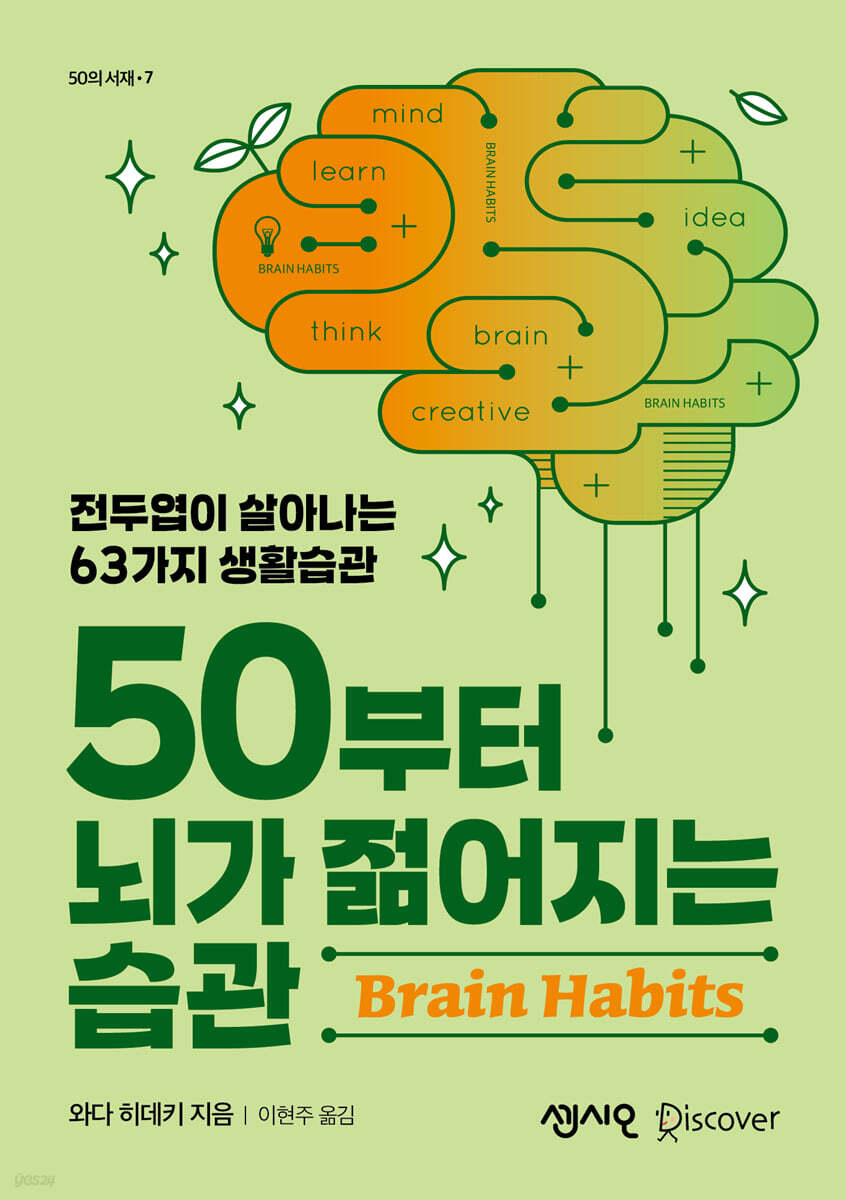
Habits that keep your brain young from age 50
 |
Description
Book Introduction
What is the secret of people who keep their brains sharp even as they age?
63 lifestyle habits that will revive your frontal lobe!
As I approach 50, I often find myself thinking, "I guess I'm getting old."
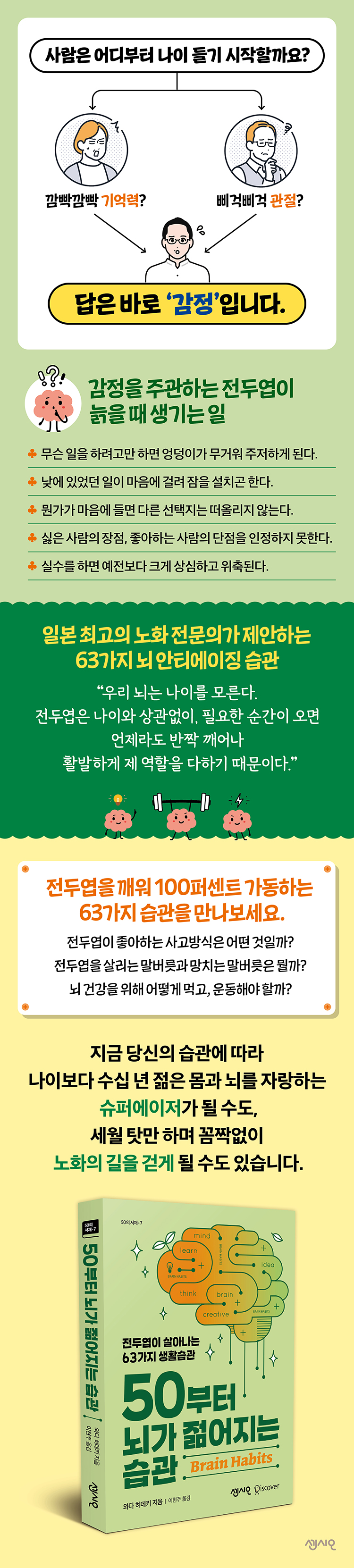
There's one symptom that makes aging even more evident than disobedient joints or a lapsed memory: the aging of our emotions.
It's becoming increasingly difficult to admire or be happy about something like I used to.
But sometimes, when something bothers me, I keep thinking about it and lose sleep at night.
What on earth happens to our brains after middle age to cause this situation to unfold?
Hideki Wada, Japan's top aging specialist, explains:
As humans age, blood flow to the brain decreases, brain function declines, and the secretion of serotonin, a happiness hormone, decreases, leading to mental imbalance. The most important reason, they say, is that the frontal lobe ages.
The human brain atrophies as we age, and the frontal lobe is where the most rapid changes begin.
It starts as early as 40.
The problem is that the frontal lobe is responsible for 'human intelligence', that is, motivation, emotions, and creativity.
This is why emotions age first.
The problem is that if left untreated, both the body and appearance will begin to age rapidly, and in severe cases, dementia may even begin.
Therefore, it is said that in order to keep the brain young, the frontal lobe must be kept young above all else.
Depending on how you use and stimulate your frontal lobe, you can become a super-ager with a body and brain that looks decades younger than your age, or you can just blame the passage of time and walk the path of aging inevitably.
Because the brain doesn't know age.
《Habits that Keep Your Brain Younger from 50》 is a book that contains 63 habits that can keep your frontal lobe young for a long time.
The author says that even a slight change in daily habits, preferences, tendencies, and thought patterns that we take for granted can cause the frontal lobe to suddenly awaken.
In addition, we will introduce methods to rejuvenate the cerebral blood vessels, which are the three major causes of brain aging, and methods to increase the secretion of serotonin, the happiness hormone, and female hormones, which are the main culprits of menopause.
If you want to live a vibrant life as you age, you should focus on habits and attitudes you can implement right now, rather than dwelling on vague anxieties about dementia or aging.
Because life after 50 changes dramatically depending on how you use your brain.
In this book, we will learn how to wake up the brain that is quietly waiting and make it work happily.
63 lifestyle habits that will revive your frontal lobe!
As I approach 50, I often find myself thinking, "I guess I'm getting old."
There's one symptom that makes aging even more evident than disobedient joints or a lapsed memory: the aging of our emotions.
It's becoming increasingly difficult to admire or be happy about something like I used to.
But sometimes, when something bothers me, I keep thinking about it and lose sleep at night.
What on earth happens to our brains after middle age to cause this situation to unfold?
Hideki Wada, Japan's top aging specialist, explains:
As humans age, blood flow to the brain decreases, brain function declines, and the secretion of serotonin, a happiness hormone, decreases, leading to mental imbalance. The most important reason, they say, is that the frontal lobe ages.
The human brain atrophies as we age, and the frontal lobe is where the most rapid changes begin.
It starts as early as 40.
The problem is that the frontal lobe is responsible for 'human intelligence', that is, motivation, emotions, and creativity.
This is why emotions age first.
The problem is that if left untreated, both the body and appearance will begin to age rapidly, and in severe cases, dementia may even begin.
Therefore, it is said that in order to keep the brain young, the frontal lobe must be kept young above all else.
Depending on how you use and stimulate your frontal lobe, you can become a super-ager with a body and brain that looks decades younger than your age, or you can just blame the passage of time and walk the path of aging inevitably.
Because the brain doesn't know age.
《Habits that Keep Your Brain Younger from 50》 is a book that contains 63 habits that can keep your frontal lobe young for a long time.
The author says that even a slight change in daily habits, preferences, tendencies, and thought patterns that we take for granted can cause the frontal lobe to suddenly awaken.
In addition, we will introduce methods to rejuvenate the cerebral blood vessels, which are the three major causes of brain aging, and methods to increase the secretion of serotonin, the happiness hormone, and female hormones, which are the main culprits of menopause.
If you want to live a vibrant life as you age, you should focus on habits and attitudes you can implement right now, rather than dwelling on vague anxieties about dementia or aging.
Because life after 50 changes dramatically depending on how you use your brain.
In this book, we will learn how to wake up the brain that is quietly waiting and make it work happily.
- You can preview some of the book's contents.
Preview
index
Starting Article_Characteristics of People Whose Brains Get Younger as They Age
Brain Aging Test - How old is my 'frontal lobe age'?
Chapter 1.
Brain Anti-Aging: What You Need to Know Starting at 50
To stop the passage of time, focus on your brain.
The surprising changes that happen to our brains as we approach 50.
As time goes by, my body feels heavier and heavier, making it harder to get out of bed.
Don't ignore male menopause.
As the blood vessels in the brain narrow, so does one's social standing.
The key to anti-aging: keeping your frontal lobe young
〈Brain Guardian Column〉 Our Brain with Clear Division of Work
〈Brain Guardian Column〉 Protecting Humanity and Individuality
Chapter 2.
Now is the age where 'output' is more important than 'input' for the brain.
If you keep getting stuck for words, asking yourself, "What was that word?"
Silence at 50 is not 'gold' but 'poison'
Diary: Finding Meaning in an Ordinary Day
How to Use Social Media to Develop Your "Power to Write"
Let's experience connecting with a world we never knew existed.
What is it about an object that triggers a chain reaction of memories for you?
Planning a 'Smart Consumer Lifestyle' for Adults
Even my plans need deadlines.
Lifelong learning? Do we really need to keep learning as we age?
〈Brain Guardian Column〉 Now is the time to focus on the output system rather than the input system.
Chapter 3.
The brain becomes younger when it adapts to change.
When is the frontal lobe most excited?
The frontal lobe that enjoys stocks and lottery
The excitement of middle age is always YES!
Try a new restaurant rather than your regular restaurant
Let's add a new singer to our playlist
If you're facing a crisis, trust your frontal lobe.
Complaints come from an old brain.
A variety of options makes for a good choice.
The frontal lobe that sees the future
True experimentalism is about keeping failure in mind.
〈Brain Guardian Column〉 Even the hardships of aging are worth buying.
Chapter 4.
Fluffy emotions, sharp thoughts
Finding my own 'true'
We need the warmth we share with others periodically.
Why You Age So Quickly After Retirement
When I live round and round and lose myself
Sometimes crookedly, sharply
The discussion begins, shall we have some brain sparring?
The Brain-Moving Spell: "Then You Do It"
Sometimes, let's become a desire lady or a desire uncle.
People who are stuck in past glory
The fun of bumpy and uncomfortable reading
Let's swallow those words, "These days, kids are like that~"
Practice 'honest joy'
When life needs a reset button
To break the habit of obsessing over trivial things
How to Prevent Rash Thoughts
Doubting the statement “It was like that originally”
The "maybe" mindset that glimpses new possibilities
Why read books that make you angry
I think you shouldn't bring up famous people's names
The Usefulness of 'Useless Work'
Prefrontal Stimulation in the Digital Age
Let's put forth a strange hypothesis.
〈Brain Guardian Column〉 'What if I get dementia?' If you're already worried
〈Brain Guardian Column〉 Is King Lear a tragedy caused by frontotemporal dementia?
Chapter 5.
Lifestyle habits that keep your brain young
Change begins with action, not with the mind.
The "planning brain" awakens the frontal lobe.
Even if you have a belly or wrinkles, you're still stylish
The Best Investment for Brain Health
Is it true that exercise is only good if you build muscle?
A walk with pauses and rest
After 50, should you really cut down on meat consumption?
Is cholesterol the enemy of health? How far is it safe?
Dieting in middle age is about eating well, not eating less.
Drinking alone when you feel empty can lead to depression.
The misconception that 'I'm lacking stamina'
Don't hesitate to get glasses for presbyopia
The correlation between laughter and immunity
Abnormal results from health checkups, don't be too scared.
No more health screenings
It's a wonderful age to know how to enjoy something rather than how to do it well.
〈Brain Guardian Column〉 Perfectly Taken "Unfunny" Photos
Brain Aging Test - How old is my 'frontal lobe age'?
Chapter 1.
Brain Anti-Aging: What You Need to Know Starting at 50
To stop the passage of time, focus on your brain.
The surprising changes that happen to our brains as we approach 50.
As time goes by, my body feels heavier and heavier, making it harder to get out of bed.
Don't ignore male menopause.
As the blood vessels in the brain narrow, so does one's social standing.
The key to anti-aging: keeping your frontal lobe young
〈Brain Guardian Column〉 Our Brain with Clear Division of Work
〈Brain Guardian Column〉 Protecting Humanity and Individuality
Chapter 2.
Now is the age where 'output' is more important than 'input' for the brain.
If you keep getting stuck for words, asking yourself, "What was that word?"
Silence at 50 is not 'gold' but 'poison'
Diary: Finding Meaning in an Ordinary Day
How to Use Social Media to Develop Your "Power to Write"
Let's experience connecting with a world we never knew existed.
What is it about an object that triggers a chain reaction of memories for you?
Planning a 'Smart Consumer Lifestyle' for Adults
Even my plans need deadlines.
Lifelong learning? Do we really need to keep learning as we age?
〈Brain Guardian Column〉 Now is the time to focus on the output system rather than the input system.
Chapter 3.
The brain becomes younger when it adapts to change.
When is the frontal lobe most excited?
The frontal lobe that enjoys stocks and lottery
The excitement of middle age is always YES!
Try a new restaurant rather than your regular restaurant
Let's add a new singer to our playlist
If you're facing a crisis, trust your frontal lobe.
Complaints come from an old brain.
A variety of options makes for a good choice.
The frontal lobe that sees the future
True experimentalism is about keeping failure in mind.
〈Brain Guardian Column〉 Even the hardships of aging are worth buying.
Chapter 4.
Fluffy emotions, sharp thoughts
Finding my own 'true'
We need the warmth we share with others periodically.
Why You Age So Quickly After Retirement
When I live round and round and lose myself
Sometimes crookedly, sharply
The discussion begins, shall we have some brain sparring?
The Brain-Moving Spell: "Then You Do It"
Sometimes, let's become a desire lady or a desire uncle.
People who are stuck in past glory
The fun of bumpy and uncomfortable reading
Let's swallow those words, "These days, kids are like that~"
Practice 'honest joy'
When life needs a reset button
To break the habit of obsessing over trivial things
How to Prevent Rash Thoughts
Doubting the statement “It was like that originally”
The "maybe" mindset that glimpses new possibilities
Why read books that make you angry
I think you shouldn't bring up famous people's names
The Usefulness of 'Useless Work'
Prefrontal Stimulation in the Digital Age
Let's put forth a strange hypothesis.
〈Brain Guardian Column〉 'What if I get dementia?' If you're already worried
〈Brain Guardian Column〉 Is King Lear a tragedy caused by frontotemporal dementia?
Chapter 5.
Lifestyle habits that keep your brain young
Change begins with action, not with the mind.
The "planning brain" awakens the frontal lobe.
Even if you have a belly or wrinkles, you're still stylish
The Best Investment for Brain Health
Is it true that exercise is only good if you build muscle?
A walk with pauses and rest
After 50, should you really cut down on meat consumption?
Is cholesterol the enemy of health? How far is it safe?
Dieting in middle age is about eating well, not eating less.
Drinking alone when you feel empty can lead to depression.
The misconception that 'I'm lacking stamina'
Don't hesitate to get glasses for presbyopia
The correlation between laughter and immunity
Abnormal results from health checkups, don't be too scared.
No more health screenings
It's a wonderful age to know how to enjoy something rather than how to do it well.
〈Brain Guardian Column〉 Perfectly Taken "Unfunny" Photos
Detailed image
Into the book
The function of the frontal lobe is called the 'source of humanity'.
Even if the frontal lobe gradually ages, it doesn't cause much inconvenience in eating, sleeping, or living, so you can live somehow.
But we gradually lose our ‘uniqueness’.
In reality, people around them may sense that the person has changed and is no longer the same, but the person themselves often remains unaware of the symptoms. MRI scans and other imaging tests can reveal the aging and atrophy of the frontal lobe.
But the sad and scary thing about frontal lobe aging is that it's not easy to realize it on your own.
--- p.45
It's common to keep putting things off, saying, "It's not urgent right now, I'll do it later when I have time," or in the worst case, to just throw it away.
But no matter how many plans and ideas you've hatched in your head, what good are they if you don't put them into print? The key is to first "speak" them out loud to others.
This way, it becomes easier to put it into ‘action’.
--- p.67
An 'unexpected situation' is usually an unpleasant situation.
Due to unforeseen circumstances, long-awaited performances or games may be canceled, and roads may be closed.
So people are reluctant to face unexpected situations.
But for the frontal lobe, anything unexpected is welcomed with open arms.
The frontal lobe had been preparing thoroughly in advance, waiting for this moment when it would make its grand appearance.
--- p.76
The only reason we have such a sad illusion is because of ‘frontal lobe aging.’
As the brain ages, it begins to prefer things that are comfortable.
So, they interpret everything to their own advantage and avoid hardship or excessive work.
But in this age of 100, people in their 40s and 50s are still in their prime.
I can't just sit there and lament how old I've become.
You have to keep going back to the past and going against the forces trying to find the safety device.
--- p.102-103
We often compare 'aging' to the smooth, mature taste of old wine.
But there are people who, even in middle age, do not lose their sharpness at all and remain as sharp as cola.
These people have no way of accepting information or knowledge without any criticism.
We often ask ourselves, “Is this information true?”, “Is there another hidden agenda?”
He often sees through things that an ordinary person would just pass over from a different perspective and pinpoints the essence.
Even if the frontal lobe gradually ages, it doesn't cause much inconvenience in eating, sleeping, or living, so you can live somehow.
But we gradually lose our ‘uniqueness’.
In reality, people around them may sense that the person has changed and is no longer the same, but the person themselves often remains unaware of the symptoms. MRI scans and other imaging tests can reveal the aging and atrophy of the frontal lobe.
But the sad and scary thing about frontal lobe aging is that it's not easy to realize it on your own.
--- p.45
It's common to keep putting things off, saying, "It's not urgent right now, I'll do it later when I have time," or in the worst case, to just throw it away.
But no matter how many plans and ideas you've hatched in your head, what good are they if you don't put them into print? The key is to first "speak" them out loud to others.
This way, it becomes easier to put it into ‘action’.
--- p.67
An 'unexpected situation' is usually an unpleasant situation.
Due to unforeseen circumstances, long-awaited performances or games may be canceled, and roads may be closed.
So people are reluctant to face unexpected situations.
But for the frontal lobe, anything unexpected is welcomed with open arms.
The frontal lobe had been preparing thoroughly in advance, waiting for this moment when it would make its grand appearance.
--- p.76
The only reason we have such a sad illusion is because of ‘frontal lobe aging.’
As the brain ages, it begins to prefer things that are comfortable.
So, they interpret everything to their own advantage and avoid hardship or excessive work.
But in this age of 100, people in their 40s and 50s are still in their prime.
I can't just sit there and lament how old I've become.
You have to keep going back to the past and going against the forces trying to find the safety device.
--- p.102-103
We often compare 'aging' to the smooth, mature taste of old wine.
But there are people who, even in middle age, do not lose their sharpness at all and remain as sharp as cola.
These people have no way of accepting information or knowledge without any criticism.
We often ask ourselves, “Is this information true?”, “Is there another hidden agenda?”
He often sees through things that an ordinary person would just pass over from a different perspective and pinpoints the essence.
--- p.117-118
Publisher's Review
Will you always be a youthful super-ager?
Will you become a middle-aged person who only blames the passage of time and grows old?
As I approach 50, I often find myself thinking, "I guess I'm getting old."
There's one symptom that makes aging even more evident than disobedient joints or a lapsed memory: the aging of our emotions.
Judgment becomes duller and motivation wanes.
As your emotions harden, it becomes increasingly difficult to feel admiration or joy over things as you used to.
But sometimes, when something bothers me, I keep thinking about it and lose sleep at night.
What exactly happens to our brains after middle age to cause this situation? As we age, serotonin, the "happiness hormone," declines, leading to increased feelings of depression, anxiety, and irritability, leading to mental imbalances.
Additionally, blood flow to the brain decreases, which impairs brain function, and male hormone levels drop, which causes a noticeable decrease in concentration and initiative, and a lack of motivation in everything.
The most important brain change of all is that the frontal lobe ages.
The human brain atrophies as we age, and the area where changes begin most rapidly is the frontal lobe.
The phenomenon of accelerated decline in nerve cells in the frontal lobe begins much earlier than we think, around the age of 40 or 50.
The frontal lobe is the part that controls 'human' intelligence.
Motivation, curiosity, creativity, planning, etc. all depend on how active the frontal lobe is.
Conversely, this means that we can slow down the atrophy and aging of the frontal lobe by keeping our motivation, emotions, thinking skills, and creativity young and controlling them.
Hideki Wada, Japan's leading aging specialist, explains in his book, "Habits That Make Your Brain Younger From 50," that "the brain doesn't know age."
Depending on how you use and stimulate your frontal lobe, you can either become a super-ager with a body and brain that looks decades younger than your age, or you can end up aging helplessly, blaming the passage of time.
If you settle into the same old routine, devoid of any surprises, and turn away from new changes or challenges, thinking, "What can I do at this age?", you will literally grow older day by day.
This book introduces 63 habits that will rejuvenate your frontal lobe, with friendly explanations and entertaining examples.
When we make small changes to our daily habits of eating, moving, and forming relationships, as well as the perspectives and thoughts we take for granted, our frontal lobe suddenly awakens.
Exciting activities that awaken the frontal lobe make the brain younger!
63 Anti-Aging Brain Habits to Start Today
Everyone has probably felt the fear of, 'What if I get dementia?' at least once.
In fact, pathological dementia such as Alzheimer's disease or cerebrovascular disease can only be slowed down to a certain extent with modern medicine, but complete prevention or treatment is impossible.
However, 'dementia-like symptoms', which occur nearly 7 times more frequently than dementia, are caused by brain aging, so they can be effectively prevented and improved by consistently stimulating the brain with lifestyle habits that train the frontal lobe.
《Habits that Make Your Brain Younger from 50》 suggests various 'brain anti-aging' habits that stimulate the frontal lobe.
One important principle is to focus on output rather than input.
As we age, we often worry about our brain's input function, such as not being able to remember what we read or not being able to remember it for a long time.
But what we need to consider more seriously from an aging perspective is the brain's output function.
There are many ways to compensate for the creaks in the input system, but the output system has no one to rely on but the frontal lobe.
For example, the author advises that you first 'speak out' in front of people about the various plans or ideas that come to mind.
This is because it becomes easier to put it into ‘action’.
If you declare to your friends, “No matter what happens, I will definitely do ‘this and that’ by ‘that and that’ date,” from then on, you will desperately try to figure out a specific method to do it.
In this output process of turning thoughts into words and words into actions, the frontal lobe works hard and lights up. When the results of this full-on frontal lobe are satisfactory, motivation increases and a virtuous cycle of rejuvenation of the brain occurs.
If you want to live a vibrant life as you age, you should focus on habits and attitudes you can implement right now, rather than dwelling on vague anxieties about dementia or aging.
The "63 Habits for a Younger Brain" presented in this book help us actively seek out and utilize the information scattered throughout our brains, allowing us to experience and enjoy the world more vividly.
Life after 50 changes dramatically depending on how you use your brain.
In this book, we will learn how to wake up the brain that is quietly waiting and make it work happily.
Will you become a middle-aged person who only blames the passage of time and grows old?
As I approach 50, I often find myself thinking, "I guess I'm getting old."
There's one symptom that makes aging even more evident than disobedient joints or a lapsed memory: the aging of our emotions.
Judgment becomes duller and motivation wanes.
As your emotions harden, it becomes increasingly difficult to feel admiration or joy over things as you used to.
But sometimes, when something bothers me, I keep thinking about it and lose sleep at night.
What exactly happens to our brains after middle age to cause this situation? As we age, serotonin, the "happiness hormone," declines, leading to increased feelings of depression, anxiety, and irritability, leading to mental imbalances.
Additionally, blood flow to the brain decreases, which impairs brain function, and male hormone levels drop, which causes a noticeable decrease in concentration and initiative, and a lack of motivation in everything.
The most important brain change of all is that the frontal lobe ages.
The human brain atrophies as we age, and the area where changes begin most rapidly is the frontal lobe.
The phenomenon of accelerated decline in nerve cells in the frontal lobe begins much earlier than we think, around the age of 40 or 50.
The frontal lobe is the part that controls 'human' intelligence.
Motivation, curiosity, creativity, planning, etc. all depend on how active the frontal lobe is.
Conversely, this means that we can slow down the atrophy and aging of the frontal lobe by keeping our motivation, emotions, thinking skills, and creativity young and controlling them.
Hideki Wada, Japan's leading aging specialist, explains in his book, "Habits That Make Your Brain Younger From 50," that "the brain doesn't know age."
Depending on how you use and stimulate your frontal lobe, you can either become a super-ager with a body and brain that looks decades younger than your age, or you can end up aging helplessly, blaming the passage of time.
If you settle into the same old routine, devoid of any surprises, and turn away from new changes or challenges, thinking, "What can I do at this age?", you will literally grow older day by day.
This book introduces 63 habits that will rejuvenate your frontal lobe, with friendly explanations and entertaining examples.
When we make small changes to our daily habits of eating, moving, and forming relationships, as well as the perspectives and thoughts we take for granted, our frontal lobe suddenly awakens.
Exciting activities that awaken the frontal lobe make the brain younger!
63 Anti-Aging Brain Habits to Start Today
Everyone has probably felt the fear of, 'What if I get dementia?' at least once.
In fact, pathological dementia such as Alzheimer's disease or cerebrovascular disease can only be slowed down to a certain extent with modern medicine, but complete prevention or treatment is impossible.
However, 'dementia-like symptoms', which occur nearly 7 times more frequently than dementia, are caused by brain aging, so they can be effectively prevented and improved by consistently stimulating the brain with lifestyle habits that train the frontal lobe.
《Habits that Make Your Brain Younger from 50》 suggests various 'brain anti-aging' habits that stimulate the frontal lobe.
One important principle is to focus on output rather than input.
As we age, we often worry about our brain's input function, such as not being able to remember what we read or not being able to remember it for a long time.
But what we need to consider more seriously from an aging perspective is the brain's output function.
There are many ways to compensate for the creaks in the input system, but the output system has no one to rely on but the frontal lobe.
For example, the author advises that you first 'speak out' in front of people about the various plans or ideas that come to mind.
This is because it becomes easier to put it into ‘action’.
If you declare to your friends, “No matter what happens, I will definitely do ‘this and that’ by ‘that and that’ date,” from then on, you will desperately try to figure out a specific method to do it.
In this output process of turning thoughts into words and words into actions, the frontal lobe works hard and lights up. When the results of this full-on frontal lobe are satisfactory, motivation increases and a virtuous cycle of rejuvenation of the brain occurs.
If you want to live a vibrant life as you age, you should focus on habits and attitudes you can implement right now, rather than dwelling on vague anxieties about dementia or aging.
The "63 Habits for a Younger Brain" presented in this book help us actively seek out and utilize the information scattered throughout our brains, allowing us to experience and enjoy the world more vividly.
Life after 50 changes dramatically depending on how you use your brain.
In this book, we will learn how to wake up the brain that is quietly waiting and make it work happily.
GOODS SPECIFICS
- Date of issue: July 28, 2025
- Page count, weight, size: 226 pages | 248g | 120*170*14mm
- ISBN13: 9791166572012
- ISBN10: 1166572013
You may also like
카테고리
korean


korean

![GQ KOREA Mark (Monthly): December [2025]](http://librairie.coreenne.fr/cdn/shop/files/8ef265dbbfbf186523ed75ba7319009d.jpg?v=1765340328&width=3840)


