

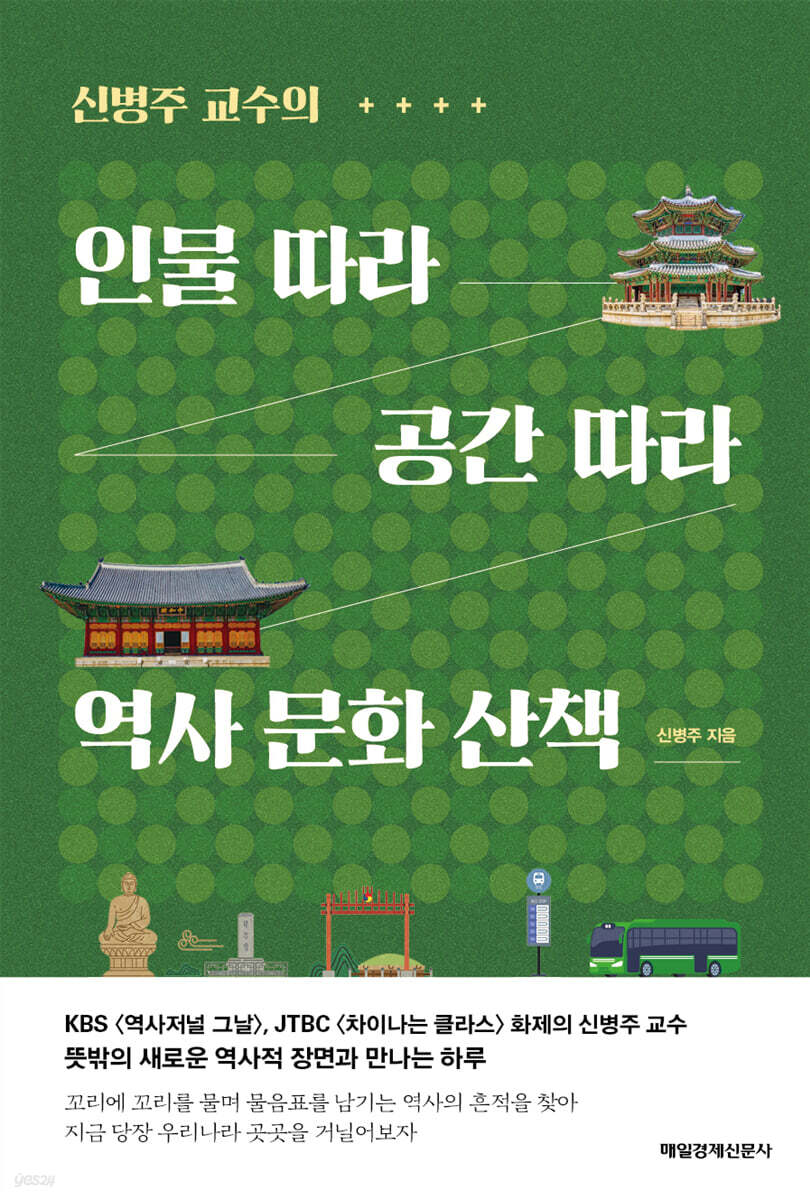
A historical and cultural walk along the people and spaces
 |
Description
Book Introduction
Professor Shin Byeong-ju, a hot topic on KBS's "History Journal That Day" and JTBC's "China Class"
A day filled with unexpected new historical scenes
In search of traces of history that leave question marks behind them
Let's take a walk around our country right now.
Historical events are embedded in every path we pass by without noticing.
Once you know its historical background, the road is no longer just an ordinary place.
As the people, events, and spaces of that time are connected, you will have the amazing experience of encountering vivid historical scenes.
An encounter with the past is also an encounter with a new world.
It has a different charm from the heavy historical books that focus on narrative causality.
Let's grab this book, which will teach us vivid and true history by allowing us to actually encounter the scenes from that time, and go out and explore every corner of our country right now.
Along the way, unexpected new meanings emerge, and historical figures and events feel like they are not far away in connection with the present.
As we follow the layers of historical stories one by one, we glimpse the wonderful wisdom and character of our ancestors, and the enlightenment we gain today is a bonus.
A day filled with unexpected new historical scenes
In search of traces of history that leave question marks behind them
Let's take a walk around our country right now.
Historical events are embedded in every path we pass by without noticing.
Once you know its historical background, the road is no longer just an ordinary place.
As the people, events, and spaces of that time are connected, you will have the amazing experience of encountering vivid historical scenes.
An encounter with the past is also an encounter with a new world.
It has a different charm from the heavy historical books that focus on narrative causality.
Let's grab this book, which will teach us vivid and true history by allowing us to actually encounter the scenes from that time, and go out and explore every corner of our country right now.
Along the way, unexpected new meanings emerge, and historical figures and events feel like they are not far away in connection with the present.
As we follow the layers of historical stories one by one, we glimpse the wonderful wisdom and character of our ancestors, and the enlightenment we gain today is a bonus.
- You can preview some of the book's contents.
Preview
index
Introduction
Part 1: Royal History, Inside the Palace
Naeuiwon, a healing space within the palace
Spaces that remember Crown Prince Munjong
Jiphyeonjeon, the birthplace of talent
Snow scene in the rear garden of Changdeokgung Palace
King Jeongjo's birth and death, Gyeongchunjeon and Yeongchunheon
Jibokjae, the library inside Gyeongbokgung Palace
The Joseon Dynasty's kinship management department, Jongchinbu
King Sejong's coronation ceremony, Geunjeongjeon Hall at Gyeongbokgung Palace
Changgyeonggung Palace, the palace that started out for royal women
Gyeonghuigung Palace, the fifth palace of Joseon
Prince Sohyeon's suspicious death, Hwangyeongjeon Hall at Changgyeonggung Palace
Restoration of Hyangwonjeong and Chwihyanggyo
Jeongjo and the 10 Views of Sangrim
The magnificent landscaping of Gyeonghoeru Pavilion at Gyeongbokgung Palace
Tongmyeongjeon, the space where Queen Jeongsun was chosen
From Gyeongungung Palace to Deoksugung Palace
Part 2: Seoul: A Space of Conflict and Change
Han Myeong-hoe's downfall due to Apgujeong
Children's Grand Park and Neungdong
Namsan's rituals and sunrise
Chilgung, a shrine dedicated to the concubines who gave birth to the king
The story of the private residence and the sleeping quarters where the king was born
Queen Munjeong's Bongeunsa Temple
The humiliation of Samjeondo and the Samjeondo Monument
Russian Embassy in Jeongdong
Jongmyo Shrine, the place visited by kings in the new year
The joy of walking through Hanyangdoseong
High schools located in the bosom of Bukchon, Seoul
Namsan Beacon Mound, the final destination of beacon fires
The royal wedding ceremony site, Eouigung
Naksan Park and Heungdeok
Injo Byeolseo Yugibi, designated as a national treasure
The history of Songseokwon, the center of Chinese culture
Hwangudan, a symbolic space of the Korean Empire
Spaces that remember Jangchungdan
Taylor and Dilkusha
The spaces of the Injo Restoration in March 1623
King Sukjong, the distribution of Sangpyeong Tongbo, and the Sangpyeong Office
Park Jae-ga and 'Bukhak-ui', who aimed for an open world
The day of the Gapsin Coup in December 1884
Jeongjo and Yongyangbong Reservoir
Part 3: History of the Outskirts, Gyeonggi-do
Chusa Kim Jeong-hui and Gwacheon Gwaji Chodang
Directions to Donggureung
Historic sites in Seoul and Yeoju that commemorate King Sejong
Jeong Mong-ju, Jo Gwang-jo, and Yongin
Ganghwa Island, which has relics from different periods
The story of the tombs of King Yeongjo's wife and mother
Achasan Mountain and Goguryeo Fortress Remains
Why did King Jeongjo establish Oegyujanggak on Ganghwa Island?
Part 4: The hometown of scholars, Gyeongsang-do
The first private medical institution, Jonaewon
Scenes from Andong Hahoe Village
Sites of the Battle of Hansando in 1592
Sancheonjae, Nammyeong Josik and the Righteous Army
The scent of Toegye found in Dosan-myeon, Andong
Namhae Geumsan Boriam
Namhae Nodo and Exile Literature Museum
Battle of Noryang and the remains of Gwaneumpo in Namhae
Yeongcheon Imgo Seowon and Gocheon Seowon
Hamyang Gaepyeong Village and Namgye Seowon
Jangsa Landing Operation Victory Memorial Hall
Lee Yuk-sa Literature Museum and Yukwoo-dang
Discovery of the Hunminjeongeum Haeryebon
Part 5: Learning Blossomed in Exile: Jeolla Province
Yangsanbo and Soswaewon
UNESCO World Heritage Site, Museong Seowon in Jeongeup
Jeong Yak-jeon and Heuksando Sachonseosil
Jeonju Omokdae commemorating Yi Seong-gye's victory
Yu Hyeong-won and Buan Bangye Seodang
The pride of Muju, the Jeoksangsan accident
Jeong Yak-yong and his place of exile in Gangjin
The prepared general Yi Sun-sin and the Yeosu Historic Site
Part 6: Traces of Integrity and Catholicism, Chungcheong Province
Maeng Sa-seong, the upright official, and the Maeng clan's conduct
Chusa Kim Jeong-hui's old house in Yesan
Hongseong Seongsammun Ruins Site, South Chungcheong Province
Chungju Goguryeo Stele, Danyang Silla Jeokseong Stele, and Bukhansan Stele
The Tomb of King Muryeong of Gongju Revealed After 1,450 Years
Okcheon Jeong Ji-yong's birthplace
Father Kim Dae-geon and Solmoe Holy Ground
Places Remembering Dr. Yun Bong-gil
Part 7: Heo Nanseolheon and Kim Mandeok, Gangwon-do and Jeju-do
Ojukheon, the space of Shin Saimdang and Yi I
Heo Nanseolheon's birthplace in Gangneung
The relationship between Sejo and Sangwonsa
People who protected the historical records
Jeju Island Hangpaduri Castle Historic Site
Kim Man-deok and the spirit of sharing
The Birth of Sehando and Jeju Chusa Museum
Part 1: Royal History, Inside the Palace
Naeuiwon, a healing space within the palace
Spaces that remember Crown Prince Munjong
Jiphyeonjeon, the birthplace of talent
Snow scene in the rear garden of Changdeokgung Palace
King Jeongjo's birth and death, Gyeongchunjeon and Yeongchunheon
Jibokjae, the library inside Gyeongbokgung Palace
The Joseon Dynasty's kinship management department, Jongchinbu
King Sejong's coronation ceremony, Geunjeongjeon Hall at Gyeongbokgung Palace
Changgyeonggung Palace, the palace that started out for royal women
Gyeonghuigung Palace, the fifth palace of Joseon
Prince Sohyeon's suspicious death, Hwangyeongjeon Hall at Changgyeonggung Palace
Restoration of Hyangwonjeong and Chwihyanggyo
Jeongjo and the 10 Views of Sangrim
The magnificent landscaping of Gyeonghoeru Pavilion at Gyeongbokgung Palace
Tongmyeongjeon, the space where Queen Jeongsun was chosen
From Gyeongungung Palace to Deoksugung Palace
Part 2: Seoul: A Space of Conflict and Change
Han Myeong-hoe's downfall due to Apgujeong
Children's Grand Park and Neungdong
Namsan's rituals and sunrise
Chilgung, a shrine dedicated to the concubines who gave birth to the king
The story of the private residence and the sleeping quarters where the king was born
Queen Munjeong's Bongeunsa Temple
The humiliation of Samjeondo and the Samjeondo Monument
Russian Embassy in Jeongdong
Jongmyo Shrine, the place visited by kings in the new year
The joy of walking through Hanyangdoseong
High schools located in the bosom of Bukchon, Seoul
Namsan Beacon Mound, the final destination of beacon fires
The royal wedding ceremony site, Eouigung
Naksan Park and Heungdeok
Injo Byeolseo Yugibi, designated as a national treasure
The history of Songseokwon, the center of Chinese culture
Hwangudan, a symbolic space of the Korean Empire
Spaces that remember Jangchungdan
Taylor and Dilkusha
The spaces of the Injo Restoration in March 1623
King Sukjong, the distribution of Sangpyeong Tongbo, and the Sangpyeong Office
Park Jae-ga and 'Bukhak-ui', who aimed for an open world
The day of the Gapsin Coup in December 1884
Jeongjo and Yongyangbong Reservoir
Part 3: History of the Outskirts, Gyeonggi-do
Chusa Kim Jeong-hui and Gwacheon Gwaji Chodang
Directions to Donggureung
Historic sites in Seoul and Yeoju that commemorate King Sejong
Jeong Mong-ju, Jo Gwang-jo, and Yongin
Ganghwa Island, which has relics from different periods
The story of the tombs of King Yeongjo's wife and mother
Achasan Mountain and Goguryeo Fortress Remains
Why did King Jeongjo establish Oegyujanggak on Ganghwa Island?
Part 4: The hometown of scholars, Gyeongsang-do
The first private medical institution, Jonaewon
Scenes from Andong Hahoe Village
Sites of the Battle of Hansando in 1592
Sancheonjae, Nammyeong Josik and the Righteous Army
The scent of Toegye found in Dosan-myeon, Andong
Namhae Geumsan Boriam
Namhae Nodo and Exile Literature Museum
Battle of Noryang and the remains of Gwaneumpo in Namhae
Yeongcheon Imgo Seowon and Gocheon Seowon
Hamyang Gaepyeong Village and Namgye Seowon
Jangsa Landing Operation Victory Memorial Hall
Lee Yuk-sa Literature Museum and Yukwoo-dang
Discovery of the Hunminjeongeum Haeryebon
Part 5: Learning Blossomed in Exile: Jeolla Province
Yangsanbo and Soswaewon
UNESCO World Heritage Site, Museong Seowon in Jeongeup
Jeong Yak-jeon and Heuksando Sachonseosil
Jeonju Omokdae commemorating Yi Seong-gye's victory
Yu Hyeong-won and Buan Bangye Seodang
The pride of Muju, the Jeoksangsan accident
Jeong Yak-yong and his place of exile in Gangjin
The prepared general Yi Sun-sin and the Yeosu Historic Site
Part 6: Traces of Integrity and Catholicism, Chungcheong Province
Maeng Sa-seong, the upright official, and the Maeng clan's conduct
Chusa Kim Jeong-hui's old house in Yesan
Hongseong Seongsammun Ruins Site, South Chungcheong Province
Chungju Goguryeo Stele, Danyang Silla Jeokseong Stele, and Bukhansan Stele
The Tomb of King Muryeong of Gongju Revealed After 1,450 Years
Okcheon Jeong Ji-yong's birthplace
Father Kim Dae-geon and Solmoe Holy Ground
Places Remembering Dr. Yun Bong-gil
Part 7: Heo Nanseolheon and Kim Mandeok, Gangwon-do and Jeju-do
Ojukheon, the space of Shin Saimdang and Yi I
Heo Nanseolheon's birthplace in Gangneung
The relationship between Sejo and Sangwonsa
People who protected the historical records
Jeju Island Hangpaduri Castle Historic Site
Kim Man-deok and the spirit of sharing
The Birth of Sehando and Jeju Chusa Museum
Detailed image

Into the book
Hanyangdoseong, which had its original form during the reign of King Taejo, was left abandoned for a while after King Jeongjong ascended the throne in 1398 and the capital was moved to Gaeseong.
After Taejo, the person who commanded the construction of the capital city was Sejong.
On December 10, 1421, King Sejong appointed Right State Councillor Jeong Tak as the person in charge of rebuilding the capital city.
28,487 collapsed areas were rebuilt.
During the reign of King Taejo, young men were conscripted from all over the country, including Gyeonggi-do and Chungcheong-do, which had not participated.
It can be seen that along with a total of 320,000 men, there were also about 2,000 craftsmen who participated.
In the late Joseon Dynasty, large-scale reconstruction work was carried out during the reigns of King Sukjong and King Sunjo, and the status of the capital city's construction in each period can be understood through the shapes of stones of different sizes.
With the full opening of the Blue House in May 2022, Hanyangdoseong can now be viewed from Baekaksan Mountain behind the Blue House.
If you climb up to Naksan Park, where Hanyangdoseong is located, you can see Seoul surrounded by four mountains at a glance.
We hope you will take a stroll through Hanyangdoseong, a representative space where the history and culture of the Joseon Dynasty continue to this day, and appreciate Seoul's past and present.
--- From "The Joy of Walking Through Hanyangdoseong"
The Samjeondo Monument was torn down in 1895 by order of Emperor Gojong after the Sino-Japanese War, but was re-erected in its place in 1913 during the Japanese colonial period.
In 1956, the Ministry of Education took the lead in burying the monument underground, and its suffering continued.
When the monument was revealed by the flood in 1963, the government moved it to Seokchon-dong, near its original location, with the intention of making it a place of reflection on the history of Samjeondo.
It was moved to its current location near Seokchon Lake in 2010.
It is clear that the Samjeondo Monument has deeply wounded our pride, but on the other hand, it vividly reminds us of how dangerous a war waged in the name of justification can be.
--- From "The Humiliation of Samjeondo and the Samjeondo Monument"
During the Joseon Dynasty, Bukchon was a place where mainly noblemen and high-ranking officials resided.
It was located between Gyeongbokgung Palace and Changdeokgung Palace, and was a suitable place for residence as it was located on Yukjo Street, where government offices were concentrated, and a market was formed nearby.
Bukchon's favorable location continued into modern times, with major Seoul schools now located here.
Schools that were located in Bukchon, such as Gyeonggi High School, Gyeonggi Girls' High School, Whimoon High School, Jungdong High School, Changdeok Girls' High School, and Poongmoon Girls' High School, were mostly relocated to Gangnam in the 1970s, with the exception of Jungang High School and Deokseong Girls' High School, as the government's policy of relocating to Gangnam was implemented.
Gyeonggi Girls' High School moved to Jeong-dong next to the U.S. Embassy in 1945 and to Gaepo-dong, Gangnam-gu in 1988.
After Gyeonggi Girls' High School relocated, Changdeok Girls' High School took its place, and Changdeok Girls' High School relocated to Bangi-dong, Songpa-gu in 1989.
At the site of the Constitutional Court, there is a white pine tree, a natural monument, and a stone marker marking the home of Park Gyu-su, the grandson of Park Ji-won, a Silhak scholar from the late Joseon Dynasty, and Hong Yeong-sik, a reformist politician.
The first hospital, Jejungwon, founded in 1885, was also located here.
Pungmoon Girls' High School, which was located on Gamgodang-gil until recently, moved to Jagok-dong, Gangnam-gu in 2017 and was renamed Pungmoon High School.
--- From "High Schools in the Bosom of Bukchon, Seoul"
The current Seochon was the center of the late Joseon Dynasty's central culture.
The middle class, located between the yangban and commoners, consisted mainly of technical workers and secretaries in central government offices.
In the late Joseon Dynasty, middle-class people held meetings and engaged in poetry and prose competitions.
The center of the activity was Songseokwon (松石園), whose owner was poet Cheon Su-gyeong. The owner of this place changed several times after that.
After passing through the Jangdong Kim clan and the Yeoheung Min clan, around 1910, pro-Japanese collaborator Yun Deok-yeong owned Songseokwon.
After the forced annexation of Korea by Japan in 1910, Yun Deok-yeong purchased more than half of the land in Okin-dong, Seochon, between 1914 and 1915.
And on the site of the old Songseokwon, he built a mansion called Byeoksusanjang (碧樹山莊) with a French-style Western-style building at its center.
Although Byeoksusanjang was so large that it could be seen from afar, people mocked it and called it 'Hanyang's Abanggung Palace'.
To the south of Byeoksusanjang was a two-story brick house built by Yun Deok-yeong for his daughter and son-in-law.
Designed by modern architect Park Gil-ryong in the 1930s, it had a unique form that mixed Korean and Western techniques with Japanese and Chinese styles.
This house was owned by artist Park No-su (1927-2013) from 1972, and after his death, the house and its artworks were donated to Jongno-gu.
Around the Park No-soo Art Museum, you can also find signs for the 'Lee Sang House,' which is located on the site of the house where poet Lee Sang lived for 20 years, and the 'Yoon Dong-ju Boarding House,' which tells us that Yun Dong-ju, a student at Yonsei College, boarded at the house of novelist Kim Song.
--- From "The History of Song Seok-won, the Center of Chinese Culture"
In Haengchon-dong, near Seodaemun Subway Station in Seoul, a two-story Western-style house with a red brick exterior stands out at first glance next to an old ginkgo tree.
This house, which had been abandoned for a while, was discovered to have been the home of Albert and Mary Taylor in the mid-2000s when a stone inscribed with the words "DILKUSHA 1923" was discovered.
'Dilkusha' is a Hindi word meaning 'ideal world' or 'happy heart'.
Built in 1923, the couple lived here for about 20 years until they were deported to the United States by the Japanese in 1942, and Mary even wrote her autobiography, Chain of Amber.
The March 1st Movement of 1919 came to Albert like fate.
Mary gave birth to her baby at Severance Hospital on February 28, the day before the March 1st Movement.
Severance Hospital is located in Peach Valley outside Namdaemun, where the Yonsei Foundation Severance Building is currently located.
--- From "The Taylors and Dilkusha"
While medical institutions such as Naeuiwon, Jeonuigam, Hyeminseo, and Hwalinseo were state-run medical institutions, Jonaewon holds great historical significance as a private medical institution established in a local area.
Jonaewon was founded by scholars representing the Sangju region, including Kim Gak, Seong Ram, Lee Jeon, Lee Jun, Kang Eung Cheol, Kim Gwang Du, and Jeong Gyeong Se, with 13 clans participating.
Jeong Gyeong-se, a disciple of Yu Seong-ryong, actively encouraged the local yangban to establish a medical center, and Seong Ram, a Confucian scholar who was also skilled in medicine, served as the first attending physician of Jonaewon.
The name of the Jonaewon is taken from the words of Song Dynasty Confucian scholar Jeong Myeong-do, which means “to protect and nurture the mind and love all things.”
In the collected works of Jeong Gyeong-se and Lee Jun, there is a record of establishing the medical institution Jonaewon in 1602, and in the biography of Jeong Gyeong-se written by Song Si-yeol, a scholar of the late Joseon Dynasty, there is a record that “he and his comrades prepared medicine and helped the sick in the county, and named it Jonaewon after the words of Seon Master Jeong Myeong-do.”
--- From "The First Private Medical Institution, Jonaewon"
Along with Lee Sang-ryong and Kim Yong-hwan, Lee Yuk-sa (1904-1944) is a representative independence activist of the Andong region.
He was born in 1904 in Wonchon-dong, Uidong-myeon, Yean-gun, Gyeongsangbuk-do, as the 14th generation descendant of Toegye Yi Hwang.
His real name is Wonrok or Wonsam, and he changed his name to Hwal.
He studied Chinese classics from his grandfather in Andong and attended Gyonam School in Daegu. In 1925, he joined the independence movement group Uiyeoldan.
The pride of being a descendant of Yi Hwang's prestigious family must have been a great driving force that led him to devote himself to the independence movement.
He went to Beijing in 1926 and entered the Beijing Military Academy. In 1927, he was implicated in the bombing of the Daegu branch of the Bank of Joseon and was imprisoned in Daegu Prison for three years.
It is said that the prisoner number at that time, 264, was used to name the prison 'Yuksa'.
Yukwoo-dang, which means 'the house that protects the friendship of six brothers', was originally located in Woncheon-ri, where the Cheongpodo Stele is currently located, but was submerged due to the construction of Andong Dam, and was relocated to Taehwa-dong, Andong-si in April 1976.
After the function of the house was damaged due to flooding, it was restored through research and is now in its current form.
--- From "Yuksa Lee Literary Museum and Yukwoo Hall"
In Damyang, you can easily find pavilions that embody the elegance and style of the Joseon Dynasty scholars from Honam, and among them, the best is Soswaewon, a garden built by Yangsanbo (1503-1557).
Yangsanbo was a disciple of Jo Gwang-jo. After his teacher's tragic death, he built a pavilion here and lived a life of seclusion.
Soswaewon is the best private garden in Joseon, and the harmony between nature and man-made structures is very attractive, as buildings were built here and there while preserving the natural appearance.
The name Soswaewon means ‘clear and clean’ and was given by Yangsanbo.
It contains Yang San-bo's intention to escape from the turbid political reality and devote himself to academics with a clear and pure mind.
Construction of Soswaewon began in 1520 and began in earnest in the 1530s.
By the 1540s, it had taken on the appearance of a garden.
Although Soswaewon was a place of seclusion for Yangsanbo, it was also a gathering place for scholars of the time.
Here, representative scholars of Honam, including Song Soon, Kim In-hu, Im Eok-ryeong, Jeong Cheol, and Go Gyeong-myeong, gathered to exchange poetry and enjoy academics and culture.
Song Soon helped build Soswaewon based on his experience in building Myeonangjeong, and did not spare financial support when Soswaewon was being expanded.
--- From "Yangsanbo and Soswaewon"
The brothers Jeong Yak-yong (1762-1836) and Jeong Yak-jeon (1758-1816) were exiled due to the Sinyu Persecution, a representative Catholic persecution that occurred during the regency of Queen Jeongsun in 1801.
Many people know the story of Jeong Yak-yong perfecting Silhak in Gangjin, Jeolla Province, but the only thing known about Jeong Yak-jeon, who was exiled with him and stayed on Heuksando Island, is that he was the author of Jasaneobo.
The space where Jeong Yak-jeon taught his disciples and wrote books is his cousin's study in Sari Village, Heuksando Island.
While in Gangjin, Jeong Yak-yong frequently exchanged letters with Jeong Yak-jeon.
Regarding the cousin's study, "It has been seven years since my older brother, Mr. Son Am, was exiled to Heuksando, a small island far to the south.
Five or six children there followed their older brother and learned the story.
“My brother has already built a couple of thatched cottages and named them ‘Chonseosil’,” he wrote.
The cousin's study room is also called cousin's school or Bokseongjae, and is remembered as the birthplace of the 『Jasaneobo』.
--- From "Jeong Yak-jeon and Heuksando Cousin's Study"
When we think of Kim Jeong-hui (1786-1856), who is famous for his “Sehando,” we often think of Jeju Island, where he was exiled, but his birthplace is Yesan, Chungcheong Province.
Kim Jeong-hui was born in 1786 in Yonggung-ri, Sinam-myeon, Yesan-hyeon, South Chungcheong Province, to his father Kim No-gyeong and his mother, Lady Yu Gi-gi.
It is also noteworthy that on the right side of Chusa House is the Hongmun of Princess Hwasun, the only female member of the Joseon Dynasty royal family.
Princess Hwasun was the daughter of King Yeongjo, the wife of Kim Han-sin, and the great-grandmother of Kim Jeong-hui.
When Kim Han-shin died at the age of 38, Princess Hwasun followed her husband to death after a hunger strike despite King Yeongjo's persuasion.
King Yeongjo, who was upset by his daughter's death, did not recognize her as a chaste woman, but during the reign of King Jeongjo, he established Hongmun to recognize her as a chaste woman.
After Taejo, the person who commanded the construction of the capital city was Sejong.
On December 10, 1421, King Sejong appointed Right State Councillor Jeong Tak as the person in charge of rebuilding the capital city.
28,487 collapsed areas were rebuilt.
During the reign of King Taejo, young men were conscripted from all over the country, including Gyeonggi-do and Chungcheong-do, which had not participated.
It can be seen that along with a total of 320,000 men, there were also about 2,000 craftsmen who participated.
In the late Joseon Dynasty, large-scale reconstruction work was carried out during the reigns of King Sukjong and King Sunjo, and the status of the capital city's construction in each period can be understood through the shapes of stones of different sizes.
With the full opening of the Blue House in May 2022, Hanyangdoseong can now be viewed from Baekaksan Mountain behind the Blue House.
If you climb up to Naksan Park, where Hanyangdoseong is located, you can see Seoul surrounded by four mountains at a glance.
We hope you will take a stroll through Hanyangdoseong, a representative space where the history and culture of the Joseon Dynasty continue to this day, and appreciate Seoul's past and present.
--- From "The Joy of Walking Through Hanyangdoseong"
The Samjeondo Monument was torn down in 1895 by order of Emperor Gojong after the Sino-Japanese War, but was re-erected in its place in 1913 during the Japanese colonial period.
In 1956, the Ministry of Education took the lead in burying the monument underground, and its suffering continued.
When the monument was revealed by the flood in 1963, the government moved it to Seokchon-dong, near its original location, with the intention of making it a place of reflection on the history of Samjeondo.
It was moved to its current location near Seokchon Lake in 2010.
It is clear that the Samjeondo Monument has deeply wounded our pride, but on the other hand, it vividly reminds us of how dangerous a war waged in the name of justification can be.
--- From "The Humiliation of Samjeondo and the Samjeondo Monument"
During the Joseon Dynasty, Bukchon was a place where mainly noblemen and high-ranking officials resided.
It was located between Gyeongbokgung Palace and Changdeokgung Palace, and was a suitable place for residence as it was located on Yukjo Street, where government offices were concentrated, and a market was formed nearby.
Bukchon's favorable location continued into modern times, with major Seoul schools now located here.
Schools that were located in Bukchon, such as Gyeonggi High School, Gyeonggi Girls' High School, Whimoon High School, Jungdong High School, Changdeok Girls' High School, and Poongmoon Girls' High School, were mostly relocated to Gangnam in the 1970s, with the exception of Jungang High School and Deokseong Girls' High School, as the government's policy of relocating to Gangnam was implemented.
Gyeonggi Girls' High School moved to Jeong-dong next to the U.S. Embassy in 1945 and to Gaepo-dong, Gangnam-gu in 1988.
After Gyeonggi Girls' High School relocated, Changdeok Girls' High School took its place, and Changdeok Girls' High School relocated to Bangi-dong, Songpa-gu in 1989.
At the site of the Constitutional Court, there is a white pine tree, a natural monument, and a stone marker marking the home of Park Gyu-su, the grandson of Park Ji-won, a Silhak scholar from the late Joseon Dynasty, and Hong Yeong-sik, a reformist politician.
The first hospital, Jejungwon, founded in 1885, was also located here.
Pungmoon Girls' High School, which was located on Gamgodang-gil until recently, moved to Jagok-dong, Gangnam-gu in 2017 and was renamed Pungmoon High School.
--- From "High Schools in the Bosom of Bukchon, Seoul"
The current Seochon was the center of the late Joseon Dynasty's central culture.
The middle class, located between the yangban and commoners, consisted mainly of technical workers and secretaries in central government offices.
In the late Joseon Dynasty, middle-class people held meetings and engaged in poetry and prose competitions.
The center of the activity was Songseokwon (松石園), whose owner was poet Cheon Su-gyeong. The owner of this place changed several times after that.
After passing through the Jangdong Kim clan and the Yeoheung Min clan, around 1910, pro-Japanese collaborator Yun Deok-yeong owned Songseokwon.
After the forced annexation of Korea by Japan in 1910, Yun Deok-yeong purchased more than half of the land in Okin-dong, Seochon, between 1914 and 1915.
And on the site of the old Songseokwon, he built a mansion called Byeoksusanjang (碧樹山莊) with a French-style Western-style building at its center.
Although Byeoksusanjang was so large that it could be seen from afar, people mocked it and called it 'Hanyang's Abanggung Palace'.
To the south of Byeoksusanjang was a two-story brick house built by Yun Deok-yeong for his daughter and son-in-law.
Designed by modern architect Park Gil-ryong in the 1930s, it had a unique form that mixed Korean and Western techniques with Japanese and Chinese styles.
This house was owned by artist Park No-su (1927-2013) from 1972, and after his death, the house and its artworks were donated to Jongno-gu.
Around the Park No-soo Art Museum, you can also find signs for the 'Lee Sang House,' which is located on the site of the house where poet Lee Sang lived for 20 years, and the 'Yoon Dong-ju Boarding House,' which tells us that Yun Dong-ju, a student at Yonsei College, boarded at the house of novelist Kim Song.
--- From "The History of Song Seok-won, the Center of Chinese Culture"
In Haengchon-dong, near Seodaemun Subway Station in Seoul, a two-story Western-style house with a red brick exterior stands out at first glance next to an old ginkgo tree.
This house, which had been abandoned for a while, was discovered to have been the home of Albert and Mary Taylor in the mid-2000s when a stone inscribed with the words "DILKUSHA 1923" was discovered.
'Dilkusha' is a Hindi word meaning 'ideal world' or 'happy heart'.
Built in 1923, the couple lived here for about 20 years until they were deported to the United States by the Japanese in 1942, and Mary even wrote her autobiography, Chain of Amber.
The March 1st Movement of 1919 came to Albert like fate.
Mary gave birth to her baby at Severance Hospital on February 28, the day before the March 1st Movement.
Severance Hospital is located in Peach Valley outside Namdaemun, where the Yonsei Foundation Severance Building is currently located.
--- From "The Taylors and Dilkusha"
While medical institutions such as Naeuiwon, Jeonuigam, Hyeminseo, and Hwalinseo were state-run medical institutions, Jonaewon holds great historical significance as a private medical institution established in a local area.
Jonaewon was founded by scholars representing the Sangju region, including Kim Gak, Seong Ram, Lee Jeon, Lee Jun, Kang Eung Cheol, Kim Gwang Du, and Jeong Gyeong Se, with 13 clans participating.
Jeong Gyeong-se, a disciple of Yu Seong-ryong, actively encouraged the local yangban to establish a medical center, and Seong Ram, a Confucian scholar who was also skilled in medicine, served as the first attending physician of Jonaewon.
The name of the Jonaewon is taken from the words of Song Dynasty Confucian scholar Jeong Myeong-do, which means “to protect and nurture the mind and love all things.”
In the collected works of Jeong Gyeong-se and Lee Jun, there is a record of establishing the medical institution Jonaewon in 1602, and in the biography of Jeong Gyeong-se written by Song Si-yeol, a scholar of the late Joseon Dynasty, there is a record that “he and his comrades prepared medicine and helped the sick in the county, and named it Jonaewon after the words of Seon Master Jeong Myeong-do.”
--- From "The First Private Medical Institution, Jonaewon"
Along with Lee Sang-ryong and Kim Yong-hwan, Lee Yuk-sa (1904-1944) is a representative independence activist of the Andong region.
He was born in 1904 in Wonchon-dong, Uidong-myeon, Yean-gun, Gyeongsangbuk-do, as the 14th generation descendant of Toegye Yi Hwang.
His real name is Wonrok or Wonsam, and he changed his name to Hwal.
He studied Chinese classics from his grandfather in Andong and attended Gyonam School in Daegu. In 1925, he joined the independence movement group Uiyeoldan.
The pride of being a descendant of Yi Hwang's prestigious family must have been a great driving force that led him to devote himself to the independence movement.
He went to Beijing in 1926 and entered the Beijing Military Academy. In 1927, he was implicated in the bombing of the Daegu branch of the Bank of Joseon and was imprisoned in Daegu Prison for three years.
It is said that the prisoner number at that time, 264, was used to name the prison 'Yuksa'.
Yukwoo-dang, which means 'the house that protects the friendship of six brothers', was originally located in Woncheon-ri, where the Cheongpodo Stele is currently located, but was submerged due to the construction of Andong Dam, and was relocated to Taehwa-dong, Andong-si in April 1976.
After the function of the house was damaged due to flooding, it was restored through research and is now in its current form.
--- From "Yuksa Lee Literary Museum and Yukwoo Hall"
In Damyang, you can easily find pavilions that embody the elegance and style of the Joseon Dynasty scholars from Honam, and among them, the best is Soswaewon, a garden built by Yangsanbo (1503-1557).
Yangsanbo was a disciple of Jo Gwang-jo. After his teacher's tragic death, he built a pavilion here and lived a life of seclusion.
Soswaewon is the best private garden in Joseon, and the harmony between nature and man-made structures is very attractive, as buildings were built here and there while preserving the natural appearance.
The name Soswaewon means ‘clear and clean’ and was given by Yangsanbo.
It contains Yang San-bo's intention to escape from the turbid political reality and devote himself to academics with a clear and pure mind.
Construction of Soswaewon began in 1520 and began in earnest in the 1530s.
By the 1540s, it had taken on the appearance of a garden.
Although Soswaewon was a place of seclusion for Yangsanbo, it was also a gathering place for scholars of the time.
Here, representative scholars of Honam, including Song Soon, Kim In-hu, Im Eok-ryeong, Jeong Cheol, and Go Gyeong-myeong, gathered to exchange poetry and enjoy academics and culture.
Song Soon helped build Soswaewon based on his experience in building Myeonangjeong, and did not spare financial support when Soswaewon was being expanded.
--- From "Yangsanbo and Soswaewon"
The brothers Jeong Yak-yong (1762-1836) and Jeong Yak-jeon (1758-1816) were exiled due to the Sinyu Persecution, a representative Catholic persecution that occurred during the regency of Queen Jeongsun in 1801.
Many people know the story of Jeong Yak-yong perfecting Silhak in Gangjin, Jeolla Province, but the only thing known about Jeong Yak-jeon, who was exiled with him and stayed on Heuksando Island, is that he was the author of Jasaneobo.
The space where Jeong Yak-jeon taught his disciples and wrote books is his cousin's study in Sari Village, Heuksando Island.
While in Gangjin, Jeong Yak-yong frequently exchanged letters with Jeong Yak-jeon.
Regarding the cousin's study, "It has been seven years since my older brother, Mr. Son Am, was exiled to Heuksando, a small island far to the south.
Five or six children there followed their older brother and learned the story.
“My brother has already built a couple of thatched cottages and named them ‘Chonseosil’,” he wrote.
The cousin's study room is also called cousin's school or Bokseongjae, and is remembered as the birthplace of the 『Jasaneobo』.
--- From "Jeong Yak-jeon and Heuksando Cousin's Study"
When we think of Kim Jeong-hui (1786-1856), who is famous for his “Sehando,” we often think of Jeju Island, where he was exiled, but his birthplace is Yesan, Chungcheong Province.
Kim Jeong-hui was born in 1786 in Yonggung-ri, Sinam-myeon, Yesan-hyeon, South Chungcheong Province, to his father Kim No-gyeong and his mother, Lady Yu Gi-gi.
It is also noteworthy that on the right side of Chusa House is the Hongmun of Princess Hwasun, the only female member of the Joseon Dynasty royal family.
Princess Hwasun was the daughter of King Yeongjo, the wife of Kim Han-sin, and the great-grandmother of Kim Jeong-hui.
When Kim Han-shin died at the age of 38, Princess Hwasun followed her husband to death after a hunger strike despite King Yeongjo's persuasion.
King Yeongjo, who was upset by his daughter's death, did not recognize her as a chaste woman, but during the reign of King Jeongjo, he established Hongmun to recognize her as a chaste woman.
--- From "Chusa Kim Jeong-hui's Yesan House"
Publisher's Review
Friendly explanations and insights from Professor Shin Byeong-ju, a leading expert on the Joseon Dynasty.
This was the scene of history!
An encounter with a new world that you must experience at least once in your life.
A representative activity that helps us easily understand the flow of history while studying history is field trips.
The people and places that shaped history vividly show the scene of the events just by their existence.
『A Walk Through History and Culture, Following People and Space』 is a book that contains Professor Shin Byeong-ju's actual explanations from field trips, as well as his experiences and feelings from that time.
There are three main advantages to this book.
First, to enable actual field trips, the area was divided into parts by region: Seoul, Gyeonggi-do, Gyeongsang-do, Jeolla-do, Chungcheong-do, Gangwon-do, and Jeju-do.
Second, the characters, events, and spaces encountered at the historical site were described using keywords to create a sense of liveliness and presence.
Third, directions to the site and related information are marked in boxes for easy navigation in each chapter.
As the Seoul area served as the capital of Joseon for a long time, there are many meaningful historical sites throughout the area.
In the heart of Seoul, there are the five grand palaces of Gyeongbokgung, Changdeokgung, Changgyeonggung, Deoksugung, and Gyeonghuigung, where kings and queens lived, as well as the Jongmyo Shrine, where their ancestral tablets are enshrined, and the Chilgung, where the ancestral tablets of the mothers who gave birth to kings are enshrined.
Bukchon was a place where mainly noblemen and high-ranking officials resided.
At the site of the Constitutional Court in Bukchon, there is a stone marker for the home of Park Gyu-su, grandson of Park Ji-won, author of the Yeolha Diary, and Hong Yeong-sik, a reformist politician, as well as a stone marker for Jejungwon, the first hospital established in 1885.
Seochon was a place where people in the middle class between the nobility and commoners in the late Joseon Dynasty enjoyed culture such as poetry and literature.
A representative example is 'Songseokwon', where the poet Cheon Su-gyeong was the owner, and pro-Japanese collaborator Yun Deok-yeong also built a mansion called 'Byeoksusanjang', which was called the Abang Palace of Hanyang, on the same site.
Now, traces of it remain as the Park No-soo Art Museum.
Around the Park No-soo Art Museum, you can also find signs for the 'Lee Sang House,' which is located on the site of the house where poet Lee Sang lived for 20 years, and the 'Yoon Dong-ju Boarding House,' which indicates that Yun Dong-ju, a student at Yonsei College, boarded at the house of novelist Kim Song.
You can also find the Hanyangdoseong, which connects the four mountains of Naksan, Inwangsan, Namsan, and Baekaksan in the east, west, south, and north; Apgujeong, the pavilion that became the origin of Apgujeong-dong, which shows the splendid political life of Han Myeong-hoe and the futility of power; and Samjeondo Monument, which holds a painful history, towards Seokchon Lake.
In Yeoju, Gyeonggi-do, there is the Yeongneung Royal Tomb of King Sejong.
Sejong was a king who chose the location of his own tomb to the west of his father, King Taejong's tomb, Heonreung (Naegok-dong, Seocho-gu), while he was still alive, and was buried there after his death.
However, as the problem of geomancy continued to be pointed out and the eldest sons of King Munjong, King Danjong, and Crown Prince Uigyeong died one after another, Sejong's tomb was moved to Yeoju, Gyeonggi Province.
In Yongin, you can see traces of Jeong Mong-ju and Jo Gwang-jo, who contributed to the acceptance and practice of Seongrihak.
Seooreung in Goyang City and Donggureung in Guri City are representative royal tombs that house kings and queens.
Ganghwa Island is a place with a wealth of historical sites from various periods, including the ancient dolmen, the Goryeo Palace site from the Goryeo Dynasty, and the Jeongjok Mountain Sago and Oegyujanggak from the Joseon Dynasty.
Oegyujanggak was built during the reign of King Jeongjo. Since the palace was not a safe place from war or fire, Oegyujanggak was built on Ganghwa Island to preserve the royal books.
Andong in Gyeongsang Province is home to Hahoe Village, a UNESCO World Heritage site, and Dosan Seowon and Toegye Jongtaek, which are considered the cradle of Toegye Yi Hwang's scholarship.
Nearby is Yukwoo-dang, the restored birthplace of independence activist and poet Yuksa Lee, a descendant of Yi Hwang.
In Sancheong, there is Sancheonjae, the birthplace of Jo Sik, one of the two great scholars of the Yeongnam School along with Yi Hwang.
Josik, remembered as a scholar carrying a bell, a symbol of respect, and a sword, a symbol of righteousness, also produced many righteous army leaders, including Gwak Jae-u, who was active during the Imjin War.
If you go to Namhae, you can see Boriam Temple in Geumsan, which is said to have granted Yi Seong-gye's wish, Gwaneumpo, which honors Yi Sun-sin in the Battle of Noryang, and Nodo, which was the place of exile of Kim Man-jung, the author of "Sassi Namjeonggi."
In Damyang, Jeolla Province, there is Soswaewon, which embodies the elegance and style of Honam scholars.
Soswaewon is the best private garden in Joseon Dynasty. It is where Yang San-bo, a disciple of Jo Gwang-jo, built a pavilion and lived a life of seclusion after his teacher's tragic death.
Heuksando is the place of exile of Jeong Yak-jeon, the older brother of Jeong Yak-yong and the author of Jasaneobo, and is home to Sachonseosil, a space where Jeong Yak-jeon taught his students and wrote books.
The brothers Jeong Yak-yong and Jeong Yak-jeon were exiled due to the Sinyu Persecution, a persecution of Catholic believers, and the letters they exchanged during their exile have been passed down to this day.
Gangjin is the place of exile of Jeong Yak-yong.
Jeong Yak-yong built Dasan Chodang in Gangjin and made it his residence.
Since Nokwoo-dang, the ancestral home of his maternal family, the Haenam Yun clan, was located nearby, he was able to obtain many books, and he was able to talk about worldly affairs with eminent monks such as Hyejang and Cho-ui, who resided at nearby Baekryeon Temple. This allowed Jeong Yak-yong to use his time in exile as an opportunity to perfect his Silhak (practical learning).
Jeonju is where Yi Seong-gye's great-grandfather lived, and Omokdae, located in Jeonju Hanok Village, is where he stopped by on his way back after winning the Battle of Hwangsan and celebrated his victory.
In Asan, Chungcheong Province, there is the old house of Maeng Sa-seong, a man of integrity and respect who was the most ideal and respected person during the Joseon Dynasty.
It is also called Maeng’s House, meaning ‘the house with the ginkgo tree where the Maeng family lives.’
It was originally the home of General Choi Young of the late Goryeo Dynasty, but was inherited by his grandson-in-law, Maeng Sa-seong.
In Gongju, there is the Muryeong Royal Tomb, the tomb of King Muryeong, the 25th king of Baekje.
It was discovered in its original, unrobbed form in 1971 and has high academic value.
In Okcheon, there is the birthplace of poet Jeong Ji-yong, who wrote “Perfume,” and nearby is the birthplace of Mrs. Yuk Young-su.
Solmoe Shrine in Dangjin is the birthplace of Korea's first priest, Father Kim Dae-geon, and is a Catholic holy site that produced four generations of martyrs, including his great-grandfather Kim Jin-hu, his great-uncle Kim Jong-han, and his father Kim Je-jun.
There is Ojukheon in Gangneung, Gangwon-do.
Until the early Joseon Dynasty, women were treated almost equally to men, both men and women inherited property equally, and living with the wife's family was customary. Ojukheon is Shin Saimdang's maternal home and the birthplace of Yi I.
Another representative figure of Gangneung is Heo Nanseolheon.
Heo Nanseolheon, who was also the sister of Heo Gyun, the author of “The Story of Hong Gildong,” was famous for her writing, but despite her outstanding talent, she had a difficult marriage and died at the age of 27.
Heo Gyun collected his sister's poems that he had memorized or that were scattered around his parents' home and created "Nansulheongo."
This collection of poems was transmitted to the Ming Dynasty and Japan, making Heo Nanseolheon's name known.
You can also find the Odaesan accident.
'Sago' was a library that stored important national books such as the Annals of the Joseon Dynasty. After the Imjin War, it was installed in a safer mountainous area to prevent them from being lost in a fire or civil war.
One of them is the Odaesan Incident, and the 'Joseon Dynasty Annals Odaesan Incident Edition' suffered the misfortune of being leaked to Japan in 1913, but returned to Odaesan in 2023 after a long period of exile and added to its value as a resource.
In Aewol, Jeju Island, there is Hyangpaduri Castle, where the Sambyeolcho resisted until the end against the invasion of the Yuan Dynasty in the late Goryeo Dynasty.
In Jeju City, there is a Kim Man-deok Memorial Hall. Kim Man-deok is a female merchant who donated a thousand gold coins to help starving people during a great famine in Jeju in 1795, and is recorded in the Annals of the Joseon Dynasty.
It is surprising that a woman used her wealth to help the people, but it is unusual that this was recorded nationally.
If you go to Seogwipo City, you can visit the place of exile of Chusa Kim Jeong-hui, a scholar-official and calligrapher of the late Joseon Dynasty, where he lived in exile from 1840 to 1848.
This place is also well known for Kim Jeong-hui's masterpiece, "Sehando," which he painted to express his gratitude to his disciple Lee Sang-jeok, who never forgot to send him books whenever he returned from his mission to the Qing Dynasty.
This was the scene of history!
An encounter with a new world that you must experience at least once in your life.
A representative activity that helps us easily understand the flow of history while studying history is field trips.
The people and places that shaped history vividly show the scene of the events just by their existence.
『A Walk Through History and Culture, Following People and Space』 is a book that contains Professor Shin Byeong-ju's actual explanations from field trips, as well as his experiences and feelings from that time.
There are three main advantages to this book.
First, to enable actual field trips, the area was divided into parts by region: Seoul, Gyeonggi-do, Gyeongsang-do, Jeolla-do, Chungcheong-do, Gangwon-do, and Jeju-do.
Second, the characters, events, and spaces encountered at the historical site were described using keywords to create a sense of liveliness and presence.
Third, directions to the site and related information are marked in boxes for easy navigation in each chapter.
As the Seoul area served as the capital of Joseon for a long time, there are many meaningful historical sites throughout the area.
In the heart of Seoul, there are the five grand palaces of Gyeongbokgung, Changdeokgung, Changgyeonggung, Deoksugung, and Gyeonghuigung, where kings and queens lived, as well as the Jongmyo Shrine, where their ancestral tablets are enshrined, and the Chilgung, where the ancestral tablets of the mothers who gave birth to kings are enshrined.
Bukchon was a place where mainly noblemen and high-ranking officials resided.
At the site of the Constitutional Court in Bukchon, there is a stone marker for the home of Park Gyu-su, grandson of Park Ji-won, author of the Yeolha Diary, and Hong Yeong-sik, a reformist politician, as well as a stone marker for Jejungwon, the first hospital established in 1885.
Seochon was a place where people in the middle class between the nobility and commoners in the late Joseon Dynasty enjoyed culture such as poetry and literature.
A representative example is 'Songseokwon', where the poet Cheon Su-gyeong was the owner, and pro-Japanese collaborator Yun Deok-yeong also built a mansion called 'Byeoksusanjang', which was called the Abang Palace of Hanyang, on the same site.
Now, traces of it remain as the Park No-soo Art Museum.
Around the Park No-soo Art Museum, you can also find signs for the 'Lee Sang House,' which is located on the site of the house where poet Lee Sang lived for 20 years, and the 'Yoon Dong-ju Boarding House,' which indicates that Yun Dong-ju, a student at Yonsei College, boarded at the house of novelist Kim Song.
You can also find the Hanyangdoseong, which connects the four mountains of Naksan, Inwangsan, Namsan, and Baekaksan in the east, west, south, and north; Apgujeong, the pavilion that became the origin of Apgujeong-dong, which shows the splendid political life of Han Myeong-hoe and the futility of power; and Samjeondo Monument, which holds a painful history, towards Seokchon Lake.
In Yeoju, Gyeonggi-do, there is the Yeongneung Royal Tomb of King Sejong.
Sejong was a king who chose the location of his own tomb to the west of his father, King Taejong's tomb, Heonreung (Naegok-dong, Seocho-gu), while he was still alive, and was buried there after his death.
However, as the problem of geomancy continued to be pointed out and the eldest sons of King Munjong, King Danjong, and Crown Prince Uigyeong died one after another, Sejong's tomb was moved to Yeoju, Gyeonggi Province.
In Yongin, you can see traces of Jeong Mong-ju and Jo Gwang-jo, who contributed to the acceptance and practice of Seongrihak.
Seooreung in Goyang City and Donggureung in Guri City are representative royal tombs that house kings and queens.
Ganghwa Island is a place with a wealth of historical sites from various periods, including the ancient dolmen, the Goryeo Palace site from the Goryeo Dynasty, and the Jeongjok Mountain Sago and Oegyujanggak from the Joseon Dynasty.
Oegyujanggak was built during the reign of King Jeongjo. Since the palace was not a safe place from war or fire, Oegyujanggak was built on Ganghwa Island to preserve the royal books.
Andong in Gyeongsang Province is home to Hahoe Village, a UNESCO World Heritage site, and Dosan Seowon and Toegye Jongtaek, which are considered the cradle of Toegye Yi Hwang's scholarship.
Nearby is Yukwoo-dang, the restored birthplace of independence activist and poet Yuksa Lee, a descendant of Yi Hwang.
In Sancheong, there is Sancheonjae, the birthplace of Jo Sik, one of the two great scholars of the Yeongnam School along with Yi Hwang.
Josik, remembered as a scholar carrying a bell, a symbol of respect, and a sword, a symbol of righteousness, also produced many righteous army leaders, including Gwak Jae-u, who was active during the Imjin War.
If you go to Namhae, you can see Boriam Temple in Geumsan, which is said to have granted Yi Seong-gye's wish, Gwaneumpo, which honors Yi Sun-sin in the Battle of Noryang, and Nodo, which was the place of exile of Kim Man-jung, the author of "Sassi Namjeonggi."
In Damyang, Jeolla Province, there is Soswaewon, which embodies the elegance and style of Honam scholars.
Soswaewon is the best private garden in Joseon Dynasty. It is where Yang San-bo, a disciple of Jo Gwang-jo, built a pavilion and lived a life of seclusion after his teacher's tragic death.
Heuksando is the place of exile of Jeong Yak-jeon, the older brother of Jeong Yak-yong and the author of Jasaneobo, and is home to Sachonseosil, a space where Jeong Yak-jeon taught his students and wrote books.
The brothers Jeong Yak-yong and Jeong Yak-jeon were exiled due to the Sinyu Persecution, a persecution of Catholic believers, and the letters they exchanged during their exile have been passed down to this day.
Gangjin is the place of exile of Jeong Yak-yong.
Jeong Yak-yong built Dasan Chodang in Gangjin and made it his residence.
Since Nokwoo-dang, the ancestral home of his maternal family, the Haenam Yun clan, was located nearby, he was able to obtain many books, and he was able to talk about worldly affairs with eminent monks such as Hyejang and Cho-ui, who resided at nearby Baekryeon Temple. This allowed Jeong Yak-yong to use his time in exile as an opportunity to perfect his Silhak (practical learning).
Jeonju is where Yi Seong-gye's great-grandfather lived, and Omokdae, located in Jeonju Hanok Village, is where he stopped by on his way back after winning the Battle of Hwangsan and celebrated his victory.
In Asan, Chungcheong Province, there is the old house of Maeng Sa-seong, a man of integrity and respect who was the most ideal and respected person during the Joseon Dynasty.
It is also called Maeng’s House, meaning ‘the house with the ginkgo tree where the Maeng family lives.’
It was originally the home of General Choi Young of the late Goryeo Dynasty, but was inherited by his grandson-in-law, Maeng Sa-seong.
In Gongju, there is the Muryeong Royal Tomb, the tomb of King Muryeong, the 25th king of Baekje.
It was discovered in its original, unrobbed form in 1971 and has high academic value.
In Okcheon, there is the birthplace of poet Jeong Ji-yong, who wrote “Perfume,” and nearby is the birthplace of Mrs. Yuk Young-su.
Solmoe Shrine in Dangjin is the birthplace of Korea's first priest, Father Kim Dae-geon, and is a Catholic holy site that produced four generations of martyrs, including his great-grandfather Kim Jin-hu, his great-uncle Kim Jong-han, and his father Kim Je-jun.
There is Ojukheon in Gangneung, Gangwon-do.
Until the early Joseon Dynasty, women were treated almost equally to men, both men and women inherited property equally, and living with the wife's family was customary. Ojukheon is Shin Saimdang's maternal home and the birthplace of Yi I.
Another representative figure of Gangneung is Heo Nanseolheon.
Heo Nanseolheon, who was also the sister of Heo Gyun, the author of “The Story of Hong Gildong,” was famous for her writing, but despite her outstanding talent, she had a difficult marriage and died at the age of 27.
Heo Gyun collected his sister's poems that he had memorized or that were scattered around his parents' home and created "Nansulheongo."
This collection of poems was transmitted to the Ming Dynasty and Japan, making Heo Nanseolheon's name known.
You can also find the Odaesan accident.
'Sago' was a library that stored important national books such as the Annals of the Joseon Dynasty. After the Imjin War, it was installed in a safer mountainous area to prevent them from being lost in a fire or civil war.
One of them is the Odaesan Incident, and the 'Joseon Dynasty Annals Odaesan Incident Edition' suffered the misfortune of being leaked to Japan in 1913, but returned to Odaesan in 2023 after a long period of exile and added to its value as a resource.
In Aewol, Jeju Island, there is Hyangpaduri Castle, where the Sambyeolcho resisted until the end against the invasion of the Yuan Dynasty in the late Goryeo Dynasty.
In Jeju City, there is a Kim Man-deok Memorial Hall. Kim Man-deok is a female merchant who donated a thousand gold coins to help starving people during a great famine in Jeju in 1795, and is recorded in the Annals of the Joseon Dynasty.
It is surprising that a woman used her wealth to help the people, but it is unusual that this was recorded nationally.
If you go to Seogwipo City, you can visit the place of exile of Chusa Kim Jeong-hui, a scholar-official and calligrapher of the late Joseon Dynasty, where he lived in exile from 1840 to 1848.
This place is also well known for Kim Jeong-hui's masterpiece, "Sehando," which he painted to express his gratitude to his disciple Lee Sang-jeok, who never forgot to send him books whenever he returned from his mission to the Qing Dynasty.
GOODS SPECIFICS
- Date of issue: May 23, 2025
- Page count, weight, size: 336 pages | 516g | 152*225*20mm
- ISBN13: 9791164847778
You may also like
카테고리
korean


korean

![GQ KOREA Mark (Monthly): December [2025]](http://librairie.coreenne.fr/cdn/shop/files/8ef265dbbfbf186523ed75ba7319009d.jpg?v=1765340328&width=3840)


