

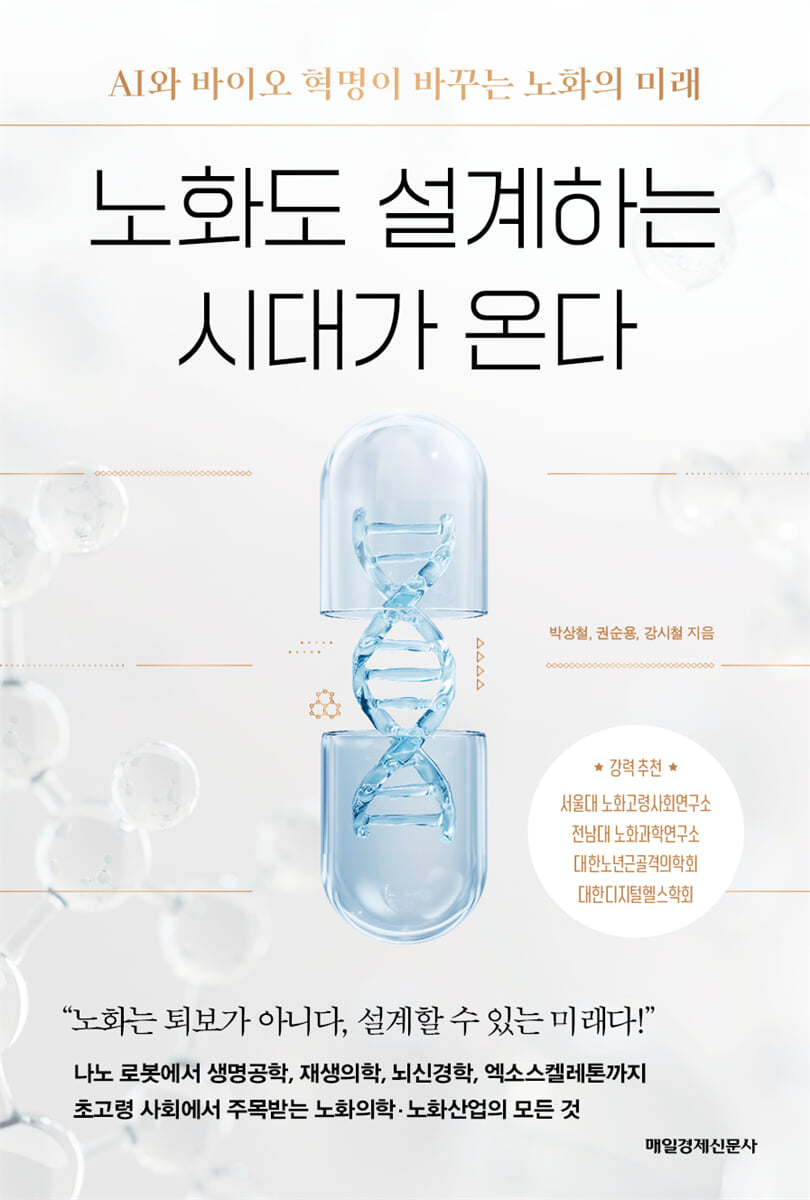
The era of designing aging is coming.
 |
Description
Book Introduction
“Aging is not a regression, it’s a future we can design!”
Aging Industries Transformed by AI and Biotechnology
40 Years of Aging Research: Insights from Medical Science and IT Experts
《The Era of Designing Aging Has Arrived》 is a book co-written by Professor Sang-Cheol Park, a pioneer in Korean aging science with 40 years of aging research; Professor Soon-Yong Kwon, the first smart hospital designer in Korea and a pioneer in digital healthcare; and Dr. Si-Cheol Kang, who has led the IT industry and future business strategies.
The authors view aging not as an “inevitable natural phenomenon,” but as something that can be controlled and designed.
Cutting-edge technologies such as genome analysis, stem cell therapy, AI-based predictive medicine, and new drugs targeting aging cells are already directly impacting the human biological clock and making it possible to extend the healthy lifespan.
Nanorobots, digital twins, and gene editing technologies are also moving beyond the research stage and are on the verge of commercialization.
This book vividly illustrates the current state of the aging industry through actual clinical trials and technology development cases being conducted around the world and domestically.
The aging that the authors talk about is not simply about 'how to live longer'.
It focuses on the question of 'how to live' beyond biological lifespan.
A meaningful old age that preserves dignity and autonomy—a form of life that cannot be achieved through technology alone—is the real challenge we face.
Based on this philosophy, 'Holy Aging' proposes a new perspective that views aging as a creative journey.
"The Age of Designing Aging Has Arrived" redefines aging by adding ethical concerns and social context to scientific and technological advances.
As we enter a super-aging society, this book presents a new life strategy that businesses, industries, and individuals must prepare together. It asks the question, not "How long will we live?" but "How will we live?"
Aging is inevitable, but we can control its direction and speed.
Aging Industries Transformed by AI and Biotechnology
40 Years of Aging Research: Insights from Medical Science and IT Experts
《The Era of Designing Aging Has Arrived》 is a book co-written by Professor Sang-Cheol Park, a pioneer in Korean aging science with 40 years of aging research; Professor Soon-Yong Kwon, the first smart hospital designer in Korea and a pioneer in digital healthcare; and Dr. Si-Cheol Kang, who has led the IT industry and future business strategies.
The authors view aging not as an “inevitable natural phenomenon,” but as something that can be controlled and designed.
Cutting-edge technologies such as genome analysis, stem cell therapy, AI-based predictive medicine, and new drugs targeting aging cells are already directly impacting the human biological clock and making it possible to extend the healthy lifespan.
Nanorobots, digital twins, and gene editing technologies are also moving beyond the research stage and are on the verge of commercialization.
This book vividly illustrates the current state of the aging industry through actual clinical trials and technology development cases being conducted around the world and domestically.
The aging that the authors talk about is not simply about 'how to live longer'.
It focuses on the question of 'how to live' beyond biological lifespan.
A meaningful old age that preserves dignity and autonomy—a form of life that cannot be achieved through technology alone—is the real challenge we face.
Based on this philosophy, 'Holy Aging' proposes a new perspective that views aging as a creative journey.
"The Age of Designing Aging Has Arrived" redefines aging by adding ethical concerns and social context to scientific and technological advances.
As we enter a super-aging society, this book presents a new life strategy that businesses, industries, and individuals must prepare together. It asks the question, not "How long will we live?" but "How will we live?"
Aging is inevitable, but we can control its direction and speed.
- You can preview some of the book's contents.
Preview
index
Opening Remarks: It Must Be a Golden Wave, Not a Gray Tsunami
Chapter 1. The Era of AI-Driven Bio-Innovation
What will change when AI and bio meet?
The Era of AI-Based Medical Innovation and Aging Management
New drug development shortened from decades to months
Personalized treatment tailored to your body, perfected through genomics
Three Key Words Driving Medical Innovation
Chapter 2.
A science-designed blueprint for life extension
The Science of Eternity: Designing a Dignified Life
Could regulating telomeres really prevent aging?
Metabolic regulation: another way to slow aging
Can Hormone Therapy Turn Back the Body's Clock?
Will removing old cells bring back youth?
Chapter 3.
Regenerative Medicine: Breathing Life into Dying Cells
Stem Cells, Cloning, and Biotechnology to Fight Aging
Life Science Rewrites the Timeline of Aging
Discover the secrets of healing hidden in the blood
In the age of life printing, 3D printing organs.
Chapter 4.
Neuroscience: Is a world without dementia possible?
Conditions for healthy aging according to neuroscience
Can Brain Plasticity Revive Cognitive Abilities?
Finding clues to recovering lost brain function
The advent of BCI, the era of controlling devices with thoughts.
Chapter 5.
Exoskeletons: Transforming Seniors' Lives
Regaining the freedom to walk and move in an aging society
Small, Smart Exoskeletons Revolutionize Everyday Life
The Evolution of Exoskeletons to Create Creative Seniors
Autonomous technology implemented by exoskeletons
Self-driving cars and exoskeletons create freedom for seniors.
Chapter 6.
Rewriting the Boundaries of Aging and Longevity with Biotechnology
Can life science overcome the limitations of aging?
Genetic Scissors: Designing Human Lifespan
Breaking Down the Boundaries of Aging in the Age of Genetic Customization
CAR-T cell therapy leading the way to conquering cancer
Synthetic biology, the technology that assembles life
The possibility of youth and longevity found in genes
In the Age of Genetics, Questions of Ethics
Chapter 7.
Nanotechnology: A Doctor Inside the Body
Nanotechnology penetrates deep into the body
Nanorobots and targeted drug delivery systems
Nano sensors that detect changes in my body in real time
The era of designing life by assembling DNA
Chapter 8.
In the age of digital consciousness, where are humans headed?
The era of storing and expanding consciousness
The World of Neural Interfaces Opened by Quantum Computing
The questions the digitalization of consciousness poses for us
Humans expanded into digital beings
Chapter 9.
Digital Symbiosis: Redesigning Humanity
Digital Symbiosis: Opening the Path to Creative Aging
The aging landscape that evolves with technology
Smartphones and wearables: Technology that has become one with our bodies
AR and VR Expand Seniors' Senses and Experiences
Technology that goes inside the body: the potential of bioimplants
Chapter 10.
K-Senior and the Human Platform Revolution
The New Role of K-Seniors Opened by Digital Platforms
Evolution of Technology Platforms to Combat Aging Populations
A society that connects across generational gaps
How far can Korea's senior technology model go?
Closing Remarks: In an age where people dream of immortality, what choices should humans make?
References and Sources
Photo and illustration source
Chapter 1. The Era of AI-Driven Bio-Innovation
What will change when AI and bio meet?
The Era of AI-Based Medical Innovation and Aging Management
New drug development shortened from decades to months
Personalized treatment tailored to your body, perfected through genomics
Three Key Words Driving Medical Innovation
Chapter 2.
A science-designed blueprint for life extension
The Science of Eternity: Designing a Dignified Life
Could regulating telomeres really prevent aging?
Metabolic regulation: another way to slow aging
Can Hormone Therapy Turn Back the Body's Clock?
Will removing old cells bring back youth?
Chapter 3.
Regenerative Medicine: Breathing Life into Dying Cells
Stem Cells, Cloning, and Biotechnology to Fight Aging
Life Science Rewrites the Timeline of Aging
Discover the secrets of healing hidden in the blood
In the age of life printing, 3D printing organs.
Chapter 4.
Neuroscience: Is a world without dementia possible?
Conditions for healthy aging according to neuroscience
Can Brain Plasticity Revive Cognitive Abilities?
Finding clues to recovering lost brain function
The advent of BCI, the era of controlling devices with thoughts.
Chapter 5.
Exoskeletons: Transforming Seniors' Lives
Regaining the freedom to walk and move in an aging society
Small, Smart Exoskeletons Revolutionize Everyday Life
The Evolution of Exoskeletons to Create Creative Seniors
Autonomous technology implemented by exoskeletons
Self-driving cars and exoskeletons create freedom for seniors.
Chapter 6.
Rewriting the Boundaries of Aging and Longevity with Biotechnology
Can life science overcome the limitations of aging?
Genetic Scissors: Designing Human Lifespan
Breaking Down the Boundaries of Aging in the Age of Genetic Customization
CAR-T cell therapy leading the way to conquering cancer
Synthetic biology, the technology that assembles life
The possibility of youth and longevity found in genes
In the Age of Genetics, Questions of Ethics
Chapter 7.
Nanotechnology: A Doctor Inside the Body
Nanotechnology penetrates deep into the body
Nanorobots and targeted drug delivery systems
Nano sensors that detect changes in my body in real time
The era of designing life by assembling DNA
Chapter 8.
In the age of digital consciousness, where are humans headed?
The era of storing and expanding consciousness
The World of Neural Interfaces Opened by Quantum Computing
The questions the digitalization of consciousness poses for us
Humans expanded into digital beings
Chapter 9.
Digital Symbiosis: Redesigning Humanity
Digital Symbiosis: Opening the Path to Creative Aging
The aging landscape that evolves with technology
Smartphones and wearables: Technology that has become one with our bodies
AR and VR Expand Seniors' Senses and Experiences
Technology that goes inside the body: the potential of bioimplants
Chapter 10.
K-Senior and the Human Platform Revolution
The New Role of K-Seniors Opened by Digital Platforms
Evolution of Technology Platforms to Combat Aging Populations
A society that connects across generational gaps
How far can Korea's senior technology model go?
Closing Remarks: In an age where people dream of immortality, what choices should humans make?
References and Sources
Photo and illustration source
Detailed image
Into the book
As AI technology rapidly drives medical innovation, fundamental changes are occurring in aging research and healthcare approaches.
For example, AI-based protein structure prediction technologies like AlphaFold are changing the paradigm of new drug development and life science research, while medical image analysis and biological digital twin technologies are enabling more accurate and detailed tracking of the aging process.
Thanks to these technological advancements, personalized health care is now possible.
AI is expanding beyond simply diagnosing diseases to encompass preventive medicine and real-time health monitoring, creating a new concept called aging management.
In the past, aging was considered a natural and unavoidable phenomenon, but now we are entering an era where AI and data analysis technologies can predict and control the pace of aging.
--- p.19, from “Chapter 1: The Era of Bio Innovation Led by AI”
David Kirkwood of the University of Minnesota first proposed the concept of xenograft, which selectively removes only senescent cells, drawing significant attention from the academic world.
He developed a method to remove cells overexpressing P16, a representative aging gene, and applied it to old animals, confirming the surprising effect of increasing the animals' activity and even making them look younger.
Similar to the strategy of selectively eliminating cancer cells in cancer treatment, this method of regaining youth by selectively removing old cells has created a huge stir because of its simple yet clear effect.
Until now, the prevailing perception was that senescent cells were highly resistant to apoptosis and thus could not be selectively removed.
However, a research team at the University of Minnesota tested several substances and discovered a component that can neutralize the resistance of aging cells.
--- p.60, from “Chapter 2: The Blueprint for Life Extension Designed by Science”
Aging has long been recognized as a natural process of time.
However, with the advancement of science and technology, aging is no longer something to be accepted, but something that can be actively managed and designed.
At the heart of innovation are stem cells and regenerative medicine, with tissue engineering and 3D bioprinting technologies in particular offering new possibilities for extending human lifespan and improving quality of life.
Tissue engineering is a field that combines life science and engineering, and is a technology that regenerates and replaces damaged tissues or organs.
The desired tissue is created by precisely combining cells, biomaterials, and bioactive substances, and the key is to design a three-dimensional structure (scaffold) on which cells can grow stably.
Now, it is evolving beyond simple tissue regeneration into an innovative concept that designs life itself.
--- p.80, from “Chapter 3_ Regenerative Medicine: Breathing Life into Dying Cells”
Medical exoskeleton technology is no longer simply a rehabilitation assistive device.
It is now emerging as a key tool for opening an era in which aging is not passively accepted, but actively designed.
Advances in this technology allow us to look at aging in a new way.
Lightweighting and miniaturization have enabled natural use in everyday life, and AI-based intelligent control systems precisely detect the user's intentions, realizing the symbiosis between machines and humans.
Furthermore, BCI technology heralds the next generation of autonomy, where movement is possible with just thoughts.
For example, AI-based protein structure prediction technologies like AlphaFold are changing the paradigm of new drug development and life science research, while medical image analysis and biological digital twin technologies are enabling more accurate and detailed tracking of the aging process.
Thanks to these technological advancements, personalized health care is now possible.
AI is expanding beyond simply diagnosing diseases to encompass preventive medicine and real-time health monitoring, creating a new concept called aging management.
In the past, aging was considered a natural and unavoidable phenomenon, but now we are entering an era where AI and data analysis technologies can predict and control the pace of aging.
--- p.19, from “Chapter 1: The Era of Bio Innovation Led by AI”
David Kirkwood of the University of Minnesota first proposed the concept of xenograft, which selectively removes only senescent cells, drawing significant attention from the academic world.
He developed a method to remove cells overexpressing P16, a representative aging gene, and applied it to old animals, confirming the surprising effect of increasing the animals' activity and even making them look younger.
Similar to the strategy of selectively eliminating cancer cells in cancer treatment, this method of regaining youth by selectively removing old cells has created a huge stir because of its simple yet clear effect.
Until now, the prevailing perception was that senescent cells were highly resistant to apoptosis and thus could not be selectively removed.
However, a research team at the University of Minnesota tested several substances and discovered a component that can neutralize the resistance of aging cells.
--- p.60, from “Chapter 2: The Blueprint for Life Extension Designed by Science”
Aging has long been recognized as a natural process of time.
However, with the advancement of science and technology, aging is no longer something to be accepted, but something that can be actively managed and designed.
At the heart of innovation are stem cells and regenerative medicine, with tissue engineering and 3D bioprinting technologies in particular offering new possibilities for extending human lifespan and improving quality of life.
Tissue engineering is a field that combines life science and engineering, and is a technology that regenerates and replaces damaged tissues or organs.
The desired tissue is created by precisely combining cells, biomaterials, and bioactive substances, and the key is to design a three-dimensional structure (scaffold) on which cells can grow stably.
Now, it is evolving beyond simple tissue regeneration into an innovative concept that designs life itself.
--- p.80, from “Chapter 3_ Regenerative Medicine: Breathing Life into Dying Cells”
Medical exoskeleton technology is no longer simply a rehabilitation assistive device.
It is now emerging as a key tool for opening an era in which aging is not passively accepted, but actively designed.
Advances in this technology allow us to look at aging in a new way.
Lightweighting and miniaturization have enabled natural use in everyday life, and AI-based intelligent control systems precisely detect the user's intentions, realizing the symbiosis between machines and humans.
Furthermore, BCI technology heralds the next generation of autonomy, where movement is possible with just thoughts.
--- p.120, from “Chapter 5_ Exoskeleton, Changing the Lives of Seniors”
Publisher's Review
From nanorobots to biotechnology, regenerative medicine, neuroscience, and exoskeletons
Everything about aging medicine and the aging industry, which are attracting attention in a super-aging society!
We no longer simply live in an 'aging society'.
We have entered an era where we predict the future with data and control our lives with technology.
Now is the time to reimagine aging. With the use of cutting-edge technologies like AI, genome analysis, nanorobots, and digital twins, human lifespan is surpassing biological limits.
Aging is no longer a simple natural phenomenon; it has become a subject that can be scientifically analyzed and controlled. This change is suggesting new directions for not only individual lifestyles but also healthcare, welfare, labor, and society as a whole.
《The Era of Designing Aging Has Arrived》 focuses on cutting-edge scientific trends such as genomics, nanotechnology, and CRISPR, and takes a fresh look at existing common sense about aging.
By examining the possibilities that technology opens up, along with the ethical concerns and practical challenges that lie behind them, we offer insights into how we can go beyond extending lifespan and reconstruct quality of life and human dignity.
It also vividly demonstrates the specific trends in technology applications and market changes that are actually taking place in each industry, including medicine, life sciences, and digital healthcare.
AI and biotechnology rewrite the equation for aging.
AI is moving beyond being a tool for exploring the causes of aging to becoming a key player in managing aging.
Protein structure prediction technologies like AlphaFold are dramatically accelerating drug development, and genome analysis is enabling personalized treatments.
This book provides a wealth of examples of how these technologies are being applied in the real-world medical and bio industries.
Digital twins create a virtual "body" based on biometric data, predicting treatment responses or simulating aging processes within it.
Nanosensors and robots detect and respond to age-related damage at the cellular level.
AI also analyzes medical images to detect invisible signs of aging early and suggest customized management strategies to prevent disease.
For example, it provides a foundation for preparing for a healthy old age by quickly detecting changes such as decreased vascular elasticity or brain atrophy.
Technology is changing not only health but also our way of life.
Advances in technology to address aging aren't just about living longer.
Technologies such as stem cell regeneration, nano-drug delivery, BCI, and exoskeletons are laying the foundation for restoring physical and cognitive function in older adults and re-establishing them as active participants in society.
Technology increases autonomy in older adults and creates an environment where they can maintain their daily lives and social roles.
This suggests that a path is opening up for people to live actively even as they age.
It also vividly demonstrates, through the flow of technology, that aging is no longer a burden on society, but is transforming into a new possibility and driving force for growth.
◆ In an era where the 'standard', not the 'direction' of technology, is becoming more important
Problems that arise as technology advances can no longer be solved by technology alone.
If life-extending technology becomes concentrated in certain classes, we could face a new class structure called “biological inequality.”
As genetic information, biometric data, and personalized treatment technologies expand, the fundamental question becomes: who will control it and by what criteria will it be utilized?
Without sovereignty and access to information, and without ethical standards and regulatory frameworks in place, technology could become another tool of discrimination rather than a boon.
The book is neither optimistic nor pessimistic about technological advancement.
Instead, it clearly points out that a sustainable future and market are possible only when technology and ethics are in harmony.
K-Senior, the Fastest-Evolving Experimental Group
Korea is a unique society where a rapidly aging population coexists with a generation familiar with digital technology.
This book illuminates how Korea's "K-Seniors"—the older generation—are emerging as new platform users and leaders in industrial experimentation.
Technologies like wearables, biometric implants, AR/VR, and exoskeletons are restoring autonomy and function to older adults, while turning them into both consumers and producers.
Old age is no longer simply a welfare object, but rather a subject that suggests a new market direction.
This compelling presentation explains the potential Korea's aging model creates when combined with technology-based industries, and why Korea is now poised to become the most dynamic stage for demonstrating the future of an aging society.
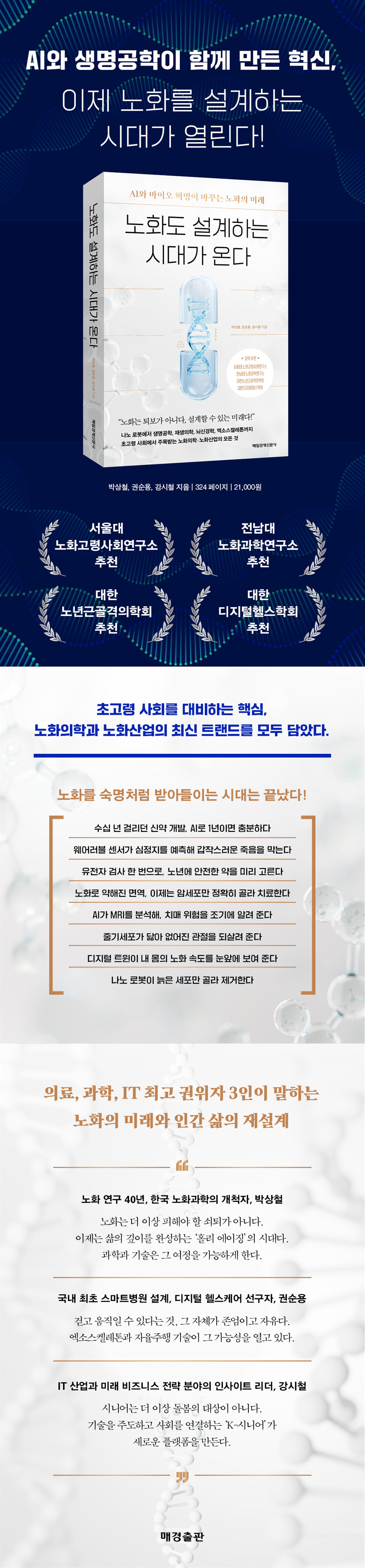
★The era of accepting aging as fate is over!★
Developing new drugs that used to take decades is now possible in just one year with AI!
Wearable sensors predict cardiac arrest and prevent sudden death!
With just one genetic test, you can choose safe medications for your old age!
Immunity weakened by aging, now accurately targets and treats only cancer cells!
AI analyzes MRIs to provide early warning of dementia risk!
Stem cells revive worn-out joints!
A digital twin shows you how quickly your body is aging!
Nano robots remove only old cells!
Everything about aging medicine and the aging industry, which are attracting attention in a super-aging society!
We no longer simply live in an 'aging society'.
We have entered an era where we predict the future with data and control our lives with technology.
Now is the time to reimagine aging. With the use of cutting-edge technologies like AI, genome analysis, nanorobots, and digital twins, human lifespan is surpassing biological limits.
Aging is no longer a simple natural phenomenon; it has become a subject that can be scientifically analyzed and controlled. This change is suggesting new directions for not only individual lifestyles but also healthcare, welfare, labor, and society as a whole.
《The Era of Designing Aging Has Arrived》 focuses on cutting-edge scientific trends such as genomics, nanotechnology, and CRISPR, and takes a fresh look at existing common sense about aging.
By examining the possibilities that technology opens up, along with the ethical concerns and practical challenges that lie behind them, we offer insights into how we can go beyond extending lifespan and reconstruct quality of life and human dignity.
It also vividly demonstrates the specific trends in technology applications and market changes that are actually taking place in each industry, including medicine, life sciences, and digital healthcare.
AI and biotechnology rewrite the equation for aging.
AI is moving beyond being a tool for exploring the causes of aging to becoming a key player in managing aging.
Protein structure prediction technologies like AlphaFold are dramatically accelerating drug development, and genome analysis is enabling personalized treatments.
This book provides a wealth of examples of how these technologies are being applied in the real-world medical and bio industries.
Digital twins create a virtual "body" based on biometric data, predicting treatment responses or simulating aging processes within it.
Nanosensors and robots detect and respond to age-related damage at the cellular level.
AI also analyzes medical images to detect invisible signs of aging early and suggest customized management strategies to prevent disease.
For example, it provides a foundation for preparing for a healthy old age by quickly detecting changes such as decreased vascular elasticity or brain atrophy.
Technology is changing not only health but also our way of life.
Advances in technology to address aging aren't just about living longer.
Technologies such as stem cell regeneration, nano-drug delivery, BCI, and exoskeletons are laying the foundation for restoring physical and cognitive function in older adults and re-establishing them as active participants in society.
Technology increases autonomy in older adults and creates an environment where they can maintain their daily lives and social roles.
This suggests that a path is opening up for people to live actively even as they age.
It also vividly demonstrates, through the flow of technology, that aging is no longer a burden on society, but is transforming into a new possibility and driving force for growth.
◆ In an era where the 'standard', not the 'direction' of technology, is becoming more important
Problems that arise as technology advances can no longer be solved by technology alone.
If life-extending technology becomes concentrated in certain classes, we could face a new class structure called “biological inequality.”
As genetic information, biometric data, and personalized treatment technologies expand, the fundamental question becomes: who will control it and by what criteria will it be utilized?
Without sovereignty and access to information, and without ethical standards and regulatory frameworks in place, technology could become another tool of discrimination rather than a boon.
The book is neither optimistic nor pessimistic about technological advancement.
Instead, it clearly points out that a sustainable future and market are possible only when technology and ethics are in harmony.
K-Senior, the Fastest-Evolving Experimental Group
Korea is a unique society where a rapidly aging population coexists with a generation familiar with digital technology.
This book illuminates how Korea's "K-Seniors"—the older generation—are emerging as new platform users and leaders in industrial experimentation.
Technologies like wearables, biometric implants, AR/VR, and exoskeletons are restoring autonomy and function to older adults, while turning them into both consumers and producers.
Old age is no longer simply a welfare object, but rather a subject that suggests a new market direction.
This compelling presentation explains the potential Korea's aging model creates when combined with technology-based industries, and why Korea is now poised to become the most dynamic stage for demonstrating the future of an aging society.
★The era of accepting aging as fate is over!★
Developing new drugs that used to take decades is now possible in just one year with AI!
Wearable sensors predict cardiac arrest and prevent sudden death!
With just one genetic test, you can choose safe medications for your old age!
Immunity weakened by aging, now accurately targets and treats only cancer cells!
AI analyzes MRIs to provide early warning of dementia risk!
Stem cells revive worn-out joints!
A digital twin shows you how quickly your body is aging!
Nano robots remove only old cells!
GOODS SPECIFICS
- Date of issue: April 18, 2025
- Page count, weight, size: 324 pages | 594g | 152*225*20mm
- ISBN13: 9791164847662
You may also like
카테고리
korean


korean

![GQ KOREA Mark (Monthly): December [2025]](http://librairie.coreenne.fr/cdn/shop/files/8ef265dbbfbf186523ed75ba7319009d.jpg?v=1765340328&width=3840)


