

Report on slowing aging
 |
Description
Book Introduction
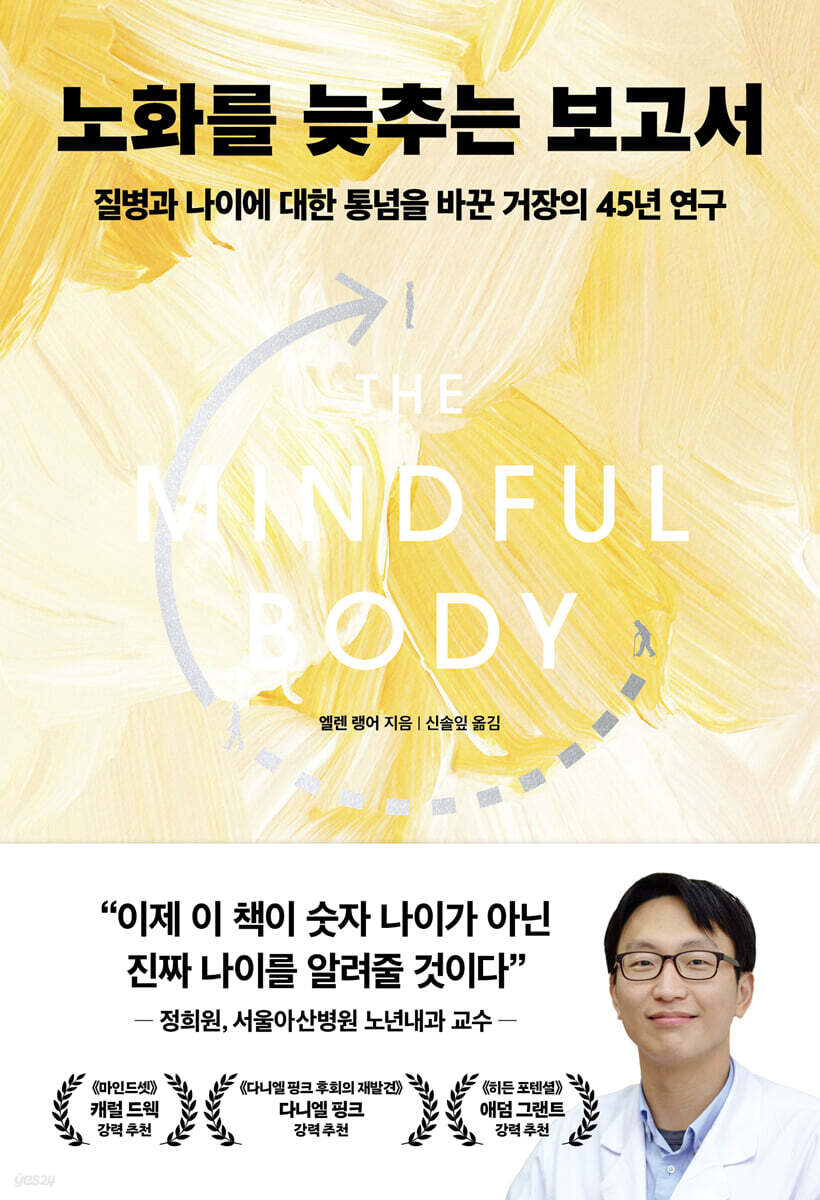
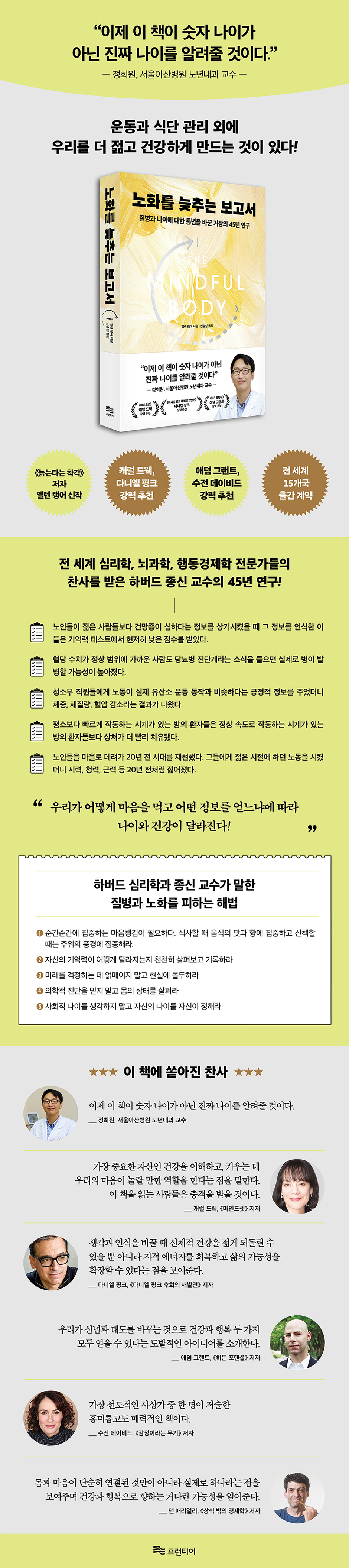
“This book will restore our lost health and youth.” _Professor Jeong Hee-won, Department of Geriatrics, Seoul Asan Medical Center A Harvard professor's 45 years of research and insights into disease and aging. Highly recommended by Carol Dweck, Daniel Pink, Adam Grant, and Susan David! Ellen Langer, a professor of psychology at Harvard and the world's leading authority on aging and disease, has published a book containing her research on how to maintain our youth and health. As life expectancy increases, interest in health and aging naturally increases. Many people are interested in exercise and diet to age healthily and slowly without disease. Professor Langer emphasizes that while these methods are important, fundamental changes in thinking and perception are necessary to avoid disease and accelerated aging. A representative example of this is her 'clock-turning-back study'. They brought people in their 70s and 80s to a rural village and made them behave like they did 20 years ago. He made me carry heavy loads, do the dishes and laundry myself, and watch news and movies from 20 years ago. After just one week, the elderly people's hearing and memory improved, and their joint flexibility and grip strength also improved, making them appear more youthful. Dr. Ellen Langer gained worldwide fame through her research, which showed that aging is not simply a physical phenomenon, but rather comes from the mind that feels old. In addition to research on turning back the clock, this book also explores, through extensive research over many years, how our bodies are connected to our minds and how we can avoid and overcome illnesses such as cancer, diabetes, and chronic diseases. This will give you a lot of inspiration to slow down aging and restore your health. In fact, experts in psychology, neuroscience, and behavioral economics have praised her research and story in her book, "Slowing Aging." “People who read this book will be shocked,” said Carol Dweck, a professor of psychology at Stanford University. “I highly recommend it,” said futurist and business thinker Daniel Pink, adding, “It shows that when you change your perception, you can not only restore your physical health, but also recover your intellectual energy and expand your life’s possibilities.” Professor Jeong Hee-won, a professor of geriatrics at Seoul Asan Medical Center and a renowned expert on slow aging in Korea, emphasized the book's significance by saying, "This book will help us regain our lost youth and health." |
- You can preview some of the book's contents.
Preview
index
Recommendation
Introduction: How can a sick or aged body recover?
Chapter 1: Rules That Make Us Old and Sick
Question the rules
The Real Dangerous Impact of the 'Risk' Label
Chapter 2: Stopping Thoughts from Controlling Your Body
The illusion of danger
We need empathy, not judgment.
We make wrong predictions every day.
Are risks and safety a choice?
The influence of the illusion of control
Chapter 3: A Mindset That Transcends the Body's Limitations
Certain standards ruin us
Those who enjoy it beat those who work hard.
Note the difference in perspective
Walk in someone else's shoes
Chapter 4: Don't Torment Yourself for the Perfect Choice
The Difference Between a Mindful Decision and a Mindful One
The more you think, the more you can't make a decision.
Rather than making the right decision, make the right decision happen.
There is no such thing as a wrong decision
Do judges' decisions change depending on hunger?
Chapter 5: Training is needed to change your mindset.
A third way of thinking that goes beyond analysis and experimentation
Paying attention to others
Our lives are meaningful because they are meaningless.
Chapter 6: Changing Your Body with Your Mind
Mind-body dualism vs. mind-body monism
Aging and disease are both influenced by the mind.
After the 'Turning Back the Clock' Study
How to relieve fatigue and stress
Why Smiling Actually Makes You Happy
Chapter 7: Placebos Are Stronger Than Medicine
Where does the power of placebo come from?
How the brain perceives pain
If you know that it is a fake drug and your body becomes healthy,
The disease got better on its own?
Outliers Strike Back
Chapter 8 We are constantly changing
Pay attention to variability and uncertainty
How to Manage Memory and Chronic Illness
Healing begins when you notice change.
Chapter 9: How Mindfulness Spreads
Attraction is not a coincidence, it's destiny
People who are sensitive to emotional signals
The Contagiousness and Health of Mindfulness
Do our senses deteriorate as we age?
The heart leaves traces
Chapter 10: The Answer to a Healthy Life
A new approach to health
The Medicine of Mindfulness
New Questions for Mental Health Diagnosis
If mindfulness were applied to medicine
Body and mind, nothing is impossible
Chapter 11: The Utopia of Mindfulness
Acknowledgements
main
Introduction: How can a sick or aged body recover?
Chapter 1: Rules That Make Us Old and Sick
Question the rules
The Real Dangerous Impact of the 'Risk' Label
Chapter 2: Stopping Thoughts from Controlling Your Body
The illusion of danger
We need empathy, not judgment.
We make wrong predictions every day.
Are risks and safety a choice?
The influence of the illusion of control
Chapter 3: A Mindset That Transcends the Body's Limitations
Certain standards ruin us
Those who enjoy it beat those who work hard.
Note the difference in perspective
Walk in someone else's shoes
Chapter 4: Don't Torment Yourself for the Perfect Choice
The Difference Between a Mindful Decision and a Mindful One
The more you think, the more you can't make a decision.
Rather than making the right decision, make the right decision happen.
There is no such thing as a wrong decision
Do judges' decisions change depending on hunger?
Chapter 5: Training is needed to change your mindset.
A third way of thinking that goes beyond analysis and experimentation
Paying attention to others
Our lives are meaningful because they are meaningless.
Chapter 6: Changing Your Body with Your Mind
Mind-body dualism vs. mind-body monism
Aging and disease are both influenced by the mind.
After the 'Turning Back the Clock' Study
How to relieve fatigue and stress
Why Smiling Actually Makes You Happy
Chapter 7: Placebos Are Stronger Than Medicine
Where does the power of placebo come from?
How the brain perceives pain
If you know that it is a fake drug and your body becomes healthy,
The disease got better on its own?
Outliers Strike Back
Chapter 8 We are constantly changing
Pay attention to variability and uncertainty
How to Manage Memory and Chronic Illness
Healing begins when you notice change.
Chapter 9: How Mindfulness Spreads
Attraction is not a coincidence, it's destiny
People who are sensitive to emotional signals
The Contagiousness and Health of Mindfulness
Do our senses deteriorate as we age?
The heart leaves traces
Chapter 10: The Answer to a Healthy Life
A new approach to health
The Medicine of Mindfulness
New Questions for Mental Health Diagnosis
If mindfulness were applied to medicine
Body and mind, nothing is impossible
Chapter 11: The Utopia of Mindfulness
Acknowledgements
main
Detailed image
Into the book
Older men who participated in this experiment lived as if they had become younger for a week.
We went back to the world 20 years ago and asked them to act like they did when they were young.
For example, even the oldest people and those with limited mobility were required to carry their own luggage from the front steps to their rooms when they arrived at the house.
Of course, it wouldn't have been a problem to move one shirt at a time instead of one bag.
So, you go back in time to your past life in a time machine? Imagine yourself becoming younger? The results are amazing.
Changes occurred in the participants' bodies.
Their eyesight, hearing, strength, and even their objective appearance became much younger and healthier.
--- From "From the Preface"
In addition to reducing prejudice by mindfully recognizing out-group members, recognizing that differences exist within the in-group can also reduce prejudice toward out-groups.
In other words, when we recognize the differences between people similar to ourselves, we come to understand how different individuals are, and this makes the differences between "us" and the outgroup not feel so great.
Recognizing similarities between things that seem different, and differences between things that seem similar – this is the essence of mindfulness.
--- From Chapter 1, “Rules That Make Us Old and Sick”
How often is memory loss, which is considered a natural part of aging, actually caused by differences in perspective?
If you test your memory with words like "Mahjong" and "Pinochle" and words like "Game Boy" and "Warcraft," older people will be better at remembering the former, as they were the names of games they commonly played when they were younger, while younger people will be better at remembering the latter.
In other words, most phenomena called memory loss are not caused by memory problems, but by differences in values.
--- From Chapter 3, “Mindset Beyond the Body’s Limits”
I wanted to know if treating work as exercise would have different effects on the body.
So, participants were randomly divided into two groups. One group was given general health information, while the other group was explained that their work could be considered exercise, likening it to gym machines and exercise (making the bed was similar to rowing machine exercise, and mopping was a great upper-body workout).
There were no noticeable differences in the intensity or hours of their work, or in the amount of food and drink they consumed during the one-month experimental intervention.
The only difference was that he came to believe that what he was doing was exercise.
As the mindset changed, a tremendous change occurred in the experimental group.
They lost weight, had lower body mass indexes, lower blood pressure, and lower waist-to-hip ratios.
We conducted a sleep study with students from Harvard Medical School.
Our intervention was simple.
The bedside clock was manipulated to create a difference between the participants' perceived and actual sleep times.
When participants were told to watch their clocks as if they had slept eight hours, even though they had actually only slept five hours, their reaction times on an auditory motor response test were faster than when they had been told they had only slept five hours.
Conversely, when people thought they had slept for only five hours but had actually slept for eight hours, their performance was worse than when they had actually slept for eight hours and had known about it.
It is clear that not only the actual amount of sleep but also the perception of sleep time plays an important role.
--- From Chapter 6, “Changing the Body with the Mind”
A 2009 study described the case of a man who developed malignant tumors the size of oranges in his armpit, groin, chest, and abdomen.
His doctor told him he had less than two weeks to live.
Then, the patient was given a new experimental drug and the tumors disappeared.
Subsequent clinical trials revealed that the drug was ineffective, and when the patients were informed of this, their tumors recurred.
I prescribed the patient another drug, telling him it was "twice as strong." It was actually a placebo. After that, the tumors disappeared once again.
--- From Chapter 7, “A Placebo Stronger Than Medicine”
My researchers and I are working with patients new to ALS and those in follow-up, as well as with a number of chronic conditions, including diabetes, Parkinson's, mild cognitive impairment, multiple sclerosis, stroke, and depression.
In each study, we educate patients—and, where possible and appropriate, their caregivers—to pay attention to the variability of their symptoms, enabling them to manage the impact of each condition through a mindful approach.
As a result, we have obtained quite positive preliminary results in MS (multiple sclerosis), stroke, and Parkinson's.
We went back to the world 20 years ago and asked them to act like they did when they were young.
For example, even the oldest people and those with limited mobility were required to carry their own luggage from the front steps to their rooms when they arrived at the house.
Of course, it wouldn't have been a problem to move one shirt at a time instead of one bag.
So, you go back in time to your past life in a time machine? Imagine yourself becoming younger? The results are amazing.
Changes occurred in the participants' bodies.
Their eyesight, hearing, strength, and even their objective appearance became much younger and healthier.
--- From "From the Preface"
In addition to reducing prejudice by mindfully recognizing out-group members, recognizing that differences exist within the in-group can also reduce prejudice toward out-groups.
In other words, when we recognize the differences between people similar to ourselves, we come to understand how different individuals are, and this makes the differences between "us" and the outgroup not feel so great.
Recognizing similarities between things that seem different, and differences between things that seem similar – this is the essence of mindfulness.
--- From Chapter 1, “Rules That Make Us Old and Sick”
How often is memory loss, which is considered a natural part of aging, actually caused by differences in perspective?
If you test your memory with words like "Mahjong" and "Pinochle" and words like "Game Boy" and "Warcraft," older people will be better at remembering the former, as they were the names of games they commonly played when they were younger, while younger people will be better at remembering the latter.
In other words, most phenomena called memory loss are not caused by memory problems, but by differences in values.
--- From Chapter 3, “Mindset Beyond the Body’s Limits”
I wanted to know if treating work as exercise would have different effects on the body.
So, participants were randomly divided into two groups. One group was given general health information, while the other group was explained that their work could be considered exercise, likening it to gym machines and exercise (making the bed was similar to rowing machine exercise, and mopping was a great upper-body workout).
There were no noticeable differences in the intensity or hours of their work, or in the amount of food and drink they consumed during the one-month experimental intervention.
The only difference was that he came to believe that what he was doing was exercise.
As the mindset changed, a tremendous change occurred in the experimental group.
They lost weight, had lower body mass indexes, lower blood pressure, and lower waist-to-hip ratios.
We conducted a sleep study with students from Harvard Medical School.
Our intervention was simple.
The bedside clock was manipulated to create a difference between the participants' perceived and actual sleep times.
When participants were told to watch their clocks as if they had slept eight hours, even though they had actually only slept five hours, their reaction times on an auditory motor response test were faster than when they had been told they had only slept five hours.
Conversely, when people thought they had slept for only five hours but had actually slept for eight hours, their performance was worse than when they had actually slept for eight hours and had known about it.
It is clear that not only the actual amount of sleep but also the perception of sleep time plays an important role.
--- From Chapter 6, “Changing the Body with the Mind”
A 2009 study described the case of a man who developed malignant tumors the size of oranges in his armpit, groin, chest, and abdomen.
His doctor told him he had less than two weeks to live.
Then, the patient was given a new experimental drug and the tumors disappeared.
Subsequent clinical trials revealed that the drug was ineffective, and when the patients were informed of this, their tumors recurred.
I prescribed the patient another drug, telling him it was "twice as strong." It was actually a placebo. After that, the tumors disappeared once again.
--- From Chapter 7, “A Placebo Stronger Than Medicine”
My researchers and I are working with patients new to ALS and those in follow-up, as well as with a number of chronic conditions, including diabetes, Parkinson's, mild cognitive impairment, multiple sclerosis, stroke, and depression.
In each study, we educate patients—and, where possible and appropriate, their caregivers—to pay attention to the variability of their symptoms, enabling them to manage the impact of each condition through a mindful approach.
As a result, we have obtained quite positive preliminary results in MS (multiple sclerosis), stroke, and Parkinson's.
--- From Chapter 8, “We Are Constantly Changing”
Publisher's Review
Change your mindset, not your diet or exercise routine.
It's not time that makes us old, it's thoughts!
Stiff shoulders and knees, poor eyesight, and a body that struggles to recover from injuries or illnesses.
We accept these symptoms as a natural part of aging.
So I manage my diet with brown rice, take protein supplements, and exercise.
But if our muscles don't grow and our bodies don't recover like they used to, we continue to look for the cause of the problem within our bodies.
They say it's because 'I'm getting older' or 'I'm not in good physical condition'.
But Dr. Langer says:
“You have to change your thoughts to change your body.”
The author points out that the cause of our deteriorating health is not bad lifestyle habits, but rather the danger of wrong thoughts, most notably stereotypes.
The stereotypes we hold about certain diseases or aging actually make our health worse.
These include the idea that forgetfulness worsens with age, the idea that chronic illnesses are difficult to cure, and the idea that the body damaged by aging and disease is difficult to recover.
The author, an authority on health psychology, draws on over 40 years of research at Harvard to suggest ways to slow down aging and live a healthy life through positive thinking and changes in perception.
These are not methods based on the diet or exercise methods we know, but on the fact that the mind and body are connected.
The body and mind are more deeply connected than we think.
It is a fundamental force that prevents disease and slows down the aging process.
Unless we change our thinking, we will continue to get sick and grow old.
Over 40 years of extensive research and analysis
How to Age Healthily: A Harvard Psychology Guru's Guide
How do our thoughts negatively impact aging and health? This book provides answers through various experiments and research.
We have a perception that older people have worse memories and are more forgetful than younger people.
When older adults were reminded of this, those with negative perceptions scored lower on memory tests than those who did not.
Additionally, even people with blood sugar levels close to the normal range were more likely to actually develop the disease after hearing that they were pre-diabetic.
Conversely, it also means that it is important to instill positive information and awareness in our bodies to change them for the better.
There was a study done on hotel housekeeping staff.
In this study, it was explained that the workers' work was similar to the movements of actual aerobic exercise and that the effects obtained when exercising were the same.
As a result, employees who heard the information experienced more positive physical changes, such as weight loss, body mass loss, and lower blood pressure, than employees who did not.
This means that our thoughts have a direct impact on our body's immune system and ability to heal.
Additionally, patients in rooms with clocks that ran faster than usual had their wounds heal faster than patients in rooms with clocks that ran at normal speed.
This shows that how we perceive time, rather than absolute time, can affect how quickly our bodies recover.
The research presented in this book clearly shows that things we once thought impossible, such as recovering from chronic diseases and slowing the aging process, are possible.
Your eyesight, hearing, and memory can be improved, you can escape from stress that is destroying your body, and you can look younger.
Without having to spend a lot of money or effort.
How about mindfulness?
Cures aging, cancer, diabetes, and chronic diseases
So how can we change our thinking? Ellen Langer emphasizes mindfulness as a solution to the problems of aging and disease.
It means focusing on each moment, not being caught up in past experiences or future worries, and not accepting situations as they are, but knowing that they can change depending on your own mindset.
For example, focusing on the taste and aroma of food while eating, or paying close attention to the sounds and scenery around you while taking a walk are small practices for mindfulness.
It's about looking at familiar things without just passing them by.
To stay healthy, you must always closely monitor your body condition.
"Which part of your body experiences the most or least discomfort? How do those sensations change over time? How do these changes affect your behavior? By noticing these changes, you can regain control over your health."
Many older people worry that their memory is declining.
And these worries actually make your memory worse.
So the authors asked older adults to assess how their memory changed, and to slowly observe and record the variability of their memory.
By paying attention like this, the phenomenon of memory loss was clearly reduced.
This kind of mindfulness ultimately helps reduce fear and stress about illness and aging, and fosters a more positive mindset.
Going beyond health recovery, we aim to contribute to improving the overall quality of life.
This book teaches us how to manage and improve our own health without relying solely on medical methods, and ultimately, these changes will create new meaning in our lives.
It's not time that makes us old, it's thoughts!
Stiff shoulders and knees, poor eyesight, and a body that struggles to recover from injuries or illnesses.
We accept these symptoms as a natural part of aging.
So I manage my diet with brown rice, take protein supplements, and exercise.
But if our muscles don't grow and our bodies don't recover like they used to, we continue to look for the cause of the problem within our bodies.
They say it's because 'I'm getting older' or 'I'm not in good physical condition'.
But Dr. Langer says:
“You have to change your thoughts to change your body.”
The author points out that the cause of our deteriorating health is not bad lifestyle habits, but rather the danger of wrong thoughts, most notably stereotypes.
The stereotypes we hold about certain diseases or aging actually make our health worse.
These include the idea that forgetfulness worsens with age, the idea that chronic illnesses are difficult to cure, and the idea that the body damaged by aging and disease is difficult to recover.
The author, an authority on health psychology, draws on over 40 years of research at Harvard to suggest ways to slow down aging and live a healthy life through positive thinking and changes in perception.
These are not methods based on the diet or exercise methods we know, but on the fact that the mind and body are connected.
The body and mind are more deeply connected than we think.
It is a fundamental force that prevents disease and slows down the aging process.
Unless we change our thinking, we will continue to get sick and grow old.
Over 40 years of extensive research and analysis
How to Age Healthily: A Harvard Psychology Guru's Guide
How do our thoughts negatively impact aging and health? This book provides answers through various experiments and research.
We have a perception that older people have worse memories and are more forgetful than younger people.
When older adults were reminded of this, those with negative perceptions scored lower on memory tests than those who did not.
Additionally, even people with blood sugar levels close to the normal range were more likely to actually develop the disease after hearing that they were pre-diabetic.
Conversely, it also means that it is important to instill positive information and awareness in our bodies to change them for the better.
There was a study done on hotel housekeeping staff.
In this study, it was explained that the workers' work was similar to the movements of actual aerobic exercise and that the effects obtained when exercising were the same.
As a result, employees who heard the information experienced more positive physical changes, such as weight loss, body mass loss, and lower blood pressure, than employees who did not.
This means that our thoughts have a direct impact on our body's immune system and ability to heal.
Additionally, patients in rooms with clocks that ran faster than usual had their wounds heal faster than patients in rooms with clocks that ran at normal speed.
This shows that how we perceive time, rather than absolute time, can affect how quickly our bodies recover.
The research presented in this book clearly shows that things we once thought impossible, such as recovering from chronic diseases and slowing the aging process, are possible.
Your eyesight, hearing, and memory can be improved, you can escape from stress that is destroying your body, and you can look younger.
Without having to spend a lot of money or effort.
How about mindfulness?
Cures aging, cancer, diabetes, and chronic diseases
So how can we change our thinking? Ellen Langer emphasizes mindfulness as a solution to the problems of aging and disease.
It means focusing on each moment, not being caught up in past experiences or future worries, and not accepting situations as they are, but knowing that they can change depending on your own mindset.
For example, focusing on the taste and aroma of food while eating, or paying close attention to the sounds and scenery around you while taking a walk are small practices for mindfulness.
It's about looking at familiar things without just passing them by.
To stay healthy, you must always closely monitor your body condition.
"Which part of your body experiences the most or least discomfort? How do those sensations change over time? How do these changes affect your behavior? By noticing these changes, you can regain control over your health."
Many older people worry that their memory is declining.
And these worries actually make your memory worse.
So the authors asked older adults to assess how their memory changed, and to slowly observe and record the variability of their memory.
By paying attention like this, the phenomenon of memory loss was clearly reduced.
This kind of mindfulness ultimately helps reduce fear and stress about illness and aging, and fosters a more positive mindset.
Going beyond health recovery, we aim to contribute to improving the overall quality of life.
This book teaches us how to manage and improve our own health without relying solely on medical methods, and ultimately, these changes will create new meaning in our lives.
GOODS SPECIFICS
- Date of issue: August 6, 2024
- Page count, weight, size: 352 pages | 568g | 147*215*25mm
- ISBN13: 9788947549653
- ISBN10: 8947549657
You may also like
카테고리
korean


korean

![GQ KOREA Mark (Monthly): December [2025]](http://librairie.coreenne.fr/cdn/shop/files/8ef265dbbfbf186523ed75ba7319009d.jpg?v=1765340328&width=3840)


