

How to Make the Best Moves
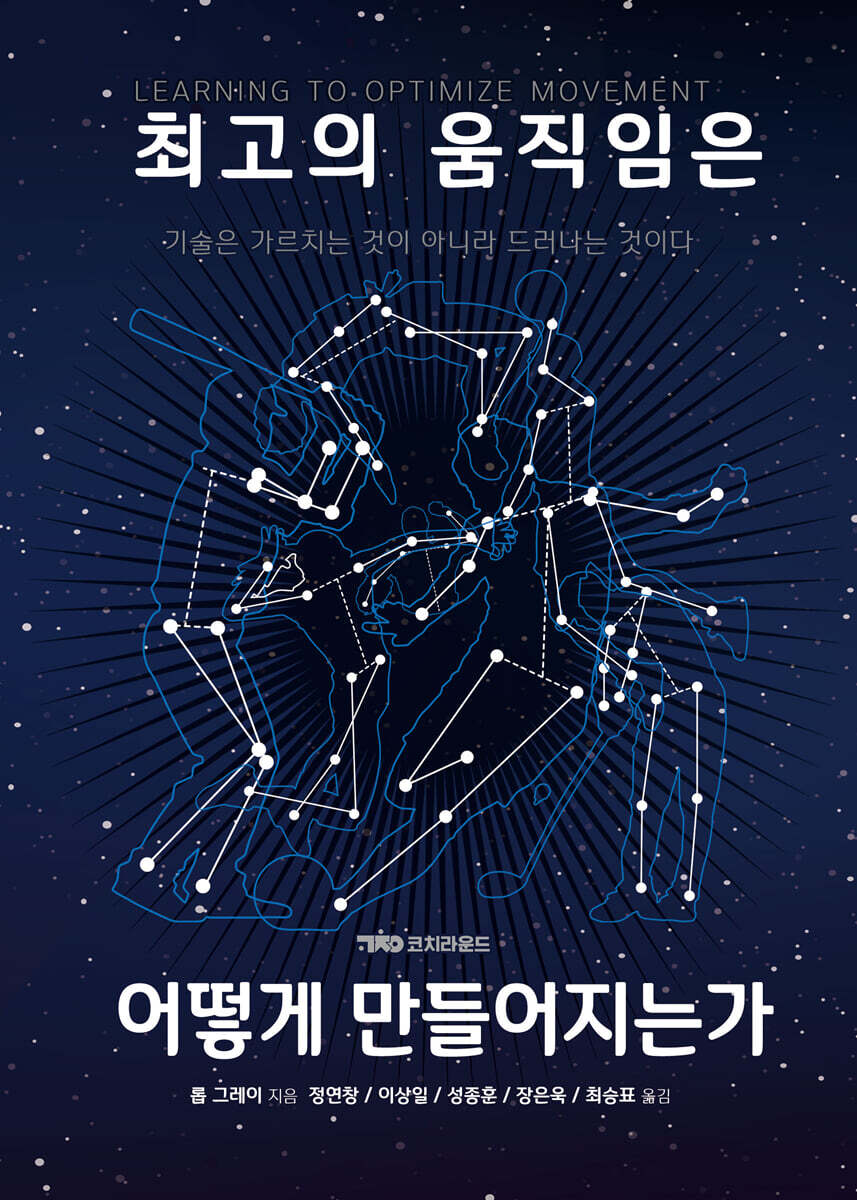 |
Description
Book Introduction
There are players who show amazing moves.
They break down the opponent's defense with passes that no one expects.
He reacts to the ball's movement that changes instantly and hits the ball hard, and he also reads his opponent's movements to freely throw uppercuts and hooks.
As if he knew it would happen.
But even the player himself doesn't know why he chose that move.
The fantastic play they display is an art that blossoms in ignorance.
Even the pressure of a full house becomes an energy that brings out their potential.
We usually call these players 'geniuses' and envy their 'natural talent'.
But Dr. Rob Gray says:
If we properly understand human movement and change our perspective on practice, we will see more geniuses on the field.
They break down the opponent's defense with passes that no one expects.
He reacts to the ball's movement that changes instantly and hits the ball hard, and he also reads his opponent's movements to freely throw uppercuts and hooks.
As if he knew it would happen.
But even the player himself doesn't know why he chose that move.
The fantastic play they display is an art that blossoms in ignorance.
Even the pressure of a full house becomes an energy that brings out their potential.
We usually call these players 'geniuses' and envy their 'natural talent'.
But Dr. Rob Gray says:
If we properly understand human movement and change our perspective on practice, we will see more geniuses on the field.
- You can preview some of the book's contents.
Preview
index
Preface: Starting again on the path of endless exploration
Technology is a verb, not a noun.
Good technology is not a process of repeating a single movement solution.
Chapter 1: The Science Behind Accurate Tackling
Humans move through perception: direct perception
Can the brain control all muscles and joints?
The Mysterious Athletic Synergy That Creates the Pitching Motion
Chapter 2 Information-Movement Control to Break Through the Space Between Defenses
Get the information you need to move directly: concrete information
Optical flow that directly indicates the direction of movement
Couple information to break through defenders
Catch the Flying Ball: Optical Acceleration
Knock down your opponent at the right time: Viewing Angle
Designing exercises for perception-action coupling
Chapter 3: The best players look from different places
What Major League Infielders and Experienced Pilots Have in Common
Change your putting technique by changing your perspective.
The goalkeeper's eye to block a penalty kick
A batter looking at the pitcher's hat: Visual pivot point
The Point Guard's Amazing Vision: Eye Anchoring Strategy
Vision is overrated
The coach told me not to move my head
Eye scanning by creative soccer players
Five Approaches to Developing Gaze Control Skills
Chapter 4: Will Focusing on Movement Improve Your Movement?
What happens when you pay attention to your body movements
Performance Results Vary by a Single Word: Intrinsic and External Cues
Why External Cues Lead to Better Performance and Learning
Four Principles for Optimal Coaching Cue Use
Why Our Attention Distracts
Chapter 5: A Dog Catching a Flying Frisbee
To create the future, you must predict it: the predictive control model.
Problems arising from misunderstandings about perception
The Frisbee Catching Dog: Forward Control Model
Unpredictable, but knocks down the opponent at the right time
Chapter 6: Change the Practice Environment, Not the Movement
An invitation from a childhood slide
Three Key Points of Affordance: Affordance-Based Coaching
A goalkeeper who flies his body as slowly as possible
It's not about the posture, it's about the conditions.
Good coaching sets the stage for practice.
Chapter 7: Training the Self-Organization of the Fascia
It may not be a mechanics issue: muscle slack
3 Ways to Eliminate Muscle Slack
The human body as a pop-up tent: the biotonic integration system
Aqua Bag and simultaneous shrinkage
Chapter 8: The Best Move is Economical
Producing the same movement with less energy: movement efficiency
Movement efficiency is itself a goal of practice.
External Cues, Feedback, and Measurement Devices: Practices to Increase Movement Efficiency
Chapter 9: Quick Decisions Are Not Always Good Decisions
The ability to postpone decisions for as long as possible: Skilled intentionality
Choices emerge from movement
An Unmissable Invitation: The Foundations of Skilled Intentionality
Develop decision-making skills through constraints
Practice to encourage good decision-making during the game
Chapter 10: Freely throw uppercuts and hooks
The Dilemma of Stability and Flexibility: The Light and Dark Side of Attractors
Change the shape of your glove according to the incoming ball: Meta Stability
Chapter 11: The Secret of Fantastic Assists
Sharing Attunement, Not Knowledge: The Affordance Sharing Model
Practice developing team coordination skills
Chapter 12: The batter's intentions change depending on the count
Rubber bands with the same length but different tensions: hysteresis
Coupling Your Swing with Your Pitching Motion: Preliminary Cues and Fine-Tuning
Coaching intentions, not predictions
Players enjoying the sold-out crowd at the finals of Chapter 13
Handling pressure is also a skill that can be developed through practice.
Athletes feel greater fear of the outcome
Key principles for setting pressure in practice
Practice effectiveness varies depending on the player's expectations
Chapter 14 Optimal Practice Difficulty for Each Player
The feeling of 'learning' that comes from simple, repetitive practice
Learning Information is in the Experience of Change and Failure: The 70% Rule
Practice is repetition and adjustment: The Art of Coaching
A skill training periodization process to vary the difficulty of the exercises.
Chapter 15: The Illusion of Returning to Your Old Body
Rehabilitation is a time to explore your new body.
The dangers of perfect form
Finding the Optimal Stress Point: Anti-Vulnerability
Rehabilitation process connecting with affordances
Chapter 16: Checklists Awaken Dormant Ideas
Checklist for Practice Design
Objectively evaluate your own practice
The value of planning and recording the variability of practice
Create, categorize, and organize coaching queues.
Epilogue
Technology is a verb, not a noun.
Good technology is not a process of repeating a single movement solution.
Chapter 1: The Science Behind Accurate Tackling
Humans move through perception: direct perception
Can the brain control all muscles and joints?
The Mysterious Athletic Synergy That Creates the Pitching Motion
Chapter 2 Information-Movement Control to Break Through the Space Between Defenses
Get the information you need to move directly: concrete information
Optical flow that directly indicates the direction of movement
Couple information to break through defenders
Catch the Flying Ball: Optical Acceleration
Knock down your opponent at the right time: Viewing Angle
Designing exercises for perception-action coupling
Chapter 3: The best players look from different places
What Major League Infielders and Experienced Pilots Have in Common
Change your putting technique by changing your perspective.
The goalkeeper's eye to block a penalty kick
A batter looking at the pitcher's hat: Visual pivot point
The Point Guard's Amazing Vision: Eye Anchoring Strategy
Vision is overrated
The coach told me not to move my head
Eye scanning by creative soccer players
Five Approaches to Developing Gaze Control Skills
Chapter 4: Will Focusing on Movement Improve Your Movement?
What happens when you pay attention to your body movements
Performance Results Vary by a Single Word: Intrinsic and External Cues
Why External Cues Lead to Better Performance and Learning
Four Principles for Optimal Coaching Cue Use
Why Our Attention Distracts
Chapter 5: A Dog Catching a Flying Frisbee
To create the future, you must predict it: the predictive control model.
Problems arising from misunderstandings about perception
The Frisbee Catching Dog: Forward Control Model
Unpredictable, but knocks down the opponent at the right time
Chapter 6: Change the Practice Environment, Not the Movement
An invitation from a childhood slide
Three Key Points of Affordance: Affordance-Based Coaching
A goalkeeper who flies his body as slowly as possible
It's not about the posture, it's about the conditions.
Good coaching sets the stage for practice.
Chapter 7: Training the Self-Organization of the Fascia
It may not be a mechanics issue: muscle slack
3 Ways to Eliminate Muscle Slack
The human body as a pop-up tent: the biotonic integration system
Aqua Bag and simultaneous shrinkage
Chapter 8: The Best Move is Economical
Producing the same movement with less energy: movement efficiency
Movement efficiency is itself a goal of practice.
External Cues, Feedback, and Measurement Devices: Practices to Increase Movement Efficiency
Chapter 9: Quick Decisions Are Not Always Good Decisions
The ability to postpone decisions for as long as possible: Skilled intentionality
Choices emerge from movement
An Unmissable Invitation: The Foundations of Skilled Intentionality
Develop decision-making skills through constraints
Practice to encourage good decision-making during the game
Chapter 10: Freely throw uppercuts and hooks
The Dilemma of Stability and Flexibility: The Light and Dark Side of Attractors
Change the shape of your glove according to the incoming ball: Meta Stability
Chapter 11: The Secret of Fantastic Assists
Sharing Attunement, Not Knowledge: The Affordance Sharing Model
Practice developing team coordination skills
Chapter 12: The batter's intentions change depending on the count
Rubber bands with the same length but different tensions: hysteresis
Coupling Your Swing with Your Pitching Motion: Preliminary Cues and Fine-Tuning
Coaching intentions, not predictions
Players enjoying the sold-out crowd at the finals of Chapter 13
Handling pressure is also a skill that can be developed through practice.
Athletes feel greater fear of the outcome
Key principles for setting pressure in practice
Practice effectiveness varies depending on the player's expectations
Chapter 14 Optimal Practice Difficulty for Each Player
The feeling of 'learning' that comes from simple, repetitive practice
Learning Information is in the Experience of Change and Failure: The 70% Rule
Practice is repetition and adjustment: The Art of Coaching
A skill training periodization process to vary the difficulty of the exercises.
Chapter 15: The Illusion of Returning to Your Old Body
Rehabilitation is a time to explore your new body.
The dangers of perfect form
Finding the Optimal Stress Point: Anti-Vulnerability
Rehabilitation process connecting with affordances
Chapter 16: Checklists Awaken Dormant Ideas
Checklist for Practice Design
Objectively evaluate your own practice
The value of planning and recording the variability of practice
Create, categorize, and organize coaching queues.
Epilogue
Detailed image

Into the book
How can a defender in a football game make a powerful tackle on an opposing offense? How does an outfielder in a baseball game know if he's running in the right direction to catch a fly ball? How does he know if, at his current speed, he can catch the ball before it hits the ground?
I observed eye movements from two infielders.
One is data from a shortstop on a college baseball team, and the other is data from a shortstop who played in the major leagues for more than five years.
If you look at the picture, you can easily see the difference.
Often times, when we move our gaze to the right object, our body movements are naturally controlled.
At this point, it feels like the body is just following the gaze.
Think about the moment when you turn a curve while driving a bicycle or car.
“Watch the ball! Don’t move your head!” This is a mantra coaches in many sports give to their athletes.
Let's consider whether this is sound advice.
I doubt if that's even possible.
Attention is an amazing resource given to humans.
It is also a resource that must be used wisely.
Attention can make or break your performance.
If you focus your attention in the wrong place, your top performance can quickly deteriorate to mediocrity.
Simply shifting your attention to the 'right object' can have many positive effects.
Is it really necessary for the brain to perform all the calculations and predictions necessary to catch a Frisbee? It seems like it would require an incredibly powerful supercomputer to do all of this.
Many people believe that the human brain plays that role.
So how do we explain the fact that dogs are much better at catching Frisbees than humans?
There are several things to check to find out why your bat speed is slow.
There may be a problem with the way you view the ball's trajectory.
Or maybe the problem is your swing mechanics.
You may be a weak hitter who needs to focus on strength training.
While these things may be the cause, the batter's muscle slack may also be a significant reason why bat speed is not generated.
When there is muscle slack, it takes longer for the batter to generate power.
If muscle slack is the root cause, coaching focused on pitch recognition, swing mechanics, or strength training likely won't work.
Considering the economy of movement also changes the way coaches design exercises.
This is related to a concept called 'overlearning' in motor learning.
Overrunning refers to a state in which an athlete's performance remains stagnant but technical progress is being made.
Even though practice continues, the athlete's movements do not become faster or more accurate.
You can't hit the ball harder or send it farther.
But the player continues to develop something.
The more an athlete practices, the less energy is used to create the same movement solution.
It creates a movement solution that reduces muscle contraction and oxygen consumption.
Movement becomes increasingly economical.
A 'quick' decision isn't always a 'good' decision.
Quick reaction times and the ability to make quick decisions have long been considered signs of good skill and expertise.
But we would bring the best athletes into the lab and be shocked to find that their reaction times were average or below average.
The pressure of practice doesn't have to be exactly the same as the pressure of a game.
In fact, it is impossible to replicate the pressure of a match in practice.
For example, just because a player is afraid of playing in front of a large crowd, there is no need to practice in a place with a large crowd.
Just making it clear that someone is watching, like filming a video, can help.
Players may also prefer a more prescriptive approach to teaching, where coaches repeat fixed drills or explicitly tell players what to do.
Such practice can also help you gain more confidence.
However, many studies clearly show that this type of practice is not the best condition for actual learning and transfer to competition.
If so, the coach's task is clear.
In practice, you need to find the challenge point where functional difficulty is optimal.
It's not just about the players' good performance that matters.
Learning must happen through practice.
Contrary to what many coaches believe, it is not beneficial for athletes to be inconsistent in their movements and not move with 'perfect form' every time.
Coaches have been trying to protect players from injury by emphasizing correct movements and perfect form.
But these studies contradict the common belief among coaches.
They say that forcing athletes to move in a variety of conditions while intentionally disrupting correct movement or perfect form can actually reduce the risk of injury and build anti-fragility.
It is important for coaches to take a cold look at what they are 'doing'.
In many cases, there is a big difference between what we can do and what we actually do.
I observed eye movements from two infielders.
One is data from a shortstop on a college baseball team, and the other is data from a shortstop who played in the major leagues for more than five years.
If you look at the picture, you can easily see the difference.
Often times, when we move our gaze to the right object, our body movements are naturally controlled.
At this point, it feels like the body is just following the gaze.
Think about the moment when you turn a curve while driving a bicycle or car.
“Watch the ball! Don’t move your head!” This is a mantra coaches in many sports give to their athletes.
Let's consider whether this is sound advice.
I doubt if that's even possible.
Attention is an amazing resource given to humans.
It is also a resource that must be used wisely.
Attention can make or break your performance.
If you focus your attention in the wrong place, your top performance can quickly deteriorate to mediocrity.
Simply shifting your attention to the 'right object' can have many positive effects.
Is it really necessary for the brain to perform all the calculations and predictions necessary to catch a Frisbee? It seems like it would require an incredibly powerful supercomputer to do all of this.
Many people believe that the human brain plays that role.
So how do we explain the fact that dogs are much better at catching Frisbees than humans?
There are several things to check to find out why your bat speed is slow.
There may be a problem with the way you view the ball's trajectory.
Or maybe the problem is your swing mechanics.
You may be a weak hitter who needs to focus on strength training.
While these things may be the cause, the batter's muscle slack may also be a significant reason why bat speed is not generated.
When there is muscle slack, it takes longer for the batter to generate power.
If muscle slack is the root cause, coaching focused on pitch recognition, swing mechanics, or strength training likely won't work.
Considering the economy of movement also changes the way coaches design exercises.
This is related to a concept called 'overlearning' in motor learning.
Overrunning refers to a state in which an athlete's performance remains stagnant but technical progress is being made.
Even though practice continues, the athlete's movements do not become faster or more accurate.
You can't hit the ball harder or send it farther.
But the player continues to develop something.
The more an athlete practices, the less energy is used to create the same movement solution.
It creates a movement solution that reduces muscle contraction and oxygen consumption.
Movement becomes increasingly economical.
A 'quick' decision isn't always a 'good' decision.
Quick reaction times and the ability to make quick decisions have long been considered signs of good skill and expertise.
But we would bring the best athletes into the lab and be shocked to find that their reaction times were average or below average.
The pressure of practice doesn't have to be exactly the same as the pressure of a game.
In fact, it is impossible to replicate the pressure of a match in practice.
For example, just because a player is afraid of playing in front of a large crowd, there is no need to practice in a place with a large crowd.
Just making it clear that someone is watching, like filming a video, can help.
Players may also prefer a more prescriptive approach to teaching, where coaches repeat fixed drills or explicitly tell players what to do.
Such practice can also help you gain more confidence.
However, many studies clearly show that this type of practice is not the best condition for actual learning and transfer to competition.
If so, the coach's task is clear.
In practice, you need to find the challenge point where functional difficulty is optimal.
It's not just about the players' good performance that matters.
Learning must happen through practice.
Contrary to what many coaches believe, it is not beneficial for athletes to be inconsistent in their movements and not move with 'perfect form' every time.
Coaches have been trying to protect players from injury by emphasizing correct movements and perfect form.
But these studies contradict the common belief among coaches.
They say that forcing athletes to move in a variety of conditions while intentionally disrupting correct movement or perfect form can actually reduce the risk of injury and build anti-fragility.
It is important for coaches to take a cold look at what they are 'doing'.
In many cases, there is a big difference between what we can do and what we actually do.
--- From the text
GOODS SPECIFICS
- Date of issue: March 15, 2024
- Page count, weight, size: 416 pages | 610g | 150*210*30mm
- ISBN13: 9791198140784
- ISBN10: 119814078X
You may also like
카테고리
korean


korean

![GQ KOREA Mark (Monthly): December [2025]](http://librairie.coreenne.fr/cdn/shop/files/8ef265dbbfbf186523ed75ba7319009d.jpg?v=1765340328&width=3840)


