

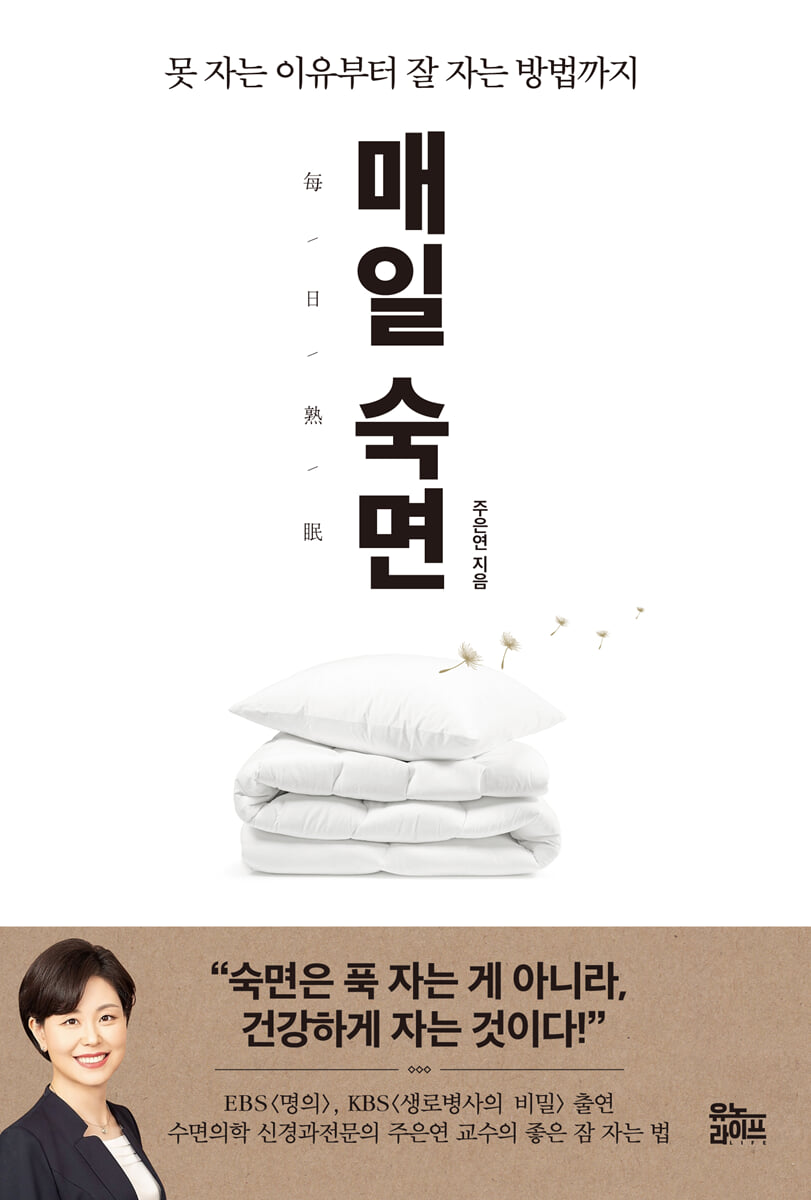
Get a good night's sleep every day
 |
Description
Book Introduction
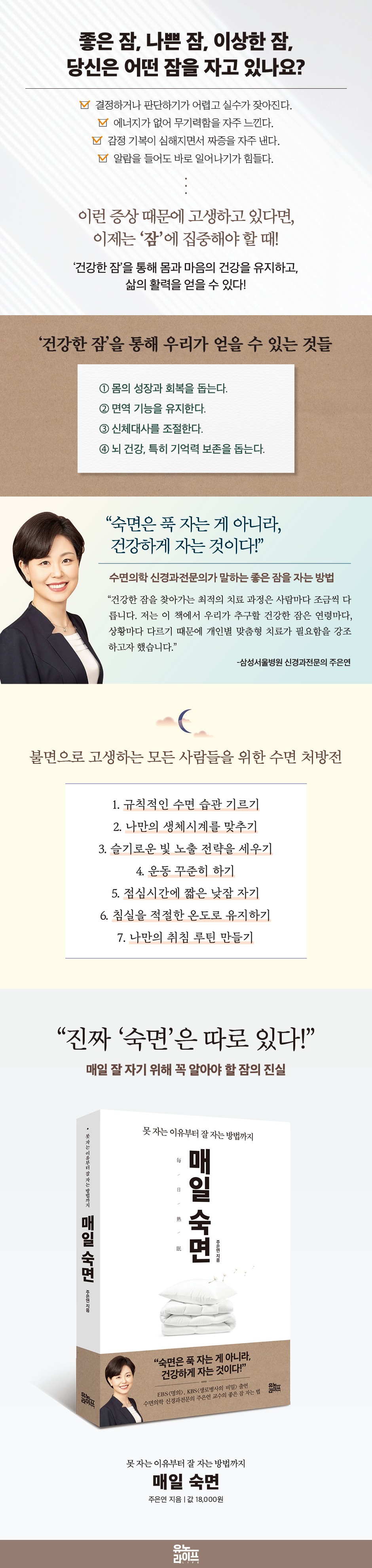
Maintain a healthy body and mind through ‘healthy sleep’,
You can gain vitality in life!
Appeared on EBS's "Myung-ui" and KBS's "Secret of Birth, Aging, Illness, and Death"
Everything You Need to Know About Sleep from the Top Sleep Doctor
It has become difficult to make decisions or judgements, and mistakes have become more frequent.
I often feel lethargic because I have no energy.
As your mood swings become more severe, you become irritable more often.
Even if I hear the alarm, it's hard to wake up right away.
The cause of all these phenomena is ‘sleep’.
Lack of sleep slows down your thinking process and reduces your concentration and memory.
It also negatively affects almost every function of our body, including mental health and immune system problems.
As such, sleep is an important process that cannot be separated from our lives and health.
According to the National Health Insurance Corporation, one in three Koreans has suffered from sleep problems at least once in their lives or is currently experiencing them.
Why are we having more and more trouble falling asleep, and how can we get better sleep?
"Daily Sleep" is a book that captures the author's experience treating over 20,000 patients with sleep disorders over the past 20 years.
From the reasons why we can't fall asleep, such as insomnia, sleep apnea, REM sleep behavior disorder, and restless leg syndrome, to how to sleep well, it's all in one book.
It provides detailed explanations of sleep characteristics by life cycle using various materials and actual patient cases.
The author says that the sleep we need is 'healthy sleep.'
Depending on age, gender, and surrounding environment, the amount of sleep I need varies.
The deep, uninterrupted sleep we desire becomes virtually impossible after our mid-teens.
Reducing excessive expectations about sleep and creating your own sleep routine are the secrets to healthy sleep, according to the author.
Getting a healthy night's sleep is like running a marathon.
Just like a marathon where you can run 5 or 10 minutes more every day, you can get good, healthy sleep every day through consistent management.
The author suggests that anyone struggling with sleepless nights start by developing regular sleep habits.
This book will provide answers for those who have trouble falling asleep, those whose daily lives are disrupted by insufficient sleep, and those who want a sleep prescription that is just right for them.
You can gain vitality in life!
Appeared on EBS's "Myung-ui" and KBS's "Secret of Birth, Aging, Illness, and Death"
Everything You Need to Know About Sleep from the Top Sleep Doctor
It has become difficult to make decisions or judgements, and mistakes have become more frequent.
I often feel lethargic because I have no energy.
As your mood swings become more severe, you become irritable more often.
Even if I hear the alarm, it's hard to wake up right away.
The cause of all these phenomena is ‘sleep’.
Lack of sleep slows down your thinking process and reduces your concentration and memory.
It also negatively affects almost every function of our body, including mental health and immune system problems.
As such, sleep is an important process that cannot be separated from our lives and health.
According to the National Health Insurance Corporation, one in three Koreans has suffered from sleep problems at least once in their lives or is currently experiencing them.
Why are we having more and more trouble falling asleep, and how can we get better sleep?
"Daily Sleep" is a book that captures the author's experience treating over 20,000 patients with sleep disorders over the past 20 years.
From the reasons why we can't fall asleep, such as insomnia, sleep apnea, REM sleep behavior disorder, and restless leg syndrome, to how to sleep well, it's all in one book.
It provides detailed explanations of sleep characteristics by life cycle using various materials and actual patient cases.
The author says that the sleep we need is 'healthy sleep.'
Depending on age, gender, and surrounding environment, the amount of sleep I need varies.
The deep, uninterrupted sleep we desire becomes virtually impossible after our mid-teens.
Reducing excessive expectations about sleep and creating your own sleep routine are the secrets to healthy sleep, according to the author.
Getting a healthy night's sleep is like running a marathon.
Just like a marathon where you can run 5 or 10 minutes more every day, you can get good, healthy sleep every day through consistent management.
The author suggests that anyone struggling with sleepless nights start by developing regular sleep habits.
This book will provide answers for those who have trouble falling asleep, those whose daily lives are disrupted by insufficient sleep, and those who want a sleep prescription that is just right for them.
- You can preview some of the book's contents.
Preview
index
As we enter, what kind of sleep are you getting?
Chapter 1: There is a real 'deep sleep'
The Secret to the 'Good Sleep' You Want
Misconceptions about sleep
Sleep structure and sleep cycle
Why do we have nightmares?
Different sleep times depending on age
Symptoms of sleep deprivation
Things that reduce sleep quality
Chapter 2: Why You Can't Sleep Every Night
The cause is bad lifestyle habits.
Weekend and weekday sleep time difference
Are you a night person or a morning person?
Correlation between depression and insomnia
Chapter 3: What is ‘healthy sleep’?
The Importance of Regular Sleep Habits
Setting Your Own Biological Clock
Smart Light Exposure Strategy
Exercise guarantees good sleep
The best way to help you sleep: fasting
A short nap is better than coffee.
Keep your bedroom at the right temperature
Create your own bedtime routine
Monitor your sleep with a sleep diary
Chapter 4: Sleep Treatment: Essential in an Age of Insomnia
Do I have a sleep disorder?
Things to check before receiving treatment
The process of polysomnography
Chapter 5: Are women and men sleeping differently?
Why so many women have trouble sleeping
The Effects of Female Hormones on Sleep
Mothers who raise children are always sleep-deprived.
Changes in a woman's sleep after menopause
Menopausal insomnia manifests itself like this:
Chapter 6: Why You Sleep Worse as You Get Older
The worries of seniors who can't sleep at night
Insomnia in old age has different standards
If you sleep less than 6 hours, you will get dementia?
Why do I wake up and go to the bathroom often?
Is it sleep talking or REM sleep behavior disorder?
Chapter 7: A Sleep Prescription for Healthy Sleep Every Day
The illusion that snoring means you sleep well
Positive airway pressure device effective for sleep apnea
Restless Leg Syndrome: A Brain Problem Even If Your Legs Feel Unwell
The causes of insomnia are very diverse.
Treatment for people with sensitive sleep
Stress is also detrimental to sleep.
Common Mistakes made by Insomniacs
Acknowledgements
References
Search
Chapter 1: There is a real 'deep sleep'
The Secret to the 'Good Sleep' You Want
Misconceptions about sleep
Sleep structure and sleep cycle
Why do we have nightmares?
Different sleep times depending on age
Symptoms of sleep deprivation
Things that reduce sleep quality
Chapter 2: Why You Can't Sleep Every Night
The cause is bad lifestyle habits.
Weekend and weekday sleep time difference
Are you a night person or a morning person?
Correlation between depression and insomnia
Chapter 3: What is ‘healthy sleep’?
The Importance of Regular Sleep Habits
Setting Your Own Biological Clock
Smart Light Exposure Strategy
Exercise guarantees good sleep
The best way to help you sleep: fasting
A short nap is better than coffee.
Keep your bedroom at the right temperature
Create your own bedtime routine
Monitor your sleep with a sleep diary
Chapter 4: Sleep Treatment: Essential in an Age of Insomnia
Do I have a sleep disorder?
Things to check before receiving treatment
The process of polysomnography
Chapter 5: Are women and men sleeping differently?
Why so many women have trouble sleeping
The Effects of Female Hormones on Sleep
Mothers who raise children are always sleep-deprived.
Changes in a woman's sleep after menopause
Menopausal insomnia manifests itself like this:
Chapter 6: Why You Sleep Worse as You Get Older
The worries of seniors who can't sleep at night
Insomnia in old age has different standards
If you sleep less than 6 hours, you will get dementia?
Why do I wake up and go to the bathroom often?
Is it sleep talking or REM sleep behavior disorder?
Chapter 7: A Sleep Prescription for Healthy Sleep Every Day
The illusion that snoring means you sleep well
Positive airway pressure device effective for sleep apnea
Restless Leg Syndrome: A Brain Problem Even If Your Legs Feel Unwell
The causes of insomnia are very diverse.
Treatment for people with sensitive sleep
Stress is also detrimental to sleep.
Common Mistakes made by Insomniacs
Acknowledgements
References
Search
Detailed image
Into the book
According to the National Health Insurance Corporation, one in three Koreans has experienced sleep problems at least once in their lives or is currently experiencing them.
The table below shows the increasing trend in the number of insomnia patients from 2015 to 2020.
With approximately 500,000 to 600,000 patients receiving treatment for insomnia every year, the condition is more serious than you might think.
--- p.15 From “The Secret to the Sweet Sleep You Want”
The growing interest in sleep and the social atmosphere of pursuing good sleep are welcome developments for sleep doctors.
However, misinformation that is passed on without any filter has led many people to become overly concerned about their sleep.
We often see cases where incorrect knowledge becomes an obsession and causes or worsens sleep problems.
--- p.22 From “False Myths About Sleep”
In summary, chronic lack of sleep increases the incidence of serious systemic diseases, shortens lifespan, and increases the risk of dementia.
In other words, sleep is an important activity that is very closely related to our lives.
--- p.44 From “Symptoms of lack of sleep”
The greater the difference between your sleep time on weekdays and weekends, the more likely you are to suffer from the 'Monday blues'.
The medical term for Monday blues is 'social jet lag.'
Social jet lag refers to the aftereffects of a two-hour or more difference in sleep time between weekdays and weekends, or between workdays and holidays.
--- p.72 From “Sleep Time Difference Between Weekends and Weekdays”
Can't sleep when you're hungry? This is proof that fake hunger is tricking your brain.
Regular sleep and eating habits ensure healthy sleep and are also excellent for weight loss.
The best food to help you sleep is a sufficient fast.
--- p.116 From “The Best Way to Help You Sleep: Fasting”
Women have to do more and more diverse tasks, such as childcare, housework, and work.
Therefore, you are more likely to sleep later than your circadian rhythm suits you.
The most persuasive argument seems to be that people will have poor sleep quality because they are getting less sleep than they need and their sleep quality is poor.
--- p.163 From “Why Many Women Can’t Sleep”
When symptoms of sleep disorders occur in the elderly, it is necessary to distinguish whether they are due to aging, a sleep disorder, or a side effect of medication or physical illness.
The goal of the older generation is to pursue healthy sleep appropriate for their age.
--- p.227 From "Is it sleep talking or REM sleep behavior disorder?"
Sixty percent of patients visiting my sleep clinic complain of insomnia.
However, the causes and symptoms of insomnia are different for each patient.
The table below shows the increasing trend in the number of insomnia patients from 2015 to 2020.
With approximately 500,000 to 600,000 patients receiving treatment for insomnia every year, the condition is more serious than you might think.
--- p.15 From “The Secret to the Sweet Sleep You Want”
The growing interest in sleep and the social atmosphere of pursuing good sleep are welcome developments for sleep doctors.
However, misinformation that is passed on without any filter has led many people to become overly concerned about their sleep.
We often see cases where incorrect knowledge becomes an obsession and causes or worsens sleep problems.
--- p.22 From “False Myths About Sleep”
In summary, chronic lack of sleep increases the incidence of serious systemic diseases, shortens lifespan, and increases the risk of dementia.
In other words, sleep is an important activity that is very closely related to our lives.
--- p.44 From “Symptoms of lack of sleep”
The greater the difference between your sleep time on weekdays and weekends, the more likely you are to suffer from the 'Monday blues'.
The medical term for Monday blues is 'social jet lag.'
Social jet lag refers to the aftereffects of a two-hour or more difference in sleep time between weekdays and weekends, or between workdays and holidays.
--- p.72 From “Sleep Time Difference Between Weekends and Weekdays”
Can't sleep when you're hungry? This is proof that fake hunger is tricking your brain.
Regular sleep and eating habits ensure healthy sleep and are also excellent for weight loss.
The best food to help you sleep is a sufficient fast.
--- p.116 From “The Best Way to Help You Sleep: Fasting”
Women have to do more and more diverse tasks, such as childcare, housework, and work.
Therefore, you are more likely to sleep later than your circadian rhythm suits you.
The most persuasive argument seems to be that people will have poor sleep quality because they are getting less sleep than they need and their sleep quality is poor.
--- p.163 From “Why Many Women Can’t Sleep”
When symptoms of sleep disorders occur in the elderly, it is necessary to distinguish whether they are due to aging, a sleep disorder, or a side effect of medication or physical illness.
The goal of the older generation is to pursue healthy sleep appropriate for their age.
--- p.227 From "Is it sleep talking or REM sleep behavior disorder?"
Sixty percent of patients visiting my sleep clinic complain of insomnia.
However, the causes and symptoms of insomnia are different for each patient.
--- p.251 From “The causes of insomnia are very diverse”
Publisher's Review
“How many hours of sleep should I get a day?”
My own sleep prescription for healthy sleep every day
How many hours of sleep do we really need? There are many opinions, such as "4 hours is enough," or "7 hours is the optimal amount of sleep," but the correct answer is "it varies from person to person."
To be a little more realistic, I would consider my optimal sleep time to be the average weekday sleep time that doesn't interfere with my daily life because I'm not sleepy the next day.
There is a type of sleep that suits me.
The amount of sleep each person needs varies depending on age, and the level of satisfaction each person feels with sleep often differs from the actual quality of sleep.
Women generally feel less comfortable sleeping than men, and as they age, their deep sleep decreases.
Therefore, it is necessary to go through the process of finding my own sleeping habits that fit the characteristics of each stage of my life.
The causes of insomnia are very diverse, and the solutions to them are also different.
The author also emphasizes the importance of sleep that suits each individual throughout the book.
The secret to the sweet sleep we desire,
How can I sleep well?
The secret to good, healthy sleep is ‘regularity.’
Going to bed and waking up at set times, exercising regularly, and not eating late at night—these things may seem easier than they are, but they are actually difficult to stick to.
Excessive alcohol and caffeine consumption, and using smartphones at night are also habits we need to improve.
These factors reduce the quality of sleep, causing us to wake up frequently and not be able to fall back to sleep.
It is also important to get rid of misconceptions about sleep.
“Sleeping pills cause dementia,” “If you snore too much, you’ll get Parkinson’s disease,” “If you snore, you’re sleeping well,” “You have to sleep all night without waking up.” We are exposed to countless pieces of information related to sleep in the media every day.
However, some of this information is true and some is false.
There are many cases where an obsession with sleep arises due to misinformation being passed on without any filter, which actually causes or worsens sleep problems.
Sleep, which accounts for one third of our lives,
What we can gain from healthy sleep
When we judge how well we slept last night, we usually focus only on 'how deeply we slept'.
However, the healthy sleep we should pursue is sleep that meets these three conditions: sufficient sleep time, excellent sleep quality, and regular sleep-wake cycle.
Healthy sleep has the following effects on our body:
1) Helps the body grow and recover
Children grow taller while they sleep, and even if they are sick or injured, they recover quickly as long as they sleep well.
Even cancer patient recovery clinics emphasize getting a good night's sleep after surgery or chemotherapy.
Deep sleep helps produce proteins that make up the body, and bones and red blood cells are formed during quality sleep.
2) Maintains immune function
Why do we feel particularly tired and unwell when we lack sleep? While we sleep, our bodies produce antibodies to protect us against external pathogens.
If you lack sleep or get poor quality sleep, you are more likely to develop various diseases and have difficulty recovering.
3) Regulates body metabolism
While you sleep, you conserve energy to prepare for the next day's activities.
Our bodies maintain normal blood sugar levels while we sleep, even if we do not consume food.
4) Helps maintain brain health, especially memory
Information learned during the day is stored in the hippocampus in the brain during deep sleep.
If you don't get enough deep sleep, you feel like your memory is poor because you don't have the information to retrieve the next day because the information isn't stored properly.
As the saying goes, “Sleep is the best medicine,” good sleep improves the quality of our lives.
Healthy sleep ultimately leads to a healthy life.
The fact that many people want to sleep well is also proof of this.
If you feel overly tired during the day, have trouble concentrating, feel out of control, or have low motivation, it's time to check if you're getting enough sleep.
My own sleep prescription for healthy sleep every day
How many hours of sleep do we really need? There are many opinions, such as "4 hours is enough," or "7 hours is the optimal amount of sleep," but the correct answer is "it varies from person to person."
To be a little more realistic, I would consider my optimal sleep time to be the average weekday sleep time that doesn't interfere with my daily life because I'm not sleepy the next day.
There is a type of sleep that suits me.
The amount of sleep each person needs varies depending on age, and the level of satisfaction each person feels with sleep often differs from the actual quality of sleep.
Women generally feel less comfortable sleeping than men, and as they age, their deep sleep decreases.
Therefore, it is necessary to go through the process of finding my own sleeping habits that fit the characteristics of each stage of my life.
The causes of insomnia are very diverse, and the solutions to them are also different.
The author also emphasizes the importance of sleep that suits each individual throughout the book.
The secret to the sweet sleep we desire,
How can I sleep well?
The secret to good, healthy sleep is ‘regularity.’
Going to bed and waking up at set times, exercising regularly, and not eating late at night—these things may seem easier than they are, but they are actually difficult to stick to.
Excessive alcohol and caffeine consumption, and using smartphones at night are also habits we need to improve.
These factors reduce the quality of sleep, causing us to wake up frequently and not be able to fall back to sleep.
It is also important to get rid of misconceptions about sleep.
“Sleeping pills cause dementia,” “If you snore too much, you’ll get Parkinson’s disease,” “If you snore, you’re sleeping well,” “You have to sleep all night without waking up.” We are exposed to countless pieces of information related to sleep in the media every day.
However, some of this information is true and some is false.
There are many cases where an obsession with sleep arises due to misinformation being passed on without any filter, which actually causes or worsens sleep problems.
Sleep, which accounts for one third of our lives,
What we can gain from healthy sleep
When we judge how well we slept last night, we usually focus only on 'how deeply we slept'.
However, the healthy sleep we should pursue is sleep that meets these three conditions: sufficient sleep time, excellent sleep quality, and regular sleep-wake cycle.
Healthy sleep has the following effects on our body:
1) Helps the body grow and recover
Children grow taller while they sleep, and even if they are sick or injured, they recover quickly as long as they sleep well.
Even cancer patient recovery clinics emphasize getting a good night's sleep after surgery or chemotherapy.
Deep sleep helps produce proteins that make up the body, and bones and red blood cells are formed during quality sleep.
2) Maintains immune function
Why do we feel particularly tired and unwell when we lack sleep? While we sleep, our bodies produce antibodies to protect us against external pathogens.
If you lack sleep or get poor quality sleep, you are more likely to develop various diseases and have difficulty recovering.
3) Regulates body metabolism
While you sleep, you conserve energy to prepare for the next day's activities.
Our bodies maintain normal blood sugar levels while we sleep, even if we do not consume food.
4) Helps maintain brain health, especially memory
Information learned during the day is stored in the hippocampus in the brain during deep sleep.
If you don't get enough deep sleep, you feel like your memory is poor because you don't have the information to retrieve the next day because the information isn't stored properly.
As the saying goes, “Sleep is the best medicine,” good sleep improves the quality of our lives.
Healthy sleep ultimately leads to a healthy life.
The fact that many people want to sleep well is also proof of this.
If you feel overly tired during the day, have trouble concentrating, feel out of control, or have low motivation, it's time to check if you're getting enough sleep.
GOODS SPECIFICS
- Date of issue: February 21, 2024
- Page count, weight, size: 284 pages | 442g | 142*210*18mm
- ISBN13: 9791191104875
- ISBN10: 1191104877
You may also like
카테고리
korean


korean

![GQ KOREA Mark (Monthly): December [2025]](http://librairie.coreenne.fr/cdn/shop/files/8ef265dbbfbf186523ed75ba7319009d.jpg?v=1765340328&width=3840)


