

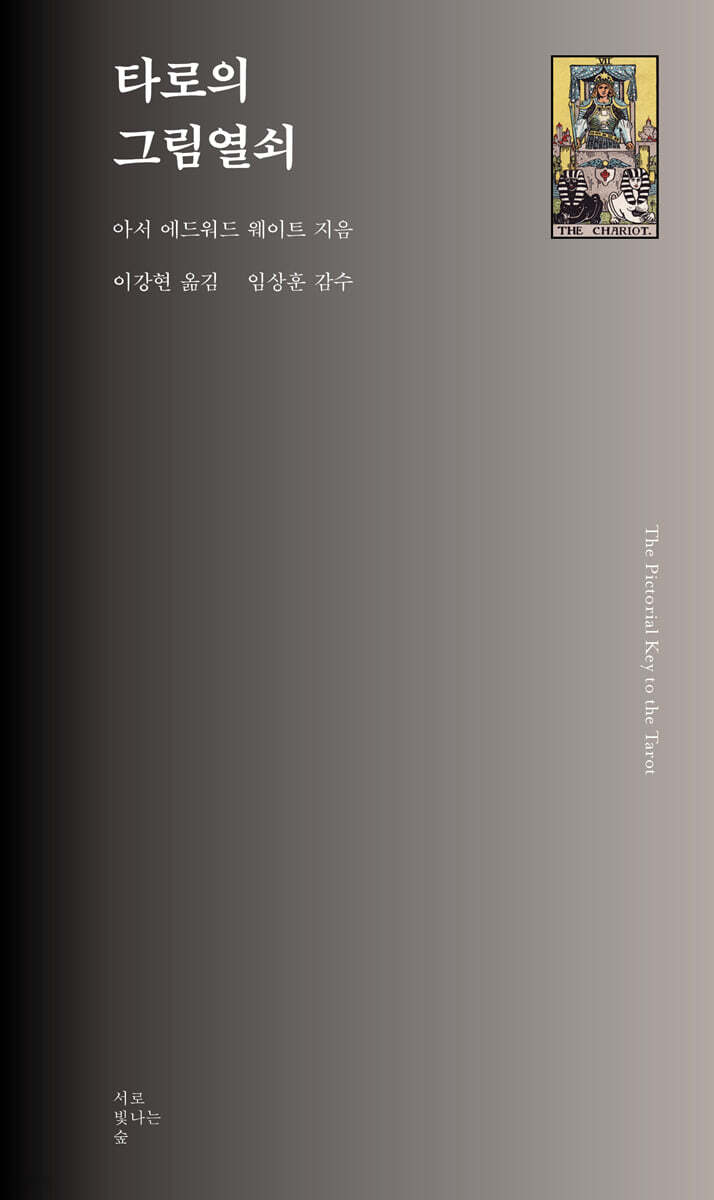
Tarot Picture Key
 |
Description
Book Introduction
Tarot Picture Key
The beginning of modern tarot, read with accurate translation and clear explanation.
The second installment of the 'Tarot Card Series', Korea's only specialized tarot card research book series, begins.
"The Picture Key of the Tarot," which was selected as the book to open the second series of Tarot card books, is a book that anyone interested in Tarot cards will have encountered. It was published along with the Rider-Waite cards, the beginning of modern Tarot cards, and has had a great influence from the past to the present.
The translator and editor have strived to make this translation more accessible, remaining as faithful to the original text as possible while also focusing on providing footnotes to explain the original text's style, which has previously been perceived as a barrier.
This book refutes existing interpretations while simultaneously presenting its own arguments.
Furthermore, starting from the origins of the Tarot cards and going beyond reanalyzing the meaning of each card, he now describes the widely used Celtic cross spread, which is also highly complete and is still used to this day.
The contents of this book still have a strong influence on the interpretation of tarot cards.
Recently, a drama based on tarot cards has been re-produced, and tarot cards have now successfully established themselves as a form of fortune telling and cultural content in Korea.
In this way, tarot cards are recognized as a tool that inspires creators and a reliable advisor for those seeking to find their own path.
The Tarot Card Series begins its second season with this meaningful book, and in the future, we plan to publish additional books that will be helpful to those who wish to take a more in-depth approach or utilize the Tarot cards at a higher level.
The beginning of modern tarot, read with accurate translation and clear explanation.
The second installment of the 'Tarot Card Series', Korea's only specialized tarot card research book series, begins.
"The Picture Key of the Tarot," which was selected as the book to open the second series of Tarot card books, is a book that anyone interested in Tarot cards will have encountered. It was published along with the Rider-Waite cards, the beginning of modern Tarot cards, and has had a great influence from the past to the present.
The translator and editor have strived to make this translation more accessible, remaining as faithful to the original text as possible while also focusing on providing footnotes to explain the original text's style, which has previously been perceived as a barrier.
This book refutes existing interpretations while simultaneously presenting its own arguments.
Furthermore, starting from the origins of the Tarot cards and going beyond reanalyzing the meaning of each card, he now describes the widely used Celtic cross spread, which is also highly complete and is still used to this day.
The contents of this book still have a strong influence on the interpretation of tarot cards.
Recently, a drama based on tarot cards has been re-produced, and tarot cards have now successfully established themselves as a form of fortune telling and cultural content in Korea.
In this way, tarot cards are recognized as a tool that inspires creators and a reliable advisor for those seeking to find their own path.
The Tarot Card Series begins its second season with this meaningful book, and in the future, we plan to publish additional books that will be helpful to those who wish to take a more in-depth approach or utilize the Tarot cards at a higher level.
index
Reviewer's Note
preface
Part 1: The Curtain and the Symbols Within
Chapter 1: Preface and General Theory
Chapter 2 Classification 1.
Trump Major or Secret Arcana
Chapter 3 Classification 2.
Four Suits or Sobimil Arcana
Chapter 4 Tarot in History
Part 2: The Doctrine Behind the Curtain
Chapter 1: Tarot and Secret Tradition
Chapter 2: Trump Major and its Inner Symbols
Conclusion on Chapter 3, "The Big Key"*
Part 3: The Superficial Principles of Trust
Chapter 1: Distinction between the Great Secret and the Less Secret Arcana
Chapter 2 The Little Key or the Four Suits of Tarot Cards
Wand suit
Cup suit
Sword suit
Pentagram suit
Chapter 3: The Great Secret and Its Divinatory Meanings
Chapter 4: Additional Meanings of Sobimil
Chapter 5 Recursion in Operation
Chapter 6: The Art of Tarot Reading
Chapter 7: Divination of the Ancient Celts
Chapter 8: Another Way to Interpret Tarot Cards
Chapter 9: Interpretation Using Thirty-Five Cards
References
Conclusion
preface
Part 1: The Curtain and the Symbols Within
Chapter 1: Preface and General Theory
Chapter 2 Classification 1.
Trump Major or Secret Arcana
Chapter 3 Classification 2.
Four Suits or Sobimil Arcana
Chapter 4 Tarot in History
Part 2: The Doctrine Behind the Curtain
Chapter 1: Tarot and Secret Tradition
Chapter 2: Trump Major and its Inner Symbols
Conclusion on Chapter 3, "The Big Key"*
Part 3: The Superficial Principles of Trust
Chapter 1: Distinction between the Great Secret and the Less Secret Arcana
Chapter 2 The Little Key or the Four Suits of Tarot Cards
Wand suit
Cup suit
Sword suit
Pentagram suit
Chapter 3: The Great Secret and Its Divinatory Meanings
Chapter 4: Additional Meanings of Sobimil
Chapter 5 Recursion in Operation
Chapter 6: The Art of Tarot Reading
Chapter 7: Divination of the Ancient Celts
Chapter 8: Another Way to Interpret Tarot Cards
Chapter 9: Interpretation Using Thirty-Five Cards
References
Conclusion
Into the book
In this way, too, we can find Tarot cards at the end of a doorway littered with the debris and remnants of the art called the Occult, which no one in their right mind would be fooled by.
However, the Tarot cards themselves belong to another realm, as they are highly symbolic.
(Omitted) It is closer to an interpretation according to the ‘law of grace.’
The mere fact that God's wisdom is like foolishness to humans does not in any sense/context presume that the foolishness of this world contributes to divine wisdom.
(Omitted) Until now, this topic has been treated as a business tool for card fortune tellers.
--- p.7
I believe that fortune telling has been a fact throughout the history of tarot cards.
So I looked up the combinations of meanings assigned to various cards in various publications and came up with the results.
Additionally, I introduced a previously unpublished method of divination.
This method has the advantage of being simple and universally applicable, so I think it could replace cumbersome and time-consuming thick guidebooks.
--- p.9
Sooner or later we will encounter the fact that the history of the Tarot cards is largely negative.
If we refute the unnecessary speculation and fantasy that has been expressed in the name of certainty so far, the following matters become clear.
The fact is that there is no history of tarot before the 14th century.
The Egyptian, Indian, and Chinese origin theories encouraged the first commentators on the history of the Tarot to fall into lies and self-deception.
--- p.18
Eliphas Levy assigned this card to 'Prudence' (one of the four cardinal virtues), but this was an expression of a desire to fill a gap in the symbolic system.
The Four Virtues are essential to the metaphysical ordering of the Trump Major.
But in this age of shallow journalism, the comfort and consumption of the general public should not be the primary purpose of the existence of a virtuous person.
--- p.26
The view that “everything unknown came from Egypt omne ignolum pro Aegyptiaco” was such a tempting option that many scholars fell for it.
Although it was acceptable at the time, the madness continued and was passed down by word of mouth within the circles of occultists.
There is no excuse for this.
--- p.46
Tarot cards may have been around for hundreds of years.
If tarot cards were intended solely for people to use to predict the future or to try their luck at gambling, the 14th century would have been quite early.
Conversely, if the Tarot cards contain deep hints of esoteric teachings, the 14th century is early enough, or at least the best we can glean from them.
--- p.53
Tarot contains symbolic representations of universal concepts, behind which lies everything inherent in the human psyche.
--- p.57
Researchers will undoubtedly criticize this difference when it comes to the Major Arcana.
Whether the criticism is justified or just nitpicking.
Therefore, I will not be concerned with the expression of opinions within the bounds of politeness and pre-existing courtesy expected of a research colleague.
There is a secret lore surrounding the Tarot, and a secret doctrine embedded within it.
I have accepted this to some extent, as long as I do not cross the lines of honor code drawn around these topics.
--- p.63
The only difference between this card and the original illustration is that the figure's cloak does not partially obscure the lamp.
The figure in the painting is the one who mixes the concept of the Ancient of Days* with the light of the world, and the thing shining in the lamp is the star.
Earlier (Part 1, Chapter 2), I explained that this card is a card that means achieving something.
To extend this concept, the figure in the painting is depicted holding a lantern on a hill.
Therefore, the Hermit card is not a wise man seeking truth and justice, as described by Zeblin, nor is it a special example of the meaning of experience, as later descriptions suggest.
His lamp suggests, “Where I am, you can be too.”**
--- p.75
Both figures have tails that indicate their animalistic nature, but their faces are intellect-like.
Also, he (the devil) who is above the characters will never be their master.
(Omitted) Levy, who had been acting as if he were an expert in the technique and pretending to respect and interpret it, went beyond his usual mockery and declared that this Baphomet-like figure was an occult scholar and magician.
Another commentator says that in the realm of God the demons symbolize predestination, but there is no connection between the realm of God and that of the beasts (and the like) below it.
--- p.81
Here is where the device of the picture applied to your denarii (suit) proves to be a great help to your intuition.
Words alone aren't enough to convey numerological power and meaning.* But pictures can act as doors to unexpected rooms and as winding paths on a wide path leading to vast possibilities.
--- p.95
First, I will show you a simple method that has long been secretly used in England, Scotland, and Ireland.
It is certain that this method has never been (publicly) introduced in any book on tarot cards.
I think this method can be used for all purposes, but for a change, I will introduce a second method known in France as the Oracles of Julia Orsini.
--- p.126
Although I pretend to be humble, this monograph is, to my knowledge, the first attempt in English to provide a complete introduction to the Tarot.
This book establishes the archaeological status of the Tarot, defines its symbolism, and presents its divination meaning and methods in detail.
From a scholarly perspective, I would like to list the textbooks on this topic and the most important secondary references that have caught my eye on the subject.
--- p.138
This book is Alphonse Louis Constant's first and magnum opus on occult philosophy.
(Omitted) According to Levy, this is the same light used in the Goetic Circle of Black Evocations and Pacts.
The three Tau may have been introduced to represent the Ace of Pentagrams.
The only Tarot card presented in this book is the Chariot, depicted as being pulled by two Sphinxes.
This established form was maintained in later generations.
Those who interpret this book as a commentary on Trump Major are only established occult researchers.
Anyone who tries to follow this is a fool and will only feel pain.
--- p.140
Following Levy's words, a revised Tarot was published by Oswald Wirth in a book of nearly 1100 pages.
There is a section devoted to the Gypsies, who are seen as the people who introduced secret traditions into Europe through cards.
Tarot is a combination of numbers and concepts, and therefore corresponds to Hebrew letters.
Unfortunately, the Hebrew quotation is so full of typos that it is almost unreadable.
--- p.144
As mentioned in the introduction, the significance of this book in the field of tarot cards is by no means small.
(Omitted) Despite these problems, there are few who have dealt with the subject matter beyond this, and even if there are, they often focus on occult elements rather than Tarot cards and miss other aspects, so the meaning and authority of this book have not been shaken yet.
There are many stories not covered in this book.
(Omitted) I also wanted to mention the story of why the keywords for each card mentioned in this book changed, but it is also unfortunate that I was unable to fully discuss this here because I tried to be faithful to the original book.
--- p.150
Future Tarot card books following this one will, for the time being, address more fundamental issues based on this perspective.
(Omitted) In addition, in this process, we would like to deal with knowledge that has not been properly highlighted in Korea or is known to be related to tarot cards.
However, the Tarot cards themselves belong to another realm, as they are highly symbolic.
(Omitted) It is closer to an interpretation according to the ‘law of grace.’
The mere fact that God's wisdom is like foolishness to humans does not in any sense/context presume that the foolishness of this world contributes to divine wisdom.
(Omitted) Until now, this topic has been treated as a business tool for card fortune tellers.
--- p.7
I believe that fortune telling has been a fact throughout the history of tarot cards.
So I looked up the combinations of meanings assigned to various cards in various publications and came up with the results.
Additionally, I introduced a previously unpublished method of divination.
This method has the advantage of being simple and universally applicable, so I think it could replace cumbersome and time-consuming thick guidebooks.
--- p.9
Sooner or later we will encounter the fact that the history of the Tarot cards is largely negative.
If we refute the unnecessary speculation and fantasy that has been expressed in the name of certainty so far, the following matters become clear.
The fact is that there is no history of tarot before the 14th century.
The Egyptian, Indian, and Chinese origin theories encouraged the first commentators on the history of the Tarot to fall into lies and self-deception.
--- p.18
Eliphas Levy assigned this card to 'Prudence' (one of the four cardinal virtues), but this was an expression of a desire to fill a gap in the symbolic system.
The Four Virtues are essential to the metaphysical ordering of the Trump Major.
But in this age of shallow journalism, the comfort and consumption of the general public should not be the primary purpose of the existence of a virtuous person.
--- p.26
The view that “everything unknown came from Egypt omne ignolum pro Aegyptiaco” was such a tempting option that many scholars fell for it.
Although it was acceptable at the time, the madness continued and was passed down by word of mouth within the circles of occultists.
There is no excuse for this.
--- p.46
Tarot cards may have been around for hundreds of years.
If tarot cards were intended solely for people to use to predict the future or to try their luck at gambling, the 14th century would have been quite early.
Conversely, if the Tarot cards contain deep hints of esoteric teachings, the 14th century is early enough, or at least the best we can glean from them.
--- p.53
Tarot contains symbolic representations of universal concepts, behind which lies everything inherent in the human psyche.
--- p.57
Researchers will undoubtedly criticize this difference when it comes to the Major Arcana.
Whether the criticism is justified or just nitpicking.
Therefore, I will not be concerned with the expression of opinions within the bounds of politeness and pre-existing courtesy expected of a research colleague.
There is a secret lore surrounding the Tarot, and a secret doctrine embedded within it.
I have accepted this to some extent, as long as I do not cross the lines of honor code drawn around these topics.
--- p.63
The only difference between this card and the original illustration is that the figure's cloak does not partially obscure the lamp.
The figure in the painting is the one who mixes the concept of the Ancient of Days* with the light of the world, and the thing shining in the lamp is the star.
Earlier (Part 1, Chapter 2), I explained that this card is a card that means achieving something.
To extend this concept, the figure in the painting is depicted holding a lantern on a hill.
Therefore, the Hermit card is not a wise man seeking truth and justice, as described by Zeblin, nor is it a special example of the meaning of experience, as later descriptions suggest.
His lamp suggests, “Where I am, you can be too.”**
--- p.75
Both figures have tails that indicate their animalistic nature, but their faces are intellect-like.
Also, he (the devil) who is above the characters will never be their master.
(Omitted) Levy, who had been acting as if he were an expert in the technique and pretending to respect and interpret it, went beyond his usual mockery and declared that this Baphomet-like figure was an occult scholar and magician.
Another commentator says that in the realm of God the demons symbolize predestination, but there is no connection between the realm of God and that of the beasts (and the like) below it.
--- p.81
Here is where the device of the picture applied to your denarii (suit) proves to be a great help to your intuition.
Words alone aren't enough to convey numerological power and meaning.* But pictures can act as doors to unexpected rooms and as winding paths on a wide path leading to vast possibilities.
--- p.95
First, I will show you a simple method that has long been secretly used in England, Scotland, and Ireland.
It is certain that this method has never been (publicly) introduced in any book on tarot cards.
I think this method can be used for all purposes, but for a change, I will introduce a second method known in France as the Oracles of Julia Orsini.
--- p.126
Although I pretend to be humble, this monograph is, to my knowledge, the first attempt in English to provide a complete introduction to the Tarot.
This book establishes the archaeological status of the Tarot, defines its symbolism, and presents its divination meaning and methods in detail.
From a scholarly perspective, I would like to list the textbooks on this topic and the most important secondary references that have caught my eye on the subject.
--- p.138
This book is Alphonse Louis Constant's first and magnum opus on occult philosophy.
(Omitted) According to Levy, this is the same light used in the Goetic Circle of Black Evocations and Pacts.
The three Tau may have been introduced to represent the Ace of Pentagrams.
The only Tarot card presented in this book is the Chariot, depicted as being pulled by two Sphinxes.
This established form was maintained in later generations.
Those who interpret this book as a commentary on Trump Major are only established occult researchers.
Anyone who tries to follow this is a fool and will only feel pain.
--- p.140
Following Levy's words, a revised Tarot was published by Oswald Wirth in a book of nearly 1100 pages.
There is a section devoted to the Gypsies, who are seen as the people who introduced secret traditions into Europe through cards.
Tarot is a combination of numbers and concepts, and therefore corresponds to Hebrew letters.
Unfortunately, the Hebrew quotation is so full of typos that it is almost unreadable.
--- p.144
As mentioned in the introduction, the significance of this book in the field of tarot cards is by no means small.
(Omitted) Despite these problems, there are few who have dealt with the subject matter beyond this, and even if there are, they often focus on occult elements rather than Tarot cards and miss other aspects, so the meaning and authority of this book have not been shaken yet.
There are many stories not covered in this book.
(Omitted) I also wanted to mention the story of why the keywords for each card mentioned in this book changed, but it is also unfortunate that I was unable to fully discuss this here because I tried to be faithful to the original book.
--- p.150
Future Tarot card books following this one will, for the time being, address more fundamental issues based on this perspective.
(Omitted) In addition, in this process, we would like to deal with knowledge that has not been properly highlighted in Korea or is known to be related to tarot cards.
--- p.151
GOODS SPECIFICS
- Date of issue: January 31, 2024
- Page count, weight, size: 152 pages | 125*210*8mm
- ISBN13: 9788998866181
You may also like
카테고리
korean


korean

![GQ KOREA Mark (Monthly): December [2025]](http://librairie.coreenne.fr/cdn/shop/files/8ef265dbbfbf186523ed75ba7319009d.jpg?v=1765340328&width=3840)


