

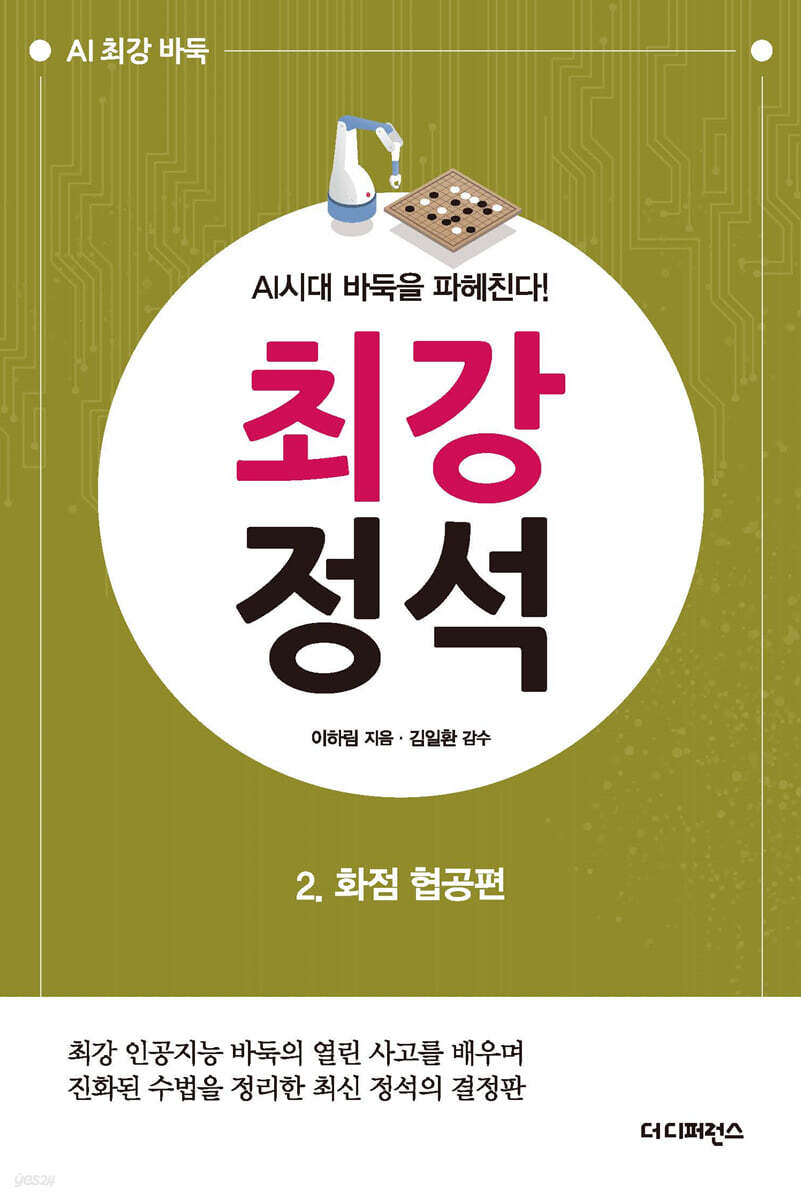
Uncovering the Art of Go in the AI Era! The Ultimate Classic 2: Fire Point Collaboration
 |
Description
Book Introduction
The world of Go is now dominated by artificial intelligence (AI). Initially, AI was considered a worthwhile endeavor, but as AI continues to evolve, it's now considered a master rather than a rival. The world of Go revealed by AI is truly fascinating.
He is a genius in shape-shifting, able to transform depending on the situation, and his powers are surprisingly powerful even when his numbers are beyond common sense.
Humans only trust visible forces, but AI uses invisible forces to analyze in detail and make comprehensive judgments.
In particular, the early stages of Baduk were a time and space dominated by emotions and sensations, a taboo area where simple artificial intelligence calculations could not surpass human intelligence. However, increasingly powerful artificial intelligence has shattered these stereotypes and overwhelmed human emotions.
Even in the early days of the unknown world, the elusive AI made calculations without hesitation, and as a result, a revolution occurred in the rules and strategies.
While artificial intelligence has been exploring the human world of Go with cold reason, it is now time to analyze the profound world of AI Go with warm human emotions.
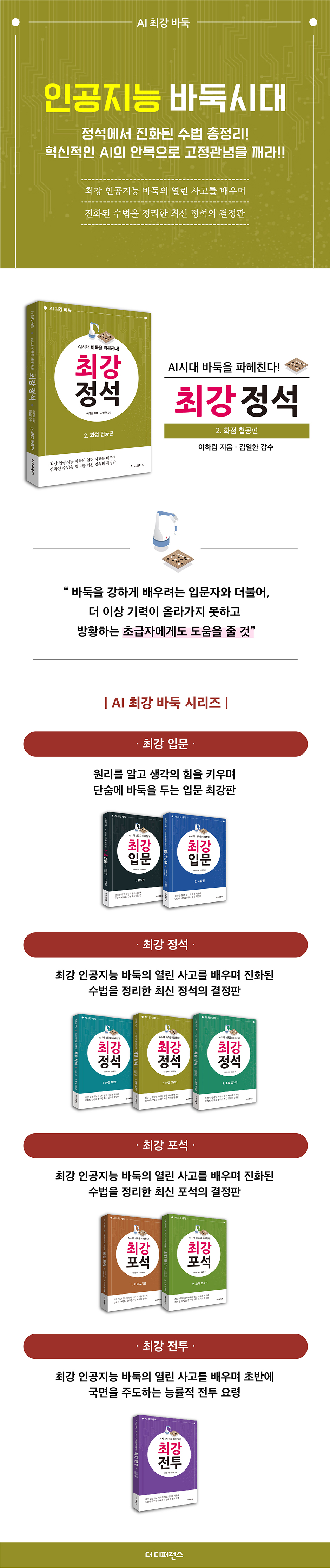
The purpose of this book is to show the changed Go techniques through the new perspective of AI.
In the field of Jeongseok, it is planned to be completed as a three-volume series.
In Volume 1, we covered the most basic principles that are most frequently encountered in the field of fire.
In this second volume, we will focus on the joint attack among the basic principles of firefighting.
In the next three volumes, we will cover the basic principles of small wood.
He is a genius in shape-shifting, able to transform depending on the situation, and his powers are surprisingly powerful even when his numbers are beyond common sense.
Humans only trust visible forces, but AI uses invisible forces to analyze in detail and make comprehensive judgments.
In particular, the early stages of Baduk were a time and space dominated by emotions and sensations, a taboo area where simple artificial intelligence calculations could not surpass human intelligence. However, increasingly powerful artificial intelligence has shattered these stereotypes and overwhelmed human emotions.
Even in the early days of the unknown world, the elusive AI made calculations without hesitation, and as a result, a revolution occurred in the rules and strategies.
While artificial intelligence has been exploring the human world of Go with cold reason, it is now time to analyze the profound world of AI Go with warm human emotions.
The purpose of this book is to show the changed Go techniques through the new perspective of AI.
In the field of Jeongseok, it is planned to be completed as a three-volume series.
In Volume 1, we covered the most basic principles that are most frequently encountered in the field of fire.
In this second volume, we will focus on the joint attack among the basic principles of firefighting.
In the next three volumes, we will cover the basic principles of small wood.
- You can preview some of the book's contents.
Preview
index
PART 1 One-Space Collaboration 1 (Methods after 3-Three Invasion and Jump)
3-3 invasion in a single-space attack of type 1
If there is a landing point on the 2nd type, 3-3 invasion
Type 3 Jumping and Covering - Basic Variations
Type 4: Jumping and Covering - Intention and Response of Use
Type 5: Jump and Wear - In case of receiving a daily dose
Type 6: Jumping and Wearing - When I Hang Up
Jump to the 7th type one-space pincer attack and counter-pincer attack
Practical application of the basic principles
PART 2 One-Space Collaboration 2 (Attached, Double-Stretched, High Collaboration)
8-type one-space pincer attack
Attach to the 9-type one-space pincer attack
10-type single-space attack - increase in attachment
Type 11 Low Heel - Stick to my strong side
12-type low double-cross - stick to the opponent's strong side
High double-crossing in a 13-type single-space attack
Key changes to the 14-type one-space high pincer attack
Practical application of the basic principles
PART 3 Two-space attack
Key changes to the 15-type two-chambered attack
Basic changes to the 16-type two-space high pincer attack
17-type double-height pincers with low double-hook
18-type two-chamber high pincer attack with high double-crossing
Practical application of the basic principles
PART 4: The Three-Khan Collaboration
19-type three-section high pincer attack - basic variation
20-type three-compartment high pincer - attached to low double-legged
21-type three-compartment high-top visor - low-hanging hood
22-type three-compartment high pincer attack - high double-crossing
Type 23 Three-Chan Pincer Attack - Key Changes to High-Ranking
Practical application of the basic principles
PART 5: Collaboration and Response After Hand-Off
24-type receiving - one-space pincer attack basics
Received 25th type - attached to the date
Hand off to the 26th type - Two-room cooperation
Receive type 27 and take your hand off - stick with garlic cloves and attack together
Practical application of the basic principles
Appendix - A Brief Guide to the AI Era
3-3 invasion in a single-space attack of type 1
If there is a landing point on the 2nd type, 3-3 invasion
Type 3 Jumping and Covering - Basic Variations
Type 4: Jumping and Covering - Intention and Response of Use
Type 5: Jump and Wear - In case of receiving a daily dose
Type 6: Jumping and Wearing - When I Hang Up
Jump to the 7th type one-space pincer attack and counter-pincer attack
Practical application of the basic principles
PART 2 One-Space Collaboration 2 (Attached, Double-Stretched, High Collaboration)
8-type one-space pincer attack
Attach to the 9-type one-space pincer attack
10-type single-space attack - increase in attachment
Type 11 Low Heel - Stick to my strong side
12-type low double-cross - stick to the opponent's strong side
High double-crossing in a 13-type single-space attack
Key changes to the 14-type one-space high pincer attack
Practical application of the basic principles
PART 3 Two-space attack
Key changes to the 15-type two-chambered attack
Basic changes to the 16-type two-space high pincer attack
17-type double-height pincers with low double-hook
18-type two-chamber high pincer attack with high double-crossing
Practical application of the basic principles
PART 4: The Three-Khan Collaboration
19-type three-section high pincer attack - basic variation
20-type three-compartment high pincer - attached to low double-legged
21-type three-compartment high-top visor - low-hanging hood
22-type three-compartment high pincer attack - high double-crossing
Type 23 Three-Chan Pincer Attack - Key Changes to High-Ranking
Practical application of the basic principles
PART 5: Collaboration and Response After Hand-Off
24-type receiving - one-space pincer attack basics
Received 25th type - attached to the date
Hand off to the 26th type - Two-room cooperation
Receive type 27 and take your hand off - stick with garlic cloves and attack together
Practical application of the basic principles
Appendix - A Brief Guide to the AI Era
Detailed image
Publisher's Review
The world of Go is now dominated by artificial intelligence (AI). Initially, AI was considered a worthwhile endeavor, but as AI continues to evolve, it's now considered a master rather than a rival. The world of Go revealed by AI is truly fascinating.
He is a genius in shape-shifting, able to transform depending on the situation, and his powers are surprisingly powerful even when his numbers are beyond common sense.
Humans only trust visible forces, but AI uses invisible forces to analyze in detail and make comprehensive judgments.
In particular, the early stages of Baduk were a time and space dominated by emotions and sensations, a taboo area where simple artificial intelligence calculations could not surpass human intelligence. However, increasingly powerful artificial intelligence has shattered these stereotypes and overwhelmed human emotions.
Even in the early days of the unknown world, the elusive AI made calculations without hesitation, and as a result, a revolution occurred in the rules and strategies.
While artificial intelligence has been exploring the human world of Go with cold reason, it is now time to analyze the profound world of AI Go with warm human emotions.
The purpose of this book is to show the changed Go techniques through the new perspective of AI.
In the field of Jeongseok, it is planned to be completed as a three-volume series.
In Volume 1, we covered the most basic principles that are most frequently encountered in the field of fire.
In this second volume, we will focus on the joint attack among the basic principles of firefighting.
In the next three volumes, we will cover the basic principles of small wood.
This book is subtitled 'Fire Spot Collaboration' and is divided into five parts based on the location and time of the collaboration.
The location of the pincer attack is one, two, or three spaces depending on the interval, and there is also a time for pincer attack when the hand is removed after receiving the ear.
One-space collaborators frequently appear in combat as an offensive tool, but as they change significantly due to the influence of AI, we will cover them in Parts 1 and 2.
'Part 1' covers the 3-step invasion and the jump-out variation, while 'Part 2' includes the attachment, double-crossing, and one-step higher pincer attack.
Active methods such as two-space and three-space joint attacks also frequently appear in real-life situations, and many of these techniques have been developed and evolved under the influence of AI.
'Part 3' covers two-space attacks, and 'Part 4' covers three-space attacks.
It is not uncommon for the opponent to withdraw their hand after receiving a hit, but this is due to the influence of AI that is good at withdrawing their hand.
Part 5 covers the collaborative attack following this handshake.
The text is divided into 27 types, organized by type.
For supplementary learning, we have included 'One-Point Lessons' at the end of each type as needed, and for three-dimensional learning, we have included 'Practical Application of the Classics' at the end of each part.
Lastly, in the 'Appendix', we have listed the classics that symbolize the AI era in connection with the main text, allowing you to visually view the latest trends in classics.
Overall, we've strived to create a systematic, practical, and engaging guide to the AI era, tailored to the reader's level, from low to high.
What we can learn from AI is a comprehensive perspective on the big picture and creative thinking based on open thinking.
This book presents various principles and variations learned from AI, but in reality, AI doesn't even know what principles are. It simply calculates and applies them to the board.
Since the Jeongseok, which is part of the overall situation, is also a human language, how you utilize it will depend on your perspective as you look at the whole country.
He is a genius in shape-shifting, able to transform depending on the situation, and his powers are surprisingly powerful even when his numbers are beyond common sense.
Humans only trust visible forces, but AI uses invisible forces to analyze in detail and make comprehensive judgments.
In particular, the early stages of Baduk were a time and space dominated by emotions and sensations, a taboo area where simple artificial intelligence calculations could not surpass human intelligence. However, increasingly powerful artificial intelligence has shattered these stereotypes and overwhelmed human emotions.
Even in the early days of the unknown world, the elusive AI made calculations without hesitation, and as a result, a revolution occurred in the rules and strategies.
While artificial intelligence has been exploring the human world of Go with cold reason, it is now time to analyze the profound world of AI Go with warm human emotions.
The purpose of this book is to show the changed Go techniques through the new perspective of AI.
In the field of Jeongseok, it is planned to be completed as a three-volume series.
In Volume 1, we covered the most basic principles that are most frequently encountered in the field of fire.
In this second volume, we will focus on the joint attack among the basic principles of firefighting.
In the next three volumes, we will cover the basic principles of small wood.
This book is subtitled 'Fire Spot Collaboration' and is divided into five parts based on the location and time of the collaboration.
The location of the pincer attack is one, two, or three spaces depending on the interval, and there is also a time for pincer attack when the hand is removed after receiving the ear.
One-space collaborators frequently appear in combat as an offensive tool, but as they change significantly due to the influence of AI, we will cover them in Parts 1 and 2.
'Part 1' covers the 3-step invasion and the jump-out variation, while 'Part 2' includes the attachment, double-crossing, and one-step higher pincer attack.
Active methods such as two-space and three-space joint attacks also frequently appear in real-life situations, and many of these techniques have been developed and evolved under the influence of AI.
'Part 3' covers two-space attacks, and 'Part 4' covers three-space attacks.
It is not uncommon for the opponent to withdraw their hand after receiving a hit, but this is due to the influence of AI that is good at withdrawing their hand.
Part 5 covers the collaborative attack following this handshake.
The text is divided into 27 types, organized by type.
For supplementary learning, we have included 'One-Point Lessons' at the end of each type as needed, and for three-dimensional learning, we have included 'Practical Application of the Classics' at the end of each part.
Lastly, in the 'Appendix', we have listed the classics that symbolize the AI era in connection with the main text, allowing you to visually view the latest trends in classics.
Overall, we've strived to create a systematic, practical, and engaging guide to the AI era, tailored to the reader's level, from low to high.
What we can learn from AI is a comprehensive perspective on the big picture and creative thinking based on open thinking.
This book presents various principles and variations learned from AI, but in reality, AI doesn't even know what principles are. It simply calculates and applies them to the board.
Since the Jeongseok, which is part of the overall situation, is also a human language, how you utilize it will depend on your perspective as you look at the whole country.
GOODS SPECIFICS
- Date of issue: January 20, 2024
- Page count, weight, size: 276 pages | 153*225*20mm
- ISBN13: 9791161254395
- ISBN10: 1161254390
You may also like
카테고리
korean


korean

![GQ KOREA Mark (Monthly): December [2025]](http://librairie.coreenne.fr/cdn/shop/files/8ef265dbbfbf186523ed75ba7319009d.jpg?v=1765340328&width=3840)


