

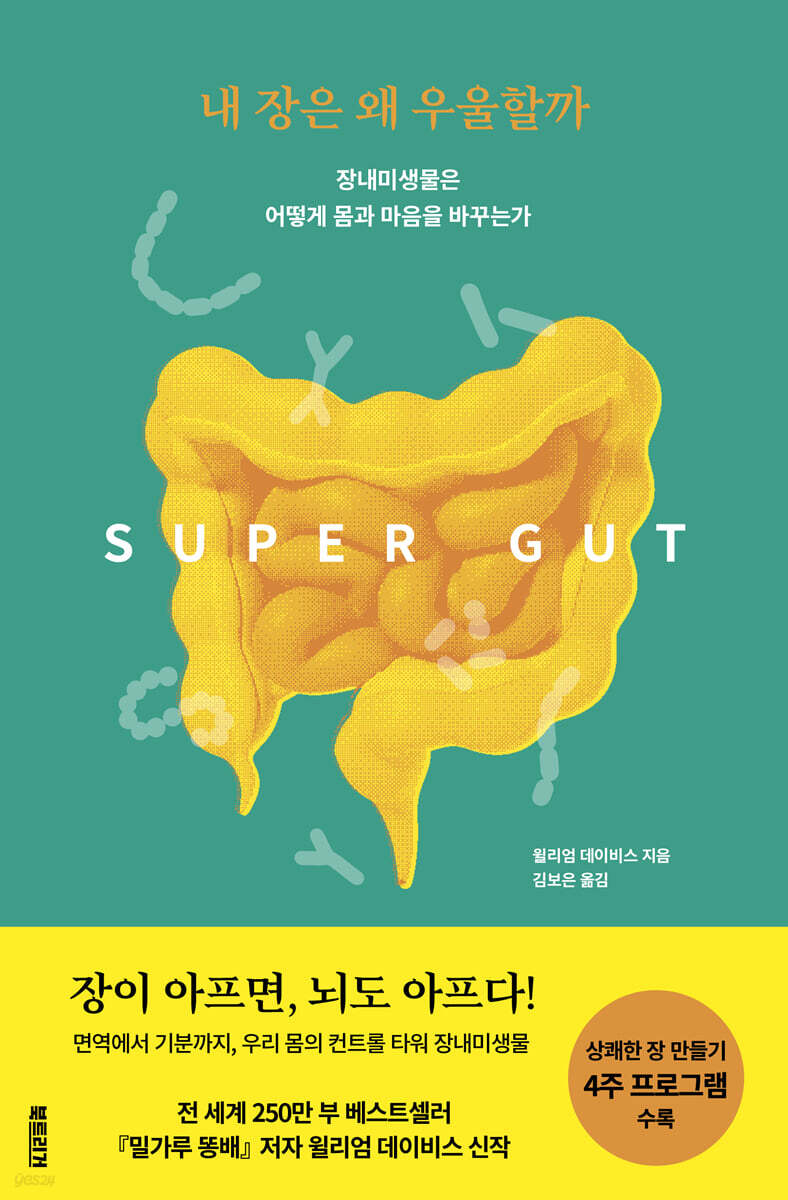
Why is my stomach depressed?
 |
Description
Book Introduction
Ruining your day and gaining unnecessary weight
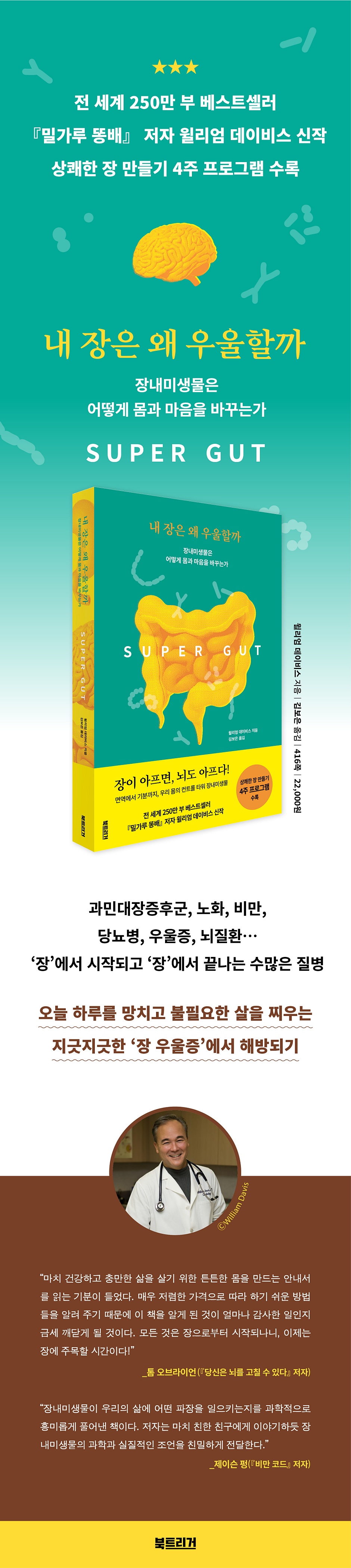
Free yourself from the nagging feeling of 'intestinal depression' Irritable bowel syndrome, aging, obesity, diabetes, depression, brain disease… Numerous diseases that begin and end in the intestines William Davis, author of the best-selling book "The Wheat Belly," which has sold over 2.5 million copies worldwide, returns with "Why Is My Gut Gloomy?" The new work preaches the importance of gut health at a more fundamental level, focusing on the gut, also known as the "second brain" or "little brain," and the microorganisms that live within it. Learn how modern lifestyles have disrupted the microbiome in our gastrointestinal tract, leading to a range of diseases, including irritable bowel syndrome, aging, obesity, diabetes, depression, and brain disease. Small Intestinal Bacterial Overgrowth (SIBO) and Small Intestinal Fungal Overgrowth (SIFO), which cause constipation, diarrhea, gas, and fatigue, are also covered in detail. Additionally, this book provides a four-week program to effectively address gut microbiota imbalance. A one-week guide to reprogram your microbiome, restore your health, and lose weight. In addition to providing a method to make delicious and affordable yogurt by selecting the species and strains of bacteria that you lack, rather than buying expensive probiotics every time, it also provides a healthy diet and shopping list. Anyone who hopes to transition to a healthy life where aging stops at 40, wrinkles don't deepen, social interaction remains unaffected, and cycling vigorously into their 80s or 90s can read this book and get one step closer to that dream. |
- You can preview some of the book's contents.
Preview
index
Introduction: There's a universe of microbes inside us.
Part 1: The Depressing Chapter
Climate change within our bodies
The Microbiome Only a Mother Can Give You
Where did all those microorganisms go?
The possessions of the occupied modern people
Mucus will save us
Part 2 Frankenstein Chapter
How is Frankenstein's intestines made?
The fungal jungle inside our bodies
Operation to recapture the stolen colony
Part 3 Refreshing Chapter
Take a walk in the wild
A strong supporter for a refreshing stomach
Part 4: 4-Week Program for Creating Refreshing Chapters
WEEK 1: Tamp down the garden soil
WEEK 2 Sowing Seeds in the Garden
WEEK 3 Watering and Fertilizing
WEEK 4: Growing a Microbial Garden
Refreshing Jang Recipes
Refreshing 3-Day Diet and Grocery List
What comes out: Mind the little things
Acknowledgements
References
Search
Part 1: The Depressing Chapter
Climate change within our bodies
The Microbiome Only a Mother Can Give You
Where did all those microorganisms go?
The possessions of the occupied modern people
Mucus will save us
Part 2 Frankenstein Chapter
How is Frankenstein's intestines made?
The fungal jungle inside our bodies
Operation to recapture the stolen colony
Part 3 Refreshing Chapter
Take a walk in the wild
A strong supporter for a refreshing stomach
Part 4: 4-Week Program for Creating Refreshing Chapters
WEEK 1: Tamp down the garden soil
WEEK 2 Sowing Seeds in the Garden
WEEK 3 Watering and Fertilizing
WEEK 4: Growing a Microbial Garden
Refreshing Jang Recipes
Refreshing 3-Day Diet and Grocery List
What comes out: Mind the little things
Acknowledgements
References
Search
Detailed image
Into the book
The microbes that live in your gut don't have names, don't have places to live, and don't even "like" you on Facebook.
But it plays a significant role in many aspects, including your optimism, skin condition, energy levels, empathy for others, and even your love life.
It even affects how quickly you age and how long you live.
---From "Page 16, Introduction"
A phenomenon that microbiologists call "microbiome death" is occurring, with old microbial species disappearing and new ones taking their place… and a shocking number of people are inhabiting their entire gastrointestinal tracts, from entrance to exit, effectively 9 meters long, causing infections and intensifying inflammatory responses.
You may have suffered from persistent, irritating eczema rashes or depression for this reason.
At this time, no matter what antidepressant the doctor prescribes, it will not be effective.
---From "Pages 24-25, Part 1, The Depressing Chapter"
Few Americans have heard of small bowel bacterial overgrowth or small bowel fungal overgrowth, but tens of millions of Americans are affected by this condition.
Of the 35 million Americans diagnosed with IBS, 35-84% have small bowel bacterial overgrowth, and a similar number of Americans who might be feeling relieved because they don't have IBS are secretly suffering from small bowel bacterial overgrowth and the resulting urgency and bloating.
---From "Pages 31-32, Part 1, The Depressing Chapter"
But the situation is getting worse.
Some harmful microbes refuse to stay where they belong and travel up the colon, about 1.5 meters, through the ileum, jejunum, and duodenum, which are about 7.3 meters long, until they reach the stomach.
The resulting small intestinal bacterial overgrowth is caused by factors surrounding us, such as herbicides and pesticides in our food and acid suppressants prescribed by our doctors.
It can be caused by sugary sodas, sugar-free drinks, or even seemingly harmless, familiar foods like ice cream or ranch dressing.
---From "Pages 97-98, Part 2, Chapter Frankenstein"
Small intestinal bacterial overgrowth is all too common.
Whether in a classroom, an office, or in society, you're likely to encounter at least a few people with small intestine bacterial overgrowth.
Of course, you can be included here too.
While the epidemic of overweight and obesity is reported in countless articles, the epidemic of small bowel bacterial overgrowth, which affects many people on a similar scale, is rarely reported.
If you look closely, you may be able to find signs of small intestine bacterial overgrowth in people around you.
---From "Pages 107-108, Part 2, Chapter Frankenstein"
When you begin a program to eradicate the Frankenstein gut and eliminate harmful bacteria and fungi, you will experience a flood of LPS endotoxins that bring on feelings of anxiety, anger, depression, etc.
All of this will affect your internal dialogue (someone with depression will have a different internal monologue than someone without), and the microbes in your gut will influence the content and tone of this dialogue.
People who suffer from depression are more likely to repeatedly think about their weaknesses, failures, inferiority, and the urge to give up.
---From "Page 238, Part 3, Refreshing Chapter"
Modern humans are doing something fundamentally wrong with our gut microbiome, and in the process, we've created a horrific and grotesque monster that threatens our health.
Whether or not we suffer from small intestinal bacterial overgrowth, modern humans have severely compromised the diversity of bacterial species that inhabit the human gastrointestinal tract, eliminating beneficial species and allowing harmful opportunists to proliferate.
Fortunately, most humans haven't reached the point of no return yet, but they're getting pretty close.
---From "Pages 191-192, Part 3, Refreshing Chapter"
If you're like me and many others who have implemented this strategy, you'll find yourself lamenting, "If only I had known this sooner!"
I have suffered from chronic insomnia ever since I became an adult.
I struggled to fall asleep, woke up several times during the night, and woke up at 4 a.m. with my eyes wide open and unable to fall back to sleep.
This sleeping habit left me feeling irritable, foggy, and tired the next day, and this cycle repeated itself night after night.
---From "Page 245, Part 4, 4-Week Program for Creating Refreshing Chapters"
There's no need to be intimidated by fermentation projects.
There is no need to feel pressured to do everything.
It's like going to a restaurant and not ordering all the appetizers, main courses, and desserts on the menu.
You just need to order the dishes you want.
Likewise, think of the yogurt recipes we'll introduce below as a menu, and choose the bacterial species and strains that have the desired effects.
---From "Page 311, Part 4, 4-Week Program for Creating Refreshing Chapters"
What if aging stopped at forty, and you could still do fifty push-ups, experience birthdays without deepening wrinkles, stress fractures, or losing interest in social interactions? What if you could still attend social gatherings and laugh after a 20-mile bike ride or a samba dance at ninety-eight? What if you could still plan your next vacation while still being captivating to your spouse? Implementing a refreshing gut strategy will bring you a few steps closer to this reality.
But it plays a significant role in many aspects, including your optimism, skin condition, energy levels, empathy for others, and even your love life.
It even affects how quickly you age and how long you live.
---From "Page 16, Introduction"
A phenomenon that microbiologists call "microbiome death" is occurring, with old microbial species disappearing and new ones taking their place… and a shocking number of people are inhabiting their entire gastrointestinal tracts, from entrance to exit, effectively 9 meters long, causing infections and intensifying inflammatory responses.
You may have suffered from persistent, irritating eczema rashes or depression for this reason.
At this time, no matter what antidepressant the doctor prescribes, it will not be effective.
---From "Pages 24-25, Part 1, The Depressing Chapter"
Few Americans have heard of small bowel bacterial overgrowth or small bowel fungal overgrowth, but tens of millions of Americans are affected by this condition.
Of the 35 million Americans diagnosed with IBS, 35-84% have small bowel bacterial overgrowth, and a similar number of Americans who might be feeling relieved because they don't have IBS are secretly suffering from small bowel bacterial overgrowth and the resulting urgency and bloating.
---From "Pages 31-32, Part 1, The Depressing Chapter"
But the situation is getting worse.
Some harmful microbes refuse to stay where they belong and travel up the colon, about 1.5 meters, through the ileum, jejunum, and duodenum, which are about 7.3 meters long, until they reach the stomach.
The resulting small intestinal bacterial overgrowth is caused by factors surrounding us, such as herbicides and pesticides in our food and acid suppressants prescribed by our doctors.
It can be caused by sugary sodas, sugar-free drinks, or even seemingly harmless, familiar foods like ice cream or ranch dressing.
---From "Pages 97-98, Part 2, Chapter Frankenstein"
Small intestinal bacterial overgrowth is all too common.
Whether in a classroom, an office, or in society, you're likely to encounter at least a few people with small intestine bacterial overgrowth.
Of course, you can be included here too.
While the epidemic of overweight and obesity is reported in countless articles, the epidemic of small bowel bacterial overgrowth, which affects many people on a similar scale, is rarely reported.
If you look closely, you may be able to find signs of small intestine bacterial overgrowth in people around you.
---From "Pages 107-108, Part 2, Chapter Frankenstein"
When you begin a program to eradicate the Frankenstein gut and eliminate harmful bacteria and fungi, you will experience a flood of LPS endotoxins that bring on feelings of anxiety, anger, depression, etc.
All of this will affect your internal dialogue (someone with depression will have a different internal monologue than someone without), and the microbes in your gut will influence the content and tone of this dialogue.
People who suffer from depression are more likely to repeatedly think about their weaknesses, failures, inferiority, and the urge to give up.
---From "Page 238, Part 3, Refreshing Chapter"
Modern humans are doing something fundamentally wrong with our gut microbiome, and in the process, we've created a horrific and grotesque monster that threatens our health.
Whether or not we suffer from small intestinal bacterial overgrowth, modern humans have severely compromised the diversity of bacterial species that inhabit the human gastrointestinal tract, eliminating beneficial species and allowing harmful opportunists to proliferate.
Fortunately, most humans haven't reached the point of no return yet, but they're getting pretty close.
---From "Pages 191-192, Part 3, Refreshing Chapter"
If you're like me and many others who have implemented this strategy, you'll find yourself lamenting, "If only I had known this sooner!"
I have suffered from chronic insomnia ever since I became an adult.
I struggled to fall asleep, woke up several times during the night, and woke up at 4 a.m. with my eyes wide open and unable to fall back to sleep.
This sleeping habit left me feeling irritable, foggy, and tired the next day, and this cycle repeated itself night after night.
---From "Page 245, Part 4, 4-Week Program for Creating Refreshing Chapters"
There's no need to be intimidated by fermentation projects.
There is no need to feel pressured to do everything.
It's like going to a restaurant and not ordering all the appetizers, main courses, and desserts on the menu.
You just need to order the dishes you want.
Likewise, think of the yogurt recipes we'll introduce below as a menu, and choose the bacterial species and strains that have the desired effects.
---From "Page 311, Part 4, 4-Week Program for Creating Refreshing Chapters"
What if aging stopped at forty, and you could still do fifty push-ups, experience birthdays without deepening wrinkles, stress fractures, or losing interest in social interactions? What if you could still attend social gatherings and laugh after a 20-mile bike ride or a samba dance at ninety-eight? What if you could still plan your next vacation while still being captivating to your spouse? Implementing a refreshing gut strategy will bring you a few steps closer to this reality.
---From "Pages 376-377, Remarks"
Publisher's Review
When your gut hurts, your brain hurts too!
From immunity to mood, our body's control tower: the gut microbiome.
A worldwide bestseller with 2.5 million copies sold
A new book by William Davis, author of "The Wheat Belly"
Everything begins with the chapter,
Now it's time to pay attention to the chapter!
In his previous work, "Wheat Belly," which was published in over 30 countries and sold over 2.5 million copies, the author argued that the wheat and grains we consume today are no longer the wheat and grains our ancestors ate, and he clearly and persuasively exposed the harmful effects of modern wheat on our health.
Going one step further, his new book, "Why Is My Gut Depressed," focuses on the root cause of those who still suffer from unresolved pain, such as sleep disorders and allergies.
The intestines, which we simply know as the digestive organ, are actually the 'second brain' or 'little brain', and the microorganisms that live within them.
Rather than simply addressing a few health issues on the surface, the author suggests ways to elevate daily functioning to a new level and achieve complete health.
This book has been very popular since its publication in 2023, maintaining the number one spot in its category on Amazon in the US and recording over 1,000 reviews.
The gut is home to 70 percent of not only microbes but also immune cells, which interact with each other and affect mental health.
In fact, there is a growing trend of reports linking gut microbiota with immune diseases (atopy and rheumatoid arthritis), metabolic diseases (obesity and diabetes), and brain diseases (depression and dementia).
As a result of analyzing the intestinal microbiota composition of 20 normal people and 20 dementia patients, it was found that the imbalance between beneficial and harmful bacteria was severe in dementia patients.
Fecal transplants performed on mice with dementia resulted in recovery of memory and cognitive dysfunction.
There are also results showing that fecal transplants performed on people with autism spectrum disorder significantly improved their autistic behavioral symptoms (Scientific Reports 2019).
Gut microbes also affect depression.
Ninety-five percent of serotonin is produced by gut microbes, which directly increase neurotransmitters to reduce inflammation and stabilize steroid hormones, improving mood.
The research results showing that the intestines and brain are connected and directly and indirectly influence each other indicate that humans not only coexist with microorganisms, but are also the sum total of microorganisms.
Choose the probiotics you need
Make it yourself easily
Hippocrates (BC460-BC377) said, “All disease begins in the gut,” and this statement has proven to be true in modern times.
It is well known that the human body is made up of many cells, but few people know that there are even more 'things' living inside our bodies.
It is the microbiome, which is a collection of intestinal microorganisms.
A variety of microorganisms live in every corner of our bodies, forming an ecosystem, and about 90 percent of them, or 38 trillion microorganisms, reside in the intestines.
According to the authors, gut microbes play a crucial role in a variety of aspects, including optimism, skin condition, energy levels, empathy for others, romantic relationships, and even how quickly we age and live longer.
The Ministry of Food and Drug Safety analyzed the intestinal microbiota distribution of 25 rural healthy longevity village residents and 44 urban residents aged 40 or older, and found that the proportion of healthy intestinal microbiota in the longevity village residents was 3 to 5 times higher than that of urban residents.
The microbes that live in our gut have evolved to coexist with their human hosts over thousands of generations, a relationship so intimate and close that some bacterial species live only in the human gastrointestinal tract, nowhere else on Earth.
For example, the very few indigenous people who have maintained a lifestyle similar to that of humans millions of years ago have not been exposed to antibiotics or other modern microbiome disruptors.
Native people who have the microbes we've lost have virtually no health problems like stomach ulcers, acid reflux, hemorrhoids, constipation, irritable bowel syndrome, or colon cancer.
Anthropologists call these diseases that frequently plague modern people "diseases of civilization."
Accordingly, the number of people taking nutritional supplements and health foods is rapidly increasing, and among them, probiotic products are considered a top priority.
That's because so many people suffer from intestinal problems, and their intestinal health affects the quality of their daily lives.
Although probiotic products are touted as a panacea for gut health, their effectiveness may or may not vary depending on the individual's gut microbiome.
Most people buy expensive products that contain probiotics without even knowing whether or not they are right for them, and only experience the placebo effect.
It is very important to understand the state of your gut microbiome and determine which bacteria you need.
Rather than buying expensive probiotics every time, this book clearly shows how to make delicious and inexpensive yogurt by selecting the species and strains of microorganisms that you lack, and what changes will occur when you take probiotics that are right for you.
A 4-week program to create a refreshing intestine
Plant healthy gut microbes
Stop physical and mental aging!
Part 1, “The Depressing Chapter,” examines the extreme “climate change” that is occurring within our own chapter.
By looking into the intestinal landscape, where all the healthy microorganisms have disappeared and only harmful bacteria have taken hold, we can deduce why modern people's intestines cannot help but be depressed.
Part 2, "The Frankenstein Chapter," focuses on the obstacles that stand in the way of replacing the harmful microbes we've cultivated with healthy ones, before introducing methods to restore youthful skin and muscles and cultivate microbes that reduce anxiety and depression.
Restoring a devastated gut is a top priority to sow the seeds of healthy microbes and allow them to thrive.
If intestinal microbiota is not properly managed, the problem is not limited to the intestines, but harmful bacteria can invade other organs, causing more serious problems.
This is called small intestinal bacterial overgrowth (SIBO) and small intestinal fungal overgrowth (SIFO). This chapter explains why SIBO and SIFO occur and how to diagnose them.
In Part 3, "Refreshing Chapter," you'll learn the background knowledge behind practical methods for rebuilding a healthy microbiome.
Just as you would meticulously cultivate plants in a garden, we will develop a roadmap to care for polluted intestines and cultivate healthy microorganisms.
Additionally, we will look at what to consider when purchasing probiotic products and explore strong support groups such as olive oil and omega-3 fatty acids that can help heal intestinal cells and mucosa and support the growth of beneficial bacteria.
Part 4, “4-Week Program for Creating a Refreshing Intestine,” covers how to prepare the soil for the garden inside your body called the intestines (Week 1), sow seeds (Week 2), water and fertilize (Week 3), and cultivate it into a microbial garden (Week 4).
The first three weeks lay the foundation for recovery from numerous ailments, and the fourth week presents methods to turn back your body's biological clock by at least 10 years, including healthy skin, faster healing, and youthful muscle and strength.
Meanwhile, just as important as probiotics are the foods you eat every day, and 'Refreshing Gut Recipes' provides helpful guidance on what and how to eat for gut health.
From immunity to mood, our body's control tower: the gut microbiome.
A worldwide bestseller with 2.5 million copies sold
A new book by William Davis, author of "The Wheat Belly"
Everything begins with the chapter,
Now it's time to pay attention to the chapter!
In his previous work, "Wheat Belly," which was published in over 30 countries and sold over 2.5 million copies, the author argued that the wheat and grains we consume today are no longer the wheat and grains our ancestors ate, and he clearly and persuasively exposed the harmful effects of modern wheat on our health.
Going one step further, his new book, "Why Is My Gut Depressed," focuses on the root cause of those who still suffer from unresolved pain, such as sleep disorders and allergies.
The intestines, which we simply know as the digestive organ, are actually the 'second brain' or 'little brain', and the microorganisms that live within them.
Rather than simply addressing a few health issues on the surface, the author suggests ways to elevate daily functioning to a new level and achieve complete health.
This book has been very popular since its publication in 2023, maintaining the number one spot in its category on Amazon in the US and recording over 1,000 reviews.
The gut is home to 70 percent of not only microbes but also immune cells, which interact with each other and affect mental health.
In fact, there is a growing trend of reports linking gut microbiota with immune diseases (atopy and rheumatoid arthritis), metabolic diseases (obesity and diabetes), and brain diseases (depression and dementia).
As a result of analyzing the intestinal microbiota composition of 20 normal people and 20 dementia patients, it was found that the imbalance between beneficial and harmful bacteria was severe in dementia patients.
Fecal transplants performed on mice with dementia resulted in recovery of memory and cognitive dysfunction.
There are also results showing that fecal transplants performed on people with autism spectrum disorder significantly improved their autistic behavioral symptoms (Scientific Reports 2019).
Gut microbes also affect depression.
Ninety-five percent of serotonin is produced by gut microbes, which directly increase neurotransmitters to reduce inflammation and stabilize steroid hormones, improving mood.
The research results showing that the intestines and brain are connected and directly and indirectly influence each other indicate that humans not only coexist with microorganisms, but are also the sum total of microorganisms.
Choose the probiotics you need
Make it yourself easily
Hippocrates (BC460-BC377) said, “All disease begins in the gut,” and this statement has proven to be true in modern times.
It is well known that the human body is made up of many cells, but few people know that there are even more 'things' living inside our bodies.
It is the microbiome, which is a collection of intestinal microorganisms.
A variety of microorganisms live in every corner of our bodies, forming an ecosystem, and about 90 percent of them, or 38 trillion microorganisms, reside in the intestines.
According to the authors, gut microbes play a crucial role in a variety of aspects, including optimism, skin condition, energy levels, empathy for others, romantic relationships, and even how quickly we age and live longer.
The Ministry of Food and Drug Safety analyzed the intestinal microbiota distribution of 25 rural healthy longevity village residents and 44 urban residents aged 40 or older, and found that the proportion of healthy intestinal microbiota in the longevity village residents was 3 to 5 times higher than that of urban residents.
The microbes that live in our gut have evolved to coexist with their human hosts over thousands of generations, a relationship so intimate and close that some bacterial species live only in the human gastrointestinal tract, nowhere else on Earth.
For example, the very few indigenous people who have maintained a lifestyle similar to that of humans millions of years ago have not been exposed to antibiotics or other modern microbiome disruptors.
Native people who have the microbes we've lost have virtually no health problems like stomach ulcers, acid reflux, hemorrhoids, constipation, irritable bowel syndrome, or colon cancer.
Anthropologists call these diseases that frequently plague modern people "diseases of civilization."
Accordingly, the number of people taking nutritional supplements and health foods is rapidly increasing, and among them, probiotic products are considered a top priority.
That's because so many people suffer from intestinal problems, and their intestinal health affects the quality of their daily lives.
Although probiotic products are touted as a panacea for gut health, their effectiveness may or may not vary depending on the individual's gut microbiome.
Most people buy expensive products that contain probiotics without even knowing whether or not they are right for them, and only experience the placebo effect.
It is very important to understand the state of your gut microbiome and determine which bacteria you need.
Rather than buying expensive probiotics every time, this book clearly shows how to make delicious and inexpensive yogurt by selecting the species and strains of microorganisms that you lack, and what changes will occur when you take probiotics that are right for you.
A 4-week program to create a refreshing intestine
Plant healthy gut microbes
Stop physical and mental aging!
Part 1, “The Depressing Chapter,” examines the extreme “climate change” that is occurring within our own chapter.
By looking into the intestinal landscape, where all the healthy microorganisms have disappeared and only harmful bacteria have taken hold, we can deduce why modern people's intestines cannot help but be depressed.
Part 2, "The Frankenstein Chapter," focuses on the obstacles that stand in the way of replacing the harmful microbes we've cultivated with healthy ones, before introducing methods to restore youthful skin and muscles and cultivate microbes that reduce anxiety and depression.
Restoring a devastated gut is a top priority to sow the seeds of healthy microbes and allow them to thrive.
If intestinal microbiota is not properly managed, the problem is not limited to the intestines, but harmful bacteria can invade other organs, causing more serious problems.
This is called small intestinal bacterial overgrowth (SIBO) and small intestinal fungal overgrowth (SIFO). This chapter explains why SIBO and SIFO occur and how to diagnose them.
In Part 3, "Refreshing Chapter," you'll learn the background knowledge behind practical methods for rebuilding a healthy microbiome.
Just as you would meticulously cultivate plants in a garden, we will develop a roadmap to care for polluted intestines and cultivate healthy microorganisms.
Additionally, we will look at what to consider when purchasing probiotic products and explore strong support groups such as olive oil and omega-3 fatty acids that can help heal intestinal cells and mucosa and support the growth of beneficial bacteria.
Part 4, “4-Week Program for Creating a Refreshing Intestine,” covers how to prepare the soil for the garden inside your body called the intestines (Week 1), sow seeds (Week 2), water and fertilize (Week 3), and cultivate it into a microbial garden (Week 4).
The first three weeks lay the foundation for recovery from numerous ailments, and the fourth week presents methods to turn back your body's biological clock by at least 10 years, including healthy skin, faster healing, and youthful muscle and strength.
Meanwhile, just as important as probiotics are the foods you eat every day, and 'Refreshing Gut Recipes' provides helpful guidance on what and how to eat for gut health.
GOODS SPECIFICS
- Date of issue: April 25, 2023
- Page count, weight, size: 416 pages | 528g | 138*210*25mm
- ISBN13: 9791189799915
- ISBN10: 118979991X
You may also like
카테고리
korean


korean

![ELLE 엘르 스페셜 에디션 A형 : 12월 [2025]](http://librairie.coreenne.fr/cdn/shop/files/b8e27a3de6c9538896439686c6b0e8fb.jpg?v=1766436872&width=3840)


