

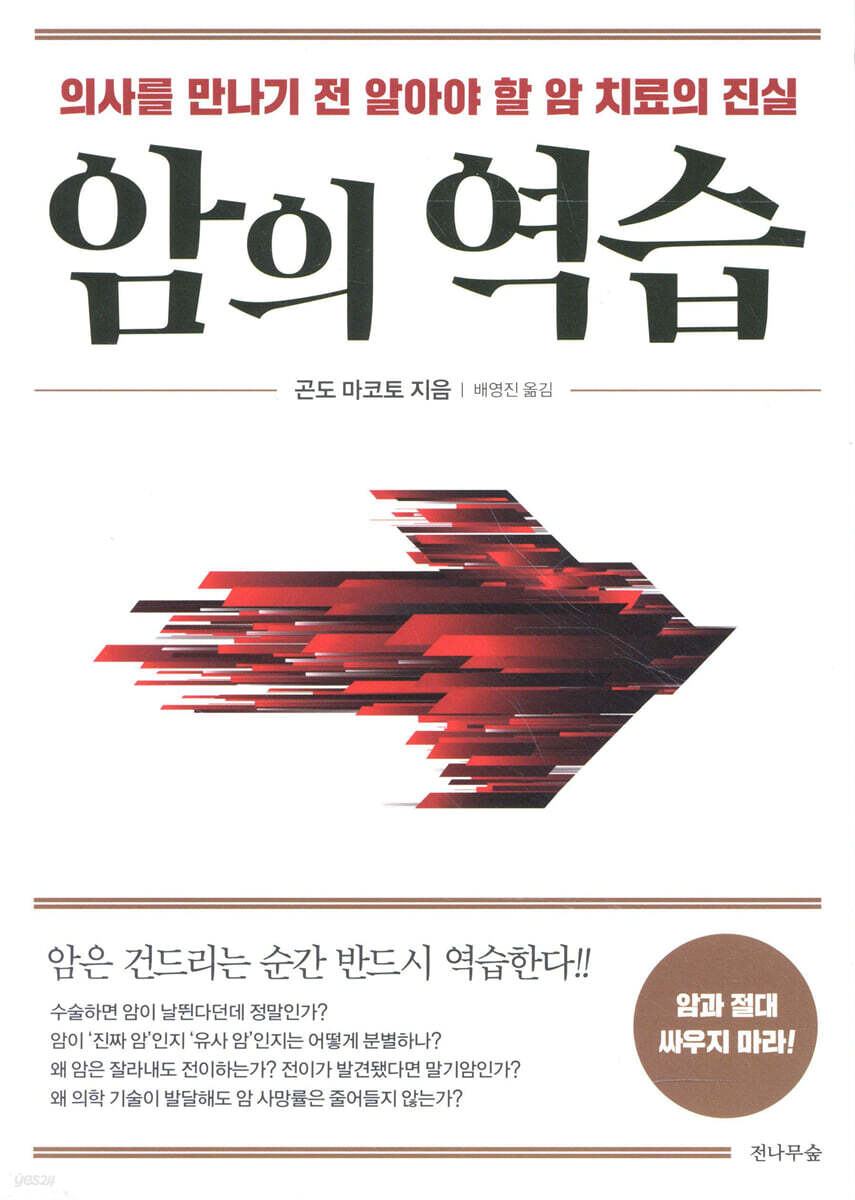
Cancer's Revenge
 |
Description
Book Introduction
The moment you start cancer treatment, Cancer begins to strike back sharply. The most common promotional slogan we hear about cancer is, "Cancer is cured through early screening, early detection, and early treatment." This means that if cancer is detected early and treated early, it can be eradicated by the roots. Therefore, cancer screenings are conducted under the names of general health screenings, workplace health screenings, and comprehensive health screenings. However, despite these promotional slogans, cancer mortality rates have not decreased, but rather continue to increase, with cancer still ranking first as the leading cause of death. Despite early detection and early treatment, why does cancer mortality rate continue to rise instead of decreasing? Despite cutting-edge medical technologies like robotic surgery, why does cancer persist? Makoto Kondo, an oncologist and Japan's leading second opinion source, says the reason is that "health checkups allow for early detection and early treatment of cancer." In fact, mass lung cancer screening was abolished in the United States and Europe 40 years ago. The reason was that “the effect of reducing lung cancer mortality is unclear and there are many disadvantages, such as the risk of radiation exposure.” As evidence of this, cancer mortality rates in the United States have decreased by 27% over the past 25 years since the 1990s. But what does it mean that 'cancer mortality rates do not decrease because cancer is detected and treated early through health checkups'? Cancer is usually diagnosed through a CT scan. After being diagnosed with cancer, you undergo surgery, chemotherapy, or radiation therapy, but the problem is that as you undergo treatment, your immune system weakens and metastasis accelerates. Excessive exposure to radiation can also cause bone fractures. Furthermore, side effects of treatment include depression, dementia, insomnia, and cognitive decline, and rapid weight loss can lead to a decline in physical strength or infection. Some people suffer from side effects such as pain, numbness, incontinence, and hair loss for the rest of their lives, and some even lose their lives. Makoto Kondo calls these disasters, which occur "in a retaliatory manner" when we try to find or kill cancer, "the cancer's counterattack." |
- You can preview some of the book's contents.
Preview
index
Prologue_ They say cancer strikes back. Is that true? What does it mean when cancer strikes back?
Chapter 1.
Q&A on "Cancer's Revenge" - Cancer Testing, Treatment, Aftereffects, Side Effects, etc.
Q1_ In the cancer diagnosis process, the terms ‘appearance’ and ‘malignancy’ are used. What do they mean?
Q2: Are true cancers malignant, and cancer-like tumors benign? Do polyps ever turn into cancer?
Q3_ Cancer screenings and comprehensive health checkups are becoming popular. Should I get them or is it better not to?
Q4_ How can I tell if my cancer is real or a pseudo-cancer? If there is metastasis to the lymph nodes, does that mean it's real cancer?
Q5_ Why does cancer metastasize even after removal? If metastasis is found, does it mean the cancer is terminal?
Q6_ Should I believe my doctor's words that "standard treatment is the best treatment"?
Q7_ I heard that surgery will cause the cancer to run wild. Is that true? Are there any other treatments?
Q8_ When the doctor was explaining about cancer surgery, he said, "Total removal followed by lymph node dissection." What does that mean?
Q9_ If cancer is not treated, will it grow bigger and worsen and I will die soon?
Q10_ Are there any famous people who have been attacked by cancer?
Q11_ It is said that recent anticancer drugs have fewer side effects and are more effective. Is this true?
Q12_ I heard that some people were cured of cancer with Opdivo. Is that true?
Q13_ What should I be careful about when treating with radiation, radio waves, or stents instead of surgery?
Chapter 2.
Don't Fight Cancer! - People I Met in "Makoto Kondo's Second Opinion: Foreign Clinic"
What is 'second opinion', and what are the pros and cons of cancer treatment and cancer neglect?
Q1_ I went to 5 different hospitals because the results of my health checkup showed that I had a cancer measuring 3cm in diameter on my stomach.
All the doctors recommend a 'total stomach removal', but I don't want to have my stomach removed.
-Takahashi (pseudonym), 53 years old, male
Q2_ I was strongly advised to have a total mastectomy because I was diagnosed with intraductal breast cancer due to ‘calcification’ of the mammary gland.
-Tanaka (pseudonym), 40 years old, female
I was diagnosed with stage 2A triple negative breast cancer and was told that there was no treatment other than surgery and chemotherapy.
-Suzuki (pseudonym), 59 years old, female
Q3_ During a comprehensive health checkup, a tumor that appeared to be bile duct cancer was found in the liver.
As an actor, I want to avoid surgery and chemotherapy.
But I wish they could do something about cancer.
-Kawashima, 52 years old, female
Q4_ During a health checkup, a cancer-like shadow measuring about 4 cm in diameter was found in my lung.
The doctor said that he would first remove it through open surgery.
Yamashita (pseudonym), 76 years old, male
Q5_ It has been two years since I had surgery to remove my colon cancer.
A metastasis measuring 1 cm in diameter was found in the liver, and the attending physician said, 'If surgery and chemotherapy are performed immediately, there is a 40% chance of recovery.'
-Tachibana (pseudonym), 58 years old, female
Chapter 3.
Coexistence with Cancer: How to Live with Cancer Without Harming Your Body
Q1_ Why doesn't the cancer mortality rate decrease even with advancements in medical technology?
Q2_ If you are over 70 years old, is it better not to receive cancer treatment?
Q3_ Doesn't medical narcotic (morphine) cause addiction or hasten death?
Q4_ Is cancer very painful until the last moment of life?
Chapter 4.
The claim that “if you do this, cancer will be prevented or eliminated” is all nonsense - rumors that confuse cancer patients.
Q1_ Will cancer disappear if I raise my body temperature by warming myself in a hot bath?
Q2_ Can cancer be prevented by using Helicobacter pylori or genetic testing kits?
Q3_ Is there really a food that can make cancer disappear?
Q4_ Like cigarettes, do alcohol and coffee also cause cancer?
30 Mindsets for Coexisting with Cancer
Chapter 1.
Q&A on "Cancer's Revenge" - Cancer Testing, Treatment, Aftereffects, Side Effects, etc.
Q1_ In the cancer diagnosis process, the terms ‘appearance’ and ‘malignancy’ are used. What do they mean?
Q2: Are true cancers malignant, and cancer-like tumors benign? Do polyps ever turn into cancer?
Q3_ Cancer screenings and comprehensive health checkups are becoming popular. Should I get them or is it better not to?
Q4_ How can I tell if my cancer is real or a pseudo-cancer? If there is metastasis to the lymph nodes, does that mean it's real cancer?
Q5_ Why does cancer metastasize even after removal? If metastasis is found, does it mean the cancer is terminal?
Q6_ Should I believe my doctor's words that "standard treatment is the best treatment"?
Q7_ I heard that surgery will cause the cancer to run wild. Is that true? Are there any other treatments?
Q8_ When the doctor was explaining about cancer surgery, he said, "Total removal followed by lymph node dissection." What does that mean?
Q9_ If cancer is not treated, will it grow bigger and worsen and I will die soon?
Q10_ Are there any famous people who have been attacked by cancer?
Q11_ It is said that recent anticancer drugs have fewer side effects and are more effective. Is this true?
Q12_ I heard that some people were cured of cancer with Opdivo. Is that true?
Q13_ What should I be careful about when treating with radiation, radio waves, or stents instead of surgery?
Chapter 2.
Don't Fight Cancer! - People I Met in "Makoto Kondo's Second Opinion: Foreign Clinic"
What is 'second opinion', and what are the pros and cons of cancer treatment and cancer neglect?
Q1_ I went to 5 different hospitals because the results of my health checkup showed that I had a cancer measuring 3cm in diameter on my stomach.
All the doctors recommend a 'total stomach removal', but I don't want to have my stomach removed.
-Takahashi (pseudonym), 53 years old, male
Q2_ I was strongly advised to have a total mastectomy because I was diagnosed with intraductal breast cancer due to ‘calcification’ of the mammary gland.
-Tanaka (pseudonym), 40 years old, female
I was diagnosed with stage 2A triple negative breast cancer and was told that there was no treatment other than surgery and chemotherapy.
-Suzuki (pseudonym), 59 years old, female
Q3_ During a comprehensive health checkup, a tumor that appeared to be bile duct cancer was found in the liver.
As an actor, I want to avoid surgery and chemotherapy.
But I wish they could do something about cancer.
-Kawashima, 52 years old, female
Q4_ During a health checkup, a cancer-like shadow measuring about 4 cm in diameter was found in my lung.
The doctor said that he would first remove it through open surgery.
Yamashita (pseudonym), 76 years old, male
Q5_ It has been two years since I had surgery to remove my colon cancer.
A metastasis measuring 1 cm in diameter was found in the liver, and the attending physician said, 'If surgery and chemotherapy are performed immediately, there is a 40% chance of recovery.'
-Tachibana (pseudonym), 58 years old, female
Chapter 3.
Coexistence with Cancer: How to Live with Cancer Without Harming Your Body
Q1_ Why doesn't the cancer mortality rate decrease even with advancements in medical technology?
Q2_ If you are over 70 years old, is it better not to receive cancer treatment?
Q3_ Doesn't medical narcotic (morphine) cause addiction or hasten death?
Q4_ Is cancer very painful until the last moment of life?
Chapter 4.
The claim that “if you do this, cancer will be prevented or eliminated” is all nonsense - rumors that confuse cancer patients.
Q1_ Will cancer disappear if I raise my body temperature by warming myself in a hot bath?
Q2_ Can cancer be prevented by using Helicobacter pylori or genetic testing kits?
Q3_ Is there really a food that can make cancer disappear?
Q4_ Like cigarettes, do alcohol and coffee also cause cancer?
30 Mindsets for Coexisting with Cancer
Detailed image

Publisher's Review
The three major standard treatments for cancer (surgery, chemotherapy, and radiation therapy)
Rather, it shortens lifespan
The best way to show the cancer's counterattack is through surgery.
Surgery is an act of curing diseases in the chest, abdomen, etc. by cutting the skin with a scalpel.
Cancer in particular is prone to requiring major surgery, which involves removing a large portion of the affected area or the entire organ, including the associated lymph nodes.
However, the moment cancer is touched, it grows and metastasizes quickly.
When a scalpel is used to cut a blood vessel, cancer cells flow out along with the blood and attach to the wound.
There, cancer cells multiply explosively, causing a recurrence called 'local metastasis'.
The extreme toxicity of anticancer drugs reduces the function of the heart, lungs, bone marrow, and kidneys, and even destroys white blood cells that fight pathogens, making the body susceptible to infections due to a weakened immune system.
Also, if you are exposed to too much radiation, it can damage your skin, organs, and bones.
Standard cancer treatments tend to hasten death rather than prolong life.
Recently, there are doctors who promote chemotherapy by saying, “There is a good chemotherapy drug without side effects.” This means that “by increasing the number or amount of chemotherapy drugs by using drugs that stop side effects, the extent to which cancer lumps temporarily shrink has been increased.”
However, most anticancer drugs are classified as 'poisons' or 'toxic drugs', and the fact remains that if a set amount is continuously injected, half of the poisons will kill even healthy people within a year.
The 'dream drug' is just an illusion.
Among the standard cancer treatments, radiation therapy is relatively less damaging to the human body.
The treatment results are the same as surgery, but it has the advantage of maintaining the quality of life before treatment.
However, if the radiation dose is excessive, the skin may become torn, organs may be punctured, and bones may break easily.
There are countless cases of people dying from cancer after undergoing cancer treatment such as surgery, chemotherapy, or radiation therapy.
Japanese actress Kaoru Yachigusa was diagnosed with pancreatic cancer during a health checkup and underwent surgery to remove her entire pancreas, but the cancer recurred in her liver a year later and she passed away 10 months later.
Actress Naomi Kawashima and former sumo wrestler Fuji Chiyono were both in excellent health, but were diagnosed with bile duct cancer and pancreatic cancer respectively, and died a year later after their cancer recurred several months after surgery.
Actor Kiyoshi Atsumi passed away four days after undergoing surgery for lung cancer that had metastasized to his liver.
A Kabuki actor underwent surgery to remove his entire esophagus for esophageal cancer, but died four months later from pulmonary edema caused by digestive juices refluxing into his lungs.
All of them are as good as dead from cancer treatment.
Neither 'real cancer' nor 'pseudo-cancer'
It is important not to treat
To avoid facing this cancerous backlash, it is important to use your intuition, intellect, and reason.
The most important thing is the intuition that 'these days cancer treatments are strange' and 'doing what the doctor says is dangerous'.
Then, by increasing your knowledge based on scientific evidence (intellect), you will have the material to think about and then decide using your own head (reason).
These three forces are the greatest defense against cancer's counterattack.
Makoto Kondo says in “Cancer Strikes Back” that “in order to have intuition, intelligence, and reason in relation to cancer, you must think of cancer as ‘real cancer’ and ‘pseudo-cancer.’”
How can we distinguish between 'real cancer' and 'pseudo-cancer', as Makoto Kondo says?
Cancer, or malignant tumor, is diagnosed based on the 'appearance' of cells observed through a microscope.
If the shape of the cells is crooked and bad, it is diagnosed as 'cancer'.
But there are 'real cancers' that look just as bad but take lives by metastasizing, and there are 'pseudo-cancers' that are harmless and don't metastasize or kill people.
More than half of cancers are 'pseudo-cancers', which are nothing more than bumps or lumps.
When looking at the appearance of cells under a microscope to confirm a cancer diagnosis in a pathology test, 'true cancer' and 'pseudo-cancer' look identical.
However, Makoto Kondo roughly guesses whether the cancer is 'real cancer' or 'pseudo-cancer' based on the location, size, and progression (stage 1-4) of the cancer found, based on medical data from around the world that he read and understood for a total of 100,000 hours and his experience treating 40,000 patients, including 'neglected cancer patients'.
Cases with a high probability of 'similar cancers': stomach cancer removed by endoscopy, stage 0 esophageal cancer, stage 0 bladder cancer, prostate cancer found by PSA test, breast cancer found only by mammography screening, stage 0 cervical cancer, breast cancer, thyroid cancer, bladder cancer, uterine cancer, cervical cancer found by non-menstrual bleeding or hematuria (breast cancer, thyroid cancer, and uterine cancer have a wide range of similar cancers.
If you survive for 5 to 10 years without metastasis until stage 2, most of them are pseudo-cancers), lung cancer, stomach cancer, colon cancer that survive for more than 5 years after surgery, cases with a high probability of being 'real cancer' such as gastric intramucosal cancer: pancreatic cancer (even if discovered without symptoms), lung cancer discovered with symptoms such as cough or bloody sputum, 20 to 30% of stage 1 lung cancers that remain in the lungs without symptoms, and about 5% of cancers that have invaded under the gastric mucosa (including stage 1 cancer)
The important point is that neither the 'real cancer' nor the 'pseudo-cancer' is treated.
'Pseudo-cancer' is harmless, while 'real cancer' has distant metastases hidden in organs a little far away from the site where the cancer first occurred. If surgery is performed in this state, the cancer will rapidly run wild and metastasize to life-threatening organs such as the lungs, liver, brain, and bones.
Advanced cancer does not require cancer treatment.
Rather, the moment you receive cancer treatment, the cancer begins to counterattack.
Instead, if you receive 'palliative care', you can live 3 to 5 more years in comfort.
Typical palliative care includes 'If the esophagus or colon is likely to be blocked by cancer, a stent (dilator) is inserted', 'If ascites accumulates, it is removed', and 'Pain is controlled with medical narcotics such as morphine'.
It is important to remember that if you try to fight cancer by using standard treatments or other methods, you may shorten your life due to excessive treatment.
Since cancer is a phenomenon of aging, the treatment that neglects cancer is
The wisest way to coexist with cancer
Many people believe that “with cutting-edge medical technology, humanity will soon overcome cancer,” but “real cancer” seems to be beyond the realm of treatment, as the National Cancer Center of Japan predicts that “the number of cancer deaths will not decrease even after 20 years.”
If this is the case, let's change our thinking to "cancer is not a disease, but a phenomenon of aging."
As the factors that cause cancer accumulate in the body with age, cancer tends to increase.
If you dissect the bodies of people over 80 years old, you will find cancer in almost all of them.
Therefore, it is much more comfortable to accept aging rather than fight cancer.
“The more frequently you go to the hospital, the more likely you are to have a shortened lifespan.” This is what Makoto Kondo says he most confidently tells his patients.
If you are healthy, you should not get tested and you should not force yourself to find cancer.
And if you keep the pledges below, you will be able to maintain your quality of life even if you get cancer.
'If cancer is found, leave it alone as long as possible.
If symptoms such as pain appear, actively receive palliative care (treatment to relieve pain in terminally ill patients) to suppress them.
This is the 'wisest way to live with cancer' that Makoto Kondo tells us.
8 Rules to Avoid Cancer Attacks
1.
Don't get tested.
Health checkups and national cancer screenings are the beginning of misfortune.
2.
Stay away from hospitals.
If you get examined hastily, cancer can be found through blood tests.
3.
Even if you are diagnosed with cancer, if there is no pain, you forget about it and ignore it.
By the time we reach middle age, we usually have cancer somewhere in our bodies.
Symbiosis is the best.
4.
No cancer surgery.
Choose a method that does not harm the body as much as possible, such as radiation, radio waves, or stents.
5.
Don't expose yourself to too much radiation.
It is effective for bone metastasis, tongue cancer, cervical cancer, bladder cancer, etc., but it is dangerous if the dose is too high.
6.
Anticancer drugs are not used for solid tumors.
The life-extending effects of all anticancer drugs, including chemotherapy, molecularly targeted agents, and Opdivo, are unclear, and their toxicity is very high.
7.
Eat a balanced diet.
In particular, by consuming animal proteins such as meat, dairy products, and eggs, normal cells are strengthened.
8.
Gain knowledge from this book.
This book, which encompasses the principles and mindset I have learned while treating over 40,000 patients, including those who have neglected their cancer, will teach you how to live happily with cancer.
Rather, it shortens lifespan
The best way to show the cancer's counterattack is through surgery.
Surgery is an act of curing diseases in the chest, abdomen, etc. by cutting the skin with a scalpel.
Cancer in particular is prone to requiring major surgery, which involves removing a large portion of the affected area or the entire organ, including the associated lymph nodes.
However, the moment cancer is touched, it grows and metastasizes quickly.
When a scalpel is used to cut a blood vessel, cancer cells flow out along with the blood and attach to the wound.
There, cancer cells multiply explosively, causing a recurrence called 'local metastasis'.
The extreme toxicity of anticancer drugs reduces the function of the heart, lungs, bone marrow, and kidneys, and even destroys white blood cells that fight pathogens, making the body susceptible to infections due to a weakened immune system.
Also, if you are exposed to too much radiation, it can damage your skin, organs, and bones.
Standard cancer treatments tend to hasten death rather than prolong life.
Recently, there are doctors who promote chemotherapy by saying, “There is a good chemotherapy drug without side effects.” This means that “by increasing the number or amount of chemotherapy drugs by using drugs that stop side effects, the extent to which cancer lumps temporarily shrink has been increased.”
However, most anticancer drugs are classified as 'poisons' or 'toxic drugs', and the fact remains that if a set amount is continuously injected, half of the poisons will kill even healthy people within a year.
The 'dream drug' is just an illusion.
Among the standard cancer treatments, radiation therapy is relatively less damaging to the human body.
The treatment results are the same as surgery, but it has the advantage of maintaining the quality of life before treatment.
However, if the radiation dose is excessive, the skin may become torn, organs may be punctured, and bones may break easily.
There are countless cases of people dying from cancer after undergoing cancer treatment such as surgery, chemotherapy, or radiation therapy.
Japanese actress Kaoru Yachigusa was diagnosed with pancreatic cancer during a health checkup and underwent surgery to remove her entire pancreas, but the cancer recurred in her liver a year later and she passed away 10 months later.
Actress Naomi Kawashima and former sumo wrestler Fuji Chiyono were both in excellent health, but were diagnosed with bile duct cancer and pancreatic cancer respectively, and died a year later after their cancer recurred several months after surgery.
Actor Kiyoshi Atsumi passed away four days after undergoing surgery for lung cancer that had metastasized to his liver.
A Kabuki actor underwent surgery to remove his entire esophagus for esophageal cancer, but died four months later from pulmonary edema caused by digestive juices refluxing into his lungs.
All of them are as good as dead from cancer treatment.
Neither 'real cancer' nor 'pseudo-cancer'
It is important not to treat
To avoid facing this cancerous backlash, it is important to use your intuition, intellect, and reason.
The most important thing is the intuition that 'these days cancer treatments are strange' and 'doing what the doctor says is dangerous'.
Then, by increasing your knowledge based on scientific evidence (intellect), you will have the material to think about and then decide using your own head (reason).
These three forces are the greatest defense against cancer's counterattack.
Makoto Kondo says in “Cancer Strikes Back” that “in order to have intuition, intelligence, and reason in relation to cancer, you must think of cancer as ‘real cancer’ and ‘pseudo-cancer.’”
How can we distinguish between 'real cancer' and 'pseudo-cancer', as Makoto Kondo says?
Cancer, or malignant tumor, is diagnosed based on the 'appearance' of cells observed through a microscope.
If the shape of the cells is crooked and bad, it is diagnosed as 'cancer'.
But there are 'real cancers' that look just as bad but take lives by metastasizing, and there are 'pseudo-cancers' that are harmless and don't metastasize or kill people.
More than half of cancers are 'pseudo-cancers', which are nothing more than bumps or lumps.
When looking at the appearance of cells under a microscope to confirm a cancer diagnosis in a pathology test, 'true cancer' and 'pseudo-cancer' look identical.
However, Makoto Kondo roughly guesses whether the cancer is 'real cancer' or 'pseudo-cancer' based on the location, size, and progression (stage 1-4) of the cancer found, based on medical data from around the world that he read and understood for a total of 100,000 hours and his experience treating 40,000 patients, including 'neglected cancer patients'.
Cases with a high probability of 'similar cancers': stomach cancer removed by endoscopy, stage 0 esophageal cancer, stage 0 bladder cancer, prostate cancer found by PSA test, breast cancer found only by mammography screening, stage 0 cervical cancer, breast cancer, thyroid cancer, bladder cancer, uterine cancer, cervical cancer found by non-menstrual bleeding or hematuria (breast cancer, thyroid cancer, and uterine cancer have a wide range of similar cancers.
If you survive for 5 to 10 years without metastasis until stage 2, most of them are pseudo-cancers), lung cancer, stomach cancer, colon cancer that survive for more than 5 years after surgery, cases with a high probability of being 'real cancer' such as gastric intramucosal cancer: pancreatic cancer (even if discovered without symptoms), lung cancer discovered with symptoms such as cough or bloody sputum, 20 to 30% of stage 1 lung cancers that remain in the lungs without symptoms, and about 5% of cancers that have invaded under the gastric mucosa (including stage 1 cancer)
The important point is that neither the 'real cancer' nor the 'pseudo-cancer' is treated.
'Pseudo-cancer' is harmless, while 'real cancer' has distant metastases hidden in organs a little far away from the site where the cancer first occurred. If surgery is performed in this state, the cancer will rapidly run wild and metastasize to life-threatening organs such as the lungs, liver, brain, and bones.
Advanced cancer does not require cancer treatment.
Rather, the moment you receive cancer treatment, the cancer begins to counterattack.
Instead, if you receive 'palliative care', you can live 3 to 5 more years in comfort.
Typical palliative care includes 'If the esophagus or colon is likely to be blocked by cancer, a stent (dilator) is inserted', 'If ascites accumulates, it is removed', and 'Pain is controlled with medical narcotics such as morphine'.
It is important to remember that if you try to fight cancer by using standard treatments or other methods, you may shorten your life due to excessive treatment.
Since cancer is a phenomenon of aging, the treatment that neglects cancer is
The wisest way to coexist with cancer
Many people believe that “with cutting-edge medical technology, humanity will soon overcome cancer,” but “real cancer” seems to be beyond the realm of treatment, as the National Cancer Center of Japan predicts that “the number of cancer deaths will not decrease even after 20 years.”
If this is the case, let's change our thinking to "cancer is not a disease, but a phenomenon of aging."
As the factors that cause cancer accumulate in the body with age, cancer tends to increase.
If you dissect the bodies of people over 80 years old, you will find cancer in almost all of them.
Therefore, it is much more comfortable to accept aging rather than fight cancer.
“The more frequently you go to the hospital, the more likely you are to have a shortened lifespan.” This is what Makoto Kondo says he most confidently tells his patients.
If you are healthy, you should not get tested and you should not force yourself to find cancer.
And if you keep the pledges below, you will be able to maintain your quality of life even if you get cancer.
'If cancer is found, leave it alone as long as possible.
If symptoms such as pain appear, actively receive palliative care (treatment to relieve pain in terminally ill patients) to suppress them.
This is the 'wisest way to live with cancer' that Makoto Kondo tells us.
8 Rules to Avoid Cancer Attacks
1.
Don't get tested.
Health checkups and national cancer screenings are the beginning of misfortune.
2.
Stay away from hospitals.
If you get examined hastily, cancer can be found through blood tests.
3.
Even if you are diagnosed with cancer, if there is no pain, you forget about it and ignore it.
By the time we reach middle age, we usually have cancer somewhere in our bodies.
Symbiosis is the best.
4.
No cancer surgery.
Choose a method that does not harm the body as much as possible, such as radiation, radio waves, or stents.
5.
Don't expose yourself to too much radiation.
It is effective for bone metastasis, tongue cancer, cervical cancer, bladder cancer, etc., but it is dangerous if the dose is too high.
6.
Anticancer drugs are not used for solid tumors.
The life-extending effects of all anticancer drugs, including chemotherapy, molecularly targeted agents, and Opdivo, are unclear, and their toxicity is very high.
7.
Eat a balanced diet.
In particular, by consuming animal proteins such as meat, dairy products, and eggs, normal cells are strengthened.
8.
Gain knowledge from this book.
This book, which encompasses the principles and mindset I have learned while treating over 40,000 patients, including those who have neglected their cancer, will teach you how to live happily with cancer.
GOODS SPECIFICS
- Publication date: March 24, 2022
- Page count, weight, size: 236 pages | 354g | 153*224*15mm
- ISBN13: 9791188544813
- ISBN10: 1188544810
You may also like
카테고리
korean


korean

![GQ KOREA Mark (Monthly): December [2025]](http://librairie.coreenne.fr/cdn/shop/files/8ef265dbbfbf186523ed75ba7319009d.jpg?v=1765340328&width=3840)


