

Movement reset other than exercise
 |
Description
Book Introduction
- A word from MD
-
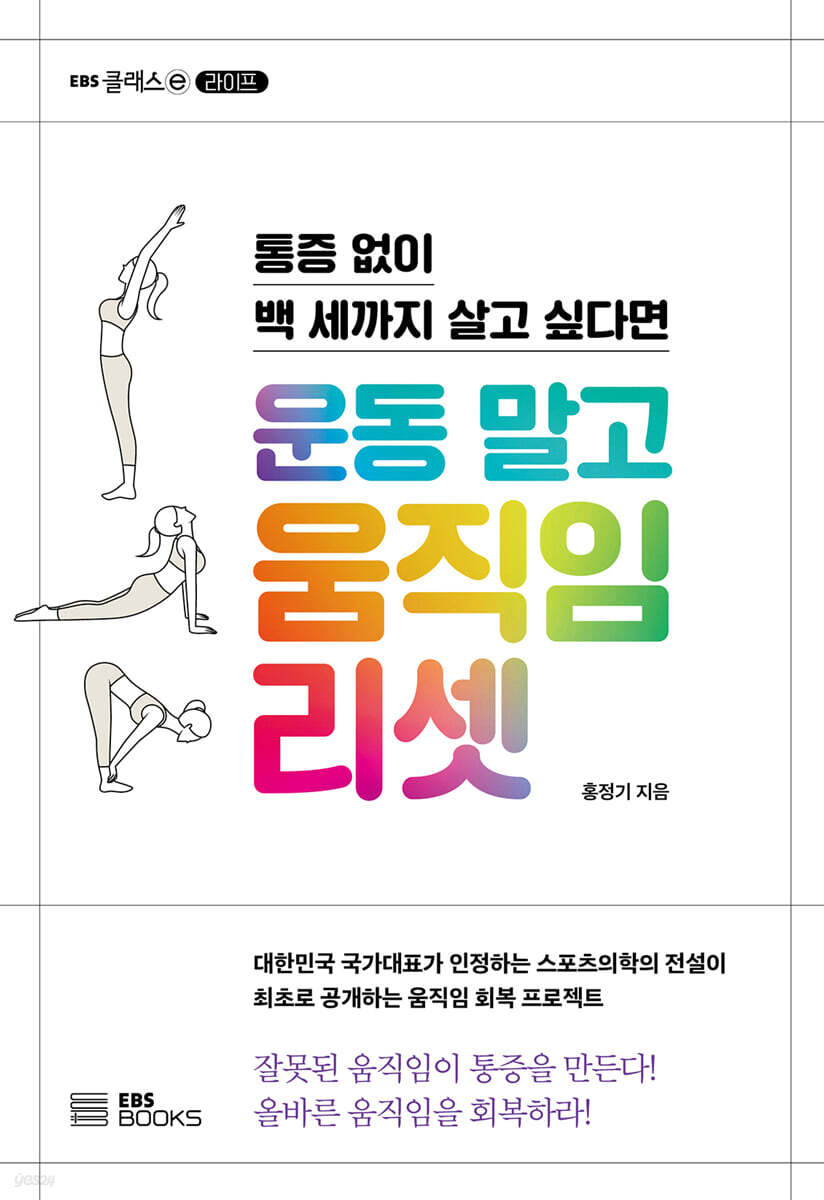
The pain goes away only when you move properlyPain disappears only when you move properly! Why do we all live with pain? Dr. Hong Jeong-gi, Korea's first sports medicine specialist and a leading rehabilitation specialist, reveals his movement recovery project.
Based on the EBS Classⓔ lecture that garnered explosive attention, we introduce a miraculous exercise method that can relieve pain and help you find the right movement.
January 14, 2022. Health and Hobbies PD Kim Hyun-joo
A legend in sports medicine recognized by the Korean national team,
Dr. Hong Jeong-gi's first-ever movement recovery project
“The pain will go away if you move properly!”
“My neck is stiff and won’t turn.” “It feels like a thousand-pound boulder is sitting on my shoulders, and it’s heavy and stiff.” “My knees tingle even when I’m still.” Many people complain of chronic pain, such as forward head posture, frozen shoulders, herniated discs, and knee pain.
What's even more surprising is that even people in their 20s and 30s who exercise diligently every day complain of pain.
Why do we all live with pain?
Author Hong Jeong-gi, one of Korea's top sports medicine experts and a doctor of exercise science, points to 'incorrect movement' as the cause of pain.
He asserts that moving correctly will make the pain go away, as incorrect movements cause pain.
People often think that when they experience pain, it is due to 'lack of exercise', but exercising 100 days a week in the wrong way is of no use.
Rather than relieving pain, there are many cases where exercise actually causes more pain.
The first thing to do is to regain the correct movement.
To do that, you need a ‘movement reset’ rather than exercise.
This book, which compiles the body part-specific exercise methods of “Barehand Pain Treatment” that garnered explosive attention during EBS Classⓔ lectures, is the first movement recovery guide to be revealed by Dr. Hong Jeong-gi, a movement science expert who is respected and praised by those who exercise.
He found the cause of all pain in 'wrong movement' and based on 30 years of practical experience in recovery exercise and exercise science theory, he included in this book a miraculous exercise method that can relieve pain and find the right movement.
Based on anatomical and scientific evidence, it analyzes the causes of pain in each body part and includes a self-diagnosis method to understand your current physical condition, as well as a carefully selected exercise for each body part to restore proper movement.
Additionally, the locations of joints, bones, and muscles for each body part are shown in detail in illustrations to increase understanding of the body.
It clearly explains common misconceptions and questions about exercise, and also includes a 10-minute daily exercise routine that you can follow when you feel pain and see immediate results.
I don't need anything else.
Let's focus and follow along for just one minute.
This one-of-a-kind encyclopedia of movements from a legend in the world of sports medicine will have you experiencing the amazing experience of pain disappearing from your body.
Dr. Hong Jeong-gi's first-ever movement recovery project
“The pain will go away if you move properly!”
“My neck is stiff and won’t turn.” “It feels like a thousand-pound boulder is sitting on my shoulders, and it’s heavy and stiff.” “My knees tingle even when I’m still.” Many people complain of chronic pain, such as forward head posture, frozen shoulders, herniated discs, and knee pain.
What's even more surprising is that even people in their 20s and 30s who exercise diligently every day complain of pain.
Why do we all live with pain?
Author Hong Jeong-gi, one of Korea's top sports medicine experts and a doctor of exercise science, points to 'incorrect movement' as the cause of pain.
He asserts that moving correctly will make the pain go away, as incorrect movements cause pain.
People often think that when they experience pain, it is due to 'lack of exercise', but exercising 100 days a week in the wrong way is of no use.
Rather than relieving pain, there are many cases where exercise actually causes more pain.
The first thing to do is to regain the correct movement.
To do that, you need a ‘movement reset’ rather than exercise.
This book, which compiles the body part-specific exercise methods of “Barehand Pain Treatment” that garnered explosive attention during EBS Classⓔ lectures, is the first movement recovery guide to be revealed by Dr. Hong Jeong-gi, a movement science expert who is respected and praised by those who exercise.
He found the cause of all pain in 'wrong movement' and based on 30 years of practical experience in recovery exercise and exercise science theory, he included in this book a miraculous exercise method that can relieve pain and find the right movement.
Based on anatomical and scientific evidence, it analyzes the causes of pain in each body part and includes a self-diagnosis method to understand your current physical condition, as well as a carefully selected exercise for each body part to restore proper movement.
Additionally, the locations of joints, bones, and muscles for each body part are shown in detail in illustrations to increase understanding of the body.
It clearly explains common misconceptions and questions about exercise, and also includes a 10-minute daily exercise routine that you can follow when you feel pain and see immediate results.
I don't need anything else.
Let's focus and follow along for just one minute.
This one-of-a-kind encyclopedia of movements from a legend in the world of sports medicine will have you experiencing the amazing experience of pain disappearing from your body.
- You can preview some of the book's contents.
Preview
index
Prologue
PART 1 Wrong Movements Cause Pain
People who have forgotten how to move
Are you exercising, abusing your muscles?
The more you exercise through the pain, the more it hurts.
Muscle pain is mostly myofascial pain.
Incorrect movements and posture cause pain.
What's more dangerous than injury is everyday life.
Movement Recovery Strategies to Reduce Pain
Is your body okay?
CHECK LIST Is my musculoskeletal system healthy?
PART 2: Recovering Your Movement! Moving Correctly Comes First
7 Laws of Movement Recovery
Rule 1: Correct movement is dynamic stretching.
Rule 2: Increase exercise intensity gradually.
Rule 3: Know Your Body's Range of Motion
Rule 4: Free Yourself from the Fear of Pain
Rule 5: Activate your motor nerves
Rule 6: Open the Doors of Your Mind with One Minute of Focus
Rule 7: Find Your Own Breath
PART 3: 1 Minute of Super Focus: A Miraculous Exercise That Eliminates Pain
Body part-specific exercises to restore proper movement
neck
3 Causes of Chronic Neck Pain
Everyone is using their neck muscles incorrectly.
When neck pain comes, shoulder pain follows.
- Self-diagnosis of throat health
Turn your neck left and right | Turn your neck up and down, left and right
- Isometric exercises to strengthen the muscles in the front of the neck
Push your head to one side and support with your hand | Support your chin with your thumb | Stretch your neck and pull
- Exercise to revive dull neck nerves
Move your neck side to side
shoulder
Know your shoulder muscles to prevent pain
Why Shoulder Impingement Syndrome Occurs
- Self-diagnosis of shoulder health
Raise your arms vertically | Move your arms up and down | Knock your fists together behind your back
- Exercises to relieve shoulder muscle stiffness
Batman Shoulder Exercise | Wrist Bend and Shoulder Pulldown | Arm Bend and Neck Bend
- Trapezius muscle strengthening exercises
Shoulder rolls | Shoulder raises
waist
Back Pain: Is It Really Due to Spinal Degeneration?
Back pain starts with fear
- Self-diagnosis of back health
Back Stretch | Back Bend | Back Twist
- Exercises to restore waist movement
Rotate your waist in all directions | Rotate your waist | Rotate your waist while standing with your legs crossed | Rotate your waist in a lunge position | Sit up from your tailbone
etc.
Why does back pain occur?
Back pain related to respiratory and digestive systems
- Self-diagnosis of back health
Chair-Sitting Thoracic Rotation | Thoracic Rotation to Stretch Your Sides
- Exercise to straighten a hunched back
Place your elbows on the chair and pull your back down | Child's pose, then straighten your upper body
- Exercises to restore movement of the thoracic spine
Lie face down on all fours with your shoulders on the floor | Place your hands on your head and rotate your thoracic spine
- Back muscle strengthening exercises
Standing back muscles
hip joint
Why do I have hip pain?
The hip joint does not move on its own.
- Self-diagnosis of hip joint health
Lying Leg Raises | Lying Leg Raises | Bend your knees to form a V shape
- Exercises to relieve hip stiffness
Swing both legs side to side | Sit with one knee up and push forward | Twist upper body while pushing one knee forward
- Hip muscle strengthening exercises
Sit with legs stretched out and lift one leg | Lying on your side and lifting your leg
knee
unstable joints with high ligament dependence
Patellofemoral pain syndrome that occurs in everyday life without injury
Bad lifestyle habits that cause knee pain
- Self-diagnosis of knee health
one leg squat
- Exercises to improve knee stability
Sit up | Step out with one foot and swing your knees side to side | Knee exercises with your ankles in and out | Step out with one foot and bend your knees | Stand on one foot and kick forward, backward, and side to side
pelvis
Be sure to maintain pelvic balance.
The Truth About Pelvic Floor Muscles and Kegel Exercises
- Self-diagnosis of pelvic health
Move your pelvis forward, backward, left, and right
- Exercises to relieve pelvic stiffness
Kick back and forth with one hand on a chair | Sit with your legs spread apart while holding onto a chair | Sit with your hips apart and push your knees with your elbows
- Pelvic muscle strengthening exercises
Step back and swing your arms to the side | Lie on your back and lift your legs to the side | Lie on your back and lift your legs to the side and kick backward | Lie on your side and spread your knees
elbows and wrists
Repetitive movements are the cause of elbow pain.
The most common wrist pain
- Self-diagnosis of elbow and wrist health
Hands back to back and elbows turned
- Exercises to relieve elbow stiffness
Move your palms side to side | Stretch your arms in opposite directions
- Exercises to relieve wrist stiffness
Press your palms against the floor and push your upper body forward | Move your wrists back and forth to apply force
feet and ankles
If you want to walk your whole life, you need healthy feet and ankles.
Ankle muscles that become increasingly shorter while sitting
Lack of exercise leads to walking difficulties
Bad habits cause leg and foot deformities.
Flexibility of the feet and sensitivity of the nerves are important.
- Self-diagnosis of feet and ankles
Stretch and pull your ankles
- Exercises to relieve stiffness in the feet and ankles
Draw a circle with your ankles | Standing with your ankles bent to the side
- Strengthening exercises for the feet and ankles
Kneel on the floor and stand up | Lie down and raise and lower your feet | Hold a chair and raise and lower your ankles | Hold a chair and straighten your ankles and sit up
PART 4: Pain and Exercise Q&A from Korea's Top Sports Medicine Experts
Questions about pain
Q1 Does frozen shoulder only occur in people in their 50s?
Q2 If I get frozen shoulder, is it better to avoid using my shoulder as much as possible?
Q3 If the soles of my feet feel tingly when I walk, should I stop walking?
Q4 Is it okay to feel pain after exercise?
Q 5 My fracture has healed and there are no problems on the X-ray, but it still hurts.
Why is that?
Questions about exercise
Q 1 Is it good to stretch stiff joints all the way?
Q2 Is stretching effective only if you feel like your muscles are tearing?
Q3 Sit-ups, is it really okay to do them?
Q4 Is it better to do planks for longer?
Q 5 When doing upper body exercises, is it effective to increase muscle strength by lifting the barbell at maximum weight?
Q6 Can I rehydrate with cold water after exercise?
Q7 I'm thinking of starting a personal trainer. What criteria should I use to select a trainer?
supplement
A 10-minute daily exercise routine that will melt away pain and restore movement.
PART 1 Wrong Movements Cause Pain
People who have forgotten how to move
Are you exercising, abusing your muscles?
The more you exercise through the pain, the more it hurts.
Muscle pain is mostly myofascial pain.
Incorrect movements and posture cause pain.
What's more dangerous than injury is everyday life.
Movement Recovery Strategies to Reduce Pain
Is your body okay?
CHECK LIST Is my musculoskeletal system healthy?
PART 2: Recovering Your Movement! Moving Correctly Comes First
7 Laws of Movement Recovery
Rule 1: Correct movement is dynamic stretching.
Rule 2: Increase exercise intensity gradually.
Rule 3: Know Your Body's Range of Motion
Rule 4: Free Yourself from the Fear of Pain
Rule 5: Activate your motor nerves
Rule 6: Open the Doors of Your Mind with One Minute of Focus
Rule 7: Find Your Own Breath
PART 3: 1 Minute of Super Focus: A Miraculous Exercise That Eliminates Pain
Body part-specific exercises to restore proper movement
neck
3 Causes of Chronic Neck Pain
Everyone is using their neck muscles incorrectly.
When neck pain comes, shoulder pain follows.
- Self-diagnosis of throat health
Turn your neck left and right | Turn your neck up and down, left and right
- Isometric exercises to strengthen the muscles in the front of the neck
Push your head to one side and support with your hand | Support your chin with your thumb | Stretch your neck and pull
- Exercise to revive dull neck nerves
Move your neck side to side
shoulder
Know your shoulder muscles to prevent pain
Why Shoulder Impingement Syndrome Occurs
- Self-diagnosis of shoulder health
Raise your arms vertically | Move your arms up and down | Knock your fists together behind your back
- Exercises to relieve shoulder muscle stiffness
Batman Shoulder Exercise | Wrist Bend and Shoulder Pulldown | Arm Bend and Neck Bend
- Trapezius muscle strengthening exercises
Shoulder rolls | Shoulder raises
waist
Back Pain: Is It Really Due to Spinal Degeneration?
Back pain starts with fear
- Self-diagnosis of back health
Back Stretch | Back Bend | Back Twist
- Exercises to restore waist movement
Rotate your waist in all directions | Rotate your waist | Rotate your waist while standing with your legs crossed | Rotate your waist in a lunge position | Sit up from your tailbone
etc.
Why does back pain occur?
Back pain related to respiratory and digestive systems
- Self-diagnosis of back health
Chair-Sitting Thoracic Rotation | Thoracic Rotation to Stretch Your Sides
- Exercise to straighten a hunched back
Place your elbows on the chair and pull your back down | Child's pose, then straighten your upper body
- Exercises to restore movement of the thoracic spine
Lie face down on all fours with your shoulders on the floor | Place your hands on your head and rotate your thoracic spine
- Back muscle strengthening exercises
Standing back muscles
hip joint
Why do I have hip pain?
The hip joint does not move on its own.
- Self-diagnosis of hip joint health
Lying Leg Raises | Lying Leg Raises | Bend your knees to form a V shape
- Exercises to relieve hip stiffness
Swing both legs side to side | Sit with one knee up and push forward | Twist upper body while pushing one knee forward
- Hip muscle strengthening exercises
Sit with legs stretched out and lift one leg | Lying on your side and lifting your leg
knee
unstable joints with high ligament dependence
Patellofemoral pain syndrome that occurs in everyday life without injury
Bad lifestyle habits that cause knee pain
- Self-diagnosis of knee health
one leg squat
- Exercises to improve knee stability
Sit up | Step out with one foot and swing your knees side to side | Knee exercises with your ankles in and out | Step out with one foot and bend your knees | Stand on one foot and kick forward, backward, and side to side
pelvis
Be sure to maintain pelvic balance.
The Truth About Pelvic Floor Muscles and Kegel Exercises
- Self-diagnosis of pelvic health
Move your pelvis forward, backward, left, and right
- Exercises to relieve pelvic stiffness
Kick back and forth with one hand on a chair | Sit with your legs spread apart while holding onto a chair | Sit with your hips apart and push your knees with your elbows
- Pelvic muscle strengthening exercises
Step back and swing your arms to the side | Lie on your back and lift your legs to the side | Lie on your back and lift your legs to the side and kick backward | Lie on your side and spread your knees
elbows and wrists
Repetitive movements are the cause of elbow pain.
The most common wrist pain
- Self-diagnosis of elbow and wrist health
Hands back to back and elbows turned
- Exercises to relieve elbow stiffness
Move your palms side to side | Stretch your arms in opposite directions
- Exercises to relieve wrist stiffness
Press your palms against the floor and push your upper body forward | Move your wrists back and forth to apply force
feet and ankles
If you want to walk your whole life, you need healthy feet and ankles.
Ankle muscles that become increasingly shorter while sitting
Lack of exercise leads to walking difficulties
Bad habits cause leg and foot deformities.
Flexibility of the feet and sensitivity of the nerves are important.
- Self-diagnosis of feet and ankles
Stretch and pull your ankles
- Exercises to relieve stiffness in the feet and ankles
Draw a circle with your ankles | Standing with your ankles bent to the side
- Strengthening exercises for the feet and ankles
Kneel on the floor and stand up | Lie down and raise and lower your feet | Hold a chair and raise and lower your ankles | Hold a chair and straighten your ankles and sit up
PART 4: Pain and Exercise Q&A from Korea's Top Sports Medicine Experts
Questions about pain
Q1 Does frozen shoulder only occur in people in their 50s?
Q2 If I get frozen shoulder, is it better to avoid using my shoulder as much as possible?
Q3 If the soles of my feet feel tingly when I walk, should I stop walking?
Q4 Is it okay to feel pain after exercise?
Q 5 My fracture has healed and there are no problems on the X-ray, but it still hurts.
Why is that?
Questions about exercise
Q 1 Is it good to stretch stiff joints all the way?
Q2 Is stretching effective only if you feel like your muscles are tearing?
Q3 Sit-ups, is it really okay to do them?
Q4 Is it better to do planks for longer?
Q 5 When doing upper body exercises, is it effective to increase muscle strength by lifting the barbell at maximum weight?
Q6 Can I rehydrate with cold water after exercise?
Q7 I'm thinking of starting a personal trainer. What criteria should I use to select a trainer?
supplement
A 10-minute daily exercise routine that will melt away pain and restore movement.
Detailed image

Into the book
To get relief from pain, you need to move properly.
It's natural to feel pain when you exercise beyond what your body can handle.
If I exercise while enduring the pain, will I ever truly be pain-free? No.
If you exercise while enduring the pain, it will only hurt more.
You should exercise only after you know exactly why you are in pain and how to move to relieve the pain.
In other words, rather than just exercising blindly, a ‘movement reset’ is needed to regain proper movement.
--- p.4, from "Prologue"
People often think that pain is something that only older people experience, but that's not true at all.
There are many people in their 20s and 30s who exercise for their health, but end up suffering from pain because of the exercise.
But how many people realize that most of this pain is caused by "incorrect movement" and "poor posture"? Few people would blame their own lack of exercise, and few would attribute it to poor movement.
However, in order to create smooth, flowing movements like water, you must move 'properly', not only in daily movements but also in exercise.
If you feel pain or have persistent discomfort, you should check your 'movement' first.
--- p.14-15, from 「PART 1 'People Who Forgot How to Move'」
It has been common knowledge that when you feel pain, you need to strengthen your muscles through exercise.
This is because you have to exercise while enduring pain to gain muscle strength and get rid of pain.
But this common sense is wrong.
While strengthening muscles through painful training can actually increase fascial tension, making pain chronic.
The same goes for stretching.
If you do this for a long time, other muscles may become stiff, which may lead to further pain.
Pain must be avoided.
If you feel any discomfort, the first thing to do is to avoid positions that cause pain and make that area comfortable.
Additionally, if you restore the flexibility of the muscles and fascia in the painful area, the pain will naturally disappear.
--- p.29, from 「PART 1 'If you exercise while overcoming pain, it will hurt more and more'」
Repeating a pattern of movements without exercise is bound to cause problems.
Therefore, it is more important than anything to take the time to move your body even a little.
It doesn't require a lot of time or intense exercise.
The key is to restore the joints' original movement.
--- p.37, from “PART 1 ‘Incorrect Movement and Posture Cause Pain’”
Unlike static stretching, dynamic stretching uses natural movement to relieve muscle stiffness.
The point is to increase the range of motion by raising, lowering, rotating, and stretching areas such as the neck, shoulders, and hip joints.
Movements that move your joints rather than holding a static posture help lengthen your muscles and make your joints more flexible.
--- p.57, from “PART 2 ‘Correct Movement is Dynamic Stretching’”
If you feel discomfort while performing the movement, you are already overdoing it.
It means that my joints and muscles have exceeded their capabilities.
To avoid side effects and achieve proper exercise effects, you must move slowly and accurately within the range of motion while being aware of your own movements.
--- p.68, from “PART 2 ‘Understand your body’s range of motion’”
The movement avoidance response of shrinking the body and using other nearby joints instead for fear of getting hurt again or getting sick again ends up increasing the pain.
Limiting joint movement to prevent pain and re-injury and then compensating with movements similar to those used to prevent pain further tightens the muscles and fascia surrounding the painful area.
Ultimately, this results in loss of elasticity and a wider area of pain.
It's okay to move.
No major problems or extreme pain.
You need to move slowly and confidently within a safe range, that is, a range where movement does not hurt, and then regain movement.
--- p.70, from 「PART 2 'Escape from the fear of pain'」
If there is a problem with one joint, the surrounding joints will be used more.
This is called 'compensatory action'.
Compensatory mechanisms result in the spread of problems in a particular joint to surrounding areas.
This is why when one joint loses function, a chain reaction occurs in the surrounding joints, causing them to become stiff.
Because the surrounding joints have to do the work of the shoulder joint that is not moving, fatigue builds up, and later, you suffer from general pain to the point where you cannot even tell where the pain started.
Therefore, it is important to treat pain actively rather than neglecting it when it first starts.
--- p.92, from 「PART 3 'When neck pain comes, shoulder pain comes next'」
Strengthening your muscles through exercise increases joint stability.
However, exercising incorrectly can actually harm your health.
For example, in exercises that involve a large amount of movement of the knee joint, such as squats or lunges, repeated movements that push the knee excessively can cause knee injuries.
(Omitted) You should check the condition of your joints and do exercises that are appropriate for them.
Otherwise, it could become poison rather than exercise.
--- p.191-192, from 「PART 3 'Bad lifestyle habits that cause knee pain'」
As the pelvis is a joint that plays a key role in the upright posture and walking of the human body, it has a great influence on the surrounding joints.
The upper spine acts as a cornerstone that supports the entire spine, so if the pelvis is misaligned, it causes pain in the lower back.
This can also lead to problems with the neck and jaw.
(Omitted) You must recognize that all joints in the human body are connected as a single ring centered on the pelvis.
Based on this premise, fundamental treatment is possible only when we approach it from the larger perspective of the balance and alignment of the human body.
Each tree is important, but to maintain health, you need to take care of your pelvis and spinal joints with the mindset of looking at the forest as a whole.
--- p.206-207, from 「PART 3 'Be sure to maintain the balance of your pelvis'」
Excessive stretching can weaken joints and ligaments, causing not only pain but also disease.
If the ligaments are overstretched due to excessive stretching, the unstable situation in which the bones are shaken continues, causing joint damage.
In particular, static stretching, which involves holding a muscle-lengthening position for 15 to 20 seconds, is not only less effective than you might think, but also carries a greater risk of injury.
Dynamic stretching is more effective than static stretching before exercise.
Movements that move the joint rather than holding it statically help lengthen the muscles and make the hip joint more flexible.
It's natural to feel pain when you exercise beyond what your body can handle.
If I exercise while enduring the pain, will I ever truly be pain-free? No.
If you exercise while enduring the pain, it will only hurt more.
You should exercise only after you know exactly why you are in pain and how to move to relieve the pain.
In other words, rather than just exercising blindly, a ‘movement reset’ is needed to regain proper movement.
--- p.4, from "Prologue"
People often think that pain is something that only older people experience, but that's not true at all.
There are many people in their 20s and 30s who exercise for their health, but end up suffering from pain because of the exercise.
But how many people realize that most of this pain is caused by "incorrect movement" and "poor posture"? Few people would blame their own lack of exercise, and few would attribute it to poor movement.
However, in order to create smooth, flowing movements like water, you must move 'properly', not only in daily movements but also in exercise.
If you feel pain or have persistent discomfort, you should check your 'movement' first.
--- p.14-15, from 「PART 1 'People Who Forgot How to Move'」
It has been common knowledge that when you feel pain, you need to strengthen your muscles through exercise.
This is because you have to exercise while enduring pain to gain muscle strength and get rid of pain.
But this common sense is wrong.
While strengthening muscles through painful training can actually increase fascial tension, making pain chronic.
The same goes for stretching.
If you do this for a long time, other muscles may become stiff, which may lead to further pain.
Pain must be avoided.
If you feel any discomfort, the first thing to do is to avoid positions that cause pain and make that area comfortable.
Additionally, if you restore the flexibility of the muscles and fascia in the painful area, the pain will naturally disappear.
--- p.29, from 「PART 1 'If you exercise while overcoming pain, it will hurt more and more'」
Repeating a pattern of movements without exercise is bound to cause problems.
Therefore, it is more important than anything to take the time to move your body even a little.
It doesn't require a lot of time or intense exercise.
The key is to restore the joints' original movement.
--- p.37, from “PART 1 ‘Incorrect Movement and Posture Cause Pain’”
Unlike static stretching, dynamic stretching uses natural movement to relieve muscle stiffness.
The point is to increase the range of motion by raising, lowering, rotating, and stretching areas such as the neck, shoulders, and hip joints.
Movements that move your joints rather than holding a static posture help lengthen your muscles and make your joints more flexible.
--- p.57, from “PART 2 ‘Correct Movement is Dynamic Stretching’”
If you feel discomfort while performing the movement, you are already overdoing it.
It means that my joints and muscles have exceeded their capabilities.
To avoid side effects and achieve proper exercise effects, you must move slowly and accurately within the range of motion while being aware of your own movements.
--- p.68, from “PART 2 ‘Understand your body’s range of motion’”
The movement avoidance response of shrinking the body and using other nearby joints instead for fear of getting hurt again or getting sick again ends up increasing the pain.
Limiting joint movement to prevent pain and re-injury and then compensating with movements similar to those used to prevent pain further tightens the muscles and fascia surrounding the painful area.
Ultimately, this results in loss of elasticity and a wider area of pain.
It's okay to move.
No major problems or extreme pain.
You need to move slowly and confidently within a safe range, that is, a range where movement does not hurt, and then regain movement.
--- p.70, from 「PART 2 'Escape from the fear of pain'」
If there is a problem with one joint, the surrounding joints will be used more.
This is called 'compensatory action'.
Compensatory mechanisms result in the spread of problems in a particular joint to surrounding areas.
This is why when one joint loses function, a chain reaction occurs in the surrounding joints, causing them to become stiff.
Because the surrounding joints have to do the work of the shoulder joint that is not moving, fatigue builds up, and later, you suffer from general pain to the point where you cannot even tell where the pain started.
Therefore, it is important to treat pain actively rather than neglecting it when it first starts.
--- p.92, from 「PART 3 'When neck pain comes, shoulder pain comes next'」
Strengthening your muscles through exercise increases joint stability.
However, exercising incorrectly can actually harm your health.
For example, in exercises that involve a large amount of movement of the knee joint, such as squats or lunges, repeated movements that push the knee excessively can cause knee injuries.
(Omitted) You should check the condition of your joints and do exercises that are appropriate for them.
Otherwise, it could become poison rather than exercise.
--- p.191-192, from 「PART 3 'Bad lifestyle habits that cause knee pain'」
As the pelvis is a joint that plays a key role in the upright posture and walking of the human body, it has a great influence on the surrounding joints.
The upper spine acts as a cornerstone that supports the entire spine, so if the pelvis is misaligned, it causes pain in the lower back.
This can also lead to problems with the neck and jaw.
(Omitted) You must recognize that all joints in the human body are connected as a single ring centered on the pelvis.
Based on this premise, fundamental treatment is possible only when we approach it from the larger perspective of the balance and alignment of the human body.
Each tree is important, but to maintain health, you need to take care of your pelvis and spinal joints with the mindset of looking at the forest as a whole.
--- p.206-207, from 「PART 3 'Be sure to maintain the balance of your pelvis'」
Excessive stretching can weaken joints and ligaments, causing not only pain but also disease.
If the ligaments are overstretched due to excessive stretching, the unstable situation in which the bones are shaken continues, causing joint damage.
In particular, static stretching, which involves holding a muscle-lengthening position for 15 to 20 seconds, is not only less effective than you might think, but also carries a greater risk of injury.
Dynamic stretching is more effective than static stretching before exercise.
Movements that move the joint rather than holding it statically help lengthen the muscles and make the hip joint more flexible.
--- p.274, from “PART 4 ‘Questions about Exercise’”
Publisher's Review
Most respected by health trainers, yoga and pilates instructors
The Ultimate Exercise Guide from an Expert in Sports Medicine and Exercise Science
South Korea's leading sports medicine expert and doctor of exercise science.
The teacher most respected and desired by health trainers, yoga and Pilates instructors.
A true authority on the domestic recovery movement.
This is an adjective that refers directly to Professor Hong Jeong-gi.
Not only South Korean national team athletes such as Olympic skeleton gold medalist Yun Song-bin, soccer player Ki Sung-yong, professional golfer Choi Hye-jin, and South Korea's 100m track and field record holder Kim Kuk-young, but also people who exercise a lot, such as YouTuber Yoo Tae-yang, who has 970,000 subscribers, and Deathrun Jo Seong-jun, seek him out.
Why is Professor Hong Jeong-gi the only expert sought out among countless others? Because he's a legend in the sports medicine field, easily the foremost in Korea.
Having completed his PhD in exercise science in the United States, a country known for its world-class sports science, and even winning the 'Professor of the Year' award, he has solidified his unrivaled position in the field of sports medicine to the point of shaking the very foundations of the Korean sports world.
Is there anyone who can explain exercise more scientifically and clearly than he can? No, it's no exaggeration to say there isn't.
He published "Movement Reset, Not Exercise," which encompasses his 30 years of experience and know-how in recovery exercise and exercise science theories for those suffering from pain.
This book contains anatomical analysis of the causes of pain in each body part, detailed muscle illustrations, and miraculous exercises to relieve pain and restore proper movement.
It is the great recovery treatment that national team athletes receive, and it is the very exercise that athletes want to learn so much.
And that's not all.
Common misconceptions about exercise, as well as endlessly debated topics such as overtraining, core strengthening exercises, and muscle pain, are clearly explained based on anatomical and scientific evidence.
It also includes a 10-minute daily exercise routine for each pain type that will make the pain melt away.
If you have suffered from chronic pain and an ailing body throughout your life, don't miss this book.
This is your chance to get a glimpse into Korea's top experts' pain-free, healthy exercise methods!
The ultimate pain relief method for a lifelong pain-free body
"Wrong movements cause pain! Restore correct movements!"
When you go to the hospital because of pain, the most common thing you hear is 'lack of exercise'.
Then most people go straight to yoga or pilates classes or head to the gym.
But after a few days, regret sets in.
I exercised because I was told it was due to lack of exercise, but it still hurt more.
What's going on? Dr. Hong Jeong-gi, Korea's leading sports medicine authority, asserts that the cause of pain isn't "lack of exercise," but "incorrect movement."
He emphasizes that if you do not correct your wrong movements, even if you exercise for 100 days, the pain may not be relieved and may actually become worse.
Joints, which are the core of movement, are made up of bones, ligaments, and muscles.
If you continue to overwork only one muscle by moving in the wrong way or taking on the wrong posture, the muscles you use will become stronger, and the muscles you don't use will become weak or stiff.
When muscles become imbalanced and blood vessels tighten against the fascia, blood circulation deteriorates, resulting in pain.
What happens if you mistakenly believe you're lacking exercise and end up overdoing it? This can lead to inflammation or damage around your joints, making the pain worse.
The root cause of all this is that the joints are not used according to their natural motor function or are used incorrectly.
Therefore, to get rid of pain, it is important to first regain proper movement, not exercise.
To do that, you need a ‘movement reset’ rather than exercise.
To restore proper movement, Dr. Hong Jeong-gi suggests 'dynamic stretching'.
The most effective way is to use natural movements to relieve muscle stiffness and increase the range of motion of joints.
When the joints recover their original movements, pain disappears and incorrect movements are corrected.
Additionally, muscle flexibility is restored and muscle strength is strengthened.
The key to eliminating pain lies in correcting incorrect movements.
Now it's time to put it into action.
Stop the massages, muscle training, and Pilates that are slowly accumulating pain in your body! Instead, open this book, which contains Dr. Hong Jeong-gi's remarkable exercise methods, which are so sought after that they're often difficult to obtain.
You can say goodbye to the aching body that has been causing you pain for the rest of your life.
A Miraculous 1-Minute Stretching Class to Eliminate Pain and Correct Misalignments
“Don’t go exercise, reset your movement!”
If you're struggling with a hunched back, shoulders that feel like they're weighing a ton, misaligned pelvis, or tingling knee pain, pay attention to "Movement Reset, Not Exercise." This book, which captures Dr. Hong Jeong-gi's "Barehand Pain Treatment," a lecture that garnered explosive attention during his EBS Classⓔ lecture series, is packed with exercises that relieve pain and correct movement errors.
The movement correction method he teaches is very systematic and scientific, based on numerous practical experiences in recovery treatment and theories of exercise science.
First, we analyzed the causes of pain in each body part based on anatomical evidence.
The locations of joints, bones, and muscles for each body part are shown in detail in illustrations to increase understanding of the body.
The exercise section divides the body parts where pain occurs into 9 categories, and includes a self-diagnosis method that allows you to understand your current physical condition, as well as a selection of exercises that can help you restore proper movement.
It's an incredibly effective exercise that's easy to follow but delivers maximum results.
So, isn't this a difficult move? Don't get me wrong.
The movement reset method suggested by the country's top sports medicine expert is simpler than you might think.
It doesn't require a lot of time or intense exercise.
It is sufficient to simply move and rotate areas such as the neck, shoulders, and hip joints up, down, left, and right.
The point is to gradually increase your range of motion by repeating these small movements that restore your daily movements.
Let's focus and follow along for just one minute.
You will feel immediate pain relief and a return to balance in your body.
The universe's strongest stiff body becomes surprisingly flexible and can perform daily life movements without difficulty.
To this extent, it is no exaggeration to call it the 'exercise bible' of the entire nation.
Make it a habit to open this book whenever pain arises.
It is possible to live pain-free until the age of 100.
The Ultimate Exercise Guide from an Expert in Sports Medicine and Exercise Science
South Korea's leading sports medicine expert and doctor of exercise science.
The teacher most respected and desired by health trainers, yoga and Pilates instructors.
A true authority on the domestic recovery movement.
This is an adjective that refers directly to Professor Hong Jeong-gi.
Not only South Korean national team athletes such as Olympic skeleton gold medalist Yun Song-bin, soccer player Ki Sung-yong, professional golfer Choi Hye-jin, and South Korea's 100m track and field record holder Kim Kuk-young, but also people who exercise a lot, such as YouTuber Yoo Tae-yang, who has 970,000 subscribers, and Deathrun Jo Seong-jun, seek him out.
Why is Professor Hong Jeong-gi the only expert sought out among countless others? Because he's a legend in the sports medicine field, easily the foremost in Korea.
Having completed his PhD in exercise science in the United States, a country known for its world-class sports science, and even winning the 'Professor of the Year' award, he has solidified his unrivaled position in the field of sports medicine to the point of shaking the very foundations of the Korean sports world.
Is there anyone who can explain exercise more scientifically and clearly than he can? No, it's no exaggeration to say there isn't.
He published "Movement Reset, Not Exercise," which encompasses his 30 years of experience and know-how in recovery exercise and exercise science theories for those suffering from pain.
This book contains anatomical analysis of the causes of pain in each body part, detailed muscle illustrations, and miraculous exercises to relieve pain and restore proper movement.
It is the great recovery treatment that national team athletes receive, and it is the very exercise that athletes want to learn so much.
And that's not all.
Common misconceptions about exercise, as well as endlessly debated topics such as overtraining, core strengthening exercises, and muscle pain, are clearly explained based on anatomical and scientific evidence.
It also includes a 10-minute daily exercise routine for each pain type that will make the pain melt away.
If you have suffered from chronic pain and an ailing body throughout your life, don't miss this book.
This is your chance to get a glimpse into Korea's top experts' pain-free, healthy exercise methods!
The ultimate pain relief method for a lifelong pain-free body
"Wrong movements cause pain! Restore correct movements!"
When you go to the hospital because of pain, the most common thing you hear is 'lack of exercise'.
Then most people go straight to yoga or pilates classes or head to the gym.
But after a few days, regret sets in.
I exercised because I was told it was due to lack of exercise, but it still hurt more.
What's going on? Dr. Hong Jeong-gi, Korea's leading sports medicine authority, asserts that the cause of pain isn't "lack of exercise," but "incorrect movement."
He emphasizes that if you do not correct your wrong movements, even if you exercise for 100 days, the pain may not be relieved and may actually become worse.
Joints, which are the core of movement, are made up of bones, ligaments, and muscles.
If you continue to overwork only one muscle by moving in the wrong way or taking on the wrong posture, the muscles you use will become stronger, and the muscles you don't use will become weak or stiff.
When muscles become imbalanced and blood vessels tighten against the fascia, blood circulation deteriorates, resulting in pain.
What happens if you mistakenly believe you're lacking exercise and end up overdoing it? This can lead to inflammation or damage around your joints, making the pain worse.
The root cause of all this is that the joints are not used according to their natural motor function or are used incorrectly.
Therefore, to get rid of pain, it is important to first regain proper movement, not exercise.
To do that, you need a ‘movement reset’ rather than exercise.
To restore proper movement, Dr. Hong Jeong-gi suggests 'dynamic stretching'.
The most effective way is to use natural movements to relieve muscle stiffness and increase the range of motion of joints.
When the joints recover their original movements, pain disappears and incorrect movements are corrected.
Additionally, muscle flexibility is restored and muscle strength is strengthened.
The key to eliminating pain lies in correcting incorrect movements.
Now it's time to put it into action.
Stop the massages, muscle training, and Pilates that are slowly accumulating pain in your body! Instead, open this book, which contains Dr. Hong Jeong-gi's remarkable exercise methods, which are so sought after that they're often difficult to obtain.
You can say goodbye to the aching body that has been causing you pain for the rest of your life.
A Miraculous 1-Minute Stretching Class to Eliminate Pain and Correct Misalignments
“Don’t go exercise, reset your movement!”
If you're struggling with a hunched back, shoulders that feel like they're weighing a ton, misaligned pelvis, or tingling knee pain, pay attention to "Movement Reset, Not Exercise." This book, which captures Dr. Hong Jeong-gi's "Barehand Pain Treatment," a lecture that garnered explosive attention during his EBS Classⓔ lecture series, is packed with exercises that relieve pain and correct movement errors.
The movement correction method he teaches is very systematic and scientific, based on numerous practical experiences in recovery treatment and theories of exercise science.
First, we analyzed the causes of pain in each body part based on anatomical evidence.
The locations of joints, bones, and muscles for each body part are shown in detail in illustrations to increase understanding of the body.
The exercise section divides the body parts where pain occurs into 9 categories, and includes a self-diagnosis method that allows you to understand your current physical condition, as well as a selection of exercises that can help you restore proper movement.
It's an incredibly effective exercise that's easy to follow but delivers maximum results.
So, isn't this a difficult move? Don't get me wrong.
The movement reset method suggested by the country's top sports medicine expert is simpler than you might think.
It doesn't require a lot of time or intense exercise.
It is sufficient to simply move and rotate areas such as the neck, shoulders, and hip joints up, down, left, and right.
The point is to gradually increase your range of motion by repeating these small movements that restore your daily movements.
Let's focus and follow along for just one minute.
You will feel immediate pain relief and a return to balance in your body.
The universe's strongest stiff body becomes surprisingly flexible and can perform daily life movements without difficulty.
To this extent, it is no exaggeration to call it the 'exercise bible' of the entire nation.
Make it a habit to open this book whenever pain arises.
It is possible to live pain-free until the age of 100.
GOODS SPECIFICS
- Date of issue: January 5, 2022
- Page count, weight, size: 288 pages | 454g | 145*210*18mm
- ISBN13: 9788954762816
- ISBN10: 8954762816
You may also like
카테고리
korean


korean

![GQ KOREA Mark (Monthly): December [2025]](http://librairie.coreenne.fr/cdn/shop/files/8ef265dbbfbf186523ed75ba7319009d.jpg?v=1765340328&width=3840)


