

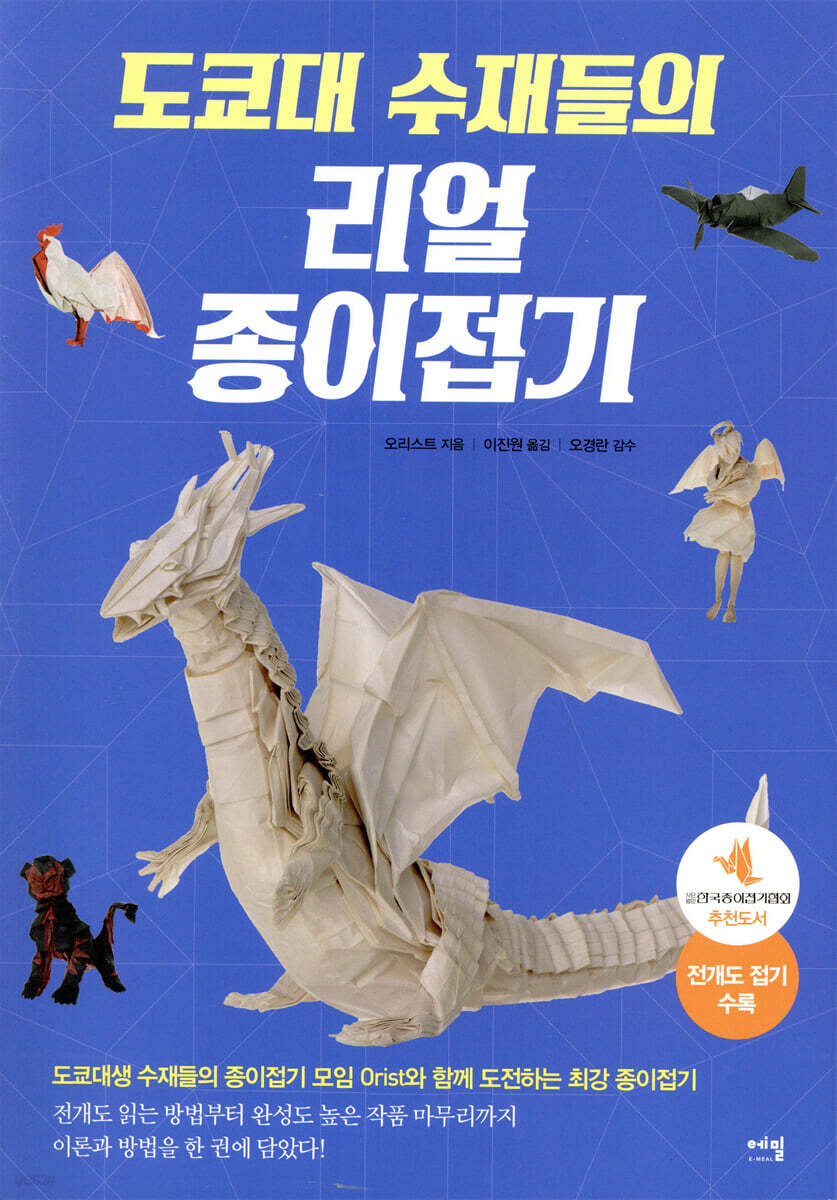
Real origami by Tokyo University's brightest students
 |
Description
Book Introduction
Challenge the ultimate origami challenge with Tokyo University's talented students.
From how to read a development diagram to finishing a high-quality work.
Theory and method in one book!
Amidst the steady love and anticipation of origami enthusiasts, a unique book in the [Real Origami] series has been published.
[Real Origami] is a representative series of Emil's origami books, filled with works of various difficulty levels and outstanding creativity.
"Tokyo University's Talented Students' Real Origami" is a collection of works by members of the Orist origami club at Tokyo University, Japan's most prestigious university. It stands out in terms of difficulty and creativity.
As this book was compiled by talented individuals, it goes beyond simply approaching origami as a fun hobby and art, and explains the theory from mathematical and logical perspectives such as geometry and shapes.
Additionally, the book includes a folding method that relies solely on the development diagram without any explanation of the process, and a cutting-and-use development diagram is included at the back of the book so that you can try it out.
To make it clearer and help readers understand it more quickly, it has undergone careful review by domestic origami artist Oh Kyung-ran.
Author Oh Kyung-ran pointed out that there are few books in Korea that cover origami theory, and emphasized that this book, with its solid theoretical support, will be of great help to those who wish to challenge themselves with creation.
This [Real Origami] book will be a welcome addition to those who want to try origami in new and diverse ways, and those who want to challenge themselves by interpreting patterns while looking at the development diagram.
Emil plans to continue publishing the [Real Origami] series in the future.
From how to read a development diagram to finishing a high-quality work.
Theory and method in one book!
Amidst the steady love and anticipation of origami enthusiasts, a unique book in the [Real Origami] series has been published.
[Real Origami] is a representative series of Emil's origami books, filled with works of various difficulty levels and outstanding creativity.
"Tokyo University's Talented Students' Real Origami" is a collection of works by members of the Orist origami club at Tokyo University, Japan's most prestigious university. It stands out in terms of difficulty and creativity.
As this book was compiled by talented individuals, it goes beyond simply approaching origami as a fun hobby and art, and explains the theory from mathematical and logical perspectives such as geometry and shapes.
Additionally, the book includes a folding method that relies solely on the development diagram without any explanation of the process, and a cutting-and-use development diagram is included at the back of the book so that you can try it out.
To make it clearer and help readers understand it more quickly, it has undergone careful review by domestic origami artist Oh Kyung-ran.
Author Oh Kyung-ran pointed out that there are few books in Korea that cover origami theory, and emphasized that this book, with its solid theoretical support, will be of great help to those who wish to challenge themselves with creation.
This [Real Origami] book will be a welcome addition to those who want to try origami in new and diverse ways, and those who want to challenge themselves by interpreting patterns while looking at the development diagram.
Emil plans to continue publishing the [Real Origami] series in the future.
- You can preview some of the book's contents.
Preview
index
Before you start
Reviewer's Note
Part 1: What Can You Do with a Sheet of Paper?
Cat|Elephant|Buffalo|Crocodile|Chicken|Crane|Star|Rose|Hexahedron containing an octagonal hyperbolic paraboloid|Wristwatch|Dogi|Number of lives|Fighter 1|Fighter 2|Mosasaurus|Brachiosaurus|White dragon|Magic dragon|Monster|Dragon messenger in mythology|Archangel Uriel|Clown mantis shrimp|Crane bookmark
Part 2 Understanding the Basics of Origami
Before you try your hand at origami! Basic origami terminology | Master origami! From the beginning to the end | Understand origami structures at a glance! What is a development diagram? | Develop critical thinking skills! Applying folding techniques
Part 3: Challenge yourself with high-difficulty origami
Student Bookmark|Elephant|Fighter 1|Star|Cat|Rose|Dragon|Life|Buffalo|Mosasaurus|Clown Mantis Shrimp
Emil Press Release│Contact: Min Seong-won│02-3141-8302│43-1 Donggyo-ro, Mapo-gu, Seoul
Collapse Appendix Development Diagram
Star|Rose|Life|Mosasaurus|Fighter 2
Reviewer's Note
Part 1: What Can You Do with a Sheet of Paper?
Cat|Elephant|Buffalo|Crocodile|Chicken|Crane|Star|Rose|Hexahedron containing an octagonal hyperbolic paraboloid|Wristwatch|Dogi|Number of lives|Fighter 1|Fighter 2|Mosasaurus|Brachiosaurus|White dragon|Magic dragon|Monster|Dragon messenger in mythology|Archangel Uriel|Clown mantis shrimp|Crane bookmark
Part 2 Understanding the Basics of Origami
Before you try your hand at origami! Basic origami terminology | Master origami! From the beginning to the end | Understand origami structures at a glance! What is a development diagram? | Develop critical thinking skills! Applying folding techniques
Part 3: Challenge yourself with high-difficulty origami
Student Bookmark|Elephant|Fighter 1|Star|Cat|Rose|Dragon|Life|Buffalo|Mosasaurus|Clown Mantis Shrimp
Emil Press Release│Contact: Min Seong-won│02-3141-8302│43-1 Donggyo-ro, Mapo-gu, Seoul
Collapse Appendix Development Diagram
Star|Rose|Life|Mosasaurus|Fighter 2
Detailed image

Into the book
Welcome to the world of origami.
Origami is a form of paper art that has captivated people of all ages and genders, both East and West.
Origami can be enjoyed anywhere as long as you have some square colored paper.
However, when you see the works introduced in this book, many people will be surprised and ask, "Are these really made from a single sheet of paper?"
If you're curious about how to fold it, take a close look at the process to see where and how it was folded, as time permits.
--- From "Before You Begin"
Included are works that are folded by looking at the folding diagram, as well as works that only present a development diagram with many reference lines drawn.
To fold a work that only presents a development diagram, the development diagram must first be interpreted, and the logical and mathematical theories required for this are also introduced.
As books on origami theory are rare in Korea, this book will be of great help to enthusiasts who wish to interpret the development diagram or even dream of creating origami.
Origami is a form of paper art that has captivated people of all ages and genders, both East and West.
Origami can be enjoyed anywhere as long as you have some square colored paper.
However, when you see the works introduced in this book, many people will be surprised and ask, "Are these really made from a single sheet of paper?"
If you're curious about how to fold it, take a close look at the process to see where and how it was folded, as time permits.
--- From "Before You Begin"
Included are works that are folded by looking at the folding diagram, as well as works that only present a development diagram with many reference lines drawn.
To fold a work that only presents a development diagram, the development diagram must first be interpreted, and the logical and mathematical theories required for this are also introduced.
As books on origami theory are rare in Korea, this book will be of great help to enthusiasts who wish to interpret the development diagram or even dream of creating origami.
--- From "The Supervisor's Note"
Publisher's Review
What is a development diagram, Inside Out,
Folding diagram, Kawasaki theorem, Maekawa theorem, n-part method…
Introduction to various theories needed to analyze and fold the development diagram.
For origami enthusiasts seeking a more challenging project, why not try folding the development diagram from "Tokyo University's Prodigies' Real Origami"? With no step-by-step instructions, you can simply follow the diagram and fold the piece. At the end, you can freely express your skills according to your own preferences, satisfying your creative desires and giving you a sense of accomplishment.
The first thing required for folding this development diagram is interpretation of the development diagram, because the development diagram not only has a reference line drawn, but also contains various hints hidden within it.
The biggest feature and advantage of this book, which is hard to find in other origami books, is that it contains various theories necessary to analyze and fold these developments.
For example, it introduces terms such as corner, inside-out, and folding diagram, detailed explanations of each step until the work is completed, what a development diagram is, and the rules of origami, such as the Maekawa theorem and Kawasaki theorem, and how to divide a line or angle into n parts.
The more difficult it is, the more fun it is, and the more profound it is, the more immersive it is!
Creativity blossoming at your fingertips,
Mathematical and logical brain training at your fingertips
Origami can be enjoyed anytime, anywhere with just a square piece of paper.
This single piece of paper transforms from flat to three-dimensional, creating a wonderful work of art and showing infinite possibilities.
This type of paper folding is not only a form of play and paper art that is attracting attention around the world, but also has an educational aspect.
Origami is a process of folding paper in order, comparing it to a model, thinking about the meaning of the process, inferring the next step, and completing it aesthetically in the final stage.
Through this process, you will acquire important non-cognitive skills such as creativity, logic, and problem-solving skills.
You train and master these abilities with your fingertips.
Origami provides a digital detox effect for adults by allowing them to put down their smartphones for a while and focus on a piece of paper, while it also provides brain training for children by allowing them to focus and think.
Folding diagram, Kawasaki theorem, Maekawa theorem, n-part method…
Introduction to various theories needed to analyze and fold the development diagram.
For origami enthusiasts seeking a more challenging project, why not try folding the development diagram from "Tokyo University's Prodigies' Real Origami"? With no step-by-step instructions, you can simply follow the diagram and fold the piece. At the end, you can freely express your skills according to your own preferences, satisfying your creative desires and giving you a sense of accomplishment.
The first thing required for folding this development diagram is interpretation of the development diagram, because the development diagram not only has a reference line drawn, but also contains various hints hidden within it.
The biggest feature and advantage of this book, which is hard to find in other origami books, is that it contains various theories necessary to analyze and fold these developments.
For example, it introduces terms such as corner, inside-out, and folding diagram, detailed explanations of each step until the work is completed, what a development diagram is, and the rules of origami, such as the Maekawa theorem and Kawasaki theorem, and how to divide a line or angle into n parts.
The more difficult it is, the more fun it is, and the more profound it is, the more immersive it is!
Creativity blossoming at your fingertips,
Mathematical and logical brain training at your fingertips
Origami can be enjoyed anytime, anywhere with just a square piece of paper.
This single piece of paper transforms from flat to three-dimensional, creating a wonderful work of art and showing infinite possibilities.
This type of paper folding is not only a form of play and paper art that is attracting attention around the world, but also has an educational aspect.
Origami is a process of folding paper in order, comparing it to a model, thinking about the meaning of the process, inferring the next step, and completing it aesthetically in the final stage.
Through this process, you will acquire important non-cognitive skills such as creativity, logic, and problem-solving skills.
You train and master these abilities with your fingertips.
Origami provides a digital detox effect for adults by allowing them to put down their smartphones for a while and focus on a piece of paper, while it also provides brain training for children by allowing them to focus and think.
GOODS SPECIFICS
- Publication date: November 24, 2021
- Page count, weight, size: 128 pages | 410g | 182*257*10mm
- ISBN13: 9791186706121
- ISBN10: 1186706120
You may also like
카테고리
korean


korean

![GQ KOREA Mark (Monthly): December [2025]](http://librairie.coreenne.fr/cdn/shop/files/8ef265dbbfbf186523ed75ba7319009d.jpg?v=1765340328&width=3840)


