

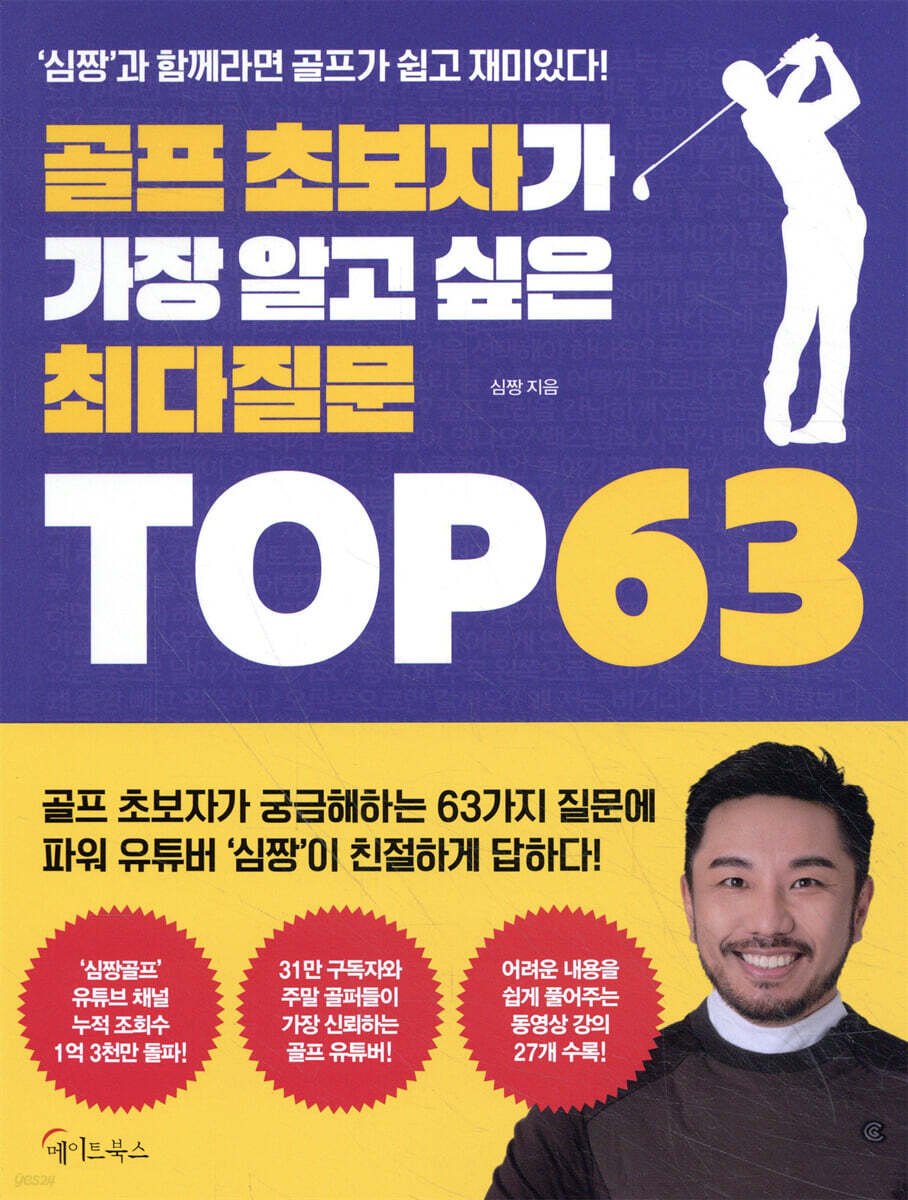
Top 63 Questions Beginners Ask About Golf
 |
Description
Book Introduction
With 'Simjang', who has accumulated 130 million views Golf becomes easy and fun! A golf boom is sweeping South Korea like a whirlwind, with even the younger generation jumping into the game. Golf courses are overflowing with golfers, and TV is flooded with golf entertainment shows. Golf is no longer perceived as a sport for the middle-aged and older generation, but is now being accepted as a healthy outdoor sport that can be enjoyed by people of all ages, as well as a hobby and means of self-expression. Although the variable called COVID-19 has further accelerated the popularization of golf, we cannot leave out 'Sim Jjang' as a living witness to the popularization of golf in Korea. Unlike other golf YouTubers who have been mushrooming recently, Sim Jang is a true first-generation golf YouTuber. Sim Jjang's unique, popular content and sincerity contributed greatly to his rise to power golf YouTuber status with 310,000 subscribers and 130 million cumulative views. This book is also full of Sim Jang's public-friendly side and sincerity, which he has shown on YouTube and TV programs, and will be of practical help to those who are just starting out in golf, as well as those who have been playing golf for several years but are losing interest because their skills are not improving. Here's a big question: Shim Jang, a well-known golf YouTuber, suddenly decided to publish a golf book. At first glance, it seems like a video explanation would be better than written explanations, but why would he publish a book? And why would a successful golf YouTuber do it? While videos might be better for golf, that doesn't mean everything is the same. Golfers who are just starting out will likely have a variety of questions, and many of them may be too basic to ask those around them. It would be great if there were many people around me who played golf and could continuously answer my questions about golf, but that's rarely the case in reality. Asking a lesson pro about my questions is impossible during the limited lesson time of a few dozen minutes for which I pay a lot of money. Searching for information on the Internet or YouTube takes too much time to find the part I'm curious about among the numerous Internet materials and videos, and the materials are likely to be a mess. So, golf YouTuber Sim Jjang has put together this book to answer the core questions about golf, from the very basics to the practical aspects, for those who are just starting out in golf, to cover various topics that cannot be expressed in videos. Above all, this book is not about teaching you a great golf swing, but rather a guide that tells you how to learn a golf swing quickly and effectively, and kindly answers various questions you may have while playing golf. |
- You can preview some of the book's contents.
Preview
index
Entering_A golf YouTuber wrote a book?
Chapter 1: Essential Golf Knowledge That Golfers Are Most Curious About
Question #1: What's the appeal of golf? And what are its challenges?
Question #2: Can I learn golf on my own? Or do I need to take lessons?
Question TOP 03 Should I go to the golf practice range indoors or outdoors?
Question TOP 04 What should I prepare for my first time on the golf course?
Question TOP 05: Golf etiquette and manners, do I really need to know them?
Question #6: Do I need to know all the golf rules? How do I calculate strokes?
Question TOP 07 Golf terminology is so unfamiliar. How much do I need to know?
Question TOP 08: Small but Important Golf Tips Nobody Tells You
Question TOP 09 What is the difference between public golf courses, par 3 golf courses, and membership golf courses?
TOP 10 QUESTIONS: Do screen golf and golf games help you play real golf?
Chapter 2: Golf Equipment Questions That Golfers Really Want to Know
Question TOP 11 I'm thinking of starting to play golf, what should I buy?
Question TOP 12 What are the characteristics of each golf club?
Question TOP 13 Is there a way to buy golf clubs cheaply?
Question TOP 14 How do I choose the right golf club set for me?
Question TOP 15 What does it mean that the shaft should be matched to my swing speed?
Question TOP 16 There are so many different types of golf balls, which one should I choose?
Question TOP 17 What kind of golf shoes should I get?
Question TOP 18 How do I choose accessories such as golf gloves and golf tees?
Chapter 3: Basic Golf Swing Practice for Beginners
Question TOP 19 How do I find the right golf swing for me?
QUESTION TOP 20 How do I hold a golf grip correctly?
Question TOP 21 Is there an easy way to get the address?
Question TOP 22 Is there a way to properly take the club back, which is the beginning of the backswing?
Question TOP 23 How do I practice to prevent the club from turning during the backswing?
Question TOP 24 Is there a way to properly turn your shoulders during the backswing?
Question TOP 25 Is there a way to practice to avoid overswinging?
Question #26 How do I get the club back on track during the downswing?
Question #27 How do I practice to create a strong impact position?
Question TOP 28 How do I practice straightening my left arm during a follow-through?
Question TOP 29 How do I shift my weight to my left foot at the finish?
Question TOP 30: How do you approach the ball and how do you control the trajectory?
Question TOP 31 How can I practice putting at home to improve my putting?
Question TOP 32 How should I practice to hit drives well?
Chapter 4: The Most Common Problems Golfers Have with Their Golf Swings
Question TOP 33 Why does the ball mostly fly to the right?
Question TOP 34 Why does the ball mostly fly to the left?
Question TOP 35 Why does my ball only go left and right instead of going to the center?
Question TOP 36 Why is my distance shorter than other people's?
Question TOP 37 Why are the distances of a 7-iron and a 6-iron the same?
Question TOP 38 Why does my irons fit well but my driver doesn't?
Question TOP 39 Why can't I shift my weight to the left side of my body?
Question TOP 40 Why do I get a sinking feeling so often?
Question TOP 41 Why do I always get a backlash?
Question TOP 42 Why do I get tapped so often?
Chapter 5 Golf Swing Tips on the Field for Escape from Baekdoli
Question TOP 43: They say that if you use the tee box well, you will definitely make fewer mistakes. What are some tips?
Question TOP 44 Why should I hold one more club than the remaining distance?
Question TOP 45 Why is so much of the weight on the right foot in the field?
Question TOP 46 I'm not sure where to look in the field. What should I do?
Question TOP 47 Reading greens is so hard. Is there a way to read greens well?
Question TOP 48 My long putts are always short. How can I get the distance right?
Question TOP 49 How do I make a nice slope putt?
Question: I need to master the TOP 50 course strategy. How do I do that?
Question TOP 51 I'm scared of going into a bunker. How do I escape from it?
Question TOP 52 There aren't many flat spots on the field, so how should I swing?
Question TOP 53: Does having your own routine help you hit the ball better?
Chapter 6: The conclusion that Simjang reached after playing golf for a long time and meeting experts
Question TOP 54: Can I become a long hitter if I work hard?
Question TOP 55 What shots should I work on to improve my score?
Question TOP 56 What is the difference between amateur golfers and average golfers?
Question TOP 57: Is it true that golf is something you have to learn for your entire life?
Question TOP 58: Do I need to hit the ball far to get a good score?
Question TOP 59 Are there swings that amateurs can and cannot do?
Question TOP 60 Is there any way to suddenly increase the distance?
Question TOP 61 How many strokes do you need to hit on the field to enjoy golf?
Question TOP 62: My skills aren't improving and I'm very stressed. What should I do?
Question TOP 63 Are the numerous media golf lessons medicine or poison?
3 things I've noticed while playing golf for a long time
Chapter 1: Essential Golf Knowledge That Golfers Are Most Curious About
Question #1: What's the appeal of golf? And what are its challenges?
Question #2: Can I learn golf on my own? Or do I need to take lessons?
Question TOP 03 Should I go to the golf practice range indoors or outdoors?
Question TOP 04 What should I prepare for my first time on the golf course?
Question TOP 05: Golf etiquette and manners, do I really need to know them?
Question #6: Do I need to know all the golf rules? How do I calculate strokes?
Question TOP 07 Golf terminology is so unfamiliar. How much do I need to know?
Question TOP 08: Small but Important Golf Tips Nobody Tells You
Question TOP 09 What is the difference between public golf courses, par 3 golf courses, and membership golf courses?
TOP 10 QUESTIONS: Do screen golf and golf games help you play real golf?
Chapter 2: Golf Equipment Questions That Golfers Really Want to Know
Question TOP 11 I'm thinking of starting to play golf, what should I buy?
Question TOP 12 What are the characteristics of each golf club?
Question TOP 13 Is there a way to buy golf clubs cheaply?
Question TOP 14 How do I choose the right golf club set for me?
Question TOP 15 What does it mean that the shaft should be matched to my swing speed?
Question TOP 16 There are so many different types of golf balls, which one should I choose?
Question TOP 17 What kind of golf shoes should I get?
Question TOP 18 How do I choose accessories such as golf gloves and golf tees?
Chapter 3: Basic Golf Swing Practice for Beginners
Question TOP 19 How do I find the right golf swing for me?
QUESTION TOP 20 How do I hold a golf grip correctly?
Question TOP 21 Is there an easy way to get the address?
Question TOP 22 Is there a way to properly take the club back, which is the beginning of the backswing?
Question TOP 23 How do I practice to prevent the club from turning during the backswing?
Question TOP 24 Is there a way to properly turn your shoulders during the backswing?
Question TOP 25 Is there a way to practice to avoid overswinging?
Question #26 How do I get the club back on track during the downswing?
Question #27 How do I practice to create a strong impact position?
Question TOP 28 How do I practice straightening my left arm during a follow-through?
Question TOP 29 How do I shift my weight to my left foot at the finish?
Question TOP 30: How do you approach the ball and how do you control the trajectory?
Question TOP 31 How can I practice putting at home to improve my putting?
Question TOP 32 How should I practice to hit drives well?
Chapter 4: The Most Common Problems Golfers Have with Their Golf Swings
Question TOP 33 Why does the ball mostly fly to the right?
Question TOP 34 Why does the ball mostly fly to the left?
Question TOP 35 Why does my ball only go left and right instead of going to the center?
Question TOP 36 Why is my distance shorter than other people's?
Question TOP 37 Why are the distances of a 7-iron and a 6-iron the same?
Question TOP 38 Why does my irons fit well but my driver doesn't?
Question TOP 39 Why can't I shift my weight to the left side of my body?
Question TOP 40 Why do I get a sinking feeling so often?
Question TOP 41 Why do I always get a backlash?
Question TOP 42 Why do I get tapped so often?
Chapter 5 Golf Swing Tips on the Field for Escape from Baekdoli
Question TOP 43: They say that if you use the tee box well, you will definitely make fewer mistakes. What are some tips?
Question TOP 44 Why should I hold one more club than the remaining distance?
Question TOP 45 Why is so much of the weight on the right foot in the field?
Question TOP 46 I'm not sure where to look in the field. What should I do?
Question TOP 47 Reading greens is so hard. Is there a way to read greens well?
Question TOP 48 My long putts are always short. How can I get the distance right?
Question TOP 49 How do I make a nice slope putt?
Question: I need to master the TOP 50 course strategy. How do I do that?
Question TOP 51 I'm scared of going into a bunker. How do I escape from it?
Question TOP 52 There aren't many flat spots on the field, so how should I swing?
Question TOP 53: Does having your own routine help you hit the ball better?
Chapter 6: The conclusion that Simjang reached after playing golf for a long time and meeting experts
Question TOP 54: Can I become a long hitter if I work hard?
Question TOP 55 What shots should I work on to improve my score?
Question TOP 56 What is the difference between amateur golfers and average golfers?
Question TOP 57: Is it true that golf is something you have to learn for your entire life?
Question TOP 58: Do I need to hit the ball far to get a good score?
Question TOP 59 Are there swings that amateurs can and cannot do?
Question TOP 60 Is there any way to suddenly increase the distance?
Question TOP 61 How many strokes do you need to hit on the field to enjoy golf?
Question TOP 62: My skills aren't improving and I'm very stressed. What should I do?
Question TOP 63 Are the numerous media golf lessons medicine or poison?
3 things I've noticed while playing golf for a long time
Detailed image
.jpg)
Into the book
The golf swing is really not easy.
No matter how much I practice, I can't get the movements I want as easily as I want, and the distance and direction are below my expectations.
All of this ultimately becomes a problem because it puts 'force' into the body.
But it takes a lot of practice to relax your body.
Letting go of the power! This isn't just a golf problem.
Every exercise, every movement, when you first learn it, it inevitably requires strength.
Golf is so difficult, but as I said before, golf is not just about having a good golf swing, it's also about practicing with other people.
Simjang's wish is to make 'difficult golf' into 'enjoyable golf' by hanging out with people, talking about various golf-related topics, and discussing golf swings. --- p.
26
If you're just starting out in golf, I recommend starting at an indoor practice range.
Of course, there are great advantages to starting at an outdoor practice range.
Being outdoors allows me to see the ball fly with my own eyes, which helps me make more accurate and realistic shots.
But when you learn to play golf, you'll spend time adjusting your swing to create a better path for the ball.
It doesn't matter whether you practice your golf swing at an outdoor or indoor practice range, but it's true that it's easier to practice your swing at an indoor practice range.
Among indoor practice facilities, I would advise you to choose one that has a simulator.
It's a video showing the ball flying, and while it may not be exactly like reality, it's quite similar.
Above all, it is a great help in correcting my swing because it shows my golf swing on the screen. --- p.
34
The most important items to prepare on the golf course are golf balls and golf tees.
It's a good idea to stock up on used golf balls as you'll lose a lot of them during your golfing days.
And golf tees are often lost or broken, so make sure to have plenty of extra ones.
If you go to the golf course, you will prepare from the night before. If you are missing something, you can borrow it from someone else or buy it at the pro shop on the golf course.
The most important thing is to arrive at the golf course with plenty of time to spare.
You must arrive at least 30 minutes before your reservation time. Once you arrive at the golf course, you will have to unload your golf bag, park, check in at the counter, change clothes in the locker room, and use the restroom, so there is not much time left.
So, it's better to arrive at the golf course a little more leisurely.
It would be nice to arrive early and have a meal, chat, stretch, or practice putting. --- pp.
41~42
A hazard, also known as a 'penalty area', is where a ball struck by a player crosses a red or yellow stake.
If you enter a hazard, you receive a one-stroke penalty.
And you can play by applying the rules that can be applied, but before explaining the various methods, I will suggest a realistic method.
Once you hit your tee shot and land in a hazard, there is usually a hazard tee in the middle of the fairway on golf courses.
As you can see in the picture on the right, you receive a penalty of 1 stroke in the penalty area and take your third shot from there.
First shot (hazard) → 1 penalty stroke from where the ball lands in the hazard → 1 penalty stroke from where the ball lands and then take the third shot. The difference from the OB rule is that with the OB rule, you take a penalty stroke from where you hit the ball and then play from that spot, whereas with the hazard, you take a penalty stroke from where you land.
So, if the tee shot goes into the hazard, it becomes the third shot if you hit it from the hazard tee designated by the golf course. --- p.
52
There are a lot of golf terms, but we don't actually need to memorize them.
Sim Jang-do has never taken the time to memorize golf terms.
It's something you hear naturally just while playing golf.
Or, you can quickly learn terms that appear on golf broadcasts or lesson broadcasts by just watching them a few times.
However, there are some words that are difficult to pronounce correctly or are confusing when writing in English.
For example, a round of golf, a round of golf.
It's a golf round, but in many places it's called a round.
It's something you just have to understand, but it's not entirely accurate. I think if you learn and use the correct terminology from the beginning when you start playing golf, you'll get better and better. --- p.
69
Golf is not only about the golf swing, but also about the mentality.
Screen golf is a game, and real golf is also a game.
They all have the same playstyle.
When there is tension, shots tend to be shaky.
Even when playing screen golf, it is important to be tense when making an important shot.
I think screen golf is helpful to real golf in this regard.
Also, the ball flying in reality and on the screen are not the same, but they are still similar.
In other words, if I am a golfer who slices on the field, I will slice on the screen too.
However, the degree of bending cannot be exactly the same.
The same would apply to distance.
However, since I think the distances are almost the same, if you have a field appointment, it would be a good idea to choose that golf course on screen golf and play it in advance.
The markings on the course, such as the locations of the structures, penalty areas, and bunkers, are almost identical, so you can get used to them just by looking at them. --- pp.
78~79
Golf clubs are often traded used.
If you are just starting out with golf, Simjang recommends buying used clubs first.
You can purchase used items through communities such as Naver Cafe.
There are so many communities for second-hand trading that it's impossible to say which one is the best. However, if you search for the name of the club you want to buy from, you can easily find a community with active second-hand trading.
To buy from a second-hand market, you need to know the exact brand and product name.
This is another study, but ultimately it is a study that all golfers do.
It's a good idea to look at product reviews on the Internet or YouTube to see which product is best.
And each brand of golf club has clubs that sell well.
For example, which brand of drivers is popular, and which brand of irons is popular.
In other words, each equipment brand has its own popular golf clubs, so it is best to choose accordingly. --- p.
97
Consider your body type, age, strength, flexibility, etc.
And I look up the swings of tour pros that appear on TV.
If you look at the swings of tour pros of a certain size, assuming they are large, you will see that they have a very similar swing pattern.
Also, if you think about it, it would be good to look at the swings of players active in the senior tour.
Likewise, it is good to consider the age and body type of female golfers among female pros.
There is definitely a difference.
Just as the swings of female and male pros are different, swings also differ depending on age and body type. --- p.
124
Please prepare one bag when setting up the address.
Hold your bag with both hands and stand at attention.
Step 1: First, think about keeping your back straight.
Step 2: With your back straight, lean your upper body slightly forward.
That's when you feel the weight of the bag.
Step 3: Bend your knees slightly.
The worst thing to do when addressing is to keep your back bent.
It is important to always keep your back straight.
Let's try to create a posture where you bend your upper body like this and feel the weight of the bag while relaxing. --- p.
130
When we say “turn your shoulders,” we often only think of the shoulders, but as explained above, there are cases where you need to turn your pelvis and head as well.
In other words, it is good to feel your body turning.
Rather than saying "turn your shoulders" during the backswing, it would be better to feel like you are turning your back.
In other words, even if you feel like you are pulling your right shoulder back as much as possible, the resulting shoulder rotation will increase.
If you think about jumping, it's like jumping up, hitting the highest point once, and then coming back down.
The thing to be careful about here is that you should not try to stop at the top of the backswing, but rather go straight into the downswing. --- pp.
148~149
There are two main ways to extend your left arm in a follow-through.
The first way is to let go of all your strength and let it straighten naturally, and the second way is to force it by applying force.
Of course, the first method is better.
If it were easy the first way, there would be no need for lessons.
So here I'm going to talk about the second method, which is to forcefully stretch.
First, you need to know what it means to extend your left arm.
Try holding the club or umbrella with only your left hand, then take a backswing and swing it through the follow-through.
Then of course it will spread.
But I would like to make it look a little more correct.
When doing the backswing, turn your shoulders, and when making impact, hold your body while swinging the club.
And when following through, the arm comes out first and the left elbow is bent.
Try doing this movement naturally several times.
And I hope you understand the order and naturalness of the movements.--- p.
166
When you go to the practice range, try placing your smartphone on the side and taking a video.
And after shooting, two imaginary lines are drawn.
One line is drawn from the club head towards the shoulder, and the other line is drawn from the club head along the shaft line.
And then see how far you come inside the imaginary line during the downswing.
If it comes down almost at the same level as the shoulder line, you can think, 'It's not that bad, so I just need to correct it a little.'
We're filming again.
Just try swinging without the ball.
When you do that, check how much it comes to the center of the two lines.
There will definitely be a big difference in your swing when there is a ball.
In other words, this is the part where you can visually confirm that force is applied when there is a ball.
If you relax and swing, it will be corrected, but unfortunately, this is something that takes several years.
Even for professional players, a missed shot is a matter of rhythm and timing, and usually happens because they can't release their strength. --- pp.
200~201
The most common way to target is to stand behind the ball, draw an imaginary line between the ball and the target with your club, and then mark an imaginary dot about 1 meter in front of the ball.
And it's good to think about hitting the ball in that direction.
It's a common method, but nothing is as good as this.
Alternatively, you can practice standing sideways, facing the target, pointing at the target with the club head in your hand, as if you were standing straight ahead, facing the target.
Here's something important.
Your hands, arms, and body should be in a straight line.
And since alignment is like a railroad track, the club head in your hand should be slightly left of the target to be aligned properly.
Remember that it is not easy to catch a target in the field, so please practice consistently. --- pp.
242~243
Since we are practicing swing form, of course we only swing, but if you look at the practice of professionals, it is clearly different.
Pros hit the ball a few times on the practice range, then step back, look at the target, practice the swing they want to make, and then hit the ball.
I often practice doing things that resemble that routine.
When the pros around me play screen golf, I watch from behind and then go into the hitting box.
In fact, with screen golf, you just need to address the ball according to the alignment of the hitting area, but you still do this routine action.
Many golfers say that they practice well, but when they go out on the field, they can't hit the ball.
One of the many reasons is that we don't have this routine.
If you have a field appointment, try to replicate your field routine on the practice range.
If you feel the importance of each shot and hit the ball in a routine like on the field, the difference between the field and the practice range will gradually disappear. --- p.
269
If you want to find the media lesson that's right for you, just watch the video you want to solve and try the movements yourself.
As I said before, there are times when you are good at speaking in front of the camera and times when you are not.
When you watch a video, you are likely to be moved by the image of someone who speaks well, but what is important is 'Can I do the movements that were taught?'
The media pro said that if you do this move, the ball will go straight, and if you watch the demonstration and words in the video, it really seems like it will go straight.
But that's the lesson pro's swing, not mine.
So, you have to try out for yourself what the lesson pro said.
The media pro that teaches you what moves you can do is the one that's right for you.
No matter how much I practice, I can't get the movements I want as easily as I want, and the distance and direction are below my expectations.
All of this ultimately becomes a problem because it puts 'force' into the body.
But it takes a lot of practice to relax your body.
Letting go of the power! This isn't just a golf problem.
Every exercise, every movement, when you first learn it, it inevitably requires strength.
Golf is so difficult, but as I said before, golf is not just about having a good golf swing, it's also about practicing with other people.
Simjang's wish is to make 'difficult golf' into 'enjoyable golf' by hanging out with people, talking about various golf-related topics, and discussing golf swings. --- p.
26
If you're just starting out in golf, I recommend starting at an indoor practice range.
Of course, there are great advantages to starting at an outdoor practice range.
Being outdoors allows me to see the ball fly with my own eyes, which helps me make more accurate and realistic shots.
But when you learn to play golf, you'll spend time adjusting your swing to create a better path for the ball.
It doesn't matter whether you practice your golf swing at an outdoor or indoor practice range, but it's true that it's easier to practice your swing at an indoor practice range.
Among indoor practice facilities, I would advise you to choose one that has a simulator.
It's a video showing the ball flying, and while it may not be exactly like reality, it's quite similar.
Above all, it is a great help in correcting my swing because it shows my golf swing on the screen. --- p.
34
The most important items to prepare on the golf course are golf balls and golf tees.
It's a good idea to stock up on used golf balls as you'll lose a lot of them during your golfing days.
And golf tees are often lost or broken, so make sure to have plenty of extra ones.
If you go to the golf course, you will prepare from the night before. If you are missing something, you can borrow it from someone else or buy it at the pro shop on the golf course.
The most important thing is to arrive at the golf course with plenty of time to spare.
You must arrive at least 30 minutes before your reservation time. Once you arrive at the golf course, you will have to unload your golf bag, park, check in at the counter, change clothes in the locker room, and use the restroom, so there is not much time left.
So, it's better to arrive at the golf course a little more leisurely.
It would be nice to arrive early and have a meal, chat, stretch, or practice putting. --- pp.
41~42
A hazard, also known as a 'penalty area', is where a ball struck by a player crosses a red or yellow stake.
If you enter a hazard, you receive a one-stroke penalty.
And you can play by applying the rules that can be applied, but before explaining the various methods, I will suggest a realistic method.
Once you hit your tee shot and land in a hazard, there is usually a hazard tee in the middle of the fairway on golf courses.
As you can see in the picture on the right, you receive a penalty of 1 stroke in the penalty area and take your third shot from there.
First shot (hazard) → 1 penalty stroke from where the ball lands in the hazard → 1 penalty stroke from where the ball lands and then take the third shot. The difference from the OB rule is that with the OB rule, you take a penalty stroke from where you hit the ball and then play from that spot, whereas with the hazard, you take a penalty stroke from where you land.
So, if the tee shot goes into the hazard, it becomes the third shot if you hit it from the hazard tee designated by the golf course. --- p.
52
There are a lot of golf terms, but we don't actually need to memorize them.
Sim Jang-do has never taken the time to memorize golf terms.
It's something you hear naturally just while playing golf.
Or, you can quickly learn terms that appear on golf broadcasts or lesson broadcasts by just watching them a few times.
However, there are some words that are difficult to pronounce correctly or are confusing when writing in English.
For example, a round of golf, a round of golf.
It's a golf round, but in many places it's called a round.
It's something you just have to understand, but it's not entirely accurate. I think if you learn and use the correct terminology from the beginning when you start playing golf, you'll get better and better. --- p.
69
Golf is not only about the golf swing, but also about the mentality.
Screen golf is a game, and real golf is also a game.
They all have the same playstyle.
When there is tension, shots tend to be shaky.
Even when playing screen golf, it is important to be tense when making an important shot.
I think screen golf is helpful to real golf in this regard.
Also, the ball flying in reality and on the screen are not the same, but they are still similar.
In other words, if I am a golfer who slices on the field, I will slice on the screen too.
However, the degree of bending cannot be exactly the same.
The same would apply to distance.
However, since I think the distances are almost the same, if you have a field appointment, it would be a good idea to choose that golf course on screen golf and play it in advance.
The markings on the course, such as the locations of the structures, penalty areas, and bunkers, are almost identical, so you can get used to them just by looking at them. --- pp.
78~79
Golf clubs are often traded used.
If you are just starting out with golf, Simjang recommends buying used clubs first.
You can purchase used items through communities such as Naver Cafe.
There are so many communities for second-hand trading that it's impossible to say which one is the best. However, if you search for the name of the club you want to buy from, you can easily find a community with active second-hand trading.
To buy from a second-hand market, you need to know the exact brand and product name.
This is another study, but ultimately it is a study that all golfers do.
It's a good idea to look at product reviews on the Internet or YouTube to see which product is best.
And each brand of golf club has clubs that sell well.
For example, which brand of drivers is popular, and which brand of irons is popular.
In other words, each equipment brand has its own popular golf clubs, so it is best to choose accordingly. --- p.
97
Consider your body type, age, strength, flexibility, etc.
And I look up the swings of tour pros that appear on TV.
If you look at the swings of tour pros of a certain size, assuming they are large, you will see that they have a very similar swing pattern.
Also, if you think about it, it would be good to look at the swings of players active in the senior tour.
Likewise, it is good to consider the age and body type of female golfers among female pros.
There is definitely a difference.
Just as the swings of female and male pros are different, swings also differ depending on age and body type. --- p.
124
Please prepare one bag when setting up the address.
Hold your bag with both hands and stand at attention.
Step 1: First, think about keeping your back straight.
Step 2: With your back straight, lean your upper body slightly forward.
That's when you feel the weight of the bag.
Step 3: Bend your knees slightly.
The worst thing to do when addressing is to keep your back bent.
It is important to always keep your back straight.
Let's try to create a posture where you bend your upper body like this and feel the weight of the bag while relaxing. --- p.
130
When we say “turn your shoulders,” we often only think of the shoulders, but as explained above, there are cases where you need to turn your pelvis and head as well.
In other words, it is good to feel your body turning.
Rather than saying "turn your shoulders" during the backswing, it would be better to feel like you are turning your back.
In other words, even if you feel like you are pulling your right shoulder back as much as possible, the resulting shoulder rotation will increase.
If you think about jumping, it's like jumping up, hitting the highest point once, and then coming back down.
The thing to be careful about here is that you should not try to stop at the top of the backswing, but rather go straight into the downswing. --- pp.
148~149
There are two main ways to extend your left arm in a follow-through.
The first way is to let go of all your strength and let it straighten naturally, and the second way is to force it by applying force.
Of course, the first method is better.
If it were easy the first way, there would be no need for lessons.
So here I'm going to talk about the second method, which is to forcefully stretch.
First, you need to know what it means to extend your left arm.
Try holding the club or umbrella with only your left hand, then take a backswing and swing it through the follow-through.
Then of course it will spread.
But I would like to make it look a little more correct.
When doing the backswing, turn your shoulders, and when making impact, hold your body while swinging the club.
And when following through, the arm comes out first and the left elbow is bent.
Try doing this movement naturally several times.
And I hope you understand the order and naturalness of the movements.--- p.
166
When you go to the practice range, try placing your smartphone on the side and taking a video.
And after shooting, two imaginary lines are drawn.
One line is drawn from the club head towards the shoulder, and the other line is drawn from the club head along the shaft line.
And then see how far you come inside the imaginary line during the downswing.
If it comes down almost at the same level as the shoulder line, you can think, 'It's not that bad, so I just need to correct it a little.'
We're filming again.
Just try swinging without the ball.
When you do that, check how much it comes to the center of the two lines.
There will definitely be a big difference in your swing when there is a ball.
In other words, this is the part where you can visually confirm that force is applied when there is a ball.
If you relax and swing, it will be corrected, but unfortunately, this is something that takes several years.
Even for professional players, a missed shot is a matter of rhythm and timing, and usually happens because they can't release their strength. --- pp.
200~201
The most common way to target is to stand behind the ball, draw an imaginary line between the ball and the target with your club, and then mark an imaginary dot about 1 meter in front of the ball.
And it's good to think about hitting the ball in that direction.
It's a common method, but nothing is as good as this.
Alternatively, you can practice standing sideways, facing the target, pointing at the target with the club head in your hand, as if you were standing straight ahead, facing the target.
Here's something important.
Your hands, arms, and body should be in a straight line.
And since alignment is like a railroad track, the club head in your hand should be slightly left of the target to be aligned properly.
Remember that it is not easy to catch a target in the field, so please practice consistently. --- pp.
242~243
Since we are practicing swing form, of course we only swing, but if you look at the practice of professionals, it is clearly different.
Pros hit the ball a few times on the practice range, then step back, look at the target, practice the swing they want to make, and then hit the ball.
I often practice doing things that resemble that routine.
When the pros around me play screen golf, I watch from behind and then go into the hitting box.
In fact, with screen golf, you just need to address the ball according to the alignment of the hitting area, but you still do this routine action.
Many golfers say that they practice well, but when they go out on the field, they can't hit the ball.
One of the many reasons is that we don't have this routine.
If you have a field appointment, try to replicate your field routine on the practice range.
If you feel the importance of each shot and hit the ball in a routine like on the field, the difference between the field and the practice range will gradually disappear. --- p.
269
If you want to find the media lesson that's right for you, just watch the video you want to solve and try the movements yourself.
As I said before, there are times when you are good at speaking in front of the camera and times when you are not.
When you watch a video, you are likely to be moved by the image of someone who speaks well, but what is important is 'Can I do the movements that were taught?'
The media pro said that if you do this move, the ball will go straight, and if you watch the demonstration and words in the video, it really seems like it will go straight.
But that's the lesson pro's swing, not mine.
So, you have to try out for yourself what the lesson pro said.
The media pro that teaches you what moves you can do is the one that's right for you.
--- p.
312
312
Publisher's Review
I was curious but had no one to ask
A book that kindly answers questions!
The golf that Sim Jang thinks of is ‘golf that is fun.’
If you enter the world of golf, you must know how to enjoy golf.
We learn golf not to become pros, but to enjoy it with the people around us.
Yet, we often see people taking lessons to become pros and learning moves they would never be able to do like a pro.
We need to learn golf by knowing the range of golf swings we can do, and above all, to enjoy golf, we need to have the leisure to enjoy the game itself while hitting the ball, socialize with people, and enjoy the scenery around us.
So, in this book, Simjang includes a lot of content related to golf lessons, but he also wants to share various interesting stories related to golf.
This book is filled with Sim Jang's generous heart, hoping that readers will find joy in golf just by reading it.
Existing golf books on the market may focus too much on technical aspects, lacking vitality, or may be written in an overly sentimental essay style, lacking much content tailored to the level of beginners.
So, in this book, I tried to vividly capture both the inhalation and exhalation of golf.
This book is like a dictionary that beginners in golf want to know the most and must know, so they can always take it out and study it.
In particular, the 20 video lectures included in the text will be of great help as they explain difficult or important content in a way that readers can easily understand.
This book, written with kindness and honesty by Sim Jang, is designed to provide practical help to countless beginner golfers in Korea. Through this book, all golfers will come to enjoy and love golf more than just a sport, but as a part of their lives.
A book that kindly answers questions!
The golf that Sim Jang thinks of is ‘golf that is fun.’
If you enter the world of golf, you must know how to enjoy golf.
We learn golf not to become pros, but to enjoy it with the people around us.
Yet, we often see people taking lessons to become pros and learning moves they would never be able to do like a pro.
We need to learn golf by knowing the range of golf swings we can do, and above all, to enjoy golf, we need to have the leisure to enjoy the game itself while hitting the ball, socialize with people, and enjoy the scenery around us.
So, in this book, Simjang includes a lot of content related to golf lessons, but he also wants to share various interesting stories related to golf.
This book is filled with Sim Jang's generous heart, hoping that readers will find joy in golf just by reading it.
Existing golf books on the market may focus too much on technical aspects, lacking vitality, or may be written in an overly sentimental essay style, lacking much content tailored to the level of beginners.
So, in this book, I tried to vividly capture both the inhalation and exhalation of golf.
This book is like a dictionary that beginners in golf want to know the most and must know, so they can always take it out and study it.
In particular, the 20 video lectures included in the text will be of great help as they explain difficult or important content in a way that readers can easily understand.
This book, written with kindness and honesty by Sim Jang, is designed to provide practical help to countless beginner golfers in Korea. Through this book, all golfers will come to enjoy and love golf more than just a sport, but as a part of their lives.
GOODS SPECIFICS
- Publication date: November 25, 2021
- Page count, weight, size: 320 pages | 602g | 165*215*22mm
- ISBN13: 9791160023589
- ISBN10: 1160023581
You may also like
카테고리
korean


korean

![GQ KOREA Mark (Monthly): December [2025]](http://librairie.coreenne.fr/cdn/shop/files/8ef265dbbfbf186523ed75ba7319009d.jpg?v=1765340328&width=3840)


