

Idiom transcription notebook
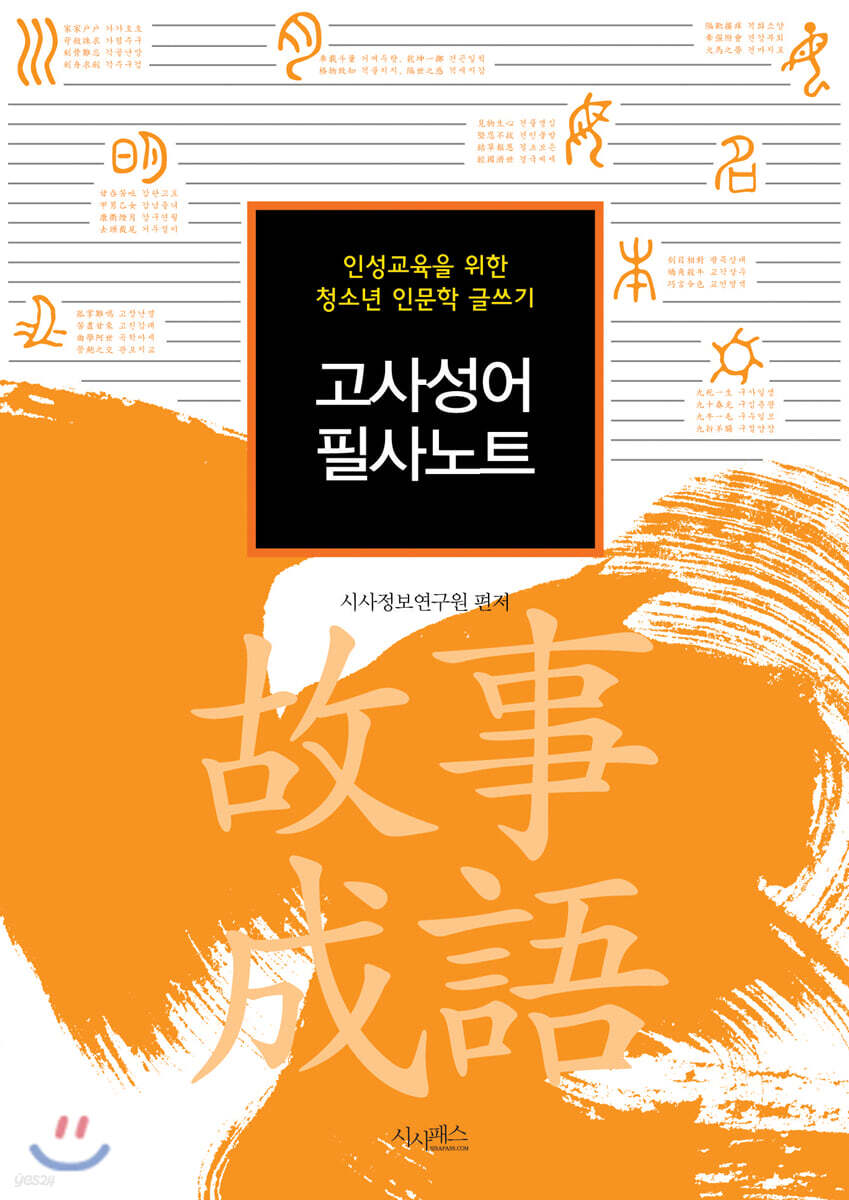 |
Description
Book Introduction
Covers everyday language, college entrance exam knowledge, and Chinese characters all at once.
Humanities Writing for Youth Character Education: "Idiom Notes"
Idioms derived from old tales are mostly made up of four characters, so they are also called four-character idioms.
Idioms are used consistently over time and contain deep and broad wisdom about life.
In addition, idioms are used as lessons, adages, metaphors, symbols, idioms, and proverbs, enriching our daily language expressions.
Since idioms are mainly used in everyday language, readers who have opened the Sisa Pass 『Idiom Handwriting Notes』 can easily find familiar content.
However, even if an idiom frequently appears in books, mass media, or everyday conversation, it is not easy to memorize it if you do not know the Chinese characters well.
To learn effectively, it is important to first become familiar with Chinese characters by memorizing the context of the Chinese idioms and the meaning of the Chinese characters in the 『Chinese Idiom Transcription Notes』.
One of the features of the 『Idiom Handbook』 is that it includes example sentences for each idiom so that it can be applied directly to real life.
Because you can immediately apply it just by looking at the example sentences, as you read, you will find yourself unconsciously using appropriate idioms that come out of your mouth.
There are many books on idioms, but the advantage of 『Idiom Handwriting Notes』 published by Sisapass is that you can learn idioms along with learning Chinese characters.
The order in which Chinese characters are written is called stroke order, and the 『Idiom Transcription Note』 indicates the stroke order for each Chinese character and edits the text so that the characters can be written according to the stroke order.
If you study like this, you can learn idioms much faster than if you just read the text.
We hope that readers will broaden their knowledge of everyday life by reading and writing down idioms in Korean and Chinese characters step by step through the 『Idiom Handwriting Notes』 published by Sisa Pass.
Humanities Writing for Youth Character Education: "Idiom Notes"
Idioms derived from old tales are mostly made up of four characters, so they are also called four-character idioms.
Idioms are used consistently over time and contain deep and broad wisdom about life.
In addition, idioms are used as lessons, adages, metaphors, symbols, idioms, and proverbs, enriching our daily language expressions.
Since idioms are mainly used in everyday language, readers who have opened the Sisa Pass 『Idiom Handwriting Notes』 can easily find familiar content.
However, even if an idiom frequently appears in books, mass media, or everyday conversation, it is not easy to memorize it if you do not know the Chinese characters well.
To learn effectively, it is important to first become familiar with Chinese characters by memorizing the context of the Chinese idioms and the meaning of the Chinese characters in the 『Chinese Idiom Transcription Notes』.
One of the features of the 『Idiom Handbook』 is that it includes example sentences for each idiom so that it can be applied directly to real life.
Because you can immediately apply it just by looking at the example sentences, as you read, you will find yourself unconsciously using appropriate idioms that come out of your mouth.
There are many books on idioms, but the advantage of 『Idiom Handwriting Notes』 published by Sisapass is that you can learn idioms along with learning Chinese characters.
The order in which Chinese characters are written is called stroke order, and the 『Idiom Transcription Note』 indicates the stroke order for each Chinese character and edits the text so that the characters can be written according to the stroke order.
If you study like this, you can learn idioms much faster than if you just read the text.
We hope that readers will broaden their knowledge of everyday life by reading and writing down idioms in Korean and Chinese characters step by step through the 『Idiom Handwriting Notes』 published by Sisa Pass.
- You can preview some of the book's contents.
Preview
index
preface
Features of this book
How to Use the Youth Character Education Idiom Notepad!
The formation principles of Chinese characters
Basic principles of writing Chinese characters
Idiom
Features of this book
How to Use the Youth Character Education Idiom Notepad!
The formation principles of Chinese characters
Basic principles of writing Chinese characters
Idiom
Detailed image
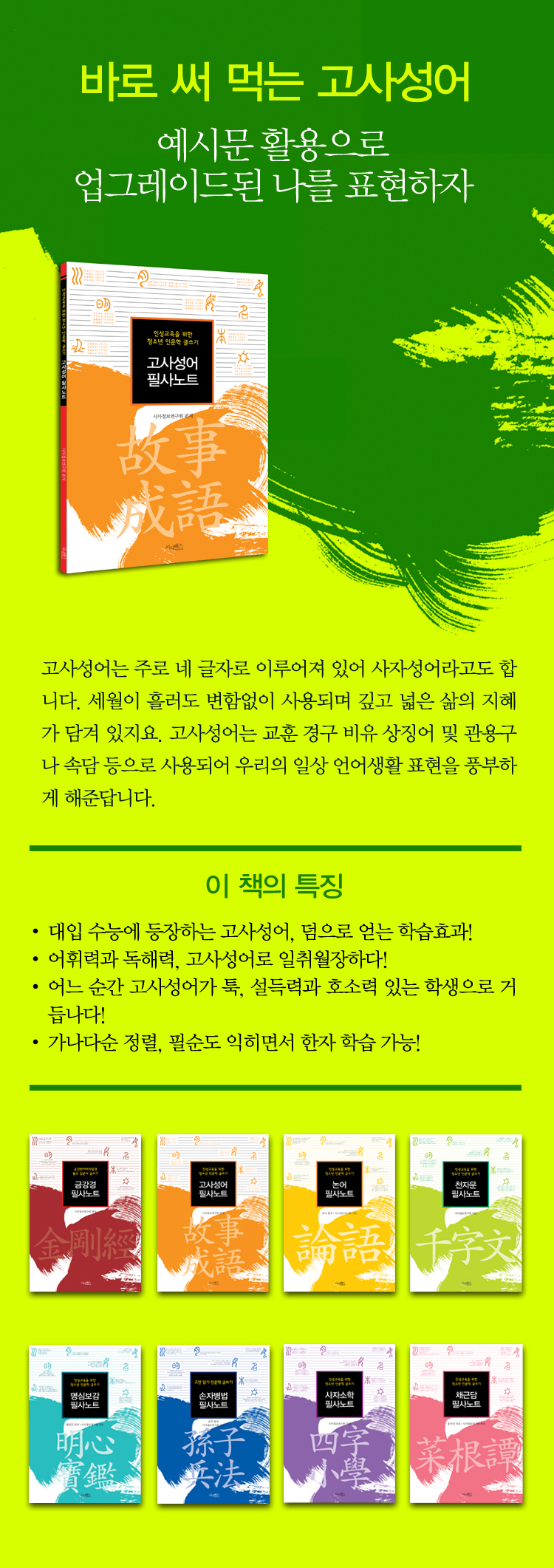
Publisher's Review
Covers everyday language, college entrance exam knowledge, and Chinese characters all at once.
Humanities Writing for Youth Character Education [Idiom Notepad]
Adolescence is a time for self-reflection, specifically exploring what you like and are good at, what interests you, what kind of life you dream of, and what kind of person you want to become.
To find the life and dreams you truly desire, you must first know yourself.
The process of getting to know yourself is the first step in character education.
To properly develop one's innate conscience through character education, one must possess the capacity to independently explore and learn the humanities that cannot be learned in depth through the school curriculum.
To foster the humanities knowledge of young people, the Current Affairs Information Research Institute and Sisa Pass have planned a series of humanities classics handwritten notebooks for character education.
[Idiom Transcription Note] is also one of that series.
Idioms derived from old tales are mostly made up of four characters, so they are also called four-character idioms.
Idioms are used consistently over time and contain deep and broad wisdom about life.
In addition, idioms are used as lessons, adages, metaphors, symbols, idioms, and proverbs, enriching our daily language expressions.
Since idioms are mainly used in everyday language, readers who have opened the Sisa Pass [Idiom Handwriting Notes] can easily find familiar content.
However, even if an idiom frequently appears in books, mass media, or everyday conversation, it is not easy to memorize it if you do not know the Chinese characters well.
To learn effectively, it is important to first become familiar with Chinese characters by memorizing the context of the Chinese idioms and the meaning of the Chinese characters in the [Chinese Idiom Transcription Notes].
One of the features of [Idiom Notepad] is that it includes example sentences for each idiom so that you can apply it directly to real life.
Because you can immediately apply it just by looking at the example sentences, as you read, you will find yourself unconsciously using appropriate idioms that come out of your mouth.
There are many books on idioms, but the advantage of [Idiom Handwriting Notes] published by Sisapass is that you can learn idioms along with learning Chinese characters.
The order in which Chinese characters are written is called stroke order, and [Idiom Transcription Note] has edited the text so that each Chinese character is marked with the stroke order and the characters can be written according to the stroke order.
If you study like this, you can learn idioms much faster than if you just read the text.
We hope that readers will broaden their knowledge of everyday life by reading and writing down idioms in Korean and Chinese characters step by step through the [Idiom Handwriting Notes] published by Sisa Pass.
[Idiom Transcription Note] Features
The learning benefits of idioms that appear in the college entrance exam are a bonus!
Knowing idioms makes it easier to understand the meaning of conversations or literary works, and to grasp hidden meanings.
[Idiom Notepad] is a collection of idioms that are frequently used in our daily lives and are frequently used in textbooks, so you can also get extra benefits in preparing for the college entrance exam and learning.
Improve your vocabulary, reading comprehension, and idioms by leaps and bounds!
Most books that explain idioms are based on old stories.
As a result, it is easy to understand the background of the creation of idioms, but as time goes by, there are many cases where you do not know in what situation they were used or in what situation you should use them.
[Idiom Transcription Note] is organized so that you can immediately use the idioms by providing examples of the situations in which they are used along with their meanings.
It also helps with vocabulary and reading comprehension because you can practice inferring the overall meaning by thinking about the meaning of the Chinese characters that make up the idiom.
At some point, a simple idiom suddenly appears, and the student is reborn as a persuasive and appealing student!
As you learn idioms by seeing them with your eyes, speaking them with your mouth, and writing them with your hands, you will find yourself using appropriate idioms without even realizing it.
A single idiom used in the right context is far more persuasive than a long and complicated explanation.
You can learn Chinese characters while learning alphabetical order and stroke order!
[Idiom Transcription Note] is arranged in alphabetical order, making it easy to look up idioms.
The stroke order of Chinese characters is indicated, so readers can learn Chinese characters on their own.
If you write Chinese characters in stroke order, you will not only be able to write Chinese characters beautifully, but you will also be able to correct your own handwriting.
How to Use Your Youth Character Education Idiom Notepad
▶Let's learn one idiom aloud every day.
Set aside time for yourself to study, read the idioms out loud, and write them down by hand to memorize them.
Because it contains idioms and symbols that are essential to our lives, it helps us grow into upright and mature individuals.
▶It is good for brain development, increased thinking ability, and enhanced concentration.
Our brain has the most neurons connected to our hands.
Moving your fingers a lot stimulates brain cells, which helps brain development.
Finger exercises are also recommended for the treatment and disease prevention of the elderly to activate the brain.
As many researchers have proven through their experiments, learning while writing activates our brains, improves memory, and significantly improves learning effectiveness.
▶You can learn to write neat, clean, pretty, and correct handwriting on your own.
As you write idioms, your handwriting will become neat and pretty.
It has been said since ancient times that handwriting represents one's personality.
By learning idioms, you will develop the ability to learn on your own and at the same time learn neat and pretty handwriting.
Humanities Writing for Youth Character Education [Idiom Notepad]
Adolescence is a time for self-reflection, specifically exploring what you like and are good at, what interests you, what kind of life you dream of, and what kind of person you want to become.
To find the life and dreams you truly desire, you must first know yourself.
The process of getting to know yourself is the first step in character education.
To properly develop one's innate conscience through character education, one must possess the capacity to independently explore and learn the humanities that cannot be learned in depth through the school curriculum.
To foster the humanities knowledge of young people, the Current Affairs Information Research Institute and Sisa Pass have planned a series of humanities classics handwritten notebooks for character education.
[Idiom Transcription Note] is also one of that series.
Idioms derived from old tales are mostly made up of four characters, so they are also called four-character idioms.
Idioms are used consistently over time and contain deep and broad wisdom about life.
In addition, idioms are used as lessons, adages, metaphors, symbols, idioms, and proverbs, enriching our daily language expressions.
Since idioms are mainly used in everyday language, readers who have opened the Sisa Pass [Idiom Handwriting Notes] can easily find familiar content.
However, even if an idiom frequently appears in books, mass media, or everyday conversation, it is not easy to memorize it if you do not know the Chinese characters well.
To learn effectively, it is important to first become familiar with Chinese characters by memorizing the context of the Chinese idioms and the meaning of the Chinese characters in the [Chinese Idiom Transcription Notes].
One of the features of [Idiom Notepad] is that it includes example sentences for each idiom so that you can apply it directly to real life.
Because you can immediately apply it just by looking at the example sentences, as you read, you will find yourself unconsciously using appropriate idioms that come out of your mouth.
There are many books on idioms, but the advantage of [Idiom Handwriting Notes] published by Sisapass is that you can learn idioms along with learning Chinese characters.
The order in which Chinese characters are written is called stroke order, and [Idiom Transcription Note] has edited the text so that each Chinese character is marked with the stroke order and the characters can be written according to the stroke order.
If you study like this, you can learn idioms much faster than if you just read the text.
We hope that readers will broaden their knowledge of everyday life by reading and writing down idioms in Korean and Chinese characters step by step through the [Idiom Handwriting Notes] published by Sisa Pass.
[Idiom Transcription Note] Features
The learning benefits of idioms that appear in the college entrance exam are a bonus!
Knowing idioms makes it easier to understand the meaning of conversations or literary works, and to grasp hidden meanings.
[Idiom Notepad] is a collection of idioms that are frequently used in our daily lives and are frequently used in textbooks, so you can also get extra benefits in preparing for the college entrance exam and learning.
Improve your vocabulary, reading comprehension, and idioms by leaps and bounds!
Most books that explain idioms are based on old stories.
As a result, it is easy to understand the background of the creation of idioms, but as time goes by, there are many cases where you do not know in what situation they were used or in what situation you should use them.
[Idiom Transcription Note] is organized so that you can immediately use the idioms by providing examples of the situations in which they are used along with their meanings.
It also helps with vocabulary and reading comprehension because you can practice inferring the overall meaning by thinking about the meaning of the Chinese characters that make up the idiom.
At some point, a simple idiom suddenly appears, and the student is reborn as a persuasive and appealing student!
As you learn idioms by seeing them with your eyes, speaking them with your mouth, and writing them with your hands, you will find yourself using appropriate idioms without even realizing it.
A single idiom used in the right context is far more persuasive than a long and complicated explanation.
You can learn Chinese characters while learning alphabetical order and stroke order!
[Idiom Transcription Note] is arranged in alphabetical order, making it easy to look up idioms.
The stroke order of Chinese characters is indicated, so readers can learn Chinese characters on their own.
If you write Chinese characters in stroke order, you will not only be able to write Chinese characters beautifully, but you will also be able to correct your own handwriting.
How to Use Your Youth Character Education Idiom Notepad
▶Let's learn one idiom aloud every day.
Set aside time for yourself to study, read the idioms out loud, and write them down by hand to memorize them.
Because it contains idioms and symbols that are essential to our lives, it helps us grow into upright and mature individuals.
▶It is good for brain development, increased thinking ability, and enhanced concentration.
Our brain has the most neurons connected to our hands.
Moving your fingers a lot stimulates brain cells, which helps brain development.
Finger exercises are also recommended for the treatment and disease prevention of the elderly to activate the brain.
As many researchers have proven through their experiments, learning while writing activates our brains, improves memory, and significantly improves learning effectiveness.
▶You can learn to write neat, clean, pretty, and correct handwriting on your own.
As you write idioms, your handwriting will become neat and pretty.
It has been said since ancient times that handwriting represents one's personality.
By learning idioms, you will develop the ability to learn on your own and at the same time learn neat and pretty handwriting.
GOODS SPECIFICS
- Date of publication: November 7, 2019
- Page count, weight, size: 96 pages | 192g | 175*247*5mm
- ISBN13: 9788980974542
- ISBN10: 898097454X
You may also like
카테고리
korean


korean

![GQ KOREA Mark (Monthly): December [2025]](http://librairie.coreenne.fr/cdn/shop/files/8ef265dbbfbf186523ed75ba7319009d.jpg?v=1765340328&width=3840)


