

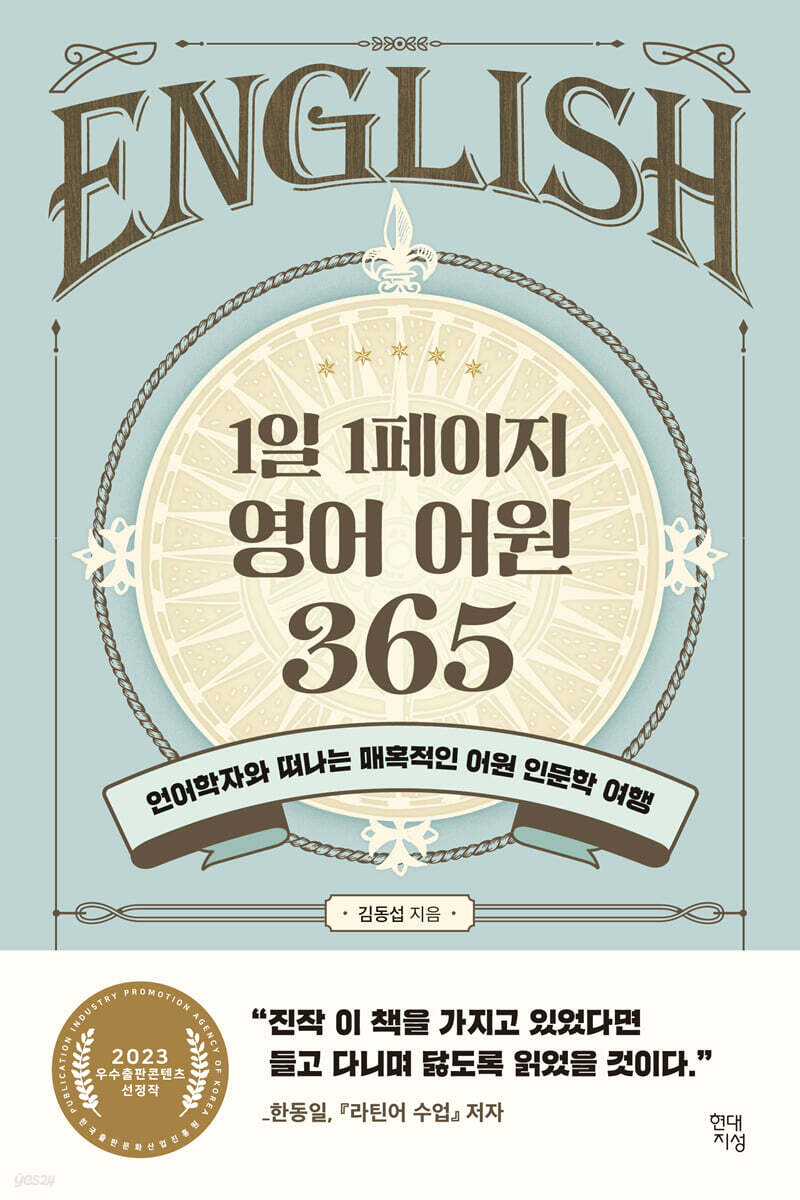
English Etymology 365, One Page a Day
 |
Description
Book Introduction
1 page per day for 365 days
Build your English skills and general knowledge
The World's Most Fascinating Etymological Humanities Journey
Selected for the 2023 Outstanding Publishing Content Humanities and Liberal Arts category!
Highly recommended by Dong-il Han, author of "Latin Lessons"!
Korea's first English etymology textbook tailored to Koreans!
When you break down a language, you see its history and culture.
All languages, including English, did not have their current form from the beginning.
If we trace back the history of English words, we finally reach their roots (etymology).
In the process of exploring and finding its roots, we encounter the diverse history and culture of mankind.
This book is an etymological humanities textbook written by one of Korea's leading linguists, introducing the etymology of English words and the various histories related to them, including literature, mythology, economics, science, religion, art, food, and sports, one page per day for 365 days.
Each of the 365 words has its own unique story.
After reading this interesting story, you will never forget the English words.
In this way, our English skills and general knowledge are built up in our heads.
Although public interest in English etymology has been growing recently, most foreign translations are familiar only to English-speaking readers, leaving Korean readers feeling somewhat distant.
Feeling regretful about this, the author carefully selected words that readers would be familiar with while also arousing their intellectual curiosity.
It unfolds the fascinating story of how these words came to have specific meanings through storytelling.
Additionally, each page is enriched with 365 full-color images related to the story, helping readers understand the content and adding visual enjoyment.
As the author says, after a long journey, discovering the roots of a language and understanding how it has evolved brings the thrill and joy of discovering a hidden treasure.
Through this book, you too can embark on a delightful journey of knowledge into the fascinating and exciting world created by mankind.
Build your English skills and general knowledge
The World's Most Fascinating Etymological Humanities Journey
Selected for the 2023 Outstanding Publishing Content Humanities and Liberal Arts category!
Highly recommended by Dong-il Han, author of "Latin Lessons"!
Korea's first English etymology textbook tailored to Koreans!
When you break down a language, you see its history and culture.
All languages, including English, did not have their current form from the beginning.
If we trace back the history of English words, we finally reach their roots (etymology).
In the process of exploring and finding its roots, we encounter the diverse history and culture of mankind.
This book is an etymological humanities textbook written by one of Korea's leading linguists, introducing the etymology of English words and the various histories related to them, including literature, mythology, economics, science, religion, art, food, and sports, one page per day for 365 days.
Each of the 365 words has its own unique story.
After reading this interesting story, you will never forget the English words.
In this way, our English skills and general knowledge are built up in our heads.
Although public interest in English etymology has been growing recently, most foreign translations are familiar only to English-speaking readers, leaving Korean readers feeling somewhat distant.
Feeling regretful about this, the author carefully selected words that readers would be familiar with while also arousing their intellectual curiosity.
It unfolds the fascinating story of how these words came to have specific meanings through storytelling.
Additionally, each page is enriched with 365 full-color images related to the story, helping readers understand the content and adding visual enjoyment.
As the author says, after a long journey, discovering the roots of a language and understanding how it has evolved brings the thrill and joy of discovering a hidden treasure.
Through this book, you too can embark on a delightful journey of knowledge into the fascinating and exciting world created by mankind.
- You can preview some of the book's contents.
Preview
index
Recommendation
Entering
january
January 1st
2 days Reconquista
Win brownie points on the 3rd day to win favor
4th Economy
5 days Computer Computer
6th Referee/Umpire
7-day Tattoo
8-day Hair of the Dog hangover cure
9th Tire Tire
10 days Coward
Toast on the 11th
Aleatory luck on the 12th
13th Adolescent
14th Maginot Line
15th Inveigle Sweet Talk
Rehearsal on the 16th
17th Vaccine
18th Adultery
19th Ambrosia Ambrosia
20th Brassiere bra
Amazon on the 21st
22nd Pie Pie
Attorney on the 23rd
24th Queen consort
25-day Average
26th Australia
27th Bull and Bear
28th Blasphemy
29th Carnivore
30-day Book
Deadline on the 31st
february
February 1st
2-day Symposium
3-day Printing
4 days Veronica Veronica
5 days Blow hot and cold, very moody
6th Tulip mania
7th Red-letter day
8th King's evil performance
9th Maroon
10-day Bowel
11th Carat Carat
12th Character Character
13th Nicotine
14th Cliche
15 days Mile Mile
Clue 16th
17th Cognate, a word with the same etymology
18th Data Data
19th Read the riot act Severely scold
Consul on the 20th
Derby on the 21st
22nd Devil
23rd Juggernaut
24th Slogan
25th Dream Dream
Issue Issue on the 26th
27th Egregious
28th Napkin Napkin
March
1st Spring
2 days Bite the dust
3-day Fee
4th Galaxy
5 days Gay Gay
6th Glamour
7 days Birdie Buddy
8-day Cohort Cohort
9th Palace Palace
10-day Helpmate Spouse
11th Queer
12th Avocado Avocado
13th Assassination
14th Man
15th Et tu, Brute! Brutus, you too!
16th Hippopotamus hippopotamus
17th Hobby
18th Host Host
19th Humble Pie Humiliation
I woke up and practiced Smell of the Lamp on the 20th.
21st Village idiot
22nd Chauffeur Private Car Driver
23rd Boycott
24th Internecine war
25th Island
Auction on the 26th
27th Jubilee
28th Ignition
29-day Taboo
30-day Encyclopedia
31st Macho
april
April Fools' Day
2 days Turn a blind eye, pretend not to know
3 days Giga
4 days Dollar
5 days Easter Island
6 days Fury
7th Cross
8 days of Imsomnia
9th Cousin
10 days Lethal
11th Mall Mall
12th Metaverse
13th Hygiene
14th Fiance
15th Nickname
16th Narcissism
17-day Diet
Nice on the 18th
Mass on the 19th
20th Omen Sign
21 days of Migraine
22nd Gymnasium Indoor Gymnasium
23rd Quixotic Fantastic
24th Disaster
25th America America
26th Moon
27th Candidate
28th Investment
29th Electricity
30 days Cajun
May
1st Love Day
Day 2 Lunch
3 days Green-eyed Jealous
4th Don't count your chickens Don't drink kimchi stew first
5 days Panic Panic
6th Swiss mercenaries
7 days Homo Sapiens
8 days Medium
9th Handicap
10 days Sour grapes
11th Circus Circus
12th Menu Menu
13th Curriculum Curriculum
14th Absolute monarchy
15th Realty
16th Lingerie
17th Alibi Alibi
18th Sphinx
19th Manuscript
Pardon on the 20th
21st Bacon Bacon
22nd Baptism
23rd Monster
24th Thermometer
25th Iris Iris
26th Expedition
27th Agenda
Eclipse on the 28th
29th Fumade Smoked Herring
30-day Pomade
Prince of Wales on the 31st
June
1 day Salad days, the days of recklessness
2-day picnic
3 days Capital
4 days Acre acre
5th Subject: Shinha
6 days Zero Zero
7th Providence
8 days Anorexia
9th Patient
10-day terror fear
11th Gothic Gothic
12th Experiment
13th Epicurean Hedonist
14th Census
15-day Flour
16th day, kill the god Deicide
King Rex on the 17th
18th Meteorology
Aqueduct on the 19th
20th Extraterrestrial
21st Execution
22nd Alto
Pope on the 23rd
24th Inebriation
25th Petroleum
Oracle Trust on the 26th
27th Sponge
28th Thumb
29th Ketchup
30 days of liberal arts
July
1 day Novel
2nd Annunciation
3 days Rara avis rare sight
4 days of Shambles mess
5-day Parasite
6 days Utopia Utopia
7-day Pattern
8th Penthouse Penthouse
9th Person
10 days Omnipotence
11th Protocol Ceremony
12th Quicksilver Mercury
13th Sell down the river betray
14th Revolution
15th Pigeon
16th Planet
17th Plumber
18th Pretext Pretext
19th Lesbian
20-day Plot Conspiracy
21st Atlas Atlas
Conquest on the 22nd
23rd Fascism
24th Sycophant Flatterer
25th Andrew Andrew
26th Cancer
27th Germany
28th Salary
29th Senate
30-day Silhouette
31st Porcelain
August
August 1st
2-day Quintessence
3 days Maverick
4th Siren Siren
5 days Slave
6-day Shampoo
7 days Stamina
On the 8th, the Stentorian voice boomed
9th Canada
10 days Dog days Sambok heat
11th Propaganda
12th Steward
13th Scandal
14th Brand Brand
15th Stomach
Target on the 16th
17th Test Test
18th Treasure
19th Tuxedo
20 days Epic
21st Whiskey
22nd Surgeon
23rd Golden age
24th Rice
25th Benjamin
The Last Supper on the 26th Cenacle
27th Holocaust
28th Hierarchy
29th Phoenix
30 days Bed of Procrustes
Exodus on the 31st
September
1-day furlough
2nd Speak well of the dead
3 days Fly in the ointment
4 days to become a generic name for Genericide
5th Sabbath
6 days Lesser evil
7th Indian Summer
8th Misanthrope A person who hates people
9th Anglo-Saxon
Last minute on the 10th, 11th hour
11th Ground Zero
12th Croissant
13th Poor as Job Very poor
14th Archaeology
15th Cosmos
16th Calligraphy
17th Hemophilia
18th Democracy
19th Metropolis
20th Crocodile tears
21st Knot Note
22nd Idiom
23rd Theology
24th Ergonomics
25th Cyber
26th Volume Volume
27th Hostage Hostage
28th Astronaut
29th Heroin Heroin
30-day bill of exchange
october
1 day Ballista Ballista
2 days Bear Bear
3 days Heart of stone buried person
4 days Devil's advocate
5-day Quiz Quiz
6th Dunce Dunjae
7-day Pension
8 days Berserk Violent
9th Nightmare
10 days Groggy unable to control body
11th Genuine genuine
12th Bibulous Drunkard
13th When pigs fly, hold the intestines in your hand
14th Cue
15-day Hazard Risk
Euthanasia euthanasia on the 16th
17th Wild-goose chase in vain
Zenith peak on the 18th
19th Design Design
Windfall windfall on the 20th
21st Admiral
22nd Purple
23rd Nostalgia perfume
24th Usurer Moneylender
Thursday the 25th
Peter Pan on the 26th
27th Malaria
28th Bidet Bidet
29th Entrepreneur
30 days Onomatopoeia
Halloween on the 31st
November
1-Day Jargon Terminology
2 days Knock on wood! Don't let the negativity get to you
Please do it!
3 days Spill salt
4 days It's all Greek to me! I don't know a thing!
5-day Ostracism
6th Will
7 days Gordian knot Gordian knot
8th Cynic
Coup d'Etat on the 9th
10 days Thorn in my side headache
11th Chapel
12th Etymology
13th Moratorium
14 days Mayonnaise
15th Misogynist Misogynist Man
16th Analogue & Digital Analogue and
digital
17th Wool
18th Decoupling
Tragedy on the 19th
20 days Muscle Muscle
21st Balloon Balloon
22nd Original Original
23rd Xenophobia
24th Oxymoron Oxymoron
25th Humor
26-day Guarantee
27th Villain
Haven asset safe asset on the 28th
29th Parachute
30 days Melancholy
december
1 day Dutch courage guest
2 days Lion's share
3 days Ammonia
4th Album Album
Blessings on the 5th
6-day Slush fund
7-day Breakfast
8 days Fan Fan
9 days of harassing Rankle
10 days Dynamite
11th Accord Agreement
12th Restaurant
13th Gossip
14th Blue
15th Mummy
16th Grand Slam Grand Slam
17th Deuce
18th Obsession
19th Entree
20th Malice
21st Jovial Very cheerful
22nd Tense tense
Grease one's palm on the 23rd to use bribes
24th Buffet
25th Hooligan
26th Crew
27th Hieroglyph
28-day Kinesitherapy exercise therapy
29th Irony
30 days Weird
31st Hyperborea Hyperborea
Americas
Entering
january
January 1st
2 days Reconquista
Win brownie points on the 3rd day to win favor
4th Economy
5 days Computer Computer
6th Referee/Umpire
7-day Tattoo
8-day Hair of the Dog hangover cure
9th Tire Tire
10 days Coward
Toast on the 11th
Aleatory luck on the 12th
13th Adolescent
14th Maginot Line
15th Inveigle Sweet Talk
Rehearsal on the 16th
17th Vaccine
18th Adultery
19th Ambrosia Ambrosia
20th Brassiere bra
Amazon on the 21st
22nd Pie Pie
Attorney on the 23rd
24th Queen consort
25-day Average
26th Australia
27th Bull and Bear
28th Blasphemy
29th Carnivore
30-day Book
Deadline on the 31st
february
February 1st
2-day Symposium
3-day Printing
4 days Veronica Veronica
5 days Blow hot and cold, very moody
6th Tulip mania
7th Red-letter day
8th King's evil performance
9th Maroon
10-day Bowel
11th Carat Carat
12th Character Character
13th Nicotine
14th Cliche
15 days Mile Mile
Clue 16th
17th Cognate, a word with the same etymology
18th Data Data
19th Read the riot act Severely scold
Consul on the 20th
Derby on the 21st
22nd Devil
23rd Juggernaut
24th Slogan
25th Dream Dream
Issue Issue on the 26th
27th Egregious
28th Napkin Napkin
March
1st Spring
2 days Bite the dust
3-day Fee
4th Galaxy
5 days Gay Gay
6th Glamour
7 days Birdie Buddy
8-day Cohort Cohort
9th Palace Palace
10-day Helpmate Spouse
11th Queer
12th Avocado Avocado
13th Assassination
14th Man
15th Et tu, Brute! Brutus, you too!
16th Hippopotamus hippopotamus
17th Hobby
18th Host Host
19th Humble Pie Humiliation
I woke up and practiced Smell of the Lamp on the 20th.
21st Village idiot
22nd Chauffeur Private Car Driver
23rd Boycott
24th Internecine war
25th Island
Auction on the 26th
27th Jubilee
28th Ignition
29-day Taboo
30-day Encyclopedia
31st Macho
april
April Fools' Day
2 days Turn a blind eye, pretend not to know
3 days Giga
4 days Dollar
5 days Easter Island
6 days Fury
7th Cross
8 days of Imsomnia
9th Cousin
10 days Lethal
11th Mall Mall
12th Metaverse
13th Hygiene
14th Fiance
15th Nickname
16th Narcissism
17-day Diet
Nice on the 18th
Mass on the 19th
20th Omen Sign
21 days of Migraine
22nd Gymnasium Indoor Gymnasium
23rd Quixotic Fantastic
24th Disaster
25th America America
26th Moon
27th Candidate
28th Investment
29th Electricity
30 days Cajun
May
1st Love Day
Day 2 Lunch
3 days Green-eyed Jealous
4th Don't count your chickens Don't drink kimchi stew first
5 days Panic Panic
6th Swiss mercenaries
7 days Homo Sapiens
8 days Medium
9th Handicap
10 days Sour grapes
11th Circus Circus
12th Menu Menu
13th Curriculum Curriculum
14th Absolute monarchy
15th Realty
16th Lingerie
17th Alibi Alibi
18th Sphinx
19th Manuscript
Pardon on the 20th
21st Bacon Bacon
22nd Baptism
23rd Monster
24th Thermometer
25th Iris Iris
26th Expedition
27th Agenda
Eclipse on the 28th
29th Fumade Smoked Herring
30-day Pomade
Prince of Wales on the 31st
June
1 day Salad days, the days of recklessness
2-day picnic
3 days Capital
4 days Acre acre
5th Subject: Shinha
6 days Zero Zero
7th Providence
8 days Anorexia
9th Patient
10-day terror fear
11th Gothic Gothic
12th Experiment
13th Epicurean Hedonist
14th Census
15-day Flour
16th day, kill the god Deicide
King Rex on the 17th
18th Meteorology
Aqueduct on the 19th
20th Extraterrestrial
21st Execution
22nd Alto
Pope on the 23rd
24th Inebriation
25th Petroleum
Oracle Trust on the 26th
27th Sponge
28th Thumb
29th Ketchup
30 days of liberal arts
July
1 day Novel
2nd Annunciation
3 days Rara avis rare sight
4 days of Shambles mess
5-day Parasite
6 days Utopia Utopia
7-day Pattern
8th Penthouse Penthouse
9th Person
10 days Omnipotence
11th Protocol Ceremony
12th Quicksilver Mercury
13th Sell down the river betray
14th Revolution
15th Pigeon
16th Planet
17th Plumber
18th Pretext Pretext
19th Lesbian
20-day Plot Conspiracy
21st Atlas Atlas
Conquest on the 22nd
23rd Fascism
24th Sycophant Flatterer
25th Andrew Andrew
26th Cancer
27th Germany
28th Salary
29th Senate
30-day Silhouette
31st Porcelain
August
August 1st
2-day Quintessence
3 days Maverick
4th Siren Siren
5 days Slave
6-day Shampoo
7 days Stamina
On the 8th, the Stentorian voice boomed
9th Canada
10 days Dog days Sambok heat
11th Propaganda
12th Steward
13th Scandal
14th Brand Brand
15th Stomach
Target on the 16th
17th Test Test
18th Treasure
19th Tuxedo
20 days Epic
21st Whiskey
22nd Surgeon
23rd Golden age
24th Rice
25th Benjamin
The Last Supper on the 26th Cenacle
27th Holocaust
28th Hierarchy
29th Phoenix
30 days Bed of Procrustes
Exodus on the 31st
September
1-day furlough
2nd Speak well of the dead
3 days Fly in the ointment
4 days to become a generic name for Genericide
5th Sabbath
6 days Lesser evil
7th Indian Summer
8th Misanthrope A person who hates people
9th Anglo-Saxon
Last minute on the 10th, 11th hour
11th Ground Zero
12th Croissant
13th Poor as Job Very poor
14th Archaeology
15th Cosmos
16th Calligraphy
17th Hemophilia
18th Democracy
19th Metropolis
20th Crocodile tears
21st Knot Note
22nd Idiom
23rd Theology
24th Ergonomics
25th Cyber
26th Volume Volume
27th Hostage Hostage
28th Astronaut
29th Heroin Heroin
30-day bill of exchange
october
1 day Ballista Ballista
2 days Bear Bear
3 days Heart of stone buried person
4 days Devil's advocate
5-day Quiz Quiz
6th Dunce Dunjae
7-day Pension
8 days Berserk Violent
9th Nightmare
10 days Groggy unable to control body
11th Genuine genuine
12th Bibulous Drunkard
13th When pigs fly, hold the intestines in your hand
14th Cue
15-day Hazard Risk
Euthanasia euthanasia on the 16th
17th Wild-goose chase in vain
Zenith peak on the 18th
19th Design Design
Windfall windfall on the 20th
21st Admiral
22nd Purple
23rd Nostalgia perfume
24th Usurer Moneylender
Thursday the 25th
Peter Pan on the 26th
27th Malaria
28th Bidet Bidet
29th Entrepreneur
30 days Onomatopoeia
Halloween on the 31st
November
1-Day Jargon Terminology
2 days Knock on wood! Don't let the negativity get to you
Please do it!
3 days Spill salt
4 days It's all Greek to me! I don't know a thing!
5-day Ostracism
6th Will
7 days Gordian knot Gordian knot
8th Cynic
Coup d'Etat on the 9th
10 days Thorn in my side headache
11th Chapel
12th Etymology
13th Moratorium
14 days Mayonnaise
15th Misogynist Misogynist Man
16th Analogue & Digital Analogue and
digital
17th Wool
18th Decoupling
Tragedy on the 19th
20 days Muscle Muscle
21st Balloon Balloon
22nd Original Original
23rd Xenophobia
24th Oxymoron Oxymoron
25th Humor
26-day Guarantee
27th Villain
Haven asset safe asset on the 28th
29th Parachute
30 days Melancholy
december
1 day Dutch courage guest
2 days Lion's share
3 days Ammonia
4th Album Album
Blessings on the 5th
6-day Slush fund
7-day Breakfast
8 days Fan Fan
9 days of harassing Rankle
10 days Dynamite
11th Accord Agreement
12th Restaurant
13th Gossip
14th Blue
15th Mummy
16th Grand Slam Grand Slam
17th Deuce
18th Obsession
19th Entree
20th Malice
21st Jovial Very cheerful
22nd Tense tense
Grease one's palm on the 23rd to use bribes
24th Buffet
25th Hooligan
26th Crew
27th Hieroglyph
28-day Kinesitherapy exercise therapy
29th Irony
30 days Weird
31st Hyperborea Hyperborea
Americas
Detailed image
.jpg)
Into the book
Janus also rules over the beginning and end of time.
Janus also rules over dawn, the beginning of the day, and the first day of the month, the beginning of the month.
The name Janus is included in January, the beginning of the year, because we see both December, the end of the year, and January, the beginning of the new year, at the same time.
Janus' reputation is conflicting in ancient Rome and modern Europe.
Ancient Roman soldiers prayed for good luck by looking at the face of the god carved in the temple of Janus.
However, 18th century Europeans perceived Janus with two faces as a negative image, attaching the meaning of a 'double-faced hypocrite' to him.
--- From "January 1st"
The satyr led the man into the house, who was constantly blowing on his hand.
The satyr found this strange and asked.
“Why are you blowing on my hand like that?” The man replied that he was doing it to warm his cold hand.
As soon as we got home, the satyr brought out a thick, hot meal of porridge.
The man who had just taken a sip of the soup began to blow his breath onto the spoon.
Then the satyr asked again.
“Why are you blowing on the porridge?” The man replied that the porridge was too hot and he was blowing on it to cool it down.
Then the satyr said:
“I just can’t understand it.
“Humans can make things hot or cold with the same breath…” The English expression that came from this is ‘blow hot and cold.’
--- From "Blow hot and cold (fickle)" on February 5th
In Korea, where Confucian traditions are strong, homosexuality is almost taboo.
For this reason, ‘queer festivals’ are sometimes permitted or not permitted depending on the government’s inclination.
If you look up the English word queer in the dictionary, the first meaning is 'strange' and the second meaning is 'homosexuality between men'.
The English word queer originally comes from Scottish, and in the 18th century it came to mean 'out of the bounds of normal feelings and behavior'.
Afterwards, it was also used as a slang term for ‘counterfeit money.’
In English, the idiom "in queer street" does not mean "to be on a queer street," but rather "to be suffering from a lack of money."
--- From "March 11 Queer"
In 1992, American novelist Neal Stephenson first used the term metaverse by combining meta with universe in his novel Snow Crash.
Here, meta- means ‘transcending’.
He named the 3D virtual world that transcends reality the metaverse. In other words, the metaverse can be said to be a 3D virtual space where social and economic activities similar to those in the real world are common.
The concept of the metaverse is already being applied in online games, with buying and selling game items, for example, taking place in the metaverse space.
--- From "Metaverse, April 12"
Among Shakespeare's four major tragedies, Othello also depicts a tragedy caused by human jealousy.
There is a famous line in this work.
This is what Iago says to Othello.
“Oh, my lord, beware of jealousy.
“Jealousy is a green-eyed monster that preys on the human heart.” (Act 3, Scene 3)
Here, Shakespeare describes the 'jealousy incarnate' as a green-eyed monster.
The ancient Greeks believed that if someone was blinded by jealousy, their eyes would turn green due to excessive secretion of bile. This expression was created from this.
--- From "Green-eyed (Jealous)" on May 3rd
The stomach is one of the most important organs in the human body.
The ancient Greeks called the stomach stoma, which, oddly enough, meant 'mouth'.
Perhaps it was so named because the mouth and stomach are connected by the esophagus.
In English, mouth sores are called stomatitis.
The meaning of stoma, meaning mouth, still lives on.
The word stoma, which used to mean the mouth, later gradually changed to refer to the lower organs of the human body.
It passes through the throat and esophagus and finally reaches the stomach.
The English word stomach, which refers to the top, also has a metaphorical meaning.
The ancient Romans believed that the stomach controlled human mood.
So, as we entered the 16th century, take stomach came to mean take heart, and when stomach was used as a verb, it came to mean attack.
In modern English, stomach is used to mean 'to enjoy' and 'to endure', meanings that come from the ancient Romans who believed that the stomach regulates human emotions.
--- From "August 15th Stomach (above)"
Meanwhile, the Germanic people who destroyed the Roman Empire named the days of the week after their gods.
Representative days are Wednesday, Thursday, and Friday.
Wednesday is the day of Odin, the chief god of Norse mythology, Thursday is the day of Thor, the god of thunder and lightning, and Friday is the day of Freya, the goddess of beauty.
In Greek mythology, the god in charge of thunder and lightning is Zeus (Jupiter in Roman mythology), whereas in Germanic mythology, Thor, the son of Odin, controls thunder and lightning and is also the god of agriculture.
The word thunder, which means lightning in English, comes from Thor.
Janus also rules over dawn, the beginning of the day, and the first day of the month, the beginning of the month.
The name Janus is included in January, the beginning of the year, because we see both December, the end of the year, and January, the beginning of the new year, at the same time.
Janus' reputation is conflicting in ancient Rome and modern Europe.
Ancient Roman soldiers prayed for good luck by looking at the face of the god carved in the temple of Janus.
However, 18th century Europeans perceived Janus with two faces as a negative image, attaching the meaning of a 'double-faced hypocrite' to him.
--- From "January 1st"
The satyr led the man into the house, who was constantly blowing on his hand.
The satyr found this strange and asked.
“Why are you blowing on my hand like that?” The man replied that he was doing it to warm his cold hand.
As soon as we got home, the satyr brought out a thick, hot meal of porridge.
The man who had just taken a sip of the soup began to blow his breath onto the spoon.
Then the satyr asked again.
“Why are you blowing on the porridge?” The man replied that the porridge was too hot and he was blowing on it to cool it down.
Then the satyr said:
“I just can’t understand it.
“Humans can make things hot or cold with the same breath…” The English expression that came from this is ‘blow hot and cold.’
--- From "Blow hot and cold (fickle)" on February 5th
In Korea, where Confucian traditions are strong, homosexuality is almost taboo.
For this reason, ‘queer festivals’ are sometimes permitted or not permitted depending on the government’s inclination.
If you look up the English word queer in the dictionary, the first meaning is 'strange' and the second meaning is 'homosexuality between men'.
The English word queer originally comes from Scottish, and in the 18th century it came to mean 'out of the bounds of normal feelings and behavior'.
Afterwards, it was also used as a slang term for ‘counterfeit money.’
In English, the idiom "in queer street" does not mean "to be on a queer street," but rather "to be suffering from a lack of money."
--- From "March 11 Queer"
In 1992, American novelist Neal Stephenson first used the term metaverse by combining meta with universe in his novel Snow Crash.
Here, meta- means ‘transcending’.
He named the 3D virtual world that transcends reality the metaverse. In other words, the metaverse can be said to be a 3D virtual space where social and economic activities similar to those in the real world are common.
The concept of the metaverse is already being applied in online games, with buying and selling game items, for example, taking place in the metaverse space.
--- From "Metaverse, April 12"
Among Shakespeare's four major tragedies, Othello also depicts a tragedy caused by human jealousy.
There is a famous line in this work.
This is what Iago says to Othello.
“Oh, my lord, beware of jealousy.
“Jealousy is a green-eyed monster that preys on the human heart.” (Act 3, Scene 3)
Here, Shakespeare describes the 'jealousy incarnate' as a green-eyed monster.
The ancient Greeks believed that if someone was blinded by jealousy, their eyes would turn green due to excessive secretion of bile. This expression was created from this.
--- From "Green-eyed (Jealous)" on May 3rd
The stomach is one of the most important organs in the human body.
The ancient Greeks called the stomach stoma, which, oddly enough, meant 'mouth'.
Perhaps it was so named because the mouth and stomach are connected by the esophagus.
In English, mouth sores are called stomatitis.
The meaning of stoma, meaning mouth, still lives on.
The word stoma, which used to mean the mouth, later gradually changed to refer to the lower organs of the human body.
It passes through the throat and esophagus and finally reaches the stomach.
The English word stomach, which refers to the top, also has a metaphorical meaning.
The ancient Romans believed that the stomach controlled human mood.
So, as we entered the 16th century, take stomach came to mean take heart, and when stomach was used as a verb, it came to mean attack.
In modern English, stomach is used to mean 'to enjoy' and 'to endure', meanings that come from the ancient Romans who believed that the stomach regulates human emotions.
--- From "August 15th Stomach (above)"
Meanwhile, the Germanic people who destroyed the Roman Empire named the days of the week after their gods.
Representative days are Wednesday, Thursday, and Friday.
Wednesday is the day of Odin, the chief god of Norse mythology, Thursday is the day of Thor, the god of thunder and lightning, and Friday is the day of Freya, the goddess of beauty.
In Greek mythology, the god in charge of thunder and lightning is Zeus (Jupiter in Roman mythology), whereas in Germanic mythology, Thor, the son of Odin, controls thunder and lightning and is also the god of agriculture.
The word thunder, which means lightning in English, comes from Thor.
--- From "Thursday, October 25th"
Publisher's Review
If you split the language
History and culture are visible
All languages, including English, did not have their current form from the beginning.
If we trace back the history of English words, we finally reach their roots (etymology).
In the process of exploring and finding its roots, we encounter the diverse history and culture of mankind.
I'll introduce just three of the 365 stories in "1 Page a Day, 365 English Etymology" as a taste.
First, let's look at the word 'ketchup'.
Where did this word come from? The British who arrived in the Malay Peninsula in the 19th century were also very interested in local cuisine.
One day, an English gentleman stopped by a Chinese restaurant and saw a fermented fish sauce called 'Kuechiip'.
It is the Chinese pronunciation of the Chinese character 鮭汁, meaning fish juice.
Later, the British made a tomato-based sauce without fish, and called it 'ketchup'.
The arm guards worn by soldiers in medieval Europe were called brassiere in French.
In French, bras means 'arm'.
In modern French, brassier refers to a vest or marine life jacket worn by children.
However, when this word entered English, it was reborn as 'brassiere', a women's underwear.
The semantic link can be understood by thinking of the similarity between wearing a bra and a life jacket.
The etymology of the word 'shampoo' is also interesting.
The word shampoo comes from the Sanskrit word chapati, an ancient Indian word.
It is a word with the same meaning as ‘press,’ ‘knead,’ or ‘relax.’
The cool and soft feeling that modern people feel when washing their hair at a beauty salon is the origin of the word shampoo.
Korea's first customized Korean
English Etymology Humanities Textbook
This book was written by Professor Kim Dong-seop, one of Korea's leading linguists.
The author, who majored in French language and linguistics in France, is a rare linguist in Korea who has long studied the humanities background of language, including history, culture, mythology, and religion.
He has consistently dedicated himself to colorfully interpreting Western history and mythology through various languages, including ancient Greek, Latin, medieval French, and medieval English.
This book is the definitive edition of a general etymological humanities textbook, presented to the general public based on the author's accumulated academic skills and outstanding writing skills.
Recently, public interest in English etymology has been increasing.
However, most foreign translations are only familiar to English-speaking readers, so they feel somewhat distant to domestic readers.
Feeling regretful about this, the author carefully selected and introduced words that are widely used by domestic readers and are likely to arouse intellectual curiosity, such as symposium, tattoo, data, brand, issue, boycott, lesbian, metaverse, diet, panic, agenda, scandal, and cyber.
It also introduces unfamiliar but useful idiomatic expressions such as 'green-eyed', 'win brownie points', 'bow hot and cld', and 'turn a blind eye'.
It unfolds the fascinating story of how these words came to have specific meanings through storytelling.
Additionally, each page is enriched with 365 full-color images related to the story, helping readers understand the content and adding visual enjoyment.
"1 Page a Day, 365 English Etymology," the first etymology textbook tailored to Koreans, was recognized for its innovative concept and was selected as a book in the humanities category in the "2023 Excellent Publishing Content Production Support Project" conducted by the Korea Creative Content Agency.
And improve your English skills
Build up your general knowledge
As the title suggests, this book contains the etymology of English words and the history, literature, mythology, economics, science, religion, art, food, sports, and other various histories related to them, one word per page per day for 365 days.
Each of the 365 words introduced in this book has its own unique story.
After reading this interesting story, you will never forget the English words.
In this way, our English skills and general knowledge are naturally built up in our heads.
It will be a useful help not only for middle and high school students preparing for English exams, but also for anyone of any age or gender who is learning English on their own to study English in a unique and fun way.
As the author says, after a long journey, discovering the roots of a language and understanding how it has evolved brings the thrill and joy of discovering a hidden treasure.
The joy of discovering the secret of etymology at this time is comparable to Archimedes' “Eureka!”
Readers, let us embark on a delightful journey of knowledge through this book into the fascinating and exciting world created by mankind.
History and culture are visible
All languages, including English, did not have their current form from the beginning.
If we trace back the history of English words, we finally reach their roots (etymology).
In the process of exploring and finding its roots, we encounter the diverse history and culture of mankind.
I'll introduce just three of the 365 stories in "1 Page a Day, 365 English Etymology" as a taste.
First, let's look at the word 'ketchup'.
Where did this word come from? The British who arrived in the Malay Peninsula in the 19th century were also very interested in local cuisine.
One day, an English gentleman stopped by a Chinese restaurant and saw a fermented fish sauce called 'Kuechiip'.
It is the Chinese pronunciation of the Chinese character 鮭汁, meaning fish juice.
Later, the British made a tomato-based sauce without fish, and called it 'ketchup'.
The arm guards worn by soldiers in medieval Europe were called brassiere in French.
In French, bras means 'arm'.
In modern French, brassier refers to a vest or marine life jacket worn by children.
However, when this word entered English, it was reborn as 'brassiere', a women's underwear.
The semantic link can be understood by thinking of the similarity between wearing a bra and a life jacket.
The etymology of the word 'shampoo' is also interesting.
The word shampoo comes from the Sanskrit word chapati, an ancient Indian word.
It is a word with the same meaning as ‘press,’ ‘knead,’ or ‘relax.’
The cool and soft feeling that modern people feel when washing their hair at a beauty salon is the origin of the word shampoo.
Korea's first customized Korean
English Etymology Humanities Textbook
This book was written by Professor Kim Dong-seop, one of Korea's leading linguists.
The author, who majored in French language and linguistics in France, is a rare linguist in Korea who has long studied the humanities background of language, including history, culture, mythology, and religion.
He has consistently dedicated himself to colorfully interpreting Western history and mythology through various languages, including ancient Greek, Latin, medieval French, and medieval English.
This book is the definitive edition of a general etymological humanities textbook, presented to the general public based on the author's accumulated academic skills and outstanding writing skills.
Recently, public interest in English etymology has been increasing.
However, most foreign translations are only familiar to English-speaking readers, so they feel somewhat distant to domestic readers.
Feeling regretful about this, the author carefully selected and introduced words that are widely used by domestic readers and are likely to arouse intellectual curiosity, such as symposium, tattoo, data, brand, issue, boycott, lesbian, metaverse, diet, panic, agenda, scandal, and cyber.
It also introduces unfamiliar but useful idiomatic expressions such as 'green-eyed', 'win brownie points', 'bow hot and cld', and 'turn a blind eye'.
It unfolds the fascinating story of how these words came to have specific meanings through storytelling.
Additionally, each page is enriched with 365 full-color images related to the story, helping readers understand the content and adding visual enjoyment.
"1 Page a Day, 365 English Etymology," the first etymology textbook tailored to Koreans, was recognized for its innovative concept and was selected as a book in the humanities category in the "2023 Excellent Publishing Content Production Support Project" conducted by the Korea Creative Content Agency.
And improve your English skills
Build up your general knowledge
As the title suggests, this book contains the etymology of English words and the history, literature, mythology, economics, science, religion, art, food, sports, and other various histories related to them, one word per page per day for 365 days.
Each of the 365 words introduced in this book has its own unique story.
After reading this interesting story, you will never forget the English words.
In this way, our English skills and general knowledge are naturally built up in our heads.
It will be a useful help not only for middle and high school students preparing for English exams, but also for anyone of any age or gender who is learning English on their own to study English in a unique and fun way.
As the author says, after a long journey, discovering the roots of a language and understanding how it has evolved brings the thrill and joy of discovering a hidden treasure.
The joy of discovering the secret of etymology at this time is comparable to Archimedes' “Eureka!”
Readers, let us embark on a delightful journey of knowledge through this book into the fascinating and exciting world created by mankind.
GOODS SPECIFICS
- Date of issue: October 25, 2023
- Page count, weight, size: 408 pages | 606g | 150*225*25mm
- ISBN13: 9791139716122
- ISBN10: 1139716123
You may also like
카테고리
korean


korean

![GQ KOREA Mark (Monthly): December [2025]](http://librairie.coreenne.fr/cdn/shop/files/8ef265dbbfbf186523ed75ba7319009d.jpg?v=1765340328&width=3840)


