

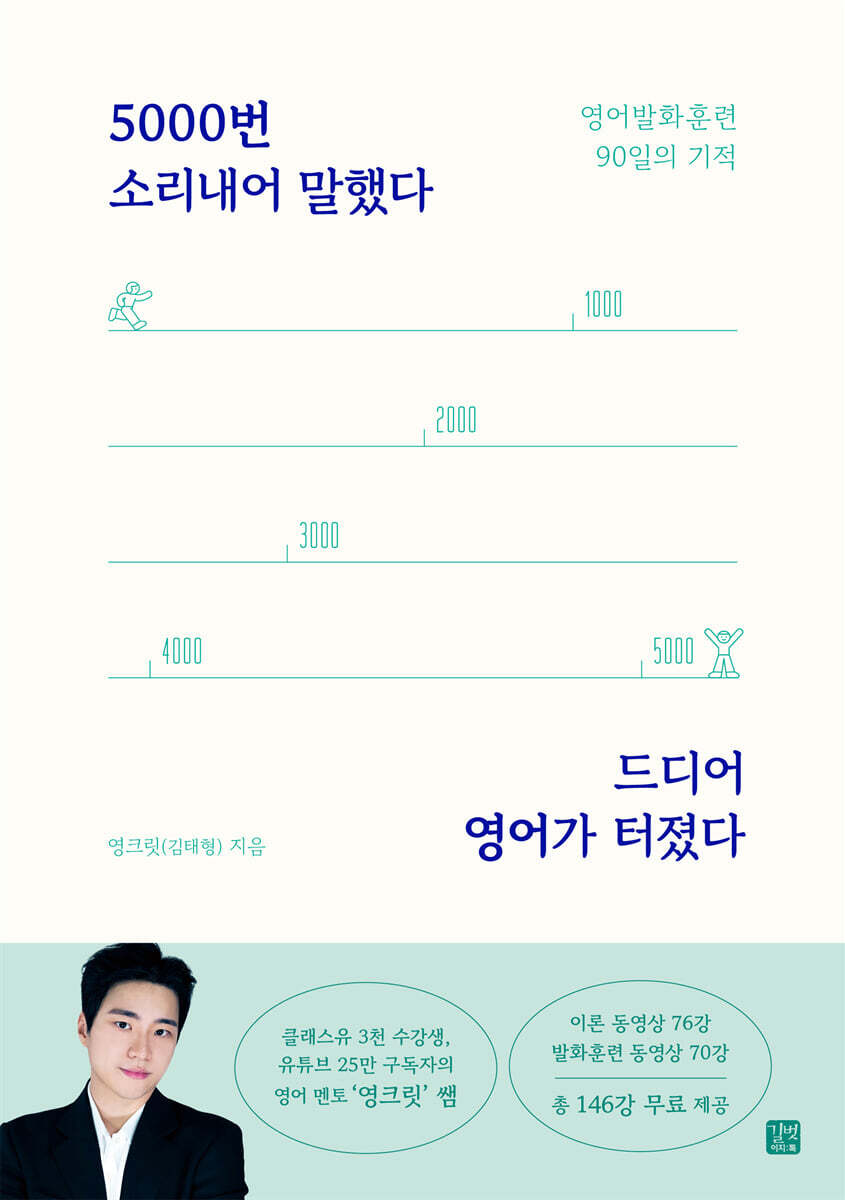
I said it out loud 5000 times and finally got my English out.
 |
Description
Book Introduction
English Secret: 5,000 Speech Practice The author of this book, 'Youngcreet Teacher', is an English YouTuber and instructor with 250,000 subscribers, and is often mistaken for someone who studied abroad. However, he started from the bottom of the English language as a dirt spoon from a domestic family with a 5th place score on the CSAT. It's job season, so I decided to invest just 100 days in English to become a hotelier by utilizing my major. After that, he spent 100 days practicing speaking short and simple sentences like crazy, and experienced his speaking skills opening up. With his fluent English skills, he was recognized as a Korean-American and confidently joined the Chosun Hotel. While working as a manager at the Chosun Hotel for many years, he passed on his secret English skills to those close to him. As word of mouth spread and more people started to seek him out, he began to teach English in earnest. During his 10 years as an instructor, his students all praise him, saying that they learned real English conversation that allowed them to open their mouths without having to learn complicated grammar. The key to speaking English that he emphasizes is to repeat the sentences that are absolutely necessary for me out loud for three months. These sentences should be very easy to interpret. It's a sentence that looks easy, but it's not something that comes out right away. Only through repeated speaking, when declarative memory (a memory that is quickly forgotten) changes into procedural memory (a memory that the body remembers and spontaneously comes out), does the mouth open. In this book, you will practice speaking 1,000 sentences 5 times each to 'procedurally memorize' English, for a total of 5,000 times. In addition to short lecture videos by Youngcrit, training videos are also provided so that you can follow along without giving up. Just follow the program and speak without learning complicated grammar, and procedural memory will occur, automatically developing a feel for English. Until now, our English learning has focused on memorizing grammar and vocabulary, building declarative memory, or complex interpretation training for exams. If you no longer need to force yourself to speak English that you don't actually use for test scores, then this time, try speaking real English out loud. I'm thinking of the cool image of someone speaking English confidently. Then the English will finally burst out. |
- You can preview some of the book's contents.
Preview
index
Orientation
The Man Who Wanted to Be Chandler: Youngkrit's English Success Story
ㆍ3 Reasons Why You Can't Speak English
ㆍ3 Steps to Improving Your English Speaking Skills
Course 1.
Training to speak my mind
Day 1 | Describe your current situation (present tense)
Day 2 | Asking about the current situation (be verb interrogative sentence)
Day 3 | Talking about past states (past tense of the verb "be")
Day 4 | Asking about past states (be verb past tense questions)
Day 5 | Course 1.
Inbody Checks
Why should I check my learning comprehension?
Course 2.
Training to speak the movements
Day 6 | Talking about doing (present tense)
Day 7 | Asking about what to do (interrogative sentences with regular verbs)
Day 8 | Telling What You Did (Past Tense Verbs)
Day 9 | Asking about what was done (Past question with regular verbs)
Day 10 | Say what you need (need to, want to, have to)
Day 11 | Asking for Needs (Need to, Want to, Have to)
I'm confused! Is it Do you or Are you?
Day 12 | Learn Universal Action Phrases (take, get, do, have)
Day 13 | Irregular Past Tense Verbs (Irregular Past Tense Verbs)
Day 14 | Talking about sensations (verbs of sensation and perception)
Day 15 | Talking about ongoing actions (present progressive tense)
Day 16 | Course 2.
Inbody Checks
Don't stress about English!
Course 3.
Long-term speaking training
Day 17 | Connecting Sentences 1 (Conjunctions)
Day 18 | Connecting Sentences 2 (Conjunctions)
Day 19 | Speaking of Specific Objects (Nouns)
Day 20 | Learn Prepositions Through Images (Prepositions)
Day 21 | Telling the Location 1 (Preposition)
Day 22 | Telling the Location 2 (Preposition)
Day 23 | Talking About Relationships (Prepositions)
Day 24 | Learning Conjugated Verbs and Prepositions (Phrasal Verbs)
Day 25 | Let's talk about it (adverb)
Day 26 | Course 3.
Inbody Checks
Do I need to study grammar separately?
Course 4.
Training to emphasize time
Day 27 | State your intentions and plans (will, be going to)
Day 28 | Explain the context of the incident (before, after)
Day 29 | Using Time Expressions (by, until, for, during, while)
Day 30 | Let's take a quick review!
Day 31 | Mastering Tenses in Storytelling
Day 32 | Course 4.
Inbody Checks
Day 33 | Midterm Checks 1
Day 34 | Midterm Checks 2
When will I be able to say what I want to say?
Course 5.
Training to speak across time
Day 35 | Learning the Past Participle (pp) (Past Participle)
Day 36 | Speaking the Passive Voice
Day 37 | Expressing Emotions Passively (Passive Emotion Expression)
Day 38 | Expressing Duty and Will (Auxiliary Verbs)
Day 39 | Expressing Probability and Guessing (Auxiliary Verbs)
Day 40 | Speaking Politely (Auxiliary Verb)
Day 41 | Let's Talk About Habits (would, used to)
I'm confused! Are there any other tenses besides present/past/future?
Day 42 | Telling the story of what's happening so far (present perfect)
Day 43 | Talking about Experiences (Present Perfect/Experience)
Day 44 | Talk about what's currently in progress (present perfect progressive)
Day 45 | Telling Time Using It (Present Perfect with Subject)
Day 46 | Telling about something that happened in the past (past perfect)
Day 47 | Talking about past events (past perfect continuous)
Day 48 | Let's review briefly!
Day 49 | Course 5.
Inbody Checks
What if my self-esteem is low because of English?
Course 6.
Training in speaking by comparison, exaggeration, and assumption
Day 50 | Let's Compare (Comparative)
Day 51 | Emphasizing Comparisons (Comparative Emphasis)
Day 52 | Comparing Similar Things (Special Expressions for Comparatives)
Day 53 | Speaking the as~as Sentence (Special Expressions for Comparatives)
Day 54 | Telling the Best (Superior)
Day 55 | Emphasize the Best (Superlative Emphasis)
Day 56 | Talking About Regrets (Regrets About the Past)
Day 57 | Guessing About the Past (Speculations About the Past)
Day 58 | Let's talk about the present and future (simple conditional sentences)
Day 59 | Let's talk about the present by assuming the past (Past Subjunctive)
Day 60 | Let's talk about the past by assuming the past (past perfect subjunctive)
Day 61 | Let's review briefly!
Day 62 | Mixing Up Multiple "Assumptions"
Day 63 | Mastering the Conditional Mood in Storytelling
Day 64 | Course 6.
Inbody Checks
I'm starting to feel more confident, what's the next step?
Course 7.
Training to speak in English word order
Day 65 | Let's Embellish the Subject 1 (Nominative Relative Pronoun)
Day 66 | Let's Embellish the Subject 2 (Objective Relative Pronouns)
Day 67 | Describe the owner of the object in detail (possessive relative pronoun)
Day 68 | Speaking Using Participles (Participles)
Day 69 | Describe the time, place, and reason in detail (relative adverbs)
Day 70 | Asking Various Questions (Interrogatives)
Day 71 | Uncovering the Secrets of the To Infinitive
Day 72 | Adding meaning with the to-infinitive (to-infinitive)
Day 73 | Describing Objects with the To-Infinitive (To-Infinitive)
Day 74 | Speaking Verbs Like Nouns 1 (To-Infinitive)
Day 75 | Let's review briefly!
Day 76 | Speaking Verbs Like Nouns 2 (Gerunds)
Day 77 | Understanding the nuances of infinitives and gerunds
Day 78 | Telling the Reason (Causality)
Day 79 | Contrasting (Adverbial Clauses of Concession)
Day 80 | Learning to Express Reasons in Storytelling
Day 81 | Course 7.
Inbody Checks
Want to improve your English skills so you stand out instantly?
Course 8.
Training to speak like a Korean
Day 82 | Speaking with a Consonant Sound
Day 83 | Trying Filler 1 (Filler Wars)
Day 84 | Trying Fillers Part 2 (Filler Wars)
Day 85 | Verb and Preposition Combinations 1 (Phrasal Verbs)
Day 86 | Verb and Preposition Combinations 2 (Phrasal Verbs)
Day 87 | Learn Slang
Day 88 | Learn Acronyms
Day 89 | Course 8.
Inbody Checks
Day 90 | Final Checks
| Appendix | Use Your Own English Speaking Recipe for a Lifetime
Use ChatGPT as a native English tutor.
The Man Who Wanted to Be Chandler: Youngkrit's English Success Story
ㆍ3 Reasons Why You Can't Speak English
ㆍ3 Steps to Improving Your English Speaking Skills
Course 1.
Training to speak my mind
Day 1 | Describe your current situation (present tense)
Day 2 | Asking about the current situation (be verb interrogative sentence)
Day 3 | Talking about past states (past tense of the verb "be")
Day 4 | Asking about past states (be verb past tense questions)
Day 5 | Course 1.
Inbody Checks
Why should I check my learning comprehension?
Course 2.
Training to speak the movements
Day 6 | Talking about doing (present tense)
Day 7 | Asking about what to do (interrogative sentences with regular verbs)
Day 8 | Telling What You Did (Past Tense Verbs)
Day 9 | Asking about what was done (Past question with regular verbs)
Day 10 | Say what you need (need to, want to, have to)
Day 11 | Asking for Needs (Need to, Want to, Have to)
I'm confused! Is it Do you or Are you?
Day 12 | Learn Universal Action Phrases (take, get, do, have)
Day 13 | Irregular Past Tense Verbs (Irregular Past Tense Verbs)
Day 14 | Talking about sensations (verbs of sensation and perception)
Day 15 | Talking about ongoing actions (present progressive tense)
Day 16 | Course 2.
Inbody Checks
Don't stress about English!
Course 3.
Long-term speaking training
Day 17 | Connecting Sentences 1 (Conjunctions)
Day 18 | Connecting Sentences 2 (Conjunctions)
Day 19 | Speaking of Specific Objects (Nouns)
Day 20 | Learn Prepositions Through Images (Prepositions)
Day 21 | Telling the Location 1 (Preposition)
Day 22 | Telling the Location 2 (Preposition)
Day 23 | Talking About Relationships (Prepositions)
Day 24 | Learning Conjugated Verbs and Prepositions (Phrasal Verbs)
Day 25 | Let's talk about it (adverb)
Day 26 | Course 3.
Inbody Checks
Do I need to study grammar separately?
Course 4.
Training to emphasize time
Day 27 | State your intentions and plans (will, be going to)
Day 28 | Explain the context of the incident (before, after)
Day 29 | Using Time Expressions (by, until, for, during, while)
Day 30 | Let's take a quick review!
Day 31 | Mastering Tenses in Storytelling
Day 32 | Course 4.
Inbody Checks
Day 33 | Midterm Checks 1
Day 34 | Midterm Checks 2
When will I be able to say what I want to say?
Course 5.
Training to speak across time
Day 35 | Learning the Past Participle (pp) (Past Participle)
Day 36 | Speaking the Passive Voice
Day 37 | Expressing Emotions Passively (Passive Emotion Expression)
Day 38 | Expressing Duty and Will (Auxiliary Verbs)
Day 39 | Expressing Probability and Guessing (Auxiliary Verbs)
Day 40 | Speaking Politely (Auxiliary Verb)
Day 41 | Let's Talk About Habits (would, used to)
I'm confused! Are there any other tenses besides present/past/future?
Day 42 | Telling the story of what's happening so far (present perfect)
Day 43 | Talking about Experiences (Present Perfect/Experience)
Day 44 | Talk about what's currently in progress (present perfect progressive)
Day 45 | Telling Time Using It (Present Perfect with Subject)
Day 46 | Telling about something that happened in the past (past perfect)
Day 47 | Talking about past events (past perfect continuous)
Day 48 | Let's review briefly!
Day 49 | Course 5.
Inbody Checks
What if my self-esteem is low because of English?
Course 6.
Training in speaking by comparison, exaggeration, and assumption
Day 50 | Let's Compare (Comparative)
Day 51 | Emphasizing Comparisons (Comparative Emphasis)
Day 52 | Comparing Similar Things (Special Expressions for Comparatives)
Day 53 | Speaking the as~as Sentence (Special Expressions for Comparatives)
Day 54 | Telling the Best (Superior)
Day 55 | Emphasize the Best (Superlative Emphasis)
Day 56 | Talking About Regrets (Regrets About the Past)
Day 57 | Guessing About the Past (Speculations About the Past)
Day 58 | Let's talk about the present and future (simple conditional sentences)
Day 59 | Let's talk about the present by assuming the past (Past Subjunctive)
Day 60 | Let's talk about the past by assuming the past (past perfect subjunctive)
Day 61 | Let's review briefly!
Day 62 | Mixing Up Multiple "Assumptions"
Day 63 | Mastering the Conditional Mood in Storytelling
Day 64 | Course 6.
Inbody Checks
I'm starting to feel more confident, what's the next step?
Course 7.
Training to speak in English word order
Day 65 | Let's Embellish the Subject 1 (Nominative Relative Pronoun)
Day 66 | Let's Embellish the Subject 2 (Objective Relative Pronouns)
Day 67 | Describe the owner of the object in detail (possessive relative pronoun)
Day 68 | Speaking Using Participles (Participles)
Day 69 | Describe the time, place, and reason in detail (relative adverbs)
Day 70 | Asking Various Questions (Interrogatives)
Day 71 | Uncovering the Secrets of the To Infinitive
Day 72 | Adding meaning with the to-infinitive (to-infinitive)
Day 73 | Describing Objects with the To-Infinitive (To-Infinitive)
Day 74 | Speaking Verbs Like Nouns 1 (To-Infinitive)
Day 75 | Let's review briefly!
Day 76 | Speaking Verbs Like Nouns 2 (Gerunds)
Day 77 | Understanding the nuances of infinitives and gerunds
Day 78 | Telling the Reason (Causality)
Day 79 | Contrasting (Adverbial Clauses of Concession)
Day 80 | Learning to Express Reasons in Storytelling
Day 81 | Course 7.
Inbody Checks
Want to improve your English skills so you stand out instantly?
Course 8.
Training to speak like a Korean
Day 82 | Speaking with a Consonant Sound
Day 83 | Trying Filler 1 (Filler Wars)
Day 84 | Trying Fillers Part 2 (Filler Wars)
Day 85 | Verb and Preposition Combinations 1 (Phrasal Verbs)
Day 86 | Verb and Preposition Combinations 2 (Phrasal Verbs)
Day 87 | Learn Slang
Day 88 | Learn Acronyms
Day 89 | Course 8.
Inbody Checks
Day 90 | Final Checks
| Appendix | Use Your Own English Speaking Recipe for a Lifetime
Use ChatGPT as a native English tutor.
Detailed image

Into the book
Why haven't I been able to speak English until now? I've been studying English for over 10 years, but I just can't speak it, so I gave up.
There is a significant difference in the level of English ‘reading’ and ‘speaking’ among Koreans.
I can't say that it's possible to interpret.
You need to practice speaking in understandable (relatively easy) sentences to open your mouth.
I always feel nervous when speaking English.
Set a role model and believe that you can definitely say the same thing.
Just as role models in life are important in forming values and achieving success, the same is true for learning English.
Believing that you can do it gives you confidence.
I'm addicted to the feeling of knowing something when I watch English lectures on YouTube.
Just because you understand something when you listen to a lecture doesn't mean you can use it.
After a day, I forget again.
You must practice speaking to become procedurally literate in order to speak English spontaneously.
Don't get addicted to the false sense of accomplishment that comes from just listening to lectures. Instead, practice speaking, starting with simple sentences that are absolutely necessary.
There is a significant difference in the level of English ‘reading’ and ‘speaking’ among Koreans.
I can't say that it's possible to interpret.
You need to practice speaking in understandable (relatively easy) sentences to open your mouth.
I always feel nervous when speaking English.
Set a role model and believe that you can definitely say the same thing.
Just as role models in life are important in forming values and achieving success, the same is true for learning English.
Believing that you can do it gives you confidence.
I'm addicted to the feeling of knowing something when I watch English lectures on YouTube.
Just because you understand something when you listen to a lecture doesn't mean you can use it.
After a day, I forget again.
You must practice speaking to become procedurally literate in order to speak English spontaneously.
Don't get addicted to the false sense of accomplishment that comes from just listening to lectures. Instead, practice speaking, starting with simple sentences that are absolutely necessary.
--- From the text
Publisher's Review
Through 5000 firing exercises
The English word for 'declarative memory' is 'procedural memory'.
*Declarative memory: Memory that is quickly forgotten due to fragmentary knowledge.
ex) phone number, math formula
*Procedural memory: Memories that are ingrained in the body through training and can be recalled immediately when needed. Ex) native language, riding a bicycle, typing
Program 1: Orientation
'Youngcreet Teacher', a Korean-American aspiring hotelier, reveals his English success story, becoming the manager of the Chosun Hotel and becoming an English YouTuber with 250,000 followers in just 90 days.
Program 2: Quick Theory Summary by Young Crit Teacher
Drawing on big data accumulated over 10 years of teaching 5,000 students, this course provides a concise overview of the basic principles for beginners. Scanning the QR code instantly plays the course, and it consists of 76 lectures.
Program 3: 1000 Sentences x 5 Repeated Speaking Training
We will carefully select 1,000 English sentences frequently used by native speakers and begin speaking practice by repeating them 5 times each.
Just by repeating the words without learning complicated grammar, procedural memory will occur and you will automatically develop a feel for English.
Program 4: Comprehension Check
To help you master 1000 sentences, you will take a 'comprehension test'.
If you lack understanding, practice speaking the sentences from that date again.
Program 5: Role Model Training
Get motivated through famous English quotes from speakers and gain confidence that you can speak English like a role model.
The English word for 'declarative memory' is 'procedural memory'.
*Declarative memory: Memory that is quickly forgotten due to fragmentary knowledge.
ex) phone number, math formula
*Procedural memory: Memories that are ingrained in the body through training and can be recalled immediately when needed. Ex) native language, riding a bicycle, typing
Program 1: Orientation
'Youngcreet Teacher', a Korean-American aspiring hotelier, reveals his English success story, becoming the manager of the Chosun Hotel and becoming an English YouTuber with 250,000 followers in just 90 days.
Program 2: Quick Theory Summary by Young Crit Teacher
Drawing on big data accumulated over 10 years of teaching 5,000 students, this course provides a concise overview of the basic principles for beginners. Scanning the QR code instantly plays the course, and it consists of 76 lectures.
Program 3: 1000 Sentences x 5 Repeated Speaking Training
We will carefully select 1,000 English sentences frequently used by native speakers and begin speaking practice by repeating them 5 times each.
Just by repeating the words without learning complicated grammar, procedural memory will occur and you will automatically develop a feel for English.
Program 4: Comprehension Check
To help you master 1000 sentences, you will take a 'comprehension test'.
If you lack understanding, practice speaking the sentences from that date again.
Program 5: Role Model Training
Get motivated through famous English quotes from speakers and gain confidence that you can speak English like a role model.
GOODS SPECIFICS
- Date of issue: July 30, 2023
- Page count, weight, size: 356 pages | 474g | 148*210*17mm
- ISBN13: 9791140704422
You may also like
카테고리
korean


korean

![GQ KOREA Mark (Monthly): December [2025]](http://librairie.coreenne.fr/cdn/shop/files/8ef265dbbfbf186523ed75ba7319009d.jpg?v=1765340328&width=3840)


