

Magical Chinese Characters ①
 |
Description
Book Introduction
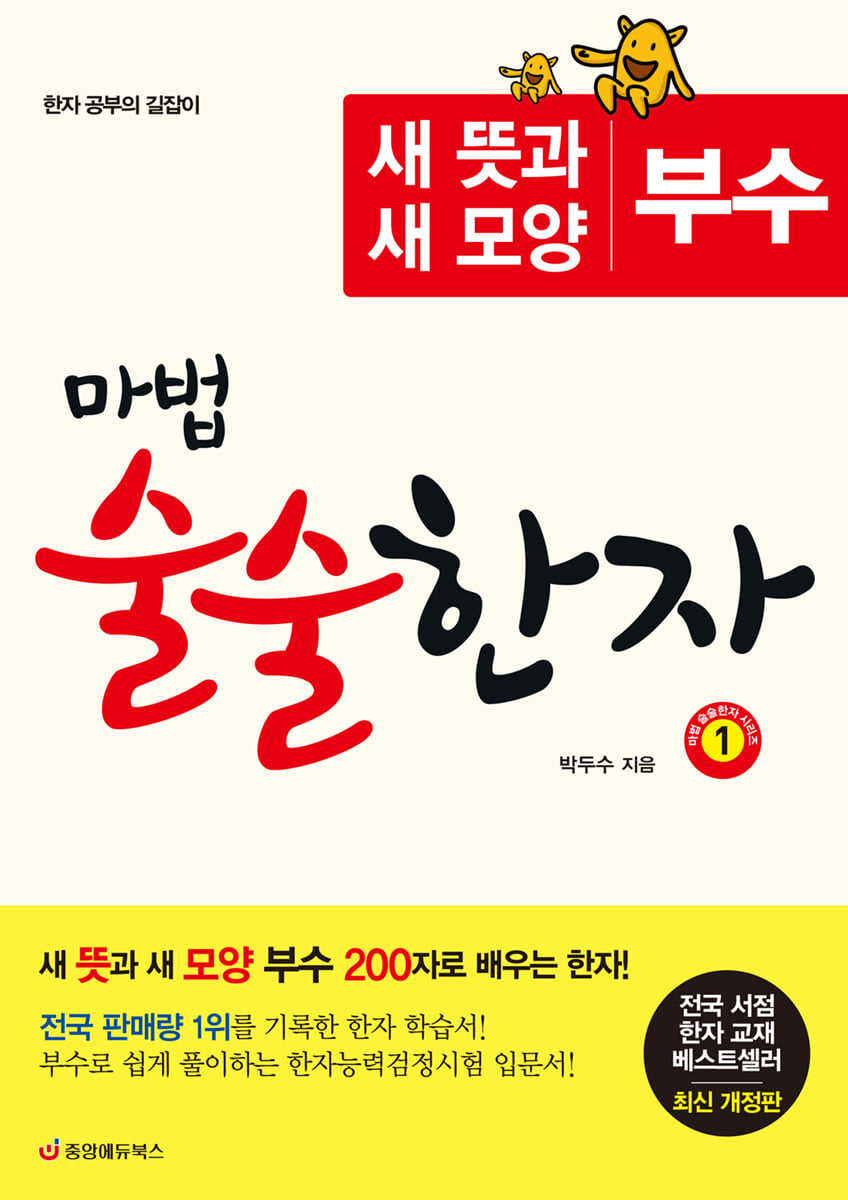
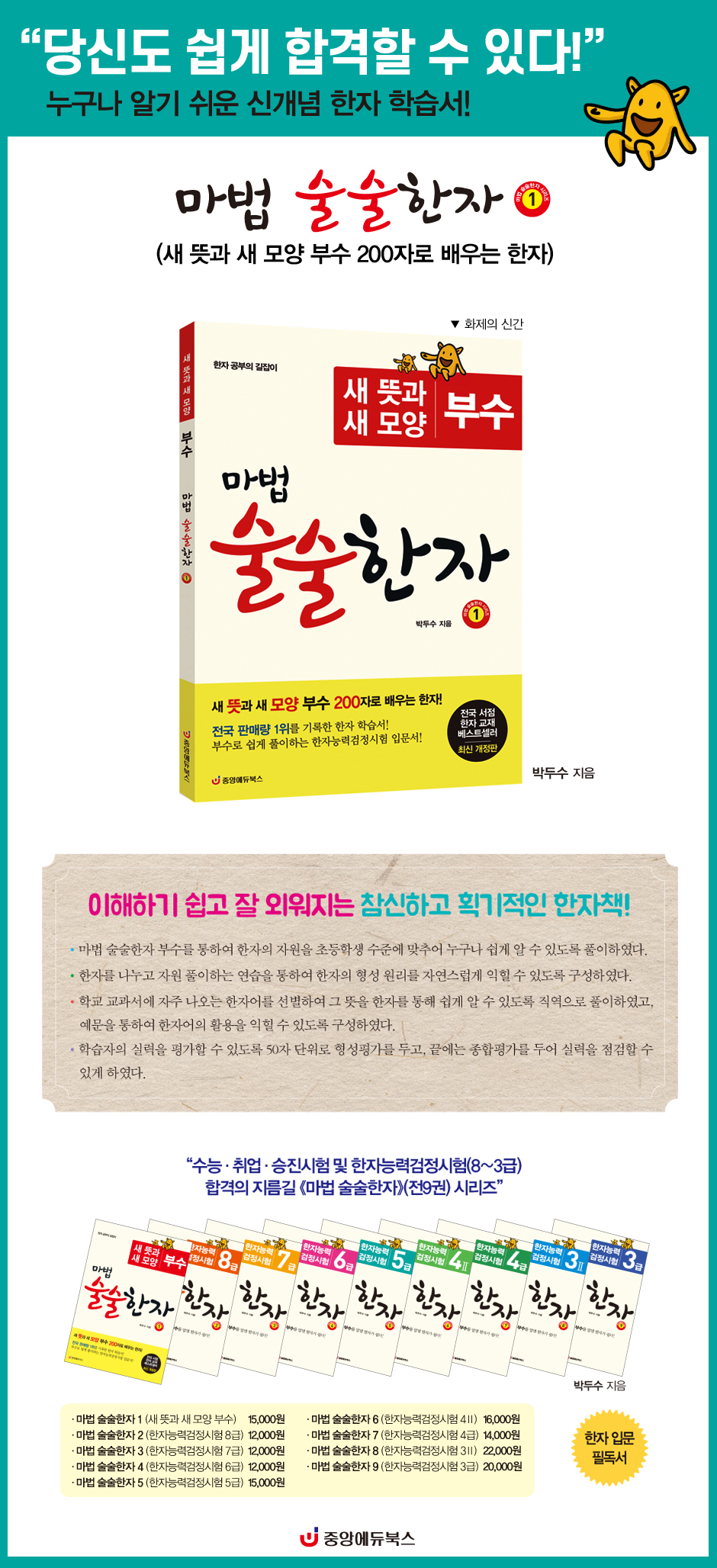
* Learn Chinese characters with 200 radicals with new meanings and new shapes!
* Best-selling Chinese character textbook in bookstores nationwide!
Chinese characters are letters created by combining radicals.
So, just like the consonants and vowels of Korean, or the English alphabet, you can learn Chinese characters easily by studying them from the radicals.
However, the current number of radicals is too large and the meanings and sounds are all messed up, making it impossible to properly interpret the resources of Chinese characters.
So, excluding the less commonly used radicals, we combined the radicals with similar shapes and organized the 214 radicals into 200.
Also, the meaning and sound were reorganized, and new radical shapes were completed.
Author Park Du-su was born into a family of scholars of Chinese classics and learned Chinese classics from his father from a young age. With the intention of carrying on the family tradition, he majored in Chinese classics in college.
After studying Chinese characters for a long time, he developed a learning method that makes it easy to learn Chinese characters through radicals with new meanings and new shapes, and wrote a series of Chinese character proficiency test preparation books, such as “Magic Fluent Chinese Characters” (9 volumes) and “Elementary Chinese Characters” (6 volumes).
* Best-selling Chinese character textbook in bookstores nationwide!
Chinese characters are letters created by combining radicals.
So, just like the consonants and vowels of Korean, or the English alphabet, you can learn Chinese characters easily by studying them from the radicals.
However, the current number of radicals is too large and the meanings and sounds are all messed up, making it impossible to properly interpret the resources of Chinese characters.
So, excluding the less commonly used radicals, we combined the radicals with similar shapes and organized the 214 radicals into 200.
Also, the meaning and sound were reorganized, and new radical shapes were completed.
Author Park Du-su was born into a family of scholars of Chinese classics and learned Chinese classics from his father from a young age. With the intention of carrying on the family tradition, he majored in Chinese classics in college.
After studying Chinese characters for a long time, he developed a learning method that makes it easy to learn Chinese characters through radicals with new meanings and new shapes, and wrote a series of Chinese character proficiency test preparation books, such as “Magic Fluent Chinese Characters” (9 volumes) and “Elementary Chinese Characters” (6 volumes).
- You can preview some of the book's contents.
Preview
index
Hello, this is Park Du-su.
You're studying Chinese characters without even knowing the radicals?
How to learn Chinese characters easily
Why does it have to be a fluent character?
Understanding Chinese characters
Structure of Chinese characters
About the subsidiary
Location and name of the subsidiary
Principle of stroke order
How to find a bicycle
Learning Chinese character radicals fluently
Comprehensive evaluation
You're studying Chinese characters without even knowing the radicals?
How to learn Chinese characters easily
Why does it have to be a fluent character?
Understanding Chinese characters
Structure of Chinese characters
About the subsidiary
Location and name of the subsidiary
Principle of stroke order
How to find a bicycle
Learning Chinese character radicals fluently
Comprehensive evaluation
Detailed image
Into the book
Chinese characters are not something you memorize by writing them unconditionally.
There is a principle behind the creation of Chinese characters.
Chinese characters are letters created by combining radicals.
So, just like the consonants and vowels of Korean, and the English alphabet, Chinese characters must be studied starting from the radicals.
--- p.5
It is said that Chinese characters were created by the historian Cangjie about 5,000 years ago during the reign of the legendary emperor Huangdi in ancient China, after observing the footprints of birds and beasts. However, in reality, they were not created by a single person, but rather were created and refined by many people over a long period of time, until they took on the form they have today.
The oldest form of Chinese characters is the oracle bone script (甲骨文字), which was created during the Yin Dynasty in the Yellow River basin about 3,500 years ago.
--- p.8
In the old days when there were no letters, if you wanted to talk about a mountain, you would draw its shape to show it.
And ideas and concepts that could not be expressed in pictures were expressed by creating symbols using recognizable dots or lines.
Over time, these pictures and symbols developed into a set of written characters.
But as time passed, it became difficult to express all of one's thoughts using only text.
So, we started to create new letters with new meanings by combining letters that were already in use.
--- p.9
What should you do when you encounter an unfamiliar Chinese character? You'll need to consult a Chinese character dictionary, or "ja-dyeon" (字典). Radicals are the characters that serve as guides for finding Chinese characters in dictionaries, and there are about 200 of them in use.
In the dictionary, Chinese characters are organized by radicals, so if you know the radicals, you can easily find the Chinese character.
Letters belonging to the same radical basically have similar meanings.
--- p.11
Chinese characters with the radical 心
刃 (blade in) + 心 (heart sim) = 忍 (patience in) → It means to endure the pain of a blade piercing the heart.
亡 (to ruin) + 心 (to forget) = 忘 (to forget) → It means to forget the memories of ruin without keeping them in your heart.
There is a principle behind the creation of Chinese characters.
Chinese characters are letters created by combining radicals.
So, just like the consonants and vowels of Korean, and the English alphabet, Chinese characters must be studied starting from the radicals.
--- p.5
It is said that Chinese characters were created by the historian Cangjie about 5,000 years ago during the reign of the legendary emperor Huangdi in ancient China, after observing the footprints of birds and beasts. However, in reality, they were not created by a single person, but rather were created and refined by many people over a long period of time, until they took on the form they have today.
The oldest form of Chinese characters is the oracle bone script (甲骨文字), which was created during the Yin Dynasty in the Yellow River basin about 3,500 years ago.
--- p.8
In the old days when there were no letters, if you wanted to talk about a mountain, you would draw its shape to show it.
And ideas and concepts that could not be expressed in pictures were expressed by creating symbols using recognizable dots or lines.
Over time, these pictures and symbols developed into a set of written characters.
But as time passed, it became difficult to express all of one's thoughts using only text.
So, we started to create new letters with new meanings by combining letters that were already in use.
--- p.9
What should you do when you encounter an unfamiliar Chinese character? You'll need to consult a Chinese character dictionary, or "ja-dyeon" (字典). Radicals are the characters that serve as guides for finding Chinese characters in dictionaries, and there are about 200 of them in use.
In the dictionary, Chinese characters are organized by radicals, so if you know the radicals, you can easily find the Chinese character.
Letters belonging to the same radical basically have similar meanings.
--- p.11
Chinese characters with the radical 心
刃 (blade in) + 心 (heart sim) = 忍 (patience in) → It means to endure the pain of a blade piercing the heart.
亡 (to ruin) + 心 (to forget) = 忘 (to forget) → It means to forget the memories of ruin without keeping them in your heart.
--- p.67
Publisher's Review
* The #1 selling Chinese character textbook nationwide!
* An introduction to the Chinese Character Proficiency Test, easily explained with radicals!
In order to learn Chinese characters correctly, you must learn and use radicals properly.
Therefore, the author studied Chinese characters and completed 200 magical Chinese characters with new meanings and new shapes.
This book includes a diagram showing the formation principle of each radical, along with an explanation of each radical and advice on how to distinguish between stroke order and easily confused radicals.
In addition, by combining radicals to create Chinese characters, students can naturally learn the principles of forming Chinese characters, and various repetitions and evaluations are provided to enable students to check their skills.
This is a useful Chinese character textbook for students as well as those who want to effectively study the "Magic Fluent Chinese Character" series in preparation for the Chinese Character Proficiency Test.
* Understanding the structure and radicals of Chinese characters!
* The principle of stroke order and how to find the cycle!
Chinese characters are the representative writing system of the East and are used by about a quarter of the world's population.
Chinese characters account for more than 70% of the Korean language, and 2,122 Chinese characters and approximately 140,000 Chinese character words appear in the 10 basic subjects taught in the first year of middle school.
Therefore, if you are good at Chinese characters, you can also do well in other subjects.
In fact, there are statistics showing that academic performance has improved thanks to learning through Chinese characters.
However, it is difficult to learn these Chinese characters if you focus on writing and memorizing them.
Not only is it impossible to memorize all of the tens of thousands of Chinese characters, but even if you do memorize them, there are many characters that are confusing because they look similar.
So, you can easily learn Chinese characters by thinking about the principles behind their creation.
This book is designed to help you learn Chinese characters naturally, one by one, and furthermore, by linking similar characters together, by explaining the formation principles of Chinese characters through radicals.
* An introduction to the Chinese Character Proficiency Test, easily explained with radicals!
In order to learn Chinese characters correctly, you must learn and use radicals properly.
Therefore, the author studied Chinese characters and completed 200 magical Chinese characters with new meanings and new shapes.
This book includes a diagram showing the formation principle of each radical, along with an explanation of each radical and advice on how to distinguish between stroke order and easily confused radicals.
In addition, by combining radicals to create Chinese characters, students can naturally learn the principles of forming Chinese characters, and various repetitions and evaluations are provided to enable students to check their skills.
This is a useful Chinese character textbook for students as well as those who want to effectively study the "Magic Fluent Chinese Character" series in preparation for the Chinese Character Proficiency Test.
* Understanding the structure and radicals of Chinese characters!
* The principle of stroke order and how to find the cycle!
Chinese characters are the representative writing system of the East and are used by about a quarter of the world's population.
Chinese characters account for more than 70% of the Korean language, and 2,122 Chinese characters and approximately 140,000 Chinese character words appear in the 10 basic subjects taught in the first year of middle school.
Therefore, if you are good at Chinese characters, you can also do well in other subjects.
In fact, there are statistics showing that academic performance has improved thanks to learning through Chinese characters.
However, it is difficult to learn these Chinese characters if you focus on writing and memorizing them.
Not only is it impossible to memorize all of the tens of thousands of Chinese characters, but even if you do memorize them, there are many characters that are confusing because they look similar.
So, you can easily learn Chinese characters by thinking about the principles behind their creation.
This book is designed to help you learn Chinese characters naturally, one by one, and furthermore, by linking similar characters together, by explaining the formation principles of Chinese characters through radicals.
GOODS SPECIFICS
- Date of issue: October 25, 2025
- Page count, weight, size: 192 pages | 650g | 210*297*10mm
- ISBN13: 9788994465548
- ISBN10: 8994465545
You may also like
카테고리
korean


korean

![GQ KOREA Mark (Monthly): December [2025]](http://librairie.coreenne.fr/cdn/shop/files/8ef265dbbfbf186523ed75ba7319009d.jpg?v=1765340328&width=3840)


