

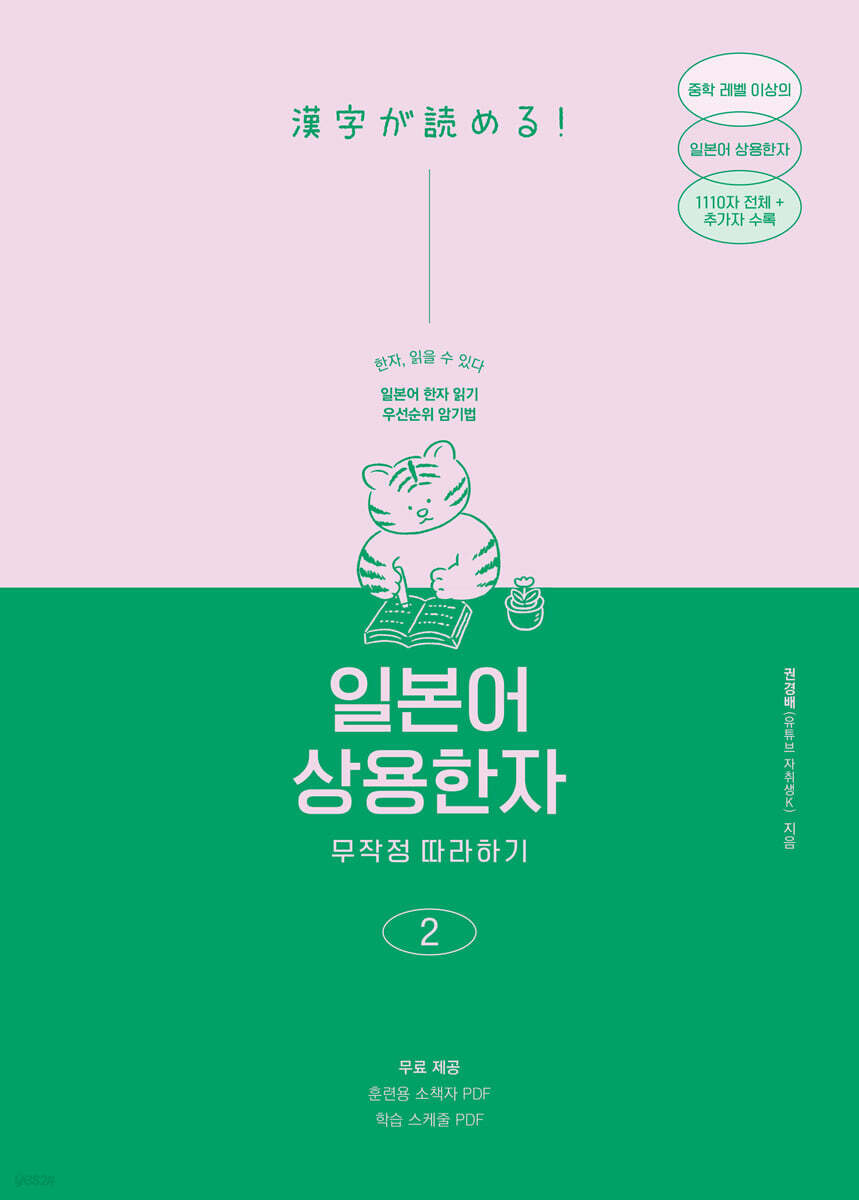
Japanese Common Kanji: Just Following It 2
 |
Description
Book Introduction
The sequel to 『Japanese Common Kanji Untakki』 released!
The sequel to "Japanese Common Kanji: Just Follow Along 1," which was praised as "the best Japanese Kanji textbook of all time" with detailed explanations, has been published. "Japanese Common Kanji: Just Follow Along 2," a complete guide to 2,136 common Japanese kanji, is a book that will help you completely master common kanji at the middle school level or higher (JLPT N2). It contains 1,110 essential kanji characters for Japanese middle school education and 4 additional characters. It contains all the Chinese character information that helps with memorization as well as understanding in one book. It provides a variety of information to help you learn Chinese characters with certainty, including explanations of principles, reference pictures, and hidden rules explained in a storytelling format. Additionally, for the first time in Korea, all pronunciations are prioritized, allowing you to efficiently study the content you need to focus on. The author (Ryu-Sensei, YouTube channel '자취생K'), a linguistics expert and YouTuber, has compiled all the points that Chinese character learners might be curious about and provided detailed tips and explanations. |
- You can preview some of the book's contents.
Preview
index
Even if you hate the first yard, let's re-engrave it firmly! Build the basics.
Let's learn about the derivative relationships of the seven major units in the second yard! Derived Chinese characters by topic
First word: nature
01 Derivation of 'Sun and Stars'
02 Derivation of 'pool'
03 Derivation of 'tree'
04 Derivation of 'Hills and Mountains'
05 Derivation of 'grain'
06 Derivation of 'field'
07 Derivation of 'Earth and Minerals'
08 Derivation of 'Water and Fire'
Second word: Animals
09 Derivation of 'beast'
10 Derivations of 'livestock'
11 Derivation of 'flying beast'
12 Derivation of 'crustacean'
Third verse: Body/Senses
13 Derivation of 'head (upper part)'
14 Derivation of 'head (lower part)'
15 Derivatives of 'hand' 1
16 Derivation of 'hand' 2
17 Derivatives of 'Fist and Nail'
18 Derivation of 'arms and legs'
19 Derivation of 'body'
20 Derivation of 'bone, flesh, skin'
Fourth verse: Weapon
21 Derivation of 'sword'
22 Derivation of 'Veda'
23 Derivatives of 'axe'
24 Derivatives of 'window'
25 Derivation of 'bow and arrow'
26 Derivation of 'Shield and Club'
Fifth verse: Life/tools
27 Derivatives of 'house'
28 Derivatives of 'table setting'
29 Derivation of 'fabric'
30 Derivatives of 'tool'
31 Derivatives of 'wellside'
32 Derivatives of 'transport'
Sixth verse: Society
33 Derivation of 'person'
34 Derivatives of 'family'
35 Derivation of 'public and private'
36 Derivation of 'King and Subject'
37 Derivatives of 'God and Servant'
Seventh verse ㆍ Action/state 38 Derivation of 'many'
Derivation of 'big' and 'small'
Derivative of '40' high
Derivatives of 'stand'
Derivatives of 'kneel'
43 Derivation of 'go·run'
44 Derivatives of 'stop' and 'walk'
Special Bonus
How do Japanese people choose their kanji for reading?
Special appendix
01 Confirmation question answer
02 Look up Chinese characters
Let's learn about the derivative relationships of the seven major units in the second yard! Derived Chinese characters by topic
First word: nature
01 Derivation of 'Sun and Stars'
02 Derivation of 'pool'
03 Derivation of 'tree'
04 Derivation of 'Hills and Mountains'
05 Derivation of 'grain'
06 Derivation of 'field'
07 Derivation of 'Earth and Minerals'
08 Derivation of 'Water and Fire'
Second word: Animals
09 Derivation of 'beast'
10 Derivations of 'livestock'
11 Derivation of 'flying beast'
12 Derivation of 'crustacean'
Third verse: Body/Senses
13 Derivation of 'head (upper part)'
14 Derivation of 'head (lower part)'
15 Derivatives of 'hand' 1
16 Derivation of 'hand' 2
17 Derivatives of 'Fist and Nail'
18 Derivation of 'arms and legs'
19 Derivation of 'body'
20 Derivation of 'bone, flesh, skin'
Fourth verse: Weapon
21 Derivation of 'sword'
22 Derivation of 'Veda'
23 Derivatives of 'axe'
24 Derivatives of 'window'
25 Derivation of 'bow and arrow'
26 Derivation of 'Shield and Club'
Fifth verse: Life/tools
27 Derivatives of 'house'
28 Derivatives of 'table setting'
29 Derivation of 'fabric'
30 Derivatives of 'tool'
31 Derivatives of 'wellside'
32 Derivatives of 'transport'
Sixth verse: Society
33 Derivation of 'person'
34 Derivatives of 'family'
35 Derivation of 'public and private'
36 Derivation of 'King and Subject'
37 Derivatives of 'God and Servant'
Seventh verse ㆍ Action/state 38 Derivation of 'many'
Derivation of 'big' and 'small'
Derivative of '40' high
Derivatives of 'stand'
Derivatives of 'kneel'
43 Derivation of 'go·run'
44 Derivatives of 'stop' and 'walk'
Special Bonus
How do Japanese people choose their kanji for reading?
Special appendix
01 Confirmation question answer
02 Look up Chinese characters
Detailed image
.jpg)
Publisher's Review
1110 Japanese educational kanji characters + additional characters included!
How to perfectly master intermediate Japanese kanji!
Korea's first! Priority Chinese character learning!
Japanese pronunciation is always a headache, with its complex and numerous things to memorize! Here, we've listed the priorities you need to know for each pronunciation.
You can immediately check the content you need to focus on and study efficiently.
A comprehensive guide to Chinese character information for 'acquisition'!
It contains all the contents that help with understanding as well as memorization.
From storytelling-based explanations of principles to easy-to-remember reference illustrations and hidden rules, this comprehensive guide provides comprehensive information to ensure a solid grasp of Chinese characters.
Clear explanations from a linguistics expert!
For learners who find Chinese characters difficult and burdensome, the author reveals all of his memorization know-how.
Additionally, it helps self-study by collecting only the points that Chinese character learners are curious about and providing detailed tips and explanations.
If you are intermediate or higher in Japanese, Japanese kanji is even more difficult!
Are you struggling with Chinese characters and want to give up on Japanese?
Discover a Chinese character learning method suggested by a linguistics expert!
1.
A comprehensive guide to Chinese character information to help you memorize and understand!
This book covers all 1,110 essential kanji characters for Japanese middle school students and above, plus 4 additional characters, for a total of 1,114 kanji characters.
From educational kanji levels, JLPT levels, actual usage frequency rankings, explanations of principles, Kun-yin, total stroke count, stroke order, reference illustrations, on-yomi (pronunciation), kun-yomi (pronunciation), and even a "Just a Minute" corner for additional explanations! This isn't just a list of information; it's a comprehensive guide to all kanji information to aid understanding and memorization.
In particular, the explanation of the principles uses a storytelling method that connects the shape and meaning of Chinese characters, making it easy to remember Chinese characters.
2.
A structure that makes it easy to learn Chinese characters!
In the first yard, we will review the basic components before starting full-scale learning.
The second chapter is the main chapter of this book, and it covers the explanation of 1,114 Chinese characters.
We've provided detailed and friendly explanations and appropriately placed corners to help you study with as little effort as possible.
3.
Japanese pronunciation should be your top priority!
The large number and complexity of Japanese pronunciations are the main culprits that make studying Japanese kanji difficult.
Usually, most people just put all the pronunciations on the same line and memorize them.
However, there is a frequently used priority in the pronunciation and meaning of Chinese characters.
This book is the first in Korea to rank words from 1 to 4 according to their productivity when read aloud.
This is the only book that allows you to study efficiently, starting with the important pronunciation that you need to focus on and memorize first.
4.
Detailed study tips and commentary from a linguistics expert!
Detailed and clear explanations and tips are included throughout the book to help you understand Japanese kanji.
The author, a linguistics expert and YouTuber, added a unique touch to this book by including 'The Principle of Writing Japanese Kun-yori into Kanji' to help readers understand Japanese Kun-yori and Kanji notation.
Through corners like 'Just a moment' and 'I have a question,' you can not only resolve your curiosity about Chinese characters but also study them in depth.
* A word from beta testers
I recommend this to those who are stuck in Chinese characters!
Learning Japanese kanji is a marathon, not a sprint.
Knowing the right study method will help you complete the course without getting lost.
When I first started studying Chinese characters, I just filled up a lot of paper and studied them, only to forget them after a few days, and I felt a sense of futility.
Then I came across this textbook.
By prioritizing my studies, I gained a variety of information, including how to learn Chinese characters and their basic origins. I also felt at ease as I felt myself growing little by little each day.
I recommend this to those who, like me in the past, are interested in studying Japanese but are unsure of how to plan their studies, and those who know the basics of Japanese but are stuck with kanji.
You'll be hard-pressed to find a book that explains Chinese character learning in such detail.
Chan-Hong Park | 20s, semiconductor engineer
A book worth keeping for a lifetime!
Unlike general textbooks that simply list common Japanese kanji like a dictionary, this book organizes the subject, radical, difficulty, and potentially confusing kanji of each kanji so that learners can study easily.
Also, reading the additional explanations in the 'Just a Minute' corner made it easier to understand and memorize Chinese characters, as if I was listening to a lecture by student K living alone.
If Volume 1 covers basic kanji at the level of Japanese elementary school students, Volume 2 covers kanji at the level of middle school or higher, or JLPT Level 2 or higher.
I think this book is worth keeping for a lifetime if you speak Japanese.
Kim Byeong-chan | 30s, electrical engineer
A revolutionary book for learners who hate simple, labor-intensive memorization!
This book tells a story by connecting the meanings of each radical of a Chinese character, and that was really helpful to me.
Before I came across this book, I just blindly copied along until it was all in my head. But then my hands started to hurt, and it quickly faded from my memory, so I lost interest and it just felt like simple labor.
However, after studying this book, I started to get interested in Chinese characters as I thought, 'This Chinese character can be interpreted in this way too.'
Also, the story was imprinted in my head, and once I memorized the Chinese characters properly, I could remember them even after a week.
For those of you who, like me, find Chinese characters difficult and dislike memorization techniques, this book is a revolution.
Shin Ha-min | 20s, college student
I recommend this to anyone who feels like something is missing while studying Japanese!
I've read many different Japanese kanji books, but none of them are as simple as "Just Follow Japanese Common Kanji" and contain only the essentials for learning.
I prefer to study by grouping the chapters, and this book was easy to study because it was organized by topic and then further categorized by chapter.
What I liked most was that the author provided detailed explanations here and there, making it possible to learn about Japanese kanji in its entirety.
So, I highly recommend this book to those who feel like something is missing or unsatisfied while studying Japanese.
Kim Min | 30s, office worker
* Preview of the main text
First yard
Before we begin learning in earnest, let's review the basic components.
Second yard
This is the main chapter of this book, and it covers the explanation of 1,114 Chinese characters in detail.
We've provided detailed and friendly explanations and appropriately placed corners to help you study with as little effort as possible.
① Serial number: This is a unique number for each Chinese character.
Following Volume 1, it was numbered from 1215 to 2328.
② Types of Chinese characters: The number of radicals / radicals are indicated with separate symbols.
③ Title Chinese characters: Chinese characters that are used in various forms or as radicals are also indicated.
④ Grade: Japanese educational kanji level is indicated (elementary school 1st to 6th grade/middle school).
⑤ JLPT Levels: N1 to N4 are indicated, but kanji that is not included in the levels are indicated as ‘outside of level.’
⑥ Ranking of actual usage frequency: This shows the actual usage frequency (appearance frequency) of each Chinese character in books/Internet.
⑦ Principle: The principle of formation of Chinese characters is explained and presented.
⑧ Hun-eum: Indicates the meaning of the Chinese character (hun) + how to read it (eum).
⑨ Total strokes/stroke order: The total number of strokes and stroke order are organized.
⑩ Reference pictures: Pictures are provided to help you understand the principles or remember the shapes.
(302 cuts in total)
⑪ Ranking 1~4: The level of “word productivity” of each pronunciation is ranked.
⑫ Word notation order: Words are written in the order of “Chinese character + meaning + (hiragana)”.
You can get used to the process of looking at a Chinese character → thinking of the Korean sound → naturally thinking of the Japanese sound through the Korean sound.
⑬ *: Cases where the Korean pronunciation and Japanese pronunciation do not match are marked with an asterisk (*).
⑭ [ ]: The part of the verb (adjective/verb) that is replaced with a Chinese character
⑮ → : Words derived from basic reading
16.
The order of the words is written in the following order: “Chinese character + (hiragana) + meaning.”
17.
Exceptions: We have compiled a list of exceptional sounds that are unproductive and are only used in that vocabulary.
18.
Wait a minute: This is a corner for supplementary explanations needed for learning.
We have compiled meaning explanations, practical usage and learning precautions, distinction between homonyms, and Chinese characters with similar forms.
Verification problem
This is a corner where you can check whether you have learned the Chinese characters for each lesson correctly by asking questions.
The answer is in the Special Appendix.
If there are any mistakes, be sure to go back to the main text and check again.
I have a question
We have compiled questions and answers in a question-and-answer format regarding the content of the main text that students may be curious about.
Your understanding of Japanese kanji will increase and you will be able to study kanji in depth.
Special Bonus
To help you understand Japanese Kunyori and Kanji notation, we introduce the 'principle of transcribing Japanese Kunyori into Kanji.'
Special Appendix (Answers to Confirmation Questions/Chinese Character Lookup)
The answers to the verification questions and the 1,114 Chinese characters included in this book are organized in alphabetical order so that you can find them.
Booklet PDF
You can download the key summary booklet for free from our website.
Review easily with this booklet packed with essential information! Each lesson's Chinese characters are collected on a single page, allowing you to grasp what you've learned at a glance.
How to perfectly master intermediate Japanese kanji!
Korea's first! Priority Chinese character learning!
Japanese pronunciation is always a headache, with its complex and numerous things to memorize! Here, we've listed the priorities you need to know for each pronunciation.
You can immediately check the content you need to focus on and study efficiently.
A comprehensive guide to Chinese character information for 'acquisition'!
It contains all the contents that help with understanding as well as memorization.
From storytelling-based explanations of principles to easy-to-remember reference illustrations and hidden rules, this comprehensive guide provides comprehensive information to ensure a solid grasp of Chinese characters.
Clear explanations from a linguistics expert!
For learners who find Chinese characters difficult and burdensome, the author reveals all of his memorization know-how.
Additionally, it helps self-study by collecting only the points that Chinese character learners are curious about and providing detailed tips and explanations.
If you are intermediate or higher in Japanese, Japanese kanji is even more difficult!
Are you struggling with Chinese characters and want to give up on Japanese?
Discover a Chinese character learning method suggested by a linguistics expert!
1.
A comprehensive guide to Chinese character information to help you memorize and understand!
This book covers all 1,110 essential kanji characters for Japanese middle school students and above, plus 4 additional characters, for a total of 1,114 kanji characters.
From educational kanji levels, JLPT levels, actual usage frequency rankings, explanations of principles, Kun-yin, total stroke count, stroke order, reference illustrations, on-yomi (pronunciation), kun-yomi (pronunciation), and even a "Just a Minute" corner for additional explanations! This isn't just a list of information; it's a comprehensive guide to all kanji information to aid understanding and memorization.
In particular, the explanation of the principles uses a storytelling method that connects the shape and meaning of Chinese characters, making it easy to remember Chinese characters.
2.
A structure that makes it easy to learn Chinese characters!
In the first yard, we will review the basic components before starting full-scale learning.
The second chapter is the main chapter of this book, and it covers the explanation of 1,114 Chinese characters.
We've provided detailed and friendly explanations and appropriately placed corners to help you study with as little effort as possible.
3.
Japanese pronunciation should be your top priority!
The large number and complexity of Japanese pronunciations are the main culprits that make studying Japanese kanji difficult.
Usually, most people just put all the pronunciations on the same line and memorize them.
However, there is a frequently used priority in the pronunciation and meaning of Chinese characters.
This book is the first in Korea to rank words from 1 to 4 according to their productivity when read aloud.
This is the only book that allows you to study efficiently, starting with the important pronunciation that you need to focus on and memorize first.
4.
Detailed study tips and commentary from a linguistics expert!
Detailed and clear explanations and tips are included throughout the book to help you understand Japanese kanji.
The author, a linguistics expert and YouTuber, added a unique touch to this book by including 'The Principle of Writing Japanese Kun-yori into Kanji' to help readers understand Japanese Kun-yori and Kanji notation.
Through corners like 'Just a moment' and 'I have a question,' you can not only resolve your curiosity about Chinese characters but also study them in depth.
* A word from beta testers
I recommend this to those who are stuck in Chinese characters!
Learning Japanese kanji is a marathon, not a sprint.
Knowing the right study method will help you complete the course without getting lost.
When I first started studying Chinese characters, I just filled up a lot of paper and studied them, only to forget them after a few days, and I felt a sense of futility.
Then I came across this textbook.
By prioritizing my studies, I gained a variety of information, including how to learn Chinese characters and their basic origins. I also felt at ease as I felt myself growing little by little each day.
I recommend this to those who, like me in the past, are interested in studying Japanese but are unsure of how to plan their studies, and those who know the basics of Japanese but are stuck with kanji.
You'll be hard-pressed to find a book that explains Chinese character learning in such detail.
Chan-Hong Park | 20s, semiconductor engineer
A book worth keeping for a lifetime!
Unlike general textbooks that simply list common Japanese kanji like a dictionary, this book organizes the subject, radical, difficulty, and potentially confusing kanji of each kanji so that learners can study easily.
Also, reading the additional explanations in the 'Just a Minute' corner made it easier to understand and memorize Chinese characters, as if I was listening to a lecture by student K living alone.
If Volume 1 covers basic kanji at the level of Japanese elementary school students, Volume 2 covers kanji at the level of middle school or higher, or JLPT Level 2 or higher.
I think this book is worth keeping for a lifetime if you speak Japanese.
Kim Byeong-chan | 30s, electrical engineer
A revolutionary book for learners who hate simple, labor-intensive memorization!
This book tells a story by connecting the meanings of each radical of a Chinese character, and that was really helpful to me.
Before I came across this book, I just blindly copied along until it was all in my head. But then my hands started to hurt, and it quickly faded from my memory, so I lost interest and it just felt like simple labor.
However, after studying this book, I started to get interested in Chinese characters as I thought, 'This Chinese character can be interpreted in this way too.'
Also, the story was imprinted in my head, and once I memorized the Chinese characters properly, I could remember them even after a week.
For those of you who, like me, find Chinese characters difficult and dislike memorization techniques, this book is a revolution.
Shin Ha-min | 20s, college student
I recommend this to anyone who feels like something is missing while studying Japanese!
I've read many different Japanese kanji books, but none of them are as simple as "Just Follow Japanese Common Kanji" and contain only the essentials for learning.
I prefer to study by grouping the chapters, and this book was easy to study because it was organized by topic and then further categorized by chapter.
What I liked most was that the author provided detailed explanations here and there, making it possible to learn about Japanese kanji in its entirety.
So, I highly recommend this book to those who feel like something is missing or unsatisfied while studying Japanese.
Kim Min | 30s, office worker
* Preview of the main text
First yard
Before we begin learning in earnest, let's review the basic components.
Second yard
This is the main chapter of this book, and it covers the explanation of 1,114 Chinese characters in detail.
We've provided detailed and friendly explanations and appropriately placed corners to help you study with as little effort as possible.
① Serial number: This is a unique number for each Chinese character.
Following Volume 1, it was numbered from 1215 to 2328.
② Types of Chinese characters: The number of radicals / radicals are indicated with separate symbols.
③ Title Chinese characters: Chinese characters that are used in various forms or as radicals are also indicated.
④ Grade: Japanese educational kanji level is indicated (elementary school 1st to 6th grade/middle school).
⑤ JLPT Levels: N1 to N4 are indicated, but kanji that is not included in the levels are indicated as ‘outside of level.’
⑥ Ranking of actual usage frequency: This shows the actual usage frequency (appearance frequency) of each Chinese character in books/Internet.
⑦ Principle: The principle of formation of Chinese characters is explained and presented.
⑧ Hun-eum: Indicates the meaning of the Chinese character (hun) + how to read it (eum).
⑨ Total strokes/stroke order: The total number of strokes and stroke order are organized.
⑩ Reference pictures: Pictures are provided to help you understand the principles or remember the shapes.
(302 cuts in total)
⑪ Ranking 1~4: The level of “word productivity” of each pronunciation is ranked.
⑫ Word notation order: Words are written in the order of “Chinese character + meaning + (hiragana)”.
You can get used to the process of looking at a Chinese character → thinking of the Korean sound → naturally thinking of the Japanese sound through the Korean sound.
⑬ *: Cases where the Korean pronunciation and Japanese pronunciation do not match are marked with an asterisk (*).
⑭ [ ]: The part of the verb (adjective/verb) that is replaced with a Chinese character
⑮ → : Words derived from basic reading
16.
The order of the words is written in the following order: “Chinese character + (hiragana) + meaning.”
17.
Exceptions: We have compiled a list of exceptional sounds that are unproductive and are only used in that vocabulary.
18.
Wait a minute: This is a corner for supplementary explanations needed for learning.
We have compiled meaning explanations, practical usage and learning precautions, distinction between homonyms, and Chinese characters with similar forms.
Verification problem
This is a corner where you can check whether you have learned the Chinese characters for each lesson correctly by asking questions.
The answer is in the Special Appendix.
If there are any mistakes, be sure to go back to the main text and check again.
I have a question
We have compiled questions and answers in a question-and-answer format regarding the content of the main text that students may be curious about.
Your understanding of Japanese kanji will increase and you will be able to study kanji in depth.
Special Bonus
To help you understand Japanese Kunyori and Kanji notation, we introduce the 'principle of transcribing Japanese Kunyori into Kanji.'
Special Appendix (Answers to Confirmation Questions/Chinese Character Lookup)
The answers to the verification questions and the 1,114 Chinese characters included in this book are organized in alphabetical order so that you can find them.
Booklet PDF
You can download the key summary booklet for free from our website.
Review easily with this booklet packed with essential information! Each lesson's Chinese characters are collected on a single page, allowing you to grasp what you've learned at a glance.
GOODS SPECIFICS
- Date of issue: March 31, 2023
- Page count, weight, size: 584 pages | 1,030g | 174*243*25mm
- ISBN13: 9791140701476
You may also like
카테고리
korean


korean

![GQ KOREA Mark (Monthly): December [2025]](http://librairie.coreenne.fr/cdn/shop/files/8ef265dbbfbf186523ed75ba7319009d.jpg?v=1765340328&width=3840)


