

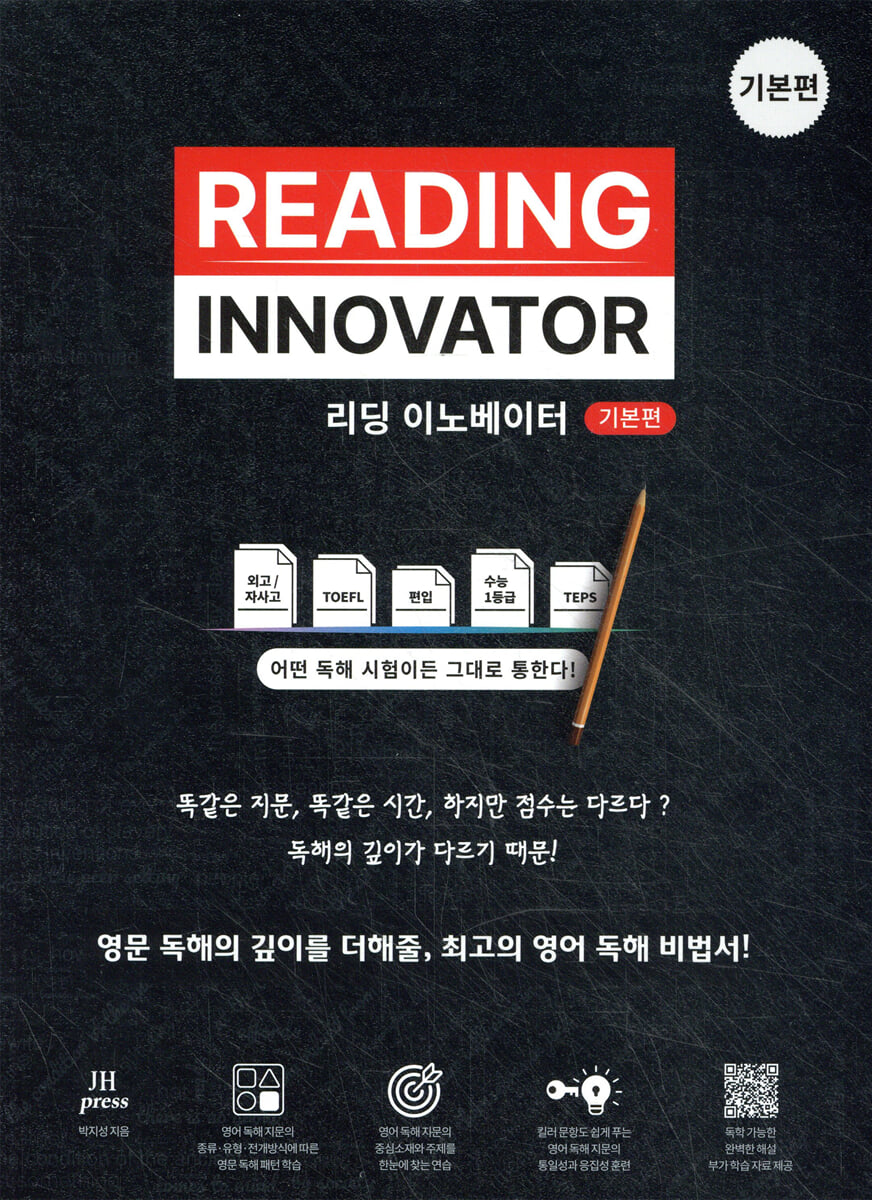
Leading Innovator Fundamentals
 |
Description
Book Introduction
This book will help you master any test! The ultimate English reading guide to deepen your English reading comprehension skills!
It provides detailed explanations and examples of 14 key elements that native speakers must consider when writing, and offers quick and in-depth reading solutions based on English writing theory.
It contains a training course to break away from Eastern thinking and acquire Western thinking.
We provide a set of practice problems called 'Finding the Topic, Finding the Summary, Finding the Title, and Matching and Mismatching Content' that are required as basic questions on various exams.
It contains high-difficulty questions of various types that can only be solved with native speaker thinking, as well as killer questions from various English tests.
Based on native speaker thinking, we provide a guide to solving English reading comprehension problems. We provide reading strategies and problem-solving methods that differ depending on the types and formats of original texts that you must know.
It provides the central theme, topic, and supporting statements of each passage separately, and includes solutions to killer problems that could not be solved even with perfect interpretation through the unity and cohesion of the text.
We provide lectures that summarize only the key points that top students are curious about.
With 25 sessions of 30 minutes each, you can quickly resolve only the necessary parts.
It provides a perfect approach to killer questions.
It provides detailed explanations and examples of 14 key elements that native speakers must consider when writing, and offers quick and in-depth reading solutions based on English writing theory.
It contains a training course to break away from Eastern thinking and acquire Western thinking.
We provide a set of practice problems called 'Finding the Topic, Finding the Summary, Finding the Title, and Matching and Mismatching Content' that are required as basic questions on various exams.
It contains high-difficulty questions of various types that can only be solved with native speaker thinking, as well as killer questions from various English tests.
Based on native speaker thinking, we provide a guide to solving English reading comprehension problems. We provide reading strategies and problem-solving methods that differ depending on the types and formats of original texts that you must know.
It provides the central theme, topic, and supporting statements of each passage separately, and includes solutions to killer problems that could not be solved even with perfect interpretation through the unity and cohesion of the text.
We provide lectures that summarize only the key points that top students are curious about.
With 25 sessions of 30 minutes each, you can quickly resolve only the necessary parts.
It provides a perfect approach to killer questions.
- You can preview some of the book's contents.
Preview
index
[Main book]
Part 1: Analysis of Text Components and Practical Application Practice Problems 12
1. Breadth of themes and central themes 14
2. Setting the scope of the central material based on the central content 17
3 Topic sentences revealing the central material and central content 22
4 The structure of the text and its relationship to the topic sentence 28
5 Topic Sentences and Supporting Sentences 47
6 Supplementary Statement 61
7 Unity and Cohesion 65
8 General and Specific Statements 72
9 Distinguishing between facts, opinions, beliefs, and prejudices 79
10 Key Points Leading Signal Research 83
Title of Article 105
12. Writing style 110
13 Types of Writing 140
14 Types of Writing 152
Part 2: 174 Practice Questions by Type
Test 1 Topic Selection Problem 176
Test 2: Selecting the Main Point Question 193
Test 3 Title Selection Problem 202
Test 4 Content Matching/Detail Checking Question 216
Test 5 Practice Comprehensive Problems 233
[Special Issue - Commentary]
〈Part 1〉Analysis and explanation of practical application practice problems (including original text interpretation and answers) 4
〈Part 2〉Analysis and explanation of problems by type (including original text interpretation and answers) 128
Part 1: Analysis of Text Components and Practical Application Practice Problems 12
1. Breadth of themes and central themes 14
2. Setting the scope of the central material based on the central content 17
3 Topic sentences revealing the central material and central content 22
4 The structure of the text and its relationship to the topic sentence 28
5 Topic Sentences and Supporting Sentences 47
6 Supplementary Statement 61
7 Unity and Cohesion 65
8 General and Specific Statements 72
9 Distinguishing between facts, opinions, beliefs, and prejudices 79
10 Key Points Leading Signal Research 83
Title of Article 105
12. Writing style 110
13 Types of Writing 140
14 Types of Writing 152
Part 2: 174 Practice Questions by Type
Test 1 Topic Selection Problem 176
Test 2: Selecting the Main Point Question 193
Test 3 Title Selection Problem 202
Test 4 Content Matching/Detail Checking Question 216
Test 5 Practice Comprehensive Problems 233
[Special Issue - Commentary]
〈Part 1〉Analysis and explanation of practical application practice problems (including original text interpretation and answers) 4
〈Part 2〉Analysis and explanation of problems by type (including original text interpretation and answers) 128
Detailed image

Publisher's Review
When we say 'English reading comprehension', learners generally think of sentence-by-sentence interpretation.
And most people think that this is all there is to reading comprehension.
This background is not unrelated to the educational climate of the past that emphasized grammar.
A set of rules related to a specific language is called grammar, and when learning grammar, most learners deal with single, independent sentences containing specific grammar rules, rather than paragraphs consisting of multiple sentences.
At first, interpreting individual sentences is usually not only burdensome but also requires a significant investment of time.
In such situations, learners tend to attribute their difficulty in reading to the interpretation of individual sentences, and naturally end up investing more time in grammar.
In this way, they have a vague idea that if they master grammar, their reading comprehension will improve. In a way, this can be seen as a result of the investment-to-reward mentality.
However, as time goes by, you will soon realize that just because you have acquired the ability to interpret sentences, it does not mean that you will be able to read well.
It is not without reason that the words “I can interpret it, but I don’t quite understand the meaning of the entire text” come out of the learner’s mouth.
This is an obvious result that comes from not studying the grammatical knowledge of individual sentences and applying it to paragraph reading.
So, what do we need to learn to read paragraphs? English reading involves reading texts written in English-speaking countries, so understanding the different writing styles of each culture is a prerequisite.
Applied linguist Robert Kaplan suggests that different cultures lead to different ways of thinking, which in turn leads to different ways of writing.
Looking at the unique writing styles of each culture presented in the diagram above, we can see that in the case of English, the writer first presents the main point he or she wants to convey in the introduction and then follows it with supporting statements, adopting a parenthetical structure. This signifies the linear (deductive) thinking of “claim - supporting evidence,” which is the most prominent characteristic of English writing.
In contrast, the Oriental writing style tends to begin with a peripheral story that has little to do with the main idea of the text, and then reveal the text's intention in the middle or latter half of the text.
Even this shows a significant difference from the English-speaking world's loose structure, which draws conclusions based on valid grounds.
The importance of recognizing these differences is that when people accustomed to Eastern culture (i.e., Korean learners) encounter English texts without prior knowledge of English writing styles, they tend to analyze the texts based on Eastern thinking.
Therefore, recognizing this situation and relying on the simple problem-solving method of “problem-explanation-vocabulary-interpretation” without systematic study of the characteristics of English texts cannot be a correct alternative.
So, what is the connection between understanding English writing skills and problem solving?
The beginning of all problem solving is a thorough analysis of the original text.
As mentioned earlier, to properly analyze English texts, you need to learn writing methods specific to that culture.
The most common structure of writing in English-speaking countries is commonly called parentheses. Understanding this structure goes beyond simply being able to analyze text well and has a direct connection to problem-solving.
For example, questions on all official English exams are related to the ability to understand the relationship between the topic sentence and the supporting sentence.
If you can distinguish between the topic sentence and the supporting sentence, you can achieve the following effects when solving problems.
First, since the topic sentence is a sentence that contains the central material and main content, you can quickly and accurately solve the topic problem without reading the entire text.
Second, understanding the topic sentence enables “reading with prediction.”
For example, if you understand the topic sentence, “Writing styles differ across cultures,” you can expect that the given text will present unique writing styles for each culture.
The ability to identify the topic sentence and supporting sentences allows for a deeper analysis of the given passage, thereby enhancing the understanding of the entire passage. This not only increases the accuracy of understanding questions that ask about the topic, but also the accuracy of understanding questions that test takers find difficult, such as content consistency and inconsistency.
It also enables speed reading in a time-sensitive test room based on “reading with anticipation.”
As mentioned before, most existing reading comprehension workbooks are structured in the “problem-explanation-vocabulary-interpretation” format.
This book breaks away from this stereotypical structure and first covers the fundamental core principles of English writing essential for English reading comprehension, and then presents and explains how to apply them to problem solving.
I hope that you will master and utilize this book well and achieve your goals.
And most people think that this is all there is to reading comprehension.
This background is not unrelated to the educational climate of the past that emphasized grammar.
A set of rules related to a specific language is called grammar, and when learning grammar, most learners deal with single, independent sentences containing specific grammar rules, rather than paragraphs consisting of multiple sentences.
At first, interpreting individual sentences is usually not only burdensome but also requires a significant investment of time.
In such situations, learners tend to attribute their difficulty in reading to the interpretation of individual sentences, and naturally end up investing more time in grammar.
In this way, they have a vague idea that if they master grammar, their reading comprehension will improve. In a way, this can be seen as a result of the investment-to-reward mentality.
However, as time goes by, you will soon realize that just because you have acquired the ability to interpret sentences, it does not mean that you will be able to read well.
It is not without reason that the words “I can interpret it, but I don’t quite understand the meaning of the entire text” come out of the learner’s mouth.
This is an obvious result that comes from not studying the grammatical knowledge of individual sentences and applying it to paragraph reading.
So, what do we need to learn to read paragraphs? English reading involves reading texts written in English-speaking countries, so understanding the different writing styles of each culture is a prerequisite.
Applied linguist Robert Kaplan suggests that different cultures lead to different ways of thinking, which in turn leads to different ways of writing.
Looking at the unique writing styles of each culture presented in the diagram above, we can see that in the case of English, the writer first presents the main point he or she wants to convey in the introduction and then follows it with supporting statements, adopting a parenthetical structure. This signifies the linear (deductive) thinking of “claim - supporting evidence,” which is the most prominent characteristic of English writing.
In contrast, the Oriental writing style tends to begin with a peripheral story that has little to do with the main idea of the text, and then reveal the text's intention in the middle or latter half of the text.
Even this shows a significant difference from the English-speaking world's loose structure, which draws conclusions based on valid grounds.
The importance of recognizing these differences is that when people accustomed to Eastern culture (i.e., Korean learners) encounter English texts without prior knowledge of English writing styles, they tend to analyze the texts based on Eastern thinking.
Therefore, recognizing this situation and relying on the simple problem-solving method of “problem-explanation-vocabulary-interpretation” without systematic study of the characteristics of English texts cannot be a correct alternative.
So, what is the connection between understanding English writing skills and problem solving?
The beginning of all problem solving is a thorough analysis of the original text.
As mentioned earlier, to properly analyze English texts, you need to learn writing methods specific to that culture.
The most common structure of writing in English-speaking countries is commonly called parentheses. Understanding this structure goes beyond simply being able to analyze text well and has a direct connection to problem-solving.
For example, questions on all official English exams are related to the ability to understand the relationship between the topic sentence and the supporting sentence.
If you can distinguish between the topic sentence and the supporting sentence, you can achieve the following effects when solving problems.
First, since the topic sentence is a sentence that contains the central material and main content, you can quickly and accurately solve the topic problem without reading the entire text.
Second, understanding the topic sentence enables “reading with prediction.”
For example, if you understand the topic sentence, “Writing styles differ across cultures,” you can expect that the given text will present unique writing styles for each culture.
The ability to identify the topic sentence and supporting sentences allows for a deeper analysis of the given passage, thereby enhancing the understanding of the entire passage. This not only increases the accuracy of understanding questions that ask about the topic, but also the accuracy of understanding questions that test takers find difficult, such as content consistency and inconsistency.
It also enables speed reading in a time-sensitive test room based on “reading with anticipation.”
As mentioned before, most existing reading comprehension workbooks are structured in the “problem-explanation-vocabulary-interpretation” format.
This book breaks away from this stereotypical structure and first covers the fundamental core principles of English writing essential for English reading comprehension, and then presents and explains how to apply them to problem solving.
I hope that you will master and utilize this book well and achieve your goals.
GOODS SPECIFICS
- Date of issue: September 2, 2024
- Page count, weight, size: 496 pages | 188*257*30mm
- ISBN13: 9791198439192
- ISBN10: 119843919X
You may also like
카테고리
korean


korean

![ELLE 엘르 스페셜 에디션 A형 : 12월 [2025]](http://librairie.coreenne.fr/cdn/shop/files/b8e27a3de6c9538896439686c6b0e8fb.jpg?v=1766436872&width=3840)


