

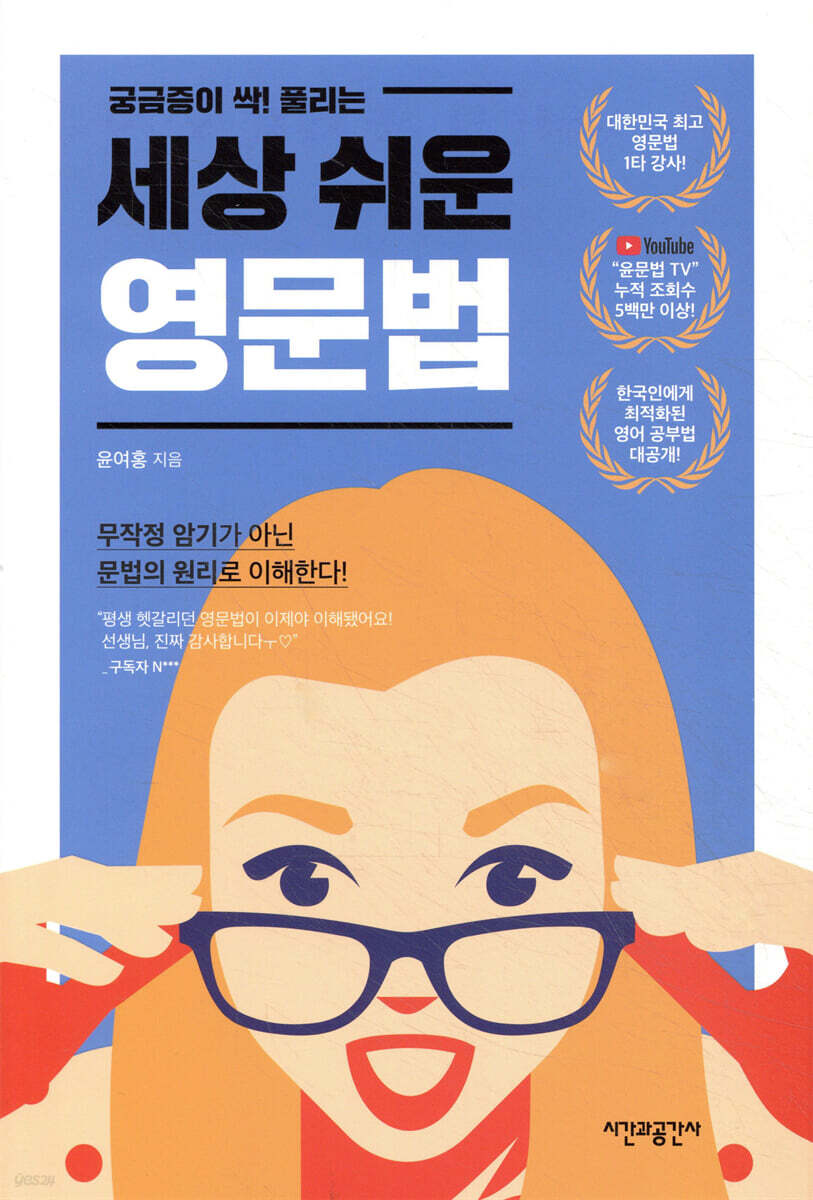
The world's easiest English grammar
 |
Description
Book Introduction
5 forms, 8 parts of speech, 12 tenses… This is so monotonous and complex Forget English grammar! Just what you really need to know 12 questions summarized! Simple English grammar that answers questions directly Turning my life around from a beginner to a top English grammar instructor in Korea! The secret was understanding, not memorization! “Wow! It’s a smooth read….” “I’ve been confused about English grammar my whole life, but now I can understand it in a new way!” “I thought English grammar was just something you had to memorize?” “Aha! I didn’t know English grammar had such an interesting principle!” “This is the first time in my life that I’ve seen the principles of English grammar explained in this way! When I ask English teachers, the answer I always get is this. “English is like that, just memorize it!” There were no English teachers who explained “why”. So I thought I was the only one who didn't know, and I was afraid of being embarrassed, so I just pretended to know and before I knew it, I had become a loser. The principles of adjectives and adverbs that I learned for the first time in my life while preparing to transfer to college after being discharged from the military! “Aha! English grammar isn’t about memorizing, it’s about understanding!” If you almost gave up on English because you hated memorizing things, this is a must-read! The author, who went from being a grammar instructor during his school days to becoming a top English grammar instructor at the best transfer academy in Korea, shares his secrets. Easy and fun English grammar principles with the author's own know-how. This is an English grammar book that anyone can read and understand easily. The author's YouTube channel, "Secrets of English Grammar You Didn't Know - Yoon Grammar TV," has garnered over 5 million views and is a hot topic among students, office workers, overseas study abroad students, and current English instructors, with a series of touching comments. It was planned several years ago and published after many revisions in response to persistent requests from YouTube subscribers. “Is school a school?” “What is the difference between Tom ran mad and Tom ran madly?” “Long hair becomes him → Long hair becomes him?” Based on 12 questions, it covers everything from the basics of English grammar to its application. I've included a QR code so you can study by linking it to the YouTube channel. There are also plenty of practice problems so you can immediately use the grammar you've learned and test yourself. |
- You can preview some of the book's contents.
Preview
index
Prologue Grammar is a matter of understanding, not memorization.
How to use this book! How to use this book and what I want to say
Curiosity 1.
Is 'School' a school?
1-1 Usage of English words that are different from Korean (feat.
Reason for matching numbers)
1-2 How do you express tenses in English?
Practice (1) Subject+verb number agreement using -s
Teacher Yoon's more friendly supplementary explanation
Curiosity 2.
Do I really need to study formats 1-5?
2-1 Regarding the reason why the 5-type spread in Korea and its value
2-2 What is the difference between Tom ran mad and Tom ran madly? (feat.
adjectives and adverbs)
Teacher Yoon's more friendly supplementary explanation
2-3 Is it 'The leaf turned yellow'?
Could it be 'The leaf turned yellowly'?
Practice (1) Subject + Verb followed by Adjective vs. Adverb (Form 1 vs. Form 2)
Teacher Yoon's more friendly supplementary explanation (1)
Teacher Yoon's more friendly supplementary explanation (2)
2-4 Long hair becomes him.
Long hair makes him? (feat.
Intransitive and transitive verbs)
Practice (2) Subject + Verb followed by Noun (Object vs. Complement)
Teacher Yoon's more friendly supplementary explanation
2-5 How many parts of speech are there in English?
Teacher Yoon's more friendly supplementary explanation
2-6 5-type principles and classification method
Practice? Distinguishing between types 1-5
Curiosity 3.
Difficult prepositions, is there any solution? (feat.
About 'Gu')
3-1 Prepositions: Usage and Study Methods
Practice (1) Preposition + Noun Phrase
Teacher Yoon's more friendly supplementary explanation
3-2 Why Koreans have difficulty with prepositions and how to solve them
Practice (2) Practice with various prepositions
on / on vs off / of / about / against / against vs for / to / in vs at / up
Curiosity 4.
I eat apple? No!
4-1 Why are English nouns counted?
4-2 Is water really an uncountable noun? (feat.
(Korean perspective on English nouns)
Practice (1) Countable vs. Uncountable Nouns
4-3 About the concept of ‘article’, which does not exist in Korean
Practice (2) When to use the definite article the
Curiosity 5.
Why do we add to or -ing to verbs?
5-1: How can you express the same thing in such different ways? Understand the context of the English!
Practice (1) Practice of auxiliary verbs (to R/R-ing)
5-2 What is the semantic subject?
5-3 Then what is the difference between to R (to infinitive) and -ing (gerund)?
Practice (2) Verbs that take R/R-ing as their object
5-4 What is the origin of R and -ing?
5-5 Why do the gerund -ing and the present participle -ing have the same shape?
Practice? Distinguishing between -ing suffixes (gerunds vs. present participles)
5-6 Why do perceptual verbs and causative verbs use the infinitive form?
Practice? Distinguishing Object Complements of Type 5 Verbs
Curiosity 6.
What on earth is a past participle (pp)?
6-1 Past participle, let me define it in one word!
Practice (1) Ved (past verb) vs pp (past participle)
Once you know pp. 6-2, passive voice becomes a piece of cake.
Practice (2) pp after be verb = passive voice
6-3 Please consider the position of the person being hit!
Practice? Passive Voice Conversion
6-4 Can't an object come after the passive voice? (feat.
Passive voice of type 4 and type 5)
Practice? Passive voice of 4th and 5th form verbs
6-5 Is be married to / be interested in passive voice?
Practice? When to use a preposition other than by after be+pp
Teacher Yoon's more friendly supplementary explanation (1)
Teacher Yoon's more friendly supplementary explanation (2)
Curiosity 7.
Why are who, that, whom, and because necessary?
(feat.
About '절')
7-1 If you know 'subordinate clauses', you're halfway through learning English! (feat.
passive voice of that clause)
When encountering a conjunction in a sentence 7-2
Practice (1) Subordinate clauses
Teacher Yoon's more friendly supplementary explanation
7-3 What are relative pronouns? What are interrogative pronouns?
Practice (2) Relatives and interrogatives
Curiosity 8.
How do I study English tenses?
8-1 There is no future for English?
8-2 When do we use the present tense?
Practice (1) Present Tense and Future
8-3 Why the Present Tense Replaces the Future
Practice (2) Adverbial clauses of time and condition
Curiosity 9.
Why do we use have+pp/be -ing?
9-1 Regarding have+pp(complete), which has a lot of different uses
Teacher Yoon's more friendly supplementary explanation
9-2 Everything you need to know about using have+pp(complete)!
Practice (1) Various uses of the present perfect
9-3 What are past perfect and future perfect?
Practice (2) Past Perfect and Future Perfect
Teacher Yoon's more friendly supplementary explanation
Practice? having+pp / to have+pp practice
9-4 When do we use the progressive tense (be -ing)?
Practice? Progress practice
Teacher Yoon's more friendly supplementary explanation
9-5 12 hour system, do I really need to know all of this?
Practice ? Practice various verb forms (negative/interrogative sentences)
Curiosity 10.
When do you use auxiliary verbs?
10-1 He might work.
He might have worked?
10-2 Why isn't the past tense of 'should' interpreted as 'had to do'?
10-3 Once you understand the auxiliary verbs, the conditional mood is a breeze!
Practice (1) Past Subjunctive/Past Perfect Subjunctive Practice
10-4 Subjunctive Present? Future?
Curiosity 11.
Why is inversion important in English?
11-1 Why do we have inversion and the difference from our language
Practice (1) Inversion Practice 1
Teacher Yoon's more friendly supplementary explanation
11-2 Regarding the translation of inverted sentences (Break Page)
11-3 Is it inversion if you move the negative adverbial to the front?
Practice (2) Inversion Practice 2
Curiosity 12.
How do you compare?
12-1 as used when A and B are similar
12-2 more-/-er ~than used when B is more than A
12-3 When A expresses 'the most ~', most, -est
Practice (1) Comparative Sentence Practice
Friendly Teacher Yoon's explanation and answers
Epilogue A book that explores and solves curiosities
Detailed image
.jpg)
Into the book
Everyone knows the word "school," right? "School = school." We all know this, right? Okay, let's interpret the sentence below together.
A person schools in the paddock.--- p.16
Understanding these two sentences will give you a solid grasp of the entire structure of the English language.
Also, what we call parts of speech.
What are those two sentences? This is it!
Tom ran mad.
Tom ran madly.--- p.35
Tom became a teacher.
Long hair becomes him.
The first sentence is easy, right? "Tom became a teacher." What about the second? "The long hair becomes him?" Hmm, what's the problem? --- p.57
But what's interesting is that when a verb is used in the 4th form, it must be interpreted by adding the word 'give', regardless of which verb it is.
What do you mean? I make him a doll.
Here, make means 'to make,' but look! There are two objects. In this case, make should be interpreted as 'to make,' not 'to make.'
--- p.88
Besides the structural issues, there is another difficult part related to prepositions.
For example, let's look at the preposition on.
What does 'on' mean? 'on = above' is usually understood like this, right?
The man stands on the hill.
The man is standing on the hill.
Tom dances on the stage.
Tom dances on stage.
Then what about the sentence below?
I turn on the radio.
I saw the fly on the wall.
I depend on his help.
It is clear that on means 'above', but why can't it be interpreted that way? --- p.107
I eat apple.
(×) I eat an apple.
(○) I drink water.
(○) I drink water.
(○)
The problem is the first sentence.
"I eat an apple." This sentence is perfectly valid in Korean, but why is it incorrect when translated directly into English? Let's explore the reason! --- p.124
But how did "to" come to be used to describe the future, and "-ing" to describe past or present events? Let me tell you a brief story.
When you learn to use the to-infinitive, you are bound to get confused.
That's right, the preposition to! Why do the to of the infinitive and the to of the preposition look the same? --- p.165
Now, from now on, I will present a simpler way to understand relative clauses, different from the conventional method.
First, if you think about the word "who," you don't know whether this "who" is a man or a woman, right? So, think of the word "who" as something like "that person" or "that person."
Then it will be easier to understand.
I met a child, who is kind.
I met a kid.
(But) he is kind.
--- p.225
If the rain tomorrow, I will go out.
If it stops raining tomorrow, I'll go out.
(A) stops (B) will stop
What's the correct answer to the question above? Consider the situation in which you're saying this.
The rain hasn't stopped yet, has it? It said it would stop tomorrow, so tomorrow is the future, and future is will! Ding! The correct answer is (A) stops.
What is the reason? --- p.250
You should study hard.
What would happen if we used the present tense "shall" instead of "should" in the sentence above? "Shall" is becoming less common these days, and that's understandable because it's incredibly strong.
So, when translated into Korean, this shall is interpreted as 'will', but unlike 'will', it is full of 'my will' and gives the nuance of making the other person do something.
--- p.293
This is another movie that I personally think has a really well-chosen title.
It's called "Monday is gone."
What was the original title of this movie? What happened to Monday?
A person schools in the paddock.--- p.16
Understanding these two sentences will give you a solid grasp of the entire structure of the English language.
Also, what we call parts of speech.
What are those two sentences? This is it!
Tom ran mad.
Tom ran madly.--- p.35
Tom became a teacher.
Long hair becomes him.
The first sentence is easy, right? "Tom became a teacher." What about the second? "The long hair becomes him?" Hmm, what's the problem? --- p.57
But what's interesting is that when a verb is used in the 4th form, it must be interpreted by adding the word 'give', regardless of which verb it is.
What do you mean? I make him a doll.
Here, make means 'to make,' but look! There are two objects. In this case, make should be interpreted as 'to make,' not 'to make.'
--- p.88
Besides the structural issues, there is another difficult part related to prepositions.
For example, let's look at the preposition on.
What does 'on' mean? 'on = above' is usually understood like this, right?
The man stands on the hill.
The man is standing on the hill.
Tom dances on the stage.
Tom dances on stage.
Then what about the sentence below?
I turn on the radio.
I saw the fly on the wall.
I depend on his help.
It is clear that on means 'above', but why can't it be interpreted that way? --- p.107
I eat apple.
(×) I eat an apple.
(○) I drink water.
(○) I drink water.
(○)
The problem is the first sentence.
"I eat an apple." This sentence is perfectly valid in Korean, but why is it incorrect when translated directly into English? Let's explore the reason! --- p.124
But how did "to" come to be used to describe the future, and "-ing" to describe past or present events? Let me tell you a brief story.
When you learn to use the to-infinitive, you are bound to get confused.
That's right, the preposition to! Why do the to of the infinitive and the to of the preposition look the same? --- p.165
Now, from now on, I will present a simpler way to understand relative clauses, different from the conventional method.
First, if you think about the word "who," you don't know whether this "who" is a man or a woman, right? So, think of the word "who" as something like "that person" or "that person."
Then it will be easier to understand.
I met a child, who is kind.
I met a kid.
(But) he is kind.
--- p.225
If the rain tomorrow, I will go out.
If it stops raining tomorrow, I'll go out.
(A) stops (B) will stop
What's the correct answer to the question above? Consider the situation in which you're saying this.
The rain hasn't stopped yet, has it? It said it would stop tomorrow, so tomorrow is the future, and future is will! Ding! The correct answer is (A) stops.
What is the reason? --- p.250
You should study hard.
What would happen if we used the present tense "shall" instead of "should" in the sentence above? "Shall" is becoming less common these days, and that's understandable because it's incredibly strong.
So, when translated into Korean, this shall is interpreted as 'will', but unlike 'will', it is full of 'my will' and gives the nuance of making the other person do something.
--- p.293
This is another movie that I personally think has a really well-chosen title.
It's called "Monday is gone."
What was the original title of this movie? What happened to Monday?
--- p.316
Publisher's Review
English grammar that is understood through principles, not memorization
Just answer the 12 questions about “Why?” and you’ll have a solid foundation in English grammar!
We've grouped together 12 common questions among English learners and included all the basic English grammar you need to learn English.
By starting with extremely common-sense questions that are not covered in general English grammar books and that everyone has wondered about at least once, we have made it possible for anyone, even those who have given up on English or know nothing about English, to confidently begin learning English grammar.
This is a grammar book optimized for Koreans who rely solely on textbooks without attending language training or native speaker lectures.
It is full of gem-like commentary obtained through the author's extensive research and teaching experience.
I left out difficult stories and used parables that anyone can easily understand and that once heard, will never be forgotten.
The author's experience is evident as he has wrestled with English grammar himself and taught students of various levels.
The author's YouTube channel, "Secrets of English Grammar You Didn't Know - Yoon Grammar TV," is loved by beginners, middle and high school students, office workers, and even current English instructors.
It breaks away from the standard methods used in existing English grammar books, such as number agreement, 5-forms, prepositions, parts of speech, to-infinitive, -ing, past participles, intransitive verbs, transitive verbs, clauses, tense, and passive voice, and approaches it in a completely new way.
Instead of complicated and difficult explanations, we've organized English grammar into short, simple explanations that anyone can understand.
It is fresh, fun, and above all, it gives you a refreshing feeling that clears up all your questions.
I especially recommend this book to readers who have stumbled over existing English grammar books.
** A relay of touching comments from YouTube subscribers of "Yoon Grammar TV" that went beyond praise **
I really hope all of our country's English learners watch this lecture.
ㅠㅠㅠㅠ The best!_ 456***
This person is the best at explaining things among English YouTubers.
Really understandable and not boring! _ONE ***
After graduating from college in Korea and completing my doctoral studies in the US, I always felt a 1% lack of understanding about articles. This lecture gave me the thrill of having my mind cleared up.
I truly hope that all students in Korea take this lecture.
_ forbin&***
Up until now, my English studies have been divided into before and after meeting Mr. Yoon Grammar.
_ SON***
This is the greatest lecture in the history of the universe.
I had been feeling somewhat unsure about the present perfect tense, but you have clearly solved it.
thank you
_ LA Korean***
I just memorized it, but now that I know the principle, I understand it better.
ㅠㅠ I wish my teachers had taught me like this when I was a student, but they just told me to memorize it... ... Grammar is really revolutionary! _ Borahae***
This is the moment when the secret is revealed after 30 years.
Thank you for explaining intransitive and transitive verbs so clearly~ ㅠㅠ _Illeung**
I am a current English teacher.
Even our English teachers had a hard time distinguishing between intransitive and intransitive verbs, so we had to put our heads together and study, but after watching this video, we were able to solve it all at once. It was really helpful.
_god**
GOODS SPECIFICS
- Publication date: October 20, 2022
- Page count, weight, size: 368 pages | 716g | 170*250*30mm
- ISBN13: 9791190818179
- ISBN10: 1190818175
You may also like
카테고리
korean


korean

![ELLE 엘르 스페셜 에디션 A형 : 12월 [2025]](http://librairie.coreenne.fr/cdn/shop/files/b8e27a3de6c9538896439686c6b0e8fb.jpg?v=1766436872&width=3840)


