

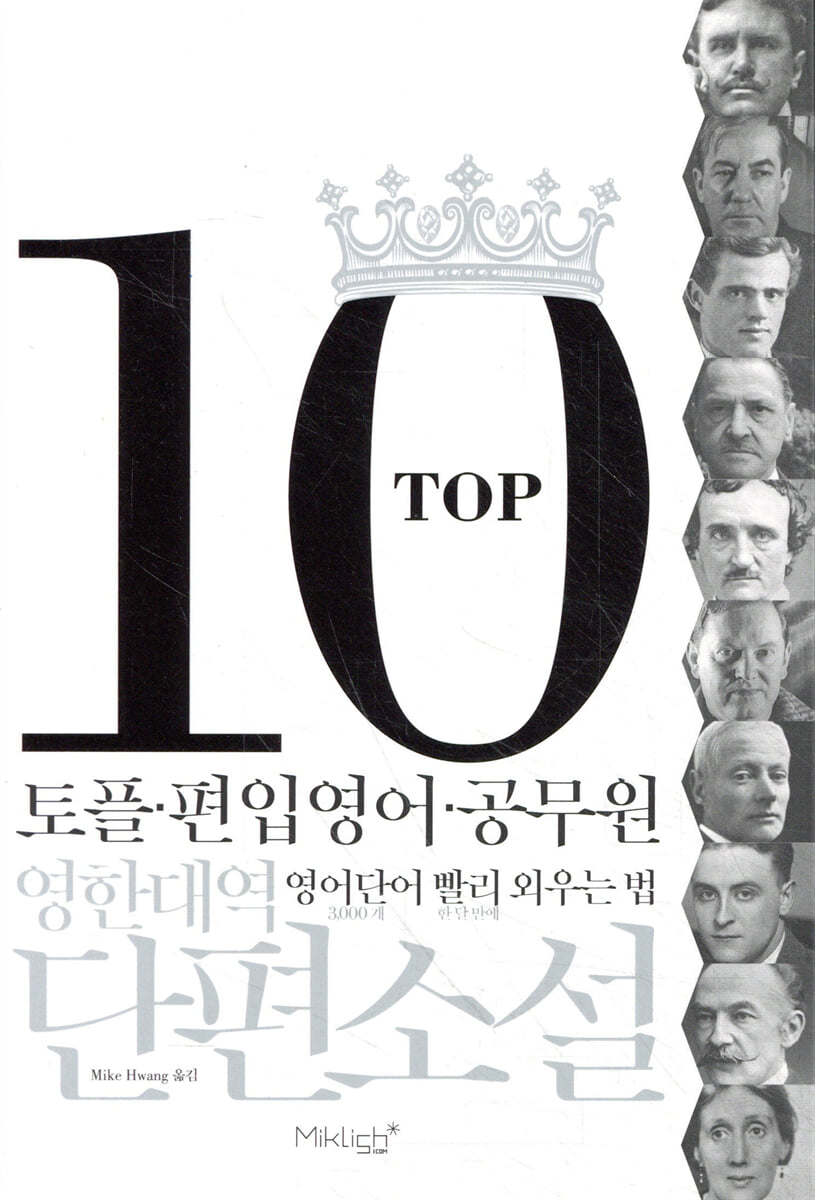
TOP 10 English-Korean Short Stories
 |
Description
Book Introduction
The reason I can't finish reading an English vocabulary list is because I only look at the words without context. Just as it is easy to memorize a subject you are familiar with, the more context you know, the easier it is to memorize. It is easier to memorize sentences than words, and writing than sentences. 『TOP 10 English-Korean Short Stories』 contains 10 short stories that are more interesting than webtoons/movies, in 512 pages. If you enjoy it repeatedly, you will memorize 60% of the English words needed for TOEIC, TOEFL, transfer, and civil service English. If there are parts that are difficult to interpret with the innovative English-Korean translation, you can look at the Korean text on the same line. We also provide free resources where native speakers read entire words and novels. If you use it for dictation/shadowing practice, your English conversation skills will also improve. |
- You can preview some of the book's contents.
Preview
index
Preface 4
Chapter 5
Book Feature 6
How to Use the Book 8
10 Ways to Memorize Words
How to Create a Vocabulary List 11
100 Important Words 12
Progress Chart 14
Short Stories TOP 1~10 16
TOP1: 16
O. Henry: 20 Years Later
O.
Henry: After 20 Years
TOP2: 32
Sherwood Anderson: Eggs
Sherwood Anderson: The Egg
TOP3: 70
Jack London: Lighting a Fire
Jack London: To Build a Fire
TOP 4: 124
William Somerset Maugham: Red
William Somerset Maugham: Red
TOP5: 194
Edgar Allan Poe: The Telltale Heart
Edgar Allan Poe: The Tell-Tale Heart
TOP6: 214
Evelyn Waugh: Mr. Loveday's Short Outing
Evelyn Waugh: Mr.
Loveday's Little Outing
TOP7: 242
William Wymack Jacobs: Monkey's Paw
William Wymark Jacobs: The Monkey's Paw
TOP8: 282
F.
Scott Fitzgerald: A Diamond as Big as the Ritz
Scott Fitzgerald: The Diamond as Big as the Ritz
TOP9: 420
Thomas Hardy: For My Wife
Thomas Hardy: To Please His Wife
TOP 10: 480
Virginia Woolf: Kew National Botanical Gardens
Virginia Woolf: Kew Gardens
Search 504
Power Giveaway TOP11 508
Chapter 5
Book Feature 6
How to Use the Book 8
10 Ways to Memorize Words
How to Create a Vocabulary List 11
100 Important Words 12
Progress Chart 14
Short Stories TOP 1~10 16
TOP1: 16
O. Henry: 20 Years Later
O.
Henry: After 20 Years
TOP2: 32
Sherwood Anderson: Eggs
Sherwood Anderson: The Egg
TOP3: 70
Jack London: Lighting a Fire
Jack London: To Build a Fire
TOP 4: 124
William Somerset Maugham: Red
William Somerset Maugham: Red
TOP5: 194
Edgar Allan Poe: The Telltale Heart
Edgar Allan Poe: The Tell-Tale Heart
TOP6: 214
Evelyn Waugh: Mr. Loveday's Short Outing
Evelyn Waugh: Mr.
Loveday's Little Outing
TOP7: 242
William Wymack Jacobs: Monkey's Paw
William Wymark Jacobs: The Monkey's Paw
TOP8: 282
F.
Scott Fitzgerald: A Diamond as Big as the Ritz
Scott Fitzgerald: The Diamond as Big as the Ritz
TOP9: 420
Thomas Hardy: For My Wife
Thomas Hardy: To Please His Wife
TOP 10: 480
Virginia Woolf: Kew National Botanical Gardens
Virginia Woolf: Kew Gardens
Search 504
Power Giveaway TOP11 508
Detailed image

Into the book
The reason why English words are difficult to memorize is because they were memorized using a 'vocabulary list'.
Most vocabulary lists are organized like mathematical formulas: 'roots, associations, synonyms, antonyms, examples, frequencies, etc.'
As I read, I start to think differently and I can't remember it well.
So, it is rare for people to finish the vocabulary list on their own, only about one in 20 people.
Just looking at a vocabulary list once won't help you memorize the words.
You have to watch it at least 5 to 30 times, which is impossible unless you are a very picky person.
Most vocabulary lists are for lectures, not self-study.
The reason why you can't interpret words even if you memorize them is because you only memorize 'words'.
The way to interpret and the meaning are completely different depending on the part of speech, usage, and context, and you cannot learn the difference by just memorizing the words.
There are words that are easy to memorize and words that are difficult to memorize.
New information in a field of interest, such as a hobby, can be memorized after hearing it only once, but information in a field of interest that is not interesting is quickly forgotten.
The same goes for words.
So, it is faster to learn from sentences rather than words without context, from paragraphs rather than sentences, and from writing rather than paragraphs.
The easiest and fastest way for intermediate and advanced learners to learn vocabulary on their own is through short stories.
Learning it in context makes it easier to memorize and interpret later.
We've compiled 10 of our most entertaining short stories into 500 pages, so you can read them over and over again.
We also provide MP3s of words and passages read by native speakers.
(provided by goo.gl/wo43vf)
It presents approximately 2500 words at an intermediate to advanced level.
Depending on your level, you can learn 1000 to 5000 words.
If you enjoy it repeatedly, you will learn 60% of the vocabulary for TOEIC, TOEFL, transfer, and civil service exams.
(See p.504)
If you find this book difficult, I recommend 『TOP10 Speeches』.
Because it is colloquial with a similar structure, it is easier than written language.
If you have any questions, please ask miklish.com.
We will respond within 3 days at the latest.
Most vocabulary lists are organized like mathematical formulas: 'roots, associations, synonyms, antonyms, examples, frequencies, etc.'
As I read, I start to think differently and I can't remember it well.
So, it is rare for people to finish the vocabulary list on their own, only about one in 20 people.
Just looking at a vocabulary list once won't help you memorize the words.
You have to watch it at least 5 to 30 times, which is impossible unless you are a very picky person.
Most vocabulary lists are for lectures, not self-study.
The reason why you can't interpret words even if you memorize them is because you only memorize 'words'.
The way to interpret and the meaning are completely different depending on the part of speech, usage, and context, and you cannot learn the difference by just memorizing the words.
There are words that are easy to memorize and words that are difficult to memorize.
New information in a field of interest, such as a hobby, can be memorized after hearing it only once, but information in a field of interest that is not interesting is quickly forgotten.
The same goes for words.
So, it is faster to learn from sentences rather than words without context, from paragraphs rather than sentences, and from writing rather than paragraphs.
The easiest and fastest way for intermediate and advanced learners to learn vocabulary on their own is through short stories.
Learning it in context makes it easier to memorize and interpret later.
We've compiled 10 of our most entertaining short stories into 500 pages, so you can read them over and over again.
We also provide MP3s of words and passages read by native speakers.
(provided by goo.gl/wo43vf)
It presents approximately 2500 words at an intermediate to advanced level.
Depending on your level, you can learn 1000 to 5000 words.
If you enjoy it repeatedly, you will learn 60% of the vocabulary for TOEIC, TOEFL, transfer, and civil service exams.
(See p.504)
If you find this book difficult, I recommend 『TOP10 Speeches』.
Because it is colloquial with a similar structure, it is easier than written language.
If you have any questions, please ask miklish.com.
We will respond within 3 days at the latest.
--- From the preface
Publisher's Review
Why I can't finish reading the vocabulary list
Only about one in twenty people ever finish a vocabulary list on their own.
This is because most vocabulary lists are lecture books that only list words.
As I read, I start to think differently and I can't remember it well.
Why I Can't Memorize Words
Even if you read the vocabulary list all the way through, you won't memorize it all at once.
You have to watch it 5 to 30 times.
Like a hobby, you can quickly memorize new information in a field that interests you, but you quickly forget information in a field that doesn't interest you.
The same goes for words.
The more you know about the content, the easier it will be to memorize.
So, it is easier to memorize words in sentences rather than words without context, in paragraphs rather than sentences, and in writing rather than paragraphs.
Why it doesn't make sense
The reason why you can't interpret words even if you memorize them is because you only memorize 'words'.
The way to interpret and the meaning are completely different depending on the part of speech, usage, and context, and you cannot learn the difference by just memorizing the words.
It is more effective to learn it from the fingerprints in the first place.
English vocabulary for TOEIC, TOEFL, transfer, and civil service exams
The book contains 2,641 words, and learners can learn 1,000 to 5,000 words depending on their level.
If you enjoy it repeatedly, you can finish 60% of the English vocabulary for TOEIC, TOEFL, transfer, and civil service exams.
The most beautiful sentence in the world
Contains short stories by American/British authors who have dedicated their lives to creating beautiful stories.
We've selected the 10 most entertaining novels from 150 representative works, so you won't be able to put them down after reading just the first three pages of each novel.
It includes a total of 512 pages, including works by famous authors such as F. Scott Fitzgerald, Edgar Allan Poe, William Somerset Maugham, Thomas Hardy, O. Henry, Virginia Woolf, Jack London, and Sherwood Anderson, as well as works by lesser-known authors such as William W. Mark Jacobs and Evelyn Waugh.
Innovative English-Korean translation and direct reading and interpretation
I read the English sentences from the beginning, one by one, trying to understand the meaning of each word.
If you have trouble interpreting a part, just read the Korean text on the same line.
You can use the book as a vocabulary list without needing a vocabulary list.
And since it is read naturally even if you only read Korean, you can enjoy it even if you don't know English at all.
Materials and Q&A
Each novel is organized with related vocabulary, and MP3s of native speakers reading the vocabulary and novel are also provided (goo.gl/wo43vf).
You can also improve your English conversation skills by dictating/shadowing with that material.
If you have any questions, please ask miklish.com and we will respond within 3 days.
Only about one in twenty people ever finish a vocabulary list on their own.
This is because most vocabulary lists are lecture books that only list words.
As I read, I start to think differently and I can't remember it well.
Why I Can't Memorize Words
Even if you read the vocabulary list all the way through, you won't memorize it all at once.
You have to watch it 5 to 30 times.
Like a hobby, you can quickly memorize new information in a field that interests you, but you quickly forget information in a field that doesn't interest you.
The same goes for words.
The more you know about the content, the easier it will be to memorize.
So, it is easier to memorize words in sentences rather than words without context, in paragraphs rather than sentences, and in writing rather than paragraphs.
Why it doesn't make sense
The reason why you can't interpret words even if you memorize them is because you only memorize 'words'.
The way to interpret and the meaning are completely different depending on the part of speech, usage, and context, and you cannot learn the difference by just memorizing the words.
It is more effective to learn it from the fingerprints in the first place.
English vocabulary for TOEIC, TOEFL, transfer, and civil service exams
The book contains 2,641 words, and learners can learn 1,000 to 5,000 words depending on their level.
If you enjoy it repeatedly, you can finish 60% of the English vocabulary for TOEIC, TOEFL, transfer, and civil service exams.
The most beautiful sentence in the world
Contains short stories by American/British authors who have dedicated their lives to creating beautiful stories.
We've selected the 10 most entertaining novels from 150 representative works, so you won't be able to put them down after reading just the first three pages of each novel.
It includes a total of 512 pages, including works by famous authors such as F. Scott Fitzgerald, Edgar Allan Poe, William Somerset Maugham, Thomas Hardy, O. Henry, Virginia Woolf, Jack London, and Sherwood Anderson, as well as works by lesser-known authors such as William W. Mark Jacobs and Evelyn Waugh.
Innovative English-Korean translation and direct reading and interpretation
I read the English sentences from the beginning, one by one, trying to understand the meaning of each word.
If you have trouble interpreting a part, just read the Korean text on the same line.
You can use the book as a vocabulary list without needing a vocabulary list.
And since it is read naturally even if you only read Korean, you can enjoy it even if you don't know English at all.
Materials and Q&A
Each novel is organized with related vocabulary, and MP3s of native speakers reading the vocabulary and novel are also provided (goo.gl/wo43vf).
You can also improve your English conversation skills by dictating/shadowing with that material.
If you have any questions, please ask miklish.com and we will respond within 3 days.
GOODS SPECIFICS
- Date of publication: July 21, 2018
- Page count, weight, size: 512 pages | 450g | 127*188*23mm
- ISBN13: 9791187158219
- ISBN10: 1187158216
You may also like
카테고리
korean


korean

![ELLE 엘르 스페셜 에디션 A형 : 12월 [2025]](http://librairie.coreenne.fr/cdn/shop/files/b8e27a3de6c9538896439686c6b0e8fb.jpg?v=1766436872&width=3840)


