

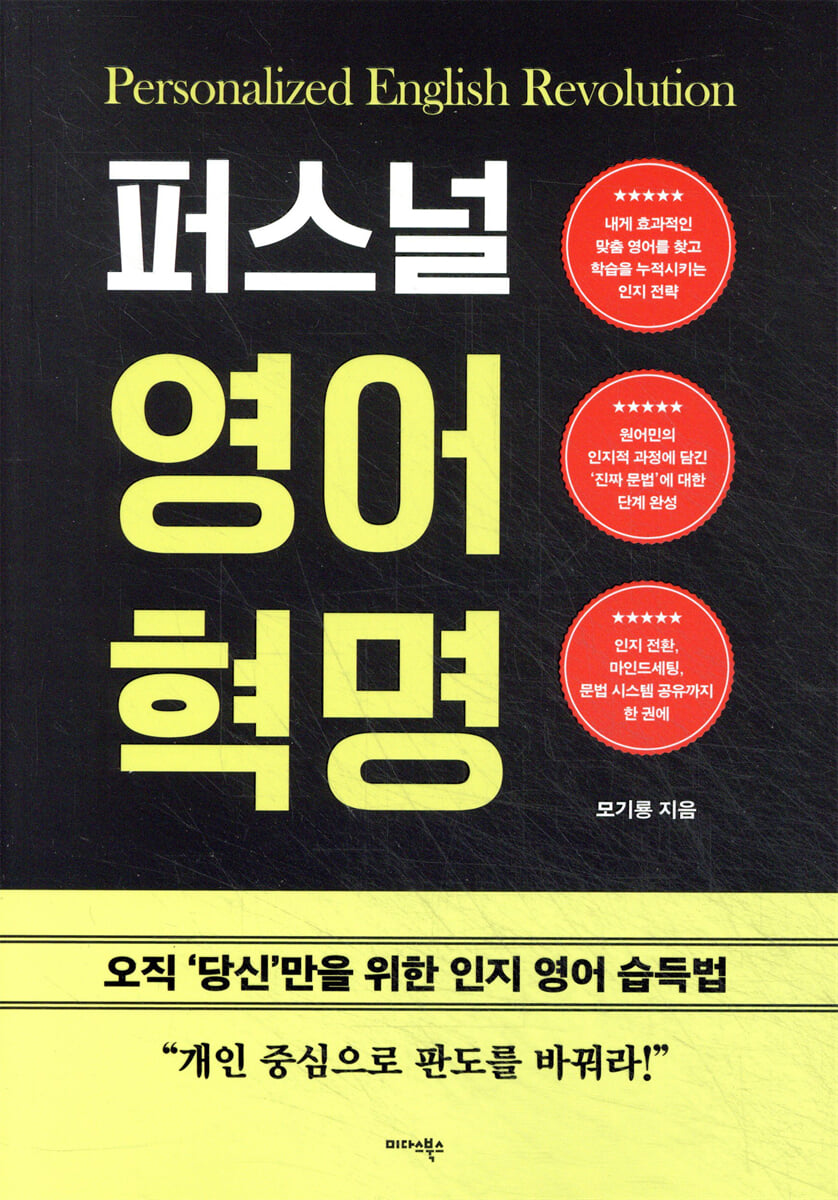
Personal English Revolution
 |
Description
Book Introduction
Only for you
Cognitive English acquisition method!
From memorization to memory,
From follow-up to individual-centered
Change the landscape of learning!
Cognitive shift, mindset,
All in one place, including sharing the grammar system!
- Cognitive strategies to find customized English that works for me and accumulate learning
- Complete the steps for real grammar contained in the cognitive processes of native speakers.
The author found the answer to why one cannot open one's mouth even after studying English for a long time, and why one must start studying from the first page every new year, in "cognition."
We need to change not only our attitude toward the English language itself, but also the way our brains perceive English, including where, with whom, and when it will be used.
The days of fitting myself into a common curriculum are over.
This book redesigns the path of English study through individual-centered, cognitive-based learning.
The point is simple.
But it is essential.
To this end, the book proposes a three-stage transition system.
After reading this book carefully, you will realize that your English studies up to now have been wrong from the start.
And before that, you will discover a completely new, most efficient way to learn English, one you have never experienced before.
It will be easier to understand if you follow the summary and implementation tasks for each step.
Cognitive English acquisition method!
From memorization to memory,
From follow-up to individual-centered
Change the landscape of learning!
Cognitive shift, mindset,
All in one place, including sharing the grammar system!
- Cognitive strategies to find customized English that works for me and accumulate learning
- Complete the steps for real grammar contained in the cognitive processes of native speakers.
The author found the answer to why one cannot open one's mouth even after studying English for a long time, and why one must start studying from the first page every new year, in "cognition."
We need to change not only our attitude toward the English language itself, but also the way our brains perceive English, including where, with whom, and when it will be used.
The days of fitting myself into a common curriculum are over.
This book redesigns the path of English study through individual-centered, cognitive-based learning.
The point is simple.
But it is essential.
To this end, the book proposes a three-stage transition system.
After reading this book carefully, you will realize that your English studies up to now have been wrong from the start.
And before that, you will discover a completely new, most efficient way to learn English, one you have never experienced before.
It will be easier to understand if you follow the summary and implementation tasks for each step.
- You can preview some of the book's contents.
Preview
index
Personal English (Personalized English) at a glance
Preface: Let's stop pouring water into a bottomless pit.
Orientation: Why We Had a Hard Time Accepting English
Part 1.
Let's speak our own English, not someone else's.
Lecture 1.
Learn English your way
Lecture 2.
So that English and Korean don't fight
Lecture 3.
Let's change 'following' to 'creating'
Lecture 4.
My context is my own.
Lesson 5.
The ability to speak requires freedom.
Lesson 6.
You are the center of the English world.
Part 1 Summary: Key Insights
Try it: Use Your Potential
Part 2.
4 Mindsets for Your Own English
Lesson 7.
Distinguish between non-English
Lesson 8.
Draw a picture of yourself after learning English
Lesson 9.
Speak English among ourselves
Lesson 10.
Approach it in two ways: understanding the content and learning English.
Part 2 Summary: Key Insights
Try it: Use Your Potential
Part 3.
Steal the cognitive picture in the mind of a native speaker.
Lesson 11.
Understand passive and active: get, have, take
Lesson 12.
Let's accept the English word order system.
Lesson 13.
Let's solve the prepositional difficulty with cognitive pictures.
Lesson 14.
Let's learn about the mental structure that creates tense expressions.
Part 3 Summary: Key Insights
Try it: Use Your Potential
Preface: Let's stop pouring water into a bottomless pit.
Orientation: Why We Had a Hard Time Accepting English
Part 1.
Let's speak our own English, not someone else's.
Lecture 1.
Learn English your way
Lecture 2.
So that English and Korean don't fight
Lecture 3.
Let's change 'following' to 'creating'
Lecture 4.
My context is my own.
Lesson 5.
The ability to speak requires freedom.
Lesson 6.
You are the center of the English world.
Part 1 Summary: Key Insights
Try it: Use Your Potential
Part 2.
4 Mindsets for Your Own English
Lesson 7.
Distinguish between non-English
Lesson 8.
Draw a picture of yourself after learning English
Lesson 9.
Speak English among ourselves
Lesson 10.
Approach it in two ways: understanding the content and learning English.
Part 2 Summary: Key Insights
Try it: Use Your Potential
Part 3.
Steal the cognitive picture in the mind of a native speaker.
Lesson 11.
Understand passive and active: get, have, take
Lesson 12.
Let's accept the English word order system.
Lesson 13.
Let's solve the prepositional difficulty with cognitive pictures.
Lesson 14.
Let's learn about the mental structure that creates tense expressions.
Part 3 Summary: Key Insights
Try it: Use Your Potential
Detailed image

Into the book
From a cognitive science perspective, solutions begin to emerge at a fundamental level: what should we put in our heads?
Ultimately, what we need to have is something that native speakers have in common in their heads.
It is not the sentences or expressions that appear on the surface, but the structure and system of the English language itself and its abstract abilities.
When we have it, we can speak creatively and naturally.
--- From the "Preface"
If I were to preface one of the most important points emphasized throughout this book, I'd say: "Don't do what others do."
The way other people speak and express themselves, and the way they acquire and learn English, are generally the same.
The fundamental reason is mainly motivation.
--- p.24
Even if it is the same word, changing the context at will is a completely 'creative work'.
A new match between objects and background is a perfect creation.
--- p.55
It's not that the way they, the native speakers, write is right and the way you write is wrong.
I also have to think that the way I write is right.
Of course, since 'all native speakers' write in the same way, it is probably part of the English language itself, so we should follow it. However, native speakers also write differently from person to person, and we should also freely use the parts that they write freely.
--- p.71
The Korean phrase "You should say this in English" creates confusion in real-life conversations, as if there's a right answer to what you're saying.
In fact, in the world of language, there are no words that are set for an individual or that must be said.
This is the freedom that language has.
We can say anything.
Playful words, unique words, unexpected words, even lies or words that upset others.
--- p.78
Until now, we have thought of English and the English-speaking world as 'other people's'.
It is difficult to learn English this way.
The center of the English world is 'you'.
Let's have egocentrism or self-centeredness in English.
Egocentrism about the world is often associated with unrealistic or selfish tendencies, but not so with the 'English world'.
--- pp.84-85
Korean and English do not overlap because they have different efficiencies.
In general, the internal structure of our mind has a nature to consider redundant things in memory as unnecessary and try to eliminate them.
However, the effectiveness of English and Korean is rarely the same and there is no overlap.
If you find yourself easily forgetting the English you've memorized, it may be because you've made it 'redundant' by matching it to something you already know.
--- p.121
Mode 1 refers to the strategic attitudes and methods that learners use when encountering English texts or corpora.
The purpose of Mode 1 is to 'quickly and effectively understand difficult English texts.'
Mode 2, on the other hand, is not aimed at that, but rather at improving your ultimate and overall English skills.
--- p.139
In fact, there are many situations where it is okay to switch 'get' and 'have' in a sentence.
On the other hand, if you change 'get' to 'take', the meaning will often change drastically or it will not make sense.
In the use of 'take', there are many cases where the meaning is similar or okay when changed to 'have', but when changed to 'get', it becomes very different and strange.
--- p.167
In conclusion, English has 'one form'.
That format could also be called SVO, but a better description is what I mentioned at the beginning: 'the core is in the front'.
All the structures of English are derived from here.
--- p.173
Native speakers don't have a list of verbs categorized by the five types, causative verbs, perceptual verbs, etc. in their heads.
As I said in the last lecture, it's like memorizing useless numbers instead of subway station names.
In the head of a native speaker, there is:
'The core comes first, the auxiliary verb is the core (king) of the sentence, and there is only one auxiliary verb in front in a sentence (clause).'
Ultimately, what we need to have is something that native speakers have in common in their heads.
It is not the sentences or expressions that appear on the surface, but the structure and system of the English language itself and its abstract abilities.
When we have it, we can speak creatively and naturally.
--- From the "Preface"
If I were to preface one of the most important points emphasized throughout this book, I'd say: "Don't do what others do."
The way other people speak and express themselves, and the way they acquire and learn English, are generally the same.
The fundamental reason is mainly motivation.
--- p.24
Even if it is the same word, changing the context at will is a completely 'creative work'.
A new match between objects and background is a perfect creation.
--- p.55
It's not that the way they, the native speakers, write is right and the way you write is wrong.
I also have to think that the way I write is right.
Of course, since 'all native speakers' write in the same way, it is probably part of the English language itself, so we should follow it. However, native speakers also write differently from person to person, and we should also freely use the parts that they write freely.
--- p.71
The Korean phrase "You should say this in English" creates confusion in real-life conversations, as if there's a right answer to what you're saying.
In fact, in the world of language, there are no words that are set for an individual or that must be said.
This is the freedom that language has.
We can say anything.
Playful words, unique words, unexpected words, even lies or words that upset others.
--- p.78
Until now, we have thought of English and the English-speaking world as 'other people's'.
It is difficult to learn English this way.
The center of the English world is 'you'.
Let's have egocentrism or self-centeredness in English.
Egocentrism about the world is often associated with unrealistic or selfish tendencies, but not so with the 'English world'.
--- pp.84-85
Korean and English do not overlap because they have different efficiencies.
In general, the internal structure of our mind has a nature to consider redundant things in memory as unnecessary and try to eliminate them.
However, the effectiveness of English and Korean is rarely the same and there is no overlap.
If you find yourself easily forgetting the English you've memorized, it may be because you've made it 'redundant' by matching it to something you already know.
--- p.121
Mode 1 refers to the strategic attitudes and methods that learners use when encountering English texts or corpora.
The purpose of Mode 1 is to 'quickly and effectively understand difficult English texts.'
Mode 2, on the other hand, is not aimed at that, but rather at improving your ultimate and overall English skills.
--- p.139
In fact, there are many situations where it is okay to switch 'get' and 'have' in a sentence.
On the other hand, if you change 'get' to 'take', the meaning will often change drastically or it will not make sense.
In the use of 'take', there are many cases where the meaning is similar or okay when changed to 'have', but when changed to 'get', it becomes very different and strange.
--- p.167
In conclusion, English has 'one form'.
That format could also be called SVO, but a better description is what I mentioned at the beginning: 'the core is in the front'.
All the structures of English are derived from here.
--- p.173
Native speakers don't have a list of verbs categorized by the five types, causative verbs, perceptual verbs, etc. in their heads.
As I said in the last lecture, it's like memorizing useless numbers instead of subway station names.
In the head of a native speaker, there is:
'The core comes first, the auxiliary verb is the core (king) of the sentence, and there is only one auxiliary verb in front in a sentence (clause).'
--- p.180
Publisher's Review
I write, I need,
Find personalized English that focuses on you, as I say.
Change the brain's cognition and fundamental attitude
English that we can communicate well with each other,
I will speak English myself today and tomorrow!
Why does studying English seem to fade away so quickly? It takes a long time to memorize, and English is just boring.
Can I escape this shackle?
Korean language learners are already structurally placed in an environment where it is difficult to acquire English.
The attitude of studying focused on entrance exams, reading, and tests, and the interference of the native language that is reinforced in adulthood when trying to have conversations that deviate slightly from tests.
This book helps you study English in a way that's just right for you by minimizing the interference between languages that occurs in the brain and personalizing motivation, input, and output.
The reason why learning English becomes more difficult, especially after puberty, is because Korean (the mother tongue) is combined with a strong 'ego'.
This book 'reversely utilizes' the ultimate power of self-preservation to acquire English.
The motivation to protect and prioritize the self and myself is powerful.
A learning strategy that encourages and utilizes one's own 'freedom', 'individuality', and 'personalization' becomes a breakthrough in the blocked acquisition of English.
Learning efficiency is on a whole new level through cognitive shift methods that prevent the Korean language that already occupies your brain from competing with the new English language that is coming in, motivational methods that select and practice materials that fit your reality and identity, and study methods that actively utilize the personal freedom needed to speak while converting imitation into 'creation.'
The goal is clear.
It is about being born from a learner who imitates ‘other people’s English’ to a user who creates ‘my own English.’
We cannot become good at English by imitating other people's methods, other people's sounds, other people's words, and other people's sentences.
Because English is something that 'I' use.
If you want to know the essence of how to apply this obvious fact to your English studies, open this book.
By the time you finish the book, you'll have your own method for selecting material, a routine for reproducing it in different situations, a speaking skill built from a minimal cognitive grammar, and a review design that transfers it to long-term memory.
Simple diagrams will visually illustrate concepts of cognitive transitions, vocabulary, and grammar, guiding you step by step into a new world.
Find personalized English that focuses on you, as I say.
Change the brain's cognition and fundamental attitude
English that we can communicate well with each other,
I will speak English myself today and tomorrow!
Why does studying English seem to fade away so quickly? It takes a long time to memorize, and English is just boring.
Can I escape this shackle?
Korean language learners are already structurally placed in an environment where it is difficult to acquire English.
The attitude of studying focused on entrance exams, reading, and tests, and the interference of the native language that is reinforced in adulthood when trying to have conversations that deviate slightly from tests.
This book helps you study English in a way that's just right for you by minimizing the interference between languages that occurs in the brain and personalizing motivation, input, and output.
The reason why learning English becomes more difficult, especially after puberty, is because Korean (the mother tongue) is combined with a strong 'ego'.
This book 'reversely utilizes' the ultimate power of self-preservation to acquire English.
The motivation to protect and prioritize the self and myself is powerful.
A learning strategy that encourages and utilizes one's own 'freedom', 'individuality', and 'personalization' becomes a breakthrough in the blocked acquisition of English.
Learning efficiency is on a whole new level through cognitive shift methods that prevent the Korean language that already occupies your brain from competing with the new English language that is coming in, motivational methods that select and practice materials that fit your reality and identity, and study methods that actively utilize the personal freedom needed to speak while converting imitation into 'creation.'
The goal is clear.
It is about being born from a learner who imitates ‘other people’s English’ to a user who creates ‘my own English.’
We cannot become good at English by imitating other people's methods, other people's sounds, other people's words, and other people's sentences.
Because English is something that 'I' use.
If you want to know the essence of how to apply this obvious fact to your English studies, open this book.
By the time you finish the book, you'll have your own method for selecting material, a routine for reproducing it in different situations, a speaking skill built from a minimal cognitive grammar, and a review design that transfers it to long-term memory.
Simple diagrams will visually illustrate concepts of cognitive transitions, vocabulary, and grammar, guiding you step by step into a new world.
GOODS SPECIFICS
- Date of issue: October 22, 2025
- Page count, weight, size: 224 pages | 148*210*20mm
- ISBN13: 9791173555152
- ISBN10: 1173555153
You may also like
카테고리
korean


korean

![ELLE 엘르 스페셜 에디션 A형 : 12월 [2025]](http://librairie.coreenne.fr/cdn/shop/files/b8e27a3de6c9538896439686c6b0e8fb.jpg?v=1766436872&width=3840)


