

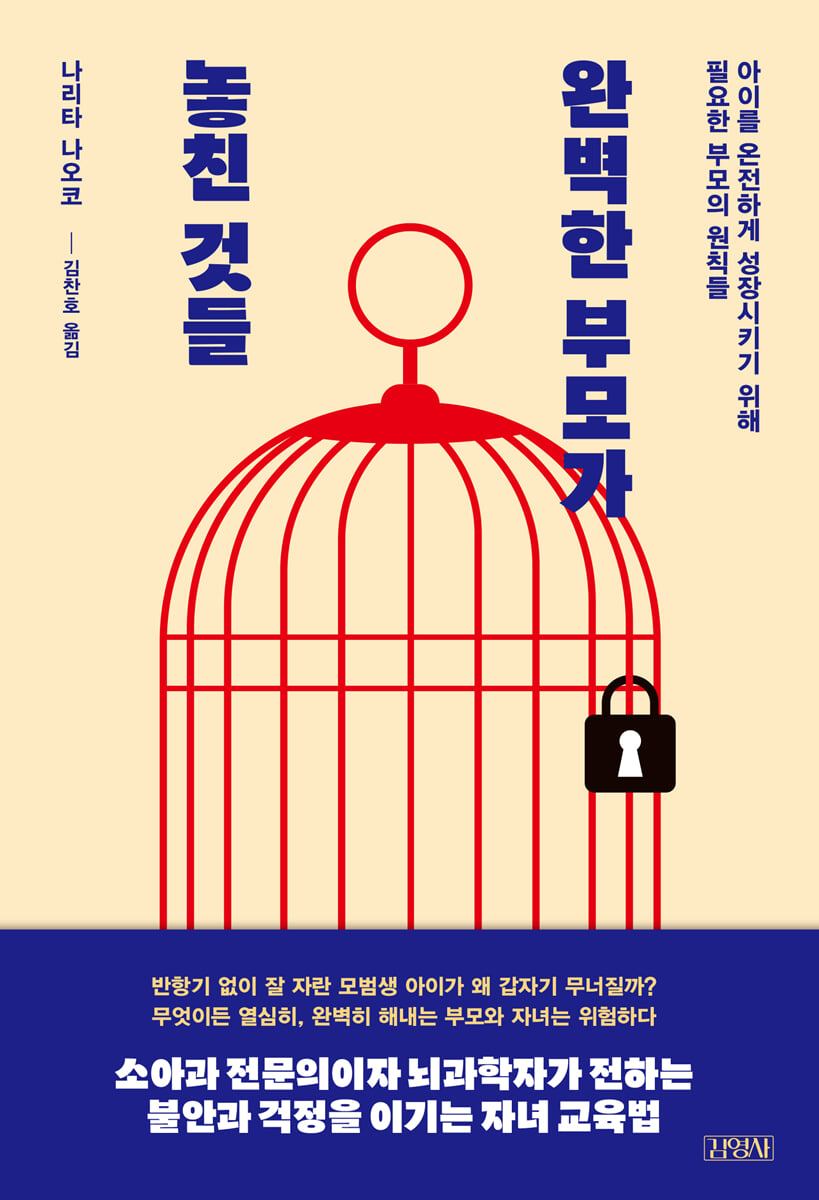
What Perfect Parents Miss
 |
Description
Book Introduction
Why can't I support my child and am always anxious?
What are smart parents missing?
A pediatrician and neuroscientist tells us:
How to Raise Children to Overcome Anxiety and Worry
★★Highly recommended by sociologist Kim Chan-ho★★
★★Highly recommended by Nobel Prize in Physiology or Medicine winner Shinya Yamanaka★★
Why do children fail to grow into strong adults despite providing the best education and environment for their future? "What Perfect Parents Miss" is a book for parents who, despite their desire for their children's success and their unwillingness to fail at parenting, always do their best, yet feel lost and unmoored in their parenting.
As many only children are born, everyone tries to raise their children well without mistakes or failures, but the education and parenting that they think is the best choice for their children may not actually be the case.
This book covers a wealth of case studies spanning childhood, adolescence, and young adulthood, pointing out the flawed parenting attitudes and pitfalls that parents often fall into when striving for perfection, and suggesting solutions.
This book was translated and recommended by sociologist Professor Kim Chan-ho.
He translated this book in the hope that Korean society, where parents are so obsessed with education that the term "4-year-old civil service exam" has emerged, will change into an environment where children can grow into happy and balanced adults, and that parents who study hard but feel helpless in parenting will find the right direction.
What are smart parents missing?
A pediatrician and neuroscientist tells us:
How to Raise Children to Overcome Anxiety and Worry
★★Highly recommended by sociologist Kim Chan-ho★★
★★Highly recommended by Nobel Prize in Physiology or Medicine winner Shinya Yamanaka★★
Why do children fail to grow into strong adults despite providing the best education and environment for their future? "What Perfect Parents Miss" is a book for parents who, despite their desire for their children's success and their unwillingness to fail at parenting, always do their best, yet feel lost and unmoored in their parenting.
As many only children are born, everyone tries to raise their children well without mistakes or failures, but the education and parenting that they think is the best choice for their children may not actually be the case.
This book covers a wealth of case studies spanning childhood, adolescence, and young adulthood, pointing out the flawed parenting attitudes and pitfalls that parents often fall into when striving for perfection, and suggesting solutions.
This book was translated and recommended by sociologist Professor Kim Chan-ho.
He translated this book in the hope that Korean society, where parents are so obsessed with education that the term "4-year-old civil service exam" has emerged, will change into an environment where children can grow into happy and balanced adults, and that parents who study hard but feel helpless in parenting will find the right direction.
- You can preview some of the book's contents.
Preview
index
Entering
Chapter 1: Child-rearing Risks Facing Highly Educated Parents
The three major risks: interference, contradiction, and blind love.
Why do highly educated parents interfere?
Highly educated parents fall into contradiction by using parentheses
Blind love, the foundation of interference and contradiction
Highly educated parents who want to raise their children 'as they grew up'
Chapter 2: Highly educated parents who worry too much
Parenting is a journey of turning worry into trust.
If there is no rebellion, it is a danger signal.
Three Reasons You Can't Trust Your Children: ① Perfectionism
A top student who throws away the lunchbox his mom made for him in the trash can
Three Reasons You Can't Trust Your Children: ② Vanity
Three Reasons You Can't Trust Your Children: ③ Loneliness
I was also a child who was not trusted by my parents.
Characteristics of Parents and Children Who Fall for Voice Phishing
Why Voice Phishing Using Daughters' Voices Is Rare
Good stress and bad stress
The genius child who stopped drawing
Chapter 3: Highly Educated Parents and Children Who Are Vulnerable
Highly educated parents haunted by their mother's ghost
Revenge-style parenting that demands high education
Revenge type is quickly exhausted
Highly educated parents who lack financial sense
Children of highly educated parents have lower resilience.
Chapter 4: Highly Educated Parents Focus on "Incorrect Early Education"
Highly educated parents teach their five-year-old sine and cosine.
Takeshi's case, where he had six tutoring sessions a week.
The brain has a growth order.
There are things more important than studying.
Raising a child to be like a caveman
Raising children with a thirst for knowledge beyond schoolwork
Raising children who can read others' minds
Talking to a 0-year-old child
'Reclusive Loners' Can Be Prevented
In European kindergartens, children are let loose in the mountains.
Parents who can nurture their children's brains, and those who cannot.
Chapter 5: Child-Raising Methods for Highly Educated Parents
Maintain a consistent, upright attitude as a parent
Don't give smartphones to toddlers.
Tell your children stories of failure rather than success.
Respect your child's bias and obsession.
Always bright and cheerful
Build a very large axis
Going out
Translator's Note
Chapter 1: Child-rearing Risks Facing Highly Educated Parents
The three major risks: interference, contradiction, and blind love.
Why do highly educated parents interfere?
Highly educated parents fall into contradiction by using parentheses
Blind love, the foundation of interference and contradiction
Highly educated parents who want to raise their children 'as they grew up'
Chapter 2: Highly educated parents who worry too much
Parenting is a journey of turning worry into trust.
If there is no rebellion, it is a danger signal.
Three Reasons You Can't Trust Your Children: ① Perfectionism
A top student who throws away the lunchbox his mom made for him in the trash can
Three Reasons You Can't Trust Your Children: ② Vanity
Three Reasons You Can't Trust Your Children: ③ Loneliness
I was also a child who was not trusted by my parents.
Characteristics of Parents and Children Who Fall for Voice Phishing
Why Voice Phishing Using Daughters' Voices Is Rare
Good stress and bad stress
The genius child who stopped drawing
Chapter 3: Highly Educated Parents and Children Who Are Vulnerable
Highly educated parents haunted by their mother's ghost
Revenge-style parenting that demands high education
Revenge type is quickly exhausted
Highly educated parents who lack financial sense
Children of highly educated parents have lower resilience.
Chapter 4: Highly Educated Parents Focus on "Incorrect Early Education"
Highly educated parents teach their five-year-old sine and cosine.
Takeshi's case, where he had six tutoring sessions a week.
The brain has a growth order.
There are things more important than studying.
Raising a child to be like a caveman
Raising children with a thirst for knowledge beyond schoolwork
Raising children who can read others' minds
Talking to a 0-year-old child
'Reclusive Loners' Can Be Prevented
In European kindergartens, children are let loose in the mountains.
Parents who can nurture their children's brains, and those who cannot.
Chapter 5: Child-Raising Methods for Highly Educated Parents
Maintain a consistent, upright attitude as a parent
Don't give smartphones to toddlers.
Tell your children stories of failure rather than success.
Respect your child's bias and obsession.
Always bright and cheerful
Build a very large axis
Going out
Translator's Note
Detailed image

Into the book
Today is an age of diversity.
The type of person society demands is also changing from moment to moment.
That is why we desperately need a ‘universal human power’ that applies to any era or environment.
This book also introduces how children can acquire it.
Rather than struggling alone, I hope you will broaden your thinking through this book.
--- p.8~9, from “Introduction”
When children are allowed to swim freely under the supervision of an adult, they learn to think and act for themselves for the first time.
As a result, sometimes we fail and get scolded, scared, and embarrassed.
These experiences can be remembered and used to help you change your behavior, thinking, "I failed this way before, so I'll do it this way this time."
By repeating trial and error, you grow and develop your self-control.
However, many parents cannot let their children swim freely.
In fact, isn't it possible that we're failing to instill in our children the ability to think for themselves, solve problems, and be independent, or are even taking them away? Having constantly pondered these questions, I was able to uncover the hidden problems within parents.
--- p.19, Chapter 1.
Among the “Childcare Risks that Highly Educated Parents Are Able to Face”
Most people cannot hand over their house keys even when they are in the 3rd or 4th grade of elementary school.
I think it would be good for even younger children to try, but when I ask why they can't leave it to me, they say, "Wouldn't it be a problem if I lost it?"
Well then, I'll give you my opinion.
“No.
You might lose it, but if you do, you'll think, 'I forgot.'
“If I think to myself, ‘I need to be careful next time,’ and don’t lose it again, won’t that build confidence and trust between parent and child?” No matter how much I tried to persuade my mother, she would say, “That’s not true.
I feel like the child is definitely going to lose it.
“If that happens, a thief will break into our house and we’ll be in big trouble,” he insists.
--- p.43, Chapter 2.
From “Highly Educated Parents Who Worry Too Much”
Because children have been taught by their parents that financial self-responsibility is a huge component of independence, they may be reluctant to ask others for help.
It is shameful to ask for help.
I don't want to be looked down on by others.
The useless pride of not wanting to show one's weak self becomes a stumbling block, preventing one from receiving social support.
If you don't feel like reaching out, you won't be able to feel that you're alive thanks to the people around you.
--- p.98, Chapter 3.
From "What Perfect Parents Miss"
What happens if you nurture a child's brain before the body's own brain fully develops? A child who listens well to their parents and excels in school as a child may be at increased risk for truancy, anxiety disorders, and other mental health issues after the upper elementary school years.
--- p.111, Chapter 4.
Highly educated parents are 'focused on the wrong early education'
Parents can easily become agitated when negative events occur, such as their child being bullied, getting poor grades, or being truant.
They lose trust in their children and start worrying and interfering.
In particular, parents who are hard-working and highly educated tend to have a surprisingly strong 'competitive spirit'.
Because the focus is on winning the competition rather than having fun, children who cannot keep up suffer.
To avoid this, it is important to practice smiling or changing your perspective to look at things positively.
The type of person society demands is also changing from moment to moment.
That is why we desperately need a ‘universal human power’ that applies to any era or environment.
This book also introduces how children can acquire it.
Rather than struggling alone, I hope you will broaden your thinking through this book.
--- p.8~9, from “Introduction”
When children are allowed to swim freely under the supervision of an adult, they learn to think and act for themselves for the first time.
As a result, sometimes we fail and get scolded, scared, and embarrassed.
These experiences can be remembered and used to help you change your behavior, thinking, "I failed this way before, so I'll do it this way this time."
By repeating trial and error, you grow and develop your self-control.
However, many parents cannot let their children swim freely.
In fact, isn't it possible that we're failing to instill in our children the ability to think for themselves, solve problems, and be independent, or are even taking them away? Having constantly pondered these questions, I was able to uncover the hidden problems within parents.
--- p.19, Chapter 1.
Among the “Childcare Risks that Highly Educated Parents Are Able to Face”
Most people cannot hand over their house keys even when they are in the 3rd or 4th grade of elementary school.
I think it would be good for even younger children to try, but when I ask why they can't leave it to me, they say, "Wouldn't it be a problem if I lost it?"
Well then, I'll give you my opinion.
“No.
You might lose it, but if you do, you'll think, 'I forgot.'
“If I think to myself, ‘I need to be careful next time,’ and don’t lose it again, won’t that build confidence and trust between parent and child?” No matter how much I tried to persuade my mother, she would say, “That’s not true.
I feel like the child is definitely going to lose it.
“If that happens, a thief will break into our house and we’ll be in big trouble,” he insists.
--- p.43, Chapter 2.
From “Highly Educated Parents Who Worry Too Much”
Because children have been taught by their parents that financial self-responsibility is a huge component of independence, they may be reluctant to ask others for help.
It is shameful to ask for help.
I don't want to be looked down on by others.
The useless pride of not wanting to show one's weak self becomes a stumbling block, preventing one from receiving social support.
If you don't feel like reaching out, you won't be able to feel that you're alive thanks to the people around you.
--- p.98, Chapter 3.
From "What Perfect Parents Miss"
What happens if you nurture a child's brain before the body's own brain fully develops? A child who listens well to their parents and excels in school as a child may be at increased risk for truancy, anxiety disorders, and other mental health issues after the upper elementary school years.
--- p.111, Chapter 4.
Highly educated parents are 'focused on the wrong early education'
Parents can easily become agitated when negative events occur, such as their child being bullied, getting poor grades, or being truant.
They lose trust in their children and start worrying and interfering.
In particular, parents who are hard-working and highly educated tend to have a surprisingly strong 'competitive spirit'.
Because the focus is on winning the competition rather than having fun, children who cannot keep up suffer.
To avoid this, it is important to practice smiling or changing your perspective to look at things positively.
--- p.159, Chapter 5.
From “Childcare Methods for Highly Educated Parents”
From “Childcare Methods for Highly Educated Parents”
Publisher's Review
Why can't I support my child and am always anxious?
What are smart parents missing?
A pediatrician and neuroscientist tells us:
How to Raise Children to Overcome Anxiety and Worry
★★Highly recommended by sociologist Kim Chan-ho★★
★★Highly recommended by Nobel Prize in Physiology or Medicine winner Shinya Yamanaka★★
Why do children fail to grow into strong adults despite providing the best education and environment for their future? A book titled "What Perfect Parents Miss" (original title: The Disease of Highly Educated Parents) has been published for parents who, despite their best efforts to ensure their children's success and avoid failure, find themselves lost and wavering in their parenting.
The original title, ‘highly educated parents,’ includes not only parents with high academic achievements but also parents who try to compensate for their children’s low academic achievements by raising their children’s academic achievements.
Because both parties are concerned with the same issues when it comes to raising children.
As many only children are born, everyone tries to raise their children well without mistakes or failures, but the education and parenting that they think is the best choice for their children may not actually be the case.
The author diagnoses that parents who strive for perfection are surprisingly prone to narrowing their perspectives, and prescribes practical parenting methods for parents and children through medicine and brain science.
“Highly educated parents are always passionate about everything.
But once you start to lose your way, you tend to get stuck in a swamp of deeper and deeper worry.
The more educated the parents are, the more likely they are to become lonely and narrow-minded.
This point will be covered in detail in the book.
Please first understand that 'there are things you cannot know on your own' and 'there are child-rearing methods in the world that I am not aware of.'
“Not only is the education you received not everything, but you can’t be certain that it’s the best choice for your child.”
_'Entering'
This book was translated and recommended by sociologist Professor Kim Chan-ho.
In Korean society, “more and more parents are complaining of helplessness.
“As we become more materially affluent, information about child-rearing abounds, and the number of children decreases, raising children feels like a burden” (p. 169, from the ‘Translator’s Note’).
He translated this book in the hope that Korean society, where parents' educational fervor is even more extreme than in Japan, to the point where the term "4-year-old civil service exam" has emerged, will change into an environment where children can grow into happy and balanced adults, and that parents who study hard but feel helpless in raising children will find the right direction.
In the hearts of parents who want to raise them well
Rather, children who are shaken
The paradox of smart education that makes children suffer
When a child first rides a two-wheeled bicycle, he or she must endure a period of trial and error, falling and getting hurt, before finally learning to balance and ride on his or her own.
If parents keep holding the bike because they are worried, the child will never be able to ride a bike on his or her own, even if he or she does not get hurt.
This book covers a wealth of case studies spanning childhood, adolescence, and young adulthood, pointing out the flawed parenting attitudes and pitfalls that parents often fall into when striving for perfection, and suggesting solutions.
Why do smart parents interfere more?
Smart parents who prepare school supplies for their children, help them register for college classes, and write job applications for them even though they are in the upper grades of elementary school.
They have worked hard to achieve success in life.
Parents over-interfere with and overprotect their children in things they can do on their own, hindering their independence and growth.
Why do intelligent parents tend to interfere more? The author argues that intelligent parents tend to exhibit attitudes that are characterized by the three major risks of parenting: interference, contradiction, and blind love.
I carefully examined the contradictions and reasons why raising children with an anxious mind, mixed with love for the child and fear of failure, leads to blind love, excessive interference, and justification of interference.
If there is no rebellion, it is a danger signal.
A child who does everything perfectly and diligently as his parents tell him to is at risk.
At around the age of 12, the ego begins to develop during 'prepuberty', when sex hormones are secreted.
This is a time when the amygdala and hippocampus are stimulated and emotions explode.
It is natural for children to rebel during this period.
But the child said, “I don’t have any particular complaints about what my mother says.
If you say, "There's no reason to rebel," this is a warning sign.
Rather, children who listened well to their parents and were excellent students in childhood end up truant or develop mental problems such as anxiety disorders.
There are many cases where a child who grew up as a model student without any rebellion falls apart as he grows up.
The genius child who stopped drawing, the honor student who threw his lunchbox in the trash
A child prodigy who used to draw original and artistic pictures stops drawing because his mother interferes too much by saying, "That's not right," when he paints apples blue and trees black.
Although I have been learning about sine, cosine, and quadratic functions since I was five, I lack financial sense and do not know how to spend or save money appropriately.
A top student, unable to overcome the stress of his parents' perfect education policy, throws away the lunchbox his mother lovingly packed for him in the school trash can every day.
Children express their parents' devotion and dedication by saying, "My parents are a burden."
Children who are not trusted by their parents, who are the closest to them, are vulnerable to crises and are unable to grow independently.
The ultimate goal of parenting is to do your best
It's about trusting the child
This book asks and answers the question: what is the ultimate goal of parenting?
The ultimate goal of parenting is to do your best to trust your child.
The author argues that we must learn to trust our children, and that the way we trust them varies depending on their age and developmental stage.
It guides you through how to trust a 0-year-old who can't do anything on their own, a 3-year-old who can dress themselves, a 10-year-old who can go out on their own, and an 18-year-old who is becoming an independent adult.
Based on brain science and medicine, we introduce trustworthy parenting methods for smart parents.
How and how long smartphones are used varies depending on the stage of brain development.
When using a smartphone, the scope of a child's autonomy should be varied according to the stage of brain development and age.
Smartphones are not allowed for children under the age of 5, who need to focus on developing their 'brain'.
Between the ages of 6 and 14, when the brain of a child is developing, they use smartphones as a tool to gather knowledge and information.
For children between the ages of 10 and 18, whose brains are developing, it is better to let them think for themselves and choose their own time, rather than having adults nag them.
Tell stories of failure rather than success.
Smart parents have many things to brag about, such as, “When I was preparing for college entrance exams, I only slept for three hours and studied” and “My child’s grades were always at the top.”
But parents' perfectionism dampens their children's motivation.
Failure stories like “Mom was really bad at singing” or “Dad’s English pronunciation was so bad that I dreaded English class” give children confidence and the joy of trying.
If parents allow and believe in their children's failures, they will grow stronger through trial and error.
Respect your child's biases and obsessions.
A child obsessed with computer games became an engineer, and a child who preferred making things with his hands to studying became a jewelry designer.
In this way, a child's obsession and bias can become a weapon to pioneer life.
However, if parents do not view bias as a weakness but rather as a potential for their child, it can be developed into a talent.
Also, set rules such as ‘don’t work for more than three hours a day’ and ‘make sure to do your homework.’
Rather than parents setting rules and informing their children, discuss them so that they can make their own decisions.
“If a child starts to fall behind, we become impatient and push them because we are obsessed with the idea that they will fall behind in life.
The more this happens, the more the child becomes discouraged and his intellectual abilities as well as his emotional and social capabilities deteriorate.
If you can't escape this vicious cycle, raising children will inevitably become painful.
I hope that readers of this book will be able to gauge where they stand now.
Additionally, you will be guided on how to raise your child in a way that will help him or her grow fully.”
_Translator's Note
What are smart parents missing?
A pediatrician and neuroscientist tells us:
How to Raise Children to Overcome Anxiety and Worry
★★Highly recommended by sociologist Kim Chan-ho★★
★★Highly recommended by Nobel Prize in Physiology or Medicine winner Shinya Yamanaka★★
Why do children fail to grow into strong adults despite providing the best education and environment for their future? A book titled "What Perfect Parents Miss" (original title: The Disease of Highly Educated Parents) has been published for parents who, despite their best efforts to ensure their children's success and avoid failure, find themselves lost and wavering in their parenting.
The original title, ‘highly educated parents,’ includes not only parents with high academic achievements but also parents who try to compensate for their children’s low academic achievements by raising their children’s academic achievements.
Because both parties are concerned with the same issues when it comes to raising children.
As many only children are born, everyone tries to raise their children well without mistakes or failures, but the education and parenting that they think is the best choice for their children may not actually be the case.
The author diagnoses that parents who strive for perfection are surprisingly prone to narrowing their perspectives, and prescribes practical parenting methods for parents and children through medicine and brain science.
“Highly educated parents are always passionate about everything.
But once you start to lose your way, you tend to get stuck in a swamp of deeper and deeper worry.
The more educated the parents are, the more likely they are to become lonely and narrow-minded.
This point will be covered in detail in the book.
Please first understand that 'there are things you cannot know on your own' and 'there are child-rearing methods in the world that I am not aware of.'
“Not only is the education you received not everything, but you can’t be certain that it’s the best choice for your child.”
_'Entering'
This book was translated and recommended by sociologist Professor Kim Chan-ho.
In Korean society, “more and more parents are complaining of helplessness.
“As we become more materially affluent, information about child-rearing abounds, and the number of children decreases, raising children feels like a burden” (p. 169, from the ‘Translator’s Note’).
He translated this book in the hope that Korean society, where parents' educational fervor is even more extreme than in Japan, to the point where the term "4-year-old civil service exam" has emerged, will change into an environment where children can grow into happy and balanced adults, and that parents who study hard but feel helpless in raising children will find the right direction.
In the hearts of parents who want to raise them well
Rather, children who are shaken
The paradox of smart education that makes children suffer
When a child first rides a two-wheeled bicycle, he or she must endure a period of trial and error, falling and getting hurt, before finally learning to balance and ride on his or her own.
If parents keep holding the bike because they are worried, the child will never be able to ride a bike on his or her own, even if he or she does not get hurt.
This book covers a wealth of case studies spanning childhood, adolescence, and young adulthood, pointing out the flawed parenting attitudes and pitfalls that parents often fall into when striving for perfection, and suggesting solutions.
Why do smart parents interfere more?
Smart parents who prepare school supplies for their children, help them register for college classes, and write job applications for them even though they are in the upper grades of elementary school.
They have worked hard to achieve success in life.
Parents over-interfere with and overprotect their children in things they can do on their own, hindering their independence and growth.
Why do intelligent parents tend to interfere more? The author argues that intelligent parents tend to exhibit attitudes that are characterized by the three major risks of parenting: interference, contradiction, and blind love.
I carefully examined the contradictions and reasons why raising children with an anxious mind, mixed with love for the child and fear of failure, leads to blind love, excessive interference, and justification of interference.
If there is no rebellion, it is a danger signal.
A child who does everything perfectly and diligently as his parents tell him to is at risk.
At around the age of 12, the ego begins to develop during 'prepuberty', when sex hormones are secreted.
This is a time when the amygdala and hippocampus are stimulated and emotions explode.
It is natural for children to rebel during this period.
But the child said, “I don’t have any particular complaints about what my mother says.
If you say, "There's no reason to rebel," this is a warning sign.
Rather, children who listened well to their parents and were excellent students in childhood end up truant or develop mental problems such as anxiety disorders.
There are many cases where a child who grew up as a model student without any rebellion falls apart as he grows up.
The genius child who stopped drawing, the honor student who threw his lunchbox in the trash
A child prodigy who used to draw original and artistic pictures stops drawing because his mother interferes too much by saying, "That's not right," when he paints apples blue and trees black.
Although I have been learning about sine, cosine, and quadratic functions since I was five, I lack financial sense and do not know how to spend or save money appropriately.
A top student, unable to overcome the stress of his parents' perfect education policy, throws away the lunchbox his mother lovingly packed for him in the school trash can every day.
Children express their parents' devotion and dedication by saying, "My parents are a burden."
Children who are not trusted by their parents, who are the closest to them, are vulnerable to crises and are unable to grow independently.
The ultimate goal of parenting is to do your best
It's about trusting the child
This book asks and answers the question: what is the ultimate goal of parenting?
The ultimate goal of parenting is to do your best to trust your child.
The author argues that we must learn to trust our children, and that the way we trust them varies depending on their age and developmental stage.
It guides you through how to trust a 0-year-old who can't do anything on their own, a 3-year-old who can dress themselves, a 10-year-old who can go out on their own, and an 18-year-old who is becoming an independent adult.
Based on brain science and medicine, we introduce trustworthy parenting methods for smart parents.
How and how long smartphones are used varies depending on the stage of brain development.
When using a smartphone, the scope of a child's autonomy should be varied according to the stage of brain development and age.
Smartphones are not allowed for children under the age of 5, who need to focus on developing their 'brain'.
Between the ages of 6 and 14, when the brain of a child is developing, they use smartphones as a tool to gather knowledge and information.
For children between the ages of 10 and 18, whose brains are developing, it is better to let them think for themselves and choose their own time, rather than having adults nag them.
Tell stories of failure rather than success.
Smart parents have many things to brag about, such as, “When I was preparing for college entrance exams, I only slept for three hours and studied” and “My child’s grades were always at the top.”
But parents' perfectionism dampens their children's motivation.
Failure stories like “Mom was really bad at singing” or “Dad’s English pronunciation was so bad that I dreaded English class” give children confidence and the joy of trying.
If parents allow and believe in their children's failures, they will grow stronger through trial and error.
Respect your child's biases and obsessions.
A child obsessed with computer games became an engineer, and a child who preferred making things with his hands to studying became a jewelry designer.
In this way, a child's obsession and bias can become a weapon to pioneer life.
However, if parents do not view bias as a weakness but rather as a potential for their child, it can be developed into a talent.
Also, set rules such as ‘don’t work for more than three hours a day’ and ‘make sure to do your homework.’
Rather than parents setting rules and informing their children, discuss them so that they can make their own decisions.
“If a child starts to fall behind, we become impatient and push them because we are obsessed with the idea that they will fall behind in life.
The more this happens, the more the child becomes discouraged and his intellectual abilities as well as his emotional and social capabilities deteriorate.
If you can't escape this vicious cycle, raising children will inevitably become painful.
I hope that readers of this book will be able to gauge where they stand now.
Additionally, you will be guided on how to raise your child in a way that will help him or her grow fully.”
_Translator's Note
GOODS SPECIFICS
- Date of issue: July 1, 2025
- Format: Hardcover book binding method guide
- Page count, weight, size: 172 pages | 132*193*20mm
- ISBN13: 9791173322471
- ISBN10: 1173322477
You may also like
카테고리
korean


korean

![ELLE 엘르 스페셜 에디션 A형 : 12월 [2025]](http://librairie.coreenne.fr/cdn/shop/files/b8e27a3de6c9538896439686c6b0e8fb.jpg?v=1766436872&width=3840)


