

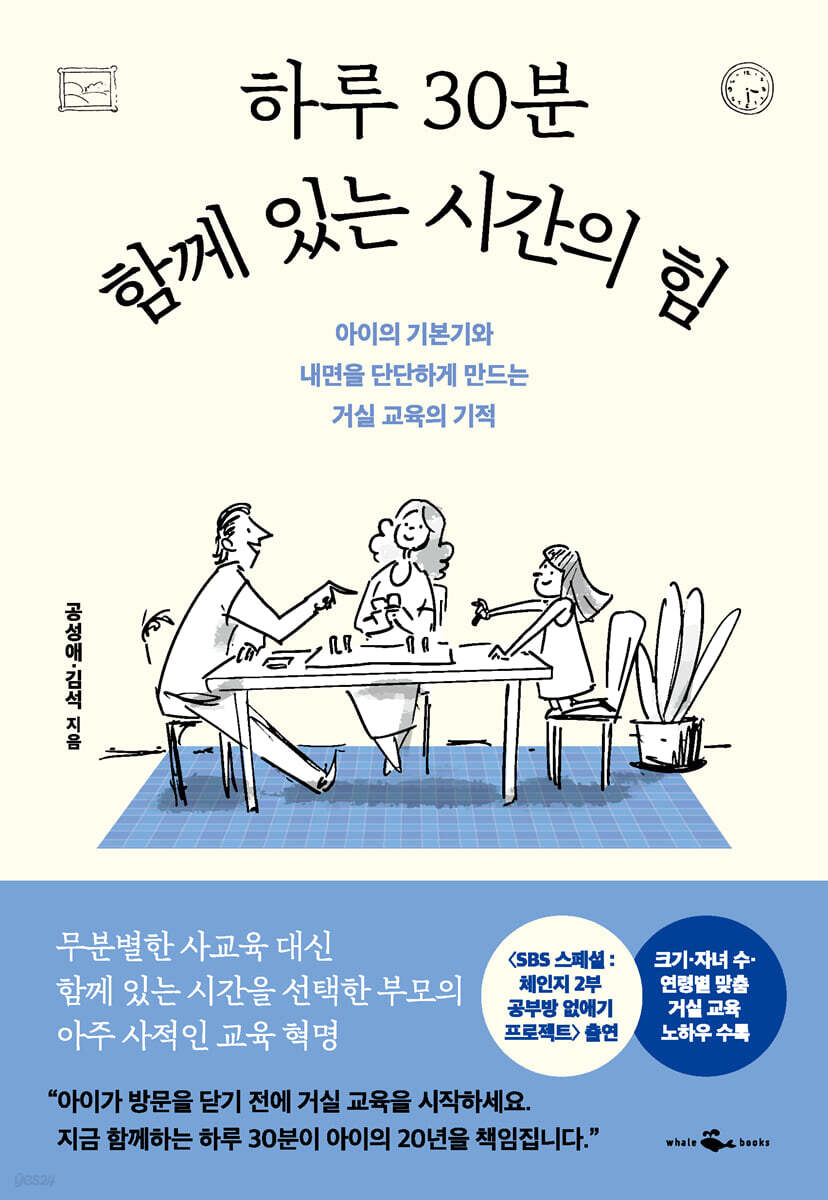
The power of 30 minutes of time together every day
 |
Description
Book Introduction
“Education that creates a child’s future is not something grand.
“Just spending 30 minutes a day together in the living room is enough.”
The easiest way to fill 30 minutes of time together each day
14 years of living room education expertise that connects the value of "togetherness" to a child's "growth."
6 minutes a day.
This is the average amount of time a father in South Korea spends with his children.
According to past surveys, our country ranked last among OECD countries.
It's a shocking number that makes you doubt your eyes, but this reality is familiar to many parents in our country.
In the morning, parents are busy preparing for the day with their children, and in the evening, they are often exhausted from work and fall asleep.
I can't even remember how many days ago it was that I sat down with my child, looked into his eyes, and had a conversation.
What the numbers are saying is not simply 'time', but the absence of 'relationships'.
We live together, but we are not together.
"The Power of 30 Minutes a Day Together" is a book that shows how just 30 minutes a day, spent together with parents in the living room, can help children grow and shape their future.
For 14 years, the author couple raised their two children in an ordinary space called the "living room," turning it into a special stage for education, and thanks to this, they were able to send them to a gifted school.
The couple, who realized early on how precious the time parents can spend with their children before they go into their own rooms, wanted to make the most of that short but important time, so they started 'living room education'.
All family activities, from childcare and study to play, conversation, and relaxation, were carried out in the living room, creating natural times for parents and children to meet.
An unbelievable number: just 6 minutes a day.
For the authors, living room education was the simplest and most effective way to change this reality. This book suggests small but powerful practices: removing the TV and installing a family table in the living room; laying down carpet for children in the early elementary grades to comfortably read and play; setting up a desk for children in the upper grades to foster study habits; and setting up a computer in the living room and setting up a designated game time. This book encourages parents and children to spend at least 30 minutes together each day.
The authors' living room education method, which was introduced in the 2023 SBS Special: Change Part 2 Study Room Elimination Project and gained attention, will become a new and practical way of child education that anyone can follow.
“Just spending 30 minutes a day together in the living room is enough.”
The easiest way to fill 30 minutes of time together each day
14 years of living room education expertise that connects the value of "togetherness" to a child's "growth."
6 minutes a day.
This is the average amount of time a father in South Korea spends with his children.
According to past surveys, our country ranked last among OECD countries.
It's a shocking number that makes you doubt your eyes, but this reality is familiar to many parents in our country.
In the morning, parents are busy preparing for the day with their children, and in the evening, they are often exhausted from work and fall asleep.
I can't even remember how many days ago it was that I sat down with my child, looked into his eyes, and had a conversation.
What the numbers are saying is not simply 'time', but the absence of 'relationships'.
We live together, but we are not together.
"The Power of 30 Minutes a Day Together" is a book that shows how just 30 minutes a day, spent together with parents in the living room, can help children grow and shape their future.
For 14 years, the author couple raised their two children in an ordinary space called the "living room," turning it into a special stage for education, and thanks to this, they were able to send them to a gifted school.
The couple, who realized early on how precious the time parents can spend with their children before they go into their own rooms, wanted to make the most of that short but important time, so they started 'living room education'.
All family activities, from childcare and study to play, conversation, and relaxation, were carried out in the living room, creating natural times for parents and children to meet.
An unbelievable number: just 6 minutes a day.
For the authors, living room education was the simplest and most effective way to change this reality. This book suggests small but powerful practices: removing the TV and installing a family table in the living room; laying down carpet for children in the early elementary grades to comfortably read and play; setting up a desk for children in the upper grades to foster study habits; and setting up a computer in the living room and setting up a designated game time. This book encourages parents and children to spend at least 30 minutes together each day.
The authors' living room education method, which was introduced in the 2023 SBS Special: Change Part 2 Study Room Elimination Project and gained attention, will become a new and practical way of child education that anyone can follow.
- You can preview some of the book's contents.
Preview
index
Prologue: 30 Minutes a Day: Our Family's Quiet Miracle Begins in the Living Room
Part 1: The Beginning of Time Together, Living Room Education
Chapter 1: Living Room Education for Our Family
· Living our own lives in the same space
Chapter 2 Preparing for Living Room Training
Things to consider before starting living room education
· Identify the needs of your child according to his or her age.
· Living room education varies depending on the number of children
· Living room training varies depending on the size of the house
Part 2: Living Room Education: Building a Strong Foundation for Children
Chapter 3 Studying Living Room
· 3 elements that create a good study environment
· How to develop a love for studying
Tips for maximizing the effectiveness of your living room study sessions
Chapter 4: The Reading Room
· The living room is a bookstore
· Living room reading patterns by child's age
· Habits and postures for completing living room reading
· How to make reading in the living room a habit
Chapter 5: The Playroom
· Why living room play is important
· Living room play that varies depending on the child's age
· The correlation between living room play and games
Part 3 Living Room Education: Strengthening Your Child's Inner Self
Chapter 6: The Living Room for Relaxation
· The living room is the heart
· To make a living room where you want to stay and rest
Chapter 7: The Communicating Living Room
· The best place to rebuild family relationships
There is an order to becoming close with a child.
· Between relief and optimal distance
· Daily communication is worth it, and studying is a bonus.
· Children's relationships in living room education
· The father effect that fills the living room
Chapter 8 Growing Living Room
· Getting to know the child
· Parents and children growing together
· Best investment, best output
Special Part: Living Room Education with Children as the Main Character
Page 1 A Child's Story
Page 2 A contract written by parents and children together
Part 1: The Beginning of Time Together, Living Room Education
Chapter 1: Living Room Education for Our Family
· Living our own lives in the same space
Chapter 2 Preparing for Living Room Training
Things to consider before starting living room education
· Identify the needs of your child according to his or her age.
· Living room education varies depending on the number of children
· Living room training varies depending on the size of the house
Part 2: Living Room Education: Building a Strong Foundation for Children
Chapter 3 Studying Living Room
· 3 elements that create a good study environment
· How to develop a love for studying
Tips for maximizing the effectiveness of your living room study sessions
Chapter 4: The Reading Room
· The living room is a bookstore
· Living room reading patterns by child's age
· Habits and postures for completing living room reading
· How to make reading in the living room a habit
Chapter 5: The Playroom
· Why living room play is important
· Living room play that varies depending on the child's age
· The correlation between living room play and games
Part 3 Living Room Education: Strengthening Your Child's Inner Self
Chapter 6: The Living Room for Relaxation
· The living room is the heart
· To make a living room where you want to stay and rest
Chapter 7: The Communicating Living Room
· The best place to rebuild family relationships
There is an order to becoming close with a child.
· Between relief and optimal distance
· Daily communication is worth it, and studying is a bonus.
· Children's relationships in living room education
· The father effect that fills the living room
Chapter 8 Growing Living Room
· Getting to know the child
· Parents and children growing together
· Best investment, best output
Special Part: Living Room Education with Children as the Main Character
Page 1 A Child's Story
Page 2 A contract written by parents and children together
Detailed image

Into the book
As the children grew and changed, so did the living room.
At first we were together, then we gradually became apart, and now we empathize and care for each other just by being together.
Now that my first child is in college and my second child is in high school, I can proudly say this as a parent.
Education doesn't have to be grand.
That ‘time spent together’ comes before teaching.
And the space where all of that was possible was the ‘living room’.
《The Power of 30 Minutes Together》 is the most truthful record of another world our family has created together in our living room for the past 14 years.
I hope that with this record as a starting point, another world will open up in your living room.
I hope you and your children grow up together there, slowly and warmly.
--- p.009, from "Prologue - 30 minutes a day, our family's quiet miracle that started in the living room"
Living room education refers to all learning processes that take place in the living room, a space in the home where the whole family gathers together.
When we talk about living room education, some people ask if it means having children study in the living room.
But for our family, the living room is not just a place to study, and living room education also has a meaning beyond just studying.
The living room is where family members engage in all their daily activities, including studying, playing, reading, playing games, talking, and relaxing. Through all of these activities, parents and children grow together, and this process is called 'living room education.'
--- p.025, from 「Chapter 1 - Living Our Lives in the Same Space」
Some parents feel that they have to give up what they want to do in order to do something for their child.
I had the same thought for a while when my children were young.
When my first child was born, I thought I had given up my job because my husband was so busy.
But when I look back on my life, I realize that I didn't 'give up' on what I wanted to do, I just 'chose' something more important.
As we go through life, we have to make choices at every moment.
You can't do everything.
After getting married, having children, and starting homeschooling, my husband cut back on golf practice and socializing, and I cut back on work, hobbies, and alone time.
I made the choice to spend more time with my children and my family.
Those who want to make their living room interior pretty may think that they have 'given up' on living room interior by turning it into a study or a library.
But I haven't given up.
To ensure a comfortable and enjoyable time with your child, you have wisely 'chosen' an interior design suitable for living room education.
--- p.039, from 「Chapter 2 - Things to Consider Before Starting Living Room Education」
In our house, we frequently changed the location of the desk while doing living room education.
When the children were young, the dining table doubled as a desk so that they could often make eye contact with their parents in the kitchen. When they were in elementary school, overflowing with curiosity and inquisitiveness, the desk was placed in front of a wall or near the veranda window to help them concentrate.
As they entered middle school, the absolute amount of studying increased, but because the children's concentration improved, the desks were placed in the center of the living room.
In this way, the children went through various changes according to time and purpose and found their own places in the living room.
In particular, the first number was studied by taking online lectures at a desk with a computer in front of the wall.
I was worried that studying while looking at the wall would be frustrating, but I heard that it actually helped me concentrate better.
Second, Hyun studied at the desk in the center of the living room, which he said was nice because it didn't feel stuffy.
If you are going to place a desk in the living room for living room education, you can start by placing it here and there.
Try different positions, such as with your back to the wall, facing the wall, in the center of the living room, with your back to the veranda, or facing the veranda window. Be sure to ask your child where he or she can concentrate best.
Even if you decide on the location of the desk based on your child's wishes, if time passes and you want to change the atmosphere, you can discuss it with your child and change it.
--- p.068~069, from 「Chapter 3 - 3 elements that create a study environment」
When the children were young, we scattered books all over the house, including the living room, bedroom, kitchen, and veranda.
This makes the book more effective as it can be used not only as a reading tool, but also as a tool to stimulate the child's curiosity and create an environment where the child wants to read.
Even while playing or doing other things, children would naturally look at books hanging from their hands or feet.
The best place to spread out books in the house is definitely the living room.
Because it is not only where children spend the most time during the day, but also the largest space.
My husband and I would scatter a bunch of books around the living room and try to keep them as they were as much as possible, only cleaning them up when they got too much.
Of course, there are parents who think that, on the contrary, they should teach their children how to organize their books after they have read them to some extent.
In fact, the direction is a matter of choice.
In our house, the kids would freely take out books and look at them, but we were worried that organizing the books would be a hassle or inconvenient and might interfere with their reading, so until elementary school, my husband and I would organize the books after the kids went to bed.
--- p.117~118, from “Chapter 4 - How to Make Reading in the Living Room a Habit”
When filming our living room in “SBS Special: Change Part 2 Study Room Elimination Project,” the producer in charge asked our family, “What does a living room mean to me?”
The answer that the second Hyeon gave to this still lingers in my mind and heart.
“I want to say that the living room is the heart.
Just as the circulation of blood begins and ends in the heart, my family always starts and interacts in the living room, and we end the day there, so I think these aspects are similar to the heart.”
The heart pumps blood that comes in at low pressure throughout the body at high pressure.
As Hyun said, the living room is really like the heart of our house.
Because it is a place that recharges the entire family when their energy is depleted and on the verge of discharge, allowing them to move forward with renewed vigor.
--- p.150~151, from 「Chapter 6 - The living room is the heart」
My husband and I have naturally developed horizontal relationships with our children through living room education.
Since being educated in the living room, children have been able to talk to their parents honestly and freely, ask for favors, and sometimes even give advice.
To get to this point, we spent time together in the living room, talked to each other every day, and made a constant effort to accept and empathize with what our children were thinking and what they liked.
In any case, the first step is the most important.
First, wait for the child in the living room, and when the child appears, I hope you will be the first to open your heart and approach him.
At first we were together, then we gradually became apart, and now we empathize and care for each other just by being together.
Now that my first child is in college and my second child is in high school, I can proudly say this as a parent.
Education doesn't have to be grand.
That ‘time spent together’ comes before teaching.
And the space where all of that was possible was the ‘living room’.
《The Power of 30 Minutes Together》 is the most truthful record of another world our family has created together in our living room for the past 14 years.
I hope that with this record as a starting point, another world will open up in your living room.
I hope you and your children grow up together there, slowly and warmly.
--- p.009, from "Prologue - 30 minutes a day, our family's quiet miracle that started in the living room"
Living room education refers to all learning processes that take place in the living room, a space in the home where the whole family gathers together.
When we talk about living room education, some people ask if it means having children study in the living room.
But for our family, the living room is not just a place to study, and living room education also has a meaning beyond just studying.
The living room is where family members engage in all their daily activities, including studying, playing, reading, playing games, talking, and relaxing. Through all of these activities, parents and children grow together, and this process is called 'living room education.'
--- p.025, from 「Chapter 1 - Living Our Lives in the Same Space」
Some parents feel that they have to give up what they want to do in order to do something for their child.
I had the same thought for a while when my children were young.
When my first child was born, I thought I had given up my job because my husband was so busy.
But when I look back on my life, I realize that I didn't 'give up' on what I wanted to do, I just 'chose' something more important.
As we go through life, we have to make choices at every moment.
You can't do everything.
After getting married, having children, and starting homeschooling, my husband cut back on golf practice and socializing, and I cut back on work, hobbies, and alone time.
I made the choice to spend more time with my children and my family.
Those who want to make their living room interior pretty may think that they have 'given up' on living room interior by turning it into a study or a library.
But I haven't given up.
To ensure a comfortable and enjoyable time with your child, you have wisely 'chosen' an interior design suitable for living room education.
--- p.039, from 「Chapter 2 - Things to Consider Before Starting Living Room Education」
In our house, we frequently changed the location of the desk while doing living room education.
When the children were young, the dining table doubled as a desk so that they could often make eye contact with their parents in the kitchen. When they were in elementary school, overflowing with curiosity and inquisitiveness, the desk was placed in front of a wall or near the veranda window to help them concentrate.
As they entered middle school, the absolute amount of studying increased, but because the children's concentration improved, the desks were placed in the center of the living room.
In this way, the children went through various changes according to time and purpose and found their own places in the living room.
In particular, the first number was studied by taking online lectures at a desk with a computer in front of the wall.
I was worried that studying while looking at the wall would be frustrating, but I heard that it actually helped me concentrate better.
Second, Hyun studied at the desk in the center of the living room, which he said was nice because it didn't feel stuffy.
If you are going to place a desk in the living room for living room education, you can start by placing it here and there.
Try different positions, such as with your back to the wall, facing the wall, in the center of the living room, with your back to the veranda, or facing the veranda window. Be sure to ask your child where he or she can concentrate best.
Even if you decide on the location of the desk based on your child's wishes, if time passes and you want to change the atmosphere, you can discuss it with your child and change it.
--- p.068~069, from 「Chapter 3 - 3 elements that create a study environment」
When the children were young, we scattered books all over the house, including the living room, bedroom, kitchen, and veranda.
This makes the book more effective as it can be used not only as a reading tool, but also as a tool to stimulate the child's curiosity and create an environment where the child wants to read.
Even while playing or doing other things, children would naturally look at books hanging from their hands or feet.
The best place to spread out books in the house is definitely the living room.
Because it is not only where children spend the most time during the day, but also the largest space.
My husband and I would scatter a bunch of books around the living room and try to keep them as they were as much as possible, only cleaning them up when they got too much.
Of course, there are parents who think that, on the contrary, they should teach their children how to organize their books after they have read them to some extent.
In fact, the direction is a matter of choice.
In our house, the kids would freely take out books and look at them, but we were worried that organizing the books would be a hassle or inconvenient and might interfere with their reading, so until elementary school, my husband and I would organize the books after the kids went to bed.
--- p.117~118, from “Chapter 4 - How to Make Reading in the Living Room a Habit”
When filming our living room in “SBS Special: Change Part 2 Study Room Elimination Project,” the producer in charge asked our family, “What does a living room mean to me?”
The answer that the second Hyeon gave to this still lingers in my mind and heart.
“I want to say that the living room is the heart.
Just as the circulation of blood begins and ends in the heart, my family always starts and interacts in the living room, and we end the day there, so I think these aspects are similar to the heart.”
The heart pumps blood that comes in at low pressure throughout the body at high pressure.
As Hyun said, the living room is really like the heart of our house.
Because it is a place that recharges the entire family when their energy is depleted and on the verge of discharge, allowing them to move forward with renewed vigor.
--- p.150~151, from 「Chapter 6 - The living room is the heart」
My husband and I have naturally developed horizontal relationships with our children through living room education.
Since being educated in the living room, children have been able to talk to their parents honestly and freely, ask for favors, and sometimes even give advice.
To get to this point, we spent time together in the living room, talked to each other every day, and made a constant effort to accept and empathize with what our children were thinking and what they liked.
In any case, the first step is the most important.
First, wait for the child in the living room, and when the child appears, I hope you will be the first to open your heart and approach him.
--- p.163, from "Chapter 7? The Best Place to Reconstruct Family Relationships"
Publisher's Review
“Ordinary parents who wished for a child who is good at studying
“Why did you choose living room education?”
The secret to children growing up on their own without parents having to teach them.
The Miracle of How Your Most Private Space Becomes the Best Classroom
"How many minutes a day do you spend with your child? Do you mistakenly believe you're together just because you live in the same house and eat together?"
"The Power of 30 Minutes a Day Together" is a book that reminds us that 'time' is the most powerful key to creating a child's future.
That's not a long time, just 30 minutes a day is enough.
The author couple began their thinking around the philosophy that 'education comes from spending time together rather than one-sided teaching', and chose living room education as a solution.
First, we moved the TV, which used to occupy the center of the living room, to the bedroom, and then we transformed the living room into a study where we could sit across from our children and read books, a playground where we could laugh and play together, and an open space where we could have natural conversations.
The starting point was comic books and board games.
When parents sit down, their children come up to them and laugh, chat, and think. These small pieces of daily life accumulate, and the living room becomes a 'learning space in life' where the whole family grows.
When the child was concentrating on studying, reading, or playing, mom and dad stayed by their side quietly doing their own things.
Spending 30 minutes a day together in the living room was a warm and comforting environment for the child, and for the parents, it was a meaningful connection to the child and the most effective educational method.
Part 1 of this book meticulously covers the philosophy and practical methods of living room education, along with real-life examples, to help you spend 30 minutes a day meaningfully with your child.
When it comes to living room education, it not only includes well-known methods such as getting rid of the TV and turning the living room into a study, but also explains in detail how to organize the space according to the child's age, number of siblings, and size of the house, and how parents can keep close to their children without interfering or monitoring them.
The author couple also spent 14 years together transforming their living room from a playroom to a library and then from a library to a study cafe, in accordance with their growing child's daily routine and tasks, vividly showing that the way parents are present with their children is itself an education.
Let's go back to the first question.
If you are a parent who has hesitated and cannot give a proper answer, what you need to do right now is very simple.
Just 30 minutes a day, just being with your child.
To do that, we start living room education.
This book best illustrates the difference that small but great practices can make, and all you have to do is follow along.
“A child who goes to a gifted school without any special private education
“What kind of time did you spend with your parents in the living room?”
A child who is affectionate to his family, a child who gets along well with friends, a child who enjoys studying…
The best child who has everything starts in 'our living room'!
What makes this book special is that it doesn't just provide a brief introduction to living room education; it also provides specific guidance on how to incorporate the philosophy into daily life, so that anyone can follow along.
Beyond being a book filled with helpful advice for raising children, this book is a powerful force for action that will make you want to reconfigure your living room to be more child-friendly and change your attitude toward your children in everyday life.
So, Part 2 is divided into living room education that strengthens the child's fundamentals through studying, reading, and playing, and Part 3 is divided into living room education that strengthens the child's inner self through rest, communication, and growth.
This clearly shows how 30 minutes of living room education a day can become the foundation for growth that embraces a child's entire life.
For example, in Part 2, if a child in the lower grades of elementary school refuses to sit at a desk and does not like to study or read, instead of forcing them to do so, we tell them to slowly begin by laying down a carpet on the living room floor and using the sofa to get closer to books as if it were play.
For upper elementary school students, it is recommended to install a computer and a timer in the living room to help them develop media control skills, and for middle and high school students, it is recommended to decorate the living room like a study cafe to encourage immersion.
In Part 3, we share our know-how on how to take the living room beyond a study space and turn it into an emotional refuge where the whole family can share their emotions.
As children enter adolescence, this book systematically and movingly explains that parents should show silence rather than advice, and trust rather than interference, and that even if they spend time together in the same space, such as the living room, the skill of 'pretending not to hear or see' is by no means indifference, but the best consideration that fosters a child's autonomy.
What's most surprising is that this whole process actually worked.
The author couple's eldest child entered a gifted school through living room education and is currently continuing his studies at Yonsei University.
The second one is also moving forward along the same path.
The Special Part, the last part of this book, includes 'A Child's Story' written by the first child himself, allowing a vivid look into the effects of living room education as perceived by the child.
With this, parents who read this book will be able to have some confidence that 'my child can grow up like this too.'
As small 30-minute periods accumulate day by day, children develop the strength to grow independently, and parents learn how to respect and support their children.
"The Power of 30 Minutes a Day" will provide children with the motivation to live, study, and grow independently, and parents with a practical opportunity to establish a positive relationship with their children and set a clear direction for their education.
Moreover, it will allow us to encounter a new educational philosophy in which parents and children live their own lives while living in the same space, that is, the essence of child education that is most needed now.
“Why did you choose living room education?”
The secret to children growing up on their own without parents having to teach them.
The Miracle of How Your Most Private Space Becomes the Best Classroom
"How many minutes a day do you spend with your child? Do you mistakenly believe you're together just because you live in the same house and eat together?"
"The Power of 30 Minutes a Day Together" is a book that reminds us that 'time' is the most powerful key to creating a child's future.
That's not a long time, just 30 minutes a day is enough.
The author couple began their thinking around the philosophy that 'education comes from spending time together rather than one-sided teaching', and chose living room education as a solution.
First, we moved the TV, which used to occupy the center of the living room, to the bedroom, and then we transformed the living room into a study where we could sit across from our children and read books, a playground where we could laugh and play together, and an open space where we could have natural conversations.
The starting point was comic books and board games.
When parents sit down, their children come up to them and laugh, chat, and think. These small pieces of daily life accumulate, and the living room becomes a 'learning space in life' where the whole family grows.
When the child was concentrating on studying, reading, or playing, mom and dad stayed by their side quietly doing their own things.
Spending 30 minutes a day together in the living room was a warm and comforting environment for the child, and for the parents, it was a meaningful connection to the child and the most effective educational method.
Part 1 of this book meticulously covers the philosophy and practical methods of living room education, along with real-life examples, to help you spend 30 minutes a day meaningfully with your child.
When it comes to living room education, it not only includes well-known methods such as getting rid of the TV and turning the living room into a study, but also explains in detail how to organize the space according to the child's age, number of siblings, and size of the house, and how parents can keep close to their children without interfering or monitoring them.
The author couple also spent 14 years together transforming their living room from a playroom to a library and then from a library to a study cafe, in accordance with their growing child's daily routine and tasks, vividly showing that the way parents are present with their children is itself an education.
Let's go back to the first question.
If you are a parent who has hesitated and cannot give a proper answer, what you need to do right now is very simple.
Just 30 minutes a day, just being with your child.
To do that, we start living room education.
This book best illustrates the difference that small but great practices can make, and all you have to do is follow along.
“A child who goes to a gifted school without any special private education
“What kind of time did you spend with your parents in the living room?”
A child who is affectionate to his family, a child who gets along well with friends, a child who enjoys studying…
The best child who has everything starts in 'our living room'!
What makes this book special is that it doesn't just provide a brief introduction to living room education; it also provides specific guidance on how to incorporate the philosophy into daily life, so that anyone can follow along.
Beyond being a book filled with helpful advice for raising children, this book is a powerful force for action that will make you want to reconfigure your living room to be more child-friendly and change your attitude toward your children in everyday life.
So, Part 2 is divided into living room education that strengthens the child's fundamentals through studying, reading, and playing, and Part 3 is divided into living room education that strengthens the child's inner self through rest, communication, and growth.
This clearly shows how 30 minutes of living room education a day can become the foundation for growth that embraces a child's entire life.
For example, in Part 2, if a child in the lower grades of elementary school refuses to sit at a desk and does not like to study or read, instead of forcing them to do so, we tell them to slowly begin by laying down a carpet on the living room floor and using the sofa to get closer to books as if it were play.
For upper elementary school students, it is recommended to install a computer and a timer in the living room to help them develop media control skills, and for middle and high school students, it is recommended to decorate the living room like a study cafe to encourage immersion.
In Part 3, we share our know-how on how to take the living room beyond a study space and turn it into an emotional refuge where the whole family can share their emotions.
As children enter adolescence, this book systematically and movingly explains that parents should show silence rather than advice, and trust rather than interference, and that even if they spend time together in the same space, such as the living room, the skill of 'pretending not to hear or see' is by no means indifference, but the best consideration that fosters a child's autonomy.
What's most surprising is that this whole process actually worked.
The author couple's eldest child entered a gifted school through living room education and is currently continuing his studies at Yonsei University.
The second one is also moving forward along the same path.
The Special Part, the last part of this book, includes 'A Child's Story' written by the first child himself, allowing a vivid look into the effects of living room education as perceived by the child.
With this, parents who read this book will be able to have some confidence that 'my child can grow up like this too.'
As small 30-minute periods accumulate day by day, children develop the strength to grow independently, and parents learn how to respect and support their children.
"The Power of 30 Minutes a Day" will provide children with the motivation to live, study, and grow independently, and parents with a practical opportunity to establish a positive relationship with their children and set a clear direction for their education.
Moreover, it will allow us to encounter a new educational philosophy in which parents and children live their own lives while living in the same space, that is, the essence of child education that is most needed now.
GOODS SPECIFICS
- Date of issue: June 5, 2025
- Page count, weight, size: 224 pages | 145*210*20mm
- ISBN13: 9791194627067
- ISBN10: 1194627064
You may also like
카테고리
korean


korean

![GQ KOREA Mark (Monthly): December [2025]](http://librairie.coreenne.fr/cdn/shop/files/8ef265dbbfbf186523ed75ba7319009d.jpg?v=1765340328&width=3840)


