

My son's adolescence
 |
Description
Book Introduction
The Ultimate Guide to Understanding Your Teenage Son
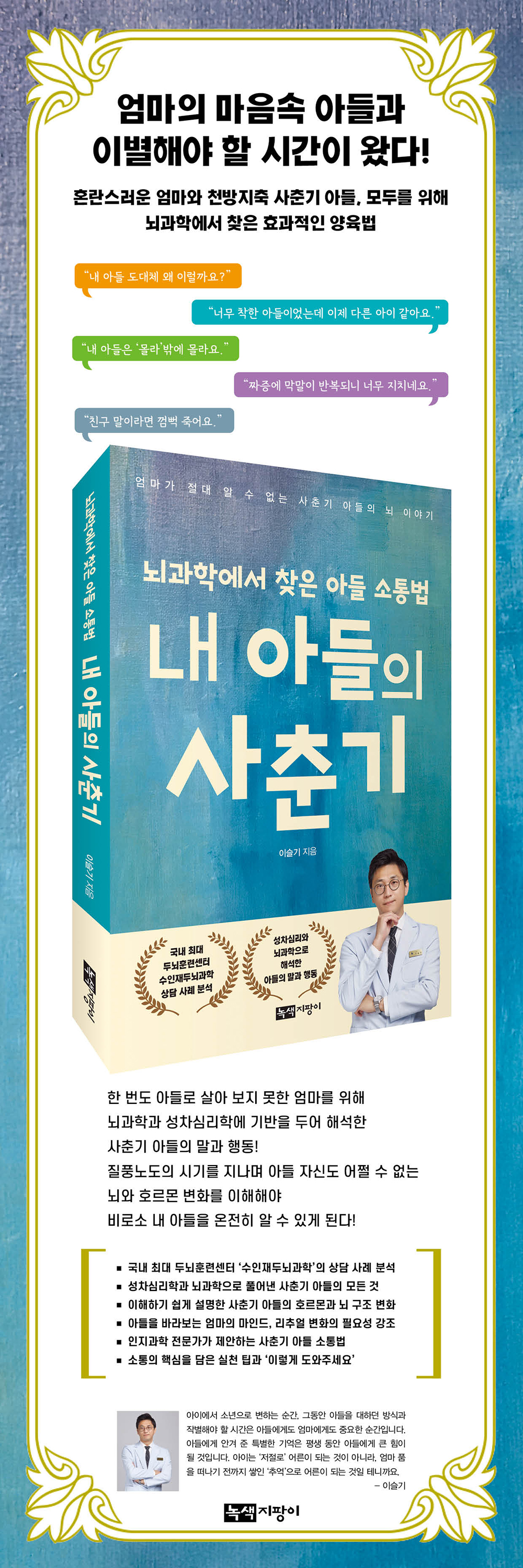
A special solution for frustrated and confused moms!
“Why on earth is my son like this?”
“He’s really my child, but I feel like this is all happening to him. I just want to give up and run away.”
“It’s so tiring because I keep getting annoyed and swearing at people whenever I feel even a little bit of dislike or dissatisfaction.”
“No matter what I ask my son, he just says ‘I don’t know.’”
“I don’t listen to my mom and dad, but I’m completely blind to what my friends say.”
“Aside from being upset, I really don’t know how to handle a child.”
Any mother raising a teenage son will likely experience frustrations almost daily.
This book offers practical, multifaceted solutions to mothers who are feeling frustrated and confused to the point of bursting.
This is not a simple parenting theory book, but rather presents the counseling case know-how of 'Suinjae Brain Science', the largest brain research center in Korea, while at the same time scientifically analyzing the inner thoughts and behaviors of adolescent sons through brain science research and gender psychology theories, and suggesting effective communication methods.
A special solution for frustrated and confused moms!
“Why on earth is my son like this?”
“He’s really my child, but I feel like this is all happening to him. I just want to give up and run away.”
“It’s so tiring because I keep getting annoyed and swearing at people whenever I feel even a little bit of dislike or dissatisfaction.”
“No matter what I ask my son, he just says ‘I don’t know.’”
“I don’t listen to my mom and dad, but I’m completely blind to what my friends say.”
“Aside from being upset, I really don’t know how to handle a child.”
Any mother raising a teenage son will likely experience frustrations almost daily.
This book offers practical, multifaceted solutions to mothers who are feeling frustrated and confused to the point of bursting.
This is not a simple parenting theory book, but rather presents the counseling case know-how of 'Suinjae Brain Science', the largest brain research center in Korea, while at the same time scientifically analyzing the inner thoughts and behaviors of adolescent sons through brain science research and gender psychology theories, and suggesting effective communication methods.
- You can preview some of the book's contents.
Preview
index
Prologue_Even when a mother becomes a grandmother, she is still a mother
Chapter 1: The Moment My Son's Brain Was Born 017
1.
Even after waking up from death, the mother doesn't know the state of her son's mind.
Why do children act so wildly? 020
My son is overwhelmed by emotions. What should I say? 024
Psychology's Guide to Raising Children 031
Sons Listen Differently From Their Mothers 035
Men Who Have a Hard Time Understanding Their Own Emotions 040
Why Reading Others' Minds Is So Difficult for My Son 045
2.
The process of a son growing into a man
Why can't I sit still for even a moment? 053
Children Obsessed with Shooting Games: My Son's Brain Grows into a Hunter 059
The moment dopamine bursts from my son's brain 066
Jekyll and Hyde Hidden in a Child 073
3.
Moments when I need my dad
The day my son rebelled, holding onto his mother's arms 080
A Father's Perspective on His Son's Desires 085
It's Time to Stop Disciplining Your Son 091
100 Creative Ways to Scold Your Son
Chapter 2: Hidden Pictures in the Son's Language 107
1.
My son's language and the psychology of his peers
Find the code in your adolescent son's words 110
A teenage son's words reveal a hidden desire for friends. 114
120 Language Habits of Men Who Want to Appear Strong
2.
A son's words that hurt his mother's heart
The Son's Language, Like a Hammer 126
Machiavelli Hidden in the Son's Mind 131
A son living for the future and a mother obsessed with the past 136
3.
A son's memory method contained in language
A Son's Memories Are Written Differently 142
A Son's Memory Method, Totally Different from His Daughter's 144
There's No Story in My Son's World 146
Understanding the Grief of a Son Who Is Awkward to Express Emotions 148
Teenage 'masked depression': Different from adult depression 150
The Son's True Truth Hidden in His Ignorance 155
How to Talk to a Son Who Makes Mom Sad 158
Chapter 3: When Your Son's Brain Connects with His Peers 163
1.
A son's sociality is different from that of a daughter.
The Mirror in Your Brain 168: Reading Others' Minds
Emotional Independence Between Adolescent Sons and Their Mothers 171
2.
Understanding Your Son's Ways of Interacting with His Friends
Things my son is sensitive to: "What's a game like that?" 177
Born Smart: Children Living in an Age Where Smartphones Are a Absolute 181
185 Moments When Minor Reactions Lead to Bullying
3.
High self-esteem leads to better social skills.
My son's self-esteem fluctuates based on his athletic ability. 191
Puberty: When Personality Begins to Show Instead of Temperament 195
198 Things That Affect a Child's Personality
Please bring order to your son's emotions. 201
The Attached Child vs. the Smooth-Reconciling Child 204
Chapter 4: The Son's Private Life 209
1.
Sexuality of adolescent sons
Sexual Impulses and My Son's Inner Thoughts: Beyond Freudian Psychology, Part 212
216 Videos on the Internet Your Mom Didn't Know About
2.
Is gaming addiction really an addiction?
My son is obsessed with gaming, even cutting down on sleep. Is he addicted? 224
232 Cases When Addiction Really Becomes a Problem
You Need to Know Why Your Son Is Addicted to Gaming 235
What matters in the end is family 239
Frontal lobe dysfunction and ADHD 242
Epilogue_One Step Behind 248
[Appendix] The Landscape of the Mind as Depicted by Developmental Psychology 252
Americas 262
Chapter 1: The Moment My Son's Brain Was Born 017
1.
Even after waking up from death, the mother doesn't know the state of her son's mind.
Why do children act so wildly? 020
My son is overwhelmed by emotions. What should I say? 024
Psychology's Guide to Raising Children 031
Sons Listen Differently From Their Mothers 035
Men Who Have a Hard Time Understanding Their Own Emotions 040
Why Reading Others' Minds Is So Difficult for My Son 045
2.
The process of a son growing into a man
Why can't I sit still for even a moment? 053
Children Obsessed with Shooting Games: My Son's Brain Grows into a Hunter 059
The moment dopamine bursts from my son's brain 066
Jekyll and Hyde Hidden in a Child 073
3.
Moments when I need my dad
The day my son rebelled, holding onto his mother's arms 080
A Father's Perspective on His Son's Desires 085
It's Time to Stop Disciplining Your Son 091
100 Creative Ways to Scold Your Son
Chapter 2: Hidden Pictures in the Son's Language 107
1.
My son's language and the psychology of his peers
Find the code in your adolescent son's words 110
A teenage son's words reveal a hidden desire for friends. 114
120 Language Habits of Men Who Want to Appear Strong
2.
A son's words that hurt his mother's heart
The Son's Language, Like a Hammer 126
Machiavelli Hidden in the Son's Mind 131
A son living for the future and a mother obsessed with the past 136
3.
A son's memory method contained in language
A Son's Memories Are Written Differently 142
A Son's Memory Method, Totally Different from His Daughter's 144
There's No Story in My Son's World 146
Understanding the Grief of a Son Who Is Awkward to Express Emotions 148
Teenage 'masked depression': Different from adult depression 150
The Son's True Truth Hidden in His Ignorance 155
How to Talk to a Son Who Makes Mom Sad 158
Chapter 3: When Your Son's Brain Connects with His Peers 163
1.
A son's sociality is different from that of a daughter.
The Mirror in Your Brain 168: Reading Others' Minds
Emotional Independence Between Adolescent Sons and Their Mothers 171
2.
Understanding Your Son's Ways of Interacting with His Friends
Things my son is sensitive to: "What's a game like that?" 177
Born Smart: Children Living in an Age Where Smartphones Are a Absolute 181
185 Moments When Minor Reactions Lead to Bullying
3.
High self-esteem leads to better social skills.
My son's self-esteem fluctuates based on his athletic ability. 191
Puberty: When Personality Begins to Show Instead of Temperament 195
198 Things That Affect a Child's Personality
Please bring order to your son's emotions. 201
The Attached Child vs. the Smooth-Reconciling Child 204
Chapter 4: The Son's Private Life 209
1.
Sexuality of adolescent sons
Sexual Impulses and My Son's Inner Thoughts: Beyond Freudian Psychology, Part 212
216 Videos on the Internet Your Mom Didn't Know About
2.
Is gaming addiction really an addiction?
My son is obsessed with gaming, even cutting down on sleep. Is he addicted? 224
232 Cases When Addiction Really Becomes a Problem
You Need to Know Why Your Son Is Addicted to Gaming 235
What matters in the end is family 239
Frontal lobe dysfunction and ADHD 242
Epilogue_One Step Behind 248
[Appendix] The Landscape of the Mind as Depicted by Developmental Psychology 252
Americas 262
Detailed image
Into the book
As children enter puberty, their brains become emotionally hypersensitive while their frontal lobe control becomes unstable.
The stimulation received from peers who are going through these changes together with them further reinforces the changes of adolescence.
As a result, they become more influenced by their friends' stories than by parental control.
--- p.24
It is important to remember that children are inherently immature and are still developing at this very moment.
Parents, too, are individuals who are constantly developing as they take on the role of parent.
--- p.33
Mothers need to practice keeping a certain distance from their sons' words and actions as they enter puberty.
It was time to say goodbye to the rituals I had formed while looking at my son.
This emotional detachment is natural.
--- p.51
Ironically, when a son overpowers his mother and acts according to his own will, it leaves psychological scars on the son as well.
No matter what anyone says, a mother is a mother.
My son also knows very well that he is the one who gives me love and loves me more than anyone else.
Just as the psychological trauma that physical punishment leaves in a son comes from the fact that "the one who loves me most is attacking me," the fact that "I hurt the one who loves me most" also leaves a deep wound in a son's heart.
--- p.83
Even though they are in the same puberty stage, daughters have active brains to read subtle emotional changes and have innately higher auditory sensitivity than boys, whereas sons are not only insensitive to auditory stimuli, but also have little interest in reading and expressing emotions.
--- p.102
In the special relationship between mother and son, the mother has a parental duty to create a sense of psychological security and bond with her son, knowing that he has someone to rely on even when he makes mistakes.
If you repeatedly point out, criticize, and scold your child for making the wrong choices, the child will learn less from the world.
--- p.138~139
Your teenage son needs just as much effort as you did as a toddler.
The only difference is that, unlike the toddler years, where parents needed to take care of everything from start to finish, the effort needed for adolescent sons should be to 'accept the child's expressions.'
--- p.161
My adolescent son's sensitivity to peer relationships is, paradoxically, a desperate plea for understanding.
It's about discovering myself in my friends, empathizing with them, and feeling happiness in the time I spend with them.
That is why it can be said that a mother's most important role during this period is to provide time and space for her teenage son to experience various activities with his friends.
--- p.170~171
First and foremost, what mothers need to know is that for children these days, games are not just games, but also mean 'social relationships.'
That is, preventing someone from playing a game is understood as blocking their communication with their friends.
--- p.181
Your adolescent son's motor development and physical ability development have a major impact on his self-esteem.
It is no exaggeration to say that this is beyond what mothers can imagine.
Even from a developmental psychology perspective, motor skills and self-esteem are deeply related.
It is especially important to pay close attention to the development of motor skills, as they have a significant emotional impact throughout childhood and adolescence.
--- p.192
When there is concern that a child may have incorrect perceptions of sex during the period of conception, it is necessary to bring the inner issues to the surface, even if it means fighting with the child.
You need to fight well with your child and face the problem.
Remember, you're not fighting to win over your child, you're fighting to figure out how to help your child.
The stimulation received from peers who are going through these changes together with them further reinforces the changes of adolescence.
As a result, they become more influenced by their friends' stories than by parental control.
--- p.24
It is important to remember that children are inherently immature and are still developing at this very moment.
Parents, too, are individuals who are constantly developing as they take on the role of parent.
--- p.33
Mothers need to practice keeping a certain distance from their sons' words and actions as they enter puberty.
It was time to say goodbye to the rituals I had formed while looking at my son.
This emotional detachment is natural.
--- p.51
Ironically, when a son overpowers his mother and acts according to his own will, it leaves psychological scars on the son as well.
No matter what anyone says, a mother is a mother.
My son also knows very well that he is the one who gives me love and loves me more than anyone else.
Just as the psychological trauma that physical punishment leaves in a son comes from the fact that "the one who loves me most is attacking me," the fact that "I hurt the one who loves me most" also leaves a deep wound in a son's heart.
--- p.83
Even though they are in the same puberty stage, daughters have active brains to read subtle emotional changes and have innately higher auditory sensitivity than boys, whereas sons are not only insensitive to auditory stimuli, but also have little interest in reading and expressing emotions.
--- p.102
In the special relationship between mother and son, the mother has a parental duty to create a sense of psychological security and bond with her son, knowing that he has someone to rely on even when he makes mistakes.
If you repeatedly point out, criticize, and scold your child for making the wrong choices, the child will learn less from the world.
--- p.138~139
Your teenage son needs just as much effort as you did as a toddler.
The only difference is that, unlike the toddler years, where parents needed to take care of everything from start to finish, the effort needed for adolescent sons should be to 'accept the child's expressions.'
--- p.161
My adolescent son's sensitivity to peer relationships is, paradoxically, a desperate plea for understanding.
It's about discovering myself in my friends, empathizing with them, and feeling happiness in the time I spend with them.
That is why it can be said that a mother's most important role during this period is to provide time and space for her teenage son to experience various activities with his friends.
--- p.170~171
First and foremost, what mothers need to know is that for children these days, games are not just games, but also mean 'social relationships.'
That is, preventing someone from playing a game is understood as blocking their communication with their friends.
--- p.181
Your adolescent son's motor development and physical ability development have a major impact on his self-esteem.
It is no exaggeration to say that this is beyond what mothers can imagine.
Even from a developmental psychology perspective, motor skills and self-esteem are deeply related.
It is especially important to pay close attention to the development of motor skills, as they have a significant emotional impact throughout childhood and adolescence.
--- p.192
When there is concern that a child may have incorrect perceptions of sex during the period of conception, it is necessary to bring the inner issues to the surface, even if it means fighting with the child.
You need to fight well with your child and face the problem.
Remember, you're not fighting to win over your child, you're fighting to figure out how to help your child.
--- p.223
Publisher's Review
The time has come for a mother to say goodbye to her son!
For the confused mother and the wild teenage son,
Effective Parenting Methods Discovered by Brain Science
“Puberty is not about ‘rebellion’, it’s about ‘development’!”
A must-read for mothers struggling with their teenage sons' unpredictable behavior and mood swings has been published.
In fact, sons are not simply rebelling against their mothers; their brain development and hormonal changes make it difficult for them to control their emotions and make them act impulsively.
However, the mother reflects on her son's childhood and becomes more disappointed and hurt by his current state, turning into a 'nagging queen' who only yells.
The more this happens, the more the relationship between the two becomes entangled.
This book suggests, above all, that a mother's mindset needs to change, and explains why her son cannot help but become like that: how hormones and brain development change during puberty.
Not only is it difficult to control emotions because the frontal lobe is not fully developed, but the secretion of testosterone, a male hormone, becomes active, overstimulating the amygdala.
So, you may feel angry, anxious, or afraid for no reason, or you may become overly sensitive to trivial things that you could otherwise just ignore.
Moreover, boys are innately less capable of hearing than girls, as well as reading other people's emotions, and they have difficulty or find it bothersome to express their emotions verbally.
Above all, we have moved beyond the days when mothers were the only caregivers, and now peers are the top priority.
They are very concerned about their peer group ranking and may even use harsh language to avoid appearing to be pushed down the pecking order.
The author emphasizes that it is important for mothers to deeply understand the physical and psychological characteristics of their adolescent sons, and to stop blaming and nagging them, as well as to trust and watch over them from a distance.
Adolescence is a period of development that is clearly finite, as it is a period of not only cognitive development but also the development of empathy, so it is necessary to look at children with a long-term perspective and guide them to protect themselves.
In addition, he says that a mother's attitude toward her son each day is more important than anything else, because the words and actions of parents have a decisive influence on the formation of a child's self-image during adolescence.
If you're a mother raising a teenage son, this book will help you understand his developmental process, strengthen your relationship with him, reduce conflict, and discover ways to communicate healthily.
- Analysis of counseling cases from Suinjae Brain Science, Korea's largest brain training center.
- Adolescent Son's Words and Behaviors Explained Through Gender Psychology and Neuroscience
- Hormonal and brain structural changes in adolescent boys explained in an easy-to-understand way
- A mother's mindset toward her son, emphasizing the need for ritual change.
- Cognitive Science Experts Suggest Communication Methods for Your Teenage Son
- Practical tips and "Help Me Like This" that capture the essence of communication.
- An appendix containing a look at my son's inner self through the lens of developmental psychology.
For the confused mother and the wild teenage son,
Effective Parenting Methods Discovered by Brain Science
“Puberty is not about ‘rebellion’, it’s about ‘development’!”
A must-read for mothers struggling with their teenage sons' unpredictable behavior and mood swings has been published.
In fact, sons are not simply rebelling against their mothers; their brain development and hormonal changes make it difficult for them to control their emotions and make them act impulsively.
However, the mother reflects on her son's childhood and becomes more disappointed and hurt by his current state, turning into a 'nagging queen' who only yells.
The more this happens, the more the relationship between the two becomes entangled.
This book suggests, above all, that a mother's mindset needs to change, and explains why her son cannot help but become like that: how hormones and brain development change during puberty.
Not only is it difficult to control emotions because the frontal lobe is not fully developed, but the secretion of testosterone, a male hormone, becomes active, overstimulating the amygdala.
So, you may feel angry, anxious, or afraid for no reason, or you may become overly sensitive to trivial things that you could otherwise just ignore.
Moreover, boys are innately less capable of hearing than girls, as well as reading other people's emotions, and they have difficulty or find it bothersome to express their emotions verbally.
Above all, we have moved beyond the days when mothers were the only caregivers, and now peers are the top priority.
They are very concerned about their peer group ranking and may even use harsh language to avoid appearing to be pushed down the pecking order.
The author emphasizes that it is important for mothers to deeply understand the physical and psychological characteristics of their adolescent sons, and to stop blaming and nagging them, as well as to trust and watch over them from a distance.
Adolescence is a period of development that is clearly finite, as it is a period of not only cognitive development but also the development of empathy, so it is necessary to look at children with a long-term perspective and guide them to protect themselves.
In addition, he says that a mother's attitude toward her son each day is more important than anything else, because the words and actions of parents have a decisive influence on the formation of a child's self-image during adolescence.
If you're a mother raising a teenage son, this book will help you understand his developmental process, strengthen your relationship with him, reduce conflict, and discover ways to communicate healthily.
- Analysis of counseling cases from Suinjae Brain Science, Korea's largest brain training center.
- Adolescent Son's Words and Behaviors Explained Through Gender Psychology and Neuroscience
- Hormonal and brain structural changes in adolescent boys explained in an easy-to-understand way
- A mother's mindset toward her son, emphasizing the need for ritual change.
- Cognitive Science Experts Suggest Communication Methods for Your Teenage Son
- Practical tips and "Help Me Like This" that capture the essence of communication.
- An appendix containing a look at my son's inner self through the lens of developmental psychology.
GOODS SPECIFICS
- Date of issue: April 25, 2025
- Page count, weight, size: 246 pages | 490g | 152*225*20mm
- ISBN13: 9791186552827
- ISBN10: 1186552824
You may also like
카테고리
korean


korean

![GQ KOREA Mark (Monthly): December [2025]](http://librairie.coreenne.fr/cdn/shop/files/8ef265dbbfbf186523ed75ba7319009d.jpg?v=1765340328&width=3840)


