

Every child is sensitive
 |
Description
Book Introduction
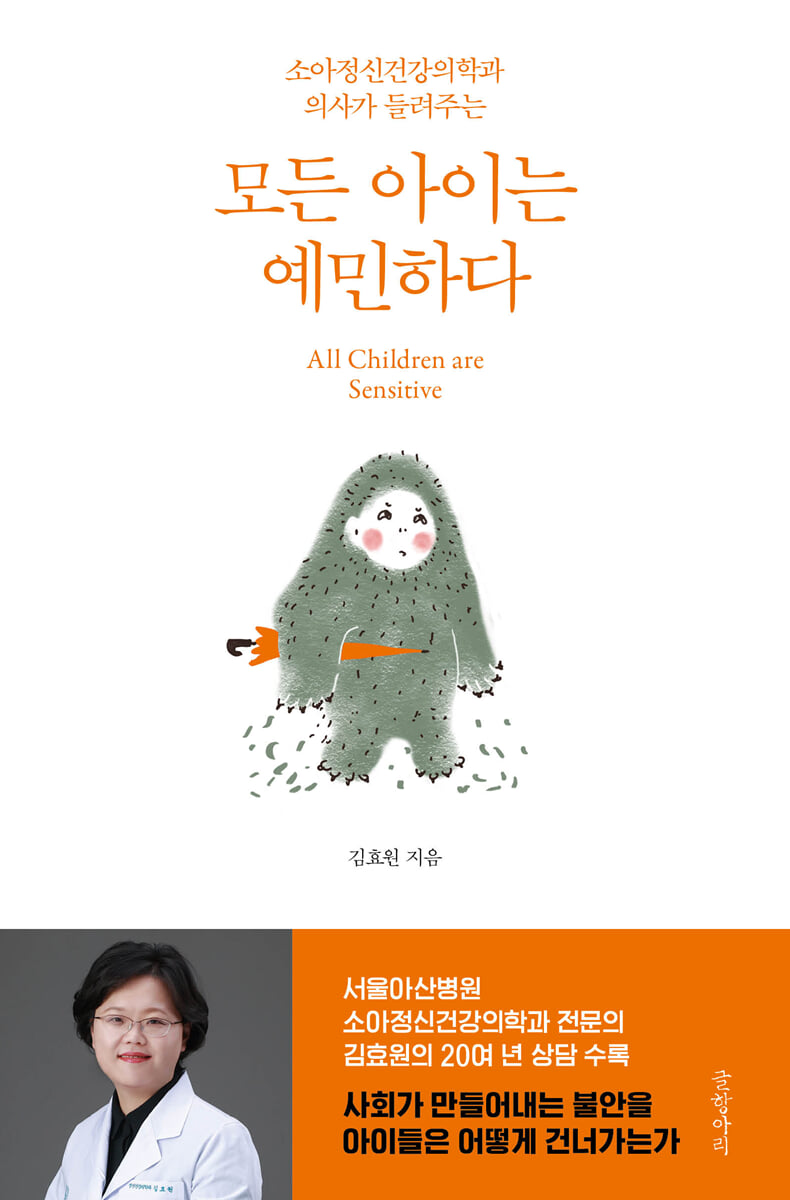
This book is a collection of types, cases, and treatments for sensitive children written by a doctor who has been treating children and adolescents in the Department of Child and Adolescent Psychiatry for over 20 years.
Society creates certain symptoms in the people who live in it.
Many of the children the author has seen in his clinic over the past 10 years have complained of 'anxiety' in particular.
These children were very sensitive and had a hard time going to daycare, kindergarten, and elementary school.
Unlike their peers who grow up without a hitch, for some children life is a series of hurdles to overcome.
The author is also a mother of two children, and her eldest daughter falls into the 'super sensitive' category.
Now that I am a college student, I have experienced severe growing pains due to my difficult personality, and I have also spent a lot of time blaming myself.
In other words, this book contains my experiences as a mother of a sensitive child and as a professional who has observed similar types of children in the clinic.
Society creates certain symptoms in the people who live in it.
Many of the children the author has seen in his clinic over the past 10 years have complained of 'anxiety' in particular.
These children were very sensitive and had a hard time going to daycare, kindergarten, and elementary school.
Unlike their peers who grow up without a hitch, for some children life is a series of hurdles to overcome.
The author is also a mother of two children, and her eldest daughter falls into the 'super sensitive' category.
Now that I am a college student, I have experienced severe growing pains due to my difficult personality, and I have also spent a lot of time blaming myself.
In other words, this book contains my experiences as a mother of a sensitive child and as a professional who has observed similar types of children in the clinic.
- You can preview some of the book's contents.
Preview
index
preface
Part 1: Children Born with Sensitivity and Delicacy
Let's figure out your innate tendencies
Is sensitivity a disease?
Normal anxiety by developmental stage
temperament
Characteristics of highly sensitive children
The impact of trauma and parenting environment
The sensitive child's brain
Part 2: How to Raise a Sensitive Child
How a Child's Sensitivity Affects Parents
Sensitive Parents vs. Insensitive Parents
Does sensitivity need to be treated?
What Parents Can Do to Reduce Their Child's Anxiety
Treatments to Help Sensitive Children
Part 3: Sensitive Children Are Everywhere
A child biting his nails
A child who doesn't eat well
A child sensitive to sound
A child who goes to the bathroom frequently
A child blinking
A child who feels anxious and has a stomachache when separated from his mother
A child who always says sorry
Empathetic children vs. socially challenged children
A child who doesn't speak when he goes to school
A child who only experiences anxiety at home
A child who gets angry when anxious
A child afraid of birds
A child who is afraid of losing in competition
A child pulling out hair
Part 4: The Sensitive Child Who Became a Teenager
When sensitive children become teenagers
A child wiping a chair with hand sanitizer
A child who can't breathe when he thinks about the college entrance exam
A child who cannot get a single question wrong
A child reflecting on relationships
A child who blames himself for all problems
A child obsessed with his friend
A child who hates his parents
A child checking Instagram mutual followers
A child whose anxiety manifests as physical symptoms
Expressing feelings in writing
Mom must be enduring more than me, right?
Develop the power to control anxiety
Part 5: The Sensitive Child in the Parents' Hearts
A sensitive child born to sensitive parents
A mother watches her child masturbate all night long.
A mother who can't stand it if you don't follow her instructions right away.
A mom who changes academies every month
A mom who is uncomfortable meeting people
When I put it down, it was the first time I thought the child was cute.
Mom who tells me the schedule 30 times
A mother who is embarrassed by her child
A mother who always thinks she's crazy
A father who tries to accommodate his child's anxieties
Mothers raising children with developmental delays
It's important to comfort your mother's heart.
It's not the mother's fault that her child is sensitive.
Conclusion
Part 1: Children Born with Sensitivity and Delicacy
Let's figure out your innate tendencies
Is sensitivity a disease?
Normal anxiety by developmental stage
temperament
Characteristics of highly sensitive children
The impact of trauma and parenting environment
The sensitive child's brain
Part 2: How to Raise a Sensitive Child
How a Child's Sensitivity Affects Parents
Sensitive Parents vs. Insensitive Parents
Does sensitivity need to be treated?
What Parents Can Do to Reduce Their Child's Anxiety
Treatments to Help Sensitive Children
Part 3: Sensitive Children Are Everywhere
A child biting his nails
A child who doesn't eat well
A child sensitive to sound
A child who goes to the bathroom frequently
A child blinking
A child who feels anxious and has a stomachache when separated from his mother
A child who always says sorry
Empathetic children vs. socially challenged children
A child who doesn't speak when he goes to school
A child who only experiences anxiety at home
A child who gets angry when anxious
A child afraid of birds
A child who is afraid of losing in competition
A child pulling out hair
Part 4: The Sensitive Child Who Became a Teenager
When sensitive children become teenagers
A child wiping a chair with hand sanitizer
A child who can't breathe when he thinks about the college entrance exam
A child who cannot get a single question wrong
A child reflecting on relationships
A child who blames himself for all problems
A child obsessed with his friend
A child who hates his parents
A child checking Instagram mutual followers
A child whose anxiety manifests as physical symptoms
Expressing feelings in writing
Mom must be enduring more than me, right?
Develop the power to control anxiety
Part 5: The Sensitive Child in the Parents' Hearts
A sensitive child born to sensitive parents
A mother watches her child masturbate all night long.
A mother who can't stand it if you don't follow her instructions right away.
A mom who changes academies every month
A mom who is uncomfortable meeting people
When I put it down, it was the first time I thought the child was cute.
Mom who tells me the schedule 30 times
A mother who is embarrassed by her child
A mother who always thinks she's crazy
A father who tries to accommodate his child's anxieties
Mothers raising children with developmental delays
It's important to comfort your mother's heart.
It's not the mother's fault that her child is sensitive.
Conclusion
Detailed image
Into the book
Raising my sensitive daughter and seeing similar children in my clinic, I've spent the past 20 years pondering where their struggles come from and what we can do to make their lives and their families' lives more comfortable.
On the other hand, I have seen parents who try to raise sensitive children well in a good environment or who provide various treatments to ease their sensitivity, and I have also seen children's ability to control their sensitivity grow.
--- p.17
Elaine Aaron began calling people who tend to notice more of what's going on around them and think things through before acting highly sensitive people.
And I found out that most of them had difficult childhoods because of their sensitivity.
These children exhibit sensory sensitivity, intense emotional responses, and a tendency to think more deeply.
They are also sensitive to environmental stimuli, subtle changes, and emotional changes in those around them, and are easily influenced and overwhelmed.
Some children throw tantrums to avoid or in response to something that annoys or overwhelms them.
These children need more rest and recharge time than their peers.
You may be highly social because you have a strong capacity for empathy, but you may also be unable to be considerate of those around you due to overwhelming emotions.
.--- p.23
Sensitivity is not a disease.
It's just an innate tendency, like being short or tall, good or bad at sports, or having an extroverted or introverted personality.
As these children grow older, their anxiety may worsen, or they may develop symptoms of more specific anxiety disorders such as obsessive-compulsive disorder or panic disorder, or they may even develop depression or behavioral problems. However, being sensitive in and of itself is not a disease.
However, in today's society where there is a lot of stimulation and things to think about, that is the case.
As children grow up, they suffer from environmental stimuli and are hurt in their relationships with their peers, and they come to realize that they are different.
--- p.23
If parents are overprotective, sensitive tendencies, especially separation anxiety, can worsen.
Children can become more sensitive if they are overly stressed about the consequences of their actions, such as not washing their hands will cause them to get sick, not locking the door properly will cause burglars to break into their home, or whining at school will make them disliked.
The more anxious a child is, the more he or she observes and learns from his or her parents' anxiety.
Additionally, children who are overly controlled or have poor separation from their parents have difficulty distinguishing between their own emotions and those of others.
--- p.45
When raising a sensitive child, it is important to understand not only the child's personality but also your own.
In other words, I need to examine whether I am a sensitive person or not.
If I am not sensitive, I may panic when I see a child.
However, the more sensitive a child is, the more he or she wants to find solace in emotionally stable caregivers, so even insensitive parents can raise sensitive children well.
Being a good parent doesn't mean you have to understand all of your child's feelings and emotions.
--- p.58
Children of perfectionists often become perfectionists themselves.
Children of anxious mothers are almost invariably anxious themselves.
If you force your child to study too much like Yujun's mother and try to control him as she pleases, he may not be able to handle it and may become depressed or lethargic.
Or, you may feel rebellious and angry toward parents who force you to do something unfair.
Even children like Yujun who follow their mothers' orders to some extent feel frustrated and angry inside.
--- p.265~266
A mother's anxiety is her share.
It may sound cold, but my mother's childhood wounds are also her responsibility.
To reduce the mother's anxiety, do not confirm with the child, rush the child, or push the child.
To prevent anxiety from being passed on to the next generation, mothers must address their own anxieties first.
Having a difficult childhood doesn't mean all parents have trouble parenting.
Let's reflect on whether we are raising children because of our own unresolved problems or because of our own unfulfilled hopes or feelings of guilt.
And as parents, let’s look into our inner selves and say to ourselves, “You’ve worked hard so far,” and give ourselves a pat on the back.
--- p.278
It is not good for parents to blame themselves too much for their child's anxiety or sensitivity.
A mother who blames herself like Joo-ha does can actually hinder her ability to read and support her child's emotions.
Sensitivity is a child's innate tendency.
Tall parents are more likely to have tall children, but they can also have short children.
Even if both parents have good eyesight, a child may be born with poor eyesight.
To put it bluntly, a parent's sensitivity is the parent's responsibility, and a child's sensitivity is the child's responsibility.
What parents can do is first and foremost take good care of their own hearts, and then stay by their child's side and share their difficulties so that their sensitive child can live in the world more comfortably.
On the other hand, I have seen parents who try to raise sensitive children well in a good environment or who provide various treatments to ease their sensitivity, and I have also seen children's ability to control their sensitivity grow.
--- p.17
Elaine Aaron began calling people who tend to notice more of what's going on around them and think things through before acting highly sensitive people.
And I found out that most of them had difficult childhoods because of their sensitivity.
These children exhibit sensory sensitivity, intense emotional responses, and a tendency to think more deeply.
They are also sensitive to environmental stimuli, subtle changes, and emotional changes in those around them, and are easily influenced and overwhelmed.
Some children throw tantrums to avoid or in response to something that annoys or overwhelms them.
These children need more rest and recharge time than their peers.
You may be highly social because you have a strong capacity for empathy, but you may also be unable to be considerate of those around you due to overwhelming emotions.
.--- p.23
Sensitivity is not a disease.
It's just an innate tendency, like being short or tall, good or bad at sports, or having an extroverted or introverted personality.
As these children grow older, their anxiety may worsen, or they may develop symptoms of more specific anxiety disorders such as obsessive-compulsive disorder or panic disorder, or they may even develop depression or behavioral problems. However, being sensitive in and of itself is not a disease.
However, in today's society where there is a lot of stimulation and things to think about, that is the case.
As children grow up, they suffer from environmental stimuli and are hurt in their relationships with their peers, and they come to realize that they are different.
--- p.23
If parents are overprotective, sensitive tendencies, especially separation anxiety, can worsen.
Children can become more sensitive if they are overly stressed about the consequences of their actions, such as not washing their hands will cause them to get sick, not locking the door properly will cause burglars to break into their home, or whining at school will make them disliked.
The more anxious a child is, the more he or she observes and learns from his or her parents' anxiety.
Additionally, children who are overly controlled or have poor separation from their parents have difficulty distinguishing between their own emotions and those of others.
--- p.45
When raising a sensitive child, it is important to understand not only the child's personality but also your own.
In other words, I need to examine whether I am a sensitive person or not.
If I am not sensitive, I may panic when I see a child.
However, the more sensitive a child is, the more he or she wants to find solace in emotionally stable caregivers, so even insensitive parents can raise sensitive children well.
Being a good parent doesn't mean you have to understand all of your child's feelings and emotions.
--- p.58
Children of perfectionists often become perfectionists themselves.
Children of anxious mothers are almost invariably anxious themselves.
If you force your child to study too much like Yujun's mother and try to control him as she pleases, he may not be able to handle it and may become depressed or lethargic.
Or, you may feel rebellious and angry toward parents who force you to do something unfair.
Even children like Yujun who follow their mothers' orders to some extent feel frustrated and angry inside.
--- p.265~266
A mother's anxiety is her share.
It may sound cold, but my mother's childhood wounds are also her responsibility.
To reduce the mother's anxiety, do not confirm with the child, rush the child, or push the child.
To prevent anxiety from being passed on to the next generation, mothers must address their own anxieties first.
Having a difficult childhood doesn't mean all parents have trouble parenting.
Let's reflect on whether we are raising children because of our own unresolved problems or because of our own unfulfilled hopes or feelings of guilt.
And as parents, let’s look into our inner selves and say to ourselves, “You’ve worked hard so far,” and give ourselves a pat on the back.
--- p.278
It is not good for parents to blame themselves too much for their child's anxiety or sensitivity.
A mother who blames herself like Joo-ha does can actually hinder her ability to read and support her child's emotions.
Sensitivity is a child's innate tendency.
Tall parents are more likely to have tall children, but they can also have short children.
Even if both parents have good eyesight, a child may be born with poor eyesight.
To put it bluntly, a parent's sensitivity is the parent's responsibility, and a child's sensitivity is the child's responsibility.
What parents can do is first and foremost take good care of their own hearts, and then stay by their child's side and share their difficulties so that their sensitive child can live in the world more comfortably.
--- p.305
Publisher's Review
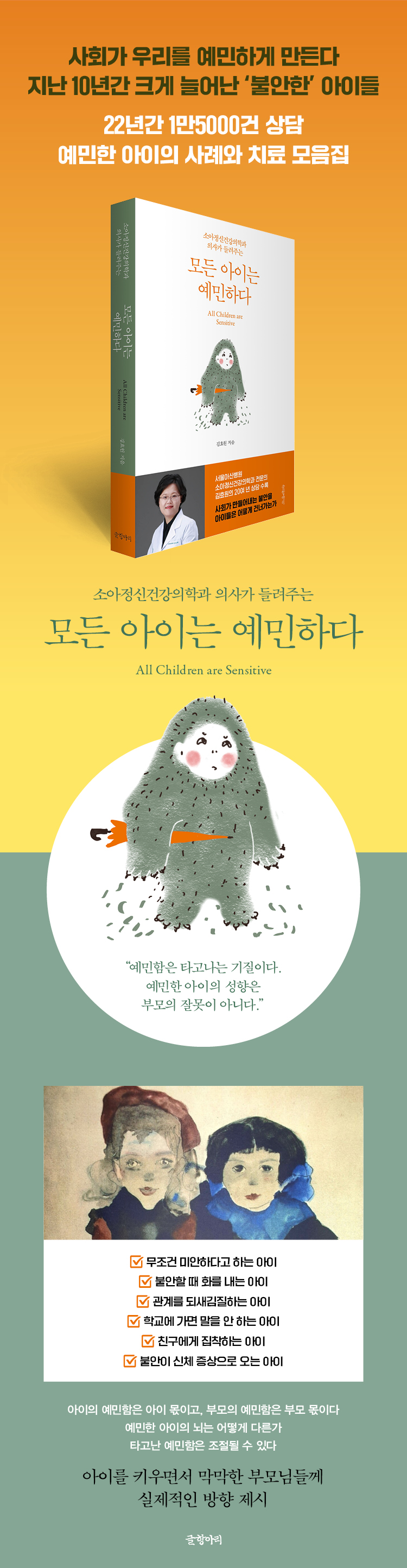
15,000 consultations over 22 years
A collection of all types, cases, and treatments for sensitive children.
A doctor who looks into the brains of sensitive children tells parents
Sensitivity is an innate trait.
A sensitive child is not the parents' fault.
This book is a collection of types, cases, and treatments for sensitive children written by a doctor who has been treating children and adolescents in the Department of Child and Adolescent Psychiatry for over 20 years.
Society creates certain symptoms in the people who live in it.
Many of the children the author has seen in his clinic over the past 10 years have complained of 'anxiety' in particular.
These children were very sensitive and had a hard time going to daycare, kindergarten, and elementary school.
Unlike their peers who grow up without a hitch, for some children life is a series of hurdles to overcome.
The author is also a mother of two children, and her eldest daughter falls into the 'super sensitive' category.
Now that I am a college student, I have experienced severe growing pains due to my difficult personality, and I have also spent a lot of time blaming myself.
In other words, this book contains my experiences as a mother of a sensitive child and as a professional who has observed similar types of children in the clinic.
The core content of this book is as follows.
“Sensitivity is an innate trait.
“A sensitive child’s temperament is not the parents’ fault.” Two things cannot be overemphasized.
This is because parents blame themselves, thinking that their child has trouble sleeping, barely eats, cries nonstop, and has trouble getting along with peers because they did something wrong during pregnancy or because they raised the child incorrectly.
But sensitivity is just a temperament.
So it's not the parents' fault, and it's not a disease that needs treatment.
With this in mind, let's examine whether our children are sensitive or not.
Characteristics of highly sensitive children include:
·Senses: Sensitive to smells, sounds, changes in other people's facial expressions or posture, and tone of voice.
·Cognitive: Cognitively flexible, deep thinker, creative and imaginative.
Be aware of what's happening around you.
On the other hand, they may have difficulty controlling fearful or anxious thoughts and may show perfectionist tendencies.
·Emotions: Shows greater emotional reactions than others to good or bad events.
We feel more intensely, experience more stress, and have stronger attachments to nature, people, animals, and things.
·Relationships: They react more strongly to social attention and criticism, avoid conflict, and spend a lot of time ruminating on their own mistakes.
These characteristics present various challenges to the child depending on the stage of growth.
In Part 3, “Sensitive Children Are Everywhere,” the author divides the sensitive temperament that commonly appears from infancy to elementary school into 14 types.
Hyunwoo who bites his nails, Byeongmin who doesn't eat well, Jiyoon who is sensitive to noise, Jisoo who goes to the bathroom every few minutes, Taehoon who blinks his eyes, Jiwoo who gets a stomachache when he is separated from his mom, Jooyeon who keeps saying "I'm sorry, I'm sorry" while checking his friends' moods, Dojun who gets hurt by his friends' trivial words and actions, Yubin who just reads books silently at school, Giwon who throws tantrums and even acts of violence at his parents and grandparents at home, Jinwoo who gets aggressive when he is anxious, Ji-eun who is afraid of birds, Jang-hyeon who is obsessed with being number one, and Yejun who has an obsessive-compulsive disorder that pulls out his hair visited the hospital, and through cognitive behavioral therapy, play therapy, and psychotherapy with the author, they were able to gradually soften their sensitivity.
There are several types that we will look at in detail here.
For example, a child who is good at empathy and a child who is poor at social skills may seem like polar opposites at first glance, but in reality, they both belong to the sensitive category.
A child who is sensitive and watches his friends' reactions is good at empathizing, but he is also a sensitive child who uses up a lot of energy.
On the other hand, children with low social skills are sensitive to unfamiliar people or places, have difficulty adapting, and may show awkwardness in interpersonal relationships.
Sensitivity can be both an advantage and a disadvantage. For example, Jiyeon, whom the author met, often cried alone in kindergarten and took a long time to adjust when she went to a new academy, but that cautious personality shone through in elementary school.
The tendency to not do things that would upset the teacher, to get along well with friends, and to adapt to the surrounding environment actually increased social adaptability.
What kind of teenager will a sensitive child become?
It is also important to determine whether or not the parents are sensitive.
The strength of this book is that it traces the challenges and changes that sensitive children face as they become teenagers.
Parents are usually new to parenting and tend to feel anxious when they think about their child's future.
It is difficult to paint the future optimistically because the social changes and influences are so significant, and if we miss the opportunity for nurturing and discipline at the initial stage, it cannot be reversed.
In Part 4, the book examines 13 different types of sensitive youth.
During adolescence, many changes occur in the brain and mind.
Synaptic pruning allows brain tissue and neural circuits to become more sophisticated, but it also leaves the frontal lobe unfunctioning, leading to anxiety and severe mood swings.
Children tend to be more sensitive until early adolescence and then decrease in early adulthood, and with support from those around them, their sensitivity often improves quickly.
The author tells the story of Hyunmin (obsessive-compulsive disorder) who wipes the chair with hand sanitizer, Yonghoon (panic disorder) who has trouble breathing just thinking about the college entrance exam, Yujin (perfectionism) who cannot get a single question wrong, Jaehyung who ruminates on relationships, Sumin (depression) who blames herself for all her problems, Yejin (lack of affection) who is obsessed with her friends, Sejin who writes bad things about her parents in her diary, Hayoon who checks mutual followers on Instagram, Seongjin who gets headaches and stomachaches when he is anxious (physical symptoms of anxiety), Jiyu who suffered from anxiety and helplessness under her perfectionist father, Hayul who feels alienated and frustrated in interpersonal relationships, and Yeongmi who suddenly suffers from violent obsessive thoughts.
Adolescence is a time when sensitivity explodes due to the strengthening of peer relationships and competitive academic achievement.
During this period, the number of children who self-harm increases, and some children drop out of school or have extreme conflicts with their parents.
Moreover, children with perfectionistic tendencies may become depressed due to the pressure they feel for the next test as they get better grades.
Society suffocates sensitive children, and sometimes parents side with society, leaving their children with nowhere to run.
Even if perfectionism leads to high academic achievement, it is not a very healthy way to live, the author says.
Because it is better to escape from the pressure and take control of your own life more quickly.
The author observes and nurtures the impact of sensitivity on children's lives as they grow into adulthood in her clinic.
The comfort this book offers is that sensitive children will grow no matter how difficult it may be, so we should trust in that and wait for it.
The author sees not only children and adolescents in his clinic, but also their parents.
So, Part 5 deals with sensitive parents, and that's one of the things that sets this book apart.
Sensitive parents are more likely to have sensitive children, but there is not necessarily a causal relationship.
Moreover, sensitive parents have the advantage of being able to understand and nurture their sensitive children based on their own personalities.
This does not mean that insensitive parents are not doing their job, but children always find comfort in stable parents.
This book shares with parents the intersections, number of cases, and complex variables of all these cases, drawn from the author's own counseling and treatment cases.
***
The author has been treating sensitive children for a long time.
However, parents play an important role in soothing their children's sensitivity on a daily basis, and this book consistently emphasizes reading children's emotions.
Children are not good at describing what they are experiencing right now.
So, if parents verbalize their anticipated emotions, such as, “I thought Mom would hug me right after I got off the kindergarten bus, but she didn’t, so I’m upset,” or “I heard the whining sound and I was worried that bugs might come out,” the child’s negative emotions will gradually subside.
Afterwards, the child learns how to manage his or her own sensitivity while judging the situation more objectively.
This book presents a variety of sensitive children commonly encountered in real life, categorized by type, and offers practical tips for each article, providing parents with actionable guidance they can immediately put to use.
It is also a more detailed type, encompassing almost all the characteristics of children we encounter.
A collection of all types, cases, and treatments for sensitive children.
A doctor who looks into the brains of sensitive children tells parents
Sensitivity is an innate trait.
A sensitive child is not the parents' fault.
This book is a collection of types, cases, and treatments for sensitive children written by a doctor who has been treating children and adolescents in the Department of Child and Adolescent Psychiatry for over 20 years.
Society creates certain symptoms in the people who live in it.
Many of the children the author has seen in his clinic over the past 10 years have complained of 'anxiety' in particular.
These children were very sensitive and had a hard time going to daycare, kindergarten, and elementary school.
Unlike their peers who grow up without a hitch, for some children life is a series of hurdles to overcome.
The author is also a mother of two children, and her eldest daughter falls into the 'super sensitive' category.
Now that I am a college student, I have experienced severe growing pains due to my difficult personality, and I have also spent a lot of time blaming myself.
In other words, this book contains my experiences as a mother of a sensitive child and as a professional who has observed similar types of children in the clinic.
The core content of this book is as follows.
“Sensitivity is an innate trait.
“A sensitive child’s temperament is not the parents’ fault.” Two things cannot be overemphasized.
This is because parents blame themselves, thinking that their child has trouble sleeping, barely eats, cries nonstop, and has trouble getting along with peers because they did something wrong during pregnancy or because they raised the child incorrectly.
But sensitivity is just a temperament.
So it's not the parents' fault, and it's not a disease that needs treatment.
With this in mind, let's examine whether our children are sensitive or not.
Characteristics of highly sensitive children include:
·Senses: Sensitive to smells, sounds, changes in other people's facial expressions or posture, and tone of voice.
·Cognitive: Cognitively flexible, deep thinker, creative and imaginative.
Be aware of what's happening around you.
On the other hand, they may have difficulty controlling fearful or anxious thoughts and may show perfectionist tendencies.
·Emotions: Shows greater emotional reactions than others to good or bad events.
We feel more intensely, experience more stress, and have stronger attachments to nature, people, animals, and things.
·Relationships: They react more strongly to social attention and criticism, avoid conflict, and spend a lot of time ruminating on their own mistakes.
These characteristics present various challenges to the child depending on the stage of growth.
In Part 3, “Sensitive Children Are Everywhere,” the author divides the sensitive temperament that commonly appears from infancy to elementary school into 14 types.
Hyunwoo who bites his nails, Byeongmin who doesn't eat well, Jiyoon who is sensitive to noise, Jisoo who goes to the bathroom every few minutes, Taehoon who blinks his eyes, Jiwoo who gets a stomachache when he is separated from his mom, Jooyeon who keeps saying "I'm sorry, I'm sorry" while checking his friends' moods, Dojun who gets hurt by his friends' trivial words and actions, Yubin who just reads books silently at school, Giwon who throws tantrums and even acts of violence at his parents and grandparents at home, Jinwoo who gets aggressive when he is anxious, Ji-eun who is afraid of birds, Jang-hyeon who is obsessed with being number one, and Yejun who has an obsessive-compulsive disorder that pulls out his hair visited the hospital, and through cognitive behavioral therapy, play therapy, and psychotherapy with the author, they were able to gradually soften their sensitivity.
There are several types that we will look at in detail here.
For example, a child who is good at empathy and a child who is poor at social skills may seem like polar opposites at first glance, but in reality, they both belong to the sensitive category.
A child who is sensitive and watches his friends' reactions is good at empathizing, but he is also a sensitive child who uses up a lot of energy.
On the other hand, children with low social skills are sensitive to unfamiliar people or places, have difficulty adapting, and may show awkwardness in interpersonal relationships.
Sensitivity can be both an advantage and a disadvantage. For example, Jiyeon, whom the author met, often cried alone in kindergarten and took a long time to adjust when she went to a new academy, but that cautious personality shone through in elementary school.
The tendency to not do things that would upset the teacher, to get along well with friends, and to adapt to the surrounding environment actually increased social adaptability.
What kind of teenager will a sensitive child become?
It is also important to determine whether or not the parents are sensitive.
The strength of this book is that it traces the challenges and changes that sensitive children face as they become teenagers.
Parents are usually new to parenting and tend to feel anxious when they think about their child's future.
It is difficult to paint the future optimistically because the social changes and influences are so significant, and if we miss the opportunity for nurturing and discipline at the initial stage, it cannot be reversed.
In Part 4, the book examines 13 different types of sensitive youth.
During adolescence, many changes occur in the brain and mind.
Synaptic pruning allows brain tissue and neural circuits to become more sophisticated, but it also leaves the frontal lobe unfunctioning, leading to anxiety and severe mood swings.
Children tend to be more sensitive until early adolescence and then decrease in early adulthood, and with support from those around them, their sensitivity often improves quickly.
The author tells the story of Hyunmin (obsessive-compulsive disorder) who wipes the chair with hand sanitizer, Yonghoon (panic disorder) who has trouble breathing just thinking about the college entrance exam, Yujin (perfectionism) who cannot get a single question wrong, Jaehyung who ruminates on relationships, Sumin (depression) who blames herself for all her problems, Yejin (lack of affection) who is obsessed with her friends, Sejin who writes bad things about her parents in her diary, Hayoon who checks mutual followers on Instagram, Seongjin who gets headaches and stomachaches when he is anxious (physical symptoms of anxiety), Jiyu who suffered from anxiety and helplessness under her perfectionist father, Hayul who feels alienated and frustrated in interpersonal relationships, and Yeongmi who suddenly suffers from violent obsessive thoughts.
Adolescence is a time when sensitivity explodes due to the strengthening of peer relationships and competitive academic achievement.
During this period, the number of children who self-harm increases, and some children drop out of school or have extreme conflicts with their parents.
Moreover, children with perfectionistic tendencies may become depressed due to the pressure they feel for the next test as they get better grades.
Society suffocates sensitive children, and sometimes parents side with society, leaving their children with nowhere to run.
Even if perfectionism leads to high academic achievement, it is not a very healthy way to live, the author says.
Because it is better to escape from the pressure and take control of your own life more quickly.
The author observes and nurtures the impact of sensitivity on children's lives as they grow into adulthood in her clinic.
The comfort this book offers is that sensitive children will grow no matter how difficult it may be, so we should trust in that and wait for it.
The author sees not only children and adolescents in his clinic, but also their parents.
So, Part 5 deals with sensitive parents, and that's one of the things that sets this book apart.
Sensitive parents are more likely to have sensitive children, but there is not necessarily a causal relationship.
Moreover, sensitive parents have the advantage of being able to understand and nurture their sensitive children based on their own personalities.
This does not mean that insensitive parents are not doing their job, but children always find comfort in stable parents.
This book shares with parents the intersections, number of cases, and complex variables of all these cases, drawn from the author's own counseling and treatment cases.
***
The author has been treating sensitive children for a long time.
However, parents play an important role in soothing their children's sensitivity on a daily basis, and this book consistently emphasizes reading children's emotions.
Children are not good at describing what they are experiencing right now.
So, if parents verbalize their anticipated emotions, such as, “I thought Mom would hug me right after I got off the kindergarten bus, but she didn’t, so I’m upset,” or “I heard the whining sound and I was worried that bugs might come out,” the child’s negative emotions will gradually subside.
Afterwards, the child learns how to manage his or her own sensitivity while judging the situation more objectively.
This book presents a variety of sensitive children commonly encountered in real life, categorized by type, and offers practical tips for each article, providing parents with actionable guidance they can immediately put to use.
It is also a more detailed type, encompassing almost all the characteristics of children we encounter.
GOODS SPECIFICS
- Date of issue: June 3, 2024
- Page count, weight, size: 320 pages | 135*205*30mm
- ISBN13: 9791169092418
- ISBN10: 1169092411
You may also like
카테고리
korean


korean

![GQ KOREA Mark (Monthly): December [2025]](http://librairie.coreenne.fr/cdn/shop/files/8ef265dbbfbf186523ed75ba7319009d.jpg?v=1765340328&width=3840)


