

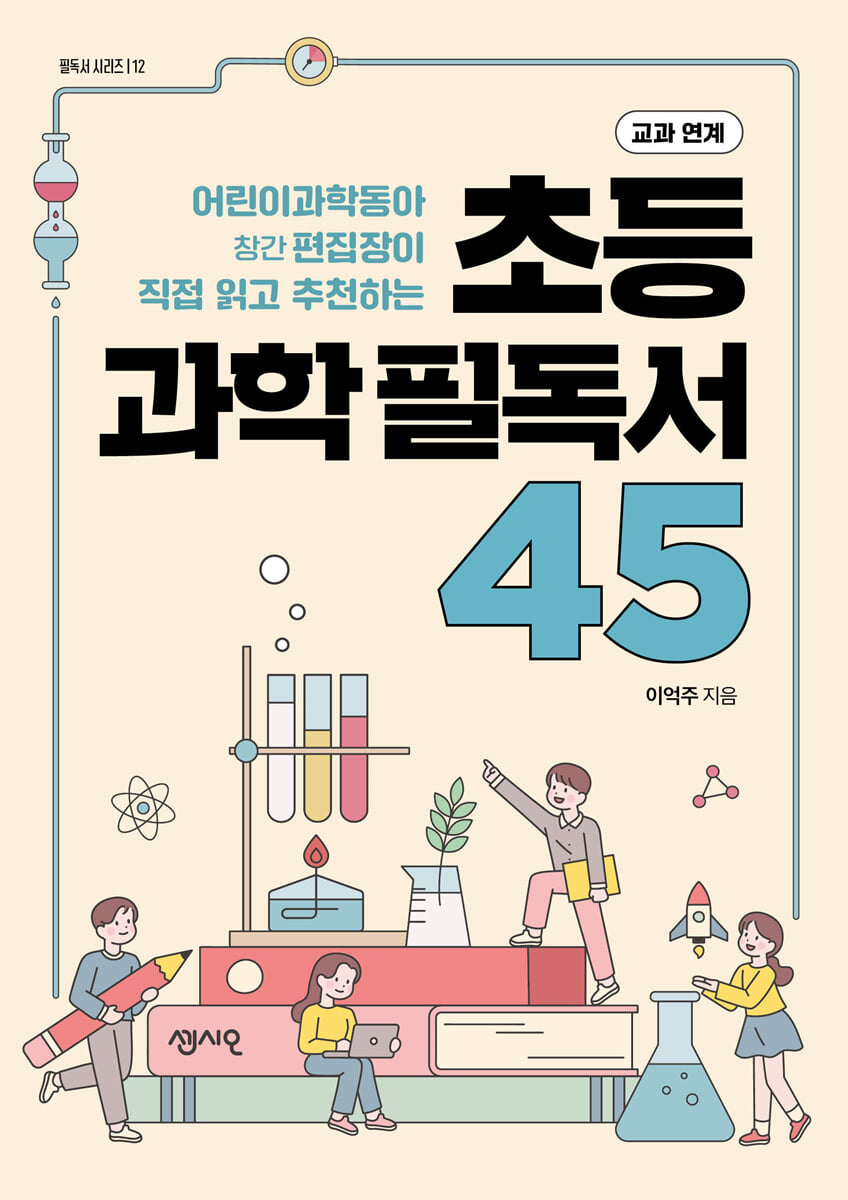
Elementary Science Must-Read Books 45
 |
Description
Book Introduction
The founding editor of Children's Science Dong-A
45 must-read science books that I personally read and recommend in one volume
A book has been published that contains 45 must-know science classics for elementary school students.
We carefully selected 45 famous books by field from books selected by scientific organizations, books recommended by libraries, and books recommended by elementary school science teachers.
The 45 volumes are divided into four areas in line with the elementary school curriculum and are introduced in a storytelling format so that children who find science difficult can easily understand it.
The author is an elementary science expert who served as the founding editor-in-chief of Children's Science Donga and the editor-in-chief of Science Boy.
The reason for studying science is to develop the ability to think scientifically and to develop an eye for viewing the origins of nature and the world.
But with so many science books out there, it can be difficult to know which ones your child should start reading.
There is not enough time to read dozens of books.
And science books are a little difficult.
The book that solves these problems is 『45 Essential Readings for Elementary Science』.
This is because it is a book that selects 45 famous books from among numerous science books and explains them in an easy-to-understand way, while being linked to the elementary school curriculum and covering topics that children will find interesting.
The books introduced here are recognized masterpieces in the field of science.
From the world's best-selling science book, "The Magic School Bus," to the classic science book by Fabre, Charles Darwin's "On the Origin of Species," the book by Professor Choi Jae-cheon, a leading expert in animal behavior in Korea, Einstein's book, and Professor Jeong Jae-seung's book, these books are considered the best in their field, from classics to the latest.
You can read the best books in the field of science for just 450 won per volume, so it is also the best value for money.
The 45 books were divided into four areas according to the curriculum.
We introduce books that help us understand the origins of plant and animal life; books that easily explain the essential but difficult to explain topics such as black holes, nuclear power plants, astronomy, and the theory of relativity; books that discuss who I am and what kind of being I am, how big data is used in our lives, and curiosity, the attitude that scientists should have; and books that discuss convergence, which allows us to look at myths, magic, movies, art, and science fiction from a scientific perspective.
It doesn't matter where you start reading the book.
If there is a book that your child is interested in, you can start from there.
Because the first step is for children to enjoy science.
45 must-read science books that I personally read and recommend in one volume
A book has been published that contains 45 must-know science classics for elementary school students.
We carefully selected 45 famous books by field from books selected by scientific organizations, books recommended by libraries, and books recommended by elementary school science teachers.
The 45 volumes are divided into four areas in line with the elementary school curriculum and are introduced in a storytelling format so that children who find science difficult can easily understand it.
The author is an elementary science expert who served as the founding editor-in-chief of Children's Science Donga and the editor-in-chief of Science Boy.
The reason for studying science is to develop the ability to think scientifically and to develop an eye for viewing the origins of nature and the world.
But with so many science books out there, it can be difficult to know which ones your child should start reading.
There is not enough time to read dozens of books.
And science books are a little difficult.
The book that solves these problems is 『45 Essential Readings for Elementary Science』.
This is because it is a book that selects 45 famous books from among numerous science books and explains them in an easy-to-understand way, while being linked to the elementary school curriculum and covering topics that children will find interesting.
The books introduced here are recognized masterpieces in the field of science.
From the world's best-selling science book, "The Magic School Bus," to the classic science book by Fabre, Charles Darwin's "On the Origin of Species," the book by Professor Choi Jae-cheon, a leading expert in animal behavior in Korea, Einstein's book, and Professor Jeong Jae-seung's book, these books are considered the best in their field, from classics to the latest.
You can read the best books in the field of science for just 450 won per volume, so it is also the best value for money.
The 45 books were divided into four areas according to the curriculum.
We introduce books that help us understand the origins of plant and animal life; books that easily explain the essential but difficult to explain topics such as black holes, nuclear power plants, astronomy, and the theory of relativity; books that discuss who I am and what kind of being I am, how big data is used in our lives, and curiosity, the attitude that scientists should have; and books that discuss convergence, which allows us to look at myths, magic, movies, art, and science fiction from a scientific perspective.
It doesn't matter where you start reading the book.
If there is a book that your child is interested in, you can start from there.
Because the first step is for children to enjoy science.
- You can preview some of the book's contents.
Preview
index
Introduction: Let's find out who I am in the future through books!
Part 1: The Quest for Life
· BOOK 01 · What's the crucial difference between whales and sharks? "Why did whales go to the sea?"
· BOOK 02 · The now-defunct insect and plant collection 『Fabre's Insect Book』
· BOOK 03 · Fabre, who loved plants before insects, "Fabre's Plant Stories"
· BOOK 04 · The distant and dark island of Heuksando, 『Jeong Yak-jeon and Jasaneobo』
· BOOK 05 · What was Charles Darwin's defining moment? "The Origin of Species for Children"
· BOOK 06 · Let's look into my life through the life of a butterfly. 『Hope for Flowers』
· BOOK 07 · Board Dr. Ant's Beagle 『Choi Jae-cheon's Animal Adventure』
· BOOK 08 · Extinction and Evolution Have a Reason! "Extinction for a Reason"
· BOOK 09 · What kind of comics do scientists draw? 『Learning Dinosaur Ecology through Comics』
· BOOK 10 · What if you observed one place for a year? 『The Tale of the Toad Field』
· BOOK 11 · The Birds That Don't Return Even When Spring Comes 『Rachel Carson』
· BOOK 12 · Primates and Three Women, One of Them: Jane Goodall's The Chimpanzee I Loved
Part 2: Exploring the Essence
· BOOK 13 · So much science in a single candle! "The Science of Candlelight"
· BOOK 14 · The Real Reason You Need to Know the Elements: All Elements of the World 118
· BOOK 15 · What is Matter Made of? 『10 Things You Should Know About Matter』
· BOOK 16 · What happens when you take good notes? "The Secret Notes of a Scientific Genius: Physics and Chemistry"
· BOOK 17 · Create a world with just your thoughts! 『Einstein's Thought Laboratory』
· BOOK 18 · What's the difference between the principle of relativity and the theory of relativity? "Is this your first time learning about the theory of relativity?"
· BOOK 19 · The 21st Century is the Age of Quantum Mechanics! 『Quantum Mechanics for Elementary School Students』
· BOOK 20 · Can't physics be as fun as dinosaurs? "The Suspicious Lab of Physics Ph.D. Kim Sang-wook"
· BOOK 21 · Black Holes and White Holes? "What is a Black Hole?"
· BOOK 22 · The Difference Between Astronomy and Astrology: A Single Sheet of Paper? "An Astronomy Story So Fun You'll Read It All Night"
· BOOK 23 · Who named the asteroid after King Sejong? 『Cider 3: The Solar System × The Little Prince』
· BOOK 24 · What's Most Important When Seeing a Shooting Star? "Space Stories from the Shooting Star Lady"
Exploring the Third Question
· BOOK 25 · The moment you board the bus, you'll be captivated by the magic of science! 『The Magical School Bus』
· BOOK 26 · Announcing the start of science picture books! The "Snail Science Fairy Tale" series
· BOOK 27 · Filled with persistent observation and love! "Barley Children's Illustrated Guide"
· BOOK 28 · Who am I and what kind of being am I? 『Jeong Jae-seung's Human Exploration Report』
· BOOK 29 · Science begins with inquiry. 『Inquiry』
· BOOK 30 · Listening to science like watching a concert 『Jeong Jae-seung's Cartoon Science Concert』
· BOOK 31 · The Science Museum: A Place to Ask New Questions 『Absurd Questions from the Science Museum』
· BOOK 32 · What Big Data Can Do: Big Data and Physics with Professor Kim Beom-jun
· BOOK 33 · 17 Attitudes a Scientist Should Have 『What Science Has Taught Us』
· BOOK 34 · Could the future have been predicted 10,000 years ago? "The Future Is Coming"
Part 4: Exploring Convergence
· BOOK 35 · Unraveling the world of magic through the world of science: Harry Potter Science
· BOOK 36 · Looking at Mythology through a Scientific Eye: 『Greek and Roman Mythology Science』
· BOOK 37 · Proverbs Reveal Our Ancestors' Scientific Abilities?! 『The Science Hidden in Proverbs』
· BOOK 38 · Is it more fun to ride if you know science? "Let's Ride Science! Amusement Park Rides"
· BOOK 39 · The Suspicious Cinema That Stole Science: How Photography Made It Move
· BOOK 40 · The Commonality Between Art and Science: Creativity 『Interesting Science Stories in Famous Paintings』
· BOOK 41 · A Scientific Perspective on Film: A Humanities Journey Through Science for Teens
· BOOK 42 · What science and technology are needed to build a house? "Fun Science Stories in Architecture"
· BOOK 43 · The Crucial Difference Between Music and Noise? "What Does This Mean?! Music and Noise"
· BOOK 44 · Myth is ultimately another expression of science 『Scientific Odyssey』
· BOOK 45 · Journey to the Center of the Earth by Jules Verne, the world's greatest science fiction writer
Part 1: The Quest for Life
· BOOK 01 · What's the crucial difference between whales and sharks? "Why did whales go to the sea?"
· BOOK 02 · The now-defunct insect and plant collection 『Fabre's Insect Book』
· BOOK 03 · Fabre, who loved plants before insects, "Fabre's Plant Stories"
· BOOK 04 · The distant and dark island of Heuksando, 『Jeong Yak-jeon and Jasaneobo』
· BOOK 05 · What was Charles Darwin's defining moment? "The Origin of Species for Children"
· BOOK 06 · Let's look into my life through the life of a butterfly. 『Hope for Flowers』
· BOOK 07 · Board Dr. Ant's Beagle 『Choi Jae-cheon's Animal Adventure』
· BOOK 08 · Extinction and Evolution Have a Reason! "Extinction for a Reason"
· BOOK 09 · What kind of comics do scientists draw? 『Learning Dinosaur Ecology through Comics』
· BOOK 10 · What if you observed one place for a year? 『The Tale of the Toad Field』
· BOOK 11 · The Birds That Don't Return Even When Spring Comes 『Rachel Carson』
· BOOK 12 · Primates and Three Women, One of Them: Jane Goodall's The Chimpanzee I Loved
Part 2: Exploring the Essence
· BOOK 13 · So much science in a single candle! "The Science of Candlelight"
· BOOK 14 · The Real Reason You Need to Know the Elements: All Elements of the World 118
· BOOK 15 · What is Matter Made of? 『10 Things You Should Know About Matter』
· BOOK 16 · What happens when you take good notes? "The Secret Notes of a Scientific Genius: Physics and Chemistry"
· BOOK 17 · Create a world with just your thoughts! 『Einstein's Thought Laboratory』
· BOOK 18 · What's the difference between the principle of relativity and the theory of relativity? "Is this your first time learning about the theory of relativity?"
· BOOK 19 · The 21st Century is the Age of Quantum Mechanics! 『Quantum Mechanics for Elementary School Students』
· BOOK 20 · Can't physics be as fun as dinosaurs? "The Suspicious Lab of Physics Ph.D. Kim Sang-wook"
· BOOK 21 · Black Holes and White Holes? "What is a Black Hole?"
· BOOK 22 · The Difference Between Astronomy and Astrology: A Single Sheet of Paper? "An Astronomy Story So Fun You'll Read It All Night"
· BOOK 23 · Who named the asteroid after King Sejong? 『Cider 3: The Solar System × The Little Prince』
· BOOK 24 · What's Most Important When Seeing a Shooting Star? "Space Stories from the Shooting Star Lady"
Exploring the Third Question
· BOOK 25 · The moment you board the bus, you'll be captivated by the magic of science! 『The Magical School Bus』
· BOOK 26 · Announcing the start of science picture books! The "Snail Science Fairy Tale" series
· BOOK 27 · Filled with persistent observation and love! "Barley Children's Illustrated Guide"
· BOOK 28 · Who am I and what kind of being am I? 『Jeong Jae-seung's Human Exploration Report』
· BOOK 29 · Science begins with inquiry. 『Inquiry』
· BOOK 30 · Listening to science like watching a concert 『Jeong Jae-seung's Cartoon Science Concert』
· BOOK 31 · The Science Museum: A Place to Ask New Questions 『Absurd Questions from the Science Museum』
· BOOK 32 · What Big Data Can Do: Big Data and Physics with Professor Kim Beom-jun
· BOOK 33 · 17 Attitudes a Scientist Should Have 『What Science Has Taught Us』
· BOOK 34 · Could the future have been predicted 10,000 years ago? "The Future Is Coming"
Part 4: Exploring Convergence
· BOOK 35 · Unraveling the world of magic through the world of science: Harry Potter Science
· BOOK 36 · Looking at Mythology through a Scientific Eye: 『Greek and Roman Mythology Science』
· BOOK 37 · Proverbs Reveal Our Ancestors' Scientific Abilities?! 『The Science Hidden in Proverbs』
· BOOK 38 · Is it more fun to ride if you know science? "Let's Ride Science! Amusement Park Rides"
· BOOK 39 · The Suspicious Cinema That Stole Science: How Photography Made It Move
· BOOK 40 · The Commonality Between Art and Science: Creativity 『Interesting Science Stories in Famous Paintings』
· BOOK 41 · A Scientific Perspective on Film: A Humanities Journey Through Science for Teens
· BOOK 42 · What science and technology are needed to build a house? "Fun Science Stories in Architecture"
· BOOK 43 · The Crucial Difference Between Music and Noise? "What Does This Mean?! Music and Noise"
· BOOK 44 · Myth is ultimately another expression of science 『Scientific Odyssey』
· BOOK 45 · Journey to the Center of the Earth by Jules Verne, the world's greatest science fiction writer
Detailed image

Into the book
Here's another quiz! Blue whale calves can weigh 15,000 kilograms after just seven months.
So, how many kilograms does a blue whale calf gain per hour? One hour? Can you feel the weight gain in an hour? Anyway, let's do the math.
7 months is 7 x 30 = 210 (days).
In 7 months, the baby will weigh 15,000 kilograms, so the baby will gain about 15,000 ÷ 210 = 71.5 kilograms per day.
Then, in one hour, you gain 71.5÷24=about 3 kilograms.
Compared to the average adult's weight of 70 kilograms, whales are truly enormous.
There is one thing that is most peculiar about whales.
It is a mass death of whales.
In July 1976, about 30 pilot dolphins were stranded off the coast of Florida, USA.
A grounding is when a ship, whale, fish, or other object is washed ashore and cannot return to the water.
They say that guide dolphins strand a lot.
It is still not known exactly why whales strand.
There are many reasons, but whales are so heavy that when they come onto land, their bodies are crushed and they can't breathe properly, so they suffocate.
In some cases, stranded whales that are returned to the sea may return to the beach and die.
If you have any further questions about whales, read "Why Did Whales Go to the Sea?"
--- p.17
However, Aristotle, the ancient Greek philosopher who can be said to be the founder of natural science, thought that insects do not come from insects, but from dew, dung, animal carcasses, and mud.
This is called the 'spontaneous generation' of animals.
I didn't know how insects that we commonly see around us came to be.
At that time, people thought that things that crawled were bugs and things that flew were birds.
In particular, I never thought that insects would transform into eggs, larvae, pupae, and then adult insects.
The theory of spontaneous generation was accepted as fact until 1862, when French microbiologist Louis Pasteur conducted the 'swan-neck flask experiment'.
Thanks to Pasteur, the theory of biogenesis, which states that all living things do not occur spontaneously and that living things must have parents to produce offspring, became known.
Yet, Aristotle remains the great natural scientist who first proposed methods for observing, dissecting, and classifying living things.
The greatest observer of nature after Aristotle was Charles Darwin (1809-1882), famous for his work On the Origin of Species.
Born into a wealthy family of doctors, Darwin enjoyed collecting insects as a child.
It's said that even after collecting a handful of beetles, Darwin would put the ones he had in his hand in his mouth and catch more insects if he encountered them for the first time. This shows how much he loved insects. Darwin entered university to study theology and medicine, but he couldn't shake his passion for biology and became a naturalist.
His father was a doctor, but his grandfather, Erasmus Darwin, was also a naturalist.
--- p.19~20
About 2,300 years ago, on the small island of Lesbos in the eastern Aegean Sea of Greece, the great philosopher Aristotle was wrestling with a cuttlefish on the beach.
Aristotle was dissecting a cuttlefish, examining its internal structure one by one.
In this way, Aristotle wrote a book called "Animal Enquiries" in which he organized the ecology of about 500 animals that could be seen on the coast of Lesbos.
This showed the true nature of scientists who directly observe and record nature and animals.
Around 1810, more than 2,000 years after Aristotle published his "Zoology," this scene was also seen on Heuksando Island in Korea.
It's Jeong Yak-jeon.
Jeong Yak-jeon is the older brother of Jeong Yak-yong, who made great scientific contributions to the construction of Hwaseong Fortress in Suwon.
Jeong Yak-jeon's family was punished for believing in Catholicism, which was banned by the country at the time.
So, Jeong Yak-yong was exiled to Gangjin and Jeong Yak-jeon was exiled to Heuksando.
Exile is a punishment that sends criminals to live far away from Seoul, where the king lives.
Heuksando is an island in Heuksando-myeon, Sinan-gun, Jeollanam-do, which is the current administrative district.
It was a very far place, about 450 kilometers from Seoul, and once I went there, I didn't know when I would come back.
Jeong Yak-jeon was interested in learning from a young age, so he never took his eyes off books even in Heuksando, where he was exiled.
Then, he met Jang Chang-dae, a fisherman who lived on Heuksando Island, and became interested in fish and other marine life.
Jeong Yak-jeon, with the help of Jang Chang-dae, begins to investigate fish, crabs, shrimp, shellfish, and birds living in the sea.
The book that was completed this way is 『Jasan Eobo』.
If Greece had Aristotle and 『Animal Research』, then Korea had Jeong Yak-jeon and 『Jasaneobo』.
--- p.33~34
Oh, wait! Let me introduce you to some uniquely shaped animals that were unjustly extinct.
The name is 'Halucigenia'.
It is a distant relative of arthropods such as trilobites, an animal with a long, slender body that appears soft and has seven pairs of spines.
While trilobites hardened their entire body surface, Hallucigenia chose a strategy of hardening only its long spines.
At first, the thorns were small and useless, but they gradually grew longer as they happened to help protect the body from natural enemies.
But it was so long, heavy, and bulky that it was inconvenient to walk around.
Eventually, the burden of creating and maintaining thorns became too great, and the results were not good enough for the effort, so they went extinct.
It was a case of trying to do well but unfortunately going extinct.
The last part of Volume 3 introduces 10 animals that 'prospered for a reason.'
Some animals go extinct for a reason, while others thrive for a reason! There are so many reasons why animals on Earth live and die.
--- p.66
There are famous primatologists who study chimpanzees, gorillas, and orangutans, which are very similar to humans.
They are all female scientists: Jane Goodall for chimpanzees, Dian Fossey for gorillas, and Birute Galdikas for orangutans.
First, Dian Fossey was born in the United States in 1932 and received her doctorate in zoology from the University of Cambridge in England.
At the age of 31, I began studying gorillas after meeting anthropologist Dr. Louis Leakey while on safari in Africa, which led me to become a primatologist.
While studying gorillas in Rwanda, Africa, I created the first case of friendly contact between humans and gorillas.
However, after seeing a male gorilla that he had been living with being killed by poachers, he became an active activist for gorilla conservation.
During this process, Dian Fossey died a mysterious death.
Dian Fossey's book, Gorillas in the Mist, brought attention to gorilla conservation around the world and was made into a movie of the same name, making her a famous person.
Birute Galdikas was born in Germany in 1946 and received his PhD in anthropology from the University of California, Los Angeles (UCLA).
Afterwards, I studied orangutans in Indonesia while working as a professor at the National University of Indonesia and as a professor of archaeology at Simon Fraser University in Canada.
Birute Galdikas says he decided to study orangutans after hearing a lecture by Louis Leakey at UCLA.
Unlike chimpanzees and gorillas who move in groups, orangutans can go for over a month without ever meeting another orangutan.
That's why orangutan research is so difficult and time-consuming, and Birute Galdikas says it took him eight years to first observe orangutans using tools.
The scene where they use tools is a male orangutan scratching his butt with a piece of wood for 25 seconds, which is a bit funny, isn't it? --- p.91~92
The animals ask Grandpa Raccoon.
Grandpa Raccoon, who carefully examined the tree, said, “There are bad bugs hiding in the tree.
“The insects are eating away at the inside of the tree, causing it to wither,” he said.
The animals are chatter about how to catch the bugs.
The bear tries to shake the tree to shake off the bugs, but it is in vain.
Even if a tiger roars loudly, the insects don't flinch.
Even if an eagle flies in and pecks at a tree with its sharp beak, the insects hide deeper.
At this time, Grandpa Owl wakes up from his nap at the loud noise and says a word.
“We should bring a woodpecker.” The animals bring a woodpecker with their beaks bare.
Woodpeckers grasp trees with their sharp claws, stabilize themselves with their stiff tail feathers, and tap the tree with their beaks.
'Knock knock knock.' The insects that were hiding deep inside are caught by the woodpecker's long tongue.
The withered leaves are becoming fresh again.
“Wow, long live the woodpecker.” All the animals hug and rejoice.
The woodpecker was a forest doctor who saved dying trees.
At the end of the story, the woodpecker tells how he dug holes in trees and caught insects to eat.
It also explains the appearance of woodpeckers and their role in the forest.
I wonder, 'If a woodpecker digs a hole in a tree, won't it harm the tree?'
But the answer is that if a woodpecker catches the insects that build their nests and lay eggs in the tree, the tree will fill in the hole on its own and grow healthy.
Do you know why woodpeckers are called tree doctors?
--- p.201
When I look at her, I think of Foucault's pendulum.
Aristotle, the great ancient Greek philosopher and natural scientist, argued:
“All the celestial bodies in the sky are perfect and move in circles around the Earth, while the objects on the Earth are imperfect and move in straight lines.” Aristotle was such a renowned philosopher that no one could question this claim.
Aristotle was also a scientist who discovered that the Earth is round when he observed the Earth's shadow on the moon during a lunar eclipse, when the sun, Earth, and moon are in a straight line and the moon enters the Earth's shadow, making it difficult to see.
Aristotle's claims were accepted as truth for nearly 2,000 years.
Until Galileo Galilei (1564–1642) and Isaac Newton (1642–1727) developed new theories of motion, people believed Aristotle's claims were correct.
Every day we see the sun rise in the east and set in the west.
Not only the sun, but also stars, planets, and the moon rise in the east and set in the west.
The Earth appears to be stationary at the center and all celestial bodies appear to revolve in circles.
It's not strange at all to think like this.
Does Aristotle seem right?
So, how many kilograms does a blue whale calf gain per hour? One hour? Can you feel the weight gain in an hour? Anyway, let's do the math.
7 months is 7 x 30 = 210 (days).
In 7 months, the baby will weigh 15,000 kilograms, so the baby will gain about 15,000 ÷ 210 = 71.5 kilograms per day.
Then, in one hour, you gain 71.5÷24=about 3 kilograms.
Compared to the average adult's weight of 70 kilograms, whales are truly enormous.
There is one thing that is most peculiar about whales.
It is a mass death of whales.
In July 1976, about 30 pilot dolphins were stranded off the coast of Florida, USA.
A grounding is when a ship, whale, fish, or other object is washed ashore and cannot return to the water.
They say that guide dolphins strand a lot.
It is still not known exactly why whales strand.
There are many reasons, but whales are so heavy that when they come onto land, their bodies are crushed and they can't breathe properly, so they suffocate.
In some cases, stranded whales that are returned to the sea may return to the beach and die.
If you have any further questions about whales, read "Why Did Whales Go to the Sea?"
--- p.17
However, Aristotle, the ancient Greek philosopher who can be said to be the founder of natural science, thought that insects do not come from insects, but from dew, dung, animal carcasses, and mud.
This is called the 'spontaneous generation' of animals.
I didn't know how insects that we commonly see around us came to be.
At that time, people thought that things that crawled were bugs and things that flew were birds.
In particular, I never thought that insects would transform into eggs, larvae, pupae, and then adult insects.
The theory of spontaneous generation was accepted as fact until 1862, when French microbiologist Louis Pasteur conducted the 'swan-neck flask experiment'.
Thanks to Pasteur, the theory of biogenesis, which states that all living things do not occur spontaneously and that living things must have parents to produce offspring, became known.
Yet, Aristotle remains the great natural scientist who first proposed methods for observing, dissecting, and classifying living things.
The greatest observer of nature after Aristotle was Charles Darwin (1809-1882), famous for his work On the Origin of Species.
Born into a wealthy family of doctors, Darwin enjoyed collecting insects as a child.
It's said that even after collecting a handful of beetles, Darwin would put the ones he had in his hand in his mouth and catch more insects if he encountered them for the first time. This shows how much he loved insects. Darwin entered university to study theology and medicine, but he couldn't shake his passion for biology and became a naturalist.
His father was a doctor, but his grandfather, Erasmus Darwin, was also a naturalist.
--- p.19~20
About 2,300 years ago, on the small island of Lesbos in the eastern Aegean Sea of Greece, the great philosopher Aristotle was wrestling with a cuttlefish on the beach.
Aristotle was dissecting a cuttlefish, examining its internal structure one by one.
In this way, Aristotle wrote a book called "Animal Enquiries" in which he organized the ecology of about 500 animals that could be seen on the coast of Lesbos.
This showed the true nature of scientists who directly observe and record nature and animals.
Around 1810, more than 2,000 years after Aristotle published his "Zoology," this scene was also seen on Heuksando Island in Korea.
It's Jeong Yak-jeon.
Jeong Yak-jeon is the older brother of Jeong Yak-yong, who made great scientific contributions to the construction of Hwaseong Fortress in Suwon.
Jeong Yak-jeon's family was punished for believing in Catholicism, which was banned by the country at the time.
So, Jeong Yak-yong was exiled to Gangjin and Jeong Yak-jeon was exiled to Heuksando.
Exile is a punishment that sends criminals to live far away from Seoul, where the king lives.
Heuksando is an island in Heuksando-myeon, Sinan-gun, Jeollanam-do, which is the current administrative district.
It was a very far place, about 450 kilometers from Seoul, and once I went there, I didn't know when I would come back.
Jeong Yak-jeon was interested in learning from a young age, so he never took his eyes off books even in Heuksando, where he was exiled.
Then, he met Jang Chang-dae, a fisherman who lived on Heuksando Island, and became interested in fish and other marine life.
Jeong Yak-jeon, with the help of Jang Chang-dae, begins to investigate fish, crabs, shrimp, shellfish, and birds living in the sea.
The book that was completed this way is 『Jasan Eobo』.
If Greece had Aristotle and 『Animal Research』, then Korea had Jeong Yak-jeon and 『Jasaneobo』.
--- p.33~34
Oh, wait! Let me introduce you to some uniquely shaped animals that were unjustly extinct.
The name is 'Halucigenia'.
It is a distant relative of arthropods such as trilobites, an animal with a long, slender body that appears soft and has seven pairs of spines.
While trilobites hardened their entire body surface, Hallucigenia chose a strategy of hardening only its long spines.
At first, the thorns were small and useless, but they gradually grew longer as they happened to help protect the body from natural enemies.
But it was so long, heavy, and bulky that it was inconvenient to walk around.
Eventually, the burden of creating and maintaining thorns became too great, and the results were not good enough for the effort, so they went extinct.
It was a case of trying to do well but unfortunately going extinct.
The last part of Volume 3 introduces 10 animals that 'prospered for a reason.'
Some animals go extinct for a reason, while others thrive for a reason! There are so many reasons why animals on Earth live and die.
--- p.66
There are famous primatologists who study chimpanzees, gorillas, and orangutans, which are very similar to humans.
They are all female scientists: Jane Goodall for chimpanzees, Dian Fossey for gorillas, and Birute Galdikas for orangutans.
First, Dian Fossey was born in the United States in 1932 and received her doctorate in zoology from the University of Cambridge in England.
At the age of 31, I began studying gorillas after meeting anthropologist Dr. Louis Leakey while on safari in Africa, which led me to become a primatologist.
While studying gorillas in Rwanda, Africa, I created the first case of friendly contact between humans and gorillas.
However, after seeing a male gorilla that he had been living with being killed by poachers, he became an active activist for gorilla conservation.
During this process, Dian Fossey died a mysterious death.
Dian Fossey's book, Gorillas in the Mist, brought attention to gorilla conservation around the world and was made into a movie of the same name, making her a famous person.
Birute Galdikas was born in Germany in 1946 and received his PhD in anthropology from the University of California, Los Angeles (UCLA).
Afterwards, I studied orangutans in Indonesia while working as a professor at the National University of Indonesia and as a professor of archaeology at Simon Fraser University in Canada.
Birute Galdikas says he decided to study orangutans after hearing a lecture by Louis Leakey at UCLA.
Unlike chimpanzees and gorillas who move in groups, orangutans can go for over a month without ever meeting another orangutan.
That's why orangutan research is so difficult and time-consuming, and Birute Galdikas says it took him eight years to first observe orangutans using tools.
The scene where they use tools is a male orangutan scratching his butt with a piece of wood for 25 seconds, which is a bit funny, isn't it? --- p.91~92
The animals ask Grandpa Raccoon.
Grandpa Raccoon, who carefully examined the tree, said, “There are bad bugs hiding in the tree.
“The insects are eating away at the inside of the tree, causing it to wither,” he said.
The animals are chatter about how to catch the bugs.
The bear tries to shake the tree to shake off the bugs, but it is in vain.
Even if a tiger roars loudly, the insects don't flinch.
Even if an eagle flies in and pecks at a tree with its sharp beak, the insects hide deeper.
At this time, Grandpa Owl wakes up from his nap at the loud noise and says a word.
“We should bring a woodpecker.” The animals bring a woodpecker with their beaks bare.
Woodpeckers grasp trees with their sharp claws, stabilize themselves with their stiff tail feathers, and tap the tree with their beaks.
'Knock knock knock.' The insects that were hiding deep inside are caught by the woodpecker's long tongue.
The withered leaves are becoming fresh again.
“Wow, long live the woodpecker.” All the animals hug and rejoice.
The woodpecker was a forest doctor who saved dying trees.
At the end of the story, the woodpecker tells how he dug holes in trees and caught insects to eat.
It also explains the appearance of woodpeckers and their role in the forest.
I wonder, 'If a woodpecker digs a hole in a tree, won't it harm the tree?'
But the answer is that if a woodpecker catches the insects that build their nests and lay eggs in the tree, the tree will fill in the hole on its own and grow healthy.
Do you know why woodpeckers are called tree doctors?
--- p.201
When I look at her, I think of Foucault's pendulum.
Aristotle, the great ancient Greek philosopher and natural scientist, argued:
“All the celestial bodies in the sky are perfect and move in circles around the Earth, while the objects on the Earth are imperfect and move in straight lines.” Aristotle was such a renowned philosopher that no one could question this claim.
Aristotle was also a scientist who discovered that the Earth is round when he observed the Earth's shadow on the moon during a lunar eclipse, when the sun, Earth, and moon are in a straight line and the moon enters the Earth's shadow, making it difficult to see.
Aristotle's claims were accepted as truth for nearly 2,000 years.
Until Galileo Galilei (1564–1642) and Isaac Newton (1642–1727) developed new theories of motion, people believed Aristotle's claims were correct.
Every day we see the sun rise in the east and set in the west.
Not only the sun, but also stars, planets, and the moon rise in the east and set in the west.
The Earth appears to be stationary at the center and all celestial bodies appear to revolve in circles.
It's not strange at all to think like this.
Does Aristotle seem right?
--- p.300
Publisher's Review
Explained by an elementary science expert
Discover 45 science textbooks in one volume.
Parents want their children to read science books, but science can sometimes feel complicated and distant.
Maybe that's why children often read a book for a bit, then lose interest and push it to the corner.
"Elementary Science Essential Reading 45" is a book that provides a good solution to these problems.
This is because it is a book that selects 45 famous books from among numerous science books and explains them in an easy-to-understand way, while being linked to the elementary school curriculum and covering topics that children will find interesting.
The 45 must-read books were selected from among science books that were recommended by specialized organizations such as the Korea Foundation for the Advancement of Science and Creativity's Excellent Science Books, various media, and leading libraries, and are books that all elementary school students must read at least once.
Topics linked to the curriculum were also used as selection criteria.
The author is a children's science expert who founded and served as the editor-in-chief of Children's Science Donga, the editor-in-chief of Science Boy, and the founder and editor-in-chief of Korea's first children's mathematics education magazine, Math Donga.
New Horizons in Children's Science Reading
Scientific thinking and academic achievement at the same time
The books introduced are works that children should read at least once in various fields of science, from classics to modern science.
For example, it covers everything from classics like Fabre's Plants and Animals, which we are all familiar with, to the TV animation "The Magical School Bus," which easily conveys the joy of science to children, and even the vivid research records of Professor Choi Jae-cheon, an authority on animal behavior.
We also introduce a book that highlights the scientific achievements of Jeong Yak-jeon, known as the Einstein of Korea, a fascinating work that delves into the scientific truths hidden in proverbs, and a book that has received international acclaim for its detailed observation of nature.
The author, with his extensive experience as editor-in-chief of a children's science journal, delivers these works in a more three-dimensional, in-depth, and engaging way.
There is a preconception that science is somewhat difficult.
However, the author explains scientific knowledge in an easy and fun way by asking interesting questions about difficult scientific principles.
For example, “What is the most important thing you need when looking at a shooting star?” The answer is a mat.
As you turn the pages of the book and see the somewhat odd answers, you will naturally gain knowledge about the formation of shooting stars and celestial bodies.
Now, we can know how Galileo, Newton, Maxwell, Einstein, and others influenced each other and what their theories were without having to open thick technical books.
Even Einstein received help from his friends when it came to difficult math, so it might be a good idea for our children to learn about science through this book.
The book is divided into four areas, each linked to the elementary school curriculum.
The first part introduces books related to the curriculum for the upper grades, with the later part introducing books related to the curriculum for the lower grades.
Part 1 focuses on the field of life sciences, covering animals, plants, dinosaurs, ecosystems, and the environment, and presents books that help readers realize the preciousness of life.
The purpose is to increase understanding of nature and life and to promote the value of respect for life.
Part 2 focuses on exploring the nature of the world.
Through the fields of physics, chemistry, and astronomy, we explore how the world is made up and what the interactions between matter mean.
Introduces the essence of scientific inquiry and inspires a spirit of inquiry.
Part 3 covers books that satisfy curiosity and enhance imagination.
Stimulate children's curiosity by exploring questions and broaden their horizons of knowledge by solving them.
The final four parts focus on the convergence of science and other fields.
It enriches scientific thinking and shows how science plays an important role in various fields.
This allows us to understand how science is not limited to mere theory, but is applied in real life.
Discover 45 science textbooks in one volume.
Parents want their children to read science books, but science can sometimes feel complicated and distant.
Maybe that's why children often read a book for a bit, then lose interest and push it to the corner.
"Elementary Science Essential Reading 45" is a book that provides a good solution to these problems.
This is because it is a book that selects 45 famous books from among numerous science books and explains them in an easy-to-understand way, while being linked to the elementary school curriculum and covering topics that children will find interesting.
The 45 must-read books were selected from among science books that were recommended by specialized organizations such as the Korea Foundation for the Advancement of Science and Creativity's Excellent Science Books, various media, and leading libraries, and are books that all elementary school students must read at least once.
Topics linked to the curriculum were also used as selection criteria.
The author is a children's science expert who founded and served as the editor-in-chief of Children's Science Donga, the editor-in-chief of Science Boy, and the founder and editor-in-chief of Korea's first children's mathematics education magazine, Math Donga.
New Horizons in Children's Science Reading
Scientific thinking and academic achievement at the same time
The books introduced are works that children should read at least once in various fields of science, from classics to modern science.
For example, it covers everything from classics like Fabre's Plants and Animals, which we are all familiar with, to the TV animation "The Magical School Bus," which easily conveys the joy of science to children, and even the vivid research records of Professor Choi Jae-cheon, an authority on animal behavior.
We also introduce a book that highlights the scientific achievements of Jeong Yak-jeon, known as the Einstein of Korea, a fascinating work that delves into the scientific truths hidden in proverbs, and a book that has received international acclaim for its detailed observation of nature.
The author, with his extensive experience as editor-in-chief of a children's science journal, delivers these works in a more three-dimensional, in-depth, and engaging way.
There is a preconception that science is somewhat difficult.
However, the author explains scientific knowledge in an easy and fun way by asking interesting questions about difficult scientific principles.
For example, “What is the most important thing you need when looking at a shooting star?” The answer is a mat.
As you turn the pages of the book and see the somewhat odd answers, you will naturally gain knowledge about the formation of shooting stars and celestial bodies.
Now, we can know how Galileo, Newton, Maxwell, Einstein, and others influenced each other and what their theories were without having to open thick technical books.
Even Einstein received help from his friends when it came to difficult math, so it might be a good idea for our children to learn about science through this book.
The book is divided into four areas, each linked to the elementary school curriculum.
The first part introduces books related to the curriculum for the upper grades, with the later part introducing books related to the curriculum for the lower grades.
Part 1 focuses on the field of life sciences, covering animals, plants, dinosaurs, ecosystems, and the environment, and presents books that help readers realize the preciousness of life.
The purpose is to increase understanding of nature and life and to promote the value of respect for life.
Part 2 focuses on exploring the nature of the world.
Through the fields of physics, chemistry, and astronomy, we explore how the world is made up and what the interactions between matter mean.
Introduces the essence of scientific inquiry and inspires a spirit of inquiry.
Part 3 covers books that satisfy curiosity and enhance imagination.
Stimulate children's curiosity by exploring questions and broaden their horizons of knowledge by solving them.
The final four parts focus on the convergence of science and other fields.
It enriches scientific thinking and shows how science plays an important role in various fields.
This allows us to understand how science is not limited to mere theory, but is applied in real life.
GOODS SPECIFICS
- Date of issue: January 31, 2024
- Page count, weight, size: 364 pages | 602g | 152*215*30mm
- ISBN13: 9791166571367
- ISBN10: 116657136X
You may also like
카테고리
korean


korean

![ELLE 엘르 스페셜 에디션 A형 : 12월 [2025]](http://librairie.coreenne.fr/cdn/shop/files/b8e27a3de6c9538896439686c6b0e8fb.jpg?v=1766436872&width=3840)


