

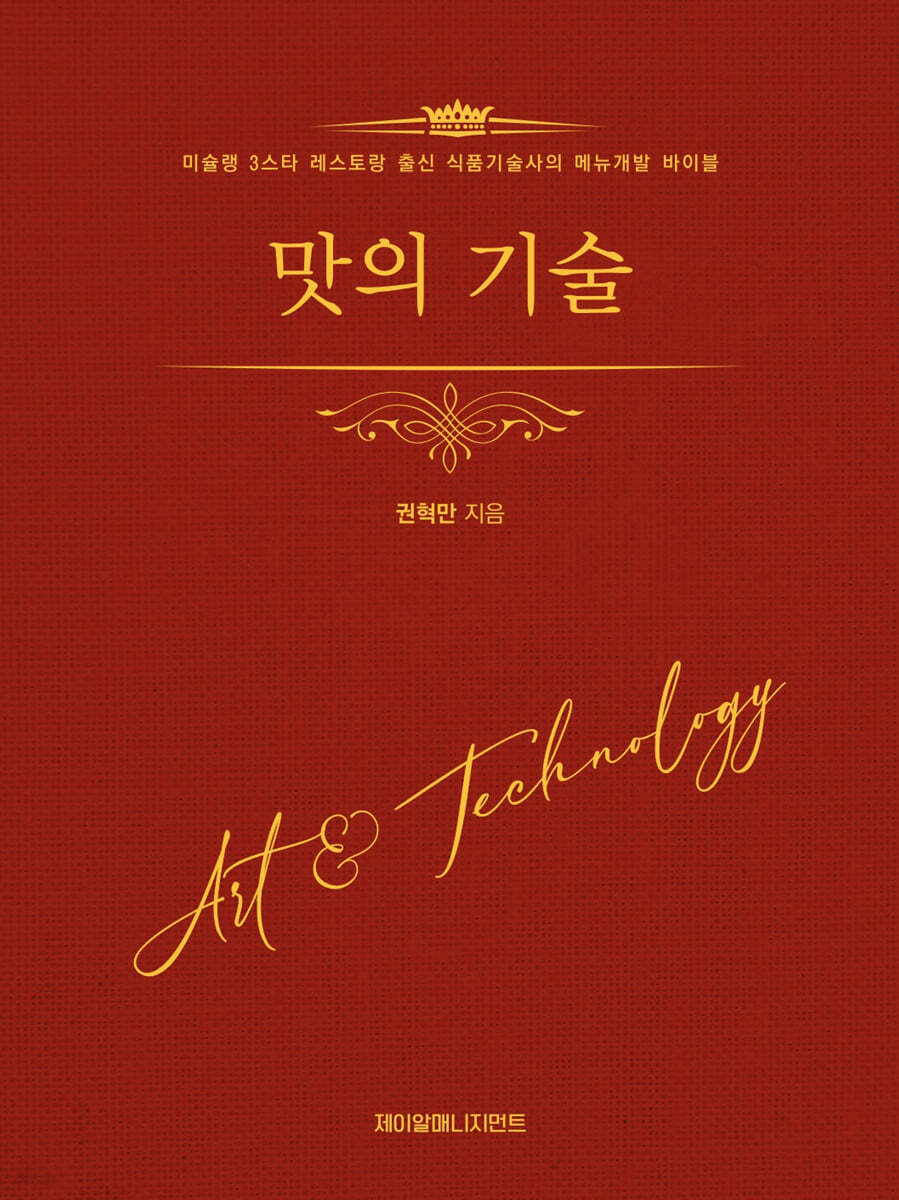
The Art of Taste
 |
Description
Book Introduction
“A cook-friendly and practical theory book”
Includes numerous food seasoning techniques, cooking principles, examples of culinary differentiation, and recipes.
〈The Art of Taste〉 is a cooking-friendly, low-barrier-to-entry theory book. It is designed for those who want to become chefs who can explain the “WHY” of taste, those who want to create a distinctive franchise brand (taste balance, differentiation, cost reduction, quality uniformity), and those who want to acquire the “art of taste” that enables application. It actively accepts opinions from non-majors as well as experts in each field of cooking and food, so that even ordinary people who do not major in cooking can understand it.
Includes numerous food seasoning techniques, cooking principles, examples of culinary differentiation, and recipes.
〈The Art of Taste〉 is a cooking-friendly, low-barrier-to-entry theory book. It is designed for those who want to become chefs who can explain the “WHY” of taste, those who want to create a distinctive franchise brand (taste balance, differentiation, cost reduction, quality uniformity), and those who want to acquire the “art of taste” that enables application. It actively accepts opinions from non-majors as well as experts in each field of cooking and food, so that even ordinary people who do not major in cooking can understand it.
- You can preview some of the book's contents.
Preview
index
Chapter 1: Taste Like a Pro
-How do food company researchers taste?
Chapter 2: Harnessing Umami
-Umami, uses beyond what is known
Chapter 3: Supporting Umami
-How does 5mi improve the taste of food?
Chapter 4: The Relativity of Umami: Culinary Differentiation Strategies
-To go beyond just delicious food to amazing food
Chapter 5: Taste and Aroma Release Patterns
-Secrets to raising the level of culinary differentiation
Chapter 6: The Relationship Between Ingredients and Delicious Dishes
-Are fresh ingredients the best ingredients?
Chapter 7: Enlightenment: The Adoption of Food Technology
-Cooking application of food knowledge
In conclusion: Between technology and mind
-Narrow the gap
-How do food company researchers taste?
Chapter 2: Harnessing Umami
-Umami, uses beyond what is known
Chapter 3: Supporting Umami
-How does 5mi improve the taste of food?
Chapter 4: The Relativity of Umami: Culinary Differentiation Strategies
-To go beyond just delicious food to amazing food
Chapter 5: Taste and Aroma Release Patterns
-Secrets to raising the level of culinary differentiation
Chapter 6: The Relationship Between Ingredients and Delicious Dishes
-Are fresh ingredients the best ingredients?
Chapter 7: Enlightenment: The Adoption of Food Technology
-Cooking application of food knowledge
In conclusion: Between technology and mind
-Narrow the gap
Detailed image

Into the book
“We often mistake flavor for aroma and aroma for taste.”
1. Distinguishing between taste and aroma
To taste well, you must taste well, and to taste well, you must first be able to distinguish between taste and aroma.
To create a dish that suits the purpose of development, it is necessary to consider the different chemical properties of taste and aroma.
The taste and aroma of food influence each other so much that it's easy to mistake them for one.
But even if you drink a glass of orange juice, rather than saying, “It tastes like orange,” a more accurate and professional sensory description would be, “I can taste sweetness, tartness, and orange aroma.”
There are only five flavors, and there is no such thing as 'orange flavor'.
All flavor aspects other than the five flavors come from aroma.
There are times when the problem of taste must be solved with aroma, and vice versa, the problem of aroma must be solved with taste. Since taste dissolves well in water and aroma dissolves well in oil, and although they have different characteristics, they are complementary in making delicious dishes, so we need to practice feeling the sense that we have so far perceived as a single integrated 'flavor' by dividing it into taste and aroma.
There is no such thing as the so-called 'beef taste'.
There is only a beefy flavor in the taste, such as sweetness and savory.
To date, only five tastes have been officially recognized: salty, sweet, umami, sour, and bitter. The remaining sensory diversity is due to factors other than taste, such as smell, touch (texture, temperature, etc.), or sight or hearing.
The differences in taste between beef, chicken, pork, and lamb also come from their aroma.
The unique flavor of meat is dissolved in the fat, so it is said that if the fat was technically completely separated from the meat of each animal, it would be difficult to distinguish whether it was beef, chicken, or pork.
1. Distinguishing between taste and aroma
To taste well, you must taste well, and to taste well, you must first be able to distinguish between taste and aroma.
To create a dish that suits the purpose of development, it is necessary to consider the different chemical properties of taste and aroma.
The taste and aroma of food influence each other so much that it's easy to mistake them for one.
But even if you drink a glass of orange juice, rather than saying, “It tastes like orange,” a more accurate and professional sensory description would be, “I can taste sweetness, tartness, and orange aroma.”
There are only five flavors, and there is no such thing as 'orange flavor'.
All flavor aspects other than the five flavors come from aroma.
There are times when the problem of taste must be solved with aroma, and vice versa, the problem of aroma must be solved with taste. Since taste dissolves well in water and aroma dissolves well in oil, and although they have different characteristics, they are complementary in making delicious dishes, so we need to practice feeling the sense that we have so far perceived as a single integrated 'flavor' by dividing it into taste and aroma.
There is no such thing as the so-called 'beef taste'.
There is only a beefy flavor in the taste, such as sweetness and savory.
To date, only five tastes have been officially recognized: salty, sweet, umami, sour, and bitter. The remaining sensory diversity is due to factors other than taste, such as smell, touch (texture, temperature, etc.), or sight or hearing.
The differences in taste between beef, chicken, pork, and lamb also come from their aroma.
The unique flavor of meat is dissolved in the fat, so it is said that if the fat was technically completely separated from the meat of each animal, it would be difficult to distinguish whether it was beef, chicken, or pork.
---From the text
GOODS SPECIFICS
- Date of issue: August 1, 2023
- Page count, weight, size: 316 pages | 987g | 182*240*22mm
- ISBN13: 9791191730265
- ISBN10: 1191730263
You may also like
카테고리
korean


korean

![GQ KOREA Mark (Monthly): December [2025]](http://librairie.coreenne.fr/cdn/shop/files/8ef265dbbfbf186523ed75ba7319009d.jpg?v=1765340328&width=3840)


