

Our Child's Temperament-Tailored Parenting Manual
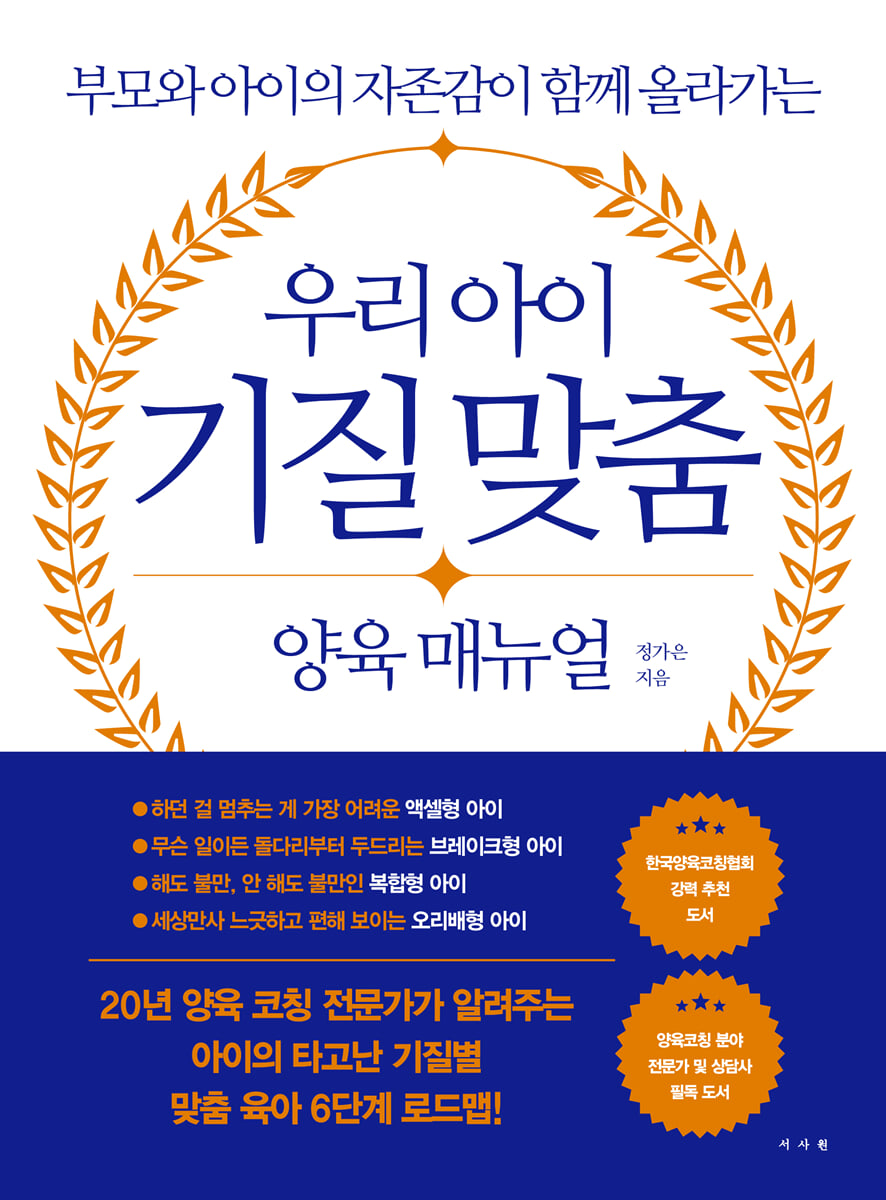 |
Description
Book Introduction
★ Based on the TCI temperament and personality test
The first parenting book that interprets the temperament of infants, toddlers, and children! ★
“Why is parenting so difficult for us?
“Why do things go wrong even though I love my child so much and raise him/her with so much effort?”
To you who are adrift in the sea of parenting,
Understand your child's innate temperament and grasp the beginning and end of parenting at a glance.
A parenting coaching expert with 20 years of experience helping you set the right goals and direction.
Introducing the '6-Step Parenting Roadmap Tailored to Your Child's Temperament'!
[Course 1] Checking the Current Parenting Status of Your Family
[Course 2] Developing a Parenting Strategy to Help You Reach Your Ultimate Parenting Destination
[Course 3] Understanding Your Child's Innate Temperament
[Course 4] Understanding what kind of parenting style I have
[Course 5] Healing emotional wounds through re-experiencing and truly understanding what kind of couple we are.
[Course 6] Establishing a New Parenting Model for Your Family That Makes Everyone Happier
The author of this book, "Our Child's Personalized Parenting Manual," says that each child is a unique seed, and that only by giving them the love that suits them can they bear the best fruit.
To this end, I emphasize that it is most important for parents to identify the starting and ending points of parenting and draw a comprehensive picture of how they will raise their children.
To do that, we need to properly understand what kind of child our child is, what kind of parent we are, and what kind of couple we are with our spouse.
That way, we can reach our family's destination without wavering.
For parents who have not yet found the right parenting method for their children and are lost and adrift in the sea of parenting, the author, a parenting coaching expert and therapist who majored in child psychology and has been counseling various families in psychiatry departments and counseling centers since 2003, wrote this book, “Our Child’s Temperament-Tailored Parenting Manual,” by putting together ① the knowledge learned while majoring in child psychology, ② the clinical skills developed through research and development based on the TCI, a temperament and personality test based on the psychobiological personality model of Claude Robert Cloninger, an American psychiatrist and geneticist, and ③ the know-how gained while raising three siblings.
This book is the first parenting book that interprets the temperament of infants and children based on the 'TCI Temperament and Personality Test', which scientifically measures and comprehensively evaluates a person's temperament and personality to broadly and precisely understand an individual's way of thinking, emotional patterns, behavioral patterns, interpersonal relationship patterns, and preference tendencies.
Through this, parents can systematically learn about the temperament of their child and the appropriate parenting style through the '6-step temperament-tailored parenting roadmap'.
Furthermore, I can understand how the parenting style I received from my parents affects my current parenting style as well as my relationship with my spouse, so I can raise my child in a way that both parents and children can improve their self-esteem.
Parenting is definitely difficult.
However, if I find a way to overcome the shortcomings and wounds within me while raising a child, parenting will return many treasures to me.
If you're wondering where to go with your family, why not embark on a journey into the world of parenting with this book, "My Child's Personalized Parenting Manual," written by a seasoned guide, mother of three, and parenting coach with 20 years of experience?
The first parenting book that interprets the temperament of infants, toddlers, and children! ★
“Why is parenting so difficult for us?
“Why do things go wrong even though I love my child so much and raise him/her with so much effort?”
To you who are adrift in the sea of parenting,
Understand your child's innate temperament and grasp the beginning and end of parenting at a glance.
A parenting coaching expert with 20 years of experience helping you set the right goals and direction.
Introducing the '6-Step Parenting Roadmap Tailored to Your Child's Temperament'!
[Course 1] Checking the Current Parenting Status of Your Family
[Course 2] Developing a Parenting Strategy to Help You Reach Your Ultimate Parenting Destination
[Course 3] Understanding Your Child's Innate Temperament
[Course 4] Understanding what kind of parenting style I have
[Course 5] Healing emotional wounds through re-experiencing and truly understanding what kind of couple we are.
[Course 6] Establishing a New Parenting Model for Your Family That Makes Everyone Happier
The author of this book, "Our Child's Personalized Parenting Manual," says that each child is a unique seed, and that only by giving them the love that suits them can they bear the best fruit.
To this end, I emphasize that it is most important for parents to identify the starting and ending points of parenting and draw a comprehensive picture of how they will raise their children.
To do that, we need to properly understand what kind of child our child is, what kind of parent we are, and what kind of couple we are with our spouse.
That way, we can reach our family's destination without wavering.
For parents who have not yet found the right parenting method for their children and are lost and adrift in the sea of parenting, the author, a parenting coaching expert and therapist who majored in child psychology and has been counseling various families in psychiatry departments and counseling centers since 2003, wrote this book, “Our Child’s Temperament-Tailored Parenting Manual,” by putting together ① the knowledge learned while majoring in child psychology, ② the clinical skills developed through research and development based on the TCI, a temperament and personality test based on the psychobiological personality model of Claude Robert Cloninger, an American psychiatrist and geneticist, and ③ the know-how gained while raising three siblings.
This book is the first parenting book that interprets the temperament of infants and children based on the 'TCI Temperament and Personality Test', which scientifically measures and comprehensively evaluates a person's temperament and personality to broadly and precisely understand an individual's way of thinking, emotional patterns, behavioral patterns, interpersonal relationship patterns, and preference tendencies.
Through this, parents can systematically learn about the temperament of their child and the appropriate parenting style through the '6-step temperament-tailored parenting roadmap'.
Furthermore, I can understand how the parenting style I received from my parents affects my current parenting style as well as my relationship with my spouse, so I can raise my child in a way that both parents and children can improve their self-esteem.
Parenting is definitely difficult.
However, if I find a way to overcome the shortcomings and wounds within me while raising a child, parenting will return many treasures to me.
If you're wondering where to go with your family, why not embark on a journey into the world of parenting with this book, "My Child's Personalized Parenting Manual," written by a seasoned guide, mother of three, and parenting coach with 20 years of experience?
- You can preview some of the book's contents.
Preview
index
Prologue _ To you who are adrift in the sea of parenting
Preview the 6-Step Roadmap for Tailored Parenting Based on Your Child's Innate Temperament
Part I.
Parenting, where did it go wrong?
[Course 1] Checking the current parenting status
Why is raising children so difficult?
The child in the best-selling child education book and my child are different children
Parenting is a complex and intertwined problem
The inheritance of deprivation and wounds
Becoming a parent without knowing what parenting is
Immature parents who grew up with their desires suppressed as children
The illusion of knowing my child well
Emotions that are difficult to endure while raising a child
The results of parenting that come after a long time
Why does it seem like there is no right answer when it comes to parenting?
The love parents want to give ≠ the love children want to receive
·What if the love parents give is not the love the child wants to receive?
The love parents want to give
·What makes a good parent?
·Where does parenting style come from?
The love a child wants to receive
·Children are like a blank sheet of paper?
The love parents want to give ≠ their actual parenting attitude
·What is my current parenting style?
·Why do I resemble my parents, whom I hated, now?
·Why does my upbringing influence my parenting style?
·What is the process of inheritance of personality and upbringing?
Why Parenting Seems Like There's No Right Answer
· A parenting environment that fails to find common ground
·What is ineffective parenting?
3 Checkpoints for Proper Parenting
Checkpoint One: What Kind of Child Will My Child Be?
Checkpoint two: What kind of parent am I?
Checkpoint 3: What kind of couple are we?
Part Ⅱ.
Follow the parenting roadmap
[Course 2] Developing a Parenting Strategy
Why do we need a strategy in parenting?
Introducing two parenting strategies!
Strategy 1: Give Your Child the Love He Wants
·Why do parents explode at their children?
·Don't waste money, time, and energy on useless things?
Strategy Two: Problem Solving for Your Child
·Is the goal of parenting to help children solve their own problems?
·Is the purpose of parenting to help children adjust to the limitations of their innate temperament?
Is there a different way to raise my child?
Why My Child Doesn't Listen to Me
My Child's Customized User Manual
Other people's parenting methods are ruining my child.
We propose a new roadmap for parenting!
Parenting Roadmap from [Course 1] to [Course 6]
The destination of parenting and the gifts you will receive along the journey to that destination
[Course 3] Knowing Your Child Well
The first step in parenting is understanding your child's temperament!
My child's temperament is not a choice, it's a lottery.
Children are born with their own unique seeds
Why Children Don't Bear Their Own Fruits
A fight between parents and children
Fruits that can help you check if your child is growing well
A special time to see the fruit my child is bearing
Are you saying that parenting methods should vary depending on the child's temperament?
Why Children with High Self-Esteem Produce Better Results
Here are two parenting strategies that work for your child!
Strategy 1: Accommodating Your Child's Temperamental Needs
·If I give in to all my child's needs, won't he grow up to be a spoiled child?
Strategy 2: Finding the Right Problem-Solving Method for Your Child
·Does your innate temperament have limitations in solving certain problems?
What is temperament?
Three temperament dimensions
The seed my child is carrying
·What are Excel functions?
·Each child has a different reason for pressing the accelerator?
·What is the brake function?
·Each child has a different reason for hitting the brakes?
·What is the emotional fuel tank function?
·Does each child have different emotional needs that they want to fill?
Parenting methods based on temperament type
Axel type child (accelerator↑brake↓): A child who always goes Go! Go!
·A child who has difficulty stopping
·The child becomes more excited the moment you say, “Don’t do that! No!”
A child who, once erupted like a volcano, could never be stopped
Two Parenting Strategies for Axel-Type Children
·Relationships, discipline, and education methods for children with a large emotional fuel tank
·Axle type + destination for children with large emotional fuel tanks
·Axel-type + emotional fuel tank small child's relationship, discipline, and education methods
·Axle type + emotional fuel tank is a destination for small children
Brake type child (accelerator↓brake↑): A child who stops for a moment!
·A child who has difficulty getting over the chin
·A child who feels resentful when asked, “What are you afraid of?”
·A child who becomes more and more stagnant when told, “If you’re scared, don’t do it.”
Two Parenting Strategies for a Break-Type Child
·Relationship, discipline, and education methods for children with a large emotional fuel tank and a brake type
· Brake type + destination for children with large emotional fuel tanks
·Brake type + emotional fuel tank small child relationship, discipline, and education method
· Brake type + emotional fuel tank is a destination for small children
Complex child (accelerator↑brake↑): A child whose brain is prone to accidents
·A child who is dissatisfied even if he does something, and dissatisfied even if he doesn't do something
Two Parenting Strategies for Complex Children
·Relationships, discipline, and education methods for complex + emotionally challenged children
·Destination for complex + emotionally fueled children
·Complex + Emotional Fuel Tank Relationships, Discipline, and Education Methods for Children with Small Abilities
·Complex + Emotional Fuel Tank is a destination for small children
Duck-shaped child (accelerator↓brake↓): A child who floats endlessly when left alone
A child who looks comfortable in the world
Two Parenting Strategies for a Duck-Pear-Shaped Child
·Relationships, discipline, and education methods for children with a duck-shaped body and a large emotional fuel tank
·Destination for children with a large emotional fuel tank and a duck-shaped body
·Duck boat type + relationship, discipline, and education methods for children with small emotional fuel tanks
·Duck boat shape + destination for children with small emotional fuel tanks
No matter what type of child you are, they are precious in and of themselves.
[Course 4] Knowing What Kind of Parent I Am
What kind of parent are you to your child?
What does my parenting look like?
What does my discipline look like?
What does acceptance of my emotions look like?
·Emotional reduction
·Emotionally suppressed type
·Emotionally tolerant
·Emotional coaching type
What does my parenting style look like?
·Permissive parenting (affection↑ control↓)
Authoritarian parenting (affection↓ control↑)
· Neglectful parenting (affection↓ control↓)
Democratic parenting (affection↑ control↑)
[Course 5] Understanding What Kind of Couple We Are
Where did things go wrong between us?
Aren't you hoping that the other person will solve your shortcomings and wounds?
Attachment is survival?
Does infant attachment lead to adult attachment?
· Preoccupied insecure attachment: self-denial, other-affirmation
·Dismissive avoidant attachment: self-affirmation, others-denial
·Disorganized insecure attachment: self-denial, denial of others
·Order-type secure attachment: self-affirmation, other-affirmation
Re-parenting, allowing each other to experience being new parents?
Is there a key to turning a cursed marriage into a blessing?
Part III.
Proposing a new parenting model for our family
[Course 6] Discovering Our Family's New Parenting Model
Experts offer customized parenting solutions!
Two Axes of Parenting
·A parenting method that burns down the house while trying to catch fleas
·What are the two aspects of control?
·What is balanced parenting?
What is good parenting?
·The process of the three little pigs building their own house
What is the role of a good parent?
What can be fixed and what can't be fixed
What to praise and what not to praise
What does it mean to raise a child with high self-esteem?
The course you must take to raise a child well
Let the child solve the child's problem.
Consistent parenting
Help your child adapt to the situation
Parenting should focus on the minus (-) rather than the plus (+).
Customized parenting that accepts and adjusts to your child's individuality
Rather than scolding them, you should manage their limitations and turn them into strengths.
Thinking of yourself as worthy of love
Experts offer customized training solutions!
What is discipline?
Wrong Discipline Motives vs. Right Discipline Motives
Long-term vs. immediate discipline
The Formula of Discipline
Two Ways to Get Your Child to Listen to You
Exploiting the 'bad' side of temperament vs. exploiting the 'good' side of temperament
The formula for cooperation that will help your child obey you.
Bad discipline that causes regression vs. good discipline that causes growth
Discipline focused on problem solving
Parenting is a long-term project
Experts offer customized parenting solutions!
I too was a child who wanted to receive love.
Solving parents' own problems
The wrong family dynamics must be stopped and readjusted.
Parenting should be done efficiently, and any remaining energy should be used for the parents themselves.
What if the parent-child relationship is a business relationship with commuting?
Parenting is a great career
It means bearing fruit 30, 60, and 100 times over.
Here & Now, a blessing for living today
Experts offer customized home solutions!
How to connect by straightening a crooked heart
How to Keep Your Family Connected in a Healthy Way
Our family's goal is to find the intersection of our family.
Our family is the best dream team
A New Roadmap for Parenting
Epilogue _ Wishing peace to all parents in the world
Preview the 6-Step Roadmap for Tailored Parenting Based on Your Child's Innate Temperament
Part I.
Parenting, where did it go wrong?
[Course 1] Checking the current parenting status
Why is raising children so difficult?
The child in the best-selling child education book and my child are different children
Parenting is a complex and intertwined problem
The inheritance of deprivation and wounds
Becoming a parent without knowing what parenting is
Immature parents who grew up with their desires suppressed as children
The illusion of knowing my child well
Emotions that are difficult to endure while raising a child
The results of parenting that come after a long time
Why does it seem like there is no right answer when it comes to parenting?
The love parents want to give ≠ the love children want to receive
·What if the love parents give is not the love the child wants to receive?
The love parents want to give
·What makes a good parent?
·Where does parenting style come from?
The love a child wants to receive
·Children are like a blank sheet of paper?
The love parents want to give ≠ their actual parenting attitude
·What is my current parenting style?
·Why do I resemble my parents, whom I hated, now?
·Why does my upbringing influence my parenting style?
·What is the process of inheritance of personality and upbringing?
Why Parenting Seems Like There's No Right Answer
· A parenting environment that fails to find common ground
·What is ineffective parenting?
3 Checkpoints for Proper Parenting
Checkpoint One: What Kind of Child Will My Child Be?
Checkpoint two: What kind of parent am I?
Checkpoint 3: What kind of couple are we?
Part Ⅱ.
Follow the parenting roadmap
[Course 2] Developing a Parenting Strategy
Why do we need a strategy in parenting?
Introducing two parenting strategies!
Strategy 1: Give Your Child the Love He Wants
·Why do parents explode at their children?
·Don't waste money, time, and energy on useless things?
Strategy Two: Problem Solving for Your Child
·Is the goal of parenting to help children solve their own problems?
·Is the purpose of parenting to help children adjust to the limitations of their innate temperament?
Is there a different way to raise my child?
Why My Child Doesn't Listen to Me
My Child's Customized User Manual
Other people's parenting methods are ruining my child.
We propose a new roadmap for parenting!
Parenting Roadmap from [Course 1] to [Course 6]
The destination of parenting and the gifts you will receive along the journey to that destination
[Course 3] Knowing Your Child Well
The first step in parenting is understanding your child's temperament!
My child's temperament is not a choice, it's a lottery.
Children are born with their own unique seeds
Why Children Don't Bear Their Own Fruits
A fight between parents and children
Fruits that can help you check if your child is growing well
A special time to see the fruit my child is bearing
Are you saying that parenting methods should vary depending on the child's temperament?
Why Children with High Self-Esteem Produce Better Results
Here are two parenting strategies that work for your child!
Strategy 1: Accommodating Your Child's Temperamental Needs
·If I give in to all my child's needs, won't he grow up to be a spoiled child?
Strategy 2: Finding the Right Problem-Solving Method for Your Child
·Does your innate temperament have limitations in solving certain problems?
What is temperament?
Three temperament dimensions
The seed my child is carrying
·What are Excel functions?
·Each child has a different reason for pressing the accelerator?
·What is the brake function?
·Each child has a different reason for hitting the brakes?
·What is the emotional fuel tank function?
·Does each child have different emotional needs that they want to fill?
Parenting methods based on temperament type
Axel type child (accelerator↑brake↓): A child who always goes Go! Go!
·A child who has difficulty stopping
·The child becomes more excited the moment you say, “Don’t do that! No!”
A child who, once erupted like a volcano, could never be stopped
Two Parenting Strategies for Axel-Type Children
·Relationships, discipline, and education methods for children with a large emotional fuel tank
·Axle type + destination for children with large emotional fuel tanks
·Axel-type + emotional fuel tank small child's relationship, discipline, and education methods
·Axle type + emotional fuel tank is a destination for small children
Brake type child (accelerator↓brake↑): A child who stops for a moment!
·A child who has difficulty getting over the chin
·A child who feels resentful when asked, “What are you afraid of?”
·A child who becomes more and more stagnant when told, “If you’re scared, don’t do it.”
Two Parenting Strategies for a Break-Type Child
·Relationship, discipline, and education methods for children with a large emotional fuel tank and a brake type
· Brake type + destination for children with large emotional fuel tanks
·Brake type + emotional fuel tank small child relationship, discipline, and education method
· Brake type + emotional fuel tank is a destination for small children
Complex child (accelerator↑brake↑): A child whose brain is prone to accidents
·A child who is dissatisfied even if he does something, and dissatisfied even if he doesn't do something
Two Parenting Strategies for Complex Children
·Relationships, discipline, and education methods for complex + emotionally challenged children
·Destination for complex + emotionally fueled children
·Complex + Emotional Fuel Tank Relationships, Discipline, and Education Methods for Children with Small Abilities
·Complex + Emotional Fuel Tank is a destination for small children
Duck-shaped child (accelerator↓brake↓): A child who floats endlessly when left alone
A child who looks comfortable in the world
Two Parenting Strategies for a Duck-Pear-Shaped Child
·Relationships, discipline, and education methods for children with a duck-shaped body and a large emotional fuel tank
·Destination for children with a large emotional fuel tank and a duck-shaped body
·Duck boat type + relationship, discipline, and education methods for children with small emotional fuel tanks
·Duck boat shape + destination for children with small emotional fuel tanks
No matter what type of child you are, they are precious in and of themselves.
[Course 4] Knowing What Kind of Parent I Am
What kind of parent are you to your child?
What does my parenting look like?
What does my discipline look like?
What does acceptance of my emotions look like?
·Emotional reduction
·Emotionally suppressed type
·Emotionally tolerant
·Emotional coaching type
What does my parenting style look like?
·Permissive parenting (affection↑ control↓)
Authoritarian parenting (affection↓ control↑)
· Neglectful parenting (affection↓ control↓)
Democratic parenting (affection↑ control↑)
[Course 5] Understanding What Kind of Couple We Are
Where did things go wrong between us?
Aren't you hoping that the other person will solve your shortcomings and wounds?
Attachment is survival?
Does infant attachment lead to adult attachment?
· Preoccupied insecure attachment: self-denial, other-affirmation
·Dismissive avoidant attachment: self-affirmation, others-denial
·Disorganized insecure attachment: self-denial, denial of others
·Order-type secure attachment: self-affirmation, other-affirmation
Re-parenting, allowing each other to experience being new parents?
Is there a key to turning a cursed marriage into a blessing?
Part III.
Proposing a new parenting model for our family
[Course 6] Discovering Our Family's New Parenting Model
Experts offer customized parenting solutions!
Two Axes of Parenting
·A parenting method that burns down the house while trying to catch fleas
·What are the two aspects of control?
·What is balanced parenting?
What is good parenting?
·The process of the three little pigs building their own house
What is the role of a good parent?
What can be fixed and what can't be fixed
What to praise and what not to praise
What does it mean to raise a child with high self-esteem?
The course you must take to raise a child well
Let the child solve the child's problem.
Consistent parenting
Help your child adapt to the situation
Parenting should focus on the minus (-) rather than the plus (+).
Customized parenting that accepts and adjusts to your child's individuality
Rather than scolding them, you should manage their limitations and turn them into strengths.
Thinking of yourself as worthy of love
Experts offer customized training solutions!
What is discipline?
Wrong Discipline Motives vs. Right Discipline Motives
Long-term vs. immediate discipline
The Formula of Discipline
Two Ways to Get Your Child to Listen to You
Exploiting the 'bad' side of temperament vs. exploiting the 'good' side of temperament
The formula for cooperation that will help your child obey you.
Bad discipline that causes regression vs. good discipline that causes growth
Discipline focused on problem solving
Parenting is a long-term project
Experts offer customized parenting solutions!
I too was a child who wanted to receive love.
Solving parents' own problems
The wrong family dynamics must be stopped and readjusted.
Parenting should be done efficiently, and any remaining energy should be used for the parents themselves.
What if the parent-child relationship is a business relationship with commuting?
Parenting is a great career
It means bearing fruit 30, 60, and 100 times over.
Here & Now, a blessing for living today
Experts offer customized home solutions!
How to connect by straightening a crooked heart
How to Keep Your Family Connected in a Healthy Way
Our family's goal is to find the intersection of our family.
Our family is the best dream team
A New Roadmap for Parenting
Epilogue _ Wishing peace to all parents in the world
Detailed image
.jpg)
Into the book
While the specific methods of raising a child, such as discipline and education, are important, the first thing to do is to draw a big picture of how to raise a child and know the starting point and end point of parenting.
Detailed methods should be included here.
If we know what kind of child our child is, what kind of parent we are, and what kind of couple we are, wouldn't we be able to set our own family's destination and move toward that destination without wavering?
Now, I am waiting for those who will walk this path with me, holding the guiding flag, like a guide, so that both parents and children can walk along the roadmap of happy parenting.
When building a building, the first thing you do is draw up a blueprint. Even when ordering food, you think about what you'll eat beforehand and then order.
But if I've never drawn a roadmap for where and how parenting, which involves my child's life and my life as a parent, should go, is that really okay?_p.7
The final checkpoint we need to check is, 'What kind of couple are we?'
A child is born with half of his genes from his father and half from his mother.
There may be circumstances where parents and children cannot live together, but even in such cases, parents must tell their children that they are our children born of love, so that they can grow up with firm roots in the world.
The love that parents hold tightly to each other is the best soil for a child to take root. However, if parents do not provide soil for their child to take root just because their relationship is strained, it is a failure of parental duty.
Especially, even if the couple does not get along well, it is not good to badmouth or criticize your spouse to your child.
This is like telling a child, “Your other half sucks!”
---p.56
We've taken the first step toward finding a new parenting model that's right for our family.
The first course we arrived at was a part that checked my current parenting status.
We looked at the love parents want to give their children, the love children want to receive from their parents, and the actual parenting attitudes, and looked at why parenting is difficult in our families.
In Course 2, I learned that parenting also requires strategy.
Now we will set out to find the right parenting destination for our family.
In Course 3, we will find out what kind of child I have, in Course 4, we will find out what kind of parent I am to my child, and in Course 5, we will find out what kind of couple we are.
And in the final 6th course, we will find the parenting style that suits our family and develop our own parenting strategy.
---p.69
Rather, in times like these, we need to help each other and maturely navigate this process.
Because we are not that kid anymore.
We must bring out the inner child who has not yet grown into an adult and is crying due to the wounds and deprivations he received from his parents and help him grow.
That way, I can raise my child well as an adult.
But if a couple still hasn't resolved these issues, it's like a young boy and girl meeting and raising a child.
This is the soil where my child's seed cannot take root and grow safely.
Can a child take responsibility for someone else's life? We need to break free from the comforting thought that we still have a childlike innocence within us and become true adults who can guide our children's lives.
To do this, couples need to bring out each other's inner child and help them grow into adults.
From now on, we will explore how couples can help each other heal their shortcomings and wounds so that they can grow into mature adults.
---pp.249~250
Parenting is a long-term project.
Parents don't need to be overly excited or depressed about their child's behavior right now.
Even if you've thought about what to do when a problem arises and promised to do it this way next time, and your child still hasn't finished his homework on time or thrown another toy at his friend, it doesn't mean that your parental discipline has failed.
We will continue to be patient, teaching our children, encouraging them to make better choices, and growing together.
There's no need to be discouraged if your child makes a bad choice today, because our goal is to help them choose better values.
Imagine your child growing into a strong, vibrant, green tree.
Imagine becoming a beautiful tree with deep roots, strong trunk and branches, and abundant edible fruit, a noble tree that has a positive influence not only on yourself but also on others.
Looking at the child's current behavior, it may seem like that would be impossible, but that is not the case.
Because every single child is precious and unique.
Every child's seed contains its own unique treasure, the most shining of all.
Some people make good use of this and live brilliantly, while others hate themselves and cannot use this treasure.
This treasure is none other than ‘your true self.’
If we each demonstrate our true selves, we can each bear beautiful fruit.
Detailed methods should be included here.
If we know what kind of child our child is, what kind of parent we are, and what kind of couple we are, wouldn't we be able to set our own family's destination and move toward that destination without wavering?
Now, I am waiting for those who will walk this path with me, holding the guiding flag, like a guide, so that both parents and children can walk along the roadmap of happy parenting.
When building a building, the first thing you do is draw up a blueprint. Even when ordering food, you think about what you'll eat beforehand and then order.
But if I've never drawn a roadmap for where and how parenting, which involves my child's life and my life as a parent, should go, is that really okay?_p.7
The final checkpoint we need to check is, 'What kind of couple are we?'
A child is born with half of his genes from his father and half from his mother.
There may be circumstances where parents and children cannot live together, but even in such cases, parents must tell their children that they are our children born of love, so that they can grow up with firm roots in the world.
The love that parents hold tightly to each other is the best soil for a child to take root. However, if parents do not provide soil for their child to take root just because their relationship is strained, it is a failure of parental duty.
Especially, even if the couple does not get along well, it is not good to badmouth or criticize your spouse to your child.
This is like telling a child, “Your other half sucks!”
---p.56
We've taken the first step toward finding a new parenting model that's right for our family.
The first course we arrived at was a part that checked my current parenting status.
We looked at the love parents want to give their children, the love children want to receive from their parents, and the actual parenting attitudes, and looked at why parenting is difficult in our families.
In Course 2, I learned that parenting also requires strategy.
Now we will set out to find the right parenting destination for our family.
In Course 3, we will find out what kind of child I have, in Course 4, we will find out what kind of parent I am to my child, and in Course 5, we will find out what kind of couple we are.
And in the final 6th course, we will find the parenting style that suits our family and develop our own parenting strategy.
---p.69
Rather, in times like these, we need to help each other and maturely navigate this process.
Because we are not that kid anymore.
We must bring out the inner child who has not yet grown into an adult and is crying due to the wounds and deprivations he received from his parents and help him grow.
That way, I can raise my child well as an adult.
But if a couple still hasn't resolved these issues, it's like a young boy and girl meeting and raising a child.
This is the soil where my child's seed cannot take root and grow safely.
Can a child take responsibility for someone else's life? We need to break free from the comforting thought that we still have a childlike innocence within us and become true adults who can guide our children's lives.
To do this, couples need to bring out each other's inner child and help them grow into adults.
From now on, we will explore how couples can help each other heal their shortcomings and wounds so that they can grow into mature adults.
---pp.249~250
Parenting is a long-term project.
Parents don't need to be overly excited or depressed about their child's behavior right now.
Even if you've thought about what to do when a problem arises and promised to do it this way next time, and your child still hasn't finished his homework on time or thrown another toy at his friend, it doesn't mean that your parental discipline has failed.
We will continue to be patient, teaching our children, encouraging them to make better choices, and growing together.
There's no need to be discouraged if your child makes a bad choice today, because our goal is to help them choose better values.
Imagine your child growing into a strong, vibrant, green tree.
Imagine becoming a beautiful tree with deep roots, strong trunk and branches, and abundant edible fruit, a noble tree that has a positive influence not only on yourself but also on others.
Looking at the child's current behavior, it may seem like that would be impossible, but that is not the case.
Because every single child is precious and unique.
Every child's seed contains its own unique treasure, the most shining of all.
Some people make good use of this and live brilliantly, while others hate themselves and cannot use this treasure.
This treasure is none other than ‘your true self.’
If we each demonstrate our true selves, we can each bear beautiful fruit.
---p.250
Publisher's Review
From a family that is in a state of ecstasy to a fantastic family, changing the vicious cycle of inherited parenting into a virtuous cycle,
A personalized healing project for our family from a parenting coaching expert who has healed hundreds of families for over 20 years!
[Course 1] Let’s check the current parenting status of our family.
Why is parenting so difficult and challenging? No matter how hard you try to raise your child well, as they grow up, there are more and more instances where they don't live up to your expectations.
The more this happens, the more parents try to apply parenting methods from best-selling parenting books or TV programs to their children, but this only makes their relationship with their children worse.
Why is that? Because my child is different from that child.
Additionally, the fact that each family has different factors, including the parents' own factors and environmental factors, makes it seem like there is no right answer to parenting.
The author argues that because each child has a different innate temperament and each family has different situational factors, the way to raise children should also be different for each family.
So, I emphasize that when parents set parenting goals, they must first check the current parenting status of their family.
If parents are wasting their energy raising their children in a way that is not right for them, it is just wasting time inefficiently for both parents and children.
Being a personalized parent to your child starts with knowing yourself, your spouse, and your child well.
If you follow the six steps in this book, "My Child's Temperament-Tailored Parenting Manual," you will be able to figure out what kind of temperament your child has, what kind of parenting style you have, and what kind of couple you are to each other, and draw a parenting roadmap that will lead you to the right destination.
[Course 2] Let's develop a parenting strategy to help you reach your final destination in parenting.
Why do we need a parenting strategy? First, there's something every parent should know.
The point is that parental love is also a ‘limited’ resource.
To ensure that both parents and children live well with limited resources, an effective strategy is necessary to continue moving toward the goal and ultimately reach the destination.
Moreover, this time must be valuable to me as a parent so that I can continue to do it without giving up.
This book, "Our Child's Temperament-Tailored Parenting Manual," introduces two strategies to parents to help them create an effective parenting plan.
The first strategy is to give your child the love he or she wants from you, and the second strategy is to find a problem-solving method that suits your child's temperament and help him or her in an appropriate way.
The reason this strategy is necessary is because there are limitations to the temperament.
These are problems that children cannot solve because they are not yet able to control their temperament on their own.
As parents, we must help our children solve these problems on their own.
As a parenting coach and child psychotherapist with 20 years of experience, I believe the ultimate goal of parenting is to understand what kind of child you are, what kind of parent you are, and how your family can become a perfect dream team.
With this book, children will receive the love that best suits them and build their lives well. Parents, too, will be able to steadily progress on the path to becoming more mature by healing their own inner deficiencies and wounds while raising their children.
[Course 3] How can I properly find out what my child's innate temperament is?
My child's temperament is not a choice, it's a lottery.
It's not something your parents can decide.
That is, if I win an apple seed, an apple will grow, and if I win an olive seed, an olive will grow.
But what if I were to give the olive seed the nutrients it needs, hoping it would bear olives, but instead, I were to give the apple seed the nutrients it needs? The apple seed wouldn't grow into a fruitful apple tree.
Parenting is the same.
If parents give their children the love they want to give rather than the love their children want to receive, the child's temperament will be suppressed and they will not be able to grow up properly.
This book, “Our Child’s Temperament-Tailored Parenting Manual,” divides children’s temperaments into four types (① Acceler Type ② Brake Type ③ Complex Type ④ Duck Pear Type) based on the TCI (Temperament and Character Inventory), a temperament and personality test based on the psychobiological personality model of American geneticist Claude Robert Cloninger, and a model researched and developed by the [Korea Parenting Coaching Association] and [Mom & Mom Coaching Center].
Here, the love a child wants to receive is expressed as an 'emotional fuel tank', and depending on whether this emotional fuel tank is big or small, the child's temperament is explained in 8 cases (① Accelerator type + large emotional fuel tank ② Accelerator type + small emotional fuel tank ③ Brake type + large emotional fuel tank ④ Brake type + small emotional fuel tank ⑤ Complex type + large emotional fuel tank ⑥ Complex type + small emotional fuel tank ⑦ Duck pear type + large emotional fuel tank ⑧ Duck pear type + small emotional fuel tank).
For each temperament, the author provides specific guidance on how to educate and discipline children based on actual cases he has personally counseled. This will allow parents to properly raise their children by accommodating their child's needs and providing appropriate problem-solving methods tailored to their innate temperament.
[Course 4] Let's figure out what kind of parenting style I have.
It is very likely that my current parenting style was influenced by the parenting style I received from my parents.
Therefore, if you have received a lot of wounds and deficiencies from your parents, it is not easy to improve your parenting style through your own efforts alone.
Even though I don't want to pass on the pain and shortcomings I experienced to my children, they become ingrained in me and without me knowing, the behavior my parents did to me comes out to my children.
If you haven't thought about how you're raising your child yet, I hope this book, "My Child's Temperament-Tailored Parenting Manual," will give you an opportunity to reflect on your current parenting and discipline attitudes, your acceptance of emotions, and other factors, and think about what kind of parent you are to your child.
Only then can I become a parent who gives my child the love that is right for him or her.
To this end, the author introduces four types of parents (① Emotional Reduction, ② Emotional Suppression, ③ Emotional Allowance, ④ Emotional Coaching) who react to their child's emotional situation and four types of parenting (① Permissive Parenting, ② Authoritarian Parenting, ③ Neglectful Parenting, ④ Democratic Parenting) and recommends that parents examine what type of emotional acceptance and parenting style they exhibit.
Even if you were an immature parent who had been raising your child in a way that didn't suit your child, I am confident that with this book, "My Child's Temperament-Tailored Parenting Manual," even complex problems that were so tangled that you didn't know where to start will magically become a part of your daily life.
[Course 5] Let's heal our emotional wounds through re-experiencing and examine what kind of couple we are.
People who get married because they think, “I can’t live without you!” but end up breaking up because they think, “I can’t live because of you!” are called couples.
It's surprising how things that we didn't know about while dating are updated without notice once we start living together after marriage, and when we have a child, even the emotions we've been ignoring are revealed in a stark way.
Then, the spouse is shocked to see something he has never seen before.
I feel burdened because I feel like I'm relying too much on myself, and I'm upset because I don't understand and care for myself.
The parenting style I received from my parents has a great influence on my current parenting style as a parent, but it also has a great influence on my relationship with my spouse.
Infant attachment leads to adult attachment.
The author says that even adults can improve significantly if they form a stable attachment through 'marriage' from now on.
Re-parenting is a second chance for couples to experience new care and affection for each other, thereby healing their emotional wounds and deficiencies and growing more personally.
If we fail to properly utilize this, the vicious cycle of parenting will be passed down, so we must change this so that parenting can return to a virtuous cycle.
Through this book, “Our Child’s Temperament-Tailored Parenting Manual,” you will be able to face your true feelings hidden beneath the fake emotions, create a healthy attachment once again, and become a true couple and parents who can provide a stable attachment to your child.
[Course 6] Let's create a new parenting model for our family that makes everyone happy.
Have you successfully followed the parenting roadmap guided by a parenting coaching expert up to [Course 5]? Congratulations! You're now ready to create a new parenting model for your family that will bring happiness to everyone.
To this end, this book, “Our Child’s Temperament-Tailored Parenting Manual,” contains the author’s four suggestions: ① Tailored Parenting Solutions, ② Tailored Discipline Solutions, ③ Tailored Parent Solutions, and ④ Tailored Family Solutions.
"Custom Parenting Solutions" introduces what good parenting is and how to do it through various examples, and "Custom Discipline Solutions" compares incorrect and correct discipline and provides specific methods for correct discipline that focus on long-term problem solving.
'Custom Parenting Solutions' tells you how to make raising children the best part of your career, not a break in your career, and 'Custom Family Solutions' tells you how to straighten out the hearts of each family member who has been crooked so far and connect the whole family healthily. We recommend ways for our family to straighten out the hearts that have been crooked so far and connect the whole family healthily.
If you successfully complete the grand journey of the parenting roadmap, the final [Course 6], with a parenting coaching expert, I am confident that you will be able to draw your own life roadmap, and your child will be able to draw his or her own life roadmap, which will boost both your self-esteem and your child's self-esteem.
A personalized healing project for our family from a parenting coaching expert who has healed hundreds of families for over 20 years!
[Course 1] Let’s check the current parenting status of our family.
Why is parenting so difficult and challenging? No matter how hard you try to raise your child well, as they grow up, there are more and more instances where they don't live up to your expectations.
The more this happens, the more parents try to apply parenting methods from best-selling parenting books or TV programs to their children, but this only makes their relationship with their children worse.
Why is that? Because my child is different from that child.
Additionally, the fact that each family has different factors, including the parents' own factors and environmental factors, makes it seem like there is no right answer to parenting.
The author argues that because each child has a different innate temperament and each family has different situational factors, the way to raise children should also be different for each family.
So, I emphasize that when parents set parenting goals, they must first check the current parenting status of their family.
If parents are wasting their energy raising their children in a way that is not right for them, it is just wasting time inefficiently for both parents and children.
Being a personalized parent to your child starts with knowing yourself, your spouse, and your child well.
If you follow the six steps in this book, "My Child's Temperament-Tailored Parenting Manual," you will be able to figure out what kind of temperament your child has, what kind of parenting style you have, and what kind of couple you are to each other, and draw a parenting roadmap that will lead you to the right destination.
[Course 2] Let's develop a parenting strategy to help you reach your final destination in parenting.
Why do we need a parenting strategy? First, there's something every parent should know.
The point is that parental love is also a ‘limited’ resource.
To ensure that both parents and children live well with limited resources, an effective strategy is necessary to continue moving toward the goal and ultimately reach the destination.
Moreover, this time must be valuable to me as a parent so that I can continue to do it without giving up.
This book, "Our Child's Temperament-Tailored Parenting Manual," introduces two strategies to parents to help them create an effective parenting plan.
The first strategy is to give your child the love he or she wants from you, and the second strategy is to find a problem-solving method that suits your child's temperament and help him or her in an appropriate way.
The reason this strategy is necessary is because there are limitations to the temperament.
These are problems that children cannot solve because they are not yet able to control their temperament on their own.
As parents, we must help our children solve these problems on their own.
As a parenting coach and child psychotherapist with 20 years of experience, I believe the ultimate goal of parenting is to understand what kind of child you are, what kind of parent you are, and how your family can become a perfect dream team.
With this book, children will receive the love that best suits them and build their lives well. Parents, too, will be able to steadily progress on the path to becoming more mature by healing their own inner deficiencies and wounds while raising their children.
[Course 3] How can I properly find out what my child's innate temperament is?
My child's temperament is not a choice, it's a lottery.
It's not something your parents can decide.
That is, if I win an apple seed, an apple will grow, and if I win an olive seed, an olive will grow.
But what if I were to give the olive seed the nutrients it needs, hoping it would bear olives, but instead, I were to give the apple seed the nutrients it needs? The apple seed wouldn't grow into a fruitful apple tree.
Parenting is the same.
If parents give their children the love they want to give rather than the love their children want to receive, the child's temperament will be suppressed and they will not be able to grow up properly.
This book, “Our Child’s Temperament-Tailored Parenting Manual,” divides children’s temperaments into four types (① Acceler Type ② Brake Type ③ Complex Type ④ Duck Pear Type) based on the TCI (Temperament and Character Inventory), a temperament and personality test based on the psychobiological personality model of American geneticist Claude Robert Cloninger, and a model researched and developed by the [Korea Parenting Coaching Association] and [Mom & Mom Coaching Center].
Here, the love a child wants to receive is expressed as an 'emotional fuel tank', and depending on whether this emotional fuel tank is big or small, the child's temperament is explained in 8 cases (① Accelerator type + large emotional fuel tank ② Accelerator type + small emotional fuel tank ③ Brake type + large emotional fuel tank ④ Brake type + small emotional fuel tank ⑤ Complex type + large emotional fuel tank ⑥ Complex type + small emotional fuel tank ⑦ Duck pear type + large emotional fuel tank ⑧ Duck pear type + small emotional fuel tank).
For each temperament, the author provides specific guidance on how to educate and discipline children based on actual cases he has personally counseled. This will allow parents to properly raise their children by accommodating their child's needs and providing appropriate problem-solving methods tailored to their innate temperament.
[Course 4] Let's figure out what kind of parenting style I have.
It is very likely that my current parenting style was influenced by the parenting style I received from my parents.
Therefore, if you have received a lot of wounds and deficiencies from your parents, it is not easy to improve your parenting style through your own efforts alone.
Even though I don't want to pass on the pain and shortcomings I experienced to my children, they become ingrained in me and without me knowing, the behavior my parents did to me comes out to my children.
If you haven't thought about how you're raising your child yet, I hope this book, "My Child's Temperament-Tailored Parenting Manual," will give you an opportunity to reflect on your current parenting and discipline attitudes, your acceptance of emotions, and other factors, and think about what kind of parent you are to your child.
Only then can I become a parent who gives my child the love that is right for him or her.
To this end, the author introduces four types of parents (① Emotional Reduction, ② Emotional Suppression, ③ Emotional Allowance, ④ Emotional Coaching) who react to their child's emotional situation and four types of parenting (① Permissive Parenting, ② Authoritarian Parenting, ③ Neglectful Parenting, ④ Democratic Parenting) and recommends that parents examine what type of emotional acceptance and parenting style they exhibit.
Even if you were an immature parent who had been raising your child in a way that didn't suit your child, I am confident that with this book, "My Child's Temperament-Tailored Parenting Manual," even complex problems that were so tangled that you didn't know where to start will magically become a part of your daily life.
[Course 5] Let's heal our emotional wounds through re-experiencing and examine what kind of couple we are.
People who get married because they think, “I can’t live without you!” but end up breaking up because they think, “I can’t live because of you!” are called couples.
It's surprising how things that we didn't know about while dating are updated without notice once we start living together after marriage, and when we have a child, even the emotions we've been ignoring are revealed in a stark way.
Then, the spouse is shocked to see something he has never seen before.
I feel burdened because I feel like I'm relying too much on myself, and I'm upset because I don't understand and care for myself.
The parenting style I received from my parents has a great influence on my current parenting style as a parent, but it also has a great influence on my relationship with my spouse.
Infant attachment leads to adult attachment.
The author says that even adults can improve significantly if they form a stable attachment through 'marriage' from now on.
Re-parenting is a second chance for couples to experience new care and affection for each other, thereby healing their emotional wounds and deficiencies and growing more personally.
If we fail to properly utilize this, the vicious cycle of parenting will be passed down, so we must change this so that parenting can return to a virtuous cycle.
Through this book, “Our Child’s Temperament-Tailored Parenting Manual,” you will be able to face your true feelings hidden beneath the fake emotions, create a healthy attachment once again, and become a true couple and parents who can provide a stable attachment to your child.
[Course 6] Let's create a new parenting model for our family that makes everyone happy.
Have you successfully followed the parenting roadmap guided by a parenting coaching expert up to [Course 5]? Congratulations! You're now ready to create a new parenting model for your family that will bring happiness to everyone.
To this end, this book, “Our Child’s Temperament-Tailored Parenting Manual,” contains the author’s four suggestions: ① Tailored Parenting Solutions, ② Tailored Discipline Solutions, ③ Tailored Parent Solutions, and ④ Tailored Family Solutions.
"Custom Parenting Solutions" introduces what good parenting is and how to do it through various examples, and "Custom Discipline Solutions" compares incorrect and correct discipline and provides specific methods for correct discipline that focus on long-term problem solving.
'Custom Parenting Solutions' tells you how to make raising children the best part of your career, not a break in your career, and 'Custom Family Solutions' tells you how to straighten out the hearts of each family member who has been crooked so far and connect the whole family healthily. We recommend ways for our family to straighten out the hearts that have been crooked so far and connect the whole family healthily.
If you successfully complete the grand journey of the parenting roadmap, the final [Course 6], with a parenting coaching expert, I am confident that you will be able to draw your own life roadmap, and your child will be able to draw his or her own life roadmap, which will boost both your self-esteem and your child's self-esteem.
GOODS SPECIFICS
- Date of issue: January 5, 2023
- Page count, weight, size: 300 pages | 508g | 170*230*18mm
- ISBN13: 9791168221277
- ISBN10: 1168221277
You may also like
카테고리
korean


korean

![ELLE 엘르 스페셜 에디션 A형 : 12월 [2025]](http://librairie.coreenne.fr/cdn/shop/files/b8e27a3de6c9538896439686c6b0e8fb.jpg?v=1766436872&width=3840)


