

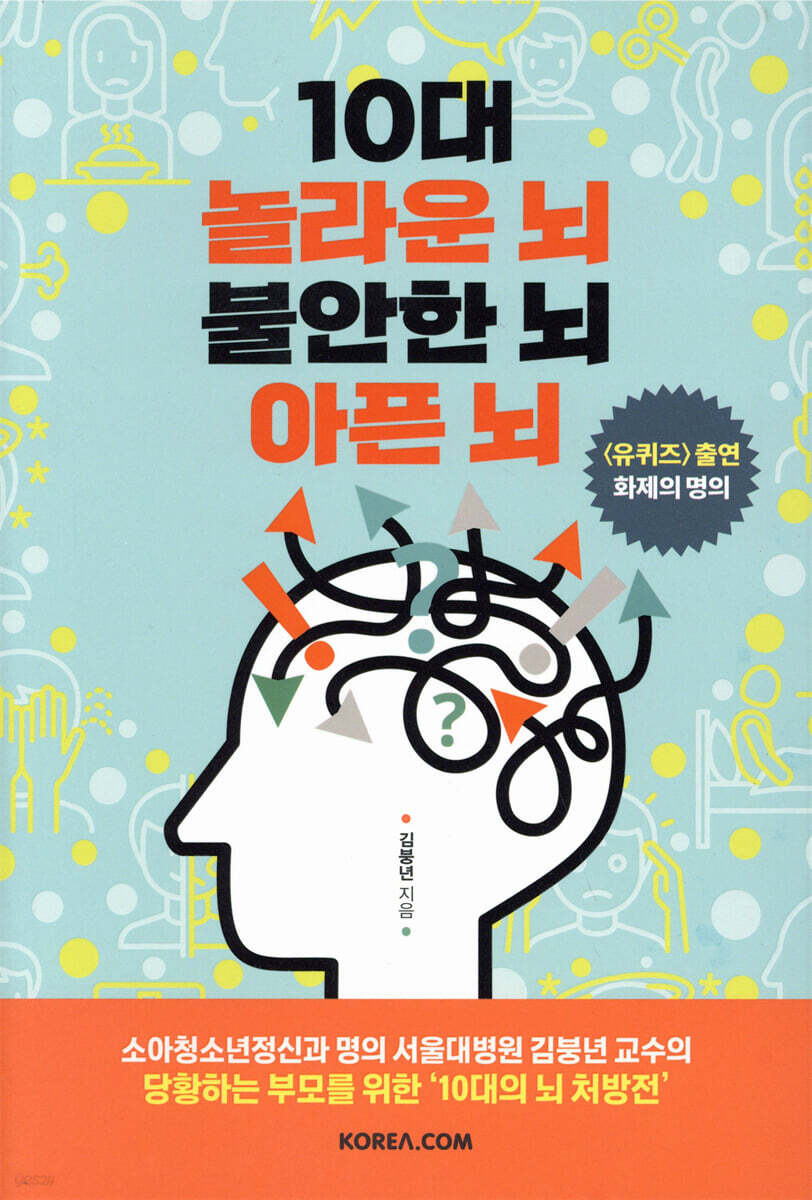
10 Amazing Brains of Teenagers: Anxious Brains, Sick Brains
 |
Description
Book Introduction
“Why on earth has my child become so strange?”
The teenage brain navigating a time of upheaval, weathering the storm.
A doctor's prescription to support the 'teen brain', which is both an opportunity and a crisis!
How should we navigate the stormy period of teenage brain development, a period that determines our entire lives?
The human brain undergoes two major changes throughout life.
0~3 years old and early to mid teens.
The brain must develop well between the ages of 0 and 3 to support the brain during the difficult teenage years, and must successfully pass the second developmental stage of adolescence to grow into a healthy adult.
However, many parents lack an understanding of teenage brain development and only consider their child's adolescent behavior as a 'problem'.
Professor Kim Boong-nyeon of Seoul National University Hospital, who enjoys the absolute support of parents, explains in this book the changes that the teenage brain goes through as it develops, the most important role that parents must play in the healthy development of the brain, and how to help in times of crisis that can lead to mental health problems, using various examples.
It's full of specific advice, including how to nurture the teenage brain as it undergoes amazing changes, how to communicate with a rebellious child, how to correct errors in thinking, why you shouldn't ignore your child's rebellion, how to recognize teenage depression, and how to recognize whether it's a sign of a sick brain rather than just a strange brain.
A must-read for parents who want to help their children's teenage years become opportunities, not crises.
The teenage brain navigating a time of upheaval, weathering the storm.
A doctor's prescription to support the 'teen brain', which is both an opportunity and a crisis!
How should we navigate the stormy period of teenage brain development, a period that determines our entire lives?
The human brain undergoes two major changes throughout life.
0~3 years old and early to mid teens.
The brain must develop well between the ages of 0 and 3 to support the brain during the difficult teenage years, and must successfully pass the second developmental stage of adolescence to grow into a healthy adult.
However, many parents lack an understanding of teenage brain development and only consider their child's adolescent behavior as a 'problem'.
Professor Kim Boong-nyeon of Seoul National University Hospital, who enjoys the absolute support of parents, explains in this book the changes that the teenage brain goes through as it develops, the most important role that parents must play in the healthy development of the brain, and how to help in times of crisis that can lead to mental health problems, using various examples.
It's full of specific advice, including how to nurture the teenage brain as it undergoes amazing changes, how to communicate with a rebellious child, how to correct errors in thinking, why you shouldn't ignore your child's rebellion, how to recognize teenage depression, and how to recognize whether it's a sign of a sick brain rather than just a strange brain.
A must-read for parents who want to help their children's teenage years become opportunities, not crises.
- You can preview some of the book's contents.
Preview
index
Part 1.
Brain development through two major upheavals throughout life: the first during 0-3 years of age and the second during the teenage years.
01.
A well-developed brain during the first upheaval supports the "adolescent brain."
-Three developmental tasks that must be accomplished during infancy and early childhood
-Humans are born with only about a third of their brain's neural network fully developed.
-The brain is created through pruning of nerve cells
-The importance of habits formed during infancy and childhood
02.
Brain health created by attachment between child and parent
Oxytocin, the happiness hormone produced through skin contact
The mirror neuron system, the key to empathy and sociality
- A society that achieves balance and moderation between reason and emotion
03.
A brain that plays creates a brain that learns.
-The power of imagination and music to create brain circuits
-Dopamine, the immersive brain
-Serotonin, the brain with emotional stability
04.
Preparing Your Child's Brain for the Upheaval of the Teenage Years
-Develop coping skills to manage stress
- Morality, essential for happiness, should be developed well during childhood.
-A shift in parental attitude toward the teenage brain
-The relationship between parents and children during infancy and childhood determines the direction of healthy adolescent brain development.
The teenage brain, between parental dependence and independence
Part 2.
The Perceptual Shift in the Teenage Brain: The Potential for Tremendous Change
01.
Explosive brain development, a second chance in life
-A second opportunity and crisis for rapid brain development
- Primary cognitive changes in the brain of children aged 0 to 3, and secondary cognitive changes in the brain of teenagers.
-The function of the frontal lobe becomes more vulnerable during development
-'Middle School Syndrome' is proof that my child's brain is developing.
02.
Testosterone, a male hormone that affects the brain regions responsible for fear and anxiety
-Testosterone during puberty, which causes both physical changes and emotional stimulation
-Aggression is also an instinctive ability for self-protection.
-Instinctive responses to hierarchy and territorial battles are also part of the process of becoming an adult.
03.
The Brain Disruption of Teenagers: My Child, So Different
-A time when mental health becomes vulnerable
-Uncovering the 'rebelliousness' and 'aggression' of the most difficult teenage years.
-Late teens, a hopeful period for cognitive and moral development
04.
Why is my child so strange?
The Confusion of the Teenage Brain: Why Each Child Reacts Differently
-Keyword 1 for reading adolescent behavior.
attachment
-Keywords for reading adolescent behavior 2.
autonomy
-Keywords for reading adolescent behavior 3.
temperament
-Training to accept a child's emotions as they are
05.
A 'time of crisis' that cannot be postponed or avoided
-A crisis that must be expressed
-Moratorium: Will postponing a crisis eliminate it?
-The teenage instinct to find 'what's theirs'
How to nurture your teen's brain: Allow time and space.
Study or something else? The explosion of intellectual curiosity in teenagers.
-A time when many things other than intellectual development are sacrificed
06.
A period that requires more attachment management than infancy and toddlerhood.
-A time when the true nature of parent-child attachment is revealed
-Attachment and temperament that determine a child's life
-If you haven't formed a deep attachment during infancy or early childhood
-If you are a parent concerned about your teenage child's behavioral problems
Part 3.
My child has become a stranger, with a strange brain and a wounded brain.
01.
Is something strange? Is something sick? The elusive teenage brain.
Why We Need to Study the Wounded Brains of Teenagers
-The alarm bells ringing in adolescence: the beginning of mental health problems.
-Please manage your mental state by not stimulating it beyond its limits.
02.
Don't obsess over the "why" of your child's behavior.
-What happens when 'why' becomes the goal
-How should we approach the solution?
-Common misconceptions about seeking professional help
03.
When Teenage Aggression Meets My Child's Idiosyncrasies
-Three characteristics of children with high aggression
-If self-rationalization that justifies violence is repeated
Adolescent aggression fueled by peer pressure
-The tragedy created by the parents' choice to ignore their child's rebellion.
04.
The problem of cognitive distortion caused by gaming and social media addiction
The online world: endless possibilities vs. excessive stimulation
Teenage brains with vulnerable frontal lobes are at risk for addiction.
Four factors that can easily lead to online addiction
-Is gaming addiction diagnosed as a disease?
-Children who have too little time for activities
-How far should we go in accommodating teenagers' gaming needs?
An online world of limitless possibilities and dangers.
-Children who try to compensate for low self-esteem through games.
-The virtual space becomes lonelier as the desire for 'likes' grows.
-'Fangirl', if my child lives with fandom
Parents with good relationships are those who "fight well" with their teenage children.
05.
Emotional problems in teenagers, such as mood disorders and anxiety disorders
- Rapidly increasing rates of teenage depression, suicide attempts, and self-harm
-How can we detect depression in teenagers?
-Secondary problems of teenage depression
Grief and depression are often misunderstood.
-Can depression be inherited?
-Teen Depression: Do I really need to take medication?
-Anxiety disorders in teenagers
06.
Neurodevelopmental disorders in teenagers enter a long-term battle called 'management'
-Differences in neurodevelopmental problems between infancy and childhood and adolescence
-It's time to find new paths and new possibilities.
Children with ADHD should choose communication over academics.
Part 4.
Parents' Role in Keeping Teenage Brains Healthy During the Storm
01.
So that you don't feel frustrated with your parents
-The kid who slammed the door, please believe me.
-Please support me by saying, "I'll take care of it."
-Rebellious child, keep talking.
-Teenagers who are struggling and frustrated, parents are the only ones who can act as a buffer
02.
We need to change our existing thoughts and attitudes toward children.
-You need to understand 'peer culture' to communicate.
-Even a child who seems to have become a monster has resilience.
-When adolescent children and middle-aged parents meet
03.
For a healthy relationship, you need to look back at your parents.
-Why can't I accept my child's heart?
-When looking back on parental attachment, temperament, and self-esteem
04.
The moment when you need to intervene in your child's 'wounded brain'
Warning signs from your teen
Anyone can have a wounded brain.
-The need for early intervention to correct thinking errors
-Treating brain pain and mental problems
05.
Dos and Don'ts for Your Child's Brain Health
-Keep the 'Things You Shouldn't Do to Your Children'
- Give yourself some time to 'space out' to combat stress.
-Please catch the flow of thought.
- Try to secure your child's sleep time.
- Leave your children's sex education to the experts.
-Let your children, now that they are teenagers, make their own choices and take responsibility for them.
-Parents are like friends, but they maintain authority.
-Don't judge too quickly and don't criticize too often.
- Participate in your child's daily life 'without prejudice'
Brain development through two major upheavals throughout life: the first during 0-3 years of age and the second during the teenage years.
01.
A well-developed brain during the first upheaval supports the "adolescent brain."
-Three developmental tasks that must be accomplished during infancy and early childhood
-Humans are born with only about a third of their brain's neural network fully developed.
-The brain is created through pruning of nerve cells
-The importance of habits formed during infancy and childhood
02.
Brain health created by attachment between child and parent
Oxytocin, the happiness hormone produced through skin contact
The mirror neuron system, the key to empathy and sociality
- A society that achieves balance and moderation between reason and emotion
03.
A brain that plays creates a brain that learns.
-The power of imagination and music to create brain circuits
-Dopamine, the immersive brain
-Serotonin, the brain with emotional stability
04.
Preparing Your Child's Brain for the Upheaval of the Teenage Years
-Develop coping skills to manage stress
- Morality, essential for happiness, should be developed well during childhood.
-A shift in parental attitude toward the teenage brain
-The relationship between parents and children during infancy and childhood determines the direction of healthy adolescent brain development.
The teenage brain, between parental dependence and independence
Part 2.
The Perceptual Shift in the Teenage Brain: The Potential for Tremendous Change
01.
Explosive brain development, a second chance in life
-A second opportunity and crisis for rapid brain development
- Primary cognitive changes in the brain of children aged 0 to 3, and secondary cognitive changes in the brain of teenagers.
-The function of the frontal lobe becomes more vulnerable during development
-'Middle School Syndrome' is proof that my child's brain is developing.
02.
Testosterone, a male hormone that affects the brain regions responsible for fear and anxiety
-Testosterone during puberty, which causes both physical changes and emotional stimulation
-Aggression is also an instinctive ability for self-protection.
-Instinctive responses to hierarchy and territorial battles are also part of the process of becoming an adult.
03.
The Brain Disruption of Teenagers: My Child, So Different
-A time when mental health becomes vulnerable
-Uncovering the 'rebelliousness' and 'aggression' of the most difficult teenage years.
-Late teens, a hopeful period for cognitive and moral development
04.
Why is my child so strange?
The Confusion of the Teenage Brain: Why Each Child Reacts Differently
-Keyword 1 for reading adolescent behavior.
attachment
-Keywords for reading adolescent behavior 2.
autonomy
-Keywords for reading adolescent behavior 3.
temperament
-Training to accept a child's emotions as they are
05.
A 'time of crisis' that cannot be postponed or avoided
-A crisis that must be expressed
-Moratorium: Will postponing a crisis eliminate it?
-The teenage instinct to find 'what's theirs'
How to nurture your teen's brain: Allow time and space.
Study or something else? The explosion of intellectual curiosity in teenagers.
-A time when many things other than intellectual development are sacrificed
06.
A period that requires more attachment management than infancy and toddlerhood.
-A time when the true nature of parent-child attachment is revealed
-Attachment and temperament that determine a child's life
-If you haven't formed a deep attachment during infancy or early childhood
-If you are a parent concerned about your teenage child's behavioral problems
Part 3.
My child has become a stranger, with a strange brain and a wounded brain.
01.
Is something strange? Is something sick? The elusive teenage brain.
Why We Need to Study the Wounded Brains of Teenagers
-The alarm bells ringing in adolescence: the beginning of mental health problems.
-Please manage your mental state by not stimulating it beyond its limits.
02.
Don't obsess over the "why" of your child's behavior.
-What happens when 'why' becomes the goal
-How should we approach the solution?
-Common misconceptions about seeking professional help
03.
When Teenage Aggression Meets My Child's Idiosyncrasies
-Three characteristics of children with high aggression
-If self-rationalization that justifies violence is repeated
Adolescent aggression fueled by peer pressure
-The tragedy created by the parents' choice to ignore their child's rebellion.
04.
The problem of cognitive distortion caused by gaming and social media addiction
The online world: endless possibilities vs. excessive stimulation
Teenage brains with vulnerable frontal lobes are at risk for addiction.
Four factors that can easily lead to online addiction
-Is gaming addiction diagnosed as a disease?
-Children who have too little time for activities
-How far should we go in accommodating teenagers' gaming needs?
An online world of limitless possibilities and dangers.
-Children who try to compensate for low self-esteem through games.
-The virtual space becomes lonelier as the desire for 'likes' grows.
-'Fangirl', if my child lives with fandom
Parents with good relationships are those who "fight well" with their teenage children.
05.
Emotional problems in teenagers, such as mood disorders and anxiety disorders
- Rapidly increasing rates of teenage depression, suicide attempts, and self-harm
-How can we detect depression in teenagers?
-Secondary problems of teenage depression
Grief and depression are often misunderstood.
-Can depression be inherited?
-Teen Depression: Do I really need to take medication?
-Anxiety disorders in teenagers
06.
Neurodevelopmental disorders in teenagers enter a long-term battle called 'management'
-Differences in neurodevelopmental problems between infancy and childhood and adolescence
-It's time to find new paths and new possibilities.
Children with ADHD should choose communication over academics.
Part 4.
Parents' Role in Keeping Teenage Brains Healthy During the Storm
01.
So that you don't feel frustrated with your parents
-The kid who slammed the door, please believe me.
-Please support me by saying, "I'll take care of it."
-Rebellious child, keep talking.
-Teenagers who are struggling and frustrated, parents are the only ones who can act as a buffer
02.
We need to change our existing thoughts and attitudes toward children.
-You need to understand 'peer culture' to communicate.
-Even a child who seems to have become a monster has resilience.
-When adolescent children and middle-aged parents meet
03.
For a healthy relationship, you need to look back at your parents.
-Why can't I accept my child's heart?
-When looking back on parental attachment, temperament, and self-esteem
04.
The moment when you need to intervene in your child's 'wounded brain'
Warning signs from your teen
Anyone can have a wounded brain.
-The need for early intervention to correct thinking errors
-Treating brain pain and mental problems
05.
Dos and Don'ts for Your Child's Brain Health
-Keep the 'Things You Shouldn't Do to Your Children'
- Give yourself some time to 'space out' to combat stress.
-Please catch the flow of thought.
- Try to secure your child's sleep time.
- Leave your children's sex education to the experts.
-Let your children, now that they are teenagers, make their own choices and take responsibility for them.
-Parents are like friends, but they maintain authority.
-Don't judge too quickly and don't criticize too often.
- Participate in your child's daily life 'without prejudice'
Detailed image
Into the book
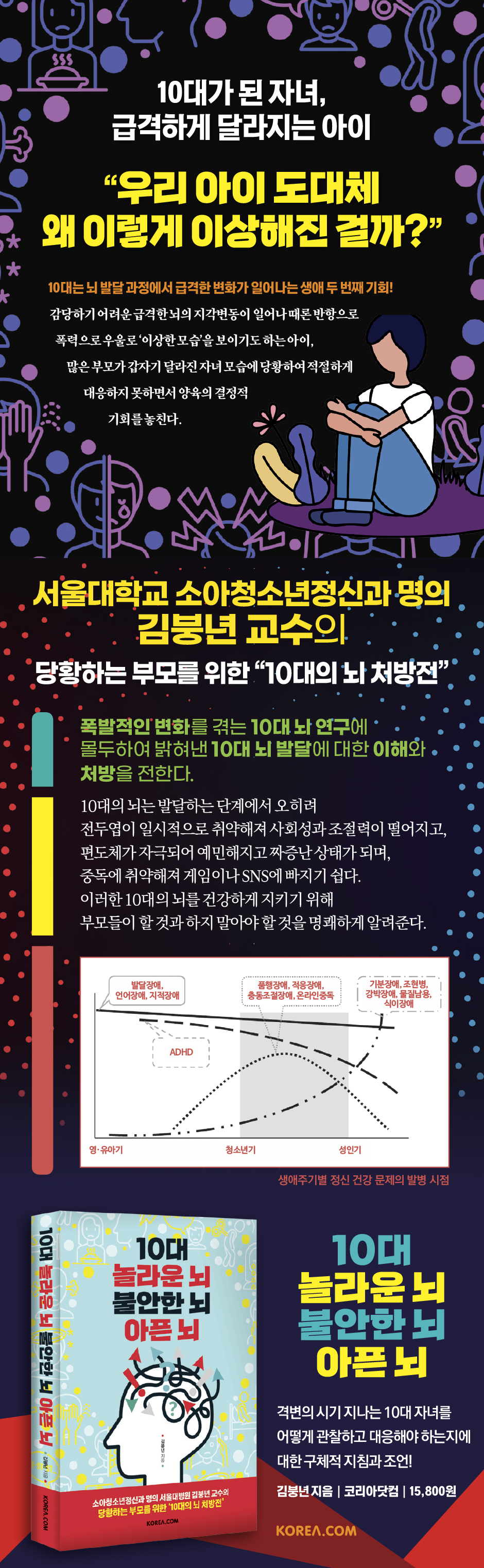
Adolescence is dynamic, whether for healthy teens or those with mental illness.
Adolescence is a time of many changes and twists and turns.
It is a time when things can change drastically if there is a certain opportunity or trigger.
In the past, this dynamic adolescent phase was explained with terms such as ‘psychological change’ and ‘establishment of self-identity.’
But when we peeled back another layer and looked inside, we discovered that there were 'brain changes' inside.
Although the history is not that long, meaningful research results on brain changes are gradually accumulating.
Changes in the adolescent brain can also lead to mental health crises and problems.
Not all brain changes are for the better.
It also creates mental illnesses based on neurodevelopmental abnormalities.
Adolescence is the most vulnerable period in life for mental illness.
Recently, research on the pathogenesis of psychiatric disorders in adolescence has become increasingly active.
Having met many friends who are going through a difficult time in their adolescence, I hope that this book will help parents recognize their pain earlier and offer comfort. I hope that it will help children navigate this stormy period of brain change safely and healthily.
--- From the "Introductory Note"
The areas we look closely at in the teenage brain are the frontal lobe and the amygdala.
If the frontal lobe develops through pruning, the amygdala develops through stimulation by male hormones.
The amygdala makes us feel fear when a threat is approaching, causing us to protect ourselves by running away from or attacking the threatening object.
For example, when the amygdala of mice, which is widely used in animal experiments, is stimulated, they start fighting over territory.
A territorial dispute is a warning to stay away from this area, as it is your territory.
The self-preservation instinct is activated by the stimulation of testosterone.
During adolescence, when the amygdala is stimulated by testosterone, sensitivity to hierarchy and rank becomes greater.
There is a tendency to place great importance on the strength and weakness of power.
The desire to become strong arises, and the tendency to become weaker in the face of strong people also becomes stronger.
It is an instinctive reaction for a weak person to submit to a strong person, or for a strong person to try to dominate a weak person.
Sensitivity to sequence and hierarchy can also be seen as a result of stimulation of the amygdala.
--- 「Part 2.
From "The Perceptual Shift in the Teenage Brain: The Potential for Tremendous Change"
Adults are relatively less difficult to diagnose for mental health problems than adolescents.
For adults, the possibility of diagnosis is relatively clear when examining the state of adaptation to social and cultural norms.
However, judging is difficult because teenagers cross boundaries.
Even children who were previously trouble-free can become very shaken by strange behavior, excessive immersion, game addiction, anger toward parents, and self-loathing.
Most teens will eventually regain their balance after exhibiting these behaviors, but for some, the behavior can become so severe that, without proper intervention, it can lead to serious mental health problems.
As such, the boundaries between temporary strangeness and pain in children's behavior at this age are ambiguous, so we need to observe them more closely and gather information from various perspectives.
And we need to use assessment methods that are appropriate for the child's age and developmental level.
This is why there is a separate department of psychiatry that deals with children and adolescents.
--- 「Part 3.
From "My Child Has Become a Stranger, a Strange Brain and a Wounded Brain"
If you want to guide your child's gaming problem, you should divide it into two categories.
There are children who are addicted to games and children who play games to some extent in their daily lives.
For the digital generation, online spaces are a new space where they can develop their self-identity.
It's everyday life.
Because this space can be highly stimulating and potentially dangerous for teenagers, we must carefully manage their vulnerability and actively intervene and provide assistance when necessary.
However, I hope that parents will first understand that time is the best medicine, as long as it is not excessive.
In fact, when it comes to gaming issues, the secondary problems that arise from conflicts between parents and children due to gaming are more difficult to fix than the addiction itself.
We need to work together to consider and propose alternative activities to achieve a balance between online and offline life.
More than anything, I hope that parents learn together as well.
I hope parents also experience the online world and learn from their children.
When parents are involved, their children are less likely to become addicted to gaming.
--- 「Part 3.
From "My Child Has Become a Stranger, a Strange Brain and a Wounded Brain"
The adolescent brain can clearly go beyond a weird brain to a damaged brain.
Depression, anxiety, rebellion, and difficulty concentrating can become so severe that it can reach the point where it is suspected to be a medical condition.
But you can come back.
With the combined efforts of parents and the help of professionals, a child can recover.
In some cases, the child may heal naturally on his or her own after a certain period of time.
Of course, just as there are diseases in our bodies that cannot be completely cured, the brain can also develop diseases that are difficult to completely recover from, and in these cases, they must be managed consistently, just like chronic diseases such as high blood pressure, diabetes, and kidney disease.
However, if the problem is not chronic and appears with the onset of puberty, there is hope.
The problem is that parents are not ready to accept their child's strangeness and pain.
In fact, the child may already be expressing his or her difficulties sufficiently.
Perhaps parents know their child is struggling but are pretending not to? They don't know what to do, they feel they have no other options, they know their child is struggling and stressed but can't tell them to quit. Perhaps they're just pretending not to notice their child's struggles, even though they know it's difficult.
Beyond providing emotional support, parents have a role to play in their children's mental health.
It is ‘awareness’.
You need to be able to recognize the warning signs your child is sending you.
It's not about restricting and controlling your daily life.
Parents who live with their children and know their children's temperaments and characteristics well are in the best position to recognize their children's problems.
Adolescence is a time of many changes and twists and turns.
It is a time when things can change drastically if there is a certain opportunity or trigger.
In the past, this dynamic adolescent phase was explained with terms such as ‘psychological change’ and ‘establishment of self-identity.’
But when we peeled back another layer and looked inside, we discovered that there were 'brain changes' inside.
Although the history is not that long, meaningful research results on brain changes are gradually accumulating.
Changes in the adolescent brain can also lead to mental health crises and problems.
Not all brain changes are for the better.
It also creates mental illnesses based on neurodevelopmental abnormalities.
Adolescence is the most vulnerable period in life for mental illness.
Recently, research on the pathogenesis of psychiatric disorders in adolescence has become increasingly active.
Having met many friends who are going through a difficult time in their adolescence, I hope that this book will help parents recognize their pain earlier and offer comfort. I hope that it will help children navigate this stormy period of brain change safely and healthily.
--- From the "Introductory Note"
The areas we look closely at in the teenage brain are the frontal lobe and the amygdala.
If the frontal lobe develops through pruning, the amygdala develops through stimulation by male hormones.
The amygdala makes us feel fear when a threat is approaching, causing us to protect ourselves by running away from or attacking the threatening object.
For example, when the amygdala of mice, which is widely used in animal experiments, is stimulated, they start fighting over territory.
A territorial dispute is a warning to stay away from this area, as it is your territory.
The self-preservation instinct is activated by the stimulation of testosterone.
During adolescence, when the amygdala is stimulated by testosterone, sensitivity to hierarchy and rank becomes greater.
There is a tendency to place great importance on the strength and weakness of power.
The desire to become strong arises, and the tendency to become weaker in the face of strong people also becomes stronger.
It is an instinctive reaction for a weak person to submit to a strong person, or for a strong person to try to dominate a weak person.
Sensitivity to sequence and hierarchy can also be seen as a result of stimulation of the amygdala.
--- 「Part 2.
From "The Perceptual Shift in the Teenage Brain: The Potential for Tremendous Change"
Adults are relatively less difficult to diagnose for mental health problems than adolescents.
For adults, the possibility of diagnosis is relatively clear when examining the state of adaptation to social and cultural norms.
However, judging is difficult because teenagers cross boundaries.
Even children who were previously trouble-free can become very shaken by strange behavior, excessive immersion, game addiction, anger toward parents, and self-loathing.
Most teens will eventually regain their balance after exhibiting these behaviors, but for some, the behavior can become so severe that, without proper intervention, it can lead to serious mental health problems.
As such, the boundaries between temporary strangeness and pain in children's behavior at this age are ambiguous, so we need to observe them more closely and gather information from various perspectives.
And we need to use assessment methods that are appropriate for the child's age and developmental level.
This is why there is a separate department of psychiatry that deals with children and adolescents.
--- 「Part 3.
From "My Child Has Become a Stranger, a Strange Brain and a Wounded Brain"
If you want to guide your child's gaming problem, you should divide it into two categories.
There are children who are addicted to games and children who play games to some extent in their daily lives.
For the digital generation, online spaces are a new space where they can develop their self-identity.
It's everyday life.
Because this space can be highly stimulating and potentially dangerous for teenagers, we must carefully manage their vulnerability and actively intervene and provide assistance when necessary.
However, I hope that parents will first understand that time is the best medicine, as long as it is not excessive.
In fact, when it comes to gaming issues, the secondary problems that arise from conflicts between parents and children due to gaming are more difficult to fix than the addiction itself.
We need to work together to consider and propose alternative activities to achieve a balance between online and offline life.
More than anything, I hope that parents learn together as well.
I hope parents also experience the online world and learn from their children.
When parents are involved, their children are less likely to become addicted to gaming.
--- 「Part 3.
From "My Child Has Become a Stranger, a Strange Brain and a Wounded Brain"
The adolescent brain can clearly go beyond a weird brain to a damaged brain.
Depression, anxiety, rebellion, and difficulty concentrating can become so severe that it can reach the point where it is suspected to be a medical condition.
But you can come back.
With the combined efforts of parents and the help of professionals, a child can recover.
In some cases, the child may heal naturally on his or her own after a certain period of time.
Of course, just as there are diseases in our bodies that cannot be completely cured, the brain can also develop diseases that are difficult to completely recover from, and in these cases, they must be managed consistently, just like chronic diseases such as high blood pressure, diabetes, and kidney disease.
However, if the problem is not chronic and appears with the onset of puberty, there is hope.
The problem is that parents are not ready to accept their child's strangeness and pain.
In fact, the child may already be expressing his or her difficulties sufficiently.
Perhaps parents know their child is struggling but are pretending not to? They don't know what to do, they feel they have no other options, they know their child is struggling and stressed but can't tell them to quit. Perhaps they're just pretending not to notice their child's struggles, even though they know it's difficult.
Beyond providing emotional support, parents have a role to play in their children's mental health.
It is ‘awareness’.
You need to be able to recognize the warning signs your child is sending you.
It's not about restricting and controlling your daily life.
Parents who live with their children and know their children's temperaments and characteristics well are in the best position to recognize their children's problems.
--- 「Part 4.
From "Parents' Role in Keeping Teenage Brains Healthy in the Storm"
From "Parents' Role in Keeping Teenage Brains Healthy in the Storm"
Publisher's Review
“I’ve become a different kid!” What’s going on in the teenage brain?
When a child slams the door, throws a tantrum and refuses to listen, or pretends not to hear what the parent says, parents start to get nervous.
It seems like the 'puberty' we've only heard about has begun, but parents of teenagers are worried about whether they should be strict with their children to prevent them from getting distracted during this important academic period, or if they should just leave them alone and not bother them.
According to brain science, surprisingly, the 'weird' behaviors of teenagers are evidence that the child is developing well.
Adolescence is a time when cognitive and emotional abilities are at their peak.
Just as babies between the ages of 0 and 3 develop at an incredible rate to walk, crawl, run, speak, and communicate in complete sentences, the teenage brain also develops at an incredible rate to develop cognition, emotions, and social skills.
Because the range of development is so wide, the inner confusion and feelings that they experience for the first time are expressed as negative emotions, feelings, and behavioral responses, which can appear as symptoms similar to 'middle school syndrome'.
So, while the teenage brain may seem unstable, it is a time of tremendous opportunity for the brain to mature.
Knowing what's going on in your child's head gives you more room to accept their behavior.
Just as no parent would scold a baby who falls while learning to walk, we must be prepared to accept the 'strange brain' of our children who are developing 'humanly' and 'adultly'.
"Why is my child so weird?" You need to understand your child's unique "code."
In addition to understanding the brain development of teenagers, there are some important keywords to keep in mind.
It is ‘my child’s unique uniqueness.’
Professor Kim Boong-nyeon, a renowned pediatric and adolescent psychiatrist, advises parents of teenage children to do two things when meeting them.
The first is to understand the characteristics of teenage brain development so you can be more accepting of your child. The second is to think back to your child's infancy and early childhood.
Why should we recall our childhood when our children are teenagers?
Every child in the world is different.
Each child has a unique temperament, and there are also aspects that develop as the child adapts to the environment.
My child's unique 'code' discovered at this time is later hidden as sociality develops and is revealed like a true face during adolescence.
By discovering your child's uniqueness as guided by the author, parents can observe their child more closely and objectively reflect on how to raise them.
This book will help you understand what that code is, what hints there are for dealing with your child during puberty, and how to transition your role as a parent.
For the brains of teenagers standing on the borderline between 'development' and 'pain'
Teenagers cross boundaries.
Even children who had no problems before can become very shaken by strange behavior, excessive immersion, game addiction, anger toward parents, and self-loathing.
Most teenagers will eventually regain their balance after exhibiting these behaviors, but in some cases, the behaviors can become so severe that, without proper intervention, they can lead to serious mental health problems.
In fact, the incidence of mental health problems in teenagers is higher than you might think.
Schizophrenia, which was mainly known as an adult mental health problem, is said to have an approximately 40% chance of developing in mid-adolescence, that is, in the mid-teens.
Although the illness began in adolescence, many people miss the appropriate treatment period and only receive treatment for schizophrenia in adulthood.
The same goes for bipolar disorder.
More than 50% of bipolar patients treated in adulthood report that their initial bipolar symptoms began in their teens.
Because the line between temporary anomalies and illness is blurred in the behavior of teenagers, it's important to observe them more closely and gather information from multiple perspectives.
And we must use assessment methods that are appropriate for the age and developmental level.
This is why there is a separate department of psychiatry that deals with children and adolescents.
Professor Kim Boong-nyeon, a specialist in child and adolescent psychiatry at Seoul National University Children's Hospital, has been conducting mental health research integrating brain and psychological development in infants, children, and adolescents for over 20 years.
The author says he feels great sorrow when he meets children whose mental health issues are not addressed early and only come to him when they are severely advanced.
Just as anyone with a weakened immune system can catch a cold, anyone can develop a sick brain.
Therefore, the teenage years are a time when the role of parents is more important than ever, requiring close observation and timely intervention.
This book will be a useful tool for parents who are struggling to raise their teenage children.
When a child slams the door, throws a tantrum and refuses to listen, or pretends not to hear what the parent says, parents start to get nervous.
It seems like the 'puberty' we've only heard about has begun, but parents of teenagers are worried about whether they should be strict with their children to prevent them from getting distracted during this important academic period, or if they should just leave them alone and not bother them.
According to brain science, surprisingly, the 'weird' behaviors of teenagers are evidence that the child is developing well.
Adolescence is a time when cognitive and emotional abilities are at their peak.
Just as babies between the ages of 0 and 3 develop at an incredible rate to walk, crawl, run, speak, and communicate in complete sentences, the teenage brain also develops at an incredible rate to develop cognition, emotions, and social skills.
Because the range of development is so wide, the inner confusion and feelings that they experience for the first time are expressed as negative emotions, feelings, and behavioral responses, which can appear as symptoms similar to 'middle school syndrome'.
So, while the teenage brain may seem unstable, it is a time of tremendous opportunity for the brain to mature.
Knowing what's going on in your child's head gives you more room to accept their behavior.
Just as no parent would scold a baby who falls while learning to walk, we must be prepared to accept the 'strange brain' of our children who are developing 'humanly' and 'adultly'.
"Why is my child so weird?" You need to understand your child's unique "code."
In addition to understanding the brain development of teenagers, there are some important keywords to keep in mind.
It is ‘my child’s unique uniqueness.’
Professor Kim Boong-nyeon, a renowned pediatric and adolescent psychiatrist, advises parents of teenage children to do two things when meeting them.
The first is to understand the characteristics of teenage brain development so you can be more accepting of your child. The second is to think back to your child's infancy and early childhood.
Why should we recall our childhood when our children are teenagers?
Every child in the world is different.
Each child has a unique temperament, and there are also aspects that develop as the child adapts to the environment.
My child's unique 'code' discovered at this time is later hidden as sociality develops and is revealed like a true face during adolescence.
By discovering your child's uniqueness as guided by the author, parents can observe their child more closely and objectively reflect on how to raise them.
This book will help you understand what that code is, what hints there are for dealing with your child during puberty, and how to transition your role as a parent.
For the brains of teenagers standing on the borderline between 'development' and 'pain'
Teenagers cross boundaries.
Even children who had no problems before can become very shaken by strange behavior, excessive immersion, game addiction, anger toward parents, and self-loathing.
Most teenagers will eventually regain their balance after exhibiting these behaviors, but in some cases, the behaviors can become so severe that, without proper intervention, they can lead to serious mental health problems.
In fact, the incidence of mental health problems in teenagers is higher than you might think.
Schizophrenia, which was mainly known as an adult mental health problem, is said to have an approximately 40% chance of developing in mid-adolescence, that is, in the mid-teens.
Although the illness began in adolescence, many people miss the appropriate treatment period and only receive treatment for schizophrenia in adulthood.
The same goes for bipolar disorder.
More than 50% of bipolar patients treated in adulthood report that their initial bipolar symptoms began in their teens.
Because the line between temporary anomalies and illness is blurred in the behavior of teenagers, it's important to observe them more closely and gather information from multiple perspectives.
And we must use assessment methods that are appropriate for the age and developmental level.
This is why there is a separate department of psychiatry that deals with children and adolescents.
Professor Kim Boong-nyeon, a specialist in child and adolescent psychiatry at Seoul National University Children's Hospital, has been conducting mental health research integrating brain and psychological development in infants, children, and adolescents for over 20 years.
The author says he feels great sorrow when he meets children whose mental health issues are not addressed early and only come to him when they are severely advanced.
Just as anyone with a weakened immune system can catch a cold, anyone can develop a sick brain.
Therefore, the teenage years are a time when the role of parents is more important than ever, requiring close observation and timely intervention.
This book will be a useful tool for parents who are struggling to raise their teenage children.
GOODS SPECIFICS
- Publication date: April 10, 2021
- Page count, weight, size: 328 pages | 506g | 152*225*20mm
- ISBN13: 9791190488198
- ISBN10: 1190488191
You may also like
카테고리
korean


korean

![GQ KOREA Mark (Monthly): December [2025]](http://librairie.coreenne.fr/cdn/shop/files/8ef265dbbfbf186523ed75ba7319009d.jpg?v=1765340328&width=3840)


