

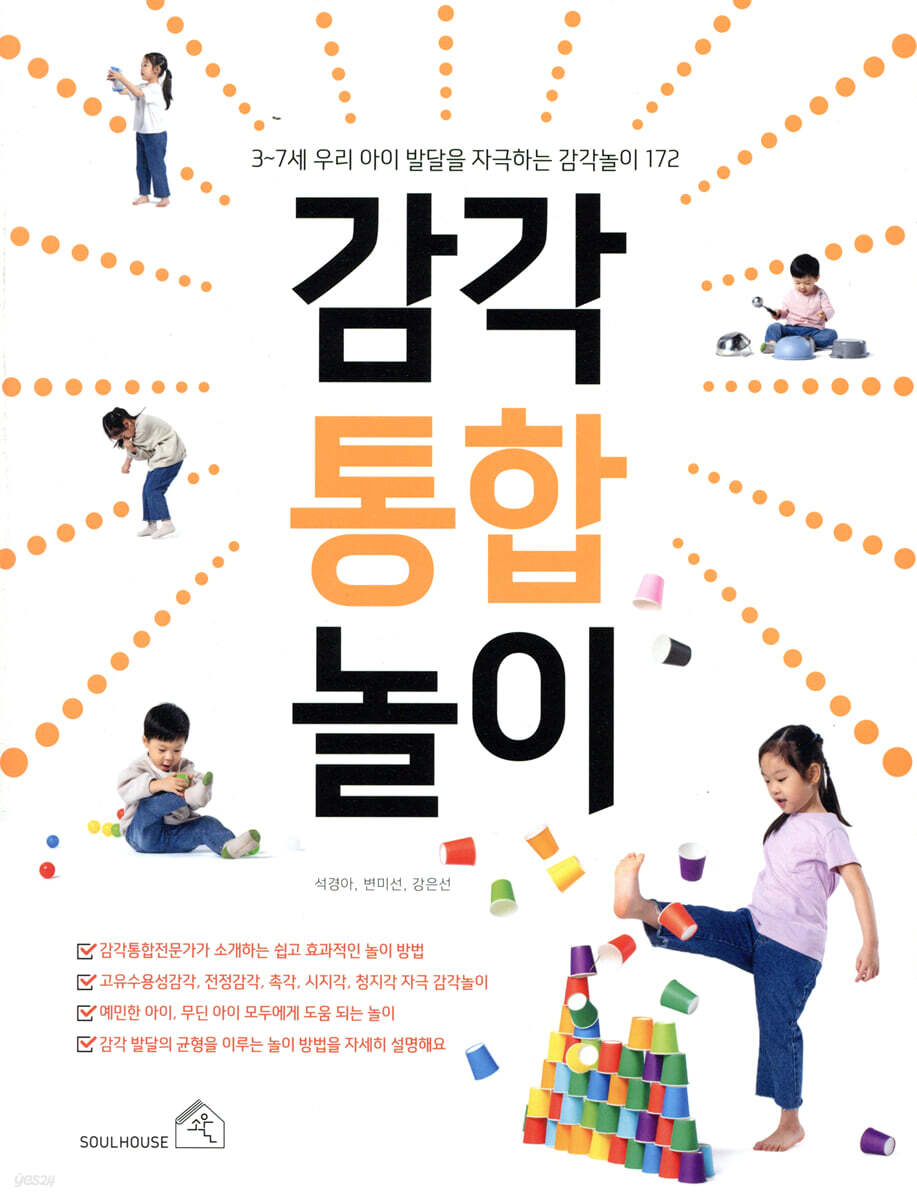
Sensory integration play
 |
Description
Book Introduction
The best sensory integration play book written by sensory integration experts.
Now, let your child develop all of his senses while having fun at home.
A book written by three sensory integration specialists who have been providing sensory integration therapy to children for over 10 years, sharing their experiences and secrets.
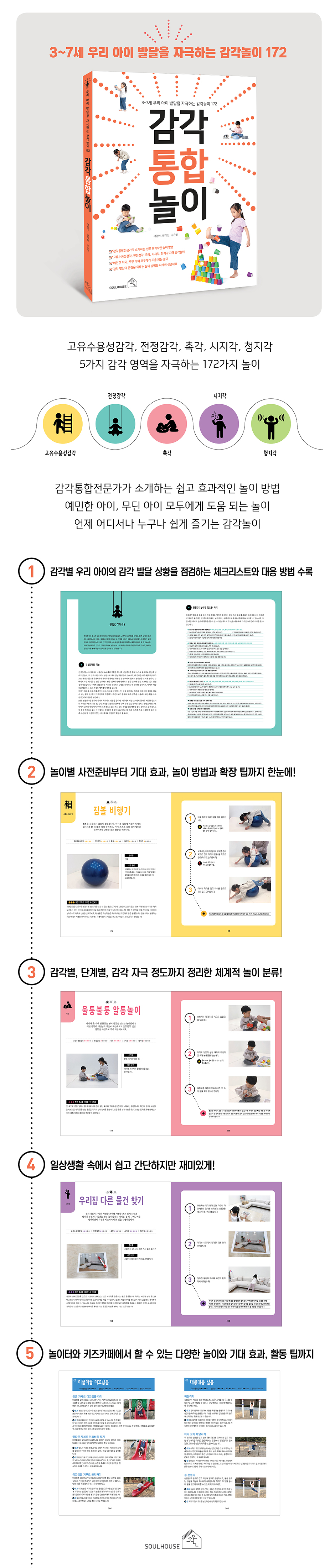
It contains 172 play methods that evenly develop five sensory areas: proprioception, vestibular sense, tactile sense, visual perception, and auditory perception.
Each play is designed to stimulate all five senses equally, helping to develop balanced sensory integration. This play can be easily done at home to promote sensory integration without any special preparation or knowledge.
As a book written by a sensory integration expert, this book goes beyond simply listing sensory play. It also explains sensory integration theory in an easy-to-understand manner, explaining why our children need sensory stimulation and what role each sense plays in them.
Additionally, we provide a checklist to assess your child's sensory development in each of the five major sensory areas, and based on the check results, we introduce appropriate play activities and suggest ways to best integrate your child's senses in each situation.
Above all, the games included in 『Sensory Integration Play』 are great because they allow sensory integration without any preparation or by appropriately utilizing household items.
It consists of classic games that we enjoyed as children, such as riding on a wooden horse or eating candy, as well as easy and fun games that utilize soap bubbles, blocks, puzzles, and paper boxes.
Therefore, sensory integration play can be done without going to a sensory integration development center, and it also helps to connect activities at the sensory integration development center and continue them at home.
Sensory integration play activities, which may seem like simple play, have a hidden, significant effect in helping children develop their senses and bodies.
And once you understand sensory integration play, its benefits begin to become apparent.
Let's explore sensory integration play, which allows us to develop our daily lives and learning skills through enjoyable play, with this book.
Now, let your child develop all of his senses while having fun at home.
A book written by three sensory integration specialists who have been providing sensory integration therapy to children for over 10 years, sharing their experiences and secrets.
It contains 172 play methods that evenly develop five sensory areas: proprioception, vestibular sense, tactile sense, visual perception, and auditory perception.
Each play is designed to stimulate all five senses equally, helping to develop balanced sensory integration. This play can be easily done at home to promote sensory integration without any special preparation or knowledge.
As a book written by a sensory integration expert, this book goes beyond simply listing sensory play. It also explains sensory integration theory in an easy-to-understand manner, explaining why our children need sensory stimulation and what role each sense plays in them.
Additionally, we provide a checklist to assess your child's sensory development in each of the five major sensory areas, and based on the check results, we introduce appropriate play activities and suggest ways to best integrate your child's senses in each situation.
Above all, the games included in 『Sensory Integration Play』 are great because they allow sensory integration without any preparation or by appropriately utilizing household items.
It consists of classic games that we enjoyed as children, such as riding on a wooden horse or eating candy, as well as easy and fun games that utilize soap bubbles, blocks, puzzles, and paper boxes.
Therefore, sensory integration play can be done without going to a sensory integration development center, and it also helps to connect activities at the sensory integration development center and continue them at home.
Sensory integration play activities, which may seem like simple play, have a hidden, significant effect in helping children develop their senses and bodies.
And once you understand sensory integration play, its benefits begin to become apparent.
Let's explore sensory integration play, which allows us to develop our daily lives and learning skills through enjoyable play, with this book.
- You can preview some of the book's contents.
Preview
index
Recommendation
Header
How to use this book
Sensory Integration and Our Children
What is proprioception?
mat slide
Mat Tunnel Play
gimbal airplane
Towel tug-of-war
Merongnori
Tick tock tick tock tool play
Hanging laundry
Sweep sweep sweep cleaning game
Palm walking
Bubble bubble car wash play
Bubble Train
rocket launch
Tongs game
Rescue toys from the ice
Hand and foot wrestling
Chugging Box Train
Ding dong, the package has arrived.
People who want to drink juice
Straw Soccer
Avoid the line
newspaper destruction
Flashlight Treasure Hunt
Crossing the stepping stones
Spider Web Escape
What is vestibular sense?
Blanket Kimbap Roll
Swinging blanket swing
blanket sled
Fly, airplane
High high horse
Tick tock, tick tock
Spinning chair
Rolling thud
Round and round
Gym ball jump
Seesaw
Upside-down picture puzzle
Gym ball forward roll
Dung beetle play
Elephant's nose spinning around
Handstand
What is touch?
Making Tofu Cake
Making Macaroni Cookies
Bumpy and bumpy playground
It's snowing on the corn stalks
Lotion Sledding
Starch Liquid Monster
Washing cardboard
It's raining cats and dogs
What does it look like?
Making a mummy
Making a hedgehog
Making fruit juice
Building a Playcon House
Making newspaper clothes
Making kimbap
Making hotteok
Making cookies
Making Inari Sushi
What's in your pocket?
What is visual perception?
Bubble Baseball
Eating dangling cookies
Find the maze
Find other items in our house
Sticking stickers
Puzzle Matching
Who will build it higher?
Matching the lids
How to fold a paper airplane
Balloon Badminton
Where are you hiding?
Parking lot play
Find the same letters
Making a refrigerator
Zigzag Golf
Our home navigation
Making twin blocks
Find your sock match
Paper Cup Treasure Hunt
What is auditory perception?
Tongtang tongtang musical instrument play
What does it sound like?
Where does the sound come from?
Stop dancing happily
The round sun has risen
Playing Empty Bottle
Guess the song title
Raising the flag
Playground/Kids Cafe
Slippery slide
Dangling horizontal bar
Swing swing
Up and down seesaw
Round and round
Riding a horse at a fast pace
A wobbly, wobbly bridge
Rock climbing
The ball pit flies away
Vroom vroom ride
Suddenly, the cypress tree falls down
Jump Jump Trampoline
Fishing game to see who catches the most
Higher and higher block play
Header
How to use this book
Sensory Integration and Our Children
What is proprioception?
mat slide
Mat Tunnel Play
gimbal airplane
Towel tug-of-war
Merongnori
Tick tock tick tock tool play
Hanging laundry
Sweep sweep sweep cleaning game
Palm walking
Bubble bubble car wash play
Bubble Train
rocket launch
Tongs game
Rescue toys from the ice
Hand and foot wrestling
Chugging Box Train
Ding dong, the package has arrived.
People who want to drink juice
Straw Soccer
Avoid the line
newspaper destruction
Flashlight Treasure Hunt
Crossing the stepping stones
Spider Web Escape
What is vestibular sense?
Blanket Kimbap Roll
Swinging blanket swing
blanket sled
Fly, airplane
High high horse
Tick tock, tick tock
Spinning chair
Rolling thud
Round and round
Gym ball jump
Seesaw
Upside-down picture puzzle
Gym ball forward roll
Dung beetle play
Elephant's nose spinning around
Handstand
What is touch?
Making Tofu Cake
Making Macaroni Cookies
Bumpy and bumpy playground
It's snowing on the corn stalks
Lotion Sledding
Starch Liquid Monster
Washing cardboard
It's raining cats and dogs
What does it look like?
Making a mummy
Making a hedgehog
Making fruit juice
Building a Playcon House
Making newspaper clothes
Making kimbap
Making hotteok
Making cookies
Making Inari Sushi
What's in your pocket?
What is visual perception?
Bubble Baseball
Eating dangling cookies
Find the maze
Find other items in our house
Sticking stickers
Puzzle Matching
Who will build it higher?
Matching the lids
How to fold a paper airplane
Balloon Badminton
Where are you hiding?
Parking lot play
Find the same letters
Making a refrigerator
Zigzag Golf
Our home navigation
Making twin blocks
Find your sock match
Paper Cup Treasure Hunt
What is auditory perception?
Tongtang tongtang musical instrument play
What does it sound like?
Where does the sound come from?
Stop dancing happily
The round sun has risen
Playing Empty Bottle
Guess the song title
Raising the flag
Playground/Kids Cafe
Slippery slide
Dangling horizontal bar
Swing swing
Up and down seesaw
Round and round
Riding a horse at a fast pace
A wobbly, wobbly bridge
Rock climbing
The ball pit flies away
Vroom vroom ride
Suddenly, the cypress tree falls down
Jump Jump Trampoline
Fishing game to see who catches the most
Higher and higher block play
Detailed image
Into the book
It's already been 10 years since I started working with children as a sensory integration therapist.
Through this time, I was able to see and feel firsthand how small, everyday play activities can change a child.
The most important thing in play is children's motivation and achievement.
Children naturally develop interests in things they like and need, and they change and expand their play based on those interests.
Children aged 3 to 5, the main target audience of this book, engage in a lot of sensory play, especially those related to their bodies.
By observing what kind of play your child enjoys in daily life, you can find out what senses your child likes, and based on that, you can gradually expand the play to include a variety of sensory plays.
Through these diverse sensory play experiences, children develop self-esteem and learn to express themselves well.
《Sensory Integration Play》 provides an easy-to-understand explanation of the senses and explains what behaviors children exhibit when sensory processing is difficult.
We also introduced what kind of sensory play would be helpful for these children.
Rather than simply providing play activities that can be done at home, we explain the positive effects they can have on children through the process.
By using the coping strategies and play in this book, both children who are seeking out sensory play they enjoy, and children who have struggled to engage in play due to sensitivity to certain senses, will be able to experience more enjoyable play.
--- From the "Header"
Sensory integration in a child's daily life
Sensory integration occurs continuously in our children's daily lives.
As soon as you open your eyes in the morning, you feel the texture of the blanket and use your proprioception and sense of touch from the process of grabbing the blanket and pulling it away.
Washing up, eating, getting dressed and carrying a bag to go to kindergarten, going to kindergarten and saying hello to teachers and friends, running around or playing with toys, etc. are all activities that involve feeling and using various senses such as sight, hearing, proprioception, vestibular sense, and touch.
To perform a single action, multiple senses are used in a complex manner, and the brain must unconsciously integrate and process these to perform a purposeful action.
Sensory integration also influences arousal (the state of the brain being awake) and regulates sleep.
If you are overly sensitive or dull to external sensations, you may scream or move around a lot when you should be asleep, or you may be in a daze and unable to wake up when you should be.
Observing the behavior of a sensitive child can help you identify sensations that are uncomfortable or difficult for them.
Once you've identified the uncomfortable sensations, you can engage in sensory integration play and anticipate your child's behavior and provide alternatives to help them with everyday activities.
Through this time, I was able to see and feel firsthand how small, everyday play activities can change a child.
The most important thing in play is children's motivation and achievement.
Children naturally develop interests in things they like and need, and they change and expand their play based on those interests.
Children aged 3 to 5, the main target audience of this book, engage in a lot of sensory play, especially those related to their bodies.
By observing what kind of play your child enjoys in daily life, you can find out what senses your child likes, and based on that, you can gradually expand the play to include a variety of sensory plays.
Through these diverse sensory play experiences, children develop self-esteem and learn to express themselves well.
《Sensory Integration Play》 provides an easy-to-understand explanation of the senses and explains what behaviors children exhibit when sensory processing is difficult.
We also introduced what kind of sensory play would be helpful for these children.
Rather than simply providing play activities that can be done at home, we explain the positive effects they can have on children through the process.
By using the coping strategies and play in this book, both children who are seeking out sensory play they enjoy, and children who have struggled to engage in play due to sensitivity to certain senses, will be able to experience more enjoyable play.
--- From the "Header"
Sensory integration in a child's daily life
Sensory integration occurs continuously in our children's daily lives.
As soon as you open your eyes in the morning, you feel the texture of the blanket and use your proprioception and sense of touch from the process of grabbing the blanket and pulling it away.
Washing up, eating, getting dressed and carrying a bag to go to kindergarten, going to kindergarten and saying hello to teachers and friends, running around or playing with toys, etc. are all activities that involve feeling and using various senses such as sight, hearing, proprioception, vestibular sense, and touch.
To perform a single action, multiple senses are used in a complex manner, and the brain must unconsciously integrate and process these to perform a purposeful action.
Sensory integration also influences arousal (the state of the brain being awake) and regulates sleep.
If you are overly sensitive or dull to external sensations, you may scream or move around a lot when you should be asleep, or you may be in a daze and unable to wake up when you should be.
Observing the behavior of a sensitive child can help you identify sensations that are uncomfortable or difficult for them.
Once you've identified the uncomfortable sensations, you can engage in sensory integration play and anticipate your child's behavior and provide alternatives to help them with everyday activities.
--- From "Sensory Integration and Our Children"
Publisher's Review
The best sensory integration play book written by sensory integration experts.
We provide a friendly explanation of everything from the principles of sensory integration to checklists for each of the five sensory areas and sensory play methods.
Now, let your child develop all of his senses while having fun at home.
Why is my child like this?
A dull child who bumps into things here and there, a sensitive child who gets irritated even if his hands get wet,
A child who insists on riding the swing all day, a child who is distracted and cannot focus on what the teacher says…
The reason a child feels awkward and has difficulty is because he or she is uncomfortable with various sensory experiences.
Don't worry.
When sensory integration is promoted through play, both daily life and learning become easier.
I wish I'd known sooner that the play I do with my children can help their sensory development! As a mother of two energetic boys, this book is a welcome addition, helping me create wonderful memories with my children while also fostering their sensory development.
After encountering "Sensory Integration Play," the grumbling about "nothing to do" during these times when we have to stay at home has completely disappeared.
It's the perfect book to give as a gift to your friends.
Bae Hyo-joo, mother of two sons who run around like crazy all day long
I thought my child was a little more sensitive than other children.
As I increased the time spent using the play included in “Sensory Integration Play,” I saw that my child was gradually adapting to the stimulation and living with confidence.
I'm so glad I met you, teacher.
Every day with my child becomes happier.
Kim Young-mi, mother of two spirited sons
'What should I do with the kids tomorrow?' This is a question I repeat every night before going to bed.
To me, “Sensory Integration Play” came as a sweet gift.
It's full of games that can be played with common props found at home.
I think that if we play this game, both children and mothers will be able to have fun every day.
Now I'm not afraid of tomorrow when I'll be home with my two kids all day.
- Hunminjeongeum's mother who never plays alone
Who knows, these senses are hidden in a child's play! A book you can read like a treasure hunt.
As a bonus, blanket kimbap rolls and blanket swings will take you on a trip down memory lane.
It's no secret that there's a sense of humor hidden in that playful play!
Kang Su-hyeon, mother of a child for whom play is a daily routine
My three siblings are so different from each other that it was difficult to find answers to parenting questions.
Then, I came across “Sensory Integration Play,” which helped me understand each and every child.
I have a desire to provide positive stimulation to children, but I always hit a limit. However, this book is a great resource because it allows children to develop their senses through play using only their surroundings.
- A mom who doesn't have much energy but wants to raise her children better than anyone else.
I was so happy to read this book, which gave me a vague understanding of sensory integration and taught me how to use sensory play with my child in everyday life.
Above all, it is very helpful as it presents activities by sense and stage so that children can have fun interacting with tools and objects at home and have sensory play, and it even includes useful tips.
- Kwon Jeong-eun, the mother of Jun, who is more special and precious than anyone else in the world
I began to understand my truly 'prickly' child who hated clay and was afraid of swings.
This book explains everything from the principles of sensory integration to tips for easily using it at home in a very user-friendly way.
In these times of ongoing social distancing due to COVID-19, "Sensory Integration Play" is a positive bible for our children, allowing them to freely use their five senses!
- Kwak In-ju, the happiest mother in the world, playing with her child
"Sensory Integration Play," a sensory play guidebook that fosters children's senses and strengthens their bond with their parents through play! This book helps you assess your child's sensory development and understand their reactions in various situations.
Even without buying new toys or turning on the TV, I enjoy spending time with my children by opening this book and thinking about what to do today.
Recommended for all parents who want to develop parenting skills through sensory play!
- Harahai's mother, who has been struggling for 5 years
There are many advantages to boast about in "Sensory Integration Play," but the best one is that it is "simple, easy, and fun."
In this era of COVID-19, with no end in sight, children are unable to properly go to kindergarten or playgrounds, and it is difficult for them to meet friends.
As the days continued where he had to play at home with his mom all day, the child became bored and irritable.
I wanted to give easy and fun play books to mothers and children who are tired of everyday life.
The games in “Sensory Integration Play” are easy and simple, yet fun.
There are many fun games that can be played with just cushions and blankets rolling around in the living room, without any special preparation.
However, there is an advantage that surpasses that advantage.
"Rediscovering play!" It was just a seemingly simple, everyday activity, but it turns out it's full of elements that stimulate our children's senses.
A great twist occurs when you learn facts that you would not have known if you had just played without meaning through “Sensory Integration Play.”
Through this book, you will learn that rolling around on a mat stimulates a child's vestibular sense, and that blowing soap bubbles also stimulates proprioception.
After watching "Sensory Integration Play," instead of nagging your child about the danger of sliding down the slide, you might just smile and say, "Hmm, that must be stimulating their vestibular senses."
If your child is a little sensitive, or if something is bothering them, this book will be especially helpful.
Using the checklist in "Sensory Integration Play", you can understand what areas your child is uncomfortable with and learn how to resolve them.
Find play that is helpful to your child, let them fully enjoy play that involves their favorite senses, and complement play that involves their lack of senses by choosing play that interests them.
Sensory integration is the foundation for the healthy growth of children's bodies and minds.
For a child's healthy development, emotional stability and a variety of balanced sensory experiences are necessary.
Now, let's look at this book and try sensory integration play that can help you grow in your daily life and learning.
You will probably encounter surprising changes.
Features of this book
● 172 play methods in five internal and external sensory areas, including proprioception, vestibular sense, tactile sense, visual perception, and auditory perception.
● Sensory integration play method introduced by sensory integration development experts who have been providing sensory integration therapy and child counseling for children in the field for over 10 years.
● Consists of sensory play methods, play effects, and extended activities that achieve a balance in sensory development
● Systematically organize the level of difficulty, amount of stimulation for each sense, and expected effects for each game.
● Includes a checklist and response methods to help you assess your child's sensory development status and any issues, and provides a guide to selecting appropriate play.
● Easy and fun way to play with mom and dad at home without any special preparation
We provide a friendly explanation of everything from the principles of sensory integration to checklists for each of the five sensory areas and sensory play methods.
Now, let your child develop all of his senses while having fun at home.
Why is my child like this?
A dull child who bumps into things here and there, a sensitive child who gets irritated even if his hands get wet,
A child who insists on riding the swing all day, a child who is distracted and cannot focus on what the teacher says…
The reason a child feels awkward and has difficulty is because he or she is uncomfortable with various sensory experiences.
Don't worry.
When sensory integration is promoted through play, both daily life and learning become easier.
I wish I'd known sooner that the play I do with my children can help their sensory development! As a mother of two energetic boys, this book is a welcome addition, helping me create wonderful memories with my children while also fostering their sensory development.
After encountering "Sensory Integration Play," the grumbling about "nothing to do" during these times when we have to stay at home has completely disappeared.
It's the perfect book to give as a gift to your friends.
Bae Hyo-joo, mother of two sons who run around like crazy all day long
I thought my child was a little more sensitive than other children.
As I increased the time spent using the play included in “Sensory Integration Play,” I saw that my child was gradually adapting to the stimulation and living with confidence.
I'm so glad I met you, teacher.
Every day with my child becomes happier.
Kim Young-mi, mother of two spirited sons
'What should I do with the kids tomorrow?' This is a question I repeat every night before going to bed.
To me, “Sensory Integration Play” came as a sweet gift.
It's full of games that can be played with common props found at home.
I think that if we play this game, both children and mothers will be able to have fun every day.
Now I'm not afraid of tomorrow when I'll be home with my two kids all day.
- Hunminjeongeum's mother who never plays alone
Who knows, these senses are hidden in a child's play! A book you can read like a treasure hunt.
As a bonus, blanket kimbap rolls and blanket swings will take you on a trip down memory lane.
It's no secret that there's a sense of humor hidden in that playful play!
Kang Su-hyeon, mother of a child for whom play is a daily routine
My three siblings are so different from each other that it was difficult to find answers to parenting questions.
Then, I came across “Sensory Integration Play,” which helped me understand each and every child.
I have a desire to provide positive stimulation to children, but I always hit a limit. However, this book is a great resource because it allows children to develop their senses through play using only their surroundings.
- A mom who doesn't have much energy but wants to raise her children better than anyone else.
I was so happy to read this book, which gave me a vague understanding of sensory integration and taught me how to use sensory play with my child in everyday life.
Above all, it is very helpful as it presents activities by sense and stage so that children can have fun interacting with tools and objects at home and have sensory play, and it even includes useful tips.
- Kwon Jeong-eun, the mother of Jun, who is more special and precious than anyone else in the world
I began to understand my truly 'prickly' child who hated clay and was afraid of swings.
This book explains everything from the principles of sensory integration to tips for easily using it at home in a very user-friendly way.
In these times of ongoing social distancing due to COVID-19, "Sensory Integration Play" is a positive bible for our children, allowing them to freely use their five senses!
- Kwak In-ju, the happiest mother in the world, playing with her child
"Sensory Integration Play," a sensory play guidebook that fosters children's senses and strengthens their bond with their parents through play! This book helps you assess your child's sensory development and understand their reactions in various situations.
Even without buying new toys or turning on the TV, I enjoy spending time with my children by opening this book and thinking about what to do today.
Recommended for all parents who want to develop parenting skills through sensory play!
- Harahai's mother, who has been struggling for 5 years
There are many advantages to boast about in "Sensory Integration Play," but the best one is that it is "simple, easy, and fun."
In this era of COVID-19, with no end in sight, children are unable to properly go to kindergarten or playgrounds, and it is difficult for them to meet friends.
As the days continued where he had to play at home with his mom all day, the child became bored and irritable.
I wanted to give easy and fun play books to mothers and children who are tired of everyday life.
The games in “Sensory Integration Play” are easy and simple, yet fun.
There are many fun games that can be played with just cushions and blankets rolling around in the living room, without any special preparation.
However, there is an advantage that surpasses that advantage.
"Rediscovering play!" It was just a seemingly simple, everyday activity, but it turns out it's full of elements that stimulate our children's senses.
A great twist occurs when you learn facts that you would not have known if you had just played without meaning through “Sensory Integration Play.”
Through this book, you will learn that rolling around on a mat stimulates a child's vestibular sense, and that blowing soap bubbles also stimulates proprioception.
After watching "Sensory Integration Play," instead of nagging your child about the danger of sliding down the slide, you might just smile and say, "Hmm, that must be stimulating their vestibular senses."
If your child is a little sensitive, or if something is bothering them, this book will be especially helpful.
Using the checklist in "Sensory Integration Play", you can understand what areas your child is uncomfortable with and learn how to resolve them.
Find play that is helpful to your child, let them fully enjoy play that involves their favorite senses, and complement play that involves their lack of senses by choosing play that interests them.
Sensory integration is the foundation for the healthy growth of children's bodies and minds.
For a child's healthy development, emotional stability and a variety of balanced sensory experiences are necessary.
Now, let's look at this book and try sensory integration play that can help you grow in your daily life and learning.
You will probably encounter surprising changes.
Features of this book
● 172 play methods in five internal and external sensory areas, including proprioception, vestibular sense, tactile sense, visual perception, and auditory perception.
● Sensory integration play method introduced by sensory integration development experts who have been providing sensory integration therapy and child counseling for children in the field for over 10 years.
● Consists of sensory play methods, play effects, and extended activities that achieve a balance in sensory development
● Systematically organize the level of difficulty, amount of stimulation for each sense, and expected effects for each game.
● Includes a checklist and response methods to help you assess your child's sensory development status and any issues, and provides a guide to selecting appropriate play.
● Easy and fun way to play with mom and dad at home without any special preparation
GOODS SPECIFICS
- Publication date: February 22, 2021
- Page count, weight, size: 216 pages | 490g | 188*245*11mm
- ISBN13: 9791188915415
- ISBN10: 118891541X
You may also like
카테고리
korean


korean

![ELLE 엘르 스페셜 에디션 A형 : 12월 [2025]](http://librairie.coreenne.fr/cdn/shop/files/b8e27a3de6c9538896439686c6b0e8fb.jpg?v=1766436872&width=3840)


