

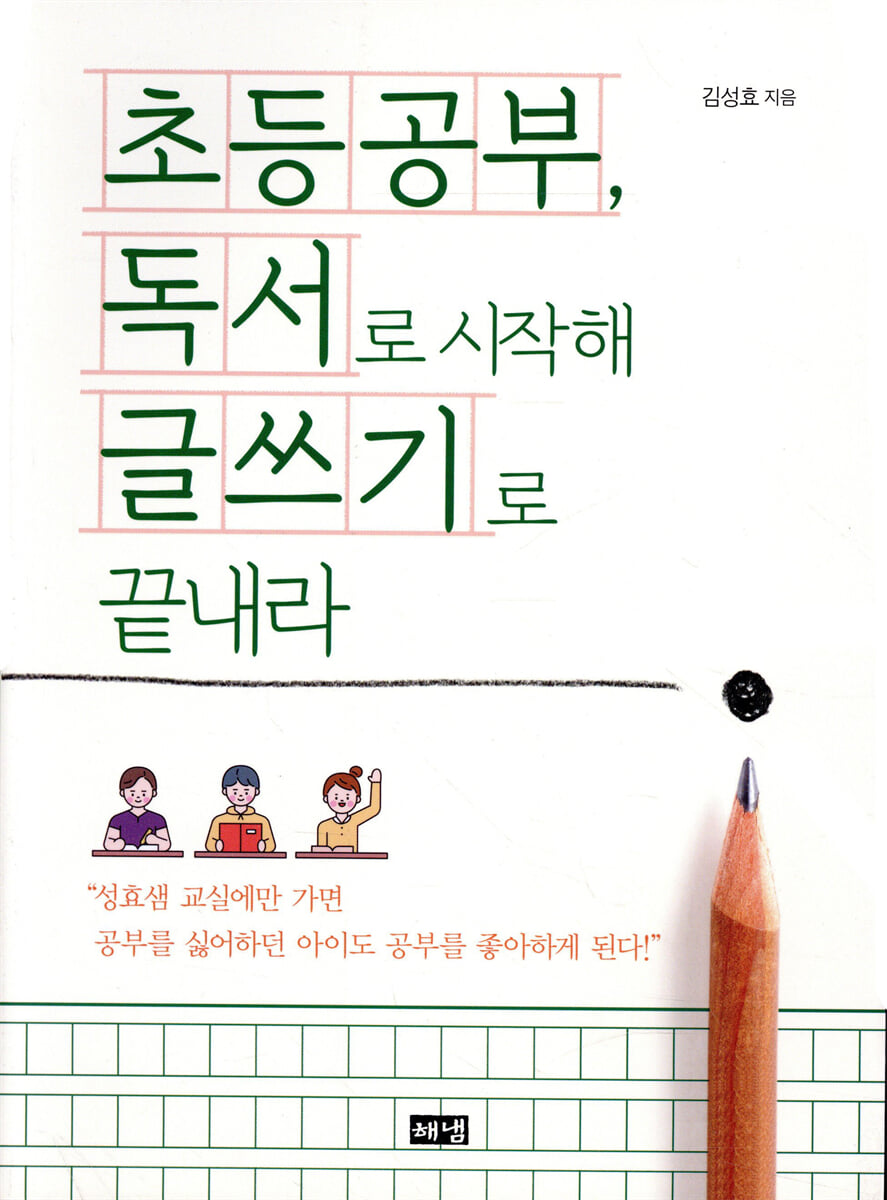
Elementary school studies: start with reading and end with writing.
 |
Description
Book Introduction
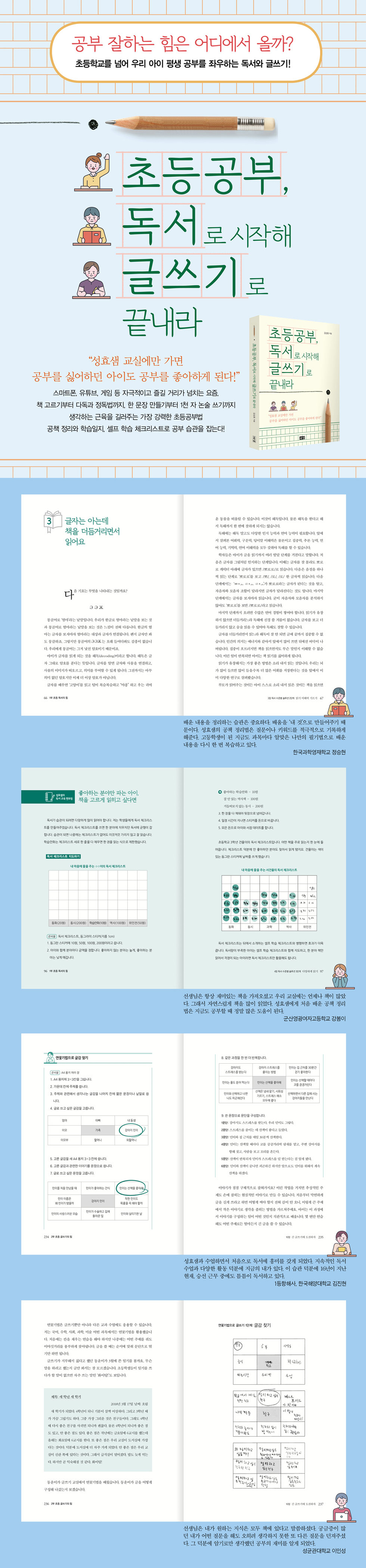
Reading and writing, which influence our children's studies throughout their lives beyond elementary school! These days, with so many exciting and enjoyable things to do, like smartphones, YouTube, and games, Discover a reading and writing education method that will help your child develop good study skills! An analysis of the 2015 Programme for International Student Assessment (PISA) reading scores shows that one in three middle and high school students in South Korea cannot read textbooks. According to the 2017 National Reading Survey, 40 percent of our adults did not read a single book in a year. Korea has a high literacy rate, but its ability to understand context is below the OECD average. It is natural that it is difficult to write when you cannot read. In this age of difficult reading and writing, what and how should we teach our children? The answer lies in consistent and correct reading and writing education during elementary school, when learning habits begin to form. However, at this time, real studies that children need to learn, such as reading and writing, seem relatively less important than English or math, which have immediate results. The problem starts from middle school. The process-oriented performance assessments implemented in middle school require students to write in various subjects, including observations, critiques, discussions, arguments, and essays. If a child did not read and write enough in elementary school, it is difficult to properly digest the material, so even children who did well in elementary school can easily give up on studying. Accordingly, Jeonbuk Provincial Office of Education Superintendent Kim Seong-hyo introduces realistic and sustainable reading and writing methods that can be used both at home and in the classroom through “Elementary School Studies: Start with Reading and End with Writing.” For 16 years, the author has helped countless children grow into good readers, writers, and students through reading and writing education that incorporates his own unique know-how. This book vividly explains everything from "why reading and writing are necessary" to "how reading and writing are accomplished," through proven and practical teaching methods and the various research results that support them. |
- You can preview some of the book's contents.
Preview
index
Foreword | The last student in the school tells the last student in the school: Reading and writing will change your life.
Part 1: The Power of Elementary Reading
Read Chapter 1: Let's get started with proper understanding.
1 How many books do people read in South Korea?
2 Some great man had to read dancing letters.
3 Reading books evolves our brains.
4 A child who reads the same book over and over again
Chapter 2: Reading Level-Based Solutions: Step 1: Reading Letters
1. The misconception that it is good to start reading early in life
2 Why should you read picture books yourself?
3 Should I read a book or teach letters?
Chapter 3: Level-Based Reading Solutions: Step 2: Developing Reading Comprehension
1 If you read a book but still don't know what it's about
2 There are so many words I don't know in the book.
I know three letters, but I'm reading the book while stumbling.
4 Studying is difficult | Read the textbook out loud
If you ask me to read a book even though I know only 5 letters,
Chapter 4: Customized Solutions for Each Reading Level: 3 Steps to Read in Different Ways
1 I don't read books, I just watch YouTube and use my smartphone.
2 A child who only wants to read educational comics
3. How to make a boy like books
4. Creating a Book Cafe at Home to Raise Book-Loving Children
5. Don't buy the complete collection, make it.
6 When Should You Read Sex Education Fairy Tales?
Chapter 5: Customized Solutions for Each Reading Level: 4-Step In-Depth Reading
1. Why do children who read a lot of fairy tales have difficulty reading textbooks?
2 If you read a long book and find it difficult to summarize the plot
3 I'm good at studying, but I don't want to read books.
4. How to Choose Between Extensive Reading and Intensive Reading
5. To develop reading skills that allow you to deeply understand books
6 Why Don't Teenagers Read?
Part 2: The Power of Elementary Writing
Chapter 6: Why Elementary Writing?
1. The world's most prestigious universities teach writing.
2 The less skilled you are at expressing your emotions, the more you need to write.
3 Ten Commandments of Elementary Writing
Chapter 7: Preparing for Elementary Writing
If you know the first letter, you can write pretty letters.
2 Writing a Manuscript: All You Need to Know
3 Ways to Use Writing Tools to Make Studying Easier
4. To write like Shakespeare, you need to be familiar with the Korean dictionary.
5 Dictation, can't it be made easier?
Chapter 8: Finding the Principles of Elementary Writing
1 Why does my child hate writing?
2. Writing Words: Playing with Words to Get Your Speech Started
3. Write a sentence: Play the Golden Sentence Game
4 Writing is Half the Battle: Writing Your Own First Words
5. Practice sentence response by increasing sentence length
Learn to describe by increasing the sentence length by 6
7 Let’s learn the metaphor as “□ is □”
Chapter 9: Easy Writing for Kids Who Hate Writing
1 Writing for Lower Grades with the 'Writing Three Musketeers'
2 Stop writing diaries that just list things that happened.
3 Play with stories like Goethe and Anthony Browne
4. Learning Decorating Words with Card Games
5 Collecting children's writing means respecting their writing.
Chapter 10: Let's Challenge Yourself to Long Writing
1. Knowing the lotus technique makes long writing easier.
2. Write paragraphs that group your thoughts into chunks.
3. Writing a Narrative Using the Lotus Technique: Travelogue
4. Writing a book report using the lotus technique
5 Writing an Essay Using the Lotus Technique
6. Writing articles that convey objective facts
7. Writing a self-introduction that confidently reveals yourself
8. Review with the 'Writing Self-Checklist'
Chapter 11: Writing That Makes Studying Easier
1. How to Conduct Process-Centered Performance Evaluations
2 Grade-Specific Writing Skills Children Learn in School
3. Making a Da Vinci Writing Notebook
4 Writing Checklists to Develop Writing Habits
5. Organizing your notebook and writing a study journal to make studying easier
Conclusion | Teacher, can my child do it too? |
Appendix | Teaching Korean in a Fun and Careful Way
Americas
Part 1: The Power of Elementary Reading
Read Chapter 1: Let's get started with proper understanding.
1 How many books do people read in South Korea?
2 Some great man had to read dancing letters.
3 Reading books evolves our brains.
4 A child who reads the same book over and over again
Chapter 2: Reading Level-Based Solutions: Step 1: Reading Letters
1. The misconception that it is good to start reading early in life
2 Why should you read picture books yourself?
3 Should I read a book or teach letters?
Chapter 3: Level-Based Reading Solutions: Step 2: Developing Reading Comprehension
1 If you read a book but still don't know what it's about
2 There are so many words I don't know in the book.
I know three letters, but I'm reading the book while stumbling.
4 Studying is difficult | Read the textbook out loud
If you ask me to read a book even though I know only 5 letters,
Chapter 4: Customized Solutions for Each Reading Level: 3 Steps to Read in Different Ways
1 I don't read books, I just watch YouTube and use my smartphone.
2 A child who only wants to read educational comics
3. How to make a boy like books
4. Creating a Book Cafe at Home to Raise Book-Loving Children
5. Don't buy the complete collection, make it.
6 When Should You Read Sex Education Fairy Tales?
Chapter 5: Customized Solutions for Each Reading Level: 4-Step In-Depth Reading
1. Why do children who read a lot of fairy tales have difficulty reading textbooks?
2 If you read a long book and find it difficult to summarize the plot
3 I'm good at studying, but I don't want to read books.
4. How to Choose Between Extensive Reading and Intensive Reading
5. To develop reading skills that allow you to deeply understand books
6 Why Don't Teenagers Read?
Part 2: The Power of Elementary Writing
Chapter 6: Why Elementary Writing?
1. The world's most prestigious universities teach writing.
2 The less skilled you are at expressing your emotions, the more you need to write.
3 Ten Commandments of Elementary Writing
Chapter 7: Preparing for Elementary Writing
If you know the first letter, you can write pretty letters.
2 Writing a Manuscript: All You Need to Know
3 Ways to Use Writing Tools to Make Studying Easier
4. To write like Shakespeare, you need to be familiar with the Korean dictionary.
5 Dictation, can't it be made easier?
Chapter 8: Finding the Principles of Elementary Writing
1 Why does my child hate writing?
2. Writing Words: Playing with Words to Get Your Speech Started
3. Write a sentence: Play the Golden Sentence Game
4 Writing is Half the Battle: Writing Your Own First Words
5. Practice sentence response by increasing sentence length
Learn to describe by increasing the sentence length by 6
7 Let’s learn the metaphor as “□ is □”
Chapter 9: Easy Writing for Kids Who Hate Writing
1 Writing for Lower Grades with the 'Writing Three Musketeers'
2 Stop writing diaries that just list things that happened.
3 Play with stories like Goethe and Anthony Browne
4. Learning Decorating Words with Card Games
5 Collecting children's writing means respecting their writing.
Chapter 10: Let's Challenge Yourself to Long Writing
1. Knowing the lotus technique makes long writing easier.
2. Write paragraphs that group your thoughts into chunks.
3. Writing a Narrative Using the Lotus Technique: Travelogue
4. Writing a book report using the lotus technique
5 Writing an Essay Using the Lotus Technique
6. Writing articles that convey objective facts
7. Writing a self-introduction that confidently reveals yourself
8. Review with the 'Writing Self-Checklist'
Chapter 11: Writing That Makes Studying Easier
1. How to Conduct Process-Centered Performance Evaluations
2 Grade-Specific Writing Skills Children Learn in School
3. Making a Da Vinci Writing Notebook
4 Writing Checklists to Develop Writing Habits
5. Organizing your notebook and writing a study journal to make studying easier
Conclusion | Teacher, can my child do it too? |
Appendix | Teaching Korean in a Fun and Careful Way
Americas
Detailed image
Into the book
There is no secret to why children say that studying became easier back then.
Our classroom focused on the essence of learning.
Reading, writing, memorizing, and counting.
I think this is the essence of studying.
Reading and writing are essential to developing the ability to study.
The effort to get to the essence of study is slow, but it is sure to be fruitful.
I experienced it myself first, and I realized it more deeply while teaching children.
All knowledge in the world is organized into language.
Mathematics is expressed in mathematical language, science in scientific language, and foreign languages in the languages of other countries.
A textbook is a book that systematically organizes a lot of knowledge that children must learn.
We call the various types of questions that ask how well you understand the book a "test," such as "Choose one out of four," "Choose all that are correct," "Write in short words," "Compare with your own thoughts," and "Write an opinion of more than 1,000 characters."
It's only natural that a child who is proficient in reading and writing will be confident in his or her studies.
---From the "Opening Remarks"
Our brain only works when countless nerve bundles are connected to each other.
A child's brain also develops by cooperating and complementing to solve difficult problems together.
Reading activates a wide range of brain regions, allowing you to complete complex reading tasks that cannot be accomplished with just a few brain regions.
Playing games and reading comics activate multiple areas, unlike some that activate only a few areas.
For this reason, studying or reading while listening to music is not a good choice.
As we've seen, our brains have to perform many complex tasks simultaneously while reading.
If the music has no linguistic information, it might be okay, but if the song has lyrics that contain meaning, the brain ends up being distracted trying to interpret the meaning.
Therefore, we can see that it is better to read a book in an environment where there is no visual distraction or auditory interference from other language information.
---From "Read Chapter 1, Let's Start by Understanding It Properly"
If you have trouble deciphering the words because you are fumbling with them, you won't be able to concentrate on the text until the end.
Human will is like energy, if you use too much of it in the front, it will run out in the back.
When your concentration is disrupted, you won't be able to understand what's being said while reading a book.
If this happens repeatedly, the child will start to hate reading.
The best way to become fluent in reading is to read out loud.
We have already seen in various studies that the more the brain listens, the more vocabulary it stores.
Whether read aloud by parents or by children themselves, the spoken language they hear while reading gradually builds up into language experience.
Children with improved vocabulary will read without stuttering when encountering unfamiliar words because they can infer from their past language experiences.
If it's easy to decipher, it's easy to read.
As reading becomes easier, children will seek out more books.
This is the virtuous cycle of reading.
Reading easy texts repeatedly will help you become fluent quickly.
As you become more fluent in reading, you will be able to focus better on the content.
You can also get better at reading because you use your concentration and willpower solely on reading.
---From "Chapter 3 Reading Level-Based Solutions: Step 2: Developing Reading Comprehension"
When recommending books to a boy who doesn't read, give him books related to his interests.
If your child likes insects, read books about insects, stories about great people who studied insects, fairy tales with insects as the main characters, or poetry collections featuring insects.
As children become familiar with books, their interests gradually expand to other fields.
I once taught a boy who loved baseball.
I don't read a single book, but I love baseball so much that I know how many threads there are in a baseball.
He said that he loved baseball so much that he memorized everything related to baseball.
I recommended a story book to my child about baseball player Jang Hoon.
The child read the book over and over again until it became tattered.
The child then read the story of Babe Ruth and the story of Chan Ho Park.
So I started looking for and reading books related to baseball, and later I started reading books on sports, and after I became familiar with books, I started reading books on other fields as well.
---From "Chapter 4 Reading Level-Based Solutions: 3 Steps to Read in Diverse Ways"
1.
Moving from writing that cultivates life to writing that changes lives.
2.
You can write honestly
3.
Let's benefit the world with good writing.
4.
Children are writers
5.
Writing is natural when it is edited by the writer.
6.
Writing isn't just about argument.
7.
Observation and research are the foundation of writing.
8.
The more you read, the more you write.
9.
I like the written word
10.
If you want to write well, write together
---From "The Ten Commandments of Elementary Writing"
Observation is a great way for elementary school students to practice writing.
Choosing one thing, looking at it in detail, and writing about it is the best way for children to write honestly and truthfully.
Observation is the foundation for writing.
Observation provides basic training to write about what you see, feel, and think.
Growing a small plant at home, observing its changes and writing about them will help children develop a keen eye for detail.
Along with observation, you must also diligently investigate.
Research is an essential part of a writer's writing process.
The attitude of seeking out and pondering things you are curious about becomes the foundation for writing and studying.
Develop a study habit by researching what you want to know more about and writing down what you find out.
---From "Chapter 6 Elementary Writing, Why Should We Do It?"
When you ask children why writing is difficult, most say they don't know where to start.
The best way to do this is to just write it down.
Don't try to write well, don't try to write cool, just write.
You can always fix a badly written sentence, but if you don't start, there will be no sentences to fix.
It's easy to get started if you have a familiar first word to start your writing.
Until the second grade, Eugene would start his writing with 'today' and 'I'.
It was something like, 'Today, I'm with my mom~', 'I'm at school~'.
When I was told to write a diary, I wrote some lyrics and went out to play.
If you don't struggle to start like Eugene, you can learn to write easily.
Some people say that you shouldn't use 'today' or 'I', but it's better to start with a familiar first word and correct it later.
In the diary that Eugene wrote in the third grade, there is no ‘I’ or ‘today.’
As you become more comfortable with writing, words like “today” and “I” will naturally disappear.
---From "Chapter 8: Finding the Principles of Elementary Writing"
I taught my students to look for golden sentences every time they read a book.
Practicing golden sentence spotting will help you identify the key sentences in any other text.
Once you get used to it, you'll be able to see the topic sentence and supporting sentences at a glance no matter what text you're reading.
Just as Eugene sets landmarks and memorizes the path, the reader begins writing a book review by finding golden sentences and guessing at the author's thoughts and intentions.
This also applies to novels and creative fairy tales.
Any piece of writing has a theme that the writer wants to talk about.
Because the author devotes so much energy to exploring the subject matter, a guide should follow, telling you which scenes were most memorable.
Please look carefully at the sentences and the main character's lines.
Our classroom focused on the essence of learning.
Reading, writing, memorizing, and counting.
I think this is the essence of studying.
Reading and writing are essential to developing the ability to study.
The effort to get to the essence of study is slow, but it is sure to be fruitful.
I experienced it myself first, and I realized it more deeply while teaching children.
All knowledge in the world is organized into language.
Mathematics is expressed in mathematical language, science in scientific language, and foreign languages in the languages of other countries.
A textbook is a book that systematically organizes a lot of knowledge that children must learn.
We call the various types of questions that ask how well you understand the book a "test," such as "Choose one out of four," "Choose all that are correct," "Write in short words," "Compare with your own thoughts," and "Write an opinion of more than 1,000 characters."
It's only natural that a child who is proficient in reading and writing will be confident in his or her studies.
---From the "Opening Remarks"
Our brain only works when countless nerve bundles are connected to each other.
A child's brain also develops by cooperating and complementing to solve difficult problems together.
Reading activates a wide range of brain regions, allowing you to complete complex reading tasks that cannot be accomplished with just a few brain regions.
Playing games and reading comics activate multiple areas, unlike some that activate only a few areas.
For this reason, studying or reading while listening to music is not a good choice.
As we've seen, our brains have to perform many complex tasks simultaneously while reading.
If the music has no linguistic information, it might be okay, but if the song has lyrics that contain meaning, the brain ends up being distracted trying to interpret the meaning.
Therefore, we can see that it is better to read a book in an environment where there is no visual distraction or auditory interference from other language information.
---From "Read Chapter 1, Let's Start by Understanding It Properly"
If you have trouble deciphering the words because you are fumbling with them, you won't be able to concentrate on the text until the end.
Human will is like energy, if you use too much of it in the front, it will run out in the back.
When your concentration is disrupted, you won't be able to understand what's being said while reading a book.
If this happens repeatedly, the child will start to hate reading.
The best way to become fluent in reading is to read out loud.
We have already seen in various studies that the more the brain listens, the more vocabulary it stores.
Whether read aloud by parents or by children themselves, the spoken language they hear while reading gradually builds up into language experience.
Children with improved vocabulary will read without stuttering when encountering unfamiliar words because they can infer from their past language experiences.
If it's easy to decipher, it's easy to read.
As reading becomes easier, children will seek out more books.
This is the virtuous cycle of reading.
Reading easy texts repeatedly will help you become fluent quickly.
As you become more fluent in reading, you will be able to focus better on the content.
You can also get better at reading because you use your concentration and willpower solely on reading.
---From "Chapter 3 Reading Level-Based Solutions: Step 2: Developing Reading Comprehension"
When recommending books to a boy who doesn't read, give him books related to his interests.
If your child likes insects, read books about insects, stories about great people who studied insects, fairy tales with insects as the main characters, or poetry collections featuring insects.
As children become familiar with books, their interests gradually expand to other fields.
I once taught a boy who loved baseball.
I don't read a single book, but I love baseball so much that I know how many threads there are in a baseball.
He said that he loved baseball so much that he memorized everything related to baseball.
I recommended a story book to my child about baseball player Jang Hoon.
The child read the book over and over again until it became tattered.
The child then read the story of Babe Ruth and the story of Chan Ho Park.
So I started looking for and reading books related to baseball, and later I started reading books on sports, and after I became familiar with books, I started reading books on other fields as well.
---From "Chapter 4 Reading Level-Based Solutions: 3 Steps to Read in Diverse Ways"
1.
Moving from writing that cultivates life to writing that changes lives.
2.
You can write honestly
3.
Let's benefit the world with good writing.
4.
Children are writers
5.
Writing is natural when it is edited by the writer.
6.
Writing isn't just about argument.
7.
Observation and research are the foundation of writing.
8.
The more you read, the more you write.
9.
I like the written word
10.
If you want to write well, write together
---From "The Ten Commandments of Elementary Writing"
Observation is a great way for elementary school students to practice writing.
Choosing one thing, looking at it in detail, and writing about it is the best way for children to write honestly and truthfully.
Observation is the foundation for writing.
Observation provides basic training to write about what you see, feel, and think.
Growing a small plant at home, observing its changes and writing about them will help children develop a keen eye for detail.
Along with observation, you must also diligently investigate.
Research is an essential part of a writer's writing process.
The attitude of seeking out and pondering things you are curious about becomes the foundation for writing and studying.
Develop a study habit by researching what you want to know more about and writing down what you find out.
---From "Chapter 6 Elementary Writing, Why Should We Do It?"
When you ask children why writing is difficult, most say they don't know where to start.
The best way to do this is to just write it down.
Don't try to write well, don't try to write cool, just write.
You can always fix a badly written sentence, but if you don't start, there will be no sentences to fix.
It's easy to get started if you have a familiar first word to start your writing.
Until the second grade, Eugene would start his writing with 'today' and 'I'.
It was something like, 'Today, I'm with my mom~', 'I'm at school~'.
When I was told to write a diary, I wrote some lyrics and went out to play.
If you don't struggle to start like Eugene, you can learn to write easily.
Some people say that you shouldn't use 'today' or 'I', but it's better to start with a familiar first word and correct it later.
In the diary that Eugene wrote in the third grade, there is no ‘I’ or ‘today.’
As you become more comfortable with writing, words like “today” and “I” will naturally disappear.
---From "Chapter 8: Finding the Principles of Elementary Writing"
I taught my students to look for golden sentences every time they read a book.
Practicing golden sentence spotting will help you identify the key sentences in any other text.
Once you get used to it, you'll be able to see the topic sentence and supporting sentences at a glance no matter what text you're reading.
Just as Eugene sets landmarks and memorizes the path, the reader begins writing a book review by finding golden sentences and guessing at the author's thoughts and intentions.
This also applies to novels and creative fairy tales.
Any piece of writing has a theme that the writer wants to talk about.
Because the author devotes so much energy to exploring the subject matter, a guide should follow, telling you which scenes were most memorable.
Please look carefully at the sentences and the main character's lines.
---From "Let's Challenge 10 Long Writings"
Publisher's Review
Penetrate the essence of study through reading and writing!
This book consists of 2 parts and 11 chapters.
Part 1, "The Power of Elementary Reading," presents step-by-step reading methods, from parents reading picture books to children selecting and reading books on their own.
It clearly answers the questions and concerns that many parents and teachers face in reading education.
For parents who are concerned about whether it would be a good idea to start reading early in life, we advise them to carefully examine whether their child's brain is ready to read, and recommend reading picture books and playing with books as a preparatory step for reading.
For children who stutter and have difficulty studying, we teach them the 'Seodang-style reading' method of reading out loud.
If you are good at reading storybooks but have difficulty reading textbooks, we suggest reading methods that vary depending on the genre through specific reading strategies.
Part 2, 'The Power of Elementary Writing', covers the basics, understanding, application, and advancement of writing, from writing correctly to writing a 1,000-character essay using the lotus technique.
For children who are unfamiliar with writing, we introduce Korean dictionary games, riddle poem writing, and onomatopoeia and mimetic word games that can be played with mothers, and teach them the joy of creating sentences.
Additionally, to ensure that writing is not just a one-time activity, we included activities that encourage students to find writing material using the lotus technique and write various types of writing, such as travelogues, book reports, and essays.
In particular, you can find friendly explanations on how to establish study habits through notebook organization, study logs, and self-checklists, and how to directly connect reading and writing with subject matter learning.
In the appendix, we have provided a fun and playful way to teach Korean letters to parents who are concerned about Korean language education.
Reading and writing becomes easier when parents and children do it together!
This book contains the author's vivid experience of teaching her two daughters, her know-how from her long experience teaching children in the classroom, and examples of one-on-one writing instruction for three boys in grades 3-6, making it a story that any parent or teacher who has to teach children can relate to.
In today's world, with so many stimulating and enjoyable things like smartphones, YouTube, and games, it's not easy to instill in children the habit of reading and developing a love of writing.
However, reading and writing cannot be neglected as they are important tools that lay the foundation for lifelong learning abilities such as deep thinking and understanding.
For this, the role of parents is more important than anything else.
To help children become familiar with books and find reading and writing a fun process, we need to play with books, read to them affectionately, talk with them, and write together.
The author says, 'Reading and writing are more powerful than any education we know.'
Seonghyo's reading education mentoring and writing tips, which are included throughout the book, are useful for everyone from elementary school students in the lower grades to the upper grades, from novice parents just starting out with learning guidance to veteran parents who want to acquire advanced know-how.
In particular, the author's affectionate encouragement contained in the text gives great courage and confidence to parents who are at a loss about how to guide their children's learning.
This book will serve as a helpful guide for parents who want to introduce children to the joys of reading and writing, and to foster healthy, independent learning habits that go beyond academic achievement and foster the core skills necessary for life.
It gives children a sense of accomplishment in studying and parents confidence in learning guidance.
Discover Seonghyo's amazing teaching secrets!
The reason I continue to read books and write short essays with my students is because of my earnest desire as a teacher to help them grow into adults who can think for themselves and empathize with others.
At the same time, from the perspective of a mother of a third-grade elementary school student who is concerned about her child's reading and writing skills, this book is full of practical and helpful know-how.
I'm really glad that there are methods that can be applied immediately at home as well as in the classroom.
If you are a parent raising an elementary school child or a teacher teaching reading and writing classes to children, I highly recommend reading this book.
Lee Kyung-ah | Middle school Korean teacher and mother of a third-grade elementary school student
Discover the fun of studying and find your dreams through Seonghyo's class!
“Mom, writing feels like building a castle with words.
“The process of completing the writing little by little is fun!” Dongwoon, who only liked building Legos and Gundams, experienced a pleasant change after meeting Seonghyo.
He takes out thick books and reads them on his own, and confidently prepares for discussion topics assigned by the school.
Now, Dongwoon seems to have realized that writing is not a scary activity, but can be a fun and playful process.
- Dongwoon's mother, Seo Yeonsu
I remember the faces of my two sons, who were just waiting for the day they would have their writing class with Seonghyo.
Not long after the writing class ended, the children won an encouragement award in a national book report contest and won an intramural science debate competition.
These days, I also write fantasy novels for fun.
As a father, I am simply amazed and grateful to see these children.
- Gunyul, Eunyul's father Seo Hyo-han
It is important to develop the habit of organizing what you have learned.
Because it makes learning ‘mine.’
Seonghyo's notebook organization method allows you to actively record questions and keywords.
Even now that I am a high school student, I am reviewing what I have learned using my own note-taking method that suits each subject.
- Jeong Seung-hyeon, Korea Science Academy
Our teacher always brought interesting books, and there were always lots of books in our classroom.
So naturally, I read a lot of books.
The notebook organization method I first learned from Seonghyo is still very helpful when studying.
- Kang Bom-i, Gunsan Yeonggwang Girls' High School
I used to only like watching TV, but things changed when I became a student of Seonghyo's class.
I learned how to concentrate by listening in class and taking diligent notes.
For the first time, I wanted to study well.
That one year of experience still helps me grow.
- Lee Tae-ho, Seoul Metropolitan University
My teacher told me that all the knowledge I wanted was in the book.
No matter what question I asked, he would ask me another question I hadn't thought of.
Thanks to that, I discovered the fun of studying, which I had only thought of as memorization.
- Lee In-seong, Sungkyunkwan University
Seonghyo is the only teacher I remember from my childhood, and he is the best teacher.
The teacher emphasized organizing notebooks very much.
After reading and writing the way the teacher taught me for a year, it naturally became the beginning of my studies.
The habits I developed back then are still helping me with my studies now that I am a college student.
- Kim Hyeon-seong, Jeonbuk National University
Habits such as studying and reading are usually established before puberty.
If you miss this time, it will be very difficult to correct your habits and adapt to future studies.
In fact, at this turning point, many of my friends around me fell away.
When I was in sixth grade, I was losing interest in writing, reading, and even studying my subjects.
That's when I met Seonghyo.
All the children in the class recited poetry and read the Analects together.
Thanks to this, I was able to move forward with interest in new studies.
- Jeong Se-young, Chonnam National University
This book consists of 2 parts and 11 chapters.
Part 1, "The Power of Elementary Reading," presents step-by-step reading methods, from parents reading picture books to children selecting and reading books on their own.
It clearly answers the questions and concerns that many parents and teachers face in reading education.
For parents who are concerned about whether it would be a good idea to start reading early in life, we advise them to carefully examine whether their child's brain is ready to read, and recommend reading picture books and playing with books as a preparatory step for reading.
For children who stutter and have difficulty studying, we teach them the 'Seodang-style reading' method of reading out loud.
If you are good at reading storybooks but have difficulty reading textbooks, we suggest reading methods that vary depending on the genre through specific reading strategies.
Part 2, 'The Power of Elementary Writing', covers the basics, understanding, application, and advancement of writing, from writing correctly to writing a 1,000-character essay using the lotus technique.
For children who are unfamiliar with writing, we introduce Korean dictionary games, riddle poem writing, and onomatopoeia and mimetic word games that can be played with mothers, and teach them the joy of creating sentences.
Additionally, to ensure that writing is not just a one-time activity, we included activities that encourage students to find writing material using the lotus technique and write various types of writing, such as travelogues, book reports, and essays.
In particular, you can find friendly explanations on how to establish study habits through notebook organization, study logs, and self-checklists, and how to directly connect reading and writing with subject matter learning.
In the appendix, we have provided a fun and playful way to teach Korean letters to parents who are concerned about Korean language education.
Reading and writing becomes easier when parents and children do it together!
This book contains the author's vivid experience of teaching her two daughters, her know-how from her long experience teaching children in the classroom, and examples of one-on-one writing instruction for three boys in grades 3-6, making it a story that any parent or teacher who has to teach children can relate to.
In today's world, with so many stimulating and enjoyable things like smartphones, YouTube, and games, it's not easy to instill in children the habit of reading and developing a love of writing.
However, reading and writing cannot be neglected as they are important tools that lay the foundation for lifelong learning abilities such as deep thinking and understanding.
For this, the role of parents is more important than anything else.
To help children become familiar with books and find reading and writing a fun process, we need to play with books, read to them affectionately, talk with them, and write together.
The author says, 'Reading and writing are more powerful than any education we know.'
Seonghyo's reading education mentoring and writing tips, which are included throughout the book, are useful for everyone from elementary school students in the lower grades to the upper grades, from novice parents just starting out with learning guidance to veteran parents who want to acquire advanced know-how.
In particular, the author's affectionate encouragement contained in the text gives great courage and confidence to parents who are at a loss about how to guide their children's learning.
This book will serve as a helpful guide for parents who want to introduce children to the joys of reading and writing, and to foster healthy, independent learning habits that go beyond academic achievement and foster the core skills necessary for life.
It gives children a sense of accomplishment in studying and parents confidence in learning guidance.
Discover Seonghyo's amazing teaching secrets!
The reason I continue to read books and write short essays with my students is because of my earnest desire as a teacher to help them grow into adults who can think for themselves and empathize with others.
At the same time, from the perspective of a mother of a third-grade elementary school student who is concerned about her child's reading and writing skills, this book is full of practical and helpful know-how.
I'm really glad that there are methods that can be applied immediately at home as well as in the classroom.
If you are a parent raising an elementary school child or a teacher teaching reading and writing classes to children, I highly recommend reading this book.
Lee Kyung-ah | Middle school Korean teacher and mother of a third-grade elementary school student
Discover the fun of studying and find your dreams through Seonghyo's class!
“Mom, writing feels like building a castle with words.
“The process of completing the writing little by little is fun!” Dongwoon, who only liked building Legos and Gundams, experienced a pleasant change after meeting Seonghyo.
He takes out thick books and reads them on his own, and confidently prepares for discussion topics assigned by the school.
Now, Dongwoon seems to have realized that writing is not a scary activity, but can be a fun and playful process.
- Dongwoon's mother, Seo Yeonsu
I remember the faces of my two sons, who were just waiting for the day they would have their writing class with Seonghyo.
Not long after the writing class ended, the children won an encouragement award in a national book report contest and won an intramural science debate competition.
These days, I also write fantasy novels for fun.
As a father, I am simply amazed and grateful to see these children.
- Gunyul, Eunyul's father Seo Hyo-han
It is important to develop the habit of organizing what you have learned.
Because it makes learning ‘mine.’
Seonghyo's notebook organization method allows you to actively record questions and keywords.
Even now that I am a high school student, I am reviewing what I have learned using my own note-taking method that suits each subject.
- Jeong Seung-hyeon, Korea Science Academy
Our teacher always brought interesting books, and there were always lots of books in our classroom.
So naturally, I read a lot of books.
The notebook organization method I first learned from Seonghyo is still very helpful when studying.
- Kang Bom-i, Gunsan Yeonggwang Girls' High School
I used to only like watching TV, but things changed when I became a student of Seonghyo's class.
I learned how to concentrate by listening in class and taking diligent notes.
For the first time, I wanted to study well.
That one year of experience still helps me grow.
- Lee Tae-ho, Seoul Metropolitan University
My teacher told me that all the knowledge I wanted was in the book.
No matter what question I asked, he would ask me another question I hadn't thought of.
Thanks to that, I discovered the fun of studying, which I had only thought of as memorization.
- Lee In-seong, Sungkyunkwan University
Seonghyo is the only teacher I remember from my childhood, and he is the best teacher.
The teacher emphasized organizing notebooks very much.
After reading and writing the way the teacher taught me for a year, it naturally became the beginning of my studies.
The habits I developed back then are still helping me with my studies now that I am a college student.
- Kim Hyeon-seong, Jeonbuk National University
Habits such as studying and reading are usually established before puberty.
If you miss this time, it will be very difficult to correct your habits and adapt to future studies.
In fact, at this turning point, many of my friends around me fell away.
When I was in sixth grade, I was losing interest in writing, reading, and even studying my subjects.
That's when I met Seonghyo.
All the children in the class recited poetry and read the Analects together.
Thanks to this, I was able to move forward with interest in new studies.
- Jeong Se-young, Chonnam National University
GOODS SPECIFICS
- Date of issue: August 8, 2019
- Page count, weight, size: 332 pages | 638g | 166*226*30mm
- ISBN13: 9788965749561
- ISBN10: 8965749565
You may also like
카테고리
korean


korean

![GQ KOREA Mark (Monthly): December [2025]](http://librairie.coreenne.fr/cdn/shop/files/8ef265dbbfbf186523ed75ba7319009d.jpg?v=1765340328&width=3840)


