

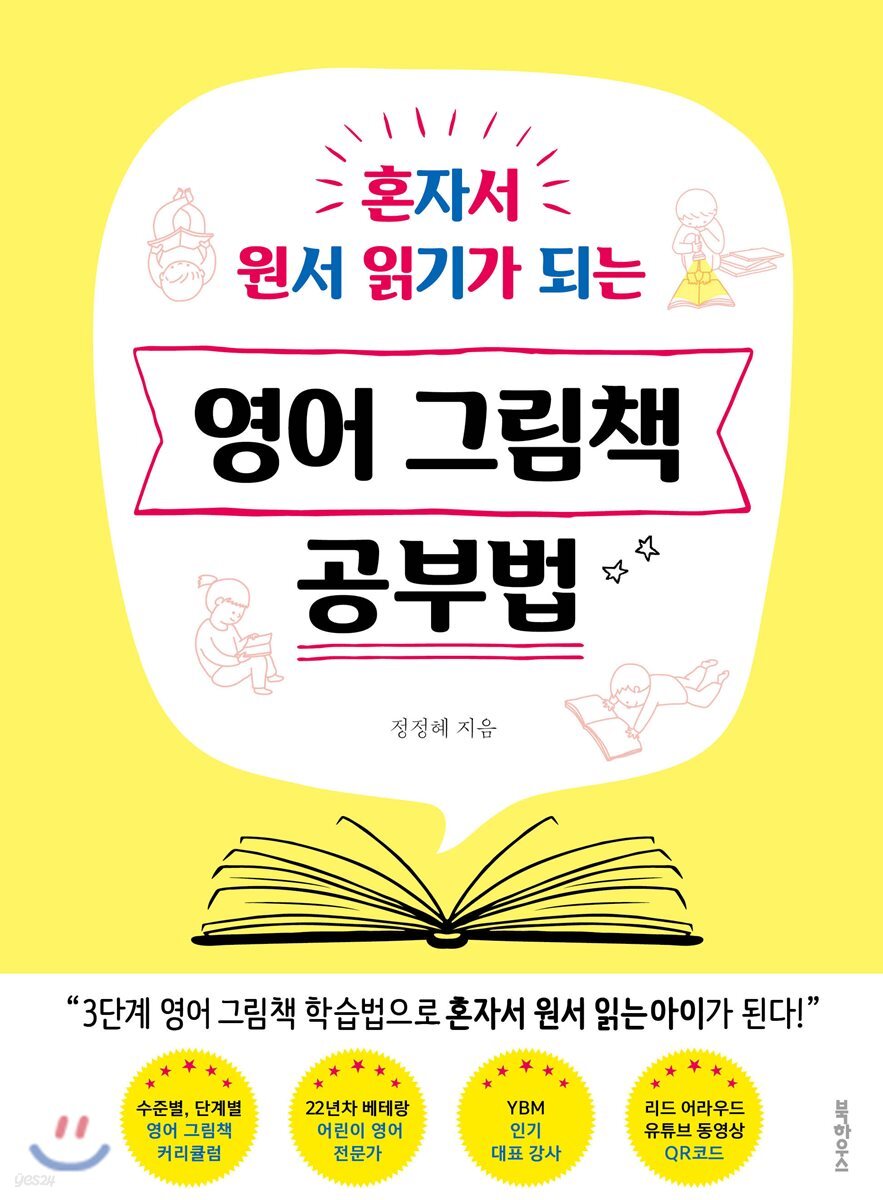
How to study English picture books
 |
Description
Book Introduction
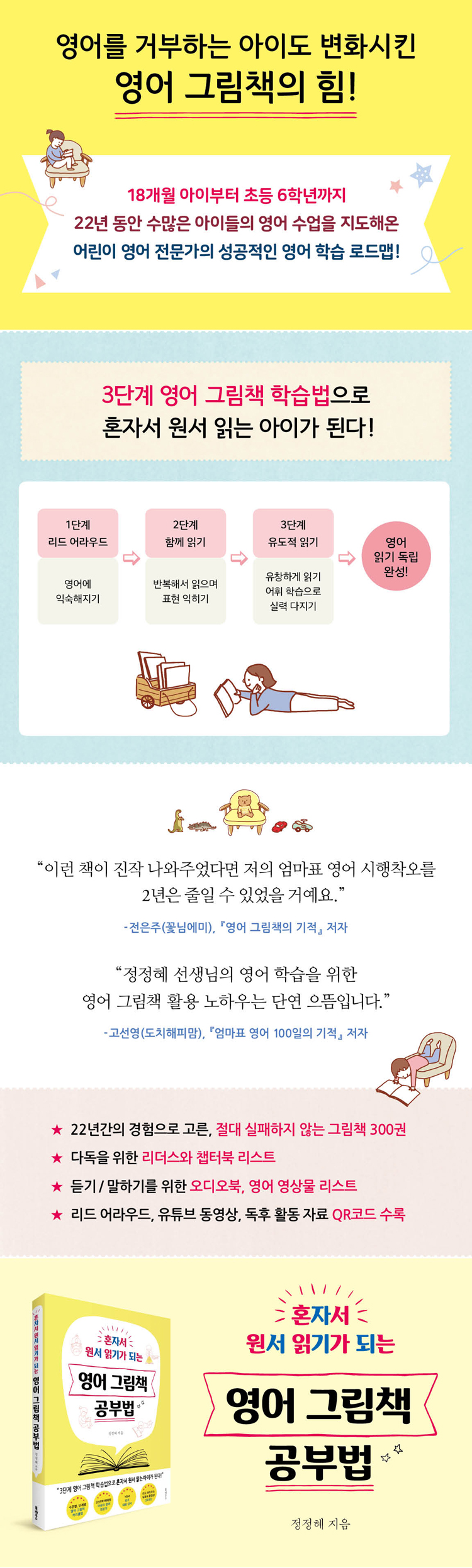
Even children who refused to speak English were transformed.
The power of English picture books!
From 18 months to 6th grade
Having taught English classes to countless children for 22 years,
A roadmap for successful English learning from a children's English expert!
When children begin to learn English, the first goal that mothers dream of is 'the child reading original texts on his or her own.'
After this stage, the burden on parents will also be significantly reduced.
However, many parents are confused about how to guide their children until they can read books on their own.
How can children learn English effectively, without getting bored, while still having fun? Author Jeong Jeong-hye, a 22-year veteran expert in children's English education who has taught countless children since 1998, has highlighted the miraculous effects of English picture book instruction.
The power of English picture books was so amazing that even a child who hated English would become completely absorbed in learning English in just three months with an English picture book class once a week.
Accordingly, author Jeong Jeong-hye organized the English picture book learning method into three levels according to level, and published 『English Picture Book Study Method』, which introduces English learning guidance methods and recommended English picture books for each level.
For parents who want to teach English to their children, we have compiled 22 years of English teaching know-how.
In particular, 『English Picture Book Study Method』, which contains 300 failproof English picture books carefully selected by the author based on many years of experience, will be the most reliable prescription for parents who feel unfamiliar and overwhelmed when choosing even a single English book.
The power of English picture books!
From 18 months to 6th grade
Having taught English classes to countless children for 22 years,
A roadmap for successful English learning from a children's English expert!
When children begin to learn English, the first goal that mothers dream of is 'the child reading original texts on his or her own.'
After this stage, the burden on parents will also be significantly reduced.
However, many parents are confused about how to guide their children until they can read books on their own.
How can children learn English effectively, without getting bored, while still having fun? Author Jeong Jeong-hye, a 22-year veteran expert in children's English education who has taught countless children since 1998, has highlighted the miraculous effects of English picture book instruction.
The power of English picture books was so amazing that even a child who hated English would become completely absorbed in learning English in just three months with an English picture book class once a week.
Accordingly, author Jeong Jeong-hye organized the English picture book learning method into three levels according to level, and published 『English Picture Book Study Method』, which introduces English learning guidance methods and recommended English picture books for each level.
For parents who want to teach English to their children, we have compiled 22 years of English teaching know-how.
In particular, 『English Picture Book Study Method』, which contains 300 failproof English picture books carefully selected by the author based on many years of experience, will be the most reliable prescription for parents who feel unfamiliar and overwhelmed when choosing even a single English book.
- You can preview some of the book's contents.
Preview
index
Reading the Prologue: The Surest Door to Independence: English Picture Books
Part 1: How to Use English Picture Books for English Learning
The goal of Mom's English: Children reading original texts on their own.
Why English Picture Books?
Build your English skills with 3-step reading skills.
The allure of picture books that anyone can't help but fall for
How to Build Confidence in a Child Who Is Afraid of English
※ Board book? Hardcover? What book should I buy?
Picture Book Study Counseling Room
- How many times should a picture book be read to help my child learn English? - My English pronunciation isn't very good. Can I read English picture books to my child?
Part 2, Step 1: Read-Aloud with Parents
Read Aloud, a time to get familiar with English
Preparing for an Effective Lead Around
※ Do I really need to do pre-reading activities for English picture books?
Picture books that are good to read at the read-around stage
Good Night, Gorilla, a bedtime story full of humor and twists
How Do You Feel?, Anthony Browne's emotional picture book
"It Looked Like Spilt Milk," a beautiful picture book beloved for 70 years.
Where Is the Green Sheep?, a magic trick that makes any answer the right answer.
『Dot』, a world expressed through a single circle
Goodnight Moon, a classic bedtime story
※ Why is rhyme important in English?
"You Are (Not) Small": I am me! A book that boosts self-esteem.
Rhyming Dust Bunnies, a fun rhyming game with dust bunnies
"Pete the Cat I Love My White Shoes," a song by cool cat Pete
Duck! Rabbit!, a good example of a good argument.
『There Was an Old Lady Who Swallowed a Fly』, Oh my! The old lady swallowed a cow!
"That Is Not a Good Idea!", a picture book that feels like watching a thrilling play.
Tap the Magic Tree: A Beautiful Transformation Made with a Single Gesture
『There Are Cats in This Book』, everyone who wants to play with cats, gather together!
『Penguin』, an unexpected twist
About Mother Goose and Learning English
Reading ability index that indicates the difficulty of a book
※ Onomatopoeia and mimetic words for animals expressed in English
Picture Book Study Counseling Room
- When I read to my child in English, he keeps asking me to explain it in Korean.
- I don't like English picture books because they are difficult.
Would you like me to read it along with the Korean translation?
Part 3, Step 2: Parents and Children Read Together
Build your English confidence through repeated reading
English learning starts with the reading together stage
Picture books that are good to read during the reading together stage
"Rosie's Walk" is a great picture book for learning prepositions!
"I'm the Biggest Thing in the Ocean!", a comparative lesson from a boastful octopus.
Hippo Has a Hat, a shopping story about stylish animals
※ English sounds and consonants that are different from Korean
Butterfly: A Book of Colors, a butterfly that captivates both children and adults.
The Chick and the Duckling, A Chick Stands Alone
『Bear about Town』, a week-long tour of the town with a bear
『David Goes to School』, Troublemaker David goes to school!
My Crayons Talk: A Magical Story Told by Crayons
Handa's Surprise: Discover African Fruits and Animals
『Each Peach Pear Plum』, find the hidden picture and even Mother Goose!
『My Dad』, I love my dad the most in the world!
Bark, George, the story of George, the dog who couldn't bark
『Llama Llama Red Pajama』, the cute antics of a baby llama who doesn't want to sleep alone.
『A Dragon on the Doorstep』, if we play hide-and-seek with animals at home
"Little Blue and Little Yellow," a classic picture book born from two pieces of colored paper. The truth about phonics you've always wanted to know.
Learning sight words, the foundation for reading
Listening/speaking training method that opens your ears and opens your mouth
※ List of audiobooks helpful for reading and listening
Picture Book Study Counseling Room
- When is the right time to practice speaking with a native English teacher? - When is the best time to start writing in English?
Part 4, Step 3: Inductive Reading for Children Who Are Trying to Read Independently
Guided reading that combines intensive and extensive reading
Picture books that are good to read during the inductive reading stage
『This Is Not My Hat』, a picture book that won both the Caldecott Medal and the Kate Greenaway Medal.
"The Watermelon Seed": 250 Picture Books That Make Even the Sounds Delicious
※ The Geisel Award is perfect for children who are just beginning to read.
『Mr.
Tiger Goes Wild, a story about a tiger who breaks free from formality.
『Knock Knock Who's There?』, cute monsters knocking on doors
"Are We There Yet?", a picture book that feels like watching an adventure movie.
『Hi! Fly Guy』, Can flies be pets?
『Suddenly!』, the misguided encounter between Preston the pig and the wolf
Where the Wild Things Are, the 20th century's best-selling picture book
The Crocodile Who Didn't Like Water, a beautifully reimagined modern-day version of the ugly duckling.
Pete's a Pizza, a full-body pizza game with your child
『I Don't Want to Be a Frog』, If Everyone Else Seems Happy Except Me
Mister Seahorse, father fish carrying eggs
The Gruffalo: A New Monster to Replace the Wolf
※ Julia Donaldson's book that became a movie
Night Monkey Day Monkey: A Fun Way to Learn Synonyms and Antonyms
"Interrupting Chicken," a story about a baby chicken who needs endless bedtime stories.
A list of leaders and chapter books for reading aloud
How to Choose an English Picture Dictionary
How to use English videos and DVDs?
※ TV series and movies based on picture books
Picture Book Study Counseling Room
- Where can I get English picture books?
- Should I absolutely read award-winning picture books and books recommended by leading American institutions?
Appendix: List of recommended English picture books by topic
Part 1: How to Use English Picture Books for English Learning
The goal of Mom's English: Children reading original texts on their own.
Why English Picture Books?
Build your English skills with 3-step reading skills.
The allure of picture books that anyone can't help but fall for
How to Build Confidence in a Child Who Is Afraid of English
※ Board book? Hardcover? What book should I buy?
Picture Book Study Counseling Room
- How many times should a picture book be read to help my child learn English? - My English pronunciation isn't very good. Can I read English picture books to my child?
Part 2, Step 1: Read-Aloud with Parents
Read Aloud, a time to get familiar with English
Preparing for an Effective Lead Around
※ Do I really need to do pre-reading activities for English picture books?
Picture books that are good to read at the read-around stage
Good Night, Gorilla, a bedtime story full of humor and twists
How Do You Feel?, Anthony Browne's emotional picture book
"It Looked Like Spilt Milk," a beautiful picture book beloved for 70 years.
Where Is the Green Sheep?, a magic trick that makes any answer the right answer.
『Dot』, a world expressed through a single circle
Goodnight Moon, a classic bedtime story
※ Why is rhyme important in English?
"You Are (Not) Small": I am me! A book that boosts self-esteem.
Rhyming Dust Bunnies, a fun rhyming game with dust bunnies
"Pete the Cat I Love My White Shoes," a song by cool cat Pete
Duck! Rabbit!, a good example of a good argument.
『There Was an Old Lady Who Swallowed a Fly』, Oh my! The old lady swallowed a cow!
"That Is Not a Good Idea!", a picture book that feels like watching a thrilling play.
Tap the Magic Tree: A Beautiful Transformation Made with a Single Gesture
『There Are Cats in This Book』, everyone who wants to play with cats, gather together!
『Penguin』, an unexpected twist
About Mother Goose and Learning English
Reading ability index that indicates the difficulty of a book
※ Onomatopoeia and mimetic words for animals expressed in English
Picture Book Study Counseling Room
- When I read to my child in English, he keeps asking me to explain it in Korean.
- I don't like English picture books because they are difficult.
Would you like me to read it along with the Korean translation?
Part 3, Step 2: Parents and Children Read Together
Build your English confidence through repeated reading
English learning starts with the reading together stage
Picture books that are good to read during the reading together stage
"Rosie's Walk" is a great picture book for learning prepositions!
"I'm the Biggest Thing in the Ocean!", a comparative lesson from a boastful octopus.
Hippo Has a Hat, a shopping story about stylish animals
※ English sounds and consonants that are different from Korean
Butterfly: A Book of Colors, a butterfly that captivates both children and adults.
The Chick and the Duckling, A Chick Stands Alone
『Bear about Town』, a week-long tour of the town with a bear
『David Goes to School』, Troublemaker David goes to school!
My Crayons Talk: A Magical Story Told by Crayons
Handa's Surprise: Discover African Fruits and Animals
『Each Peach Pear Plum』, find the hidden picture and even Mother Goose!
『My Dad』, I love my dad the most in the world!
Bark, George, the story of George, the dog who couldn't bark
『Llama Llama Red Pajama』, the cute antics of a baby llama who doesn't want to sleep alone.
『A Dragon on the Doorstep』, if we play hide-and-seek with animals at home
"Little Blue and Little Yellow," a classic picture book born from two pieces of colored paper. The truth about phonics you've always wanted to know.
Learning sight words, the foundation for reading
Listening/speaking training method that opens your ears and opens your mouth
※ List of audiobooks helpful for reading and listening
Picture Book Study Counseling Room
- When is the right time to practice speaking with a native English teacher? - When is the best time to start writing in English?
Part 4, Step 3: Inductive Reading for Children Who Are Trying to Read Independently
Guided reading that combines intensive and extensive reading
Picture books that are good to read during the inductive reading stage
『This Is Not My Hat』, a picture book that won both the Caldecott Medal and the Kate Greenaway Medal.
"The Watermelon Seed": 250 Picture Books That Make Even the Sounds Delicious
※ The Geisel Award is perfect for children who are just beginning to read.
『Mr.
Tiger Goes Wild, a story about a tiger who breaks free from formality.
『Knock Knock Who's There?』, cute monsters knocking on doors
"Are We There Yet?", a picture book that feels like watching an adventure movie.
『Hi! Fly Guy』, Can flies be pets?
『Suddenly!』, the misguided encounter between Preston the pig and the wolf
Where the Wild Things Are, the 20th century's best-selling picture book
The Crocodile Who Didn't Like Water, a beautifully reimagined modern-day version of the ugly duckling.
Pete's a Pizza, a full-body pizza game with your child
『I Don't Want to Be a Frog』, If Everyone Else Seems Happy Except Me
Mister Seahorse, father fish carrying eggs
The Gruffalo: A New Monster to Replace the Wolf
※ Julia Donaldson's book that became a movie
Night Monkey Day Monkey: A Fun Way to Learn Synonyms and Antonyms
"Interrupting Chicken," a story about a baby chicken who needs endless bedtime stories.
A list of leaders and chapter books for reading aloud
How to Choose an English Picture Dictionary
How to use English videos and DVDs?
※ TV series and movies based on picture books
Picture Book Study Counseling Room
- Where can I get English picture books?
- Should I absolutely read award-winning picture books and books recommended by leading American institutions?
Appendix: List of recommended English picture books by topic
Detailed image
Into the book
If you look at English picture books, you'll often find that they have repetitive sentence patterns.
Through these picture books, children can naturally learn English sentence structure and expand their vocabulary.
And unlike adults, children can easily create new sentences using basic sentences from picture books.
- Page 23, [Part 1: English Picture Books: How to Use Them for English Learning]
Sometimes, mothers worry that their English pronunciation is not good and that it is okay for them to read English picture books to their children.
Because of my job, I often have the opportunity to meet people who have successfully implemented the Mom's English method, and the common characteristic among them is not their 'English skills.'
It is ‘passion’ and ‘persistence’.
Since your child hears English sounds not only from you, you don't have to worry about him or her imitating your English pronunciation.
Above all, if the amount of time a child spends watching English videos or listening to audiobooks is significantly greater than that spent listening to their mother's voice, their overall pronunciation will shift towards the sounds they hear most.
So don't worry and read more English picture books to your child, more often.
- Page 36, [Part 1: How to Use English Picture Books for English Learning]
For the read-aloud stage, you should choose easy picture books.
Many parents perceive read-aloud as a form of English learning, and tend to avoid choosing picture books that mainly feature words their children already know, fearing that they will not be effective in learning.
However, the read-around stage is the stage where a child is first exposed to English picture books.
Even if children have few unfamiliar words, they are not yet familiar with the structure of the English language, so we need to focus on providing them with a variety of English sentences and allowing them to enjoy English in its original form.
- Page 48, [Part 2, Step 1, Read-Aloud for Parents]
In any case, when reading English picture books and translations together for the purpose of learning English, it is good to remember that the Korean interpretation limits the meaning of the original text.
Above all, when you encounter an unfamiliar word while reading an English book, I hope you remember the power of guessing its meaning from the context of the sentence, and the process of that ambiguity becoming clear through repeated, similar experiences.
Because that power will be the power that leads the child to think in English and express himself in English.
- Page 137, [Part 2, Step 1, Read-Aloud for Parents]
Writing can only be properly implemented when there is sufficient English input, such as listening and reading.
So don't rush, and only when you have read and listened enough to naturally understand English sentence structure and can use short sentences on your own can you start writing in earnest.
Because Korean children's speaking skills are considerably lower than their reading skills, it is better to use the time when a child can speak English and make sentences in English as a standard rather than the time when the child reads a certain level of books.
- Page 235, [Part 3, Step 2, Parents and Children Reading Together]
Our children who learn English as a foreign language have to spend time studying vocabulary separately to learn it, unlike native speakers who acquire it naturally.
To learn basic vocabulary in a short period of time, it is helpful to use an English picture dictionary during the reading-along or inductive reading stages.
Vocabulary can be broadly divided into function words, such as never, she, yet, and any, whose meaning is conveyed within a sentence, and content words, such as mouse, water, and chair, which have clear meanings in themselves. An English picture dictionary is very useful when learning the latter.
Through these picture books, children can naturally learn English sentence structure and expand their vocabulary.
And unlike adults, children can easily create new sentences using basic sentences from picture books.
- Page 23, [Part 1: English Picture Books: How to Use Them for English Learning]
Sometimes, mothers worry that their English pronunciation is not good and that it is okay for them to read English picture books to their children.
Because of my job, I often have the opportunity to meet people who have successfully implemented the Mom's English method, and the common characteristic among them is not their 'English skills.'
It is ‘passion’ and ‘persistence’.
Since your child hears English sounds not only from you, you don't have to worry about him or her imitating your English pronunciation.
Above all, if the amount of time a child spends watching English videos or listening to audiobooks is significantly greater than that spent listening to their mother's voice, their overall pronunciation will shift towards the sounds they hear most.
So don't worry and read more English picture books to your child, more often.
- Page 36, [Part 1: How to Use English Picture Books for English Learning]
For the read-aloud stage, you should choose easy picture books.
Many parents perceive read-aloud as a form of English learning, and tend to avoid choosing picture books that mainly feature words their children already know, fearing that they will not be effective in learning.
However, the read-around stage is the stage where a child is first exposed to English picture books.
Even if children have few unfamiliar words, they are not yet familiar with the structure of the English language, so we need to focus on providing them with a variety of English sentences and allowing them to enjoy English in its original form.
- Page 48, [Part 2, Step 1, Read-Aloud for Parents]
In any case, when reading English picture books and translations together for the purpose of learning English, it is good to remember that the Korean interpretation limits the meaning of the original text.
Above all, when you encounter an unfamiliar word while reading an English book, I hope you remember the power of guessing its meaning from the context of the sentence, and the process of that ambiguity becoming clear through repeated, similar experiences.
Because that power will be the power that leads the child to think in English and express himself in English.
- Page 137, [Part 2, Step 1, Read-Aloud for Parents]
Writing can only be properly implemented when there is sufficient English input, such as listening and reading.
So don't rush, and only when you have read and listened enough to naturally understand English sentence structure and can use short sentences on your own can you start writing in earnest.
Because Korean children's speaking skills are considerably lower than their reading skills, it is better to use the time when a child can speak English and make sentences in English as a standard rather than the time when the child reads a certain level of books.
- Page 235, [Part 3, Step 2, Parents and Children Reading Together]
Our children who learn English as a foreign language have to spend time studying vocabulary separately to learn it, unlike native speakers who acquire it naturally.
To learn basic vocabulary in a short period of time, it is helpful to use an English picture dictionary during the reading-along or inductive reading stages.
Vocabulary can be broadly divided into function words, such as never, she, yet, and any, whose meaning is conveyed within a sentence, and content words, such as mouse, water, and chair, which have clear meanings in themselves. An English picture dictionary is very useful when learning the latter.
- Page 314, [Part 4, Step 3, Inductive Reading for Children Challenging Independent Reading]
Publisher's Review
※ The address of the video linked to the QR code in the book has changed.
If you go to the address below, you can watch read-around videos for all the picture books in the book.
https://blog.naver.com/ourteacher/222233943966
“Become a child who can read original books on their own with the 3-step English picture book learning method!”
A solid guide for parents who want to teach their children English.
"How to Study English Picture Books" organizes three levels of English literacy skills based on the "Balanced Literacy Method," the most widely used theory in the field of English literacy.
There are three levels: Read Around (Level 1), which helps children become familiar with the structure of the English language; Shared Reading (Level 2), in which parents and children repeatedly read English picture books together to learn English expressions; and Inductive Reading (Level 3), which involves practicing independent reading while simultaneously engaging in intensive and extensive reading.
Through these three steps, the child will finally be able to read English books on his own and become independent in reading English.
This book provides specific step-by-step learning methods.
It provides detailed information on the English learning required for each child's English level and picture books that are good to read at that age, and also provides specific guidance on when to move on to the next level.
In particular, considering the characteristics of Korean children who often learn English for the first time while attending kindergarten or elementary school, we have included learning methods and recommended books that are perfect for children who have a low level of English but a high level of cognition.
Each picture book includes a read-aloud video QR code, along with detailed information on key vocabulary, key sentences, and English reading skills, allowing parents who previously found it difficult to read English picture books to their children to confidently attempt it.
A child who has to start with the alphabet, a child who hates English,
For children who have mastered phonics but cannot read English books
The only answer: How to study English picture books!
Many parents expect that once their child has mastered phonics, he or she will be able to read English books on his or her own.
But this is a common misconception among parents.
If a child does not have the structure of the English language in his or her head, he or she will not be able to read English books on his or her own even after learning phonics.
So what we need is a method to study English picture books.
It is essential for parents to read English picture books to their children and watch English videos to help them acquire English.
"How to Study English Picture Books" covers not only English picture books, but also detailed English learning methods that should be conducted at each stage, such as phonics, sight words, word study, listening/speaking training, and writing activities.
In particular, it contains all the recommended English education content that parents are thirsty for, such as a list of audiobooks that are helpful for reading and listening, a list of English videos based on picture books, and a list of picture books by topic.
In addition, we introduced various ways to utilize a single English picture book for English learning, such as fun post-reading activities to build confidence in English and how to use a picture dictionary to expand vocabulary.
If you proceed step by step at your child's level with the picture books introduced in this book, you will soon find your child happily reading books on his or her own.
If you go to the address below, you can watch read-around videos for all the picture books in the book.
https://blog.naver.com/ourteacher/222233943966
“Become a child who can read original books on their own with the 3-step English picture book learning method!”
A solid guide for parents who want to teach their children English.
"How to Study English Picture Books" organizes three levels of English literacy skills based on the "Balanced Literacy Method," the most widely used theory in the field of English literacy.
There are three levels: Read Around (Level 1), which helps children become familiar with the structure of the English language; Shared Reading (Level 2), in which parents and children repeatedly read English picture books together to learn English expressions; and Inductive Reading (Level 3), which involves practicing independent reading while simultaneously engaging in intensive and extensive reading.
Through these three steps, the child will finally be able to read English books on his own and become independent in reading English.
This book provides specific step-by-step learning methods.
It provides detailed information on the English learning required for each child's English level and picture books that are good to read at that age, and also provides specific guidance on when to move on to the next level.
In particular, considering the characteristics of Korean children who often learn English for the first time while attending kindergarten or elementary school, we have included learning methods and recommended books that are perfect for children who have a low level of English but a high level of cognition.
Each picture book includes a read-aloud video QR code, along with detailed information on key vocabulary, key sentences, and English reading skills, allowing parents who previously found it difficult to read English picture books to their children to confidently attempt it.
A child who has to start with the alphabet, a child who hates English,
For children who have mastered phonics but cannot read English books
The only answer: How to study English picture books!
Many parents expect that once their child has mastered phonics, he or she will be able to read English books on his or her own.
But this is a common misconception among parents.
If a child does not have the structure of the English language in his or her head, he or she will not be able to read English books on his or her own even after learning phonics.
So what we need is a method to study English picture books.
It is essential for parents to read English picture books to their children and watch English videos to help them acquire English.
"How to Study English Picture Books" covers not only English picture books, but also detailed English learning methods that should be conducted at each stage, such as phonics, sight words, word study, listening/speaking training, and writing activities.
In particular, it contains all the recommended English education content that parents are thirsty for, such as a list of audiobooks that are helpful for reading and listening, a list of English videos based on picture books, and a list of picture books by topic.
In addition, we introduced various ways to utilize a single English picture book for English learning, such as fun post-reading activities to build confidence in English and how to use a picture dictionary to expand vocabulary.
If you proceed step by step at your child's level with the picture books introduced in this book, you will soon find your child happily reading books on his or her own.
GOODS SPECIFICS
- Date of issue: May 1, 2019
- Page count, weight, size: 352 pages | 658g | 165*224*20mm
- ISBN13: 9791164050178
- ISBN10: 1164050176
You may also like
카테고리
korean


korean

![GQ KOREA Mark (Monthly): December [2025]](http://librairie.coreenne.fr/cdn/shop/files/8ef265dbbfbf186523ed75ba7319009d.jpg?v=1765340328&width=3840)


