

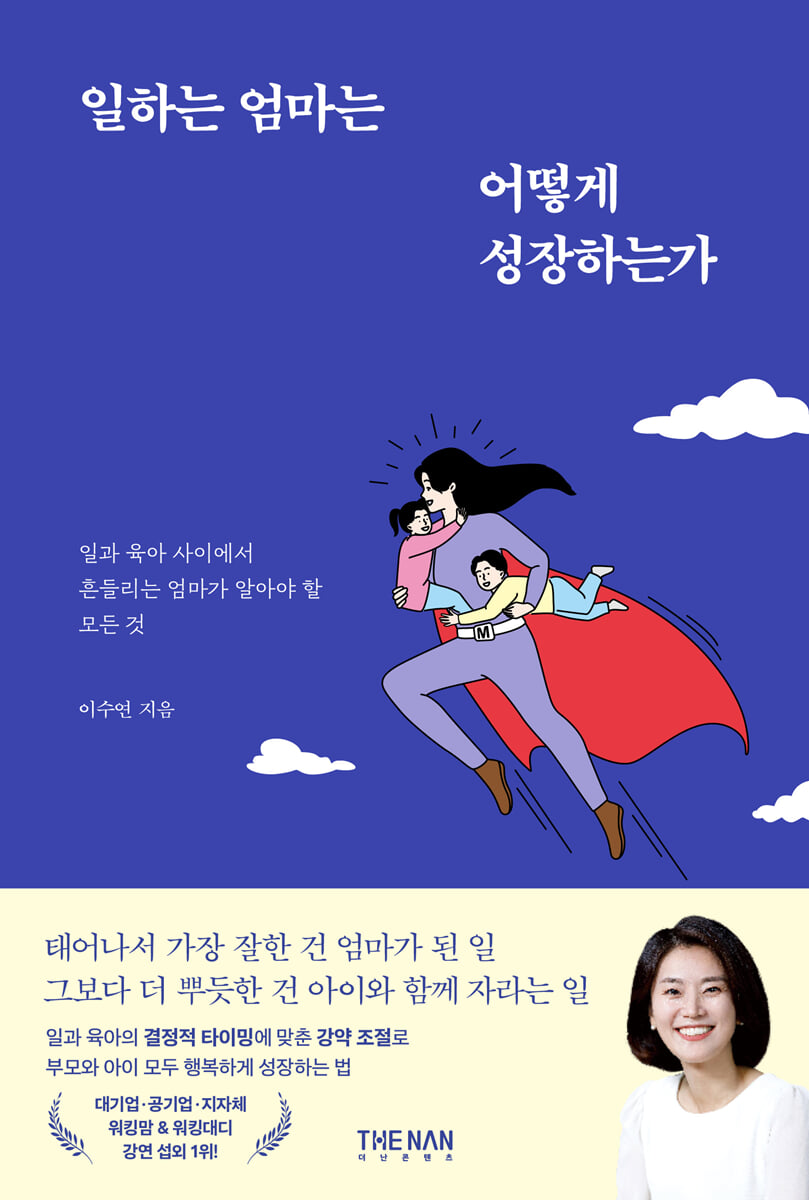
How Working Moms Grow
 |
Description
Book Introduction
Adjusting the intensity to suit the critical timing of work and childcare
How to make both parents and children grow up happily
This book was published after 10 years by author Suyeon Lee, a field expert who is most frequently invited to lecture and plan programs for working moms and working dads by large corporations, public corporations, and local governments, and who has been the director of the Korea Working Mom Research Institute for 15 years.
To all parents who struggle daily between work and family and are contemplating whether or not to quit their jobs, I offer encouragement and courage to never give up work for the sake of raising children.
The author is a working mom who has been working to help Korean parents balance work and family life for 15 years.
This book is packed with everything working mothers need to know, from the experience, knowledge, wisdom, and know-how gained from working as working moms in various fields for 15 years to the secrets of starting a business when her two sons were not even one year old and building an unrivaled career.
This book offers a wealth of practical advice and tips that can help parents advance their careers during the most crucial stages of their child's development without requiring a significant investment of energy. This valuable information is available only in this book.
The most important thing for parents to happily balance work and parenting is to find their own answers to the questions, "What kind of life do I want to live?" and "Why do I want to do this?"
While the time we spend working to earn a living is precious, we, living in an age of 100, need to have our own life goals that go beyond the perception that we work simply to make a living.
As our children grow, we too must grow together as parents and as individuals. The moment we discover our own individual value and potential, rather than as someone else's guardian or nurturer, will be the starting point of this growth.
How to make both parents and children grow up happily
This book was published after 10 years by author Suyeon Lee, a field expert who is most frequently invited to lecture and plan programs for working moms and working dads by large corporations, public corporations, and local governments, and who has been the director of the Korea Working Mom Research Institute for 15 years.
To all parents who struggle daily between work and family and are contemplating whether or not to quit their jobs, I offer encouragement and courage to never give up work for the sake of raising children.
The author is a working mom who has been working to help Korean parents balance work and family life for 15 years.
This book is packed with everything working mothers need to know, from the experience, knowledge, wisdom, and know-how gained from working as working moms in various fields for 15 years to the secrets of starting a business when her two sons were not even one year old and building an unrivaled career.
This book offers a wealth of practical advice and tips that can help parents advance their careers during the most crucial stages of their child's development without requiring a significant investment of energy. This valuable information is available only in this book.
The most important thing for parents to happily balance work and parenting is to find their own answers to the questions, "What kind of life do I want to live?" and "Why do I want to do this?"
While the time we spend working to earn a living is precious, we, living in an age of 100, need to have our own life goals that go beyond the perception that we work simply to make a living.
As our children grow, we too must grow together as parents and as individuals. The moment we discover our own individual value and potential, rather than as someone else's guardian or nurturer, will be the starting point of this growth.
index
Prologue_ Work and Parenting Are Not Choices 004
Chapter 1: Being a Working Mom Makes Me Stronger
Growing Instead of Quitting 015
Careers Grow Like Children 023
Burnout Escape Tips for Working Moms 027
When your stamina breaks down, everything breaks down. 031
Working Moms Toughen Their Children 036
Children who grow on their own 040
Resetting my life, not just as a career woman 046
★Key Summary for Busy Parents 052
Chapter 2 A Child's Life Is Determined Before He or She Turns Ten
Don't spend money on children's items until they are 5 years old. 057
Parents Are Not Friends 062
How to Win a Child's Heart in 10 Minutes a Day 066
Starting your day happy will change your life 070
It's Okay to Play Alone 073
Teach the basics of life before the age of ten 077
The more respect a child receives every day, the higher his or her self-esteem will be. 083
3 Behaviors That Destroy Your Child's Brain 089
Firmly when young, gently when adolescence 094
No child can beat a smartphone 098
Behind every good child is a father. 104
Talent isn't something you find, it's something you discover. 108
Children who do chores are better off in the world. 114
Family events are the best places for character education. 118
A Meal That's Healthier Than Supplements and Medicine 122
Even in apartments, childcare can be shared. 126
Preparing for Reinstatement with Your Child: A to Z 131
138 Things Moms Should Keep in Mind When Raising Grandmothers
How to Soothe a Child's Heart After Hurt 144
★ Key Summary for Busy Parents 148
Chapter 3: Our Children's Study Methods: Now It's Time to Change
It's enough to return home safely every day 155
How to Deal with a Child Who Doesn't Have a Talent for Studying 159
Not a child who does things like others, but a child who is different from others 162
168 To a child who asks why he or she should study
Changing How You Use Your Brain Changes Your Focus 172
The Power of 66 Days to Change Your Study Habits 177
How to Build a Smart Brain 180
Niche Reading Education: Turning Children into Book Lovers 184
★ Key Summary for Busy Parents 190
Chapter 4: How Working Moms Grow into Professionals
The more you work in a dual-income household, the more you need to work hard. 195
A mother's attitude toward work can change her child's life. 200
You need presence to seize opportunities 205
Workplace is a place where performance speaks volumes, not friendships 209
How to Build Relationships Without Getting Hurt 212
Working Moms' Time Should Flow Differently 216
My steps pave the way for the next generation. 220
★ Key Summary for Busy Parents 224
Chapter 5: A good couple influences their child's emotions.
Is everything okay between us now? 229
What Makes an Intimate Couple Different? 234
The more the child is centered, the more distant the couple becomes. 239
When a couple's relationship is strained, the child's heart becomes empty. 242
247 Things to Keep in Mind When Fighting in Front of Your Kids
Courtesy Comes Before Love 252
There are certain words that move a husband 256
How to Love Without Regrets, Part 261
★ Key Summary for Busy Parents 264
Chapter 6: Parents and Children Grow Together
When the mother is shaken, the child falls apart. 269
274 Reasons Why You Should Take Care of Yourself Before Your Children
Letting Go of Perfectionism 277
Anger leaves scars on a child's body 280
Am I Really a Good Parent? 284
The mind also needs regular checkups 288
Mom and Dad Growth Project - Now, It's Time for Parents to Grow Up Too 292
★ Key Summary for Busy Parents 296
Chapter 1: Being a Working Mom Makes Me Stronger
Growing Instead of Quitting 015
Careers Grow Like Children 023
Burnout Escape Tips for Working Moms 027
When your stamina breaks down, everything breaks down. 031
Working Moms Toughen Their Children 036
Children who grow on their own 040
Resetting my life, not just as a career woman 046
★Key Summary for Busy Parents 052
Chapter 2 A Child's Life Is Determined Before He or She Turns Ten
Don't spend money on children's items until they are 5 years old. 057
Parents Are Not Friends 062
How to Win a Child's Heart in 10 Minutes a Day 066
Starting your day happy will change your life 070
It's Okay to Play Alone 073
Teach the basics of life before the age of ten 077
The more respect a child receives every day, the higher his or her self-esteem will be. 083
3 Behaviors That Destroy Your Child's Brain 089
Firmly when young, gently when adolescence 094
No child can beat a smartphone 098
Behind every good child is a father. 104
Talent isn't something you find, it's something you discover. 108
Children who do chores are better off in the world. 114
Family events are the best places for character education. 118
A Meal That's Healthier Than Supplements and Medicine 122
Even in apartments, childcare can be shared. 126
Preparing for Reinstatement with Your Child: A to Z 131
138 Things Moms Should Keep in Mind When Raising Grandmothers
How to Soothe a Child's Heart After Hurt 144
★ Key Summary for Busy Parents 148
Chapter 3: Our Children's Study Methods: Now It's Time to Change
It's enough to return home safely every day 155
How to Deal with a Child Who Doesn't Have a Talent for Studying 159
Not a child who does things like others, but a child who is different from others 162
168 To a child who asks why he or she should study
Changing How You Use Your Brain Changes Your Focus 172
The Power of 66 Days to Change Your Study Habits 177
How to Build a Smart Brain 180
Niche Reading Education: Turning Children into Book Lovers 184
★ Key Summary for Busy Parents 190
Chapter 4: How Working Moms Grow into Professionals
The more you work in a dual-income household, the more you need to work hard. 195
A mother's attitude toward work can change her child's life. 200
You need presence to seize opportunities 205
Workplace is a place where performance speaks volumes, not friendships 209
How to Build Relationships Without Getting Hurt 212
Working Moms' Time Should Flow Differently 216
My steps pave the way for the next generation. 220
★ Key Summary for Busy Parents 224
Chapter 5: A good couple influences their child's emotions.
Is everything okay between us now? 229
What Makes an Intimate Couple Different? 234
The more the child is centered, the more distant the couple becomes. 239
When a couple's relationship is strained, the child's heart becomes empty. 242
247 Things to Keep in Mind When Fighting in Front of Your Kids
Courtesy Comes Before Love 252
There are certain words that move a husband 256
How to Love Without Regrets, Part 261
★ Key Summary for Busy Parents 264
Chapter 6: Parents and Children Grow Together
When the mother is shaken, the child falls apart. 269
274 Reasons Why You Should Take Care of Yourself Before Your Children
Letting Go of Perfectionism 277
Anger leaves scars on a child's body 280
Am I Really a Good Parent? 284
The mind also needs regular checkups 288
Mom and Dad Growth Project - Now, It's Time for Parents to Grow Up Too 292
★ Key Summary for Busy Parents 296
Detailed image

Into the book
Most mothers who are reading this book right now, raising children from kindergarten to elementary school age, are living in the '100-year era.'
No, since we live in the 100-year lifespan now, in a few decades when we are in our 70s or 80s, the basic lifespan may be 120 years.
According to the UN Future Report 2025, the average life expectancy will reach 130 years by 2030.
The insurance industry is also selling '130-year coverage insurance'.
This doesn't just mean that we're living longer biologically, but that we're now in an era where we have to work until we're at least 80.
So, you should think of your current job not simply as a means to make a living or pay for private tutoring, but as an investment in preparing for the second half of your life after your child becomes independent.
One sadder fact is that husbands are retiring earlier and earlier.
--- p.16
The important thing is that the standard for career planning must be thoroughly based on myself.
A working mom's growth plan will inevitably vary depending on her child's growth and surroundings, so there's absolutely no need to feel inferior by comparing yourself to your neighbors, friends, colleagues, or anyone on social media.
When anxiety and nervousness creep in, remember that just as life has its ups and downs, your career path won't always be an upward trajectory.
It's not that your career stops at a certain point, but rather that the 'way you move forward' changes.
If this is a time when you need to focus entirely on your child, then let go of your ego that wants to succeed at work and focus on diligently maintaining each and every task in front of you.
As your child grows and establishes a routine, you'll have plenty of time to take the next step.
--- pp.23-24
As we live, there comes a time when we have to change the direction of our lives due to unexpected circumstances.
The most common thing for married women is having to quit their jobs to care for their children.
When parents can no longer care for their children, when parental leave or flexible work arrangements are no longer available, or when a child becomes ill or emotionally challenged, we face a choice.
It would be best if you could continue working, but if you can't, don't be too upset.
In such cases, it may be a more important choice to boldly put down work and spend time with your child.
Of course it's painful.
Let's accept it though.
We're not giving up our careers right now, we're just temporarily shifting our focus from our daily lives to pursue greater values.
These words are not simply words of comfort or affirmation.
The time you can spend with your child is shorter than you think, but that time becomes precious memories that you will never forget.
British child psychologist Steve Biddulph said:
“Our lives are long enough to give a few years of our lives to our children.”
What matters is how you spend time with your child and how you return to tomorrow.” --- pp.46-47
Parents who are like friends.
It sounds good, but in reality, this statement implies a dangerous relationship without standards or boundaries.
Parents are adults and caregivers, not friends, and parents and children should not have an equal relationship like friends.
Children learn about the world and how to live in it through the window of their parents.
But if there is no discipline, no rules, no order, what kind of promises, boundaries, or manners can a child learn?
He grows up to be an arrogant person who cannot tolerate even small inconveniences or frustrations.
So, the younger your child is, the more you must clearly teach him the boundaries he should not cross.
--- p.63
One of the most enthusiastic responses from the countless fathers I've met during my 15 years of lectures was 'their daughters' dating.'
Research shows that daughters who are close to their fathers from a young age tend to start dating and having sex later in life.
Because dad is the 'standard for men'.
This means that a daughter's relationship with her father has a huge impact on her sexual self-determination and the quality of her romantic relationships.
Most fathers' eyes light up when they hear this story.
He says he is amazed at the impact he has had on his daughter's life and that it makes him want to be a better father in the future.
Due to the nature of my job, a topic that I personally pay particular attention to is 'the impact of a father's involvement in childcare and housework on children.'
As you can imagine, the biggest impact of a father's parenting is on the peace and stability of the home, and the balance between work and life.
But more importantly, a father's involvement in childcare and housework has a direct impact on children's values and cognitive development.
Children who grow up naturally seeing their fathers doing housework with their mothers are not trapped by the stereotype that 'housework is for women and earning money is for men.'
Wouldn't this kind of daily practice of gender equality demonstrated through action at home be the most natural form of gender equality education?
--- pp.105~106
It is most important to establish proper systems, organizational culture, and infrastructure to enable working mothers to balance work and childcare without having to quit their jobs.
However, creating such a system is not a problem that can be solved by an individual all at once, so each person must make an effort to implement what they can.
We are connected to each other.
The precedent I leave behind in the company directly impacts the positions and opportunities of my juniors.
The legal systems we enjoy today, such as parental leave and shortened work hours, were not given to us for free.
We enjoy this benefit today thanks to the efforts and sacrifices of our predecessors, who had to be careful even about taking three months of maternity leave.
So we must be careful not to lose confidence in ourselves.
'What precedent am I setting for our company now?'
'What attitude should I take for the next world my daughters will live in?'
Let us always remember that our decisions affect our juniors.
No, since we live in the 100-year lifespan now, in a few decades when we are in our 70s or 80s, the basic lifespan may be 120 years.
According to the UN Future Report 2025, the average life expectancy will reach 130 years by 2030.
The insurance industry is also selling '130-year coverage insurance'.
This doesn't just mean that we're living longer biologically, but that we're now in an era where we have to work until we're at least 80.
So, you should think of your current job not simply as a means to make a living or pay for private tutoring, but as an investment in preparing for the second half of your life after your child becomes independent.
One sadder fact is that husbands are retiring earlier and earlier.
--- p.16
The important thing is that the standard for career planning must be thoroughly based on myself.
A working mom's growth plan will inevitably vary depending on her child's growth and surroundings, so there's absolutely no need to feel inferior by comparing yourself to your neighbors, friends, colleagues, or anyone on social media.
When anxiety and nervousness creep in, remember that just as life has its ups and downs, your career path won't always be an upward trajectory.
It's not that your career stops at a certain point, but rather that the 'way you move forward' changes.
If this is a time when you need to focus entirely on your child, then let go of your ego that wants to succeed at work and focus on diligently maintaining each and every task in front of you.
As your child grows and establishes a routine, you'll have plenty of time to take the next step.
--- pp.23-24
As we live, there comes a time when we have to change the direction of our lives due to unexpected circumstances.
The most common thing for married women is having to quit their jobs to care for their children.
When parents can no longer care for their children, when parental leave or flexible work arrangements are no longer available, or when a child becomes ill or emotionally challenged, we face a choice.
It would be best if you could continue working, but if you can't, don't be too upset.
In such cases, it may be a more important choice to boldly put down work and spend time with your child.
Of course it's painful.
Let's accept it though.
We're not giving up our careers right now, we're just temporarily shifting our focus from our daily lives to pursue greater values.
These words are not simply words of comfort or affirmation.
The time you can spend with your child is shorter than you think, but that time becomes precious memories that you will never forget.
British child psychologist Steve Biddulph said:
“Our lives are long enough to give a few years of our lives to our children.”
What matters is how you spend time with your child and how you return to tomorrow.” --- pp.46-47
Parents who are like friends.
It sounds good, but in reality, this statement implies a dangerous relationship without standards or boundaries.
Parents are adults and caregivers, not friends, and parents and children should not have an equal relationship like friends.
Children learn about the world and how to live in it through the window of their parents.
But if there is no discipline, no rules, no order, what kind of promises, boundaries, or manners can a child learn?
He grows up to be an arrogant person who cannot tolerate even small inconveniences or frustrations.
So, the younger your child is, the more you must clearly teach him the boundaries he should not cross.
--- p.63
One of the most enthusiastic responses from the countless fathers I've met during my 15 years of lectures was 'their daughters' dating.'
Research shows that daughters who are close to their fathers from a young age tend to start dating and having sex later in life.
Because dad is the 'standard for men'.
This means that a daughter's relationship with her father has a huge impact on her sexual self-determination and the quality of her romantic relationships.
Most fathers' eyes light up when they hear this story.
He says he is amazed at the impact he has had on his daughter's life and that it makes him want to be a better father in the future.
Due to the nature of my job, a topic that I personally pay particular attention to is 'the impact of a father's involvement in childcare and housework on children.'
As you can imagine, the biggest impact of a father's parenting is on the peace and stability of the home, and the balance between work and life.
But more importantly, a father's involvement in childcare and housework has a direct impact on children's values and cognitive development.
Children who grow up naturally seeing their fathers doing housework with their mothers are not trapped by the stereotype that 'housework is for women and earning money is for men.'
Wouldn't this kind of daily practice of gender equality demonstrated through action at home be the most natural form of gender equality education?
--- pp.105~106
It is most important to establish proper systems, organizational culture, and infrastructure to enable working mothers to balance work and childcare without having to quit their jobs.
However, creating such a system is not a problem that can be solved by an individual all at once, so each person must make an effort to implement what they can.
We are connected to each other.
The precedent I leave behind in the company directly impacts the positions and opportunities of my juniors.
The legal systems we enjoy today, such as parental leave and shortened work hours, were not given to us for free.
We enjoy this benefit today thanks to the efforts and sacrifices of our predecessors, who had to be careful even about taking three months of maternity leave.
So we must be careful not to lose confidence in ourselves.
'What precedent am I setting for our company now?'
'What attitude should I take for the next world my daughters will live in?'
Let us always remember that our decisions affect our juniors.
--- pp.222~223
Publisher's Review
“Let’s let go of the compulsion to balance work and childcare 50/50.”
This is what Lee Su-yeon, the director of the Korea Working Mom Research Institute for 15 years and a mother of two sons, says.
Everything Working Moms Need to Know
Working moms in Korea live their lives fulfilling five roles: mother, wife, office worker, daughter-in-law, and daughter.
Why do they strive so hard to be better mothers?
Twenty years ago, ten years ago, and even now, working moms feel guilty and blame themselves whenever their children get sick, forget their supplies, get hurt while playing, or just look gloomy, wondering, "Maybe I'm neglecting my child because I'm working."
But the mothers who make their children sick are not working mothers, but mothers who are dissatisfied with their lives and feel unhappy.
So, don't feel sorry towards your child just because you are a working mom.
You shouldn't give up work just because of your child.
Now that the 100-year lifespan has become a reality, it has become a basic premise that everyone, regardless of age or gender, should work as long and consistently as possible.
Finding your own answer to the question, "Why do I work?" and striving to uphold that value is the way to live proudly as a working mother without being trapped in the dichotomous thinking of "work or children?" in a world that insists that "childcare is still a mother's duty."
This book contains the author's detailed account of how she raised her two sons while meeting various working mothers in numerous fields for 15 years, and how she never gave up on work and was able to grow up happily with her children.
If you're a working mom who struggles to balance work and childcare, this book will help you discover that "growing together with your child" isn't an impossible dream.
“Don’t feel sorry for the child.
We are not neglecting children, but giving them the opportunity to become independent.
“This is the best gift a working mom can give.”
Although there are many support policies for working moms and working dads, it is still not easy to raise children while working in South Korea.
From the moment you have a child, you need to consider when to take maternity leave so you can spend as much time with your child as possible without worrying about what your company thinks. When taking parental leave, you need to consider how to do so without causing a burden to the organization or hindering your future career, such as promotions or important projects.
Even after being reinstated, it is rare to find a day when you feel at ease.
I feel pressured not to work overtime, so I'm always rushing to get to work. If my child gets sick, unless it's to the point where they need to be hospitalized, all I can do is anxiously wait for the end of work.
After work, it's hard to even take a breather because of the piled up housework and caring for the children.
Work, children, and family are things we must never give up to live happily.
One cannot be sacrificed or substituted for the other.
So, even if it's difficult right now, we need to be wise and not try to hastily give up on either one by weighing work and childcare. Instead, we need to consider the timing and importance of both and find a balance, like riding a seesaw.
As I continue to ponder, "How can I continue my work while growing with my child?" and take each step forward, unexpected alternatives will emerge and clues to solving the problem will appear.
The important thing is to do your best, considering only the choices you can make 'here and now'.
Through this book, let's practice letting go of the guilt that working moms often fall into.
If you break away from the dichotomous choice of "work or children" and look a little further into the future while finding the best you can do in the present situation, you will find that both your child and you have grown up before you know it.
For mothers who want to raise their children well and grow as themselves.
56 Most Realistic and Essential Advice
This book consists of 6 chapters and 56 chapters.
First, in Chapters 1 and 4, the author introduces the cold reality and sharp advice that working moms must know about the realistic concerns they face several times a day.
The author advises us to remember that very few people work for self-actualization, and that most of us are breadwinners who must earn money to raise children and make a living.
As you follow the author's insights into why working moms need to work harder, focus more on physical health, and develop their careers, you'll find yourself waking up to the cold water.
Chapters 2 and 3 deal with the child's character and learning.
In Chapter 2, the author mentions the importance of character education, which is particularly emphasized in today's world, and shares the know-how and tips he gained while raising his two sons.
From the importance of family events, which are hard to find these days, to how to deal with a child who plays alone, why assigning chores helps a child's social life, and how to practice shared parenting in an apartment, you'll immediately want to put into practice the parenting tips detailed by experienced moms.
Chapter 3 encourages mothers not to lose sight of the purpose and essence of studying through universal common sense that all mothers raising children should know, such as reading education, discovering children's talents, and how to utilize the brain, rather than subject-specific study tips.
Chapters 5 and 6 explain the importance of fatherly parenting, the impact of marital intimacy on children, and how parents and children can grow together.
Through the commonalities and characteristics the author has discovered through analyzing the concerns of countless working moms he has encountered in the field for 15 years, this book provides an opportunity to reconsider what kind of person a father should be to a child, what specific influence the intimacy between a couple has on a child, and how we should treat our companions as someone's wife and husband before becoming parents.
The happiness of living as a mother
Finding a balance between the joys of living my life
This is true work-life balance.
“The best thing I’ve ever done is become a mother, but what’s even more rewarding is growing up with my child.”
The author emphasizes that while the past ten years of balancing work and childcare have been incredibly difficult, becoming a mother has been the happiest and most rewarding experience in the world.
If you put in just 10 years of proper effort, your child will be able to solve his or her own problems on his or her own, but if you spend this time poorly, he or she may become a child who requires constant care and attention.
That doesn't mean that 10 years is a perfect 10 years.
The author urges us not to give up, saying that if we just pay a little more attention to the critical period that suits our child's developmental characteristics, both work and a career, as well as happy parenting, are all possible.
For working mothers in Korea, who are enduring the most difficult and tiring days of their lives, even at this very moment, and who are anxious about whether they can successfully manage both work and childcare, this book will offer warm hope and firm confidence.
This is what Lee Su-yeon, the director of the Korea Working Mom Research Institute for 15 years and a mother of two sons, says.
Everything Working Moms Need to Know
Working moms in Korea live their lives fulfilling five roles: mother, wife, office worker, daughter-in-law, and daughter.
Why do they strive so hard to be better mothers?
Twenty years ago, ten years ago, and even now, working moms feel guilty and blame themselves whenever their children get sick, forget their supplies, get hurt while playing, or just look gloomy, wondering, "Maybe I'm neglecting my child because I'm working."
But the mothers who make their children sick are not working mothers, but mothers who are dissatisfied with their lives and feel unhappy.
So, don't feel sorry towards your child just because you are a working mom.
You shouldn't give up work just because of your child.
Now that the 100-year lifespan has become a reality, it has become a basic premise that everyone, regardless of age or gender, should work as long and consistently as possible.
Finding your own answer to the question, "Why do I work?" and striving to uphold that value is the way to live proudly as a working mother without being trapped in the dichotomous thinking of "work or children?" in a world that insists that "childcare is still a mother's duty."
This book contains the author's detailed account of how she raised her two sons while meeting various working mothers in numerous fields for 15 years, and how she never gave up on work and was able to grow up happily with her children.
If you're a working mom who struggles to balance work and childcare, this book will help you discover that "growing together with your child" isn't an impossible dream.
“Don’t feel sorry for the child.
We are not neglecting children, but giving them the opportunity to become independent.
“This is the best gift a working mom can give.”
Although there are many support policies for working moms and working dads, it is still not easy to raise children while working in South Korea.
From the moment you have a child, you need to consider when to take maternity leave so you can spend as much time with your child as possible without worrying about what your company thinks. When taking parental leave, you need to consider how to do so without causing a burden to the organization or hindering your future career, such as promotions or important projects.
Even after being reinstated, it is rare to find a day when you feel at ease.
I feel pressured not to work overtime, so I'm always rushing to get to work. If my child gets sick, unless it's to the point where they need to be hospitalized, all I can do is anxiously wait for the end of work.
After work, it's hard to even take a breather because of the piled up housework and caring for the children.
Work, children, and family are things we must never give up to live happily.
One cannot be sacrificed or substituted for the other.
So, even if it's difficult right now, we need to be wise and not try to hastily give up on either one by weighing work and childcare. Instead, we need to consider the timing and importance of both and find a balance, like riding a seesaw.
As I continue to ponder, "How can I continue my work while growing with my child?" and take each step forward, unexpected alternatives will emerge and clues to solving the problem will appear.
The important thing is to do your best, considering only the choices you can make 'here and now'.
Through this book, let's practice letting go of the guilt that working moms often fall into.
If you break away from the dichotomous choice of "work or children" and look a little further into the future while finding the best you can do in the present situation, you will find that both your child and you have grown up before you know it.
For mothers who want to raise their children well and grow as themselves.
56 Most Realistic and Essential Advice
This book consists of 6 chapters and 56 chapters.
First, in Chapters 1 and 4, the author introduces the cold reality and sharp advice that working moms must know about the realistic concerns they face several times a day.
The author advises us to remember that very few people work for self-actualization, and that most of us are breadwinners who must earn money to raise children and make a living.
As you follow the author's insights into why working moms need to work harder, focus more on physical health, and develop their careers, you'll find yourself waking up to the cold water.
Chapters 2 and 3 deal with the child's character and learning.
In Chapter 2, the author mentions the importance of character education, which is particularly emphasized in today's world, and shares the know-how and tips he gained while raising his two sons.
From the importance of family events, which are hard to find these days, to how to deal with a child who plays alone, why assigning chores helps a child's social life, and how to practice shared parenting in an apartment, you'll immediately want to put into practice the parenting tips detailed by experienced moms.
Chapter 3 encourages mothers not to lose sight of the purpose and essence of studying through universal common sense that all mothers raising children should know, such as reading education, discovering children's talents, and how to utilize the brain, rather than subject-specific study tips.
Chapters 5 and 6 explain the importance of fatherly parenting, the impact of marital intimacy on children, and how parents and children can grow together.
Through the commonalities and characteristics the author has discovered through analyzing the concerns of countless working moms he has encountered in the field for 15 years, this book provides an opportunity to reconsider what kind of person a father should be to a child, what specific influence the intimacy between a couple has on a child, and how we should treat our companions as someone's wife and husband before becoming parents.
The happiness of living as a mother
Finding a balance between the joys of living my life
This is true work-life balance.
“The best thing I’ve ever done is become a mother, but what’s even more rewarding is growing up with my child.”
The author emphasizes that while the past ten years of balancing work and childcare have been incredibly difficult, becoming a mother has been the happiest and most rewarding experience in the world.
If you put in just 10 years of proper effort, your child will be able to solve his or her own problems on his or her own, but if you spend this time poorly, he or she may become a child who requires constant care and attention.
That doesn't mean that 10 years is a perfect 10 years.
The author urges us not to give up, saying that if we just pay a little more attention to the critical period that suits our child's developmental characteristics, both work and a career, as well as happy parenting, are all possible.
For working mothers in Korea, who are enduring the most difficult and tiring days of their lives, even at this very moment, and who are anxious about whether they can successfully manage both work and childcare, this book will offer warm hope and firm confidence.
GOODS SPECIFICS
- Date of issue: September 20, 2025
- Page count, weight, size: 300 pages | 145*215*20mm
- ISBN13: 9791193785454
- ISBN10: 1193785456
You may also like
카테고리
korean


korean

![GQ KOREA Mark (Monthly): December [2025]](http://librairie.coreenne.fr/cdn/shop/files/8ef265dbbfbf186523ed75ba7319009d.jpg?v=1765340328&width=3840)


