

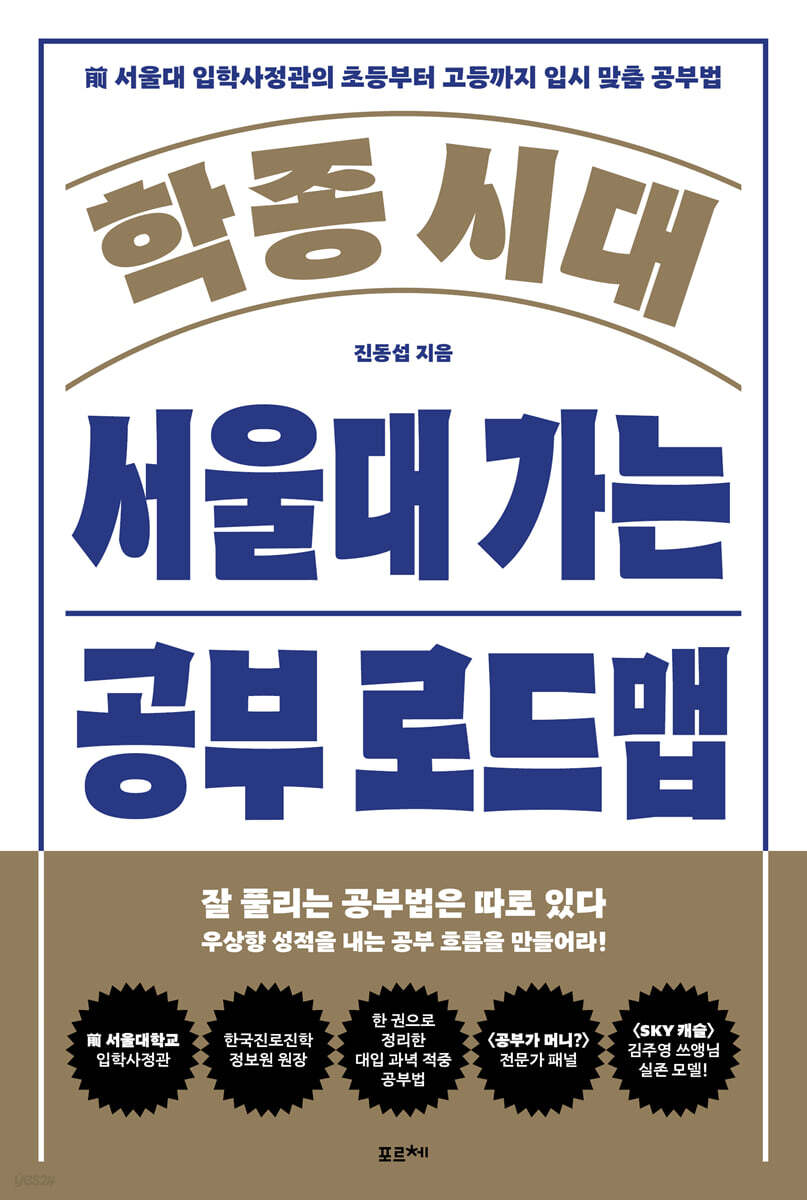
The Study Roadmap to Seoul National University in the Age of School Bells
 |
Description
Book Introduction
Self-directed study methods in the age of academic discipline, directly taught by Seoul National University admissions officers.
A study roadmap to SKY, starting from elementary school
Complete the integrated design of learning strategies, career exploration, and entrance exam preparation.
A first-class grade on your report card alone will no longer open the door to a prestigious university.
Even the most perfect report card cannot fully capture a student's true abilities.
In the past, grades were everything, but now it's different.
In the age of academic bells, universities value more the attitude of proactively designing one's own career path and life than academic scores.
Intellectual curiosity, a will to explore, and a passion for learning, which are considered key indicators of academic attitude at these prestigious universities, are not created overnight.
This is because study habits and learning environments are developed step by step from elementary school.
Author Jin Dong-seop, a former admissions officer at Seoul National University, presents a learning method that builds a solid foundation for self-directed learning in elementary school, establishes the foundation for study habits and career exploration in middle school, and naturally connects to the special subject tax system and the CSAT in high school.
From career planning to research activities, special education, reading, and college entrance exam study methods, we reveal study methods that will help you stay on track with the flow of elementary, middle, and high school studies and stay on track until the college entrance exam.
One of them is having the self-directedness to ask questions.
Questions are the starting point of intellectual curiosity and a key activity that connects the curriculum content to deep thinking rather than mere memorization.
It is also important to internalize the research activity.
Starting from the textbook, the child must practice and internalize the series of activities that lead to choosing his or her own research topic, collecting data, conducting experiments or presentations, and writing reports.
This is also a practical ability that prestigious universities carefully look at when selecting students.
A study roadmap to SKY, starting from elementary school
Complete the integrated design of learning strategies, career exploration, and entrance exam preparation.
A first-class grade on your report card alone will no longer open the door to a prestigious university.
Even the most perfect report card cannot fully capture a student's true abilities.
In the past, grades were everything, but now it's different.
In the age of academic bells, universities value more the attitude of proactively designing one's own career path and life than academic scores.
Intellectual curiosity, a will to explore, and a passion for learning, which are considered key indicators of academic attitude at these prestigious universities, are not created overnight.
This is because study habits and learning environments are developed step by step from elementary school.
Author Jin Dong-seop, a former admissions officer at Seoul National University, presents a learning method that builds a solid foundation for self-directed learning in elementary school, establishes the foundation for study habits and career exploration in middle school, and naturally connects to the special subject tax system and the CSAT in high school.
From career planning to research activities, special education, reading, and college entrance exam study methods, we reveal study methods that will help you stay on track with the flow of elementary, middle, and high school studies and stay on track until the college entrance exam.
One of them is having the self-directedness to ask questions.
Questions are the starting point of intellectual curiosity and a key activity that connects the curriculum content to deep thinking rather than mere memorization.
It is also important to internalize the research activity.
Starting from the textbook, the child must practice and internalize the series of activities that lead to choosing his or her own research topic, collecting data, conducting experiments or presentations, and writing reports.
This is also a practical ability that prestigious universities carefully look at when selecting students.
- You can preview some of the book's contents.
Preview
index
Prologue 4
Chapter 1.
Children who excel in school are raised differently.
16. Draw motivation from weaknesses
20 Preparations to Create a Study Flow Before Entering Elementary School
The Self-Initiative That Friendships Create 24
Attitude is the foundation of study 28
A child's curiosity fosters self-direction 31
Let's develop the power of questioning 34
A positive self-image drives learning 38
Putting Yourself at the Center of Your Study 44
Career path is a study that you explore on your own 48
Decisive Children Succeed 52
Chapter 2.
Practice habits change your grades.
The flow continues even during vacation 58
Preview and review come before the actual work. 63
Studying also requires forming habits 67
Consistency Makes the Ordinary Into a Genius 71
75 Reasons Why You Should Study Hard in School
The power of inquiry is completed through presentation 79
Breaking Free from Game and Smartphone Overindulgence 83
Chapter 3.
Find the right learning strategy for your child.
Clarify the concept of study 92
Summarize while taking notes 95
Spelling skills are also a solid strategy 99
How to Get Ahead of the CSAT from the First Period 103
Don't Let Literacy Hold You Back 107
Ultimately, reading skills are the answer. 118
Let's check your study with a rubric 126
Mid-Rank Mindset 129
133 Things to Consider When Your Grades Are Swaying
Raising a Child Who Goes Slow and Still 137
Stop "roughly" before it becomes a habit. 140
Chapter 4.
Self-directed study is training
Self-directedness is a competitive advantage in college admissions. 146
Why Universities Focus on Research Activities 152
Become a special brand for education tax 166
The Danger of the Illusion of Knowledge 172
We must cultivate the ability to see the forest for the trees. 175
The Power of Questions and Inquiry 180
Education is Changing in the Digital Age 186
Chapter 5.
Direction is important in college entrance exams.
College entrance competition is not easing 192
Going to college solely based on the CSAT vs. going to college without taking the CSAT 199
Half of the score depends on the subject 205
Curriculum is Key to Choosing a High School 209
Special Education Tax: Real Study Must Be Demonstrated 218
The revised curriculum provides a clear direction. 222
The promising career of the future is entrepreneurship 237
What the Changing Evaluation Methods Tell Us 245
Going to College with AI 255
Career direction is also important 261
Study and Career 268
Chapter 6.
There is no such thing as taking the college entrance exam alone.
Will fewer students make it easier to get into college? 282
What do you think of AI teachers? 286
Should I transfer to a different school district? 290
293 Questions About Admission Strategies
2028 College Entrance Exams: What Will Change? 299
Will the future CSAT be restructured into a written and essay-based format? 305
Choosing a career path and subjects is the beginning of college admissions. 311
Study to be included in the special section 316
The End of College Entrance Exams: How to Prepare for an Interview 321
Epilogue 332
Chapter 1.
Children who excel in school are raised differently.
16. Draw motivation from weaknesses
20 Preparations to Create a Study Flow Before Entering Elementary School
The Self-Initiative That Friendships Create 24
Attitude is the foundation of study 28
A child's curiosity fosters self-direction 31
Let's develop the power of questioning 34
A positive self-image drives learning 38
Putting Yourself at the Center of Your Study 44
Career path is a study that you explore on your own 48
Decisive Children Succeed 52
Chapter 2.
Practice habits change your grades.
The flow continues even during vacation 58
Preview and review come before the actual work. 63
Studying also requires forming habits 67
Consistency Makes the Ordinary Into a Genius 71
75 Reasons Why You Should Study Hard in School
The power of inquiry is completed through presentation 79
Breaking Free from Game and Smartphone Overindulgence 83
Chapter 3.
Find the right learning strategy for your child.
Clarify the concept of study 92
Summarize while taking notes 95
Spelling skills are also a solid strategy 99
How to Get Ahead of the CSAT from the First Period 103
Don't Let Literacy Hold You Back 107
Ultimately, reading skills are the answer. 118
Let's check your study with a rubric 126
Mid-Rank Mindset 129
133 Things to Consider When Your Grades Are Swaying
Raising a Child Who Goes Slow and Still 137
Stop "roughly" before it becomes a habit. 140
Chapter 4.
Self-directed study is training
Self-directedness is a competitive advantage in college admissions. 146
Why Universities Focus on Research Activities 152
Become a special brand for education tax 166
The Danger of the Illusion of Knowledge 172
We must cultivate the ability to see the forest for the trees. 175
The Power of Questions and Inquiry 180
Education is Changing in the Digital Age 186
Chapter 5.
Direction is important in college entrance exams.
College entrance competition is not easing 192
Going to college solely based on the CSAT vs. going to college without taking the CSAT 199
Half of the score depends on the subject 205
Curriculum is Key to Choosing a High School 209
Special Education Tax: Real Study Must Be Demonstrated 218
The revised curriculum provides a clear direction. 222
The promising career of the future is entrepreneurship 237
What the Changing Evaluation Methods Tell Us 245
Going to College with AI 255
Career direction is also important 261
Study and Career 268
Chapter 6.
There is no such thing as taking the college entrance exam alone.
Will fewer students make it easier to get into college? 282
What do you think of AI teachers? 286
Should I transfer to a different school district? 290
293 Questions About Admission Strategies
2028 College Entrance Exams: What Will Change? 299
Will the future CSAT be restructured into a written and essay-based format? 305
Choosing a career path and subjects is the beginning of college admissions. 311
Study to be included in the special section 316
The End of College Entrance Exams: How to Prepare for an Interview 321
Epilogue 332
Detailed image

Into the book
The basics of self-direction are designing your own career path and finding and studying the subjects you need to study to achieve that path.
Students must first be able to clearly explain the subject knowledge, concepts, and principles they have learned in class, and then engage in in-depth research activities by applying the concepts and principles to topics of interest.
In the student matching process, students are selected by evaluating self-directed inquiry activities that appear during the learning process.
--- p.6, from “Prologue”
Universities do not assess students' community competencies in all admissions processes.
However, when evaluating documents in the comprehensive student admissions process, the community competency revealed in the student record is evaluated, and in the interview process, the community competency is evaluated.
Especially in the medical and education fields, a sense of community is confirmed during interviews.
In particular, in medical school interviews, personality interviews present situations and observe how the applicant responds. Therefore, it is necessary to have community skills on a regular basis; brief practice alone will not suffice for this.
--- p.29~30, from “Attitude is the foundation of studying”
The textbooks in the current curriculum are structured to be studied through learning activities, so a lot of time must be spent on learning activities.
However, if a child learns in advance what he or she will learn in the distant future at the academy, he or she will not be able to focus on studying centered on current learning activities.
So, preparation is more important than prior preparation.
Especially when studying online, if you don't do some advance study, you'll often end up thinking about something else at an important point.
I enjoyed the interesting introduction, but I lost track of the boring main point.
--- p.65, from “Preview and review come before doing.”
In school, from the third grade of elementary school to the third grade of high school, students study for 10 years to summarize (summarize thoughts), criticize (share thoughts), and form their own opinions (organize thoughts).
The vocabulary gets increasingly difficult, so I tell them to look up the words in a dictionary while reading.
The length of the text also gradually increases, so later on, we read the single-volume book and do post-reading activities.
Keep in mind the saying that if you don't read a book even for a day, thorns will grow in your mouth, so you should read for a certain amount of time every day.
Background knowledge is also important, so you should also work hard to study social studies and science.
--- p.105, from “How to Get Ahead from the First Period of the College Scholastic Ability Test”
To create an environment where you can concentrate on your studies, you need to keep away from things that distract you from studying.
You should keep the books and materials you need for studying close by, and keep cosmetics, game consoles, smartphones, and other things that may distract you from studying away.
If you put the bed close, you will want to lie down.
It is also important to take a break after studying deeply.
Our brain is like a muscle; it gets tired after a certain period of time.
Taking breaks improves your concentration and keeps you interested in your studies.
However, self-motivated people return to studying right after their break.
Above all, parents should not do this for their children when they are unable to plan their own lives.
It is good to be there to advise and check so that the child can do it on his own.
If you do something for your child because he or she cannot do it, the child will end up just being a bystander.
--- p.151, from “Self-initiative is competitiveness in college entrance exams”
Third, since there is no problem in getting into college without taking difficult subjects due to the university's non-major selection system, you should ignore the argument that you should take subjects that will result in good grades instead of taking difficult subjects.
When universities evaluate documents, they usually reflect which subjects were chosen from the general curriculum.
Students who choose difficult subjects and do well will be given priority in filling the seats.
Because this student has a wide range of career paths.
Even if you pass without completing difficult subjects, you may have difficulty being assigned to the department you want, and even if you are assigned to a department, you may have to complete prerequisite subjects when taking the required subjects.
Students must first be able to clearly explain the subject knowledge, concepts, and principles they have learned in class, and then engage in in-depth research activities by applying the concepts and principles to topics of interest.
In the student matching process, students are selected by evaluating self-directed inquiry activities that appear during the learning process.
--- p.6, from “Prologue”
Universities do not assess students' community competencies in all admissions processes.
However, when evaluating documents in the comprehensive student admissions process, the community competency revealed in the student record is evaluated, and in the interview process, the community competency is evaluated.
Especially in the medical and education fields, a sense of community is confirmed during interviews.
In particular, in medical school interviews, personality interviews present situations and observe how the applicant responds. Therefore, it is necessary to have community skills on a regular basis; brief practice alone will not suffice for this.
--- p.29~30, from “Attitude is the foundation of studying”
The textbooks in the current curriculum are structured to be studied through learning activities, so a lot of time must be spent on learning activities.
However, if a child learns in advance what he or she will learn in the distant future at the academy, he or she will not be able to focus on studying centered on current learning activities.
So, preparation is more important than prior preparation.
Especially when studying online, if you don't do some advance study, you'll often end up thinking about something else at an important point.
I enjoyed the interesting introduction, but I lost track of the boring main point.
--- p.65, from “Preview and review come before doing.”
In school, from the third grade of elementary school to the third grade of high school, students study for 10 years to summarize (summarize thoughts), criticize (share thoughts), and form their own opinions (organize thoughts).
The vocabulary gets increasingly difficult, so I tell them to look up the words in a dictionary while reading.
The length of the text also gradually increases, so later on, we read the single-volume book and do post-reading activities.
Keep in mind the saying that if you don't read a book even for a day, thorns will grow in your mouth, so you should read for a certain amount of time every day.
Background knowledge is also important, so you should also work hard to study social studies and science.
--- p.105, from “How to Get Ahead from the First Period of the College Scholastic Ability Test”
To create an environment where you can concentrate on your studies, you need to keep away from things that distract you from studying.
You should keep the books and materials you need for studying close by, and keep cosmetics, game consoles, smartphones, and other things that may distract you from studying away.
If you put the bed close, you will want to lie down.
It is also important to take a break after studying deeply.
Our brain is like a muscle; it gets tired after a certain period of time.
Taking breaks improves your concentration and keeps you interested in your studies.
However, self-motivated people return to studying right after their break.
Above all, parents should not do this for their children when they are unable to plan their own lives.
It is good to be there to advise and check so that the child can do it on his own.
If you do something for your child because he or she cannot do it, the child will end up just being a bystander.
--- p.151, from “Self-initiative is competitiveness in college entrance exams”
Third, since there is no problem in getting into college without taking difficult subjects due to the university's non-major selection system, you should ignore the argument that you should take subjects that will result in good grades instead of taking difficult subjects.
When universities evaluate documents, they usually reflect which subjects were chosen from the general curriculum.
Students who choose difficult subjects and do well will be given priority in filling the seats.
Because this student has a wide range of career paths.
Even if you pass without completing difficult subjects, you may have difficulty being assigned to the department you want, and even if you are assigned to a department, you may have to complete prerequisite subjects when taking the required subjects.
--- p.315, from “Choosing a career path and subjects is the beginning of the entrance exam”
Publisher's Review
Prestigious universities value inquiry and inquiry skills in the "Teaching Tax Special" program.
The power to question, explore, and connect is the key to success in college entrance exams!
Academic attitude, study strategies, self-directedness, and even career planning
Increase your college entrance exam preparation by becoming a child with academic achievement!
Differences in study methods ultimately lead to differences in entrance exam results.
The more a child studies by asking questions and exploring, the more differences there are in their learning abilities.
This difference is especially evident in the current college entrance exam system.
Based on his seven years of experience as an admissions officer at Seoul National University, author Jin Dong-seop delves into the evaluation criteria for academic attitude, inquiry skills, and self-directedness through the eyes of an admissions officer, and strategically interprets how actual student record evaluation items affect university admissions.
Furthermore, self-directed learning is defined as 'having the desire to study and planning and carrying it out on one's own', and methods are suggested for parents to help their children develop such desires.
Through key messages such as, “Children who ask the right questions go ahead” and “Reading is the root of all learning,” it emphasizes that self-directed learning begins with small habits in daily life.
At the middle school level, it provides the foundation for a study method that solidifies learning-based skills such as literacy, summarizing, and note-taking, and at the high school level, it naturally expands these skills into 'curriculum tax specials' so that they are perfectly connected to the entrance exam documents.
If parents set the direction, the child will not waver.
Study strategies that even ordinary children can use to get into SKY!
If you are a parent who is worried that your child is falling behind but doesn't know how to help, there is a truth you absolutely must know.
Parents who lead their children from the front fail, while parents who create the flow from the side succeed.
Universities value "resilience" and "continuous growth" much more than short-term changes in academic performance.
Author Jin Dong-seop shares the truth: "Even if your grades falter for a semester or two, if you can clearly see the process of getting back on track, you'll likely receive a more positive evaluation."
So what specifically should parents do?
This book presents a concrete roadmap for the 'SKY Entrance Exam Basics' that will enable even ordinary children to enter prestigious universities.
Chapter 1 explains how to develop questioning skills and a study attitude during elementary school. Chapter 2 emphasizes the power of lifestyle habits that help children maintain a study rhythm, such as study methods during vacations and preview and review routines. Chapter 3 guides children on how to find the right study strategy for them.
You can take control of your learning only when you know what and how to study.
Chapter 4 introduces self-directed learning methods, which are key to success in college entrance exams.
It presents questions, electives, and exploration strategies for the AI era, along with the importance of self-directed learning.
Chapter 5 explains how to keep pace with the core trends of college admissions strategies amidst curriculum reforms and changes in the college admissions system. Chapter 6 presents practical strategies that will stand the test of time in the 2028 college admissions, including school district selection, career exploration, and interview preparation.
Before you get hung up on tuition fees and rely on private education, let's understand the principles of the entrance exam and prepare properly.
This self-directed study roadmap, written by Korea's top college entrance exam expert, will serve as an accurate compass.
The power to question, explore, and connect is the key to success in college entrance exams!
Academic attitude, study strategies, self-directedness, and even career planning
Increase your college entrance exam preparation by becoming a child with academic achievement!
Differences in study methods ultimately lead to differences in entrance exam results.
The more a child studies by asking questions and exploring, the more differences there are in their learning abilities.
This difference is especially evident in the current college entrance exam system.
Based on his seven years of experience as an admissions officer at Seoul National University, author Jin Dong-seop delves into the evaluation criteria for academic attitude, inquiry skills, and self-directedness through the eyes of an admissions officer, and strategically interprets how actual student record evaluation items affect university admissions.
Furthermore, self-directed learning is defined as 'having the desire to study and planning and carrying it out on one's own', and methods are suggested for parents to help their children develop such desires.
Through key messages such as, “Children who ask the right questions go ahead” and “Reading is the root of all learning,” it emphasizes that self-directed learning begins with small habits in daily life.
At the middle school level, it provides the foundation for a study method that solidifies learning-based skills such as literacy, summarizing, and note-taking, and at the high school level, it naturally expands these skills into 'curriculum tax specials' so that they are perfectly connected to the entrance exam documents.
If parents set the direction, the child will not waver.
Study strategies that even ordinary children can use to get into SKY!
If you are a parent who is worried that your child is falling behind but doesn't know how to help, there is a truth you absolutely must know.
Parents who lead their children from the front fail, while parents who create the flow from the side succeed.
Universities value "resilience" and "continuous growth" much more than short-term changes in academic performance.
Author Jin Dong-seop shares the truth: "Even if your grades falter for a semester or two, if you can clearly see the process of getting back on track, you'll likely receive a more positive evaluation."
So what specifically should parents do?
This book presents a concrete roadmap for the 'SKY Entrance Exam Basics' that will enable even ordinary children to enter prestigious universities.
Chapter 1 explains how to develop questioning skills and a study attitude during elementary school. Chapter 2 emphasizes the power of lifestyle habits that help children maintain a study rhythm, such as study methods during vacations and preview and review routines. Chapter 3 guides children on how to find the right study strategy for them.
You can take control of your learning only when you know what and how to study.
Chapter 4 introduces self-directed learning methods, which are key to success in college entrance exams.
It presents questions, electives, and exploration strategies for the AI era, along with the importance of self-directed learning.
Chapter 5 explains how to keep pace with the core trends of college admissions strategies amidst curriculum reforms and changes in the college admissions system. Chapter 6 presents practical strategies that will stand the test of time in the 2028 college admissions, including school district selection, career exploration, and interview preparation.
Before you get hung up on tuition fees and rely on private education, let's understand the principles of the entrance exam and prepare properly.
This self-directed study roadmap, written by Korea's top college entrance exam expert, will serve as an accurate compass.
GOODS SPECIFICS
- Date of issue: June 18, 2025
- Page count, weight, size: 336 pages | 608g | 150*223*21mm
- ISBN13: 9791194634294
- ISBN10: 119463429X
You may also like
카테고리
korean


korean

![GQ KOREA Mark (Monthly): December [2025]](http://librairie.coreenne.fr/cdn/shop/files/8ef265dbbfbf186523ed75ba7319009d.jpg?v=1765340328&width=3840)


