

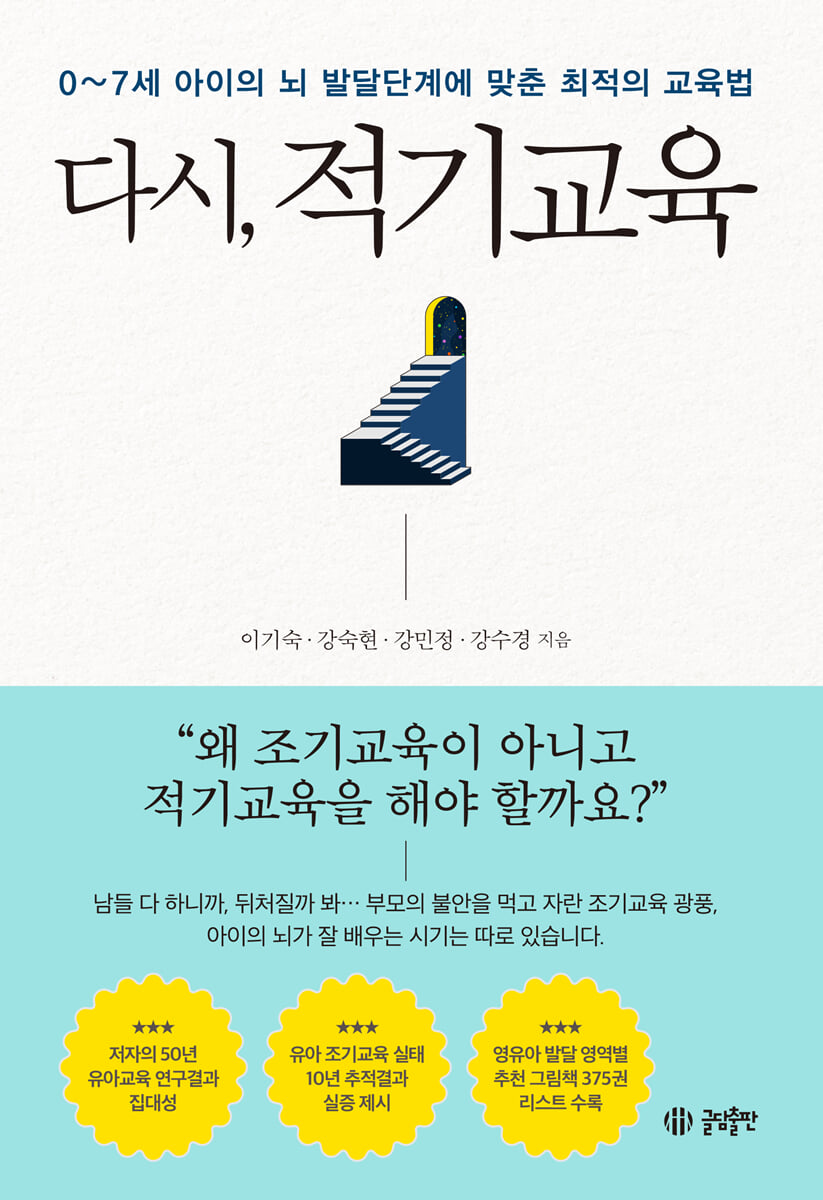
Again, early warning education
 |
Description
Book Introduction
* KBS's "Tracking 60 Minutes" (7-Year-Old Civil Service Exam: Who Is It for?)
* I'm taking the 4-year-old exam while wearing a diaper....
Spending 1.54 million won per month on English kindergarten_ YTN_2025.03.13.
* 800 billion won spent on private education for infants and toddlers in three months, more than high school students spend on English_MBN News_2025.03.13
“The sooner and more my child studies, the better he or she will do?
In an era where private education costs for infants and toddlers reach 3.2 trillion won,
The surprising power of early childhood education, starting at the right time for children aged 0-7, will soothe parents' anxieties amid the early childhood education craze!
Recently, there has been a flood of reports about the overheated state of private education for young children in Korea and its problems.
According to the Ministry of Education's 2024 Infant and Toddler Private Education Cost Survey, which was conducted for the first time, 8 out of 10 5-year-olds are receiving private education, and the cost of private English education for infants and toddlers is higher than that for high school seniors.
If “half of children under the age of 6 are Hagwon,” then foreign media is also pointing out the serious reality of private education in Korea.
The problem is that the number of children suffering from mental health problems due to excessive private education is increasing by an average of 19.4% per year.
Parents also find private education costs burdensome and are concerned about the negative effects of early learning.
However, everyone starts to learn in advance through private tutoring out of anxiety such as, 'Other kids are already learning English and math, so will my child be okay?' or 'If I don't start now, will I fall behind?'
It is also true that children who are exposed to many educational environments right now seem to be ahead of the curve.
Of course, after struggling with my child's studies because he is still not fluent in Korean, I sometimes wonder, "Is this the right thing to do?", but I don't know any other alternatives.
To help these Korean parents, Professor Lee Ki-sook, who created a buzz by conducting the first 10-year follow-up study on the effectiveness of early childhood education in Korea, has published 『Education at the Right Time Again』 with top early childhood education experts.
These experts have been researching and teaching in the field of early childhood development and education for over 30 years. Through their research and the latest domestic and international research results and case studies, they reveal in detail whether early education is truly effective for learning and what impact it has on children, and they inform us of the true meaning and importance of early education.
For parents who still believe that early childhood education means starting education late, we emphasize that early childhood education means starting education when the child's brain is ready to learn.
In other words, timely education is the most scientific educational method that helps children acquire and develop quickly with little effort without missing the right time for learning.
What parents in our country need most right now is not to say that we should not provide early education, but rather concrete methods to implement early education.
To this end, we present a specific training guide.
This can be said to be the greatest strength of this book.
We introduce practical methods that can be immediately applied, including language education through picture books, parenting methods tailored to the pace of brain growth, as well as methods for selecting toys by age and a list of 375 picture books by developmental area.
Faced with the endless questions of “When, how, and what should I teach?”, this book will provide faith instead of impatience and confidence instead of anxiety.
* I'm taking the 4-year-old exam while wearing a diaper....
Spending 1.54 million won per month on English kindergarten_ YTN_2025.03.13.
* 800 billion won spent on private education for infants and toddlers in three months, more than high school students spend on English_MBN News_2025.03.13
“The sooner and more my child studies, the better he or she will do?
In an era where private education costs for infants and toddlers reach 3.2 trillion won,
The surprising power of early childhood education, starting at the right time for children aged 0-7, will soothe parents' anxieties amid the early childhood education craze!
Recently, there has been a flood of reports about the overheated state of private education for young children in Korea and its problems.
According to the Ministry of Education's 2024 Infant and Toddler Private Education Cost Survey, which was conducted for the first time, 8 out of 10 5-year-olds are receiving private education, and the cost of private English education for infants and toddlers is higher than that for high school seniors.
If “half of children under the age of 6 are Hagwon,” then foreign media is also pointing out the serious reality of private education in Korea.
The problem is that the number of children suffering from mental health problems due to excessive private education is increasing by an average of 19.4% per year.
Parents also find private education costs burdensome and are concerned about the negative effects of early learning.
However, everyone starts to learn in advance through private tutoring out of anxiety such as, 'Other kids are already learning English and math, so will my child be okay?' or 'If I don't start now, will I fall behind?'
It is also true that children who are exposed to many educational environments right now seem to be ahead of the curve.
Of course, after struggling with my child's studies because he is still not fluent in Korean, I sometimes wonder, "Is this the right thing to do?", but I don't know any other alternatives.
To help these Korean parents, Professor Lee Ki-sook, who created a buzz by conducting the first 10-year follow-up study on the effectiveness of early childhood education in Korea, has published 『Education at the Right Time Again』 with top early childhood education experts.
These experts have been researching and teaching in the field of early childhood development and education for over 30 years. Through their research and the latest domestic and international research results and case studies, they reveal in detail whether early education is truly effective for learning and what impact it has on children, and they inform us of the true meaning and importance of early education.
For parents who still believe that early childhood education means starting education late, we emphasize that early childhood education means starting education when the child's brain is ready to learn.
In other words, timely education is the most scientific educational method that helps children acquire and develop quickly with little effort without missing the right time for learning.
What parents in our country need most right now is not to say that we should not provide early education, but rather concrete methods to implement early education.
To this end, we present a specific training guide.
This can be said to be the greatest strength of this book.
We introduce practical methods that can be immediately applied, including language education through picture books, parenting methods tailored to the pace of brain growth, as well as methods for selecting toys by age and a list of 375 picture books by developmental area.
Faced with the endless questions of “When, how, and what should I teach?”, this book will provide faith instead of impatience and confidence instead of anxiety.
- You can preview some of the book's contents.
Preview
index
preface
Chapter 1 Why should we have early childhood education?
There are appropriate times for a child's growth and development.
· Children studying in diapers
· Critical differences in early childhood education in our country
· The criteria for choosing private education are parents' anxiety.
· Parents and teachers' true feelings about early education
· Why are parents anxious?
· How much of a difference is there between parents' expectations and children's expectations?
· This is how children grow up
· To parents who say that they send their children to private education because they want to
· What interest are you showing in your child?
Become a parent with a parenting philosophy.
Chapter 2 Sweet Temptation, Early Education
:The child who leaves on time arrives on time.
· Literacy education approaches in kindergartens around the world
· Is early education more effective than early education?
· Will my child's grades fall behind if I provide early childhood education?
· What we lost through early education
· What are the characteristics of parents of gifted children?
· Memorizing formulas in exchange for curiosity
· Top grades but below average motivation to study
· Let's develop the muscles of the mind before the muscles of study.
· What should I prepare before entering elementary school?
Why Early Childhood Education is Necessary
Chapter 3: Early Childhood Education is Character Education
:There is something every parent in the world should teach their children.
· Habits that only parents can teach their children
· Empathy: The keyword of this era
· Let's foster a positive self-concept before teaching letters and math.
· A balance between self-esteem and self-worth is important.
Immersion is a core value of children's happiness.
· Even a little effort can improve your concentration.
· Raise your child to be popular with his or her friends.
Consideration is an essential manner for children.
· 3 years old, the age when one wants to be recognized as 'me'
· Understanding your child's temperament makes parenting easier.
· What kind of child is a happy child?
· To parents who feel guilty
Ten Things Successful Parents Have in Common
Chapter 4: Early Childhood Education Based on Brain Development
:The brain likes parental skin contact the most.
· A child's brain develops through parental love.
Brain development mechanisms that parents should know
· Brain development also requires timely education.
· What influences a child's brain development?
· Sweaty exercise wakes up the brain.
What Moms Must Do for Brain Development
Chapter 5: Language Education through Picture Books
:A child's literacy development begins with natural language experiences through play and communication.
· Characteristics of early childhood language development that parents should know
· Our first literacy classroom, our home where we plant the seeds of language.
· Raise your child to be a conversationalist.
· Picture books remain powerful even in this high-concept era.
· How do I choose a good picture book?
· Picture books, why 'read together'?
· Strategies for reading picture books together, conversational reading
Reading picture books together by developmental area
· Let's focus on how we think
- Reading picture books together that foster mathematical sensitivity and thinking skills.
· Understanding your own emotions
- Reading picture books together to develop emotional understanding, expression, and control skills
· Demonstrate social modeling in picture books
- Reading picture books together that foster social skills
· Language expressions learned in picture books
- Reading picture books together to develop communication and literacy skills
· Allow them to see the world in their own way
- Reading picture books together to foster visual literacy, creativity, and artistry.
Chapter 6: Digital Education Needed for Children Living in the Future Society
:Smart device use requires education on moderation and moderation.
· Now it's time to train digital capabilities.
· Children who are overly dependent on smart devices
· Early education on smart device use?
· Does being good at using smart devices make you smart?
· Advice for parents on desirable smartphone use
Chapter 7 Learning through Play
:Children grow up playing.
· Create a play culture for children.
· What is real play for children?
Outdoor play with nature is the power of future talent.
· What kind of play does your child like?
· Co-parenting between mom and dad helps children grow.
· Great toys to play with your child
Criteria for selecting toys by age and recommended toys
Chapter 1 Why should we have early childhood education?
There are appropriate times for a child's growth and development.
· Children studying in diapers
· Critical differences in early childhood education in our country
· The criteria for choosing private education are parents' anxiety.
· Parents and teachers' true feelings about early education
· Why are parents anxious?
· How much of a difference is there between parents' expectations and children's expectations?
· This is how children grow up
· To parents who say that they send their children to private education because they want to
· What interest are you showing in your child?
Become a parent with a parenting philosophy.
Chapter 2 Sweet Temptation, Early Education
:The child who leaves on time arrives on time.
· Literacy education approaches in kindergartens around the world
· Is early education more effective than early education?
· Will my child's grades fall behind if I provide early childhood education?
· What we lost through early education
· What are the characteristics of parents of gifted children?
· Memorizing formulas in exchange for curiosity
· Top grades but below average motivation to study
· Let's develop the muscles of the mind before the muscles of study.
· What should I prepare before entering elementary school?
Why Early Childhood Education is Necessary
Chapter 3: Early Childhood Education is Character Education
:There is something every parent in the world should teach their children.
· Habits that only parents can teach their children
· Empathy: The keyword of this era
· Let's foster a positive self-concept before teaching letters and math.
· A balance between self-esteem and self-worth is important.
Immersion is a core value of children's happiness.
· Even a little effort can improve your concentration.
· Raise your child to be popular with his or her friends.
Consideration is an essential manner for children.
· 3 years old, the age when one wants to be recognized as 'me'
· Understanding your child's temperament makes parenting easier.
· What kind of child is a happy child?
· To parents who feel guilty
Ten Things Successful Parents Have in Common
Chapter 4: Early Childhood Education Based on Brain Development
:The brain likes parental skin contact the most.
· A child's brain develops through parental love.
Brain development mechanisms that parents should know
· Brain development also requires timely education.
· What influences a child's brain development?
· Sweaty exercise wakes up the brain.
What Moms Must Do for Brain Development
Chapter 5: Language Education through Picture Books
:A child's literacy development begins with natural language experiences through play and communication.
· Characteristics of early childhood language development that parents should know
· Our first literacy classroom, our home where we plant the seeds of language.
· Raise your child to be a conversationalist.
· Picture books remain powerful even in this high-concept era.
· How do I choose a good picture book?
· Picture books, why 'read together'?
· Strategies for reading picture books together, conversational reading
Reading picture books together by developmental area
· Let's focus on how we think
- Reading picture books together that foster mathematical sensitivity and thinking skills.
· Understanding your own emotions
- Reading picture books together to develop emotional understanding, expression, and control skills
· Demonstrate social modeling in picture books
- Reading picture books together that foster social skills
· Language expressions learned in picture books
- Reading picture books together to develop communication and literacy skills
· Allow them to see the world in their own way
- Reading picture books together to foster visual literacy, creativity, and artistry.
Chapter 6: Digital Education Needed for Children Living in the Future Society
:Smart device use requires education on moderation and moderation.
· Now it's time to train digital capabilities.
· Children who are overly dependent on smart devices
· Early education on smart device use?
· Does being good at using smart devices make you smart?
· Advice for parents on desirable smartphone use
Chapter 7 Learning through Play
:Children grow up playing.
· Create a play culture for children.
· What is real play for children?
Outdoor play with nature is the power of future talent.
· What kind of play does your child like?
· Co-parenting between mom and dad helps children grow.
· Great toys to play with your child
Criteria for selecting toys by age and recommended toys
Detailed image

Into the book
If you look closely at the physical development process of a young baby, you will see that there is a certain order and direction.
You can sit after you can lift your head first.
And after you can sit, stand on both feet.
Language development follows a similar process.
After babbling, you can use words, and after you can use simple sentences, you can use complex sentences.
The fact that development has a certain order and direction means that previous development becomes the foundation for the next development, and when the foundation is solid, higher-level development is gradually achieved.
--- p.38
Many academies that emphasize early childhood education also claim that their education is play-centered.
But in reality, it is often learning disguised as play.
The early education discussed here refers to teaching children too much at an early age, focusing on learning content that is not appropriate for their developmental stage.
--- p.60
In March 2024, the international academic journal Science published the results of a study conducted by a research team led by Professor Margaret Birchnall of the University of Virginia in the United States, which evaluated the impact of an early childhood education program for children aged 3 to 5.
This study examines the impact of early childhood education programs on long-term academic achievement.
According to the research team, children who participated in the early education program initially showed good results in reading, writing, and arithmetic, but the effects disappeared over time.
In particular, after the third grade of elementary school, no positive effects of early education were observed, and rather, it had a negative effect.
--- pp.65-66
Learning through play is not about teaching something.
In other words, if you set a pace and evaluate what you have learned through tests, it loses its value as a playful learning method.
However, parents in our country try to teach their children how to read the clock while playing with the clock.
When playing, let your child play with the clock to his heart's content.
The important thing is observation, not interference.
Careful observation by parents is the way to view their children objectively, and that is the most powerful teaching method.
--- pp.87-88
There are two types of distraction: one is when you can't focus on anything because you're not interested in it.
Another is distraction, which comes from being curious about everything and wanting to do a variety of activities.
There is a big difference in quality between these two.
The first case is a symptom often seen in children suffering from private education.
Especially, if you receive multiple private tutoring sessions at once, you will not be able to do any of them faithfully.
Even in kindergarten, there are children who have trouble concentrating in class and are easily distracted.
Most of these children receive a lot of private tutoring after school.
--- p.124
Let Mom be a model of speaking.
This is different from being a one-sided chatterbox.
The purpose of a mother's chatter is to make the child listen and imitate what she says.
There is no need to rush ahead and use too many vocabulary in the hopes of developing a rich range of expressions.
Speed control is necessary so that the child can hear and follow along accurately with what the other person is saying.
Make them repeat similar sounds, such as 'bear', 'ball', and 'bean', naturally.
--- p.189
In the digital age, there is a strong tendency to believe that being knowledgeable and proficient in technology is a predictor of future success.
So, many parents directly link their children's technology skills to their intellectual abilities, and they often overgeneralize that their children's proficiency with smart devices will lead to their excelling in other areas as well.
--- p.246
What would happen if one day the toys children had been playing with disappeared? In a kindergarten, all the furniture and toys were removed from the five-year-old class, and the children were greeted in an empty classroom.
The children were confused by the unfamiliar situation, but soon started playing with their bodies and had a great time.
When children had no toys, they would gather natural objects and play with recycled items such as newspapers or boxes.
You can sit after you can lift your head first.
And after you can sit, stand on both feet.
Language development follows a similar process.
After babbling, you can use words, and after you can use simple sentences, you can use complex sentences.
The fact that development has a certain order and direction means that previous development becomes the foundation for the next development, and when the foundation is solid, higher-level development is gradually achieved.
--- p.38
Many academies that emphasize early childhood education also claim that their education is play-centered.
But in reality, it is often learning disguised as play.
The early education discussed here refers to teaching children too much at an early age, focusing on learning content that is not appropriate for their developmental stage.
--- p.60
In March 2024, the international academic journal Science published the results of a study conducted by a research team led by Professor Margaret Birchnall of the University of Virginia in the United States, which evaluated the impact of an early childhood education program for children aged 3 to 5.
This study examines the impact of early childhood education programs on long-term academic achievement.
According to the research team, children who participated in the early education program initially showed good results in reading, writing, and arithmetic, but the effects disappeared over time.
In particular, after the third grade of elementary school, no positive effects of early education were observed, and rather, it had a negative effect.
--- pp.65-66
Learning through play is not about teaching something.
In other words, if you set a pace and evaluate what you have learned through tests, it loses its value as a playful learning method.
However, parents in our country try to teach their children how to read the clock while playing with the clock.
When playing, let your child play with the clock to his heart's content.
The important thing is observation, not interference.
Careful observation by parents is the way to view their children objectively, and that is the most powerful teaching method.
--- pp.87-88
There are two types of distraction: one is when you can't focus on anything because you're not interested in it.
Another is distraction, which comes from being curious about everything and wanting to do a variety of activities.
There is a big difference in quality between these two.
The first case is a symptom often seen in children suffering from private education.
Especially, if you receive multiple private tutoring sessions at once, you will not be able to do any of them faithfully.
Even in kindergarten, there are children who have trouble concentrating in class and are easily distracted.
Most of these children receive a lot of private tutoring after school.
--- p.124
Let Mom be a model of speaking.
This is different from being a one-sided chatterbox.
The purpose of a mother's chatter is to make the child listen and imitate what she says.
There is no need to rush ahead and use too many vocabulary in the hopes of developing a rich range of expressions.
Speed control is necessary so that the child can hear and follow along accurately with what the other person is saying.
Make them repeat similar sounds, such as 'bear', 'ball', and 'bean', naturally.
--- p.189
In the digital age, there is a strong tendency to believe that being knowledgeable and proficient in technology is a predictor of future success.
So, many parents directly link their children's technology skills to their intellectual abilities, and they often overgeneralize that their children's proficiency with smart devices will lead to their excelling in other areas as well.
--- p.246
What would happen if one day the toys children had been playing with disappeared? In a kindergarten, all the furniture and toys were removed from the five-year-old class, and the children were greeted in an empty classroom.
The children were confused by the unfamiliar situation, but soon started playing with their bodies and had a great time.
When children had no toys, they would gather natural objects and play with recycled items such as newspapers or boxes.
--- p.281
Publisher's Review
“Korean parents think of their children as students from an early age” – OECD Education Evaluation Team
With private education costs for infants and toddlers hitting record highs every year, are our children getting smarter?
With the logic that 'you should start anything at a young age to avoid falling behind', 'the brain is 80% developed during infancy', and 'the earlier you start learning a foreign language, the more advantageous it is', the starting age for early education has become earlier and the content has become more diverse.
The cost of private education for infants and toddlers in South Korea is hitting a record high every year, reaching 3.2 trillion won.
But experts unanimously warn that we will soon face enormous side effects.
Parents are confused about what is true and what to believe.
The author of 『Again, Early Childhood Education』 is the first in Korea to conduct a multi-faceted, 10-year follow-up study on the impact of early childhood education on children.
A representative example is a study that compared and analyzed the reading ability and vocabulary of children who had received prior Korean language learning at the age of five and those who had not, through mock tests when they were elementary school students.
What were the results? Surprisingly, the two groups' mock exam scores were 49.25 (children who received pre-learning) and 50.86 (children who did not receive pre-learning), showing little difference.
The results were no different in the mock exams administered when they were in the third grade of elementary school.
Similar results were confirmed in a study that investigated mathematics-related prior learning under the same conditions as above.
"Again, Early Childhood Education" provides clear answers to parents who are swayed by the temptations of pre-school and private education through the latest domestic and international research results and case studies.
There are specific times when a child's brain learns best.
The most scientific educational method to ensure your child never misses the right time to learn, as taught by leading early childhood experts!
For parents today who are accustomed to early education, early education may be seen as delaying the timing of education.
However, the exact purpose of early learning is to not miss the 'right time to learn'.
Early cognitive learning, focusing on reading, writing, and arithmetic, occurs as the frontal lobe matures and continues to mature steadily throughout elementary and middle school.
It is not something that can be completed just by stimulating it in a short period of time.
What happens if we just flood the brain with software before all the hardware is fully formed? This may explain why there are so many pediatric psychiatrists in areas known for their school districts.
Each child has his or her own unique growth spurt.
When provided with the right education and environment for the time, one can learn and grow quickly with little effort.
To help with this, this book introduces the right-time education method that the country's top early childhood experts have accumulated through over 30 years of field and research experience.
It provides detailed guidance so that anyone can easily practice at home, including creating a parenting environment and teaching methods suited to the pace of brain development, as well as picture book reading methods that help children develop language and literacy, and age-appropriate play methods.
In particular, it is even more useful because it contains specific and practical early childhood education know-how, such as diagnosis of parents' daily speech habits, a list of 375 recommended picture books for each area of infant and toddler development, and age-specific toy selection criteria and recommended toys.
If you want to raise your child to be smart and happy,
As parents, what kind of early childhood should we give our children?
Rather than worrying about their child's education from infancy, parents should worry about what kind of life their child will lead in the future.
Let's first check what kind of parent you are.
□ I started early education because of a vague sense of anxiety.
□ We are providing early education in the hope that grades will improve.
□ I support early childhood education, but I am afraid that my child's grades will fall behind.
□ I am providing private education to my child because he or she wants it.
□ I want to provide expensive private education even if it means working a side job.
□ I still believe that a prestigious university is the shortcut to success.
□ My child is more sensitive to what others think of him/her than to what he/she thinks of himself/herself.
If you checked any of these, I highly recommend reading this book.
It's easy to observe how children struggle to focus and how they squirm when attending school or studying from homework.
On the other hand, as parents, we know very well how focused our children are when they are playing a game they like.
We must keep in mind that the habit of concentration developed during infancy ultimately becomes the most important foundation for enhancing learning effectiveness later on.
Studying is ultimately a battle of concentration.
Early childhood education begins with breaking free from the misconception about early childhood education and the obsession that children must learn everything from an early age to lay the foundation for learning.
With private education costs for infants and toddlers hitting record highs every year, are our children getting smarter?
With the logic that 'you should start anything at a young age to avoid falling behind', 'the brain is 80% developed during infancy', and 'the earlier you start learning a foreign language, the more advantageous it is', the starting age for early education has become earlier and the content has become more diverse.
The cost of private education for infants and toddlers in South Korea is hitting a record high every year, reaching 3.2 trillion won.
But experts unanimously warn that we will soon face enormous side effects.
Parents are confused about what is true and what to believe.
The author of 『Again, Early Childhood Education』 is the first in Korea to conduct a multi-faceted, 10-year follow-up study on the impact of early childhood education on children.
A representative example is a study that compared and analyzed the reading ability and vocabulary of children who had received prior Korean language learning at the age of five and those who had not, through mock tests when they were elementary school students.
What were the results? Surprisingly, the two groups' mock exam scores were 49.25 (children who received pre-learning) and 50.86 (children who did not receive pre-learning), showing little difference.
The results were no different in the mock exams administered when they were in the third grade of elementary school.
Similar results were confirmed in a study that investigated mathematics-related prior learning under the same conditions as above.
"Again, Early Childhood Education" provides clear answers to parents who are swayed by the temptations of pre-school and private education through the latest domestic and international research results and case studies.
There are specific times when a child's brain learns best.
The most scientific educational method to ensure your child never misses the right time to learn, as taught by leading early childhood experts!
For parents today who are accustomed to early education, early education may be seen as delaying the timing of education.
However, the exact purpose of early learning is to not miss the 'right time to learn'.
Early cognitive learning, focusing on reading, writing, and arithmetic, occurs as the frontal lobe matures and continues to mature steadily throughout elementary and middle school.
It is not something that can be completed just by stimulating it in a short period of time.
What happens if we just flood the brain with software before all the hardware is fully formed? This may explain why there are so many pediatric psychiatrists in areas known for their school districts.
Each child has his or her own unique growth spurt.
When provided with the right education and environment for the time, one can learn and grow quickly with little effort.
To help with this, this book introduces the right-time education method that the country's top early childhood experts have accumulated through over 30 years of field and research experience.
It provides detailed guidance so that anyone can easily practice at home, including creating a parenting environment and teaching methods suited to the pace of brain development, as well as picture book reading methods that help children develop language and literacy, and age-appropriate play methods.
In particular, it is even more useful because it contains specific and practical early childhood education know-how, such as diagnosis of parents' daily speech habits, a list of 375 recommended picture books for each area of infant and toddler development, and age-specific toy selection criteria and recommended toys.
If you want to raise your child to be smart and happy,
As parents, what kind of early childhood should we give our children?
Rather than worrying about their child's education from infancy, parents should worry about what kind of life their child will lead in the future.
Let's first check what kind of parent you are.
□ I started early education because of a vague sense of anxiety.
□ We are providing early education in the hope that grades will improve.
□ I support early childhood education, but I am afraid that my child's grades will fall behind.
□ I am providing private education to my child because he or she wants it.
□ I want to provide expensive private education even if it means working a side job.
□ I still believe that a prestigious university is the shortcut to success.
□ My child is more sensitive to what others think of him/her than to what he/she thinks of himself/herself.
If you checked any of these, I highly recommend reading this book.
It's easy to observe how children struggle to focus and how they squirm when attending school or studying from homework.
On the other hand, as parents, we know very well how focused our children are when they are playing a game they like.
We must keep in mind that the habit of concentration developed during infancy ultimately becomes the most important foundation for enhancing learning effectiveness later on.
Studying is ultimately a battle of concentration.
Early childhood education begins with breaking free from the misconception about early childhood education and the obsession that children must learn everything from an early age to lay the foundation for learning.
GOODS SPECIFICS
- Date of issue: May 15, 2025
- Page count, weight, size: 298 pages | 145*210*20mm
- ISBN13: 9791191309836
- ISBN10: 1191309835
You may also like
카테고리
korean


korean

![GQ KOREA Mark (Monthly): December [2025]](http://librairie.coreenne.fr/cdn/shop/files/8ef265dbbfbf186523ed75ba7319009d.jpg?v=1765340328&width=3840)


