

Wine Aesthetics
 |
Description
Book Introduction
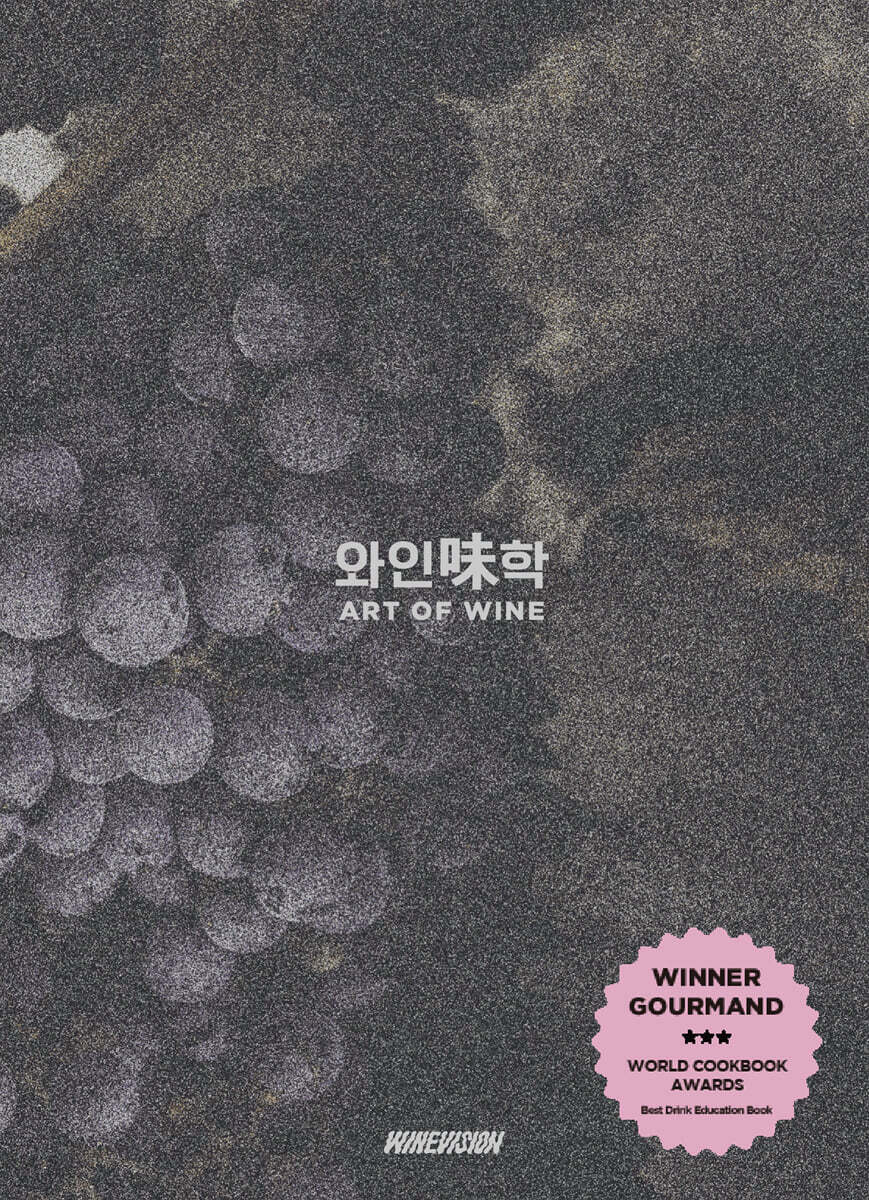
"Wine Aesthetics" is an introductory and practical book that helps anyone, from beginners to experts, easily learn about and deeply understand wine.
Covering a wide range of topics, from wine tasting techniques to grape cultivation, the brewing process, major grape varieties, and production regions, it is structured so that readers can easily understand and apply it in their daily lives.
This book, co-authored by Wine Vision Press and five wine experts, was recognized internationally for its excellence when it won the 'Best Beverage Education Book' award at the 2015 'Gourmand World Cookbook Awards'.
This revised edition reflects the latest trends and enhances the following elements to enable more in-depth and systematic learning.
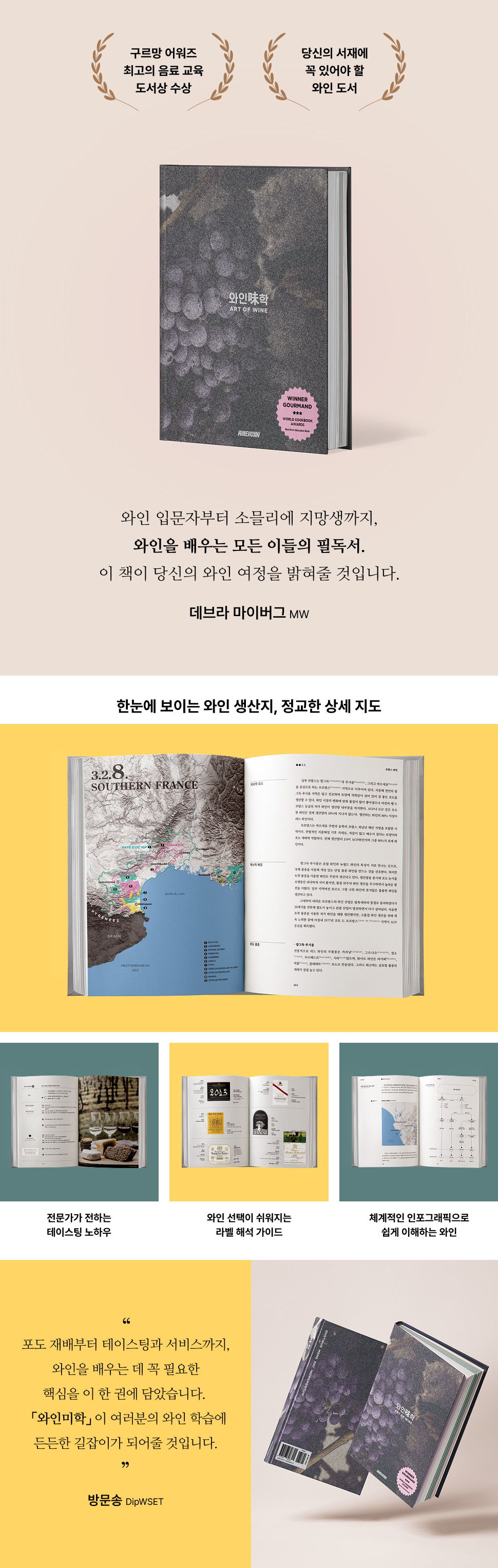
* Enhanced maps and visuals → Detailed maps have been added to help you understand wine-producing regions at a glance.
* Latest information update → More practical content reflecting changes and new trends in the wine industry.
* Clearer explanations and systematic organization → The narrative style has been improved to increase learning efficiency.
* Strengthening wine-centered expertise → Focused more on wine-related content, excluding content related to distilled liquor and Korean alcohol.
* Systematic learning design → The content is designed to be helpful to readers preparing for international wine qualification exams such as WSET and CMS.
Covering a wide range of topics, from wine tasting techniques to grape cultivation, the brewing process, major grape varieties, and production regions, it is structured so that readers can easily understand and apply it in their daily lives.
This book, co-authored by Wine Vision Press and five wine experts, was recognized internationally for its excellence when it won the 'Best Beverage Education Book' award at the 2015 'Gourmand World Cookbook Awards'.
This revised edition reflects the latest trends and enhances the following elements to enable more in-depth and systematic learning.
* Enhanced maps and visuals → Detailed maps have been added to help you understand wine-producing regions at a glance.
* Latest information update → More practical content reflecting changes and new trends in the wine industry.
* Clearer explanations and systematic organization → The narrative style has been improved to increase learning efficiency.
* Strengthening wine-centered expertise → Focused more on wine-related content, excluding content related to distilled liquor and Korean alcohol.
* Systematic learning design → The content is designed to be helpful to readers preparing for international wine qualification exams such as WSET and CMS.
- You can preview some of the book's contents.
Preview
index
PROLOGUE
How to use the book
1.
wine tasting
1.1 Wine Story
1.2 Wine Tasting
2.
The taste and quality of wine
2.1 Factors affecting the taste and quality of wine
2.2 Grape varieties
2.2.1 Green Grapes
2.2.2 Red Grapes
2.3 Growth environment
2.4 Winemaking
3.
Major wine producing regions of the world
3.1 Understanding Wine Labels
3.2 French wine
3.3 German wine
3.4 Austrian wine
3.5 Hungarian wine
3.6 Greek wine
3.7 Italian wine
3.8 Spanish wine
3.9 Portuguese wine
3.10 American Wine
3.11 Canadian Wine
3.12 Chilean Wine
3.13 Argentine Wine
3.14 South African Wine
3.15 Australian Wine
3.16 New Zealand Wine
3.17 Wines from outside Asia
4.
Wine and Life
4.1 Food and Wine Matching
4.2 Wine Service
4.3 Responsible alcohol sale and consumption
References
index
How to use the book
1.
wine tasting
1.1 Wine Story
1.2 Wine Tasting
2.
The taste and quality of wine
2.1 Factors affecting the taste and quality of wine
2.2 Grape varieties
2.2.1 Green Grapes
2.2.2 Red Grapes
2.3 Growth environment
2.4 Winemaking
3.
Major wine producing regions of the world
3.1 Understanding Wine Labels
3.2 French wine
3.3 German wine
3.4 Austrian wine
3.5 Hungarian wine
3.6 Greek wine
3.7 Italian wine
3.8 Spanish wine
3.9 Portuguese wine
3.10 American Wine
3.11 Canadian Wine
3.12 Chilean Wine
3.13 Argentine Wine
3.14 South African Wine
3.15 Australian Wine
3.16 New Zealand Wine
3.17 Wines from outside Asia
4.
Wine and Life
4.1 Food and Wine Matching
4.2 Wine Service
4.3 Responsible alcohol sale and consumption
References
index
Detailed image
Into the book
In fact, the tasting methods used by most wine lovers and experts are not very different.
The most common elements of wine tasting analysis are appearance, smell, taste, and conclusions about quality.
In this book, you'll learn how to taste wine using the Grid Tasting System, a tool that allows you to conduct wine tastings in a systematic and structured manner.
This system allows for consistent evaluation and comparison of various characteristics of wines, enabling more accurate analysis.
--- p.30
When talking about grape-producing regions, the word 'terroir' is often used.
Terroir refers to the comprehensive natural environment of the region where the vineyard is located.
It comes from the French word 'Terre', which means 'soil'.
Just looking at this word, you can see that the soil is at the center of the entire concept.
Additionally, the topography of the vineyard, macroclimate, mesoclimate, microclimate, and the interaction of all these factors are included in the concept of terroir.
Appellation Controlee, France's wine quality certification system, can be said to have been born based on this concept of terroir.
--- p.159
Vintage Port, also known as bottle-aged Port, is the most expensive and best Port.
It is made from a single vintage wine that is aged for 2-3 years in extra-large oak barrels. It is not produced every year, but only in years when the grapes are of good quality.
Quinta is a port wine produced from a single estate.
Vintage Port is bottled without fining, so a lot of sediment forms at the bottom of the bottle after bottling.
This is called a crust.
Therefore, you must decant before drinking.
Vintage Port continues to develop in the bottle, so it is best enjoyed 15 to 30 years after the vintage.
--- p.205
Pairing dry wine with sweet foods will diminish the fruity flavors of the wine and emphasize its acidity.
Therefore, it is best to pair sweet foods with wines that have a similar or higher sugar content.
Moscato goes well with sweet vanilla ice cream, and off-dry Riesling goes well with sweet and sour Thai food.
Sauternes goes well with salty, grilled foie gras, because when sweetness meets saltiness, the sweetness is intensified.
The most common elements of wine tasting analysis are appearance, smell, taste, and conclusions about quality.
In this book, you'll learn how to taste wine using the Grid Tasting System, a tool that allows you to conduct wine tastings in a systematic and structured manner.
This system allows for consistent evaluation and comparison of various characteristics of wines, enabling more accurate analysis.
--- p.30
When talking about grape-producing regions, the word 'terroir' is often used.
Terroir refers to the comprehensive natural environment of the region where the vineyard is located.
It comes from the French word 'Terre', which means 'soil'.
Just looking at this word, you can see that the soil is at the center of the entire concept.
Additionally, the topography of the vineyard, macroclimate, mesoclimate, microclimate, and the interaction of all these factors are included in the concept of terroir.
Appellation Controlee, France's wine quality certification system, can be said to have been born based on this concept of terroir.
--- p.159
Vintage Port, also known as bottle-aged Port, is the most expensive and best Port.
It is made from a single vintage wine that is aged for 2-3 years in extra-large oak barrels. It is not produced every year, but only in years when the grapes are of good quality.
Quinta is a port wine produced from a single estate.
Vintage Port is bottled without fining, so a lot of sediment forms at the bottom of the bottle after bottling.
This is called a crust.
Therefore, you must decant before drinking.
Vintage Port continues to develop in the bottle, so it is best enjoyed 15 to 30 years after the vintage.
--- p.205
Pairing dry wine with sweet foods will diminish the fruity flavors of the wine and emphasize its acidity.
Therefore, it is best to pair sweet foods with wines that have a similar or higher sugar content.
Moscato goes well with sweet vanilla ice cream, and off-dry Riesling goes well with sweet and sour Thai food.
Sauternes goes well with salty, grilled foie gras, because when sweetness meets saltiness, the sweetness is intensified.
--- p.377
Publisher's Review
Wine is not just a drink.
It is a world where history and culture, language and art, science and taste are intertwined, and it is a medium that connects people and times.
But delving deeply into its essence is not easy.
With so much knowledge and complex concepts, it can be overwhelming to know where to start.
"Wine Aesthetics" is a book that started from that very concern.
Five wine experts have written this book together to help more people learn about wine and enjoy it more deeply.
This book is not just an introductory book.
A practical guide to help you enjoy the process of learning about wine itself.
We hope that through this book, readers will understand the essence of wine, experience it firsthand, and explore it in their own way.
So, rather than simply listing information, it's packed with practical, helpful elements, including how to sensorially experience wine, how to read and interpret labels, and visual aids that compare regional characteristics.
The book covers a wide range of key elements of wine, from wine tasting techniques to the characteristics of each grape variety, growing environment, and the winemaking process. It also systematically explains how to interpret wine labels and the major production regions of each country.
Detailed maps of wine regions and a variety of visual aids help you intuitively understand complex concepts such as the winemaking process, terroir, characteristics of grape varieties, and wine classification systems.
"Wine Aesthetics" was widely recognized for its excellence, winning the "Best Beverage Education Book" award at the 2015 Gourmand World Cookbook Awards.
And this revised edition reflects the latest wine industry trends, keeping abreast of evolving trends such as the impact of climate change on wine production, the rise of natural wines, and the rise of new wine regions.
We hope this book will serve as a solid guide for anyone learning about wine.
For beginners, it provides easy tasting tips and an explanation of basic terms. For aspiring sommeliers, it provides in-depth knowledge needed to prepare for WSET and CMS courses. For wine lovers, it provides a way to discover their own wine taste.
Learning about wine is not just about acquiring knowledge.
It is a process of awakening your own senses, gaining new perspectives, and enjoying things more deeply.
『Wine Aesthetics』 will accompany you on that journey.
It is a world where history and culture, language and art, science and taste are intertwined, and it is a medium that connects people and times.
But delving deeply into its essence is not easy.
With so much knowledge and complex concepts, it can be overwhelming to know where to start.
"Wine Aesthetics" is a book that started from that very concern.
Five wine experts have written this book together to help more people learn about wine and enjoy it more deeply.
This book is not just an introductory book.
A practical guide to help you enjoy the process of learning about wine itself.
We hope that through this book, readers will understand the essence of wine, experience it firsthand, and explore it in their own way.
So, rather than simply listing information, it's packed with practical, helpful elements, including how to sensorially experience wine, how to read and interpret labels, and visual aids that compare regional characteristics.
The book covers a wide range of key elements of wine, from wine tasting techniques to the characteristics of each grape variety, growing environment, and the winemaking process. It also systematically explains how to interpret wine labels and the major production regions of each country.
Detailed maps of wine regions and a variety of visual aids help you intuitively understand complex concepts such as the winemaking process, terroir, characteristics of grape varieties, and wine classification systems.
"Wine Aesthetics" was widely recognized for its excellence, winning the "Best Beverage Education Book" award at the 2015 Gourmand World Cookbook Awards.
And this revised edition reflects the latest wine industry trends, keeping abreast of evolving trends such as the impact of climate change on wine production, the rise of natural wines, and the rise of new wine regions.
We hope this book will serve as a solid guide for anyone learning about wine.
For beginners, it provides easy tasting tips and an explanation of basic terms. For aspiring sommeliers, it provides in-depth knowledge needed to prepare for WSET and CMS courses. For wine lovers, it provides a way to discover their own wine taste.
Learning about wine is not just about acquiring knowledge.
It is a process of awakening your own senses, gaining new perspectives, and enjoying things more deeply.
『Wine Aesthetics』 will accompany you on that journey.
GOODS SPECIFICS
- Date of issue: January 8, 2025
- Format: Hardcover book binding method guide
- Page count, weight, size: 416 pages | 901g | 191*251*31mm
- ISBN13: 9791198796301
- ISBN10: 1198796308
You may also like
카테고리
korean


korean

![GQ KOREA Mark (Monthly): December [2025]](http://librairie.coreenne.fr/cdn/shop/files/8ef265dbbfbf186523ed75ba7319009d.jpg?v=1765340328&width=3840)


