

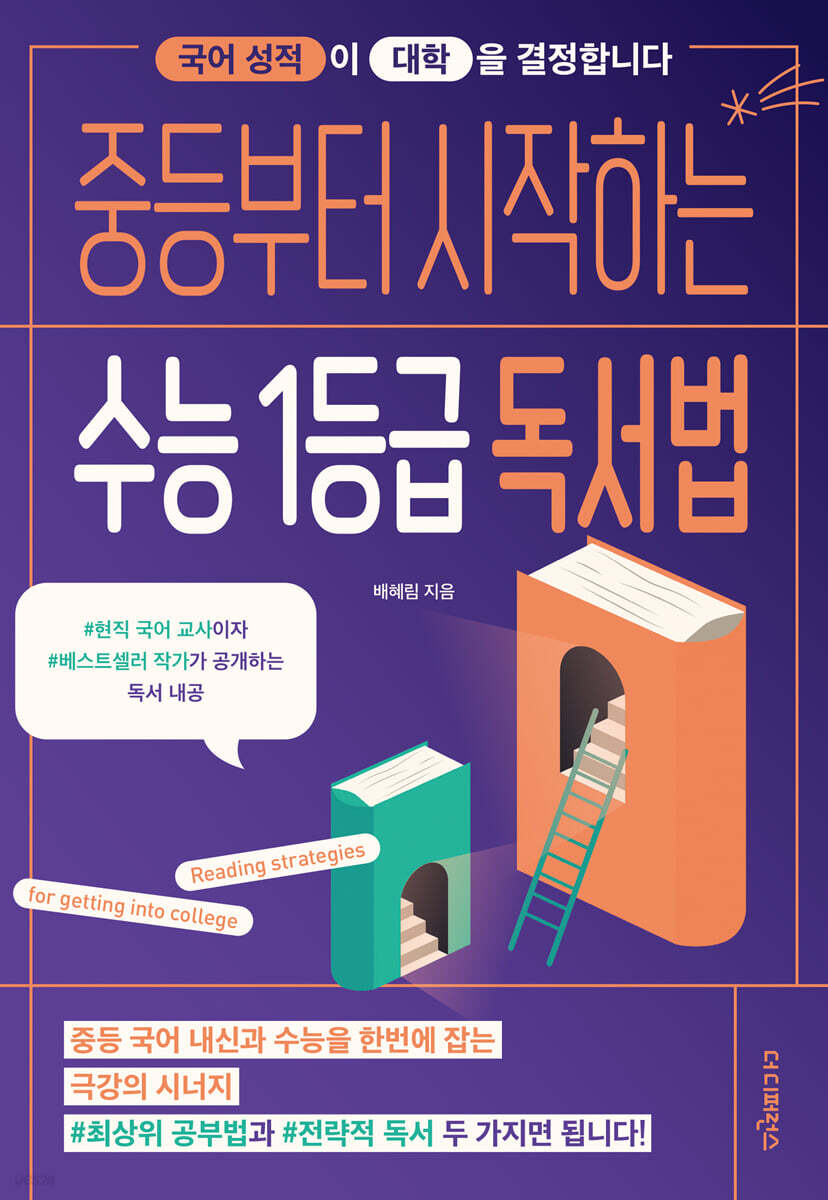
Reading method for the CSAT, starting from middle school
 |
Description
Book Introduction
Starting from middle school
A 6-Year Roadmap for Top-Ranking Korean Language Students in School and College Scholastic Ability Tests
Recently, the Korean language section of the College Scholastic Ability Test has been densely packed with passages and the level of topics and texts is also high.
It requires reading skills such as comprehension, reasoning, reading comprehension, and literacy to accurately interpret and apply the text, rather than simply the ability to read and interpret the text.
The author of this book, who has been a high school Korean language teacher for 23 years and has written numerous study method books, says that students should have a good understanding of the Korean language curriculum and develop reading comprehension skills by reading strategically starting from middle school.
By implementing the six-year roadmap for top-tier Korean language proficiency revealed in this book, you will be able to lay a solid foundation for your Korean language skills.
A 6-Year Roadmap for Top-Ranking Korean Language Students in School and College Scholastic Ability Tests
Recently, the Korean language section of the College Scholastic Ability Test has been densely packed with passages and the level of topics and texts is also high.
It requires reading skills such as comprehension, reasoning, reading comprehension, and literacy to accurately interpret and apply the text, rather than simply the ability to read and interpret the text.
The author of this book, who has been a high school Korean language teacher for 23 years and has written numerous study method books, says that students should have a good understanding of the Korean language curriculum and develop reading comprehension skills by reading strategically starting from middle school.
By implementing the six-year roadmap for top-tier Korean language proficiency revealed in this book, you will be able to lay a solid foundation for your Korean language skills.
- You can preview some of the book's contents.
Preview
index
Prologue: A 6-Year Roadmap for Top-Ranking Korean Language Students on the College Scholastic Ability Test
[Chapter 1.
[Misconceptions and Truths About Studying Korean]
Even if you study Korean, your grades won't improve, and even if you don't study, your grades won't drop.
Reading a lot improves your Korean language grades.
With just a little effort, you can quickly improve your Korean score.
Korean is not a subject to be memorized.
Korean is not a subject that requires prior knowledge.
It is important to solve many different problems.
[Chapter 2.
What is the difference between middle school and high school Korean?
Differences between elementary and middle school Korean
Differences between middle school and high school Korean
Why High School Korean is Difficult
Scope of High School Korean
Why the Korean language section of the CSAT is important
[Chapter 3.
[Korean Language Study Guide to Jump to the Top]
Korean study methods according to time period
Study methods according to the Korean language area
Listening to Korean language textbook classes
Smart textbook reading
The concepts in Korean textbooks must be memorized like math formulas.
How to Write Middle School Korean Concept Notes
How to Use the Effective Korean Language Workbook
Prepare properly for descriptive questions
Study Habits High School Students Need to Fix
Killing two birds with one stone: internal exams and mock exams
[Chapter 4.
[Strategic Reading Roadmap for Achieving a Top Grade in Korean Language on the College Scholastic Ability Test]
Reading and comprehension are different
Reading a lot isn't enough
The works included in the textbook must be read in accordance with the learning objectives for each unit.
The works included in textbooks must be read with an understanding of their essence.
Pre-reading high school literature in middle school
Reading non-fiction works in preparation for the college entrance exam or mock exams in middle school
The Importance of Vocabulary for Reading Comprehension
Be sure to solve the non-literature reading comprehension workbook
Establishing a reading habit that leads to consistent reading
│ Appendix │ Korean Language Study Roadmap Checklist
[Chapter 1.
[Misconceptions and Truths About Studying Korean]
Even if you study Korean, your grades won't improve, and even if you don't study, your grades won't drop.
Reading a lot improves your Korean language grades.
With just a little effort, you can quickly improve your Korean score.
Korean is not a subject to be memorized.
Korean is not a subject that requires prior knowledge.
It is important to solve many different problems.
[Chapter 2.
What is the difference between middle school and high school Korean?
Differences between elementary and middle school Korean
Differences between middle school and high school Korean
Why High School Korean is Difficult
Scope of High School Korean
Why the Korean language section of the CSAT is important
[Chapter 3.
[Korean Language Study Guide to Jump to the Top]
Korean study methods according to time period
Study methods according to the Korean language area
Listening to Korean language textbook classes
Smart textbook reading
The concepts in Korean textbooks must be memorized like math formulas.
How to Write Middle School Korean Concept Notes
How to Use the Effective Korean Language Workbook
Prepare properly for descriptive questions
Study Habits High School Students Need to Fix
Killing two birds with one stone: internal exams and mock exams
[Chapter 4.
[Strategic Reading Roadmap for Achieving a Top Grade in Korean Language on the College Scholastic Ability Test]
Reading and comprehension are different
Reading a lot isn't enough
The works included in the textbook must be read in accordance with the learning objectives for each unit.
The works included in textbooks must be read with an understanding of their essence.
Pre-reading high school literature in middle school
Reading non-fiction works in preparation for the college entrance exam or mock exams in middle school
The Importance of Vocabulary for Reading Comprehension
Be sure to solve the non-literature reading comprehension workbook
Establishing a reading habit that leads to consistent reading
│ Appendix │ Korean Language Study Roadmap Checklist
Detailed image

Into the book
Many students do not set aside time to study Korean.
Moreover, because I use Korean all the time, I think I know it well and am good at it.
Is that why most people overlook the importance of studying Korean?
The same goes for parents.
I am interested in studying math and English and invest more time in them.
If you look around, you can see that there are some students who go to Korean language academies, but the academies that most students from elementary school to high school go to are math academies and English academies.
The roadmap for studying math or English is better organized than the roadmap for studying Korean.
Although things have improved somewhat recently as the importance of the Korean language subject has been highlighted, many people still find it unfamiliar or overwhelming to be told that they must study Korean.
Some people ask whether studying Korean is enough if you just read well.
If you look at the Korean language textbook, there are very few difficult terms and it is easy to read, so it doesn't feel more difficult than textbooks for other subjects.
It's rather easy.
The same thing applies when working in high schools.
Many children say, “Teacher, I’m really good at Korean.
“Please look forward to my Korean language grades,” he shouts.
After the test, “Teacher, I did well on the Korean test.
“This is pretty good, right?” he says, showing the test paper.
However, when a teacher analyzes the test paper with a keen eye, the questions that are meant to test true ability are often incorrect.
Especially when there is a particularly attractive wrong answer, we often get so caught up in its charm that we end up writing down the wrong answer.
"You got this wrong? Do you know what the answer is? And can you analyze why you got it wrong?" I'd say, "Oh, teacher, that's wrong, but you got everything else right.
They don't check their own learning progress thoroughly, saying, "I'll study the mistakes later."
As students advance in grade level, these problems increase, but most of them are satisfied with their current grades and do not study Korean.
At the same time, he believes that his grades will not drop even if he doesn't study Korean.
Conversely, there are cases where you study hard but don't get good grades in Korean.
At this point, reasonable doubts arise.
Why is it that even if you study hard, you don't get good grades in Korean, and yet even if you don't, you still get good grades? The answer can be found between the lines of this article.
The thing children say most often to their Korean teachers is, “Even if I study Korean, my grades won’t improve, and even if I don’t, my grades won’t drop!”
Even if you don't study Korean, your Korean grades won't drop right away.
It is certain that as students advance in grade level, their Korean language scores gradually decline.
The problem of declining Korean language scores cannot be solved simply by solving a lot of Korean language workbooks or attending Korean language academies.
--- From "14_Korean: Even if you study, your grades won't go up, and even if you don't study, your grades won't go down"
Middle school Korean is different from elementary school Korean.
Unlike elementary school, when you become a middle school student, your 'scores' are clearly stated and appear on your report card.
Fortunately, when you enter middle school, there is a free semester system, so rather than calculating grades directly, teachers observe your activities during class like in elementary school and record the observations on your report card.
During the first or second semester of the first year of middle school, a free semester system is implemented, and for the remaining semesters, grades are calculated through written and performance evaluations.
When you become a middle school student, you can't help but worry about your grades.
Even if you read a lot until elementary school, from middle school onwards, studying Korean should be the focus rather than reading.
Of course, reading is also important.
However, if you only read without studying Korean, you may become a child who likes books but is bad at studying.
You have to walk a tightrope between reading and studying Korean.
Middle and high school students cannot get good grades in Korean language through reading alone.
Reading is the basic foundation, and you must study Korean based on this foundation.
Studying Korean doesn't simply mean reading a Korean textbook.
You must read the text in the textbook and complete the learning activities.
When a Korean concept comes up, you have to memorize that concept.
Of course, the content you learn isn't much different from what you learned in elementary school.
However, many of the Korean concepts in middle school Korean textbooks are not friendly concepts like those in elementary school, but rather vocabulary based on Chinese characters.
If you don't understand the meaning of the concepts, you can't study Korean properly.
The Korean language concepts that emerge in middle school Korean become the basis for high school Korean.
It would be good to create a concept note and memorize it every time a Korean concept comes up.
I recommend that you continue to study Korean language concept notes not only during middle school but also throughout high school.
Since concept notes are organized by me, not by someone else, I can remember them better when I look them up later.
If you organize the concepts yourself, you can organize them in connection with middle and high school.
You can review it again when organizing advanced Korean language concepts.
--- From "44_Differences between Elementary and Middle School Korean"
The entire middle school course is a preparatory course for high school.
Many things are similar between middle and high schools, including periodic written tests, in-class performance evaluations, class management methods, and student records.
So, it is a good idea to think about a roadmap until college entrance while in middle school.
But our children going through puberty don't want to follow their mother's roadmap.
When you reach puberty, you start to develop your own opinions and try to act according to your own thoughts.
I can't stand my mom's nagging anymore.
Now, mom can't hold the reins of her studies.
Children need to think about and plan for themselves what and how they should study.
From middle school onwards, we need to move from studying under our mothers to self-directed learning.
So how should our children study Korean? First and foremost, they should focus on two main areas: reading and studying Korean.
Shall we start by looking at reading?
Reading should be done for entertainment purposes until the first year of middle school, and from the second year of middle school, students should be able to read numerous literary works that are covered in high school as well as non-literary works that they will encounter in college entrance exams and mock exams.
To read strategically like this, you need to enjoy reading in elementary school.
Otherwise, I wouldn't suddenly start reading just because I'm a middle school student.
When I was in high school, I had little time to read.
You need to know the content of the numerous works covered in class to be able to follow the class.
And that's not all? There are books required for each subject to fill the curriculum, even though reading isn't reflected in the student records. Even just reading them all takes up too much time.
So, it is necessary to think that reading is something that you master in middle school.
There are numerous non-fiction books on the market aimed at middle school students.
Please read with the idea of building background knowledge in various fields.
Start with thin, non-fiction books and gradually move on to thicker books as your child develops an interest in the subject.
Even if books cover the same topic, there are differences in thickness and vocabulary between books written for teenagers and books written for adults.
Books written for teenagers tend to be easier and lighter, while books written for adults tend to be more specialized and in-depth.
However, the content that must be covered is not very different, so it would be less repulsive if you read the easier expressions first.
Please have them read a wide range of subjects, focusing on the areas covered in the CSAT.
The subjects covered in the CSAT are humanities, social sciences, science, technology, and arts.
To ensure your child can read a wide range of books without focusing on just one area, go to the library and choose books or give them books they like as gifts.
There is a definite difference in the feeling between a borrowed book and a book you own.
Literary works require reading for studying the Korean language and for maintaining reading.
What do you mean? Reading for Korean language study, to be honest, isn't fun.
There is a strong sense of obligation.
If you don't like reading, you won't be able to pursue reading for your studies.
I need some tips to get me started on reading for my studies.
That's reading to keep reading.
To live a healthy life, we need to eat a balanced diet, but sometimes we crave snacks or junk food.
Likewise, while reading for study is necessary, we also need reading that is like snacks or junk food that can spark children's interest in reading.
Children can overcome the boredom of reading for study with that strength.
To study Korean, you must read modern and classic novels.
When it comes to contemporary fiction, there are some must-reads.
It consists mainly of short stories, so it doesn't take long to read one.
Many of these works appear in middle school textbooks, so I recommend reading them in advance.
Classic novels are often written in archaic language, making it difficult to read, let alone understand, the meaning of the text.
You should read it in advance in your third year of middle school before you start high school.
You probably encountered classic novels as fairy tales when you were in elementary school.
Now, we need to read the original text properly.
Moreover, because I use Korean all the time, I think I know it well and am good at it.
Is that why most people overlook the importance of studying Korean?
The same goes for parents.
I am interested in studying math and English and invest more time in them.
If you look around, you can see that there are some students who go to Korean language academies, but the academies that most students from elementary school to high school go to are math academies and English academies.
The roadmap for studying math or English is better organized than the roadmap for studying Korean.
Although things have improved somewhat recently as the importance of the Korean language subject has been highlighted, many people still find it unfamiliar or overwhelming to be told that they must study Korean.
Some people ask whether studying Korean is enough if you just read well.
If you look at the Korean language textbook, there are very few difficult terms and it is easy to read, so it doesn't feel more difficult than textbooks for other subjects.
It's rather easy.
The same thing applies when working in high schools.
Many children say, “Teacher, I’m really good at Korean.
“Please look forward to my Korean language grades,” he shouts.
After the test, “Teacher, I did well on the Korean test.
“This is pretty good, right?” he says, showing the test paper.
However, when a teacher analyzes the test paper with a keen eye, the questions that are meant to test true ability are often incorrect.
Especially when there is a particularly attractive wrong answer, we often get so caught up in its charm that we end up writing down the wrong answer.
"You got this wrong? Do you know what the answer is? And can you analyze why you got it wrong?" I'd say, "Oh, teacher, that's wrong, but you got everything else right.
They don't check their own learning progress thoroughly, saying, "I'll study the mistakes later."
As students advance in grade level, these problems increase, but most of them are satisfied with their current grades and do not study Korean.
At the same time, he believes that his grades will not drop even if he doesn't study Korean.
Conversely, there are cases where you study hard but don't get good grades in Korean.
At this point, reasonable doubts arise.
Why is it that even if you study hard, you don't get good grades in Korean, and yet even if you don't, you still get good grades? The answer can be found between the lines of this article.
The thing children say most often to their Korean teachers is, “Even if I study Korean, my grades won’t improve, and even if I don’t, my grades won’t drop!”
Even if you don't study Korean, your Korean grades won't drop right away.
It is certain that as students advance in grade level, their Korean language scores gradually decline.
The problem of declining Korean language scores cannot be solved simply by solving a lot of Korean language workbooks or attending Korean language academies.
--- From "14_Korean: Even if you study, your grades won't go up, and even if you don't study, your grades won't go down"
Middle school Korean is different from elementary school Korean.
Unlike elementary school, when you become a middle school student, your 'scores' are clearly stated and appear on your report card.
Fortunately, when you enter middle school, there is a free semester system, so rather than calculating grades directly, teachers observe your activities during class like in elementary school and record the observations on your report card.
During the first or second semester of the first year of middle school, a free semester system is implemented, and for the remaining semesters, grades are calculated through written and performance evaluations.
When you become a middle school student, you can't help but worry about your grades.
Even if you read a lot until elementary school, from middle school onwards, studying Korean should be the focus rather than reading.
Of course, reading is also important.
However, if you only read without studying Korean, you may become a child who likes books but is bad at studying.
You have to walk a tightrope between reading and studying Korean.
Middle and high school students cannot get good grades in Korean language through reading alone.
Reading is the basic foundation, and you must study Korean based on this foundation.
Studying Korean doesn't simply mean reading a Korean textbook.
You must read the text in the textbook and complete the learning activities.
When a Korean concept comes up, you have to memorize that concept.
Of course, the content you learn isn't much different from what you learned in elementary school.
However, many of the Korean concepts in middle school Korean textbooks are not friendly concepts like those in elementary school, but rather vocabulary based on Chinese characters.
If you don't understand the meaning of the concepts, you can't study Korean properly.
The Korean language concepts that emerge in middle school Korean become the basis for high school Korean.
It would be good to create a concept note and memorize it every time a Korean concept comes up.
I recommend that you continue to study Korean language concept notes not only during middle school but also throughout high school.
Since concept notes are organized by me, not by someone else, I can remember them better when I look them up later.
If you organize the concepts yourself, you can organize them in connection with middle and high school.
You can review it again when organizing advanced Korean language concepts.
--- From "44_Differences between Elementary and Middle School Korean"
The entire middle school course is a preparatory course for high school.
Many things are similar between middle and high schools, including periodic written tests, in-class performance evaluations, class management methods, and student records.
So, it is a good idea to think about a roadmap until college entrance while in middle school.
But our children going through puberty don't want to follow their mother's roadmap.
When you reach puberty, you start to develop your own opinions and try to act according to your own thoughts.
I can't stand my mom's nagging anymore.
Now, mom can't hold the reins of her studies.
Children need to think about and plan for themselves what and how they should study.
From middle school onwards, we need to move from studying under our mothers to self-directed learning.
So how should our children study Korean? First and foremost, they should focus on two main areas: reading and studying Korean.
Shall we start by looking at reading?
Reading should be done for entertainment purposes until the first year of middle school, and from the second year of middle school, students should be able to read numerous literary works that are covered in high school as well as non-literary works that they will encounter in college entrance exams and mock exams.
To read strategically like this, you need to enjoy reading in elementary school.
Otherwise, I wouldn't suddenly start reading just because I'm a middle school student.
When I was in high school, I had little time to read.
You need to know the content of the numerous works covered in class to be able to follow the class.
And that's not all? There are books required for each subject to fill the curriculum, even though reading isn't reflected in the student records. Even just reading them all takes up too much time.
So, it is necessary to think that reading is something that you master in middle school.
There are numerous non-fiction books on the market aimed at middle school students.
Please read with the idea of building background knowledge in various fields.
Start with thin, non-fiction books and gradually move on to thicker books as your child develops an interest in the subject.
Even if books cover the same topic, there are differences in thickness and vocabulary between books written for teenagers and books written for adults.
Books written for teenagers tend to be easier and lighter, while books written for adults tend to be more specialized and in-depth.
However, the content that must be covered is not very different, so it would be less repulsive if you read the easier expressions first.
Please have them read a wide range of subjects, focusing on the areas covered in the CSAT.
The subjects covered in the CSAT are humanities, social sciences, science, technology, and arts.
To ensure your child can read a wide range of books without focusing on just one area, go to the library and choose books or give them books they like as gifts.
There is a definite difference in the feeling between a borrowed book and a book you own.
Literary works require reading for studying the Korean language and for maintaining reading.
What do you mean? Reading for Korean language study, to be honest, isn't fun.
There is a strong sense of obligation.
If you don't like reading, you won't be able to pursue reading for your studies.
I need some tips to get me started on reading for my studies.
That's reading to keep reading.
To live a healthy life, we need to eat a balanced diet, but sometimes we crave snacks or junk food.
Likewise, while reading for study is necessary, we also need reading that is like snacks or junk food that can spark children's interest in reading.
Children can overcome the boredom of reading for study with that strength.
To study Korean, you must read modern and classic novels.
When it comes to contemporary fiction, there are some must-reads.
It consists mainly of short stories, so it doesn't take long to read one.
Many of these works appear in middle school textbooks, so I recommend reading them in advance.
Classic novels are often written in archaic language, making it difficult to read, let alone understand, the meaning of the text.
You should read it in advance in your third year of middle school before you start high school.
You probably encountered classic novels as fairy tales when you were in elementary school.
Now, we need to read the original text properly.
--- From "86_Korean Language Study Methods According to Period"
Publisher's Review
A 6-year roadmap for the top tier!
Get middle school Korean language grades and college entrance exam scores at once
Extreme synergy
The two things you need are the best study method and strategic reading.
Have you ever heard of the "7-Year-Old Exam"? It's a popular exam in areas with good school districts. It's taken by five- and six-year-olds, about to enter elementary school, to gain admission to prestigious academies known as the "Big 3" and "Big 10" for subjects like English and math.
To pass this test, you have to do a lot of good deeds.
But education experts are concerned about this phenomenon.
An incorrect roadmap that does not take into account a child's learning level and grade-level educational goals can cause them to lose interest and direction in their studies, leading to burnout and failure in college admissions.
To study and achieve results, you need a strategy tailored to the curriculum for each grade level.
The author, a high school Korean language teacher with 23 years of experience and the author of several bestselling study methods such as “The Real Elementary Korean Language Study Method,” “Literacy Plus 50 from a Current Teacher,” and “Textbooks Are Stronger Than Private Education,” says that a “6-year roadmap for top-tier students starting from middle school” is important to face the changing college entrance exam without wavering.
In this book, “Reading Methods for the College Scholastic Ability Test Starting from Middle School,” the author has revealed a roadmap for reading methods that will help you achieve both middle school Korean language grades and the College Scholastic Ability Test (CSAT) at the same time.
ㆍKorean language study methods to leap to the top level
Kill two birds with one stone: school grades and the CSAT!
Everyone knows that reading is important, but high school students don't have time to read many books.
Moreover, we cover numerous works during Korean language classes.
So when should you start reading? It's right in middle school.
You should develop your reading comprehension skills by reading strategically starting in middle school.
How can I improve my reading comprehension? Is reading a lot enough? That's also good.
Reading a lot can help you build a foundation for studying Korean.
However, it is not true that a child who reads a lot is good at studying Korean.
Children who read a lot can reach a certain level of Korean language proficiency without having to study hard.
However, in order to rise to the top ranks of the first grade, thorough study of Korean is absolutely necessary.
The author reveals the solution through "The best study method to achieve a top grade in Korean language without wavering even in the changing college entrance exam," "Strategic reading method considering the curriculum," and "A smart 6-year reading roadmap that considers college entrance."
ㆍ Checklist for a successful study roadmap
You can also get a glimpse into study know-how that can be applied to other subjects, such as time management methods of children who are good at studying, how to write concept notes, and how to use a study planner.
As an appendix, we have included a ‘Korean Language Study Roadmap Checklist.’
Just as you would create a roadmap for math or English, you can create a roadmap for Korean language by assessing your child's reading level, comprehension, and literacy level to determine the direction of their studies.
Get middle school Korean language grades and college entrance exam scores at once
Extreme synergy
The two things you need are the best study method and strategic reading.
Have you ever heard of the "7-Year-Old Exam"? It's a popular exam in areas with good school districts. It's taken by five- and six-year-olds, about to enter elementary school, to gain admission to prestigious academies known as the "Big 3" and "Big 10" for subjects like English and math.
To pass this test, you have to do a lot of good deeds.
But education experts are concerned about this phenomenon.
An incorrect roadmap that does not take into account a child's learning level and grade-level educational goals can cause them to lose interest and direction in their studies, leading to burnout and failure in college admissions.
To study and achieve results, you need a strategy tailored to the curriculum for each grade level.
The author, a high school Korean language teacher with 23 years of experience and the author of several bestselling study methods such as “The Real Elementary Korean Language Study Method,” “Literacy Plus 50 from a Current Teacher,” and “Textbooks Are Stronger Than Private Education,” says that a “6-year roadmap for top-tier students starting from middle school” is important to face the changing college entrance exam without wavering.
In this book, “Reading Methods for the College Scholastic Ability Test Starting from Middle School,” the author has revealed a roadmap for reading methods that will help you achieve both middle school Korean language grades and the College Scholastic Ability Test (CSAT) at the same time.
ㆍKorean language study methods to leap to the top level
Kill two birds with one stone: school grades and the CSAT!
Everyone knows that reading is important, but high school students don't have time to read many books.
Moreover, we cover numerous works during Korean language classes.
So when should you start reading? It's right in middle school.
You should develop your reading comprehension skills by reading strategically starting in middle school.
How can I improve my reading comprehension? Is reading a lot enough? That's also good.
Reading a lot can help you build a foundation for studying Korean.
However, it is not true that a child who reads a lot is good at studying Korean.
Children who read a lot can reach a certain level of Korean language proficiency without having to study hard.
However, in order to rise to the top ranks of the first grade, thorough study of Korean is absolutely necessary.
The author reveals the solution through "The best study method to achieve a top grade in Korean language without wavering even in the changing college entrance exam," "Strategic reading method considering the curriculum," and "A smart 6-year reading roadmap that considers college entrance."
ㆍ Checklist for a successful study roadmap
You can also get a glimpse into study know-how that can be applied to other subjects, such as time management methods of children who are good at studying, how to write concept notes, and how to use a study planner.
As an appendix, we have included a ‘Korean Language Study Roadmap Checklist.’
Just as you would create a roadmap for math or English, you can create a roadmap for Korean language by assessing your child's reading level, comprehension, and literacy level to determine the direction of their studies.
GOODS SPECIFICS
- Date of issue: March 5, 2025
- Page count, weight, size: 256 pages | 348g | 145*210*16mm
- ISBN13: 9791161255316
- ISBN10: 1161255311
You may also like
카테고리
korean


korean

![GQ KOREA Mark (Monthly): December [2025]](http://librairie.coreenne.fr/cdn/shop/files/8ef265dbbfbf186523ed75ba7319009d.jpg?v=1765340328&width=3840)


