

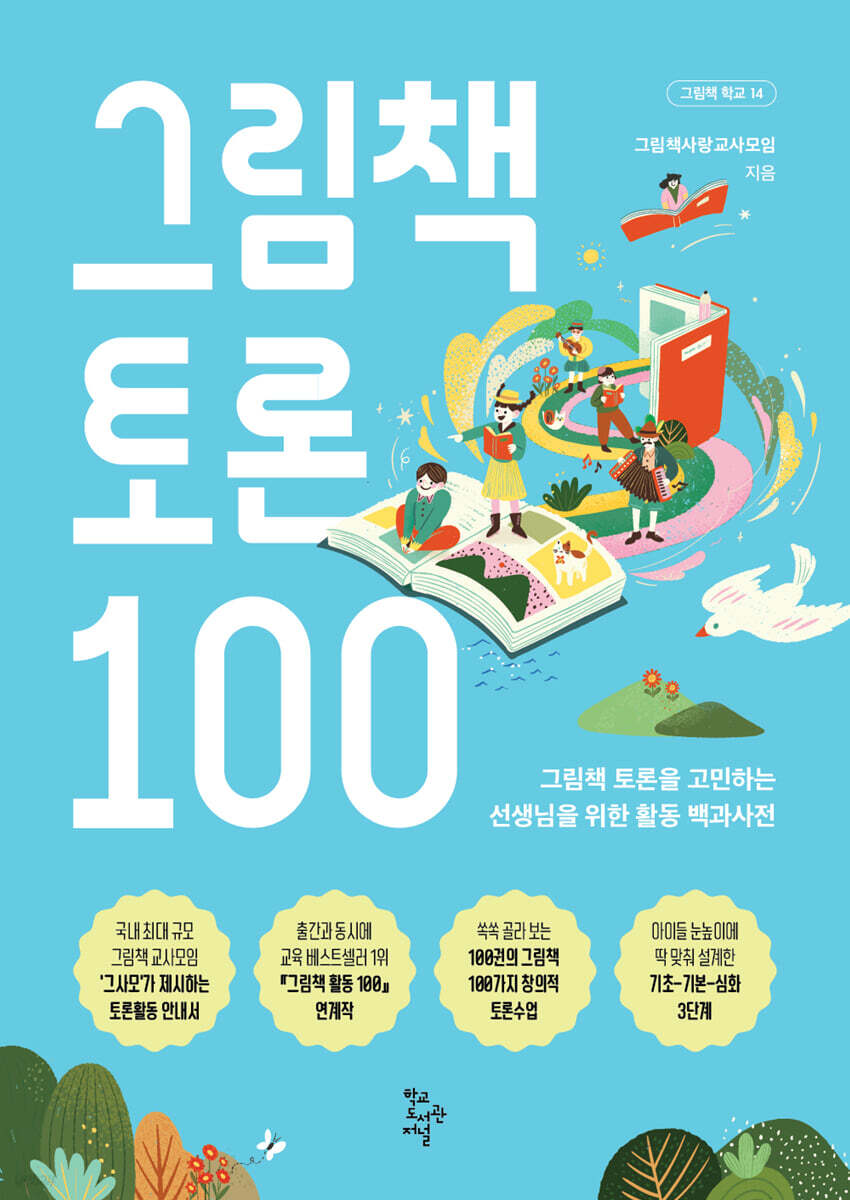
Picture Book Discussion 100
 |
Description
Book Introduction
The 'Picture Book Lovers Teachers' Group', a leading figure in the picture book education craze, has returned with 'Picture Book Discussion Classes That Grow Thoughts' and 'Picture Book Discussion Classes with Authors', followed by 'Picture Book Discussion 100', the 'final edition of picture book discussions'.
It is structured to introduce one discussion activity per picture book, and it provides detailed step-by-step guidance on how teachers should lead from start to finish, as well as rich examples of discussions shared by students in actual classes.
The structure, divided into three parts - basic, fundamental, and advanced - allows for a more easy and systematic approach to picture book discussions, which can feel overwhelming and difficult to understand where and how to start.
Whether you're a novice teacher new to picture book discussions or a veteran teacher seeking a more diverse and in-depth learning experience, these 100 discussion activities can be applied immediately to your classroom, bringing learning and joy to your children's learning experiences.
It is structured to introduce one discussion activity per picture book, and it provides detailed step-by-step guidance on how teachers should lead from start to finish, as well as rich examples of discussions shared by students in actual classes.
The structure, divided into three parts - basic, fundamental, and advanced - allows for a more easy and systematic approach to picture book discussions, which can feel overwhelming and difficult to understand where and how to start.
Whether you're a novice teacher new to picture book discussions or a veteran teacher seeking a more diverse and in-depth learning experience, these 100 discussion activities can be applied immediately to your classroom, bringing learning and joy to your children's learning experiences.
- You can preview some of the book's contents.
Preview
index
Opening remarks
1 | Two-stage argument
2 | Three-stage argument
3 | 6-stage argument
4 | Discussion on Prep Utilization
5 | Creating group sentences
6 | Double Bubble Map
7 | Flow Map
8 | Photo Standing Discussion
9 | Give one, take one
10 | Tail-biting discussion
11 | Buzz Discussion
12 | Mind Map Discussion
13 | Rolling Paper Discussion
14 | Gallery Walk
15 | Two Go, Two Leave
16 | Deriving the topic
17 | Introduction
18 | Rebuttal
19 | Traffic Light Debate
20 | PMI Discussion
21 | Round and Round Discussion
22 | Spectrum Discussion
23 | Discussion on the Four Arithmetic Operations
24 | Mandala Discussion
25 | Discussion on the Starfish Model
26 | Fishbone Discussion
27 | Gem Map Discussion
28 | Pinwheel Discussion
29 | 5WHY Discussion
30 | Brainwriting
31 | Brainstorming Collage
32 | Reverse Brainstorming
33 | Hot Seating
34 | SWOT Discussion
35 | Round Robin
36 | Question Pyramid Discussion
37 | Corner Discussion
38 | Goal Tree Discussion
39 | Rich Picture Discussion
40 | Tablo Discussion
41 | Disney Creative Strategy Discussion
42 | Keyword-centered discussion
43 | Direct Discussion
44 | Value Vertical Line Discussion
45 | Six-Colored Thinking Hat Discussion
46 | Two-Minded Debate
47 | Multi-Pyramid Discussion
48 | ERRC Discussion
49 | EDS Discussion
50 | KWL Chart Discussion
51 | Balance Discussion
52 | Carousel Discussion
53 | Unanimous Debate
54 | Fishbowl Discussion
55 | Samoa Discussion
56 | Forced Combination
57 | Discussion Using Rainbow Reading Discussion Cards
58 | Discussion on Using Reader Growth Cards
59 | Reading Question Stick Discussion
60 | Havruta Discussion Stick Utilization Discussion
61 | Climate Crisis Solver Card Discussion
62 | Thinking Gear Card Discussion
63 | Discussion on Using TRIZ Cards
64 | Discussion on Using Padlet
65 | Thinkerbell Discussion
66 | Metaverse ZEP Utilization Discussion
67 | Discussion on Pruning Using Wimzical
68 | Placemate Discussion on Using Canvas
69 | Discussion on the Use of Generative AI Rutton
70 | Discussion on Using Mentimeter
71 | Question Creation - Factual Questions, Interpretive/Inferential Questions, Critical/Appreciative Questions
72 | Discussion Using DVDM Questions
73 | Discussion Using Scamper Questions
74 | Discussion on Using ORID Questions
75 | QAR Questioning Method
76 | Synctrix Discussion
77 | Bloom's Levels of Thinking Questionnaire
78 | Problem-Solving Circle Discussion
79 | World Cafe Discussion
80 | Debate on the pros and cons of battery
81 | Hexa Discussion
82 | Cloud Model Discussion
83 | Concept Exploration Discussion
84 | Wishlist Discussion
85 | Panel Discussion
86 | Dilemma Discussion
87 | Mock Trial Debate
88 | Open Space Discussion
89 | Socratic Seminar
90 | Leadership Discussion
91 | Procon Discussion
92 | Discussion on the Reverse Side
93 | Hearing-style debate
94 | Roundtable Discussion
95 | Havruta Discussion
96 | Seoul-type debate model
97 | Stage 3 Non-Competitive Reading Discussion
98 | Public Forum Debate
99 | Lincoln-Douglas Debates
100 | Parliamentary Debate
Search
1 | Two-stage argument
2 | Three-stage argument
3 | 6-stage argument
4 | Discussion on Prep Utilization
5 | Creating group sentences
6 | Double Bubble Map
7 | Flow Map
8 | Photo Standing Discussion
9 | Give one, take one
10 | Tail-biting discussion
11 | Buzz Discussion
12 | Mind Map Discussion
13 | Rolling Paper Discussion
14 | Gallery Walk
15 | Two Go, Two Leave
16 | Deriving the topic
17 | Introduction
18 | Rebuttal
19 | Traffic Light Debate
20 | PMI Discussion
21 | Round and Round Discussion
22 | Spectrum Discussion
23 | Discussion on the Four Arithmetic Operations
24 | Mandala Discussion
25 | Discussion on the Starfish Model
26 | Fishbone Discussion
27 | Gem Map Discussion
28 | Pinwheel Discussion
29 | 5WHY Discussion
30 | Brainwriting
31 | Brainstorming Collage
32 | Reverse Brainstorming
33 | Hot Seating
34 | SWOT Discussion
35 | Round Robin
36 | Question Pyramid Discussion
37 | Corner Discussion
38 | Goal Tree Discussion
39 | Rich Picture Discussion
40 | Tablo Discussion
41 | Disney Creative Strategy Discussion
42 | Keyword-centered discussion
43 | Direct Discussion
44 | Value Vertical Line Discussion
45 | Six-Colored Thinking Hat Discussion
46 | Two-Minded Debate
47 | Multi-Pyramid Discussion
48 | ERRC Discussion
49 | EDS Discussion
50 | KWL Chart Discussion
51 | Balance Discussion
52 | Carousel Discussion
53 | Unanimous Debate
54 | Fishbowl Discussion
55 | Samoa Discussion
56 | Forced Combination
57 | Discussion Using Rainbow Reading Discussion Cards
58 | Discussion on Using Reader Growth Cards
59 | Reading Question Stick Discussion
60 | Havruta Discussion Stick Utilization Discussion
61 | Climate Crisis Solver Card Discussion
62 | Thinking Gear Card Discussion
63 | Discussion on Using TRIZ Cards
64 | Discussion on Using Padlet
65 | Thinkerbell Discussion
66 | Metaverse ZEP Utilization Discussion
67 | Discussion on Pruning Using Wimzical
68 | Placemate Discussion on Using Canvas
69 | Discussion on the Use of Generative AI Rutton
70 | Discussion on Using Mentimeter
71 | Question Creation - Factual Questions, Interpretive/Inferential Questions, Critical/Appreciative Questions
72 | Discussion Using DVDM Questions
73 | Discussion Using Scamper Questions
74 | Discussion on Using ORID Questions
75 | QAR Questioning Method
76 | Synctrix Discussion
77 | Bloom's Levels of Thinking Questionnaire
78 | Problem-Solving Circle Discussion
79 | World Cafe Discussion
80 | Debate on the pros and cons of battery
81 | Hexa Discussion
82 | Cloud Model Discussion
83 | Concept Exploration Discussion
84 | Wishlist Discussion
85 | Panel Discussion
86 | Dilemma Discussion
87 | Mock Trial Debate
88 | Open Space Discussion
89 | Socratic Seminar
90 | Leadership Discussion
91 | Procon Discussion
92 | Discussion on the Reverse Side
93 | Hearing-style debate
94 | Roundtable Discussion
95 | Havruta Discussion
96 | Seoul-type debate model
97 | Stage 3 Non-Competitive Reading Discussion
98 | Public Forum Debate
99 | Lincoln-Douglas Debates
100 | Parliamentary Debate
Search
Detailed image

Publisher's Review
Packed with practical know-how from current teachers
The most comprehensive and practical encyclopedia of discussion activities
The Picture Book Lovers Teachers Group, which has been consistently promoting the benefits of discussion classes linked to picture books and carefully selecting picture books necessary for educational settings, has returned with "Picture Book Discussion 100."
This is a follow-up to 『100 Picture Book Activities』, which became the number one bestseller in the education field upon publication, and introduces 100 picture books and 100 discussion activities.
As the 'final edition' of picture book discussions, this book allows teachers and parents preparing picture book discussion activities to create successful classes simply by following the instructions.
Looking at the book's contents, it starts with pointing out the educational effects and application of activities, and includes methods for selecting picture books, methods for reading books, examples of activities by level and stage, and discussion papers written by students themselves.
We sought to keep pace with the times by presenting not only the debate techniques we are familiar with, but also debate methods utilizing the latest online tools and AI.
In particular, it is notable that the scope of picture book selection was broadened by adding a question for each activity, “What kind of picture book would be good?” to indicate the characteristics of picture books suitable for the activity.
The encyclopedia-like volume of material and the vivid forewords based on actual classes go beyond simply repeating the fundamental idea that picture book discussions are beneficial to children's education, and help readers approach picture book discussions, which can sometimes feel overwhelming, in a more easy and systematic way.
In 3 stages: ‘Basic-Basic-Advanced’
A structure that allows you to find only the necessary activities
In order for picture book discussions to proceed smoothly, students must take the initiative to read the picture book, create questions, and then continue the discussion based on those questions.
However, students, who are actually participants in the discussion, often complain of difficulties because they do not know 'where and how' to start the picture book discussion.
In this reality, this book significantly lowers the barrier to discussion classes with its three-level structure of "Basic-Basic-Advanced," designed to perfectly match the level of students, and allows teachers to select and utilize only activities appropriate for the students' level.
Part 1, "Debate Basics," covers the essential elements of debate: argumentation and introduction/rebuttal methods, as well as how to create questions that lay the foundation for picture book debates and how to comfortably express your thoughts.
In Part 2, "Debate Basics," where more in-depth discussion activities take place, you can learn about discussion methods using teaching aids such as Reader Growth Cards and Thinking Gear Cards, as well as online discussion methods using Padlet, Thinker Bell, and Mentimeter.
We have diversified discussion media both online and offline, while also incorporating the most practical discussion methods used in the field.
The following Part 3, "Deep Debate," presents advanced debate methods that can maximize children's thinking and potential, such as debates utilizing questioning techniques, non-competitive debates, and pros and cons debates using picture books.
From basic logic classes that teach students how to develop logical thinking to parliamentary-style debates that clearly state their opinions on a topic and refute the opposing side's arguments, as they put the activities in practice in this book, children will soon discover themselves viewing the world with a broader perspective and perspective.
| Author's Note |
Picture book discussions don't force correct answers, but rather encourage children to explore and find better answers.
Through picture book discussions, we can look at world problems from various perspectives and viewpoints.
It addresses life's problems reflected in picture books and explores values for a better life.
Children's thinking skills are improved through sharing ideas based on logic.
This is why I hope more teachers will engage with children through picture book discussions.
- In the opening text
The most comprehensive and practical encyclopedia of discussion activities
The Picture Book Lovers Teachers Group, which has been consistently promoting the benefits of discussion classes linked to picture books and carefully selecting picture books necessary for educational settings, has returned with "Picture Book Discussion 100."
This is a follow-up to 『100 Picture Book Activities』, which became the number one bestseller in the education field upon publication, and introduces 100 picture books and 100 discussion activities.
As the 'final edition' of picture book discussions, this book allows teachers and parents preparing picture book discussion activities to create successful classes simply by following the instructions.
Looking at the book's contents, it starts with pointing out the educational effects and application of activities, and includes methods for selecting picture books, methods for reading books, examples of activities by level and stage, and discussion papers written by students themselves.
We sought to keep pace with the times by presenting not only the debate techniques we are familiar with, but also debate methods utilizing the latest online tools and AI.
In particular, it is notable that the scope of picture book selection was broadened by adding a question for each activity, “What kind of picture book would be good?” to indicate the characteristics of picture books suitable for the activity.
The encyclopedia-like volume of material and the vivid forewords based on actual classes go beyond simply repeating the fundamental idea that picture book discussions are beneficial to children's education, and help readers approach picture book discussions, which can sometimes feel overwhelming, in a more easy and systematic way.
In 3 stages: ‘Basic-Basic-Advanced’
A structure that allows you to find only the necessary activities
In order for picture book discussions to proceed smoothly, students must take the initiative to read the picture book, create questions, and then continue the discussion based on those questions.
However, students, who are actually participants in the discussion, often complain of difficulties because they do not know 'where and how' to start the picture book discussion.
In this reality, this book significantly lowers the barrier to discussion classes with its three-level structure of "Basic-Basic-Advanced," designed to perfectly match the level of students, and allows teachers to select and utilize only activities appropriate for the students' level.
Part 1, "Debate Basics," covers the essential elements of debate: argumentation and introduction/rebuttal methods, as well as how to create questions that lay the foundation for picture book debates and how to comfortably express your thoughts.
In Part 2, "Debate Basics," where more in-depth discussion activities take place, you can learn about discussion methods using teaching aids such as Reader Growth Cards and Thinking Gear Cards, as well as online discussion methods using Padlet, Thinker Bell, and Mentimeter.
We have diversified discussion media both online and offline, while also incorporating the most practical discussion methods used in the field.
The following Part 3, "Deep Debate," presents advanced debate methods that can maximize children's thinking and potential, such as debates utilizing questioning techniques, non-competitive debates, and pros and cons debates using picture books.
From basic logic classes that teach students how to develop logical thinking to parliamentary-style debates that clearly state their opinions on a topic and refute the opposing side's arguments, as they put the activities in practice in this book, children will soon discover themselves viewing the world with a broader perspective and perspective.
| Author's Note |
Picture book discussions don't force correct answers, but rather encourage children to explore and find better answers.
Through picture book discussions, we can look at world problems from various perspectives and viewpoints.
It addresses life's problems reflected in picture books and explores values for a better life.
Children's thinking skills are improved through sharing ideas based on logic.
This is why I hope more teachers will engage with children through picture book discussions.
- In the opening text
GOODS SPECIFICS
- Date of issue: February 28, 2025
- Page count, weight, size: 480 pages | 986g | 170*240*30mm
- ISBN13: 9788969151773
- ISBN10: 896915177X
You may also like
카테고리
korean


korean

![GQ KOREA Mark (Monthly): December [2025]](http://librairie.coreenne.fr/cdn/shop/files/8ef265dbbfbf186523ed75ba7319009d.jpg?v=1765340328&width=3840)


