

First grade studies are all about reading books.
 |
Description
Book Introduction
“This one book is all you need to know about elementary education!”
An elementary education bestseller and steady seller loved by 100,000 readers!
A must-read for parents of elementary school children that top parents know
The perfect time to develop reading habits! Teaching tips specifically for first graders.
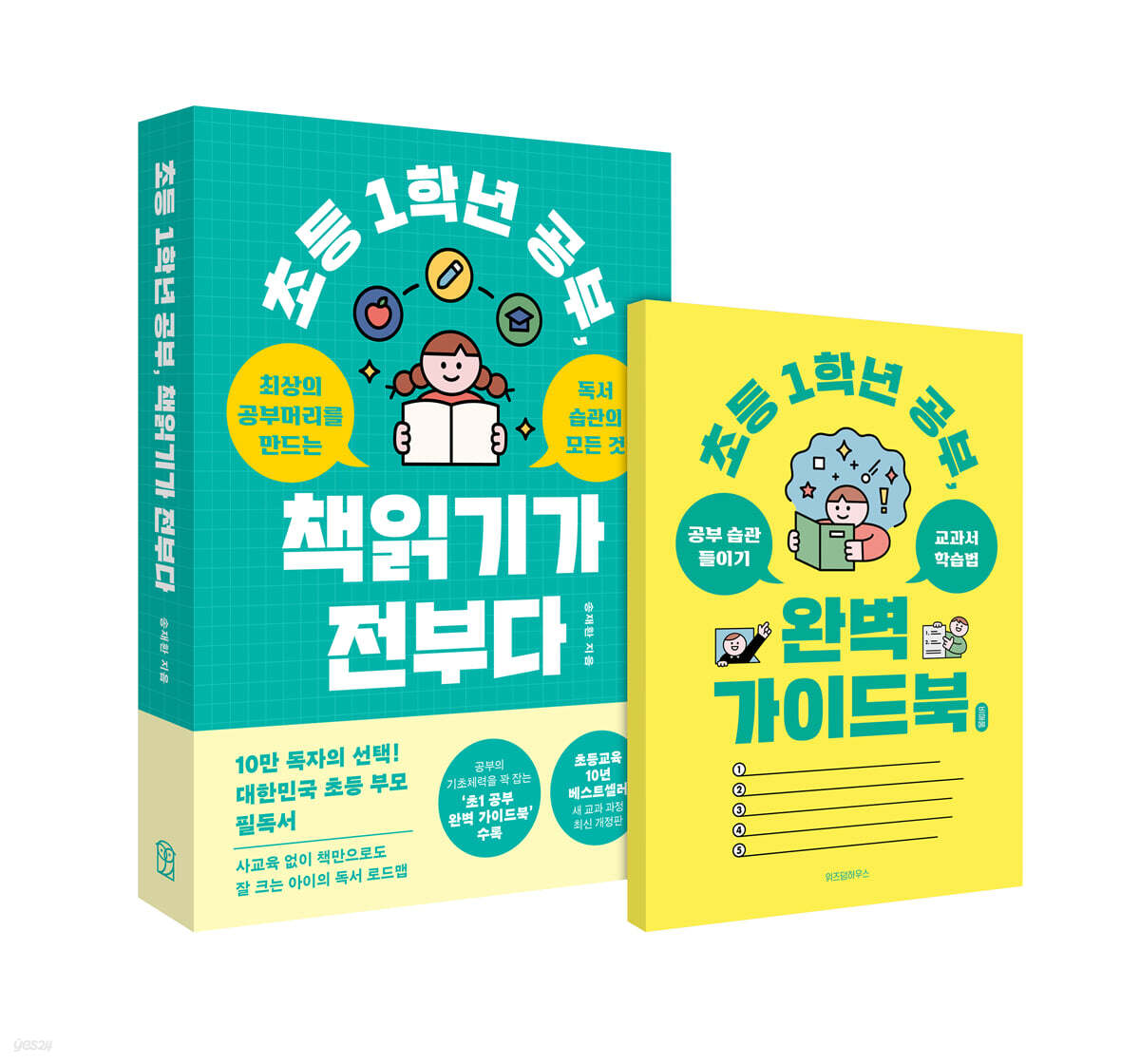
Teacher Song Jae-hwan's best-selling book, "First Grade Studying: Reading is Everything," which has been loved by countless parents for a long time, has been republished in line with the curriculum revision.
First grade is such an important time in life that it can be called the first step in life.
Depending on how you spend this time, your 16 years of school life will change.
To parents who are deeply concerned about the abundance of private education, floating educational information, and relationships with peers, the author asserts, “First-grade elementary school children only need to read books properly.”
Just by reading books, you will acquire the necessary elements for school life and studying.
This book contains a variety of reading methods, post-reading activities, and a list of recommended books tailored to the level of first graders.
For parents who are wondering, "How should I teach my elementary school-aged child?", this book will serve as a more reliable and useful guide than any other book.
An elementary education bestseller and steady seller loved by 100,000 readers!
A must-read for parents of elementary school children that top parents know
The perfect time to develop reading habits! Teaching tips specifically for first graders.
Teacher Song Jae-hwan's best-selling book, "First Grade Studying: Reading is Everything," which has been loved by countless parents for a long time, has been republished in line with the curriculum revision.
First grade is such an important time in life that it can be called the first step in life.
Depending on how you spend this time, your 16 years of school life will change.
To parents who are deeply concerned about the abundance of private education, floating educational information, and relationships with peers, the author asserts, “First-grade elementary school children only need to read books properly.”
Just by reading books, you will acquire the necessary elements for school life and studying.
This book contains a variety of reading methods, post-reading activities, and a list of recommended books tailored to the level of first graders.
For parents who are wondering, "How should I teach my elementary school-aged child?", this book will serve as a more reliable and useful guide than any other book.
- You can preview some of the book's contents.
Preview
index
Publishing a revised edition
prolog
Chapter 1
The infinite possibilities of children
Explosive period, first grade
01 The period when self-identity is formed
02 The period when vocabulary explodes
03 A period full of imagination and curiosity
04 The time to develop lifelong reading habits
Chapter 2
As much as reading a book
There is no great study
01 A child who reads on his own
02 Just reading books properly will improve your study skills.
03 All elementary school subjects are connected to reading.
04 Reading, not prior learning, determines study ability.
05 Reading books that improve comprehension
06 Reading books that foster understanding
07 Reading books that balance the left and right brain
08 Reading books stimulates a child's boundless imagination.
Chapter 3
Even if you just read the book well
Half of the first grade is a success
01 Principles of Reading for First Grade Elementary School Students
02 The more effort parents put into reading, the more children read.
03 How to Use the Library as a Playground
04 New books spark the desire to read.
05 Parents who read books, children who read books
06 A vague record beats a clear memory.
07 Stimulate your desire to read by participating in a reading contest.
Chapter 4
Even if you read one book
How to read 'properly'
01 Incorrect reading
02 Read repeatedly
03 Reading books with your ears, reading aloud
04 Reading a book orally, reading aloud
05 Hand-reading books, reading while writing
06 A book that reads like a love letter, read slowly
07 Reading books with concentration, reading with immersion
08 A fun and exciting book to read, a book to enjoy
09 Reading books that provide background knowledge, along with textbooks
Chapter 5
Developing children's thinking
Effective post-reading activities
01 Oral post-reading activity
02 Hand-held post-reading activities
03 Post-reading activities with your eyes
04 Post-reading activities on the way home
05 Post-reading activities using the body
Chapter 6
Reading the classics
Raises children's dignity
01 The power of classics, more powerful and greater than any other book
02 Why Children Should Read Classics
03 Things that change when you read the classics
04 Classics for First Graders
05 How to Read Classics Properly
Epilogue
prolog
Chapter 1
The infinite possibilities of children
Explosive period, first grade
01 The period when self-identity is formed
02 The period when vocabulary explodes
03 A period full of imagination and curiosity
04 The time to develop lifelong reading habits
Chapter 2
As much as reading a book
There is no great study
01 A child who reads on his own
02 Just reading books properly will improve your study skills.
03 All elementary school subjects are connected to reading.
04 Reading, not prior learning, determines study ability.
05 Reading books that improve comprehension
06 Reading books that foster understanding
07 Reading books that balance the left and right brain
08 Reading books stimulates a child's boundless imagination.
Chapter 3
Even if you just read the book well
Half of the first grade is a success
01 Principles of Reading for First Grade Elementary School Students
02 The more effort parents put into reading, the more children read.
03 How to Use the Library as a Playground
04 New books spark the desire to read.
05 Parents who read books, children who read books
06 A vague record beats a clear memory.
07 Stimulate your desire to read by participating in a reading contest.
Chapter 4
Even if you read one book
How to read 'properly'
01 Incorrect reading
02 Read repeatedly
03 Reading books with your ears, reading aloud
04 Reading a book orally, reading aloud
05 Hand-reading books, reading while writing
06 A book that reads like a love letter, read slowly
07 Reading books with concentration, reading with immersion
08 A fun and exciting book to read, a book to enjoy
09 Reading books that provide background knowledge, along with textbooks
Chapter 5
Developing children's thinking
Effective post-reading activities
01 Oral post-reading activity
02 Hand-held post-reading activities
03 Post-reading activities with your eyes
04 Post-reading activities on the way home
05 Post-reading activities using the body
Chapter 6
Reading the classics
Raises children's dignity
01 The power of classics, more powerful and greater than any other book
02 Why Children Should Read Classics
03 Things that change when you read the classics
04 Classics for First Graders
05 How to Read Classics Properly
Epilogue
Detailed image

Into the book
It is only natural that children who attended English kindergartens suffer from a vocabulary poverty.
Usually, in English kindergartens, you can't use your Korean.
If you go to an English kindergarten, you will not hear or speak Korean for an average of 6 hours a day.
If you calculate it based on one year, it means that we cannot use our language for thousands of hours.
The kindergarten years are a very important time, right before the vocabulary explosion.
However, if you cannot hear and speak our language properly during this period, a gap in vocabulary is bound to occur.
If you try to become good at English, you may end up not being able to use your native language properly.
I don't want to condemn English kindergartens as bad.
If your child attends an English kindergarten, parents should take special measures to ensure that their child's native language vocabulary does not decline.
Otherwise, your child may struggle in class or become a troublemaker after entering elementary school due to a lack of vocabulary.
Parents should not overlook this fact.
---From "The Period of Explosive Vocabulary"
A child whose left brain has atrophied will dislike activities that actively use the left brain.
Reading is a representative activity that stimulates the left brain.
Considering that reading is the foundation of learning, this cannot help but be a serious problem.
Studying is the activity of reading and understanding books.
The richer your vocabulary and logical thinking, the better you can study.
Since vocabulary and logical thinking skills can be improved by stimulating the left brain, studying can be said to be an activity that is advantageous to people with a developed left brain.
Therefore, in order to study well, you must develop your left brain.
Children whose left brains are not well developed have a hard time understanding what is being said when they read books.
Also, the teacher's words sound like a foreign language.
Even if I read the book, I don't understand what it says, and I don't understand what the teacher says, so studying is basically out of the question.
---From "Reading to Balance the Left and Right Brain"
Rather than academic background, there was a significant difference in the amount of reading children did depending on how interested and active their parents were in reading.
Among children of parents who were active readers, 40.7 percent read more than three books a week, while only 29.2 percent of children of parents who were passive readers read the same amount of books.
This means that no matter how highly educated a child is, if the parents do not read books at home, the child will not read books at home either.
Conversely, this means that even if a child has low academic ability, if the parents read books at home, the child will also read books.
In short, if parents read books, their children will read books, and if parents don't read books, their children will never read books.
---From "Parents Who Read Books, Children Who Read Books"
Another way to read a book is to circle words your child doesn't know.
This method will help you read the book a little more deeply.
Parents can not only gauge their child's vocabulary through the circled words, but can also easily tell whether the book is appropriate for their child's level or not.
A book with about three unfamiliar words per page is usually considered appropriate for children.
Among the words that your child circled because he or she did not know, let's make a separate vocabulary notebook and record the important words.
By accumulating and recording unknown words, your child's vocabulary will not only improve, but he or she will also feel a sense of accomplishment.
Additionally, you can improve your hand strength by writing.
---From "Reading a Book by Hand, Reading While Writing"
A type of book talk called the '1-minute speech' is also a good post-reading activity for first graders.
It's about speaking out loud as if you were giving a presentation to your family about a book you've read.
This is different from a conversation.
A one-minute speech is a kind of coherent speech.
If you ask children in lower grades to give a one-minute speech, not to mention children in higher grades, they either can't finish the minute or they waste time talking incoherently.
If you ask children to give a one-minute speech about a book they have read, they will suddenly become speechless, even if they usually talk a lot.
This is because to give a good one-minute speech, you need the thinking ability to speak the contents of the book in a unified manner.
You need to remember who the main character is, why something important happened, how it ended, how you felt, etc.
A child who lacks systematic and logical thinking cannot give a proper one-minute speech.
---From "Oral Reading Activities"
If you want to read little by little, you have to read slowly.
Which is easier, reading quickly or slowly? It depends on the person, but it's often more difficult to get children to read slowly.
This is because children's daily reading habits are biased towards speed reading.
Children are very accustomed to speed reading, reading ravenously as if they are being chased by something.
However, most children feel unfamiliar with the idea of 'reading', which involves taking a local train and stopping at each station to enjoy the scenery.
But you have to read slowly to be able to analyze, you have to read lazily to be able to imagine, and you have to read leisurely to be able to criticize.
To get your child to read slowly, have them read out loud, underline important passages, and mark unfamiliar vocabulary.
Usually, in English kindergartens, you can't use your Korean.
If you go to an English kindergarten, you will not hear or speak Korean for an average of 6 hours a day.
If you calculate it based on one year, it means that we cannot use our language for thousands of hours.
The kindergarten years are a very important time, right before the vocabulary explosion.
However, if you cannot hear and speak our language properly during this period, a gap in vocabulary is bound to occur.
If you try to become good at English, you may end up not being able to use your native language properly.
I don't want to condemn English kindergartens as bad.
If your child attends an English kindergarten, parents should take special measures to ensure that their child's native language vocabulary does not decline.
Otherwise, your child may struggle in class or become a troublemaker after entering elementary school due to a lack of vocabulary.
Parents should not overlook this fact.
---From "The Period of Explosive Vocabulary"
A child whose left brain has atrophied will dislike activities that actively use the left brain.
Reading is a representative activity that stimulates the left brain.
Considering that reading is the foundation of learning, this cannot help but be a serious problem.
Studying is the activity of reading and understanding books.
The richer your vocabulary and logical thinking, the better you can study.
Since vocabulary and logical thinking skills can be improved by stimulating the left brain, studying can be said to be an activity that is advantageous to people with a developed left brain.
Therefore, in order to study well, you must develop your left brain.
Children whose left brains are not well developed have a hard time understanding what is being said when they read books.
Also, the teacher's words sound like a foreign language.
Even if I read the book, I don't understand what it says, and I don't understand what the teacher says, so studying is basically out of the question.
---From "Reading to Balance the Left and Right Brain"
Rather than academic background, there was a significant difference in the amount of reading children did depending on how interested and active their parents were in reading.
Among children of parents who were active readers, 40.7 percent read more than three books a week, while only 29.2 percent of children of parents who were passive readers read the same amount of books.
This means that no matter how highly educated a child is, if the parents do not read books at home, the child will not read books at home either.
Conversely, this means that even if a child has low academic ability, if the parents read books at home, the child will also read books.
In short, if parents read books, their children will read books, and if parents don't read books, their children will never read books.
---From "Parents Who Read Books, Children Who Read Books"
Another way to read a book is to circle words your child doesn't know.
This method will help you read the book a little more deeply.
Parents can not only gauge their child's vocabulary through the circled words, but can also easily tell whether the book is appropriate for their child's level or not.
A book with about three unfamiliar words per page is usually considered appropriate for children.
Among the words that your child circled because he or she did not know, let's make a separate vocabulary notebook and record the important words.
By accumulating and recording unknown words, your child's vocabulary will not only improve, but he or she will also feel a sense of accomplishment.
Additionally, you can improve your hand strength by writing.
---From "Reading a Book by Hand, Reading While Writing"
A type of book talk called the '1-minute speech' is also a good post-reading activity for first graders.
It's about speaking out loud as if you were giving a presentation to your family about a book you've read.
This is different from a conversation.
A one-minute speech is a kind of coherent speech.
If you ask children in lower grades to give a one-minute speech, not to mention children in higher grades, they either can't finish the minute or they waste time talking incoherently.
If you ask children to give a one-minute speech about a book they have read, they will suddenly become speechless, even if they usually talk a lot.
This is because to give a good one-minute speech, you need the thinking ability to speak the contents of the book in a unified manner.
You need to remember who the main character is, why something important happened, how it ended, how you felt, etc.
A child who lacks systematic and logical thinking cannot give a proper one-minute speech.
---From "Oral Reading Activities"
If you want to read little by little, you have to read slowly.
Which is easier, reading quickly or slowly? It depends on the person, but it's often more difficult to get children to read slowly.
This is because children's daily reading habits are biased towards speed reading.
Children are very accustomed to speed reading, reading ravenously as if they are being chased by something.
However, most children feel unfamiliar with the idea of 'reading', which involves taking a local train and stopping at each station to enjoy the scenery.
But you have to read slowly to be able to analyze, you have to read lazily to be able to imagine, and you have to read leisurely to be able to criticize.
To get your child to read slowly, have them read out loud, underline important passages, and mark unfamiliar vocabulary.
---From "How to Read Classics Properly"
Publisher's Review
“This one book is all you need to know about elementary education!”
Contains educational principles that never change over time
Elementary Education Best & Steady Sellers
The very book that has been loved by 100,000 readers!
Mr. Song Jae-hwan, a leading elementary education expert in Korea, explains
A must-read for parents of elementary school students
Teacher Song Jae-hwan's best-selling book, "Reading is Everything for First Graders," which has been called a must-read for elementary school parents and has been loved by 100,000 readers for many years, has been republished in line with the revised curriculum.
This book presents even more substantial content, including the author's newly proposed reading guidance method, recommended books reflecting the new curriculum, and the latest educational information.
In addition, a 90-page 『Complete Guidebook for First Grade Studying』 covering ‘study habits’ and ‘learning strategies for each subject in first grade’ is provided as a special appendix.
First grade is such an important time in life that it can be called the first step in life.
Depending on how you spend this time, your 16 years of school life will change.
To parents who are deeply concerned about the abundance of private education, floating educational information, and relationships with peers, the author asserts, “First-grade elementary school children only need to read books properly.”
If you just read the book properly, the elements necessary for school life and studying will follow.
By reading consistently, your thinking becomes broader and your expressive skills improve, which not only helps you keep up with classwork but also helps you maintain good relationships with friends.
Reading books alone can greatly reduce the many worries and concerns that elementary school parents face.
The best study strategies to improve elementary literacy, vocabulary, and learning skills!
The greatest gift you can give your first grader is the habit of reading.
The "Reading Independence Project," packed with the most effective elementary reading tips.
Among parents in Daechi-dong, Gangnam, the saying, "Korean language is something you can't learn even if you sell your house" is being passed around.
English lost its ability to differentiate after changing to absolute evaluation, and while private tutoring can be effective in math to some extent, Korean was initially thought to be easy, but later it became difficult to raise scores no matter how hard you tried.
The author argues that even if you sell your house, you may not be able to master Korean, but if you read books, you will definitely be able to master Korean.
Additionally, it emphasizes that vocabulary, literacy, comprehension, problem-solving skills, and background knowledge can be acquired all at once.
Children who develop these skills through reading are bound to do well in school.
And the best time to develop this ability is during the first grade of elementary school.
So how can we foster a reading habit in our children? This book provides detailed methods for fostering this habit.
Rather than simply putting books in the child's hands, parents themselves establish 'principles of reading guidance' and teach children how to read books with enjoyment and interest.
It also contains a wealth of information on what books to buy and read to your child, what records to keep in the book when purchasing it, and various activities to do together after reading.
In particular, it can be of great help to parents as it provides detailed information on books that first graders must read.
By reading this book, parents will soon be able to guide their children like a 'reading education expert.'
The guidance method is not particularly difficult, so children and parents can enjoy reading together.
‘Reading habit’ is the greatest gift a parent can give to a child.
Just as first-graders can grow significantly just by reading, parents will also gain confidence and assurance in guiding their children's studies with just this one book.
Contains educational principles that never change over time
Elementary Education Best & Steady Sellers
The very book that has been loved by 100,000 readers!
Mr. Song Jae-hwan, a leading elementary education expert in Korea, explains
A must-read for parents of elementary school students
Teacher Song Jae-hwan's best-selling book, "Reading is Everything for First Graders," which has been called a must-read for elementary school parents and has been loved by 100,000 readers for many years, has been republished in line with the revised curriculum.
This book presents even more substantial content, including the author's newly proposed reading guidance method, recommended books reflecting the new curriculum, and the latest educational information.
In addition, a 90-page 『Complete Guidebook for First Grade Studying』 covering ‘study habits’ and ‘learning strategies for each subject in first grade’ is provided as a special appendix.
First grade is such an important time in life that it can be called the first step in life.
Depending on how you spend this time, your 16 years of school life will change.
To parents who are deeply concerned about the abundance of private education, floating educational information, and relationships with peers, the author asserts, “First-grade elementary school children only need to read books properly.”
If you just read the book properly, the elements necessary for school life and studying will follow.
By reading consistently, your thinking becomes broader and your expressive skills improve, which not only helps you keep up with classwork but also helps you maintain good relationships with friends.
Reading books alone can greatly reduce the many worries and concerns that elementary school parents face.
The best study strategies to improve elementary literacy, vocabulary, and learning skills!
The greatest gift you can give your first grader is the habit of reading.
The "Reading Independence Project," packed with the most effective elementary reading tips.
Among parents in Daechi-dong, Gangnam, the saying, "Korean language is something you can't learn even if you sell your house" is being passed around.
English lost its ability to differentiate after changing to absolute evaluation, and while private tutoring can be effective in math to some extent, Korean was initially thought to be easy, but later it became difficult to raise scores no matter how hard you tried.
The author argues that even if you sell your house, you may not be able to master Korean, but if you read books, you will definitely be able to master Korean.
Additionally, it emphasizes that vocabulary, literacy, comprehension, problem-solving skills, and background knowledge can be acquired all at once.
Children who develop these skills through reading are bound to do well in school.
And the best time to develop this ability is during the first grade of elementary school.
So how can we foster a reading habit in our children? This book provides detailed methods for fostering this habit.
Rather than simply putting books in the child's hands, parents themselves establish 'principles of reading guidance' and teach children how to read books with enjoyment and interest.
It also contains a wealth of information on what books to buy and read to your child, what records to keep in the book when purchasing it, and various activities to do together after reading.
In particular, it can be of great help to parents as it provides detailed information on books that first graders must read.
By reading this book, parents will soon be able to guide their children like a 'reading education expert.'
The guidance method is not particularly difficult, so children and parents can enjoy reading together.
‘Reading habit’ is the greatest gift a parent can give to a child.
Just as first-graders can grow significantly just by reading, parents will also gain confidence and assurance in guiding their children's studies with just this one book.
GOODS SPECIFICS
- Date of issue: January 15, 2025
- Page count, weight, size: 336 pages | 528g | 148*210*30mm
- ISBN13: 9791171713394
- ISBN10: 1171713398
You may also like
카테고리
korean


korean

![GQ KOREA Mark (Monthly): December [2025]](http://librairie.coreenne.fr/cdn/shop/files/8ef265dbbfbf186523ed75ba7319009d.jpg?v=1765340328&width=3840)


