

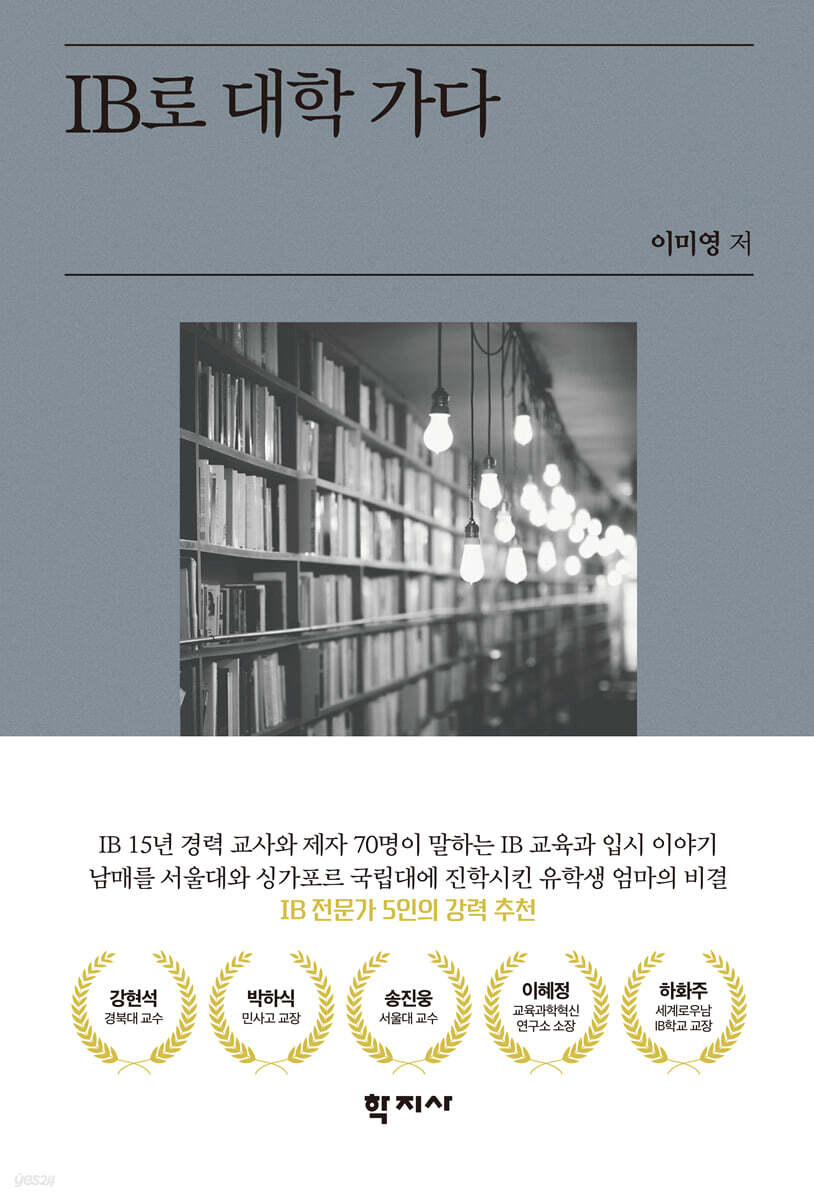
Going to college with IB
 |
Description
Book Introduction
A wave of educational reform! The IB is coming.
A mother who sent her siblings to prestigious universities around the world,
A vivid story of IB education from an IB teacher with 15 years of experience.
The rote learning method, teacher-centered, one-sided lectures that force students to solve problems faster and stifle their creativity and happiness, and the endlessly competitive college entrance exam system have forced students into a wasteful competition like partisan strife rather than a place of academic pursuit, making everyone a loser.
In this competitive swamp, the limitations of the Korean education system, which sacrifices students' lives and potential, are being revealed, and global education reform for a sustainable future is emerging as an urgent task.
Accordingly, the International Baccalaureate (IB) education, which focuses on fostering critical thinking and creative problem-solving skills, cultivating global citizens, strengthening cooperation and community awareness, emphasizing ethical responsibility and social contribution, and fostering self-directed lifelong learners, is attracting attention as a new alternative to Korean education.
The author worked as an entrance exam specialist teaching the language section of the College Scholastic Ability Test (CSAT) in Korea, but has since become an IB expert in Singapore, demonstrating the value of global education.
She also sent her siblings to the National University of Singapore and Seoul National University, respectively, demonstrating the power of holistic education and the potential for college success. The IB education, through collaborative and inquiry-based learning, helps students develop self-directed problem-solving skills and global competencies, and its excellence is recognized by top universities around the world.
This book is a vivid, field-oriented story told from the perspectives of teachers and parents by an author with 15 years of experience in IB education.
Through the case studies of over 70 students whom the author personally taught, the author vividly conveys the practical impact of IB education on students.
In particular, it highlights the potential and changes that students who grew up in the Korean education system have demonstrated as they adapted to the IB education, and strongly argues that the IB can be a key to Korean educational reform.
In addition, it organizes terms and concepts that readers new to IB education may find difficult to understand in an easy-to-understand manner, and clearly and specifically explains the pros and cons of IB education through abundant examples.
This book will not simply introduce IB education, but will also serve as a practical guide that presents a new educational paradigm.
This book is divided into steps to help you understand IB education in depth and approach it systematically.
Part 1 includes the author's experiences as an IB teacher and as a mother of international students, as well as insights into Korean education reform and the spread of IB education.
Part 2 introduces the advantages of IB education and specific examples of successful college entrance exams through vivid interviews with students and parents who studied with IB.
Part 3 presents a variety of learning and activity examples from students who have experienced the IB's main programs, PYP, MYP, and DP, demonstrating the practical impact of IB education on students.
Part 4 organizes the core information of IB education with easy and clear examples, making it easy for readers new to IB to understand.
Finally, Part 5 provides practical assistance by clearly organizing answers to frequently asked questions from students and parents studying the IB program. This book, which fosters a broader understanding of IB education, will serve as a systematic and practical guide not only for parents and educators, but also for experts concerned about the expansion and development of IB education.
A mother who sent her siblings to prestigious universities around the world,
A vivid story of IB education from an IB teacher with 15 years of experience.
The rote learning method, teacher-centered, one-sided lectures that force students to solve problems faster and stifle their creativity and happiness, and the endlessly competitive college entrance exam system have forced students into a wasteful competition like partisan strife rather than a place of academic pursuit, making everyone a loser.
In this competitive swamp, the limitations of the Korean education system, which sacrifices students' lives and potential, are being revealed, and global education reform for a sustainable future is emerging as an urgent task.
Accordingly, the International Baccalaureate (IB) education, which focuses on fostering critical thinking and creative problem-solving skills, cultivating global citizens, strengthening cooperation and community awareness, emphasizing ethical responsibility and social contribution, and fostering self-directed lifelong learners, is attracting attention as a new alternative to Korean education.
The author worked as an entrance exam specialist teaching the language section of the College Scholastic Ability Test (CSAT) in Korea, but has since become an IB expert in Singapore, demonstrating the value of global education.
She also sent her siblings to the National University of Singapore and Seoul National University, respectively, demonstrating the power of holistic education and the potential for college success. The IB education, through collaborative and inquiry-based learning, helps students develop self-directed problem-solving skills and global competencies, and its excellence is recognized by top universities around the world.
This book is a vivid, field-oriented story told from the perspectives of teachers and parents by an author with 15 years of experience in IB education.
Through the case studies of over 70 students whom the author personally taught, the author vividly conveys the practical impact of IB education on students.
In particular, it highlights the potential and changes that students who grew up in the Korean education system have demonstrated as they adapted to the IB education, and strongly argues that the IB can be a key to Korean educational reform.
In addition, it organizes terms and concepts that readers new to IB education may find difficult to understand in an easy-to-understand manner, and clearly and specifically explains the pros and cons of IB education through abundant examples.
This book will not simply introduce IB education, but will also serve as a practical guide that presents a new educational paradigm.
This book is divided into steps to help you understand IB education in depth and approach it systematically.
Part 1 includes the author's experiences as an IB teacher and as a mother of international students, as well as insights into Korean education reform and the spread of IB education.
Part 2 introduces the advantages of IB education and specific examples of successful college entrance exams through vivid interviews with students and parents who studied with IB.
Part 3 presents a variety of learning and activity examples from students who have experienced the IB's main programs, PYP, MYP, and DP, demonstrating the practical impact of IB education on students.
Part 4 organizes the core information of IB education with easy and clear examples, making it easy for readers new to IB to understand.
Finally, Part 5 provides practical assistance by clearly organizing answers to frequently asked questions from students and parents studying the IB program. This book, which fosters a broader understanding of IB education, will serve as a systematic and practical guide not only for parents and educators, but also for experts concerned about the expansion and development of IB education.
- You can preview some of the book's contents.
Preview
index
Recommendation
Opening remarks
IB Terminology
IB program
IBDP Requirements
Part 1: Mengmu's 17 Years of Drifting in Korea
01 IB Teacher Story
02 Story of a mother of an international student
03 Education Reform and the IB Story
Part 2: Interview with an IB Experienced Student
01 Students admitted to prestigious universities through IB
02 Parents who sent their children to prestigious universities through IB
03 Thoughts from students who have experienced the IB
Part 3: IB School Life Stories
01 Primary Years Program (PYP)
02 Secondary Program MYP
03 High School Program DP
04 Extracurricular Activities
Part 4: Understanding IB Education
01 Explore the IB Education
02 IB Program
Part 5: Important Questions About the IBDP
Closing remarks
References
Opening remarks
IB Terminology
IB program
IBDP Requirements
Part 1: Mengmu's 17 Years of Drifting in Korea
01 IB Teacher Story
02 Story of a mother of an international student
03 Education Reform and the IB Story
Part 2: Interview with an IB Experienced Student
01 Students admitted to prestigious universities through IB
02 Parents who sent their children to prestigious universities through IB
03 Thoughts from students who have experienced the IB
Part 3: IB School Life Stories
01 Primary Years Program (PYP)
02 Secondary Program MYP
03 High School Program DP
04 Extracurricular Activities
Part 4: Understanding IB Education
01 Explore the IB Education
02 IB Program
Part 5: Important Questions About the IBDP
Closing remarks
References
Detailed image

Into the book
When given a problem to untie a tight knot, Korean students tend to submit only one answer.
The instruction to untie a knot is understood simply as returning it to its pre-tied state.
So, I spend a lot of time and effort practicing how to untie knots quickly.
However, IB students try to submit a variety of answers.
Some offer answers that suggest leaving the knot untying process to someone more experienced than themselves to solve it efficiently, while others suggest cutting off the knotted end to quickly solve the problem. IB students submit these diverse answers, always logically explaining their reasons for their thinking.
---From "Australian English Teacher's College Scholastic Ability Test English Report Blah Blah"
Students are required to write about their volunteer experiences at Wallingheart in a reflection journal.
When I read the writings of students, most of them are negative, saying that they were forced to follow the school curriculum.
It's actually fortunate that I wrote honestly rather than pretentiously.
But the writing after the volunteer work is over is a little different.
We find our own thoughts on why we should do this kind of volunteer work and why we need to care for and share with the socially disadvantaged.
I go to volunteer work repeatedly, so the students themselves can't help but wonder why.
---From "Willing Heart Volunteer Work"
British historian G.
George Macaulay Trevelyan criticized the problems of modern education, saying, “Education has produced men who know how to read, but not men who know how to discern what is worth reading.”
Having taught at a university in the early 20th century, I had insight into how modern education would change over the past 100 years.
The essence of education is not simply to impart knowledge, but to help children grow up with a healthy mind and body.
However, the current education system often places excessive stress and pressure on children, which can harm their emotional stability and happiness.
This problem is especially pronounced in Korea, where college entrance competition is fierce.
---From "Mom will feed you, don't study"
There is a term called the 'catfish effect' that originated in the field of business administration.
The freshest way to transport mackerel, for which freshness is key, is to release a single catfish into the tank.
The herring swim hard to survive the catfish, become more active, and are transported fresh.
It is said that overly powerful competitors increase stress, but appropriate stimulation can prevent slackening and increase initiative.
If the Korean educational environment is like a herring in a tank, the IB is the catfish that provides just the right amount of stimulation. If the IB program demonstrates superior college admission rates and IB-educated students demonstrate improved character and academic abilities, parents will clamor for their schools to adopt the program as well. While the IB program is only just beginning its journey in Korea, I'm confident that the hundreds of IB schools across the country will have the impact of transforming the entire public education system.
---From "Will IB Reduce Excessive Private Education?"
First, I took the IB entrance exam, and there were times when I felt frustrated because studying was difficult and I didn't get the grades I wanted.
In times like these, you need your own motivation to get your motivation back.
I would say that this motivation is your own dream or goal that you can visualize specifically.
You need to know specifically what field you want to study, what you want to do, and what career you want to have, so you can know how much you need to study.
However, when setting your own dreams or goals, if you only choose through the eyes of a high school student, your scope will be extremely narrow.
Rather than thinking only about a specific department at a specific school, you should first think about what field you want to study and where you want to work.
---From "Hyunrin-ah (Department of Applied Biological Chemistry, Seoul National University)"
Having studied both in a regular Korean middle school and in the IB program, I found the IB Korean program to be much better at assessing students' ability to interpret practical works through IO rather than through multiple-choice tests.
Because it allowed me to think about the seriousness of global issues on my own, and to interpret literary works creatively rather than relying on set answers.
In Korean middle school, I had a hard time with the overly analytical approach to novels and the complex, multiple-choice questions that led to incorrect answers.
However, IB Korean is written in the form of a descriptive essay answering questions.
I think that although we learn the same knowledge, our attitudes toward literature and the enjoyment we have of it are completely different depending on how we evaluate it.
Studying literature at the IB program has made my perspective on the world much more global.
---From "Korean A by Idaein (Singapore CIS)"
The IB curriculum conducts learning activities based on concepts.
Concept is a word we often use in our daily lives, such as “What is a design concept?”
But when you actually ask, “So what does the concept mean?” you are left speechless.
I think I know the gist of it, but when I try to explain it, I don't know what it means.
The dictionary defines concept as 'concept'.
A concept is a universal idea obtained by extracting common elements from various ideas and synthesizing them.
An idea is any thought that arises in a person's mind.
However, if you express this concept as a concept, it becomes difficult to understand.
For example, changing “What is your ‘concept’ today?” to “What is your ‘concept’ today?” sounds vague or strange.
So, it is convenient to understand the concept of IB as a role that provides context and perspective to any idea shared by people.
---From "IB Education Concept-Based Learning"
The goal of the MYP is to develop students' ability to connect learning across different academic disciplines.
Students will receive a balanced education through eight subject groups, while also developing diverse ideas and collaboration through cross-curricular integrated classes.
Through IDU, a course that integrates two of eight subjects, students explore complex problems by integrating two or more academic fields and gain a deeper understanding of the interconnectedness between disciplines.
Students who have conducted academic research in this way are evaluated through a ‘personal project’ in the final year of the MYP.
This project is a process in which students choose a topic of interest, explore it in depth, and produce creative and independent results.
Additionally, MYP students engage in activities such as 'community projects', where they find ways to contribute to their local communities and implement plans.
---From the "Secondary Course Program"
The diploma is evaluated through internal assessment (IA) and external assessment (Final exam, Finals & External Assessment: EA) to assess students' academic achievements.
Because it assesses in various ways rather than just one test, it can effectively assess the diverse abilities of learners.
The external assessment method is an assessment administered by the IBO and is administered worldwide using the same test paper.
It accounts for 70-80% of the overall score and is scored by examiners selected by the IBO.
The Diploma External Assessment Examination is held in May and November each year, and is held at school for approximately three weeks, although the duration may vary slightly depending on the student's subject selection.
If you receive a score of 24 or lower out of 45 or fail to meet the requirements, you will not receive the IB Diploma, but will instead receive a subject-specific certificate (IB Certificate).
---From the "Advanced Course Program"
If you need to use the restroom urgently during the IBDP final exam, an exam proctor will accompany you to the restroom, assist you with your business, and then help you take the exam.
There is a policy called "Access Arrangements" that provides additional time for students who are sick or encounter special circumstances during an exam.
This policy is designed to ensure that students can take the exam fairly.
We will extend your time by 25% or provide appropriate consideration depending on the situation.
However, the evaluation criteria and evaluation method are applied equally.
The instruction to untie a knot is understood simply as returning it to its pre-tied state.
So, I spend a lot of time and effort practicing how to untie knots quickly.
However, IB students try to submit a variety of answers.
Some offer answers that suggest leaving the knot untying process to someone more experienced than themselves to solve it efficiently, while others suggest cutting off the knotted end to quickly solve the problem. IB students submit these diverse answers, always logically explaining their reasons for their thinking.
---From "Australian English Teacher's College Scholastic Ability Test English Report Blah Blah"
Students are required to write about their volunteer experiences at Wallingheart in a reflection journal.
When I read the writings of students, most of them are negative, saying that they were forced to follow the school curriculum.
It's actually fortunate that I wrote honestly rather than pretentiously.
But the writing after the volunteer work is over is a little different.
We find our own thoughts on why we should do this kind of volunteer work and why we need to care for and share with the socially disadvantaged.
I go to volunteer work repeatedly, so the students themselves can't help but wonder why.
---From "Willing Heart Volunteer Work"
British historian G.
George Macaulay Trevelyan criticized the problems of modern education, saying, “Education has produced men who know how to read, but not men who know how to discern what is worth reading.”
Having taught at a university in the early 20th century, I had insight into how modern education would change over the past 100 years.
The essence of education is not simply to impart knowledge, but to help children grow up with a healthy mind and body.
However, the current education system often places excessive stress and pressure on children, which can harm their emotional stability and happiness.
This problem is especially pronounced in Korea, where college entrance competition is fierce.
---From "Mom will feed you, don't study"
There is a term called the 'catfish effect' that originated in the field of business administration.
The freshest way to transport mackerel, for which freshness is key, is to release a single catfish into the tank.
The herring swim hard to survive the catfish, become more active, and are transported fresh.
It is said that overly powerful competitors increase stress, but appropriate stimulation can prevent slackening and increase initiative.
If the Korean educational environment is like a herring in a tank, the IB is the catfish that provides just the right amount of stimulation. If the IB program demonstrates superior college admission rates and IB-educated students demonstrate improved character and academic abilities, parents will clamor for their schools to adopt the program as well. While the IB program is only just beginning its journey in Korea, I'm confident that the hundreds of IB schools across the country will have the impact of transforming the entire public education system.
---From "Will IB Reduce Excessive Private Education?"
First, I took the IB entrance exam, and there were times when I felt frustrated because studying was difficult and I didn't get the grades I wanted.
In times like these, you need your own motivation to get your motivation back.
I would say that this motivation is your own dream or goal that you can visualize specifically.
You need to know specifically what field you want to study, what you want to do, and what career you want to have, so you can know how much you need to study.
However, when setting your own dreams or goals, if you only choose through the eyes of a high school student, your scope will be extremely narrow.
Rather than thinking only about a specific department at a specific school, you should first think about what field you want to study and where you want to work.
---From "Hyunrin-ah (Department of Applied Biological Chemistry, Seoul National University)"
Having studied both in a regular Korean middle school and in the IB program, I found the IB Korean program to be much better at assessing students' ability to interpret practical works through IO rather than through multiple-choice tests.
Because it allowed me to think about the seriousness of global issues on my own, and to interpret literary works creatively rather than relying on set answers.
In Korean middle school, I had a hard time with the overly analytical approach to novels and the complex, multiple-choice questions that led to incorrect answers.
However, IB Korean is written in the form of a descriptive essay answering questions.
I think that although we learn the same knowledge, our attitudes toward literature and the enjoyment we have of it are completely different depending on how we evaluate it.
Studying literature at the IB program has made my perspective on the world much more global.
---From "Korean A by Idaein (Singapore CIS)"
The IB curriculum conducts learning activities based on concepts.
Concept is a word we often use in our daily lives, such as “What is a design concept?”
But when you actually ask, “So what does the concept mean?” you are left speechless.
I think I know the gist of it, but when I try to explain it, I don't know what it means.
The dictionary defines concept as 'concept'.
A concept is a universal idea obtained by extracting common elements from various ideas and synthesizing them.
An idea is any thought that arises in a person's mind.
However, if you express this concept as a concept, it becomes difficult to understand.
For example, changing “What is your ‘concept’ today?” to “What is your ‘concept’ today?” sounds vague or strange.
So, it is convenient to understand the concept of IB as a role that provides context and perspective to any idea shared by people.
---From "IB Education Concept-Based Learning"
The goal of the MYP is to develop students' ability to connect learning across different academic disciplines.
Students will receive a balanced education through eight subject groups, while also developing diverse ideas and collaboration through cross-curricular integrated classes.
Through IDU, a course that integrates two of eight subjects, students explore complex problems by integrating two or more academic fields and gain a deeper understanding of the interconnectedness between disciplines.
Students who have conducted academic research in this way are evaluated through a ‘personal project’ in the final year of the MYP.
This project is a process in which students choose a topic of interest, explore it in depth, and produce creative and independent results.
Additionally, MYP students engage in activities such as 'community projects', where they find ways to contribute to their local communities and implement plans.
---From the "Secondary Course Program"
The diploma is evaluated through internal assessment (IA) and external assessment (Final exam, Finals & External Assessment: EA) to assess students' academic achievements.
Because it assesses in various ways rather than just one test, it can effectively assess the diverse abilities of learners.
The external assessment method is an assessment administered by the IBO and is administered worldwide using the same test paper.
It accounts for 70-80% of the overall score and is scored by examiners selected by the IBO.
The Diploma External Assessment Examination is held in May and November each year, and is held at school for approximately three weeks, although the duration may vary slightly depending on the student's subject selection.
If you receive a score of 24 or lower out of 45 or fail to meet the requirements, you will not receive the IB Diploma, but will instead receive a subject-specific certificate (IB Certificate).
---From the "Advanced Course Program"
If you need to use the restroom urgently during the IBDP final exam, an exam proctor will accompany you to the restroom, assist you with your business, and then help you take the exam.
There is a policy called "Access Arrangements" that provides additional time for students who are sick or encounter special circumstances during an exam.
This policy is designed to ensure that students can take the exam fairly.
We will extend your time by 25% or provide appropriate consideration depending on the situation.
However, the evaluation criteria and evaluation method are applied equally.
---From "What should I do if I suddenly get a stomachache while taking the Q10 IBDP final exam?"
Publisher's Review
Strongly recommended by Minjok History High School Principal Park Ha-sik and Korea IB Education Association President Song Jin-woong!
Everything about IB education, leading to college admission success!
How did a college entrance exam language specialist become an IB education expert?
The Korean style of education, which has left us with nothing but endless competition for ranking, can no longer be sustained, and we are desperately seeking a way out through change and innovation.
Breaking away from the outdated educational framework that forces students to memorize more and solve problems faster, the IB education, which fosters students' ability to think independently and collaborate, is emerging as an innovative alternative.
Beginning with Gyeonggi Foreign Language High School in 2010, the IB program has been introduced into public education in various regions, including Daegu, Jeju Island, and Gyeonggi Province, and is continuing to produce notable results and meaningful changes.
The author experienced the IB education firsthand in Singapore and was deeply fascinated by the IB's educational philosophy that "a friend sitting next to you is not a competitor, but a partner in cooperation who grows together."
However, the author also confesses to the painful experience of teaching the language section of the College Scholastic Ability Test in Korea and forcing students into a whirlpool of endless competition.
And ask:
“If success in life simply means gaining social status, money, and fame, and yet you have all these things but still feel lonely because you can’t trust others, can that really be called a successful life?” The author, feeling the limitations of the reality of Korean education, took his siblings to Singapore, where they grew up in a new educational environment where trusting and cooperating with others was the key to success.
We taught our children the value of cooperation, not competition, and growth, not scores, and this became a decisive turning point that changed the future of our siblings.
IB education at Cornell University, National University of Singapore, Seoul National University, and other institutions is a fast-track to becoming a global talent.
Why is the IB education gaining recognition as an innovative alternative for fostering global talent in Korean education? The IB education is based on a learning approach that fosters independent thinking and inquiry.
In this process, students develop international perspectives and self-directed problem-solving skills, qualities that are officially recognized and highly valued by leading universities around the world, including the Ivy League, and that are given priority for selection.
The author, who has been involved in IB education for 15 years, has led students to grow and develop holistically in a healthy educational environment that balances physical, moral, and intellectual development.
As a result, hundreds of students have successfully completed the IB program and achieved the success of entering prestigious universities around the world.
These examples demonstrate that IB education is not simply an entrance exam strategy, but a practical alternative for educating global leaders.
To make this IB education more vivid, we included learning experiences and activity examples from approximately 70 students.
The author's experience as an IB teacher and the extraordinary potential and growth discovered by Korean middle and high school students as they adapted to the IB program are presented in an engaging way.
It also presents practical know-how and insights for the direction of Korean educational reform and the expansion of the IB, providing clear and systematic guidelines for parents and educators.
Skip the educator-focused theory books and start with practical solutions for parents.
The author is an educational expert who has been a leading practitioner of the IB program and a parent who has helped his child advance to a world-renowned university through the IB education.
This three-dimensional experience, starting from the perspective of parents taking their first steps into the fast lane of IB education, was a great help in completing this book.
This book is systematically organized into five parts.
In Part 1, teachers and parents' experiences and thoughts were expressed in essays.
Parts 2 and 3 present real-life examples and changes in IB education through the vivid stories of students who have experienced IB education.
Part 4 summarizes the core information of IB education with vivid examples and systematic explanations to make it easy for anyone to understand.
Part 5 contains clear answers to questions and concerns that students have had difficulty finding in the IB curriculum.
This book breaks the mold of conventional, standardized theory books and organically combines essays, experience reports, theory books, and Q&A books to create a creative and practical structure.
This is in line with the philosophy pursued by the IB, and while encompassing both expertise and practical experience in IB education, it has been carefully considered so that parents and non-experts can easily understand it.
This book will be a refreshing spring of IB education for parents seeking the best education to nurture world-class talent, as well as for readers seeking to quench their thirst for difficult theoretical texts.
Furthermore, we hope that it will serve as a practical and vital guide for professionals who dream of expanding IB education.
Everything about IB education, leading to college admission success!
How did a college entrance exam language specialist become an IB education expert?
The Korean style of education, which has left us with nothing but endless competition for ranking, can no longer be sustained, and we are desperately seeking a way out through change and innovation.
Breaking away from the outdated educational framework that forces students to memorize more and solve problems faster, the IB education, which fosters students' ability to think independently and collaborate, is emerging as an innovative alternative.
Beginning with Gyeonggi Foreign Language High School in 2010, the IB program has been introduced into public education in various regions, including Daegu, Jeju Island, and Gyeonggi Province, and is continuing to produce notable results and meaningful changes.
The author experienced the IB education firsthand in Singapore and was deeply fascinated by the IB's educational philosophy that "a friend sitting next to you is not a competitor, but a partner in cooperation who grows together."
However, the author also confesses to the painful experience of teaching the language section of the College Scholastic Ability Test in Korea and forcing students into a whirlpool of endless competition.
And ask:
“If success in life simply means gaining social status, money, and fame, and yet you have all these things but still feel lonely because you can’t trust others, can that really be called a successful life?” The author, feeling the limitations of the reality of Korean education, took his siblings to Singapore, where they grew up in a new educational environment where trusting and cooperating with others was the key to success.
We taught our children the value of cooperation, not competition, and growth, not scores, and this became a decisive turning point that changed the future of our siblings.
IB education at Cornell University, National University of Singapore, Seoul National University, and other institutions is a fast-track to becoming a global talent.
Why is the IB education gaining recognition as an innovative alternative for fostering global talent in Korean education? The IB education is based on a learning approach that fosters independent thinking and inquiry.
In this process, students develop international perspectives and self-directed problem-solving skills, qualities that are officially recognized and highly valued by leading universities around the world, including the Ivy League, and that are given priority for selection.
The author, who has been involved in IB education for 15 years, has led students to grow and develop holistically in a healthy educational environment that balances physical, moral, and intellectual development.
As a result, hundreds of students have successfully completed the IB program and achieved the success of entering prestigious universities around the world.
These examples demonstrate that IB education is not simply an entrance exam strategy, but a practical alternative for educating global leaders.
To make this IB education more vivid, we included learning experiences and activity examples from approximately 70 students.
The author's experience as an IB teacher and the extraordinary potential and growth discovered by Korean middle and high school students as they adapted to the IB program are presented in an engaging way.
It also presents practical know-how and insights for the direction of Korean educational reform and the expansion of the IB, providing clear and systematic guidelines for parents and educators.
Skip the educator-focused theory books and start with practical solutions for parents.
The author is an educational expert who has been a leading practitioner of the IB program and a parent who has helped his child advance to a world-renowned university through the IB education.
This three-dimensional experience, starting from the perspective of parents taking their first steps into the fast lane of IB education, was a great help in completing this book.
This book is systematically organized into five parts.
In Part 1, teachers and parents' experiences and thoughts were expressed in essays.
Parts 2 and 3 present real-life examples and changes in IB education through the vivid stories of students who have experienced IB education.
Part 4 summarizes the core information of IB education with vivid examples and systematic explanations to make it easy for anyone to understand.
Part 5 contains clear answers to questions and concerns that students have had difficulty finding in the IB curriculum.
This book breaks the mold of conventional, standardized theory books and organically combines essays, experience reports, theory books, and Q&A books to create a creative and practical structure.
This is in line with the philosophy pursued by the IB, and while encompassing both expertise and practical experience in IB education, it has been carefully considered so that parents and non-experts can easily understand it.
This book will be a refreshing spring of IB education for parents seeking the best education to nurture world-class talent, as well as for readers seeking to quench their thirst for difficult theoretical texts.
Furthermore, we hope that it will serve as a practical and vital guide for professionals who dream of expanding IB education.
GOODS SPECIFICS
- Date of issue: January 10, 2025
- Page count, weight, size: 336 pages | 502g | 153*225*12mm
- ISBN13: 9788999732935
You may also like
카테고리
korean


korean

![GQ KOREA Mark (Monthly): December [2025]](http://librairie.coreenne.fr/cdn/shop/files/8ef265dbbfbf186523ed75ba7319009d.jpg?v=1765340328&width=3840)


