

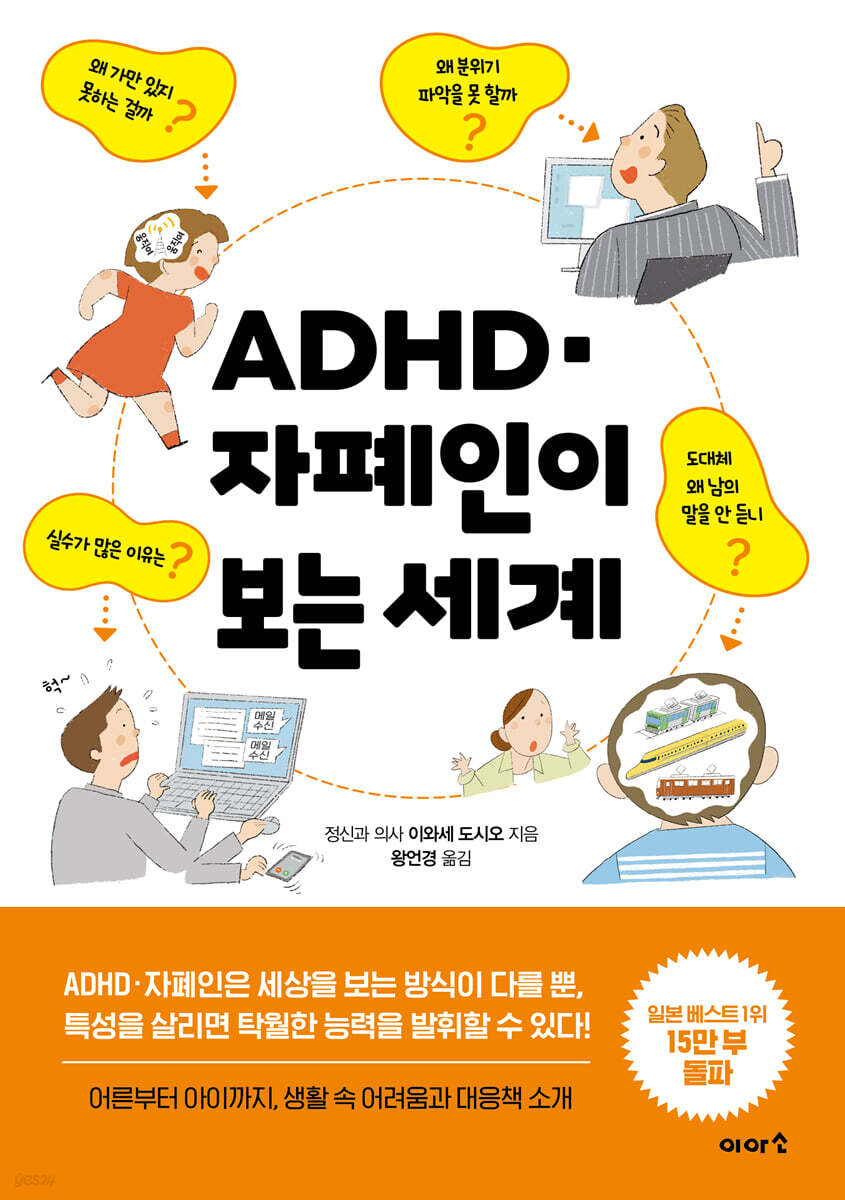
The World Seen by People with ADHD and Autism
 |
Description
Book Introduction
People with ADHD and autism just have different ways of seeing the world.
If you use your traits, you can develop outstanding abilities!
A person who says rude things to others without any ill intention, repeatedly breaks promises, or suddenly becomes emotional and cries, embarrassing those around them… … .
If your child or someone you know has this, they may have ADHD or autism. ADHD and autism are "brain traits."
Therefore, it is difficult to improve through effort alone.
The important thing is to understand that trait and change the way you deal with it.
In this book, a psychiatrist with 30 years of experience provides an easy-to-understand explanation of the world seen by people with ADHD and autism and communication methods through 32 real-life cases.
People with developmental disabilities are neither less capable nor have problems with their humanity.
Rather, if you make good use of that characteristic, you can demonstrate outstanding abilities.
If you understand how people with developmental disabilities perceive and feel situations and know how to respond to them, you will be able to understand them better and learn how to get along with them, even though they are only slightly different from people without developmental disabilities.
If you use your traits, you can develop outstanding abilities!
A person who says rude things to others without any ill intention, repeatedly breaks promises, or suddenly becomes emotional and cries, embarrassing those around them… … .
If your child or someone you know has this, they may have ADHD or autism. ADHD and autism are "brain traits."
Therefore, it is difficult to improve through effort alone.
The important thing is to understand that trait and change the way you deal with it.
In this book, a psychiatrist with 30 years of experience provides an easy-to-understand explanation of the world seen by people with ADHD and autism and communication methods through 32 real-life cases.
People with developmental disabilities are neither less capable nor have problems with their humanity.
Rather, if you make good use of that characteristic, you can demonstrate outstanding abilities.
If you understand how people with developmental disabilities perceive and feel situations and know how to respond to them, you will be able to understand them better and learn how to get along with them, even though they are only slightly different from people without developmental disabilities.
- You can preview some of the book's contents.
Preview
index
Entering
Introduction: What is ADHD and autism?
Developmental disabilities are not diseases, but rather 'traitlines' of the brain.
ADHD, which causes frequent mistakes due to inattention
ASD is sensitive to change and has poor communication skills.
When ASD and ADHD coexist, there is an undiagnosed 'gray zone'
The important thing is to understand the world you see.
ADHD, ASD Checklist
Chapter 1: Difficulties in Communication
01 I don't mean it badly, but it makes people angry.
Because I am not flexible in my thinking, I give offending answers.
Empty words don't work, and words are taken literally.
Unable to listen to others, fidgeting, rambling, and chattering
Why do we break promises we make? Why do we break important promises?
Even if it's true, it's difficult to say! Why can't I read the mood?
02 The painter is always wrong
You can't read someone's mind through their facial expressions, tone of voice, or attitude.
Don't listen to what the other person is saying
"You get the idea, right?" doesn't work, so I keep asking.
03 Simple communication is difficult
Gets angry or laughs impulsively, and easily expresses feelings through attitude
Get very angry over trivial things
Not following directions at school and not acting in a group
They are unable to understand the situation or consider others, and are obsessed with their own logic to the end.
04 Emotions are more unstable than the average person
I think, ‘I was wrong anyway…’ and I have no confidence.
I feel very anxious even about trivial things
It's hard to tell if they're happy or sad because they have no expression.
Doctor's Column 1: Secondary Disabilities Often Caused by Developmental Disabilities
Chapter 2: The Problem of Behavior
01 Lack of stability and a series of mistakes.
It only causes worry to those around you
Can't stay still, suddenly starts fidgeting and twitching
A series of failures, both at work and at home.
Most of them are 'simple mistakes'
Because my fingertips are not sharp, I often drop things and my motor skills are slow.
Failure to follow the simple rule of waiting in line
He is impatient and always rushes and hurries to do things, both work and personal.
When I see something new, I buy it impulsively without thinking about the consequences and quickly get bored.
02 Relationships with people around you keep going wrong.
Procrastination. What's the difference between ASD and ADHD?
Failing to grasp the core and being slow to get things done
Unable to respond to changing circumstances with improvisation
When I get caught up in something, I lose my mind and my daily life falls apart.
03 Lack of understanding of 'normal' things, making it difficult to respond effectively
I have trouble waking up in the morning and can't fall asleep at night.
I have very distinct likes and dislikes and only eat the same foods.
I can't ride the subway because I'm sensitive to noise.
Even though I know I shouldn't be late, I'm always late.
A child who doesn't want to take a bath.
What on earth do you hate?
I can't organize it or throw it away.
What is the true identity of the messy room owner?
I can't concentrate on conversations or work because of the noise around me.
Doctors' Column 2: Developmental Disorders and Complications
Chapter 3: Strengths Unique to People with Developmental Disabilities
Let's live confidently by finding a role that brings out our unique qualities.
By taking advantage of the characteristic of ‘maintaining identity’, we can become experts.
The power of action from "hyperactivity and impulsivity" becomes a weapon.
Excellent memory is an advantage for people with developmental disabilities.
If you turn 'carelessness' around, you get a powerful weapon called imagination.
The unique idea of 'hypersensitivity' as an artistic sensibility
Liveliness without regard for the front or back is a strength in social life.
Logical thinking, free from emotions, brings about organizational transformation.
Did the brain characteristics of people with developmental disabilities advance humanity?
This person also had a developmental disability!
Doctor's Column 3: What Treatment Methods Are Available for Developmental Disorders?
Conclusion
Introduction: What is ADHD and autism?
Developmental disabilities are not diseases, but rather 'traitlines' of the brain.
ADHD, which causes frequent mistakes due to inattention
ASD is sensitive to change and has poor communication skills.
When ASD and ADHD coexist, there is an undiagnosed 'gray zone'
The important thing is to understand the world you see.
ADHD, ASD Checklist
Chapter 1: Difficulties in Communication
01 I don't mean it badly, but it makes people angry.
Because I am not flexible in my thinking, I give offending answers.
Empty words don't work, and words are taken literally.
Unable to listen to others, fidgeting, rambling, and chattering
Why do we break promises we make? Why do we break important promises?
Even if it's true, it's difficult to say! Why can't I read the mood?
02 The painter is always wrong
You can't read someone's mind through their facial expressions, tone of voice, or attitude.
Don't listen to what the other person is saying
"You get the idea, right?" doesn't work, so I keep asking.
03 Simple communication is difficult
Gets angry or laughs impulsively, and easily expresses feelings through attitude
Get very angry over trivial things
Not following directions at school and not acting in a group
They are unable to understand the situation or consider others, and are obsessed with their own logic to the end.
04 Emotions are more unstable than the average person
I think, ‘I was wrong anyway…’ and I have no confidence.
I feel very anxious even about trivial things
It's hard to tell if they're happy or sad because they have no expression.
Doctor's Column 1: Secondary Disabilities Often Caused by Developmental Disabilities
Chapter 2: The Problem of Behavior
01 Lack of stability and a series of mistakes.
It only causes worry to those around you
Can't stay still, suddenly starts fidgeting and twitching
A series of failures, both at work and at home.
Most of them are 'simple mistakes'
Because my fingertips are not sharp, I often drop things and my motor skills are slow.
Failure to follow the simple rule of waiting in line
He is impatient and always rushes and hurries to do things, both work and personal.
When I see something new, I buy it impulsively without thinking about the consequences and quickly get bored.
02 Relationships with people around you keep going wrong.
Procrastination. What's the difference between ASD and ADHD?
Failing to grasp the core and being slow to get things done
Unable to respond to changing circumstances with improvisation
When I get caught up in something, I lose my mind and my daily life falls apart.
03 Lack of understanding of 'normal' things, making it difficult to respond effectively
I have trouble waking up in the morning and can't fall asleep at night.
I have very distinct likes and dislikes and only eat the same foods.
I can't ride the subway because I'm sensitive to noise.
Even though I know I shouldn't be late, I'm always late.
A child who doesn't want to take a bath.
What on earth do you hate?
I can't organize it or throw it away.
What is the true identity of the messy room owner?
I can't concentrate on conversations or work because of the noise around me.
Doctors' Column 2: Developmental Disorders and Complications
Chapter 3: Strengths Unique to People with Developmental Disabilities
Let's live confidently by finding a role that brings out our unique qualities.
By taking advantage of the characteristic of ‘maintaining identity’, we can become experts.
The power of action from "hyperactivity and impulsivity" becomes a weapon.
Excellent memory is an advantage for people with developmental disabilities.
If you turn 'carelessness' around, you get a powerful weapon called imagination.
The unique idea of 'hypersensitivity' as an artistic sensibility
Liveliness without regard for the front or back is a strength in social life.
Logical thinking, free from emotions, brings about organizational transformation.
Did the brain characteristics of people with developmental disabilities advance humanity?
This person also had a developmental disability!
Doctor's Column 3: What Treatment Methods Are Available for Developmental Disorders?
Conclusion
Detailed image

Publisher's Review
How to Understand and Communicate with the World of ADHD and Autism
#1 bestseller in Japan, sold over 150,000 copies!
Do you know anyone like this? Someone who says rude things to others without any ill intentions, repeatedly breaks promises or is late, or suddenly gets emotional and cries or gets angry, embarrassing everyone around them…
You might think, 'There it is, there it is!' or 'Oh, me?'
If you've ever thought it was a matter of personality or humanity, don't be.
It might be because of the characteristics of the ‘brain’.
The author, Toshio Iwase, is a developmental disorder specialist who has been treating ADHD and autistic individuals for over 30 years.
He says that many people with the same problems as mentioned above have consistent characteristics in their brains.
It is a ‘developmental disorder.’
In cases where the symptoms are not severe, they are often dismissed as 'a little bit eccentric' or 'people who can't read the atmosphere', but their way of looking at the world, accepting things, and feeling is completely different from that of people without developmental disabilities.
Because of this, it is difficult for people without developmental disabilities to understand their behavior, and people with developmental disabilities try to correct the behaviors they are pointed out, but because it is a characteristic of the brain, it does not change easily.
This book explains 32 behavioral characteristics of people with ADHD and ASD, using real-life examples, and provides information on difficulties in daily life and how to deal with them properly.
By learning about how people with developmental disabilities view the world through this book, you will be able to better understand and get along with those who are only slightly different from you.
There's a reason for thoughts and actions that are difficult to understand.
ADHD stands for 'Attention Deficit Hyperactivity Disorder', and is characterized by being easily distracted, inattentive, and having a very short attention span.
They also tend to constantly move parts of their body, have trouble handling details, and are very sensitive.
ASD stands for 'autism spectrum disorder', and people with ASD have difficulty communicating with others and tend to always stick to the same behavior.
Additionally, certain senses, such as sight or taste, may be hypersensitive to the point of interfering with daily life.
This book enhances the overall understanding of developmental disorders by explaining the characteristics of ADHD and ASD.
It also covers people in the 'gray zone' who exhibit ADHD and ASD tendencies, but not to the extent of being diagnosed with a developmental disability.
Have you ever wondered if you might have ADHD or ASD-like tendencies? Do you often find yourself behaving in a way that doesn't seem to be a problem, but others around you often don't understand your behavior? Use the "ADHD, ASD Checklist" in this book to identify your own tendencies.
Even if the behavior is the same, the cause may be different.
Knowing your specific tendencies will help you understand why people around you react the way they do and what you can do to communicate more smoothly with others.
You can live confidently by making the most of your own unique characteristics!
The author of this book, Toshio Iwase, argues that by capitalizing on the unique characteristics of individuals with developmental disabilities, they can achieve exceptional abilities. Individuals with ASD excel at repeating tasks, excel at detecting subtle differences, and often possess exceptional memories.
Furthermore, hypersensitivity can be sublimated into artistic sensibilities, and the logical thinking characteristic of those with ASD can be a great help in assessing situations objectively. People with ADHD often exhibit outstanding initiative and a vibrant imagination, making them adept at creative endeavors.
In this way, people with ASD and ADHD have strengths that are difficult to find in people without developmental disabilities, and if they develop these abilities well, they may become talents that society needs even more than people without developmental disabilities.
Elon Musk famously appeared on TV and confessed that he suffers from ASD.
Steve Jobs, Bill Gates, and Einstein are also believed to have ASD.
This means that they have succeeded in their fields by taking advantage of their developmental disabilities.
Readers of this book should also try to understand their own tendencies and those of those around them and find ways to utilize those tendencies.
#1 bestseller in Japan, sold over 150,000 copies!
Do you know anyone like this? Someone who says rude things to others without any ill intentions, repeatedly breaks promises or is late, or suddenly gets emotional and cries or gets angry, embarrassing everyone around them…
You might think, 'There it is, there it is!' or 'Oh, me?'
If you've ever thought it was a matter of personality or humanity, don't be.
It might be because of the characteristics of the ‘brain’.
The author, Toshio Iwase, is a developmental disorder specialist who has been treating ADHD and autistic individuals for over 30 years.
He says that many people with the same problems as mentioned above have consistent characteristics in their brains.
It is a ‘developmental disorder.’
In cases where the symptoms are not severe, they are often dismissed as 'a little bit eccentric' or 'people who can't read the atmosphere', but their way of looking at the world, accepting things, and feeling is completely different from that of people without developmental disabilities.
Because of this, it is difficult for people without developmental disabilities to understand their behavior, and people with developmental disabilities try to correct the behaviors they are pointed out, but because it is a characteristic of the brain, it does not change easily.
This book explains 32 behavioral characteristics of people with ADHD and ASD, using real-life examples, and provides information on difficulties in daily life and how to deal with them properly.
By learning about how people with developmental disabilities view the world through this book, you will be able to better understand and get along with those who are only slightly different from you.
There's a reason for thoughts and actions that are difficult to understand.
ADHD stands for 'Attention Deficit Hyperactivity Disorder', and is characterized by being easily distracted, inattentive, and having a very short attention span.
They also tend to constantly move parts of their body, have trouble handling details, and are very sensitive.
ASD stands for 'autism spectrum disorder', and people with ASD have difficulty communicating with others and tend to always stick to the same behavior.
Additionally, certain senses, such as sight or taste, may be hypersensitive to the point of interfering with daily life.
This book enhances the overall understanding of developmental disorders by explaining the characteristics of ADHD and ASD.
It also covers people in the 'gray zone' who exhibit ADHD and ASD tendencies, but not to the extent of being diagnosed with a developmental disability.
Have you ever wondered if you might have ADHD or ASD-like tendencies? Do you often find yourself behaving in a way that doesn't seem to be a problem, but others around you often don't understand your behavior? Use the "ADHD, ASD Checklist" in this book to identify your own tendencies.
Even if the behavior is the same, the cause may be different.
Knowing your specific tendencies will help you understand why people around you react the way they do and what you can do to communicate more smoothly with others.
You can live confidently by making the most of your own unique characteristics!
The author of this book, Toshio Iwase, argues that by capitalizing on the unique characteristics of individuals with developmental disabilities, they can achieve exceptional abilities. Individuals with ASD excel at repeating tasks, excel at detecting subtle differences, and often possess exceptional memories.
Furthermore, hypersensitivity can be sublimated into artistic sensibilities, and the logical thinking characteristic of those with ASD can be a great help in assessing situations objectively. People with ADHD often exhibit outstanding initiative and a vibrant imagination, making them adept at creative endeavors.
In this way, people with ASD and ADHD have strengths that are difficult to find in people without developmental disabilities, and if they develop these abilities well, they may become talents that society needs even more than people without developmental disabilities.
Elon Musk famously appeared on TV and confessed that he suffers from ASD.
Steve Jobs, Bill Gates, and Einstein are also believed to have ASD.
This means that they have succeeded in their fields by taking advantage of their developmental disabilities.
Readers of this book should also try to understand their own tendencies and those of those around them and find ways to utilize those tendencies.
GOODS SPECIFICS
- Date of issue: November 20, 2024
- Page count, weight, size: 196 pages | 324g | 148*210*20mm
- ISBN13: 9791187113713
- ISBN10: 1187113719
You may also like
카테고리
korean


korean

![ELLE 엘르 스페셜 에디션 A형 : 12월 [2025]](http://librairie.coreenne.fr/cdn/shop/files/b8e27a3de6c9538896439686c6b0e8fb.jpg?v=1766436872&width=3840)


