

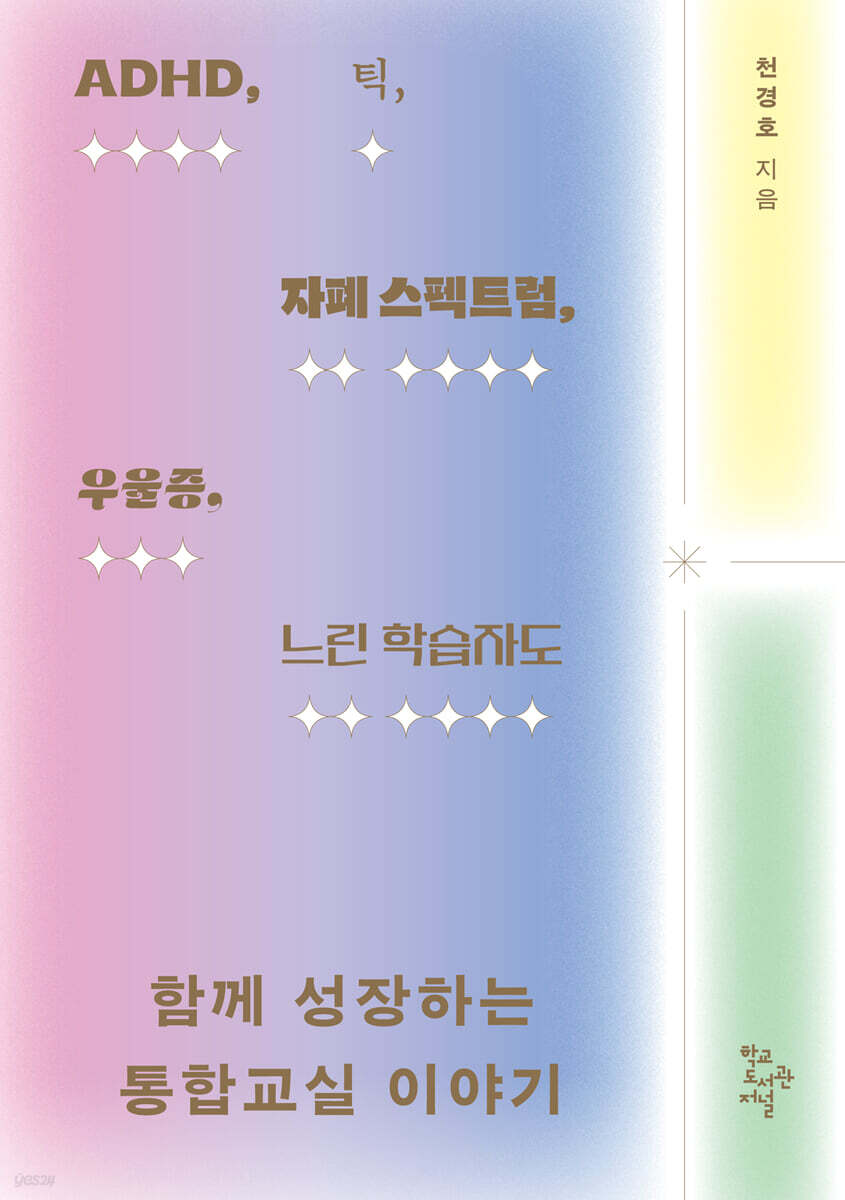
A story about an inclusive classroom where children with ADHD, tics, autism spectrum disorder, depression, and slow learners grow together.
 |
Description
Book Introduction
Teacher Cheon Gyeong-ho, who has encouraged many readers with his various 'speech studies', now talks about integrated classrooms.
The author vividly describes what it is like to live in an integrated classroom where special education students and regular students meet together, and the impact that integrated education has on children, based on his own experiences.
In the process, readers come to understand the characteristics of these somewhat special children and learn appropriate ways to deal with them.
Chapters 1 and 2 present cases of children with ADHD and autism spectrum disorders, respectively.
Chapter 3 introduces cases of children who have difficulties in school life in addition to children who need special education.
Chapter 4 presents directions for administrative improvement to establish integrated education.
Teachers and parents who are suddenly faced with an integrated classroom are bound to be confused.
Through the integrated education case studies that Mr. Cheon Gyeong-ho personally witnessed and experienced, we can glimpse the journey of how to create a classroom where diversity is respected.
The author vividly describes what it is like to live in an integrated classroom where special education students and regular students meet together, and the impact that integrated education has on children, based on his own experiences.
In the process, readers come to understand the characteristics of these somewhat special children and learn appropriate ways to deal with them.
Chapters 1 and 2 present cases of children with ADHD and autism spectrum disorders, respectively.
Chapter 3 introduces cases of children who have difficulties in school life in addition to children who need special education.
Chapter 4 presents directions for administrative improvement to establish integrated education.
Teachers and parents who are suddenly faced with an integrated classroom are bound to be confused.
Through the integrated education case studies that Mr. Cheon Gyeong-ho personally witnessed and experienced, we can glimpse the journey of how to create a classroom where diversity is respected.
- You can preview some of the book's contents.
Preview
index
ㆍRecommendation
ㆍIntroductory remarks
Chapter 1: Children with ADHD and Tics
The moment I met Jeongmo
Paper Knife: A Sharp First Interaction
The pain called a tic, we need time.
When I exposed my wounds, everything changed.
The reason for the existence of integrated classes
Chapter 2: Children on the Autism Spectrum
The moment I met Jinwoong
Teacher Cheon Kyung-ho is upset
Running to 100
Rapport comes before learning
A little higher, put it inside the circle
Can you call me by my name instead of my disability?
Activity support workers needed for everyone
The 'spark' between us that brings us closer together
The 'Spark' in Our Classroom
Jinwoong must have wanted to solve the problem too
A strange spring day, a time to grow a little more
Let's do what we can one by one
Balance is not achieved by one force alone.
We're going to have a meeting
A good path to walk together
The desire to stand alone and together
Become Sullivan for a day
The desire to be together and the frustration are directly proportional.
I will do it
The song I want to hear
Calling Names: How to Break Through the Wall a Little Every Day
Friends over work
I want to take a graduation photo
Predictability, a more friendly explanation is needed.
Yeah, I'll do well on my own in the future too.
Even though I'm not feeling well today, let's do our best.
Our dependable class assistant teacher
It just takes a little more time
Why did you avoid it?
The world also includes people on the autism spectrum.
Jinwoong wanted to do it too
The world's toughest graduation ceremony
Chapter 3: The Story of a Child, a Child, a Child
The child who doesn't turn back
A child who only cares about himself
A child who spoke for the first time in three years
A child asking to change the group
A child with borderline intelligence
Two children who are more mature than adults
A child who speaks the opposite way
A child who takes a friend's things without permission
The child who threw the sticker board
A child who doesn't eat well
A child picking up a fallen curtain
A young child with his own problems
The kid in the next class has ADHD
A child with Tourette's
A child laughing loudly
Chapter 4: A Step Toward Inclusive Education
Which school do special needs children go to?
Why Inclusive Education Should Be Expanded
Why Achievement Standards Need to Be Significantly Strengthened
Why is inclusive education important?
My hopes as a homeroom teacher for an integrated classroom
How about receiving special education?
About hiding a child's disability
The most important question hidden behind corporal punishment
Regarding the admission of children with autism spectrum disorder to middle school
Why we support and encourage special education teachers
Why We Need More Books on Inclusive Education
The need for an integrated education support system
ㆍExiting words
ㆍIntroductory remarks
Chapter 1: Children with ADHD and Tics
The moment I met Jeongmo
Paper Knife: A Sharp First Interaction
The pain called a tic, we need time.
When I exposed my wounds, everything changed.
The reason for the existence of integrated classes
Chapter 2: Children on the Autism Spectrum
The moment I met Jinwoong
Teacher Cheon Kyung-ho is upset
Running to 100
Rapport comes before learning
A little higher, put it inside the circle
Can you call me by my name instead of my disability?
Activity support workers needed for everyone
The 'spark' between us that brings us closer together
The 'Spark' in Our Classroom
Jinwoong must have wanted to solve the problem too
A strange spring day, a time to grow a little more
Let's do what we can one by one
Balance is not achieved by one force alone.
We're going to have a meeting
A good path to walk together
The desire to stand alone and together
Become Sullivan for a day
The desire to be together and the frustration are directly proportional.
I will do it
The song I want to hear
Calling Names: How to Break Through the Wall a Little Every Day
Friends over work
I want to take a graduation photo
Predictability, a more friendly explanation is needed.
Yeah, I'll do well on my own in the future too.
Even though I'm not feeling well today, let's do our best.
Our dependable class assistant teacher
It just takes a little more time
Why did you avoid it?
The world also includes people on the autism spectrum.
Jinwoong wanted to do it too
The world's toughest graduation ceremony
Chapter 3: The Story of a Child, a Child, a Child
The child who doesn't turn back
A child who only cares about himself
A child who spoke for the first time in three years
A child asking to change the group
A child with borderline intelligence
Two children who are more mature than adults
A child who speaks the opposite way
A child who takes a friend's things without permission
The child who threw the sticker board
A child who doesn't eat well
A child picking up a fallen curtain
A young child with his own problems
The kid in the next class has ADHD
A child with Tourette's
A child laughing loudly
Chapter 4: A Step Toward Inclusive Education
Which school do special needs children go to?
Why Inclusive Education Should Be Expanded
Why Achievement Standards Need to Be Significantly Strengthened
Why is inclusive education important?
My hopes as a homeroom teacher for an integrated classroom
How about receiving special education?
About hiding a child's disability
The most important question hidden behind corporal punishment
Regarding the admission of children with autism spectrum disorder to middle school
Why we support and encourage special education teachers
Why We Need More Books on Inclusive Education
The need for an integrated education support system
ㆍExiting words
Detailed image

Into the book
Now that we have a child with special needs, can we just start inclusive education? We don't fully understand how disabilities are categorized or what challenges each disability presents.
[…] In order to provide integrated education that meets the educational needs of each individual, not just one teacher, but all teachers and many experts must observe each student with a keen eye and create an environment that is suitable for each student.
--- p.12
I talked to the children in my class about the difficulties Jeongmo had with ADHD and motor tics and asked them what they thought would be helpful in addressing these issues.
The kids already knew the answer.
It was just the right time.
Jeongmo's expression changed when his friends told him that he should give her more time and that it was okay to give her more time than they did.
Because he knew his friends understood him.
No longer did Jeongmo have to come to the classroom where everyone was afraid of him.
--- p.34
There is a growing number of children who are unable to suppress their reactions to external stimuli.
To put it simply, as the number of people and spaces where children can feel comfortable decreases, the stress they experience increases, and as the stress increases, the possibility of ADHD genes being expressed also increases.
Perhaps recent ADHD in children has emerged as a response to the stress they receive at school.
So how can we reduce stress in children?
--- p.48
There was a way to minimize all these concerns.
It's an activity support worker.
If there is someone around the child who understands the child's characteristics and helps the child adapt smoothly to school life, there is less to worry about whether the child goes to a regular school or a special school.
Of course, we both know that it is really hard to find a good activity support worker, so we decided to tell Jinwoong's guardian that we should keep asking around.
--- p.91
But next to Jinwoong, a child was walking holding his hand.
I took my cell phone out of my pocket and took a picture of the backs of the two children.
Is it because I'm in a hurry?
The screen won't open.
In the end, I had to be content with taking pictures of the two children through the screen.
I am happy to be able to record the warm and beautiful moments of walking together, the path we walked hand in hand.
--- p.121
If you let them hear with their ears, see with their eyes, and feel with their hands, they will follow along little by little.
Then, if you give immediate praise and encouragement when they do it right, their expression will change.
At first, things didn't go well, so I thought his gaze would change for a moment, but Jinwoong endured it well.
Then I got absorbed in painting.
Even though I couldn't paint according to the sketch, I thought it would be a success if I could just dip the brush in paint and paint slowly.
--- p.155
Even children who exhibit behavioral problems want to do things on their own, do well, and get along with their friends.
The one who is most frustrated about not being able to do that is the child himself.
The role of a teacher and a friend is to read that mind, cheer, encourage, and teach so that they can achieve it.
--- p.208
The most important goal is to be able to socialize with friends even when away from the teacher.
Even when you go to middle school or high school, you should spend safe and happy time with your friends in integrated classes.
Even as adults, we must live our lives doing what we can as members of society.
So, what a child needs most right now is someone to hang out with.
[…] In order to provide integrated education that meets the educational needs of each individual, not just one teacher, but all teachers and many experts must observe each student with a keen eye and create an environment that is suitable for each student.
--- p.12
I talked to the children in my class about the difficulties Jeongmo had with ADHD and motor tics and asked them what they thought would be helpful in addressing these issues.
The kids already knew the answer.
It was just the right time.
Jeongmo's expression changed when his friends told him that he should give her more time and that it was okay to give her more time than they did.
Because he knew his friends understood him.
No longer did Jeongmo have to come to the classroom where everyone was afraid of him.
--- p.34
There is a growing number of children who are unable to suppress their reactions to external stimuli.
To put it simply, as the number of people and spaces where children can feel comfortable decreases, the stress they experience increases, and as the stress increases, the possibility of ADHD genes being expressed also increases.
Perhaps recent ADHD in children has emerged as a response to the stress they receive at school.
So how can we reduce stress in children?
--- p.48
There was a way to minimize all these concerns.
It's an activity support worker.
If there is someone around the child who understands the child's characteristics and helps the child adapt smoothly to school life, there is less to worry about whether the child goes to a regular school or a special school.
Of course, we both know that it is really hard to find a good activity support worker, so we decided to tell Jinwoong's guardian that we should keep asking around.
--- p.91
But next to Jinwoong, a child was walking holding his hand.
I took my cell phone out of my pocket and took a picture of the backs of the two children.
Is it because I'm in a hurry?
The screen won't open.
In the end, I had to be content with taking pictures of the two children through the screen.
I am happy to be able to record the warm and beautiful moments of walking together, the path we walked hand in hand.
--- p.121
If you let them hear with their ears, see with their eyes, and feel with their hands, they will follow along little by little.
Then, if you give immediate praise and encouragement when they do it right, their expression will change.
At first, things didn't go well, so I thought his gaze would change for a moment, but Jinwoong endured it well.
Then I got absorbed in painting.
Even though I couldn't paint according to the sketch, I thought it would be a success if I could just dip the brush in paint and paint slowly.
--- p.155
Even children who exhibit behavioral problems want to do things on their own, do well, and get along with their friends.
The one who is most frustrated about not being able to do that is the child himself.
The role of a teacher and a friend is to read that mind, cheer, encourage, and teach so that they can achieve it.
--- p.208
The most important goal is to be able to socialize with friends even when away from the teacher.
Even when you go to middle school or high school, you should spend safe and happy time with your friends in integrated classes.
Even as adults, we must live our lives doing what we can as members of society.
So, what a child needs most right now is someone to hang out with.
--- p.246
Publisher's Review
Children who are not called by their diagnosis,
A loving struggle to create an integrated classroom for children and youth
This book features children with ADHD and tics, children on the autism spectrum, and children without a diagnosis who require special attention from teachers.
This is an 'integrated classroom' where special education students and regular students live together.
The author does not introduce a systematic teaching method for inclusive education.
Instead, he calmly shares his experience running an integrated classroom.
The dialogue between teachers and students that frequently appears in the text shows how subtle differences in words can have a big impact.
How to call a child, how to point out and persuade a child's problem behavior, and how to make them understand the purpose of inclusive education are all naturally revealed in vivid conversations.
The author did not completely establish the integrated classroom from the beginning.
Sometimes I seek advice from those around me, and sometimes I worry about it alone.
But at the end of that effort, there was a classroom where diverse children could grow together.
Let's all join in this loving struggle, teachers who are in charge of integrated classrooms and parents who are concerned about integrated classrooms.
Your best supporters are your friends!
How should teachers make children understand?
One day the author witnesses an amazing scene.
A child on the autism spectrum was doing things that could be perceived as disruptive to the class, such as clapping and walking around the classroom, while the other children were going about their business without any concern.
As the child who had been wandering around the classroom calmed down and sat down, a friend came up to him and even patted him on the back.
I fully understand that children on the autism spectrum can exhibit outbursts regardless of their will.
The child reportedly did well in school life as a respectable member of the classroom with psychological support from his friends.
The most important factor in running an integrated classroom like this is ‘friends.’
Students with special needs naturally want to do things on their own, do well, and build good relationships with others.
If a child feels stressed every time they see other children because their teacher is the only one who supports them, their symptoms may worsen or they may become frustrated.
An integrated classroom is a place where all children ‘grow together.’
Teachers should pay attention to special children, but should not make other children feel excluded.
The author records small reading activities and classroom conversations to demonstrate how to communicate with children without being biased.
The future path for integrated education
An integrated classroom cannot be achieved by teachers alone.
Teachers have a lot to do.
In addition to the primary duties of teaching and researching classes, teachers have countless meticulous administrative tasks.
There are also many small, on-site tasks that teachers are traditionally responsible for, although their purpose is unclear.
If I were to be assigned to a special education student in this situation, I would no longer be able to pay attention to each and every child.
Additionally, if a child who was studying in an integrated classroom in elementary school does not continue integrated education when he or she enters middle school, all the efforts made may go down the drain.
The author, speaking from the perspective of those in the field, identifies the systems and institutions that need improvement for integrated education, including closer cooperation between activity support workers and elementary, middle, and high schools.
Through this, fellow teachers will be freed from the guilt of failing to achieve inclusive education, and parents will learn what kind of foundation is needed to ensure their children's school life continues to be successful.
A loving struggle to create an integrated classroom for children and youth
This book features children with ADHD and tics, children on the autism spectrum, and children without a diagnosis who require special attention from teachers.
This is an 'integrated classroom' where special education students and regular students live together.
The author does not introduce a systematic teaching method for inclusive education.
Instead, he calmly shares his experience running an integrated classroom.
The dialogue between teachers and students that frequently appears in the text shows how subtle differences in words can have a big impact.
How to call a child, how to point out and persuade a child's problem behavior, and how to make them understand the purpose of inclusive education are all naturally revealed in vivid conversations.
The author did not completely establish the integrated classroom from the beginning.
Sometimes I seek advice from those around me, and sometimes I worry about it alone.
But at the end of that effort, there was a classroom where diverse children could grow together.
Let's all join in this loving struggle, teachers who are in charge of integrated classrooms and parents who are concerned about integrated classrooms.
Your best supporters are your friends!
How should teachers make children understand?
One day the author witnesses an amazing scene.
A child on the autism spectrum was doing things that could be perceived as disruptive to the class, such as clapping and walking around the classroom, while the other children were going about their business without any concern.
As the child who had been wandering around the classroom calmed down and sat down, a friend came up to him and even patted him on the back.
I fully understand that children on the autism spectrum can exhibit outbursts regardless of their will.
The child reportedly did well in school life as a respectable member of the classroom with psychological support from his friends.
The most important factor in running an integrated classroom like this is ‘friends.’
Students with special needs naturally want to do things on their own, do well, and build good relationships with others.
If a child feels stressed every time they see other children because their teacher is the only one who supports them, their symptoms may worsen or they may become frustrated.
An integrated classroom is a place where all children ‘grow together.’
Teachers should pay attention to special children, but should not make other children feel excluded.
The author records small reading activities and classroom conversations to demonstrate how to communicate with children without being biased.
The future path for integrated education
An integrated classroom cannot be achieved by teachers alone.
Teachers have a lot to do.
In addition to the primary duties of teaching and researching classes, teachers have countless meticulous administrative tasks.
There are also many small, on-site tasks that teachers are traditionally responsible for, although their purpose is unclear.
If I were to be assigned to a special education student in this situation, I would no longer be able to pay attention to each and every child.
Additionally, if a child who was studying in an integrated classroom in elementary school does not continue integrated education when he or she enters middle school, all the efforts made may go down the drain.
The author, speaking from the perspective of those in the field, identifies the systems and institutions that need improvement for integrated education, including closer cooperation between activity support workers and elementary, middle, and high schools.
Through this, fellow teachers will be freed from the guilt of failing to achieve inclusive education, and parents will learn what kind of foundation is needed to ensure their children's school life continues to be successful.
GOODS SPECIFICS
- Date of issue: September 24, 2024
- Page count, weight, size: 280 pages | 384g | 148*210*15mm
- ISBN13: 9788969151728
- ISBN10: 8969151729
You may also like
카테고리
korean


korean

![ELLE 엘르 스페셜 에디션 A형 : 12월 [2025]](http://librairie.coreenne.fr/cdn/shop/files/b8e27a3de6c9538896439686c6b0e8fb.jpg?v=1766436872&width=3840)


