

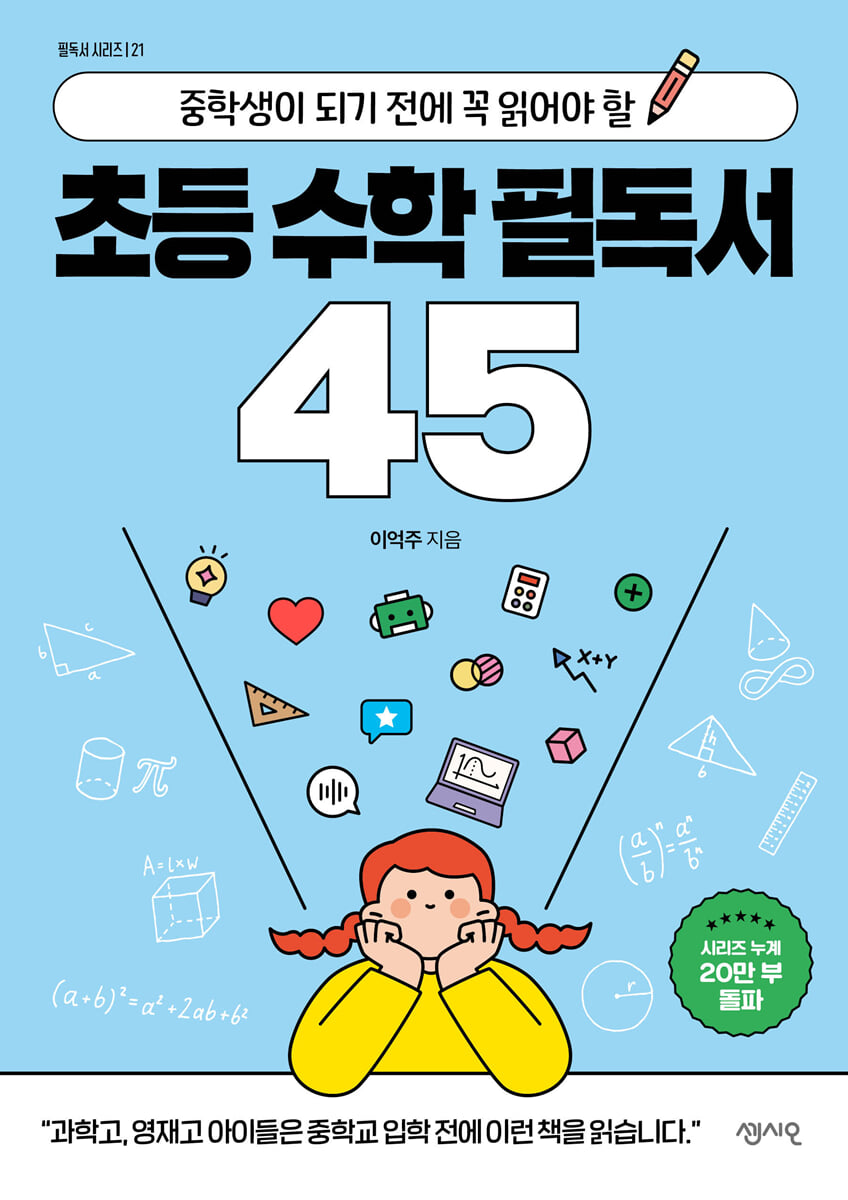
Elementary Math Must-Reads 45
 |
Description
Book Introduction
A must-read that fosters mathematical thinking and creative approaches.
Deeper and more enjoyable math!
A book titled “45 Essential Readings for Elementary School Math,” which guides children’s math studies through 45 must-read math books for elementary school students, has been published.
This must-read book will help children develop mathematical thinking skills from an early age and develop a creative approach to even difficult math problems.
Many parents put effort into their children's math studies from the early grades, as they hear that 'math grades are already determined in elementary school.'
However, excessive pre-learning and mechanical problem solving can have the counterproductive effect of making children bored with and distant from math.
How can we keep children interested in math and keep them engaged throughout the course? And how can we foster their ability to creatively solve problems through mathematical thinking?
"45 Essential Readings for Elementary Mathematics" is a book that provides an answer to this question. It is a book that helps children approach mathematics with interest through voluntary reading and fully understand the core concepts of each area of elementary mathematics.
It consists of four parts and provides a rich introduction to everything from the history of mathematics to the achievements of mathematicians, stories of mathematics in everyday life, and the importance of studying mathematics.
From books that clearly organize mathematical concepts to books that capture interest through comics and storytelling, to books that focus on the connections between mathematics and other fields, we have carefully selected books that will help children develop a strong mathematical mind and a good study attitude.
Each of the 45 books is marked with a curriculum linkage, allowing children to choose and read books that match their current grade or the unit they are studying.
Additionally, when dealing with content learned in middle school, such as the Pythagorean theorem and sets, we tried to make it as easy as possible to connect it with units learned in upper elementary school.
It is easy to read as it contains plenty of diagrams and example pictures to help with understanding, and it is designed to make it easy for elementary school students to approach difficult math concepts with fun anecdotes.
There are also a number of math quizzes that you can solve with family or friends.
Through "45 Essential Readings for Elementary School Mathematics," our children will be able to regain the curiosity they had when they first encountered mathematics, and build the assets they need to happily navigate the long journey ahead with mathematics.
Deeper and more enjoyable math!
A book titled “45 Essential Readings for Elementary School Math,” which guides children’s math studies through 45 must-read math books for elementary school students, has been published.
This must-read book will help children develop mathematical thinking skills from an early age and develop a creative approach to even difficult math problems.
Many parents put effort into their children's math studies from the early grades, as they hear that 'math grades are already determined in elementary school.'
However, excessive pre-learning and mechanical problem solving can have the counterproductive effect of making children bored with and distant from math.
How can we keep children interested in math and keep them engaged throughout the course? And how can we foster their ability to creatively solve problems through mathematical thinking?
"45 Essential Readings for Elementary Mathematics" is a book that provides an answer to this question. It is a book that helps children approach mathematics with interest through voluntary reading and fully understand the core concepts of each area of elementary mathematics.
It consists of four parts and provides a rich introduction to everything from the history of mathematics to the achievements of mathematicians, stories of mathematics in everyday life, and the importance of studying mathematics.
From books that clearly organize mathematical concepts to books that capture interest through comics and storytelling, to books that focus on the connections between mathematics and other fields, we have carefully selected books that will help children develop a strong mathematical mind and a good study attitude.
Each of the 45 books is marked with a curriculum linkage, allowing children to choose and read books that match their current grade or the unit they are studying.
Additionally, when dealing with content learned in middle school, such as the Pythagorean theorem and sets, we tried to make it as easy as possible to connect it with units learned in upper elementary school.
It is easy to read as it contains plenty of diagrams and example pictures to help with understanding, and it is designed to make it easy for elementary school students to approach difficult math concepts with fun anecdotes.
There are also a number of math quizzes that you can solve with family or friends.
Through "45 Essential Readings for Elementary School Mathematics," our children will be able to regain the curiosity they had when they first encountered mathematics, and build the assets they need to happily navigate the long journey ahead with mathematics.
- You can preview some of the book's contents.
Preview
index
Introduction: Let's find the fun of mathematics in books!
Part 1: Mathematics, a History of Humanity
·BOOK 01·What's the difference between numbers and numerals? 《Mathematics: Creating a Dense World》
·BOOK 02·The Story of How Indian Numerals Became Arabic Numerals 《Mathematica: A Mathematical Adventure》
·BOOK 03·Even if words don't work, math works! 《Mathematics is a Language》
·BOOK 04·Proof that mathematics is close to us: "Mathematics Hidden in Proverbs"
·BOOK 05·A Mathematical Tourist Attraction Seen Firsthand?! 《Math from the Backpack》
·BOOK 06·A mathematics book that compiles the history of mathematics, "A History of Mathematics for Children"
·BOOK 07·Is God's Most Important Ability Math?! 《Mathematics in Mythology》
·BOOK 08·More Important Than Math Problems: Happy Math Elementary School
·BOOK 09·Understanding the Past: Seeing the Future! 《A History of Mathematics for Everyone》
Part 2: Great Mathematicians
·BOOK 10·When you think of mathematicians, who comes to mind first? 《Pythagoras, Opening the World of Numbers》
·BOOK 11·Ride the Time Machine to Save Pythagoras! 《Operation Pythagoras Rescue》
·BOOK 12·Exciting Letters from Mathematicians: 《Special Letters from 20 Mathematicians Who Changed the World》
·BOOK 13·Knowing Mathematicians Makes Studying Visible! 《Mathematicians Who Created Textbooks》
·BOOK 14·Who is the greatest mathematician? 《Mathematical Geniuses Who Are Crazy》
·BOOK 15·Special Anecdotes of Great Mathematicians: The Kronos Mathematical Exploration Team
·BOOK 16·People who developed mathematics in Korea: Did King Sejong study mathematics?
·BOOK 17·Bringing Joseon Mathematics to the World! 《Hong Jeong-ha, the God of Joseon Mathematics》
·BOOK 18·The Most Beautiful Mathematician Is a Painter?! 《The Mathematician Who Went to the Art Museum》
·BOOK 19·Wow, there's research like this in the world! 《It's Absurd, But It's Math》
·BOOK 20·He who knows how to enjoy wins! 《The Joy of Mathematics from a Great Mathematician》
Part 3: Fun Math Stories
·BOOK 21·The Mysterious Mathematics of Nature: 100 Mathematical Concepts that Move the World
·BOOK 22·A Fun, All-Night Reading Story: A Math Story So Fun You'll Read It All Night
·BOOK 23·Even the possibility of death is expressed as a number?! 《A Really Fun Math Story》
·BOOK 24·If you want to experience math firsthand, "Math Idiot"
·BOOK 25·Why Math is Needed in Bread Making: The Math Ghost Bakery
·BOOK 26·A Campground Full of Math: "Do You Need Math When Camping?"
·BOOK 27·Sharing Emotion and Love Through Mathematics: The Adventures of Beremis the Calculator
·BOOK 28·What are your friends curious about? 《101 Elementary Math Questions Even Math Teachers Want》
·BOOK 29·A Beautiful Encounter of Architecture and Mathematics: A Journey Through Gaudí's Architecture Through Mathematics
·BOOK 30·What do mammoths and math have in common? 《Mammoth Math》
·BOOK 31·J.K. Rowling is a wizard and a mathematician?! 《Harry Potter Math Cafe》
·BOOK 32·Math becomes more fun every day! 《365 Math Experiments for Elementary School Students》
·BOOK 33·Solve Math Problems to Survive! 《The World's Scariest Math Book》
Part 4: Why should we learn math?
·BOOK 34·What is a convergent talent with mathematical thinking? 《Lee Eo-ryeong's Textbook Crossing - Mathematics》
·BOOK 35·Now, Think Horizontally, Not Vertically! 《Story Math for Teens》
·BOOK 36·Is Mathematics the Key to Unlocking the Mysteries of the Universe?! 《Pythagorean Thought Class》
·BOOK 37·Movies that Make More Sense When You Know Math: A Humanities Journey Through Math in Movies for Teens
·BOOK 38·What will the future look like through mathematics? 《The Future is Coming - Mathematics》
·BOOK 39·Math You Must Learn Even If You Don't Have a Use for It 《What Uses Learning Math?》
·BOOK 40·The Secret to Math Excellence: Literacy! "A Math Book So Different"
·BOOK 41·To Become a Painter, Study Math! 《Masterpieces Hidden in Math》
·BOOK 42·Creative Math Lessons for Kids: "I'll Only Do Useful Math"
·BOOK 43·Escape from the boring math prison! 《The Suspicious Math Prison Kids》
·BOOK 44·Sports Completed with Math: 100 Everyday but Absolute Math Knowledge in Sports
·BOOK 45·The fun of discovering hidden math! 《Find the hidden math in various stories》
Part 1: Mathematics, a History of Humanity
·BOOK 01·What's the difference between numbers and numerals? 《Mathematics: Creating a Dense World》
·BOOK 02·The Story of How Indian Numerals Became Arabic Numerals 《Mathematica: A Mathematical Adventure》
·BOOK 03·Even if words don't work, math works! 《Mathematics is a Language》
·BOOK 04·Proof that mathematics is close to us: "Mathematics Hidden in Proverbs"
·BOOK 05·A Mathematical Tourist Attraction Seen Firsthand?! 《Math from the Backpack》
·BOOK 06·A mathematics book that compiles the history of mathematics, "A History of Mathematics for Children"
·BOOK 07·Is God's Most Important Ability Math?! 《Mathematics in Mythology》
·BOOK 08·More Important Than Math Problems: Happy Math Elementary School
·BOOK 09·Understanding the Past: Seeing the Future! 《A History of Mathematics for Everyone》
Part 2: Great Mathematicians
·BOOK 10·When you think of mathematicians, who comes to mind first? 《Pythagoras, Opening the World of Numbers》
·BOOK 11·Ride the Time Machine to Save Pythagoras! 《Operation Pythagoras Rescue》
·BOOK 12·Exciting Letters from Mathematicians: 《Special Letters from 20 Mathematicians Who Changed the World》
·BOOK 13·Knowing Mathematicians Makes Studying Visible! 《Mathematicians Who Created Textbooks》
·BOOK 14·Who is the greatest mathematician? 《Mathematical Geniuses Who Are Crazy》
·BOOK 15·Special Anecdotes of Great Mathematicians: The Kronos Mathematical Exploration Team
·BOOK 16·People who developed mathematics in Korea: Did King Sejong study mathematics?
·BOOK 17·Bringing Joseon Mathematics to the World! 《Hong Jeong-ha, the God of Joseon Mathematics》
·BOOK 18·The Most Beautiful Mathematician Is a Painter?! 《The Mathematician Who Went to the Art Museum》
·BOOK 19·Wow, there's research like this in the world! 《It's Absurd, But It's Math》
·BOOK 20·He who knows how to enjoy wins! 《The Joy of Mathematics from a Great Mathematician》
Part 3: Fun Math Stories
·BOOK 21·The Mysterious Mathematics of Nature: 100 Mathematical Concepts that Move the World
·BOOK 22·A Fun, All-Night Reading Story: A Math Story So Fun You'll Read It All Night
·BOOK 23·Even the possibility of death is expressed as a number?! 《A Really Fun Math Story》
·BOOK 24·If you want to experience math firsthand, "Math Idiot"
·BOOK 25·Why Math is Needed in Bread Making: The Math Ghost Bakery
·BOOK 26·A Campground Full of Math: "Do You Need Math When Camping?"
·BOOK 27·Sharing Emotion and Love Through Mathematics: The Adventures of Beremis the Calculator
·BOOK 28·What are your friends curious about? 《101 Elementary Math Questions Even Math Teachers Want》
·BOOK 29·A Beautiful Encounter of Architecture and Mathematics: A Journey Through Gaudí's Architecture Through Mathematics
·BOOK 30·What do mammoths and math have in common? 《Mammoth Math》
·BOOK 31·J.K. Rowling is a wizard and a mathematician?! 《Harry Potter Math Cafe》
·BOOK 32·Math becomes more fun every day! 《365 Math Experiments for Elementary School Students》
·BOOK 33·Solve Math Problems to Survive! 《The World's Scariest Math Book》
Part 4: Why should we learn math?
·BOOK 34·What is a convergent talent with mathematical thinking? 《Lee Eo-ryeong's Textbook Crossing - Mathematics》
·BOOK 35·Now, Think Horizontally, Not Vertically! 《Story Math for Teens》
·BOOK 36·Is Mathematics the Key to Unlocking the Mysteries of the Universe?! 《Pythagorean Thought Class》
·BOOK 37·Movies that Make More Sense When You Know Math: A Humanities Journey Through Math in Movies for Teens
·BOOK 38·What will the future look like through mathematics? 《The Future is Coming - Mathematics》
·BOOK 39·Math You Must Learn Even If You Don't Have a Use for It 《What Uses Learning Math?》
·BOOK 40·The Secret to Math Excellence: Literacy! "A Math Book So Different"
·BOOK 41·To Become a Painter, Study Math! 《Masterpieces Hidden in Math》
·BOOK 42·Creative Math Lessons for Kids: "I'll Only Do Useful Math"
·BOOK 43·Escape from the boring math prison! 《The Suspicious Math Prison Kids》
·BOOK 44·Sports Completed with Math: 100 Everyday but Absolute Math Knowledge in Sports
·BOOK 45·The fun of discovering hidden math! 《Find the hidden math in various stories》
Detailed image

Into the book
Another reason why math is difficult is because each unit is structured like a staircase.
Mathematics is a discipline that builds up knowledge piece by piece, so if you miss a part along the way, you'll end up stuck later.
There is no problem learning subjects like Korean, English, and social studies in a different order.
But math has its own order.
If you can't even add, you can't multiply, right? Just like you need to know multiplication rules to divide, and you need to know linear equations to solve quadratic equations.
--- p.235
If you look at elementary school math textbooks broadly, you learn numbers first.
In first grade, we learn single-digit numbers, and in fourth grade, we learn large numbers up to ten thousand, hundred million, and trillion.
Next, in the area of shapes, we learn about triangles, squares, circles, plane figures, angles, and solid figures, and in the second semester of the sixth grade, we learn about cones, cylinders, and spheres.
And the most important thing to learn when learning to compare, find rules, classify, and create tables and graphs is numbers and operations.
Students learn addition, subtraction, multiplication, and division, and then learn fractions and decimals in the first semester of the third grade. This is when many students first think that math is difficult.
--- p.173
If you blindly think, 'I just need to be good at solving math problems,' you won't last long.
When you understand how mathematics came to be, when it's needed, and how mathematical thinking can help, you'll realize that mathematics isn't just about solving problems.
--- p.6
And in Egypt, they developed it with five fingers, '1, 2, 3, 4, 5, 5 and 1, 5 and 2'.
Then one day people realized that if they could count to five with one hand, they could count to ten with both hands.
From this time on, the decimal system based on 10 was created, and now all numbers are represented with 10 numbers from 0 to 9.
--- p.45
Thales is also famous for the anecdote of measuring the height of a huge pyramid with a single stick.
For example, let's say we measure the height of a pyramid with a 30cm ruler.
Even if you measure the length of the base of the pyramid, the height is different.
Because the length from the center of the pyramid to the vertex is its height.
Thales used shadows to measure the height of the pyramids.
If you stick a stick vertically into the ground, a shadow will form when the sun shines on it. If a line connecting the end of the shadow and the end of the stick forms a 45° angle to the ground, the length of the shadow will be equal to the length of the stick.
At this time, the length of the pyramid's shadow and the height of the pyramid are the same, so if you measure the length of the pyramid's shadow, you can find out its height.
--- p.71
Just as ancient China had a pendulum and ancient Greece had Pythagoras, during the Joseon Dynasty there was a mathematician named Hong Jeong-ha who stood shoulder to shoulder with world-class mathematicians.
(…) Hong Jeong-ha was born into a family of scholars and industrialists, and published the results of his lifelong research in mathematics in “Guiljip.”
He also won a competition with Ha Guk-ju, a mathematician from China, and made the world aware of the level of Korean mathematics.
So how did Hong Jeong-ha defeat Ha Guk-ju? First, let's solve some math problems in this book.
--- p.117
As you know, many scholars appear in [The School of Athens], including Socrates, Heraclitus, Democritus, and Euclid.
But did you know that among the 54, only one is a woman? The person wearing white in the lower left corner of the painting is Hypatia (c. 370–414), one of the world's greatest female mathematicians.
Hypatia was an Egyptian philosopher and mathematician, and is famous as a female mathematician who proudly stood shoulder to shoulder in the world of academia, which had been exclusive to men.
--- p.129
Let's say a cicada emerges from the ground once every six years. Since six is divisible by 1, 2, 3, and 6, any animal that lives in this cycle of years would have a life cycle that overlaps with that of the cicada.
If that animal is a natural enemy of cicadas, they will encounter it every time the cicadas struggle to emerge from the ground.
However, if they emerge from the ground every few years, the chances of encountering natural enemies are reduced.
The seventeen-year cicada will encounter its natural enemy every year for 17 years, its natural enemy every two years for 34 years, and its natural enemy every three years for 51 years.
If the thirteen-year cicada and the seventeen-year cicada came out at the same time in the same year, then they would not meet again until 221 years later.
Do you know why cicadas come out every few years?
--- p.147~148
Equilateral triangles, squares, and hexagons have special powers.
These are the only three regular polygons that can cover a plane without overlapping or gaps.
To cover a plane without any gaps, the vertices of a regular polygon must add up to 360°.
Mathematics is a discipline that builds up knowledge piece by piece, so if you miss a part along the way, you'll end up stuck later.
There is no problem learning subjects like Korean, English, and social studies in a different order.
But math has its own order.
If you can't even add, you can't multiply, right? Just like you need to know multiplication rules to divide, and you need to know linear equations to solve quadratic equations.
--- p.235
If you look at elementary school math textbooks broadly, you learn numbers first.
In first grade, we learn single-digit numbers, and in fourth grade, we learn large numbers up to ten thousand, hundred million, and trillion.
Next, in the area of shapes, we learn about triangles, squares, circles, plane figures, angles, and solid figures, and in the second semester of the sixth grade, we learn about cones, cylinders, and spheres.
And the most important thing to learn when learning to compare, find rules, classify, and create tables and graphs is numbers and operations.
Students learn addition, subtraction, multiplication, and division, and then learn fractions and decimals in the first semester of the third grade. This is when many students first think that math is difficult.
--- p.173
If you blindly think, 'I just need to be good at solving math problems,' you won't last long.
When you understand how mathematics came to be, when it's needed, and how mathematical thinking can help, you'll realize that mathematics isn't just about solving problems.
--- p.6
And in Egypt, they developed it with five fingers, '1, 2, 3, 4, 5, 5 and 1, 5 and 2'.
Then one day people realized that if they could count to five with one hand, they could count to ten with both hands.
From this time on, the decimal system based on 10 was created, and now all numbers are represented with 10 numbers from 0 to 9.
--- p.45
Thales is also famous for the anecdote of measuring the height of a huge pyramid with a single stick.
For example, let's say we measure the height of a pyramid with a 30cm ruler.
Even if you measure the length of the base of the pyramid, the height is different.
Because the length from the center of the pyramid to the vertex is its height.
Thales used shadows to measure the height of the pyramids.
If you stick a stick vertically into the ground, a shadow will form when the sun shines on it. If a line connecting the end of the shadow and the end of the stick forms a 45° angle to the ground, the length of the shadow will be equal to the length of the stick.
At this time, the length of the pyramid's shadow and the height of the pyramid are the same, so if you measure the length of the pyramid's shadow, you can find out its height.
--- p.71
Just as ancient China had a pendulum and ancient Greece had Pythagoras, during the Joseon Dynasty there was a mathematician named Hong Jeong-ha who stood shoulder to shoulder with world-class mathematicians.
(…) Hong Jeong-ha was born into a family of scholars and industrialists, and published the results of his lifelong research in mathematics in “Guiljip.”
He also won a competition with Ha Guk-ju, a mathematician from China, and made the world aware of the level of Korean mathematics.
So how did Hong Jeong-ha defeat Ha Guk-ju? First, let's solve some math problems in this book.
--- p.117
As you know, many scholars appear in [The School of Athens], including Socrates, Heraclitus, Democritus, and Euclid.
But did you know that among the 54, only one is a woman? The person wearing white in the lower left corner of the painting is Hypatia (c. 370–414), one of the world's greatest female mathematicians.
Hypatia was an Egyptian philosopher and mathematician, and is famous as a female mathematician who proudly stood shoulder to shoulder in the world of academia, which had been exclusive to men.
--- p.129
Let's say a cicada emerges from the ground once every six years. Since six is divisible by 1, 2, 3, and 6, any animal that lives in this cycle of years would have a life cycle that overlaps with that of the cicada.
If that animal is a natural enemy of cicadas, they will encounter it every time the cicadas struggle to emerge from the ground.
However, if they emerge from the ground every few years, the chances of encountering natural enemies are reduced.
The seventeen-year cicada will encounter its natural enemy every year for 17 years, its natural enemy every two years for 34 years, and its natural enemy every three years for 51 years.
If the thirteen-year cicada and the seventeen-year cicada came out at the same time in the same year, then they would not meet again until 221 years later.
Do you know why cicadas come out every few years?
--- p.147~148
Equilateral triangles, squares, and hexagons have special powers.
These are the only three regular polygons that can cover a plane without overlapping or gaps.
To cover a plane without any gaps, the vertices of a regular polygon must add up to 360°.
--- p.193
Publisher's Review
If you're curious about the secret to being good at math,
Let's find the answer in a good math book!
Math achievement is often determined as early as elementary school. How can we keep children interested in math and keep them engaged throughout? Furthermore, how can we foster creative problem-solving skills through mathematical reasoning? "45 Essential Readings for Elementary School Math" selects 45 must-read math books for elementary school students and unfolds a narrative centered around the fascinating mathematical concepts they contain.
Many elementary school students are interested in math up to the four basic operations on natural numbers, but when unfamiliar concepts like fractions and decimals appear, they feel a wall around math and begin to give up.
However, due to the nature of the subject called mathematics, once a hole is created in the basics, it becomes impossible to build new knowledge later.
Unlike other subjects, mathematics is taught from elementary school onwards, with some concepts and areas gradually increasing in level and repeating throughout middle and high school.
For example, the concepts of least common multiple, greatest common divisor, equations, and functions learned in the first year of middle school cannot be approached without learning the four basic arithmetic operations and the concepts of factors and multiples, which are completed in elementary school.
The same goes for the fact that the 'shapes' learned in elementary school lead to 'geometry' in middle school.
Therefore, if the mathematical concepts learned in elementary school are firmly established in your mind and you develop interest in them, it is not difficult to gradually increase the difficulty level and study them.
But the moment you start feeling bored and tired of superficial memorization, it becomes difficult to keep up with the long flow of mathematics.
To avoid becoming a 'math dropout', you must understand and master the basic concepts and principles of mathematics from elementary school onwards, and you must know how to handle and master mathematics so that it becomes completely yours.
This is more important than prior learning or solving difficult problems.
《45 Must-Read Elementary Math Books》 is a book that introduces math books that the founding editors of [Children's Science Donga] and [Math Donga] have personally read and recommended.
Divided into four parts, it provides a rich introduction to everything from the history of mathematics to the achievements of mathematicians, stories about mathematics in everyday life, and the importance of studying mathematics.
From books that clearly organize mathematical concepts to books that capture interest through comics and storytelling, to books that focus on the connections between mathematics and other fields, we've carefully selected books that will help children develop a keen mathematical mind and a positive attitude toward studying.
Through this one book, children can gradually learn the basics of mathematics and develop an attitude of independent study starting from elementary school.
Colorful math stories, math problems that deepen your thinking
The more you read, the more you will understand math concepts!
This book is organized so that children can choose to read it according to their grade or the unit they are studying by indicating the curriculum linkage in the table of contents.
Additionally, when dealing with content learned in middle school, such as the Pythagorean theorem and sets, we tried to make it as easy as possible to connect it with units learned in upper elementary school.
It is easy to read with plenty of diagrams and example pictures to help you understand, and it also includes many fun math quizzes that you can solve with family or friends.
If we look at the content in detail, 'Part 1: Mathematics that has accompanied mankind' starts with the background of the birth of numbers and numerals, and covers the development of civilization and the history of early mathematics.
In Part 2, 'Great Mathematicians', we introduce mathematicians who have made outstanding achievements, starting with Thales, followed by Pythagoras, Euclid, Ramanujan, and Gauss.
Even mathematical concepts that are still difficult for elementary school students are introduced with interesting anecdotes about mathematicians, making it easy for them to follow along.
Next, in Part 3: Interesting Math Stories, we introduce interesting math stories across various fields such as nature, science, literature, architecture, and art.
You can learn elementary math concepts such as factors and multiples, area of shapes, and addition and subtraction of fractions in a fun way by solving creative math problems yourself.
Lastly, in Part 4, 'Why Should We Learn Mathematics?', we mainly deal with concerns surrounding the study of mathematics.
It talks about why people find math difficult, the importance of mathematical thinking, and suggests new perspectives for children to look at math.
Additionally, building a solid foundation in elementary school instills confidence in students that they can overcome more difficult concepts.
《45 Must-Read Elementary Math Books》 introduces a wide range of math books, from easy and fun learning comics or fairy tales to high-level math books for students with a keen interest in math or who aspire to pursue a career in science and engineering.
These 45 carefully selected math books will awaken the fun and necessity of mathematics, help you develop reading habits, and connect reading with learning.
It will be a great tool for children, as well as parents and teachers, to supplement their math lessons with their children.
As the importance of mathematical thinking and independent reading grows, you can kill two birds with one stone with "45 Essential Readings for Elementary Mathematics."
Let's find the answer in a good math book!
Math achievement is often determined as early as elementary school. How can we keep children interested in math and keep them engaged throughout? Furthermore, how can we foster creative problem-solving skills through mathematical reasoning? "45 Essential Readings for Elementary School Math" selects 45 must-read math books for elementary school students and unfolds a narrative centered around the fascinating mathematical concepts they contain.
Many elementary school students are interested in math up to the four basic operations on natural numbers, but when unfamiliar concepts like fractions and decimals appear, they feel a wall around math and begin to give up.
However, due to the nature of the subject called mathematics, once a hole is created in the basics, it becomes impossible to build new knowledge later.
Unlike other subjects, mathematics is taught from elementary school onwards, with some concepts and areas gradually increasing in level and repeating throughout middle and high school.
For example, the concepts of least common multiple, greatest common divisor, equations, and functions learned in the first year of middle school cannot be approached without learning the four basic arithmetic operations and the concepts of factors and multiples, which are completed in elementary school.
The same goes for the fact that the 'shapes' learned in elementary school lead to 'geometry' in middle school.
Therefore, if the mathematical concepts learned in elementary school are firmly established in your mind and you develop interest in them, it is not difficult to gradually increase the difficulty level and study them.
But the moment you start feeling bored and tired of superficial memorization, it becomes difficult to keep up with the long flow of mathematics.
To avoid becoming a 'math dropout', you must understand and master the basic concepts and principles of mathematics from elementary school onwards, and you must know how to handle and master mathematics so that it becomes completely yours.
This is more important than prior learning or solving difficult problems.
《45 Must-Read Elementary Math Books》 is a book that introduces math books that the founding editors of [Children's Science Donga] and [Math Donga] have personally read and recommended.
Divided into four parts, it provides a rich introduction to everything from the history of mathematics to the achievements of mathematicians, stories about mathematics in everyday life, and the importance of studying mathematics.
From books that clearly organize mathematical concepts to books that capture interest through comics and storytelling, to books that focus on the connections between mathematics and other fields, we've carefully selected books that will help children develop a keen mathematical mind and a positive attitude toward studying.
Through this one book, children can gradually learn the basics of mathematics and develop an attitude of independent study starting from elementary school.
Colorful math stories, math problems that deepen your thinking
The more you read, the more you will understand math concepts!
This book is organized so that children can choose to read it according to their grade or the unit they are studying by indicating the curriculum linkage in the table of contents.
Additionally, when dealing with content learned in middle school, such as the Pythagorean theorem and sets, we tried to make it as easy as possible to connect it with units learned in upper elementary school.
It is easy to read with plenty of diagrams and example pictures to help you understand, and it also includes many fun math quizzes that you can solve with family or friends.
If we look at the content in detail, 'Part 1: Mathematics that has accompanied mankind' starts with the background of the birth of numbers and numerals, and covers the development of civilization and the history of early mathematics.
In Part 2, 'Great Mathematicians', we introduce mathematicians who have made outstanding achievements, starting with Thales, followed by Pythagoras, Euclid, Ramanujan, and Gauss.
Even mathematical concepts that are still difficult for elementary school students are introduced with interesting anecdotes about mathematicians, making it easy for them to follow along.
Next, in Part 3: Interesting Math Stories, we introduce interesting math stories across various fields such as nature, science, literature, architecture, and art.
You can learn elementary math concepts such as factors and multiples, area of shapes, and addition and subtraction of fractions in a fun way by solving creative math problems yourself.
Lastly, in Part 4, 'Why Should We Learn Mathematics?', we mainly deal with concerns surrounding the study of mathematics.
It talks about why people find math difficult, the importance of mathematical thinking, and suggests new perspectives for children to look at math.
Additionally, building a solid foundation in elementary school instills confidence in students that they can overcome more difficult concepts.
《45 Must-Read Elementary Math Books》 introduces a wide range of math books, from easy and fun learning comics or fairy tales to high-level math books for students with a keen interest in math or who aspire to pursue a career in science and engineering.
These 45 carefully selected math books will awaken the fun and necessity of mathematics, help you develop reading habits, and connect reading with learning.
It will be a great tool for children, as well as parents and teachers, to supplement their math lessons with their children.
As the importance of mathematical thinking and independent reading grows, you can kill two birds with one stone with "45 Essential Readings for Elementary Mathematics."
GOODS SPECIFICS
- Date of issue: July 29, 2024
- Page count, weight, size: 312 pages | 504g | 152*215*30mm
- ISBN13: 9791166571572
- ISBN10: 1166571572
You may also like
카테고리
korean


korean

![ELLE 엘르 스페셜 에디션 A형 : 12월 [2025]](http://librairie.coreenne.fr/cdn/shop/files/b8e27a3de6c9538896439686c6b0e8fb.jpg?v=1766436872&width=3840)


