

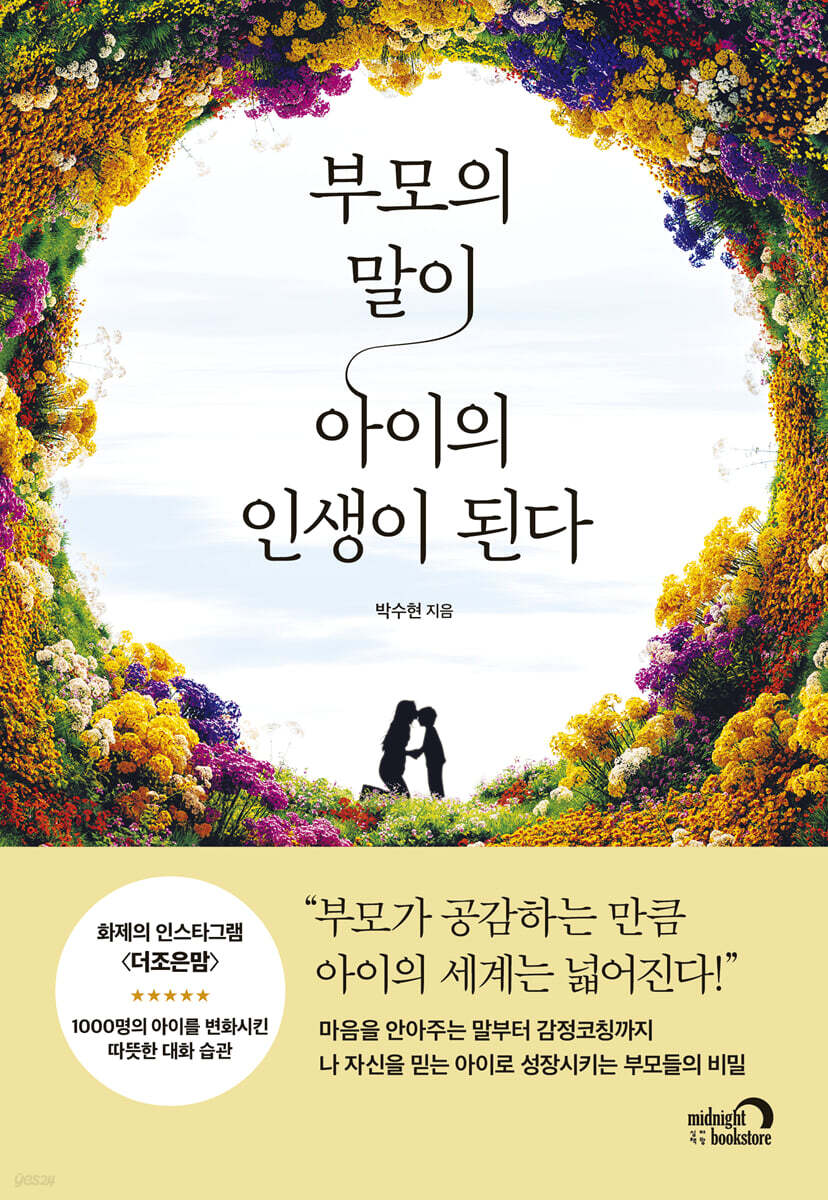
Parents' words shape their children's lives.
 |
Description
Book Introduction
“The more empathy parents have, the wider the child’s world becomes!”
The Warm Conversation Habit That Changed 1,000 Children
From words that comfort the heart to emotional coaching
The Secrets of Parents Who Raise Children Who Believe in Themselves
This book contains 'communication methods between parents and children' discovered through meeting tens of thousands of parents and observing children's minds for 10 years.
This book, which contains the message that 'the most important thing in parenting is the relationship between parents and children, and that relationship begins with the parents' words,' knocks on the door of the child's heart, empathizes with them, and suggests ways to create a relationship where parents and children trust and respect each other.
There are parents who guide their children gently and warmly without yelling or getting angry at them.
The author, who says that “empathy is an attitude of trying to understand the other person’s feelings and a heart that thinks, ‘You could do that,’ even if you don’t understand it with your head,” explains the amazing ‘power of empathy’ based on various verified theories and real-life examples that any parent can relate to.
It not only points out habits that can unintentionally hurt children in daily life, but also covers conversation methods that encourage and guide children, what children who have done wrong need more than discipline, how to raise children who can manage their emotions well, and even commonalities among parents who have raised children with high self-esteem, helping to completely break down the invisible wall between parents and children.
What words can help nurture a child's potential and possibilities? What does it mean to believe in a child? How can we quickly establish good habits in our children? If I find myself frequently getting angry at my child without realizing it, what should I do to change it? How can I give my child advice rather than nagging? This is the only book that provides clear answers to these questions.
This is a must-read for parents who are concerned about their child's mind-reading and emotional connection beyond superficial conversational skills.
The Warm Conversation Habit That Changed 1,000 Children
From words that comfort the heart to emotional coaching
The Secrets of Parents Who Raise Children Who Believe in Themselves
This book contains 'communication methods between parents and children' discovered through meeting tens of thousands of parents and observing children's minds for 10 years.
This book, which contains the message that 'the most important thing in parenting is the relationship between parents and children, and that relationship begins with the parents' words,' knocks on the door of the child's heart, empathizes with them, and suggests ways to create a relationship where parents and children trust and respect each other.
There are parents who guide their children gently and warmly without yelling or getting angry at them.
The author, who says that “empathy is an attitude of trying to understand the other person’s feelings and a heart that thinks, ‘You could do that,’ even if you don’t understand it with your head,” explains the amazing ‘power of empathy’ based on various verified theories and real-life examples that any parent can relate to.
It not only points out habits that can unintentionally hurt children in daily life, but also covers conversation methods that encourage and guide children, what children who have done wrong need more than discipline, how to raise children who can manage their emotions well, and even commonalities among parents who have raised children with high self-esteem, helping to completely break down the invisible wall between parents and children.
What words can help nurture a child's potential and possibilities? What does it mean to believe in a child? How can we quickly establish good habits in our children? If I find myself frequently getting angry at my child without realizing it, what should I do to change it? How can I give my child advice rather than nagging? This is the only book that provides clear answers to these questions.
This is a must-read for parents who are concerned about their child's mind-reading and emotional connection beyond superficial conversational skills.
- You can preview some of the book's contents.
Preview
index
Prologue: The Easiest Way to Pass Wisdom on to Children
Chapter 1: If Parental Love Doesn't Become a Weight
01 Focus on growth, not limitations.
02 If you want to be a good role model for your child
03 Trusting Your Child
04 Dress your child in good manners, not good clothes.
05 How should I start self-directed learning?
06 How to quickly establish good habits
07 Questions to ask when you're curious about your child's day
08 Parenting Styles by Parent Type
09 Practice falling
Chapter 2: Habits that Unknowingly Hurt Children
01 Courage to match my child's pace
02 Conversation methods that make children happy vs. conversation methods that make children unhappy
03 Respect your child's emotional boundaries.
04 If you keep getting angry at your child without realizing it
05 Practice speaking without falling into the trap of thinking
06 The wrong way to deal with negative emotions ruins children.
07 Add a spoonful of emotion
08 The right parenting style for my child is the right answer.
09 Don't feel sorry for your child.
Chapter 3: Conversational Methods to Encourage and Guide Children
01 Acknowledge your child's feelings
02 There is a reason for a child's behavior.
03 Common traits of parents who raised children with high self-esteem
04 A 3-step conversation method that develops thinking skills
05 Turn gratitude into seeds of happiness
06 I am a person worthy of respect.
07 Praise that is good for you and praise that is bad for you
08 How to get your child to follow the rules without getting angry
09 Empathy comes before suggestions
10 When a child asks why he or she should study
Chapter 4: What's More Needed Than Discipline When a Child Misbehaves
01 How do you want your child to live when he or she grows up?
02 Problem behavior is a sign that help is needed.
03 How to raise a child who can control his emotions well
04 The Difference Between Nagging and Advice
05 There are no right answers to parenting, but there are wrong answers.
06 Things More Important Than Grades in Studying
07 Principles to follow when developing study habits
08 How can I change a child who swears?
09 The Real Reason Why Your Child Constantly Calls for Mom
Chapter 1: If Parental Love Doesn't Become a Weight
01 Focus on growth, not limitations.
02 If you want to be a good role model for your child
03 Trusting Your Child
04 Dress your child in good manners, not good clothes.
05 How should I start self-directed learning?
06 How to quickly establish good habits
07 Questions to ask when you're curious about your child's day
08 Parenting Styles by Parent Type
09 Practice falling
Chapter 2: Habits that Unknowingly Hurt Children
01 Courage to match my child's pace
02 Conversation methods that make children happy vs. conversation methods that make children unhappy
03 Respect your child's emotional boundaries.
04 If you keep getting angry at your child without realizing it
05 Practice speaking without falling into the trap of thinking
06 The wrong way to deal with negative emotions ruins children.
07 Add a spoonful of emotion
08 The right parenting style for my child is the right answer.
09 Don't feel sorry for your child.
Chapter 3: Conversational Methods to Encourage and Guide Children
01 Acknowledge your child's feelings
02 There is a reason for a child's behavior.
03 Common traits of parents who raised children with high self-esteem
04 A 3-step conversation method that develops thinking skills
05 Turn gratitude into seeds of happiness
06 I am a person worthy of respect.
07 Praise that is good for you and praise that is bad for you
08 How to get your child to follow the rules without getting angry
09 Empathy comes before suggestions
10 When a child asks why he or she should study
Chapter 4: What's More Needed Than Discipline When a Child Misbehaves
01 How do you want your child to live when he or she grows up?
02 Problem behavior is a sign that help is needed.
03 How to raise a child who can control his emotions well
04 The Difference Between Nagging and Advice
05 There are no right answers to parenting, but there are wrong answers.
06 Things More Important Than Grades in Studying
07 Principles to follow when developing study habits
08 How can I change a child who swears?
09 The Real Reason Why Your Child Constantly Calls for Mom
Detailed image

Into the book
It is important to understand the difference between 'authoritative' and 'authoritative.'
'Having authority' means that children recognize and respect their parents' authority, while 'being authoritative' means that parents impose their authority.
Authority is created naturally when parents educate their children.
When children accept and follow their parents' teachings, their words gain authority.
The rules and limits set by parents at this time become the guidelines and safety fences needed for children to grow.
---「Chapter 1 08.
From “Parenting Styles by Parent Type”
Parents need to respect their children's individuality in various situations.
Because understanding and accepting each other's personalities, tastes, and experiences is the key to a healthy parent-child relationship.
Just because a child's brain is immature and they can't think like an adult, doesn't mean their emotions are immature.
A parent's attitude of respecting a child's boundaries makes the child feel valued and understood by the parent.
Help your child develop positive values, such as healthy self-esteem, autonomy, and self-determination, that will benefit them throughout their lives.
---「Chapter 2 03.
From “Respect your child’s emotional boundaries”
If your child is caught up in an emotion, name it, acknowledge it, and empathize with it to help them navigate it and then come out of it.
Knowledge can be taught through words and writing, but the art of managing emotions can only be taught by empathizing and sharing the moment.
When I empathize with my child's emotions, I feel like we're in a capsule just for the two of us.
It's the warmest, most cozy, and safest capsule in the world.
Seeing my child enjoy sharing his feelings with me, I think he feels the same way I do.
Please let them know that even difficult and painful emotions can be lightened by calling them by their names.
The experience of facing emotions with your mother will enable your child to manage his or her emotions on his or her own later on.
---「Chapter 4 03.
From "How to Raise a Child Who Can Manage Their Emotions Well"
Even when children are suffering from extreme guilt, when they cry silently because of worries they can't tell anyone, when they feel as if the world is falling apart, we must make them believe that "My parents love me no matter what."
Children with this belief, even if they go through a difficult adolescence, return to their parents at the last moment.
'Having authority' means that children recognize and respect their parents' authority, while 'being authoritative' means that parents impose their authority.
Authority is created naturally when parents educate their children.
When children accept and follow their parents' teachings, their words gain authority.
The rules and limits set by parents at this time become the guidelines and safety fences needed for children to grow.
---「Chapter 1 08.
From “Parenting Styles by Parent Type”
Parents need to respect their children's individuality in various situations.
Because understanding and accepting each other's personalities, tastes, and experiences is the key to a healthy parent-child relationship.
Just because a child's brain is immature and they can't think like an adult, doesn't mean their emotions are immature.
A parent's attitude of respecting a child's boundaries makes the child feel valued and understood by the parent.
Help your child develop positive values, such as healthy self-esteem, autonomy, and self-determination, that will benefit them throughout their lives.
---「Chapter 2 03.
From “Respect your child’s emotional boundaries”
If your child is caught up in an emotion, name it, acknowledge it, and empathize with it to help them navigate it and then come out of it.
Knowledge can be taught through words and writing, but the art of managing emotions can only be taught by empathizing and sharing the moment.
When I empathize with my child's emotions, I feel like we're in a capsule just for the two of us.
It's the warmest, most cozy, and safest capsule in the world.
Seeing my child enjoy sharing his feelings with me, I think he feels the same way I do.
Please let them know that even difficult and painful emotions can be lightened by calling them by their names.
The experience of facing emotions with your mother will enable your child to manage his or her emotions on his or her own later on.
---「Chapter 4 03.
From "How to Raise a Child Who Can Manage Their Emotions Well"
Even when children are suffering from extreme guilt, when they cry silently because of worries they can't tell anyone, when they feel as if the world is falling apart, we must make them believe that "My parents love me no matter what."
Children with this belief, even if they go through a difficult adolescence, return to their parents at the last moment.
---「Chapter 4 08.
From "How to Change a Child Who Swears"
From "How to Change a Child Who Swears"
Publisher's Review
“A child with strong roots cannot be shaken!”
What I discovered while observing children's minds for 10 years
The power of words to heal, grow, and give courage to move forward.
These days, a new word has emerged, following 'helicopter parents': 'lawnmower parents'.
If helicopter parents are the ones who hover over their children and immediately land to solve problems when they arise, lawnmower parents are the ones who clean up any problems that may arise for their children.
Just as a child cannot develop antibodies without vaccination, a child who does not experience failure and hardship loses the opportunity to develop resilience.
What parents should do is not to follow their children around and act as problem solvers whenever problems arise, but to express 'empathy, reassurance, and encouragement' so that children can confidently move forward into the world without easily cowering.
Parents' words are engraved in the child's subconscious and influence him or her throughout life.
When you hear a lot of positive words, you start to think, 'I'll make it eventually.'
On the other hand, if you hear a lot of negative words from your parents, even as an adult, whenever things don't go well, you may think, 'If I did that, it would be like that.'
I start to think, 'It can't go well.'
This is why we must carefully choose the words we tell our children.
In this book, the author clearly explains 37 warm conversation habits that parents use to positively change their children.
If you've ever wondered why your child lacks confidence, why they can't get along with friends, why they get irritated and angry so often, why they're sensitive and neurotic, why they're listless and depressed, why they lack self-expression and coping skills, and so on, this book will help you reflect on what you've been saying to your child and help you learn how to communicate with them in the future.
It will not only help you restore your relationship with your child, but also help you realize the infinite potential your child possesses.
The more difficult parenting becomes, the more you need to focus on communicating with your child.
All answers lie in communication with your child.
“Empathy comes before suggestions!”
The easiest way to impart wisdom to children
When a child expresses negative emotions such as being anxious, sad, depressed, or angry, parents often express their worries as anger or point out the child's mistakes and suggest solutions in order to quickly resolve the situation.
The author describes this situation as 'a fire in the child's heart'.
When a fire breaks out, the first step is to put out the fire, then identify the cause and prevent recurrence.
Likewise, when your heart is on fire, the first thing to do is to put out the fire.
Imagine your house is on fire, and the firefighters aren't even trying to put out the fire, they're just explaining the causes and prevention of fire.
Some people will stamp their feet in frustration, while others will scream and get angry.
This is how a child feels when he or she is treated by a parent who gives advice without extinguishing the fire in the child's heart.
It's not that the child is rebellious and doesn't accept the parent's advice and gets angry, it's that he or she lacks the mental capacity.
Empathy is not about spoiling your child.
Empathy is the best way to quench the fire in the heart, calm the swirling winds, and allow parental advice to reach the child.
This book is full of the author's know-how and emotional coaching methods, such as 'How to focus on a child's growth rather than their limitations', '3-step conversation method to develop thinking skills', and 'Praise that is medicine and praise that is poison', based on how to empathize with a child.
Of particular note is the powerful message that 'the wrong way to deal with negative emotions will ruin your child.'
Explaining the important role of negative emotions, it systematically introduces how to accept and manage children's emotions in a healthy way, rather than suppressing or ignoring them.
Children who have grown up with their parents understanding their emotions from a young age will ask their parents for help without hesitation when they encounter a problem, even in middle and high school.
This experience makes the child feel that his or her parents are unconditionally on his or her side and that they love him or her.
How have you been connecting emotionally with your child so far? If you're feeling dissatisfied with your communication style, or if you're struggling with a perceived problem, let's start anew today.
This book will be the best gift not only for your child's tomorrow, but also for the future 10 years from now, 20 years from now.
What I discovered while observing children's minds for 10 years
The power of words to heal, grow, and give courage to move forward.
These days, a new word has emerged, following 'helicopter parents': 'lawnmower parents'.
If helicopter parents are the ones who hover over their children and immediately land to solve problems when they arise, lawnmower parents are the ones who clean up any problems that may arise for their children.
Just as a child cannot develop antibodies without vaccination, a child who does not experience failure and hardship loses the opportunity to develop resilience.
What parents should do is not to follow their children around and act as problem solvers whenever problems arise, but to express 'empathy, reassurance, and encouragement' so that children can confidently move forward into the world without easily cowering.
Parents' words are engraved in the child's subconscious and influence him or her throughout life.
When you hear a lot of positive words, you start to think, 'I'll make it eventually.'
On the other hand, if you hear a lot of negative words from your parents, even as an adult, whenever things don't go well, you may think, 'If I did that, it would be like that.'
I start to think, 'It can't go well.'
This is why we must carefully choose the words we tell our children.
In this book, the author clearly explains 37 warm conversation habits that parents use to positively change their children.
If you've ever wondered why your child lacks confidence, why they can't get along with friends, why they get irritated and angry so often, why they're sensitive and neurotic, why they're listless and depressed, why they lack self-expression and coping skills, and so on, this book will help you reflect on what you've been saying to your child and help you learn how to communicate with them in the future.
It will not only help you restore your relationship with your child, but also help you realize the infinite potential your child possesses.
The more difficult parenting becomes, the more you need to focus on communicating with your child.
All answers lie in communication with your child.
“Empathy comes before suggestions!”
The easiest way to impart wisdom to children
When a child expresses negative emotions such as being anxious, sad, depressed, or angry, parents often express their worries as anger or point out the child's mistakes and suggest solutions in order to quickly resolve the situation.
The author describes this situation as 'a fire in the child's heart'.
When a fire breaks out, the first step is to put out the fire, then identify the cause and prevent recurrence.
Likewise, when your heart is on fire, the first thing to do is to put out the fire.
Imagine your house is on fire, and the firefighters aren't even trying to put out the fire, they're just explaining the causes and prevention of fire.
Some people will stamp their feet in frustration, while others will scream and get angry.
This is how a child feels when he or she is treated by a parent who gives advice without extinguishing the fire in the child's heart.
It's not that the child is rebellious and doesn't accept the parent's advice and gets angry, it's that he or she lacks the mental capacity.
Empathy is not about spoiling your child.
Empathy is the best way to quench the fire in the heart, calm the swirling winds, and allow parental advice to reach the child.
This book is full of the author's know-how and emotional coaching methods, such as 'How to focus on a child's growth rather than their limitations', '3-step conversation method to develop thinking skills', and 'Praise that is medicine and praise that is poison', based on how to empathize with a child.
Of particular note is the powerful message that 'the wrong way to deal with negative emotions will ruin your child.'
Explaining the important role of negative emotions, it systematically introduces how to accept and manage children's emotions in a healthy way, rather than suppressing or ignoring them.
Children who have grown up with their parents understanding their emotions from a young age will ask their parents for help without hesitation when they encounter a problem, even in middle and high school.
This experience makes the child feel that his or her parents are unconditionally on his or her side and that they love him or her.
How have you been connecting emotionally with your child so far? If you're feeling dissatisfied with your communication style, or if you're struggling with a perceived problem, let's start anew today.
This book will be the best gift not only for your child's tomorrow, but also for the future 10 years from now, 20 years from now.
GOODS SPECIFICS
- Date of issue: May 27, 2024
- Page count, weight, size: 284 pages | 438g | 145*210*20mm
- ISBN13: 9791158733018
- ISBN10: 1158733011
You may also like
카테고리
korean


korean

![GQ KOREA Mark (Monthly): December [2025]](http://librairie.coreenne.fr/cdn/shop/files/8ef265dbbfbf186523ed75ba7319009d.jpg?v=1765340328&width=3840)


