

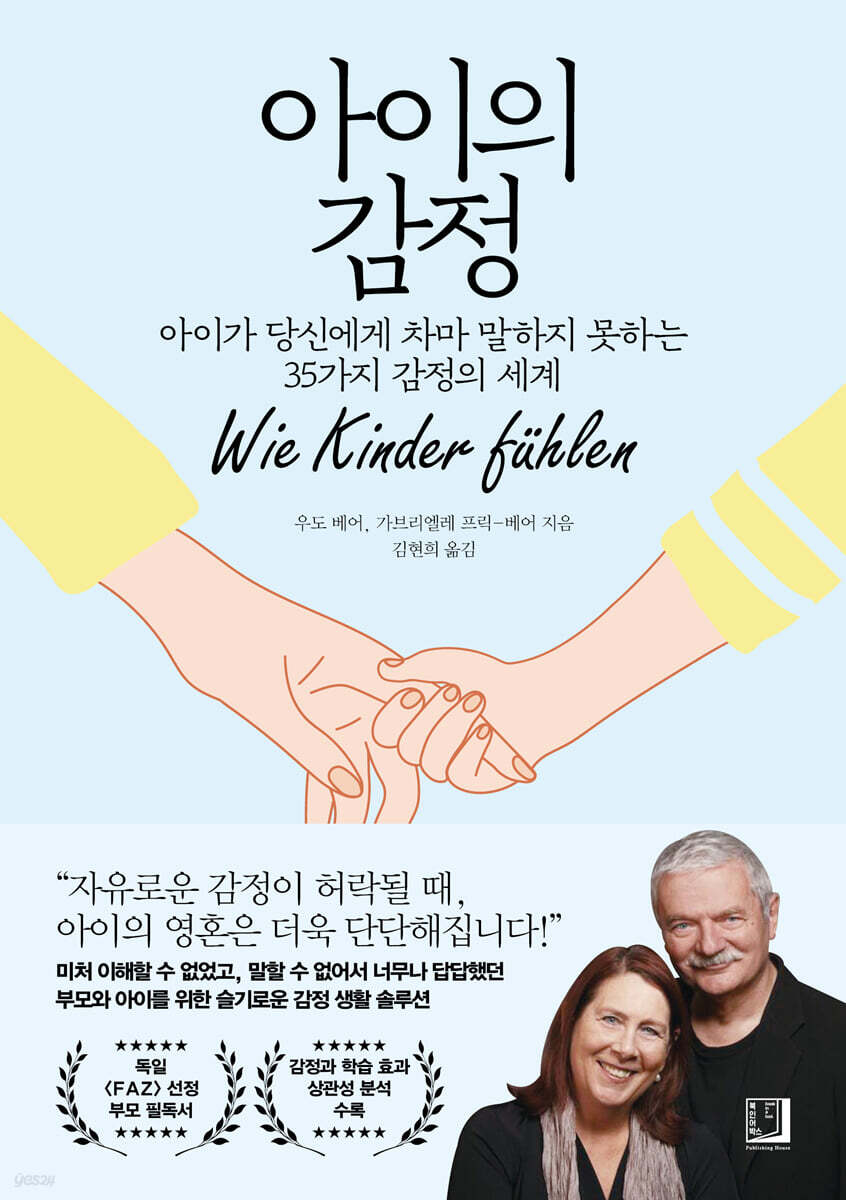
Child's emotions
 |
Description
Book Introduction
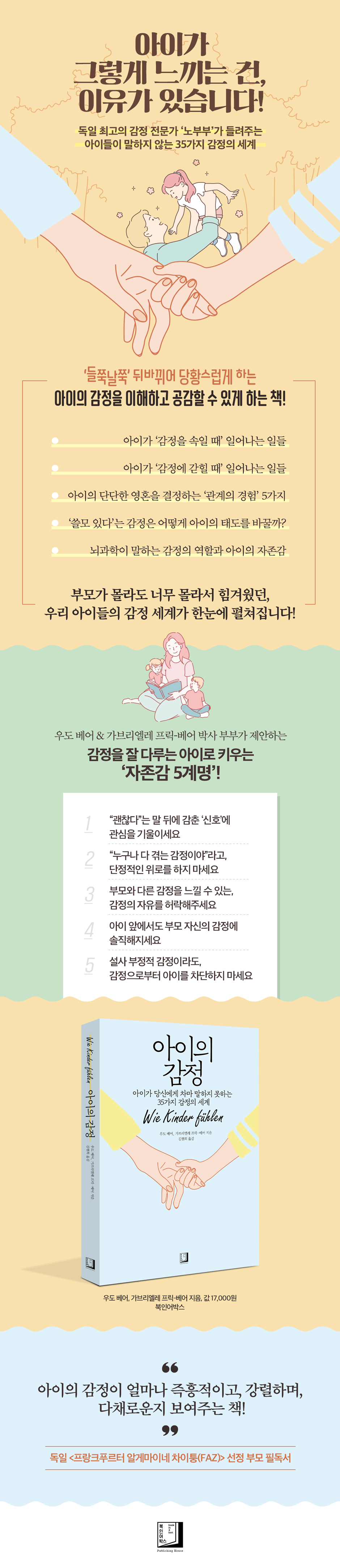
Adults' attempts to block out emotions only silence children.
When parents try to block out negative emotions, children increasingly hide and suppress their feelings.
And then they just suppress their feelings on their own.
When things don't go as planned, we blame ourselves, thinking that perhaps it's our own incompetence that prevents us from properly handling our emotions, and we come to realize that everything is our own "fault in existence."
Parents who can hide their own emotions naturally expect and demand that their children can do the same.
But this demand is very unreasonable.
- Udo Bear, Gabriele Frick-Beer
35 Emotions Your Child Doesn't 'Speak' About
This book, written by Dr. Udo Baer and Dr. Gabriele Brick-Baer, Germany's leading child and adolescent psychotherapists, based on their experience of counseling and treating various children and adolescents for over 40 years, meticulously organizes the world of 35 emotions that children never 'speak' to their parents and therefore do not show outwardly.
The book delicately depicts the 'emotional landscape' felt by children, showing how children feel, how their emotions differ from those of adults, and where their background originates.
This book provides an interesting explanation of how children can use their emotions as a major guide for their future lives, as well as the role parents play in helping children learn about emotions properly, through a wealth of examples from infants to adolescents.
When parents try to block out negative emotions, children increasingly hide and suppress their feelings.
And then they just suppress their feelings on their own.
When things don't go as planned, we blame ourselves, thinking that perhaps it's our own incompetence that prevents us from properly handling our emotions, and we come to realize that everything is our own "fault in existence."
Parents who can hide their own emotions naturally expect and demand that their children can do the same.
But this demand is very unreasonable.
- Udo Bear, Gabriele Frick-Beer
35 Emotions Your Child Doesn't 'Speak' About
This book, written by Dr. Udo Baer and Dr. Gabriele Brick-Baer, Germany's leading child and adolescent psychotherapists, based on their experience of counseling and treating various children and adolescents for over 40 years, meticulously organizes the world of 35 emotions that children never 'speak' to their parents and therefore do not show outwardly.
The book delicately depicts the 'emotional landscape' felt by children, showing how children feel, how their emotions differ from those of adults, and where their background originates.
This book provides an interesting explanation of how children can use their emotions as a major guide for their future lives, as well as the role parents play in helping children learn about emotions properly, through a wealth of examples from infants to adolescents.
- You can preview some of the book's contents.
Preview
index
PROLOGUE: When a child feels an emotion, adults remember the problem.
Part I
Landscape of Emotions
How does the child feel?
Love, guilt and responsibility, sense of belonging and friendship, pride, sense of justice and fairness, boredom, sense of existence, betrayal, distrust and honor, disgust and disgust, pressure and sense of liberation, sadness, shame, embarrassment and shame, helplessness, anger, rage and rejection, complaint and hatred, panic and despair, surprise, admiration and astonishment, interest and curiosity, enthusiasm and passion, longing, joy and happiness, empathy and sensitivity, loneliness, fatigue, envy and jealousy, emptiness,
Self-efficacy · Sense of loss · Anxiety and fear · Sense of protection and safety · Concern and trust · Apathy · Sense of stability ·
Identity and self-esteem
Part II
Facing Your Child's Emotions
Neuroscience's View of Emotions | Feelings are recorded in the brain as emotions.
Study and Emotions | Feeling "Useful" Facilitates Learning
A Confrontation of the Senses | 'Relationship Experiences' Determine a Child's Joys and Sorrows
Seeing and showing, facing the gaze · Facing the voice, facing the sound · Grasping and being held, facing understanding · Pushing and pulling, facing pressure · Waiting, facing the will
The Mask of Emotions | What Happens When Kids "Fake Their Emotions"
Internalizing Emotions | What Happens When Children Get "Stuck in Their Emotions"
Adult Emotions | What Parents Can Learn from Their Children's Emotions
Appendix 1
5 Principles for Raising Emotionally Well-Managed Children
Appendix 2
Five Principles Parents Should Keep in Mind When Dealing with Their Children's Emotions
Part I
Landscape of Emotions
How does the child feel?
Love, guilt and responsibility, sense of belonging and friendship, pride, sense of justice and fairness, boredom, sense of existence, betrayal, distrust and honor, disgust and disgust, pressure and sense of liberation, sadness, shame, embarrassment and shame, helplessness, anger, rage and rejection, complaint and hatred, panic and despair, surprise, admiration and astonishment, interest and curiosity, enthusiasm and passion, longing, joy and happiness, empathy and sensitivity, loneliness, fatigue, envy and jealousy, emptiness,
Self-efficacy · Sense of loss · Anxiety and fear · Sense of protection and safety · Concern and trust · Apathy · Sense of stability ·
Identity and self-esteem
Part II
Facing Your Child's Emotions
Neuroscience's View of Emotions | Feelings are recorded in the brain as emotions.
Study and Emotions | Feeling "Useful" Facilitates Learning
A Confrontation of the Senses | 'Relationship Experiences' Determine a Child's Joys and Sorrows
Seeing and showing, facing the gaze · Facing the voice, facing the sound · Grasping and being held, facing understanding · Pushing and pulling, facing pressure · Waiting, facing the will
The Mask of Emotions | What Happens When Kids "Fake Their Emotions"
Internalizing Emotions | What Happens When Children Get "Stuck in Their Emotions"
Adult Emotions | What Parents Can Learn from Their Children's Emotions
Appendix 1
5 Principles for Raising Emotionally Well-Managed Children
Appendix 2
Five Principles Parents Should Keep in Mind When Dealing with Their Children's Emotions
Detailed image
Into the book
A child's selfless love is unconditional and can seem close to self-abandonment.
(At least at first) you fall into a deep trust, and it seems like you're blinded.
Fundamentally, a child is ready to identify with the loved one, to put himself in their shoes, to understand, to accept, and to forgive.
(Although they are somewhat more prone to mistakes) children are capable of sensing the expectations of their loved ones and are fully prepared to meet those expectations.
--- From "Love"
A child's sense of belonging has distinct characteristics.
The thing is, belonging is rarely a concrete emotion.
It's usually a feeling of comfort and happiness.
But belonging reveals its presence when it is threatened or about to disappear.
When we are kicked out, abandoned, or betrayed, when we are continually ignored or our efforts go unanswered, our sense of belonging is shattered or lost.
A child's sense of belonging is also threatened when he or she is different from others in the peer group—smarter or perhaps more talented, more sensitive or slower, or more easily excited than others.
--- From "A Sense of Belonging"
The word boredom can hide other complex emotions.
Boredom is sometimes a specific, identifiable emotion, and often one that shifts between understanding and other interests.
But most people can understand boredom as a feeling.
Moods are more vague, more difficult to grasp, and more pervasive than emotions.
--- From "Boredom"
Parents often overlook the significance of this sense of betrayal felt by their children.
Sometimes we try to comfort our children by saying things like, “It’s not a big deal” or “It’s not that serious” and try to downplay the seriousness of the situation.
But these attempts, far from helping, actually make the situation worse.
In other words, it further strengthens the feeling of being betrayed and makes you feel alone.
As a result, it can seriously impair your attitude toward forming relationships with other people.
People who feel betrayed or are left alone for long periods of time tend to distrust others.
--- From "Betrayal"
What's particularly complex and perverse about shame is that at first it feels like a natural feeling of shame (embarrassment).
It is difficult for the parties to separate or distinguish these two from each other.
When explaining this difference to children, it's helpful to use language and examples they can understand.
Natural shame and embarrassment, which at first felt the same, can at some point produce very different results.
Shame usually leaves a bad aftertaste and is unpleasant.
When shame is repeated or widespread, it shakes the very foundation of the child.
--- From "Shame"
The various signs, so-called disorders seen in the child's life and behavior are indicators of the helplessness and difficulties experienced by the child.
It is also a cry for help.
Even though children can no longer express themselves verbally, as adults we must listen carefully to these cries for help and offer a helping hand.
--- From "Helplessness"
Although longing is irrational like other emotions in terms of logic, it is consistent and meaningful.
The longing a child feels cannot be logically evaluated or explained in words, nor should it be done so.
Rather, it is much more effective to take the child's longing seriously, find out what triggered the longing, and what power and desire are hidden in that longing.
--- From "Longing"
Self-efficacy is the feeling that you can make something happen because of yourself.
It's the feeling of being able to reach someone and change something.
Most people have this feeling and believe that they can definitely make an impact.
However, when these feelings disappear, it has a profound impact on our self-awareness and sense of self-worth.
“I am worthless.
“I can’t do anything”, “I’m incompetent.
“I can’t do anything.” When a child loses a sense of self-efficacy, this not only worsens the child’s sense of self-worth, but also deeply imprints on his or her self-awareness.
--- From "Self-Efficacy"
Fear is an emotion that alerts us to the uncertain and potentially threatening, and mobilizes every organ in our body to function properly, so it's only natural for children to feel anxious.
So if the child is not anxious or scared, this is actually more anxiety-inducing and scary.
A child who has nothing left to fear and nothing left to lose is a child who has lost the ability to feel fear and dread.
This attitude in a child is the continual result of the neglect, contempt, and devaluation that the child has experienced throughout his or her life.
--- From "Fear"
Unfortunately, the emotions that children associate with learning are fear of being punished, fear of failing, and fear of getting scolded for doing poorly.
As we have already described about the brain's workings and emotions, all the information received by each nerve cell is connected to emotions and is carried out under the involvement of the limbic system.
It is already an indisputable fact that learning is linked to emotions.
In that respect, what parents are most curious about is what emotions are involved in learning, that is, how emotions can promote learning.
--- From "The feeling of 'usefulness' promotes learning"
That's why the quality of your gaze is so important.
A look can convey both disregard and respect, or it can convey both shame and seriousness.
Sometimes, without words, gestures, or facial expressions, just a look can have the power to punish a child and silence them emotionally.
Conversely, it can also give your child courage and vitality in life.
(At least at first) you fall into a deep trust, and it seems like you're blinded.
Fundamentally, a child is ready to identify with the loved one, to put himself in their shoes, to understand, to accept, and to forgive.
(Although they are somewhat more prone to mistakes) children are capable of sensing the expectations of their loved ones and are fully prepared to meet those expectations.
--- From "Love"
A child's sense of belonging has distinct characteristics.
The thing is, belonging is rarely a concrete emotion.
It's usually a feeling of comfort and happiness.
But belonging reveals its presence when it is threatened or about to disappear.
When we are kicked out, abandoned, or betrayed, when we are continually ignored or our efforts go unanswered, our sense of belonging is shattered or lost.
A child's sense of belonging is also threatened when he or she is different from others in the peer group—smarter or perhaps more talented, more sensitive or slower, or more easily excited than others.
--- From "A Sense of Belonging"
The word boredom can hide other complex emotions.
Boredom is sometimes a specific, identifiable emotion, and often one that shifts between understanding and other interests.
But most people can understand boredom as a feeling.
Moods are more vague, more difficult to grasp, and more pervasive than emotions.
--- From "Boredom"
Parents often overlook the significance of this sense of betrayal felt by their children.
Sometimes we try to comfort our children by saying things like, “It’s not a big deal” or “It’s not that serious” and try to downplay the seriousness of the situation.
But these attempts, far from helping, actually make the situation worse.
In other words, it further strengthens the feeling of being betrayed and makes you feel alone.
As a result, it can seriously impair your attitude toward forming relationships with other people.
People who feel betrayed or are left alone for long periods of time tend to distrust others.
--- From "Betrayal"
What's particularly complex and perverse about shame is that at first it feels like a natural feeling of shame (embarrassment).
It is difficult for the parties to separate or distinguish these two from each other.
When explaining this difference to children, it's helpful to use language and examples they can understand.
Natural shame and embarrassment, which at first felt the same, can at some point produce very different results.
Shame usually leaves a bad aftertaste and is unpleasant.
When shame is repeated or widespread, it shakes the very foundation of the child.
--- From "Shame"
The various signs, so-called disorders seen in the child's life and behavior are indicators of the helplessness and difficulties experienced by the child.
It is also a cry for help.
Even though children can no longer express themselves verbally, as adults we must listen carefully to these cries for help and offer a helping hand.
--- From "Helplessness"
Although longing is irrational like other emotions in terms of logic, it is consistent and meaningful.
The longing a child feels cannot be logically evaluated or explained in words, nor should it be done so.
Rather, it is much more effective to take the child's longing seriously, find out what triggered the longing, and what power and desire are hidden in that longing.
--- From "Longing"
Self-efficacy is the feeling that you can make something happen because of yourself.
It's the feeling of being able to reach someone and change something.
Most people have this feeling and believe that they can definitely make an impact.
However, when these feelings disappear, it has a profound impact on our self-awareness and sense of self-worth.
“I am worthless.
“I can’t do anything”, “I’m incompetent.
“I can’t do anything.” When a child loses a sense of self-efficacy, this not only worsens the child’s sense of self-worth, but also deeply imprints on his or her self-awareness.
--- From "Self-Efficacy"
Fear is an emotion that alerts us to the uncertain and potentially threatening, and mobilizes every organ in our body to function properly, so it's only natural for children to feel anxious.
So if the child is not anxious or scared, this is actually more anxiety-inducing and scary.
A child who has nothing left to fear and nothing left to lose is a child who has lost the ability to feel fear and dread.
This attitude in a child is the continual result of the neglect, contempt, and devaluation that the child has experienced throughout his or her life.
--- From "Fear"
Unfortunately, the emotions that children associate with learning are fear of being punished, fear of failing, and fear of getting scolded for doing poorly.
As we have already described about the brain's workings and emotions, all the information received by each nerve cell is connected to emotions and is carried out under the involvement of the limbic system.
It is already an indisputable fact that learning is linked to emotions.
In that respect, what parents are most curious about is what emotions are involved in learning, that is, how emotions can promote learning.
--- From "The feeling of 'usefulness' promotes learning"
That's why the quality of your gaze is so important.
A look can convey both disregard and respect, or it can convey both shame and seriousness.
Sometimes, without words, gestures, or facial expressions, just a look can have the power to punish a child and silence them emotionally.
Conversely, it can also give your child courage and vitality in life.
--- From “‘Relationship Experience’ Determines a Child’s Joys and Sorrows”
Publisher's Review
Characteristics of "Children's Emotions"
1.
This book is largely divided into two parts.
Part 1 contains a dictionary-style list of 35 emotions that have the greatest impact on children's emotional world, and Part 2 introduces the latest brain science research and background materials related to children's emotions.
Part 1 is organized like a dictionary, so you don't have to read every entry in order from beginning to end.
I encourage you to find something that interests you and read it, and then explore other emotions associated with it.
However, if you are a first-time reader, I recommend reading it from beginning to end because of the interconnected nature of the emotions.
Part 2 can be of great help in understanding the 'complex emotions' that children subtly display.
For example, 'love and hate' is a complex emotion that is a mixture of 'love' and 'hate'.
These complex emotions are intertwined, leading to tantrums or rebellion against parents.
Also, children's unrealizable 'longing' is sometimes exchanged for 'fear' and 'despair', and articles about such complex emotions are useful for examining the various aspects of children's emotions.
2.
Appendix 1 and 2, titled '5 Principles for Raising Children Who Handle Their Emotions Well' and '5 Principles for Parents to Consider When Dealing with Their Children's Emotions', are articles that were included as general text in the author's original book, not as appendices.
However, in addition to the fact that it is a summary of previously published content, it was placed as a separate appendix in consideration of readability as it was judged to be the core message of this book.
Even after reading it once, I recommend that you read it again whenever you have time.
3.
The main value of this book is that it provides an opportunity to rethink children's everyday emotions.
Children's emotions are very special compared to adults' emotions.
Although they may seem similar at first glance, it is important to note that in addition to the fact that children are still growing and learning about emotions, the "emotional environment" they find themselves in is very different from that of adults.
Adults can change jobs or even break up with their spouses, but children must remember that they cannot change their own circumstances.
Therefore, if we only focus on the child's unusually occurring 'problem behaviors', it can only be an afterthought.
A child's emotions may be being hurt and damaged by parents, teachers, and friends, even at this very moment, as if nothing had happened.
What is needed now is daily attention to children's emotions and consistent support.
The importance of "children's emotions"
Parents wonder what emotions their children need to succeed.
In such an atmosphere, emotions such as ‘self-efficacy’ and ‘self-esteem’ began to gain attention.
But are these emotions innate, or are they acquired later in life? According to neuroscience, the question remains ambivalent.
However, the authors point out that even when genetic traits of emotion are taken into account, children's emotions are more influenced by their relational experiences, particularly those with their parents.
“Self-esteem is experienced as dignity and respect in relationships with others rather than as something that arises ‘from the child himself’ rather than from innate genetic factors.”
For example, parents, the closest relationship in the world, are the 'emotional passage' and 'emotional role model' through which children can learn emotions.
What does it look like for parents to be good "emotional role models"? The authors advise, "As flawed beings, parents must have the courage to be 'emotional role models.'"
The example we are talking about here does not mean that it has to be 'monumental' or 'exemplary'.
No parent, driven by their busy lives, can be perfect without flaws.
As a being with flaws, shortcomings, and emotional flaws, she is a model of how to express and share emotions naturally.
For example, children learn to feel and express emotions by observing their parents' fights and reconciliation processes.
It is about learning to accept positive emotions such as joy, love, passion, and pride, as well as negative emotions such as sadness, anger, helplessness, and depression, as part of life, and to feel and express them naturally.
You learn the principle of life that emotions fluctuate, and that current emotions either disappear naturally over time or suddenly resurface again.
In short, a child with a strong soul and high self-esteem and self-efficacy is not a child who is biased towards a particular emotion, but a child who grows up in an environment where emotions are freely allowed.
“Emotions drive action, help us evaluate the world, and determine our course of action.” Even without delving into brain science, the role of emotions in life is becoming increasingly important over time.
Emotions are the impulses that enable us to put what we perceive into action, especially the driving force behind spontaneous and direct action.
'Fear' makes you jump back in surprise and run away from danger, 'longing and yearning' makes you open your eyes wide and stretch your arms far away, and 'anger' makes you raise your voice, clench your fists, and get ready for battle.
'Disgust' makes us spit out things that are not good for our bodies, while 'love', on the other hand, attracts and makes us feel close.
In this way, emotions influence our behavior, especially our impulsive actions.
People cannot calculate the safety factor of a bridge based on emotions alone, but the 'longing' to move to the other side of the bridge and the 'fear' of the water rushing in create a passion for building a bridge.
When parents act as emotional role models, respecting their children's open emotions and empathizing with their children's feelings of shame, guilt, and love, children learn to use these emotions as crucial guides for navigating life.
1.
This book is largely divided into two parts.
Part 1 contains a dictionary-style list of 35 emotions that have the greatest impact on children's emotional world, and Part 2 introduces the latest brain science research and background materials related to children's emotions.
Part 1 is organized like a dictionary, so you don't have to read every entry in order from beginning to end.
I encourage you to find something that interests you and read it, and then explore other emotions associated with it.
However, if you are a first-time reader, I recommend reading it from beginning to end because of the interconnected nature of the emotions.
Part 2 can be of great help in understanding the 'complex emotions' that children subtly display.
For example, 'love and hate' is a complex emotion that is a mixture of 'love' and 'hate'.
These complex emotions are intertwined, leading to tantrums or rebellion against parents.
Also, children's unrealizable 'longing' is sometimes exchanged for 'fear' and 'despair', and articles about such complex emotions are useful for examining the various aspects of children's emotions.
2.
Appendix 1 and 2, titled '5 Principles for Raising Children Who Handle Their Emotions Well' and '5 Principles for Parents to Consider When Dealing with Their Children's Emotions', are articles that were included as general text in the author's original book, not as appendices.
However, in addition to the fact that it is a summary of previously published content, it was placed as a separate appendix in consideration of readability as it was judged to be the core message of this book.
Even after reading it once, I recommend that you read it again whenever you have time.
3.
The main value of this book is that it provides an opportunity to rethink children's everyday emotions.
Children's emotions are very special compared to adults' emotions.
Although they may seem similar at first glance, it is important to note that in addition to the fact that children are still growing and learning about emotions, the "emotional environment" they find themselves in is very different from that of adults.
Adults can change jobs or even break up with their spouses, but children must remember that they cannot change their own circumstances.
Therefore, if we only focus on the child's unusually occurring 'problem behaviors', it can only be an afterthought.
A child's emotions may be being hurt and damaged by parents, teachers, and friends, even at this very moment, as if nothing had happened.
What is needed now is daily attention to children's emotions and consistent support.
The importance of "children's emotions"
Parents wonder what emotions their children need to succeed.
In such an atmosphere, emotions such as ‘self-efficacy’ and ‘self-esteem’ began to gain attention.
But are these emotions innate, or are they acquired later in life? According to neuroscience, the question remains ambivalent.
However, the authors point out that even when genetic traits of emotion are taken into account, children's emotions are more influenced by their relational experiences, particularly those with their parents.
“Self-esteem is experienced as dignity and respect in relationships with others rather than as something that arises ‘from the child himself’ rather than from innate genetic factors.”
For example, parents, the closest relationship in the world, are the 'emotional passage' and 'emotional role model' through which children can learn emotions.
What does it look like for parents to be good "emotional role models"? The authors advise, "As flawed beings, parents must have the courage to be 'emotional role models.'"
The example we are talking about here does not mean that it has to be 'monumental' or 'exemplary'.
No parent, driven by their busy lives, can be perfect without flaws.
As a being with flaws, shortcomings, and emotional flaws, she is a model of how to express and share emotions naturally.
For example, children learn to feel and express emotions by observing their parents' fights and reconciliation processes.
It is about learning to accept positive emotions such as joy, love, passion, and pride, as well as negative emotions such as sadness, anger, helplessness, and depression, as part of life, and to feel and express them naturally.
You learn the principle of life that emotions fluctuate, and that current emotions either disappear naturally over time or suddenly resurface again.
In short, a child with a strong soul and high self-esteem and self-efficacy is not a child who is biased towards a particular emotion, but a child who grows up in an environment where emotions are freely allowed.
“Emotions drive action, help us evaluate the world, and determine our course of action.” Even without delving into brain science, the role of emotions in life is becoming increasingly important over time.
Emotions are the impulses that enable us to put what we perceive into action, especially the driving force behind spontaneous and direct action.
'Fear' makes you jump back in surprise and run away from danger, 'longing and yearning' makes you open your eyes wide and stretch your arms far away, and 'anger' makes you raise your voice, clench your fists, and get ready for battle.
'Disgust' makes us spit out things that are not good for our bodies, while 'love', on the other hand, attracts and makes us feel close.
In this way, emotions influence our behavior, especially our impulsive actions.
People cannot calculate the safety factor of a bridge based on emotions alone, but the 'longing' to move to the other side of the bridge and the 'fear' of the water rushing in create a passion for building a bridge.
When parents act as emotional role models, respecting their children's open emotions and empathizing with their children's feelings of shame, guilt, and love, children learn to use these emotions as crucial guides for navigating life.
GOODS SPECIFICS
- Publication date: November 24, 2023
- Page count, weight, size: 284 pages | 480g | 148*210*18mm
- ISBN13: 9791197617096
- ISBN10: 1197617094
You may also like
카테고리
korean


korean

![GQ KOREA Mark (Monthly): December [2025]](http://librairie.coreenne.fr/cdn/shop/files/8ef265dbbfbf186523ed75ba7319009d.jpg?v=1765340328&width=3840)


