

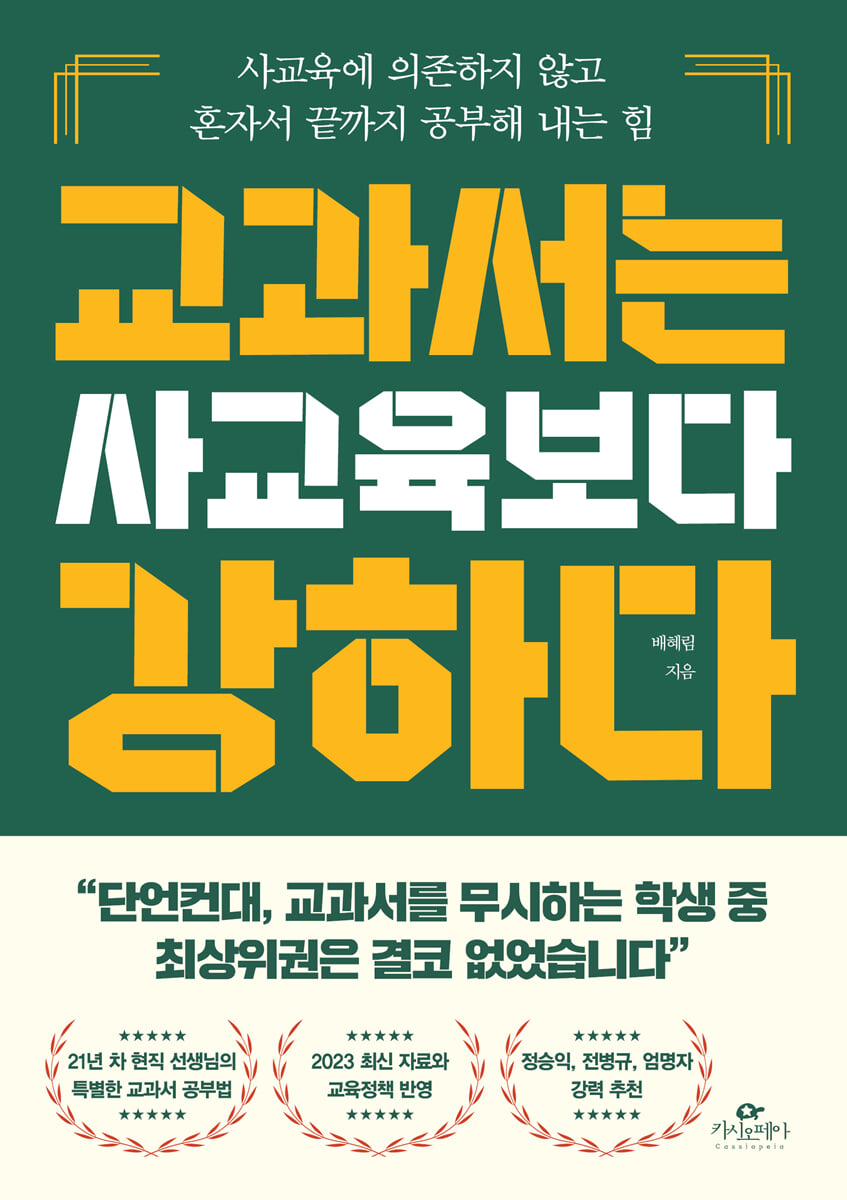
Textbooks are stronger than private education.
 |
Description
Book Introduction
★A special textbook study method from a 21-year veteran teacher.
★2023 Reflects the latest data and educational policies
★Highly recommended by Jeong Seung-ik, Jeon Byeong-gyu, and Eom Myeong-ja
“A child who studies textbooks will never fall.”
The secret of top-tier students who study without wavering
Children and parents under the Korean college entrance exam system spend astronomical amounts of money and time on the entrance exam race, from elementary school through college.
However, children who can easily solve problems several grades ahead of their peers through prior study and are at an advanced level in free English speaking raise their hands and urgently look for the teacher when they receive a test.
“Teacher, what does this word mean?” “I don’t understand the question.” Even children who played around the school in elementary school see their grades drop and lose interest in studying when they advance to middle and high school, so they give up on studying.
Why does this happen? This book begins with that very question.
After observing children for 21 years, the author has come to the realization that the answer lies in none other than the power to accurately understand a single textbook.
In the long 12-year entrance exam race from elementary to high school, the key to a child's ability to study without getting tired and to achieve top grades lies in 'textbook study.'
"Textbooks are Stronger Than Private Education" is a children's education book that contains all the study strategies for 12 years of elementary, middle, and high school textbooks, written by a current teacher based on his extensive experience and know-how.
Reflecting the latest data and educational policies for 2023, this book contains the essentials of schoolwork that all Korean parents must know, as revealed only by public education experts working in the field, and how to utilize textbooks 200% to ensure grades are improved.
No matter how much money you spend on private tutoring and advanced learning, or how many workbooks you have your child solve and hundreds of books he or she reads, it's all useless if he or she doesn't understand the textbook.
The sustainable and practical textbook study strategies presented in this book will serve as a solid foundation to keep your child grounded throughout their 12 years of schooling.
★2023 Reflects the latest data and educational policies
★Highly recommended by Jeong Seung-ik, Jeon Byeong-gyu, and Eom Myeong-ja
“A child who studies textbooks will never fall.”
The secret of top-tier students who study without wavering
Children and parents under the Korean college entrance exam system spend astronomical amounts of money and time on the entrance exam race, from elementary school through college.
However, children who can easily solve problems several grades ahead of their peers through prior study and are at an advanced level in free English speaking raise their hands and urgently look for the teacher when they receive a test.
“Teacher, what does this word mean?” “I don’t understand the question.” Even children who played around the school in elementary school see their grades drop and lose interest in studying when they advance to middle and high school, so they give up on studying.
Why does this happen? This book begins with that very question.
After observing children for 21 years, the author has come to the realization that the answer lies in none other than the power to accurately understand a single textbook.
In the long 12-year entrance exam race from elementary to high school, the key to a child's ability to study without getting tired and to achieve top grades lies in 'textbook study.'
"Textbooks are Stronger Than Private Education" is a children's education book that contains all the study strategies for 12 years of elementary, middle, and high school textbooks, written by a current teacher based on his extensive experience and know-how.
Reflecting the latest data and educational policies for 2023, this book contains the essentials of schoolwork that all Korean parents must know, as revealed only by public education experts working in the field, and how to utilize textbooks 200% to ensure grades are improved.
No matter how much money you spend on private tutoring and advanced learning, or how many workbooks you have your child solve and hundreds of books he or she reads, it's all useless if he or she doesn't understand the textbook.
The sustainable and practical textbook study strategies presented in this book will serve as a solid foundation to keep your child grounded throughout their 12 years of schooling.
- You can preview some of the book's contents.
Preview
index
Recommendation
Preface: Why do good students study textbooks?
Part 1 ◆ If you understand the textbook properly, you will have no problem studying for 12 years.
Chapter 1 / Some Misconceptions About Studying
Some misconceptions about studying
For children with low literacy skills, the answer lies in studying textbooks.
- How to use textbooks to translate literacy into teaching skills
This is how top students study
- Curriculum skills determine test scores.
If you want to study well, start with the Korean textbook.
Chapter 2 / Textbooks: Where and How to Start Studying?
Understanding the Curriculum and Learning Objectives
Understanding the components of a textbook
Using textbook-related books
4 Ways to Improve Your Teaching Ability
Chapter 3: Drawing a Roadmap for 12 Years of Textbook Study in Elementary, Middle, and High School
How to study elementary school textbooks by subject
- Studying Korean textbooks
- Studying math textbooks
- Studying social studies and science textbooks
How to study textbooks for each grade level in elementary, middle, and high school
- Lower elementary school students: Developing interest
- Elementary and middle grades: Developing reading habits
- Upper elementary school: Raising sensitivity to subject matter
- Middle School: Building Vocabulary
- High School: Reading the Question Intent
Part 2 ◆ Elementary Textbook Study Skills: Building a Foundation for Teaching Skills
Chapter 4/ Elementary school children who do not understand textbook contents
Developing reading and writing habits that improve basic literacy skills
A child with poor academic skills encountered in elementary school classrooms
- A child with poor listening skills in a lower elementary school classroom
- A struggling reader in an upper elementary school classroom
How to study important concepts from textbooks
Chapter 5: Characteristics of each elementary school grade and learning points that enhance academic skills
Characteristics of the early elementary grades: A time of learning with the whole body
- Learning Point: Raising a Child Who Loves Books
Characteristics of Middle Elementary School: Establishing Social Skills and Beginning Group Activities
- Learning Point: Developing good handwriting habits
Characteristics of Upper Elementary School: Developing Logical Thinking and Reducing Academic Burden
- Learning Point: Establishing Lifestyle Habits First
Chapter 6: The Core of Elementary Education and a Parent's Guide
Developing a positive attitude
Establish a routine for efficient time management
Elementary education can be done 'by mom's plan'
Part 3 ◆ The Art of Studying Secondary School Textbooks: Translating Literacy into Subject Matter Skills
Chapter 7: The Secret to Maintaining Top Grades in Middle School
Why do children who are good at studying see their grades plummet in middle school?
You need to increase your vocabulary to see test questions in the textbook.
Children who are too accustomed to digital technology to read textbooks
Chapter 8 / Learning Points by Middle School Grade
7th Grade Middle School: Preparing for Free Semester
Second Year of Middle School: Preparing for Written Exams
3rd year of middle school: Preparing for high school entrance exams
Chapter 9: The Core of Middle School Education and a Parent's Guide
Expanding elementary school life habits into 'study habits'
Moving from Reading for Fun to Reading for Purpose
Eighth part of performance evaluation is writing
Part 4: Studying High School Textbooks: Perfect Preparation for Grades and the College Scholastic Ability Test: Mastering Your Curriculum
Chapter 10: Managing Your Grades Begins with Studying Your Textbooks
Do I have to focus on studying textbooks in high school?
Studying high school textbooks that are directly related to exams
Why Kids Who Get Good Grades Also Do Well on the CSAT
Chapter 11 / Learning Points by High School Grade
First Year of High School: Adjusting to High School
Sophomore Year: Deciding on Electives
High School Seniors: Preparing for College
Chapter 12: The Essentials of High School Education and a Parent's Guide
6 Super Secrets to Boost Your Study Efficiency
How to manage your exam time so you don't miss a single question
Preparing for the essay
supplement
Using the 'One Book a Semester' Policy
Check the goals for each elementary, middle, and high school level by major subject
Preparing for the 2025 High School Credit System
Conclusion_I hope my child's studies will not falter until the end.
Preface: Why do good students study textbooks?
Part 1 ◆ If you understand the textbook properly, you will have no problem studying for 12 years.
Chapter 1 / Some Misconceptions About Studying
Some misconceptions about studying
For children with low literacy skills, the answer lies in studying textbooks.
- How to use textbooks to translate literacy into teaching skills
This is how top students study
- Curriculum skills determine test scores.
If you want to study well, start with the Korean textbook.
Chapter 2 / Textbooks: Where and How to Start Studying?
Understanding the Curriculum and Learning Objectives
Understanding the components of a textbook
Using textbook-related books
4 Ways to Improve Your Teaching Ability
Chapter 3: Drawing a Roadmap for 12 Years of Textbook Study in Elementary, Middle, and High School
How to study elementary school textbooks by subject
- Studying Korean textbooks
- Studying math textbooks
- Studying social studies and science textbooks
How to study textbooks for each grade level in elementary, middle, and high school
- Lower elementary school students: Developing interest
- Elementary and middle grades: Developing reading habits
- Upper elementary school: Raising sensitivity to subject matter
- Middle School: Building Vocabulary
- High School: Reading the Question Intent
Part 2 ◆ Elementary Textbook Study Skills: Building a Foundation for Teaching Skills
Chapter 4/ Elementary school children who do not understand textbook contents
Developing reading and writing habits that improve basic literacy skills
A child with poor academic skills encountered in elementary school classrooms
- A child with poor listening skills in a lower elementary school classroom
- A struggling reader in an upper elementary school classroom
How to study important concepts from textbooks
Chapter 5: Characteristics of each elementary school grade and learning points that enhance academic skills
Characteristics of the early elementary grades: A time of learning with the whole body
- Learning Point: Raising a Child Who Loves Books
Characteristics of Middle Elementary School: Establishing Social Skills and Beginning Group Activities
- Learning Point: Developing good handwriting habits
Characteristics of Upper Elementary School: Developing Logical Thinking and Reducing Academic Burden
- Learning Point: Establishing Lifestyle Habits First
Chapter 6: The Core of Elementary Education and a Parent's Guide
Developing a positive attitude
Establish a routine for efficient time management
Elementary education can be done 'by mom's plan'
Part 3 ◆ The Art of Studying Secondary School Textbooks: Translating Literacy into Subject Matter Skills
Chapter 7: The Secret to Maintaining Top Grades in Middle School
Why do children who are good at studying see their grades plummet in middle school?
You need to increase your vocabulary to see test questions in the textbook.
Children who are too accustomed to digital technology to read textbooks
Chapter 8 / Learning Points by Middle School Grade
7th Grade Middle School: Preparing for Free Semester
Second Year of Middle School: Preparing for Written Exams
3rd year of middle school: Preparing for high school entrance exams
Chapter 9: The Core of Middle School Education and a Parent's Guide
Expanding elementary school life habits into 'study habits'
Moving from Reading for Fun to Reading for Purpose
Eighth part of performance evaluation is writing
Part 4: Studying High School Textbooks: Perfect Preparation for Grades and the College Scholastic Ability Test: Mastering Your Curriculum
Chapter 10: Managing Your Grades Begins with Studying Your Textbooks
Do I have to focus on studying textbooks in high school?
Studying high school textbooks that are directly related to exams
Why Kids Who Get Good Grades Also Do Well on the CSAT
Chapter 11 / Learning Points by High School Grade
First Year of High School: Adjusting to High School
Sophomore Year: Deciding on Electives
High School Seniors: Preparing for College
Chapter 12: The Essentials of High School Education and a Parent's Guide
6 Super Secrets to Boost Your Study Efficiency
How to manage your exam time so you don't miss a single question
Preparing for the essay
supplement
Using the 'One Book a Semester' Policy
Check the goals for each elementary, middle, and high school level by major subject
Preparing for the 2025 High School Credit System
Conclusion_I hope my child's studies will not falter until the end.
Detailed image

Into the book
Textbooks have inevitably become a core keyword in Korean education over time, and teachers design curricula and create exams so that children can achieve good grades simply by studying the textbooks properly.
However, the majority of parents who lack information are unaware of this specific information and still leave their children's education to private tutoring.
---p.14 From "'Preface'"
The first thing top students open to study for exams is not a workbook or a summary, but a textbook.
I study the contents of the textbook, notes taken in class, and even any handouts the teacher gives me, thoroughly.
After understanding and studying these three things first, if there is still time left, then I solve the problem book.
---p.45 From Chapter 1, “I studied mainly from textbooks,” which I thought was a lie
Reading a textbook does not mean reading a book as if you were reading a book.
This means that you should read the textbook with a writing instrument in your hand, marking key parts with circles, triangles, squares, underlines, etc. according to your own standards.
Sometimes I organize my thoughts or summarize important content.
Only by reading actively like this can we say that we are truly reading a textbook.
This specific reading method is presented in detail in Korean language textbooks for elementary, middle, and high school.
---p.53 From Chapter 1, “I studied mainly from textbooks,” which I thought was a lie
Since the textbook contains the minimum core knowledge that students need to learn, written by experts in each field, not a single word used is chosen carelessly.
It consists of vocabulary appropriate for the developmental level of each grade.
Every single illustration and table used in the textbook is designed to suit the students' level.
The best teaching materials created by the best writers are textbooks.
---p.63 From Chapter 2, “Textbooks: Where and How Should I Start Studying?”
Classes are conducted on the assumption that elementary school students in the lower grades have not yet mastered the Korean alphabet.
So we minimize text and structure our textbooks around images and activities.
For children in the lower grades of elementary school, activities such as listening, speaking, and learning with their bodies are more important than reading.
Many of the pictures and activities that I found overwhelming while reading the textbook are made concrete through the teacher's words, and children learn the textbook content with a focus on fun and interest by touching, moving, creating, and presenting specific objects.
---p.89 From Chapter 3, “Drawing a Roadmap for 12 Years of Textbook Study in Elementary, Middle, and High School”
In the lower grades classroom, we play various word games such as 'Garasadae Nori', 'Kkongjittagi', 'Kkongjittagi', and 'When I Go to the Market'.
At first glance, this game may seem like a play activity, but behind it is an intention to develop the ability to understand the textbook.
Listening practice leads to improved reading skills.
---p.127 From Chapter 4, “Elementary School Children Who Do Not Understand Textbook Content”
The study method for private education involves listening to the teacher's explanation, solving problems, listening to explanations for incorrect answers, and then repeatedly solving the problems again until you get them right.
However, if you study this way from elementary school, your experience of reading and understanding text on your own will decrease.
There is a lack of independent thinking and exploration.
Teaching skills do not develop.
You have to learn by bumping into things and breaking things yourself, but there is no opportunity to do that.
It's hard to find a way to study on your own.
---p.184 From Chapter 7, “The Secret to Maintaining Top Grades in Middle School”
Of course, the workbook neatly organizes the contents of the textbook and the content covered by the teacher in class.
It's nice to look at and well organized.
However, if you study by reading a well-organized workbook, you will have no choice but to study passively.
You have to read the textbook and organize it yourself.
The exam questions are based on the raw content of the textbook, not summarized content like a workbook.
However, the majority of parents who lack information are unaware of this specific information and still leave their children's education to private tutoring.
---p.14 From "'Preface'"
The first thing top students open to study for exams is not a workbook or a summary, but a textbook.
I study the contents of the textbook, notes taken in class, and even any handouts the teacher gives me, thoroughly.
After understanding and studying these three things first, if there is still time left, then I solve the problem book.
---p.45 From Chapter 1, “I studied mainly from textbooks,” which I thought was a lie
Reading a textbook does not mean reading a book as if you were reading a book.
This means that you should read the textbook with a writing instrument in your hand, marking key parts with circles, triangles, squares, underlines, etc. according to your own standards.
Sometimes I organize my thoughts or summarize important content.
Only by reading actively like this can we say that we are truly reading a textbook.
This specific reading method is presented in detail in Korean language textbooks for elementary, middle, and high school.
---p.53 From Chapter 1, “I studied mainly from textbooks,” which I thought was a lie
Since the textbook contains the minimum core knowledge that students need to learn, written by experts in each field, not a single word used is chosen carelessly.
It consists of vocabulary appropriate for the developmental level of each grade.
Every single illustration and table used in the textbook is designed to suit the students' level.
The best teaching materials created by the best writers are textbooks.
---p.63 From Chapter 2, “Textbooks: Where and How Should I Start Studying?”
Classes are conducted on the assumption that elementary school students in the lower grades have not yet mastered the Korean alphabet.
So we minimize text and structure our textbooks around images and activities.
For children in the lower grades of elementary school, activities such as listening, speaking, and learning with their bodies are more important than reading.
Many of the pictures and activities that I found overwhelming while reading the textbook are made concrete through the teacher's words, and children learn the textbook content with a focus on fun and interest by touching, moving, creating, and presenting specific objects.
---p.89 From Chapter 3, “Drawing a Roadmap for 12 Years of Textbook Study in Elementary, Middle, and High School”
In the lower grades classroom, we play various word games such as 'Garasadae Nori', 'Kkongjittagi', 'Kkongjittagi', and 'When I Go to the Market'.
At first glance, this game may seem like a play activity, but behind it is an intention to develop the ability to understand the textbook.
Listening practice leads to improved reading skills.
---p.127 From Chapter 4, “Elementary School Children Who Do Not Understand Textbook Content”
The study method for private education involves listening to the teacher's explanation, solving problems, listening to explanations for incorrect answers, and then repeatedly solving the problems again until you get them right.
However, if you study this way from elementary school, your experience of reading and understanding text on your own will decrease.
There is a lack of independent thinking and exploration.
Teaching skills do not develop.
You have to learn by bumping into things and breaking things yourself, but there is no opportunity to do that.
It's hard to find a way to study on your own.
---p.184 From Chapter 7, “The Secret to Maintaining Top Grades in Middle School”
Of course, the workbook neatly organizes the contents of the textbook and the content covered by the teacher in class.
It's nice to look at and well organized.
However, if you study by reading a well-organized workbook, you will have no choice but to study passively.
You have to read the textbook and organize it yourself.
The exam questions are based on the raw content of the textbook, not summarized content like a workbook.
---p.206 From Chapter 8, "Learning Points by Middle School Grade"
Publisher's Review
Why do children who are good at studying study textbooks?
No one has ever told you properly
The Real Meaning of "I Studied Mainly from the Textbook"
The private education craze in Korea has been a hot topic for a long time.
The private education market has grown to an unmanageable level, 'edu-poor' parents who pay for education even by going into debt, and the unwavering enthusiasm of the 8th school district...
With so many children and their parents suffering from private tutoring, are their grades and college entrance exam results truly good? The reality of our education system is that most children easily tire of the 12-year long academic process, lose interest in their studies, and give up.
But paradoxically, the top students who are truly good at studying say in unison that "all the answers to problems are in the textbook," and they study by reading and rereading a single textbook until the very end.
They know the true meaning behind the phrase, “I studied mainly from the textbook,” which is often heard in interviews with students who scored perfect scores on the CSAT every year.
This means that top students understand the essence of studying and the basic logic of learning, and thus know which study methods are most effective.
That's right, the simple yet fundamental fact that 'concepts from textbooks are tested on exams.'
As a public education expert with 21 years of experience and a parent of two middle school students, the author has observed children for a long time and discovered commonalities among children who excel in school.
The child who has the power to completely master a textbook, or in other words, “teaching ability,” will succeed in the college entrance exam.
The better the child's grades, the more important they consider textbook study and invest a lot of time in it.
No matter how many workbooks you solve, if you don't understand the textbook, you won't be able to structure what you've learned and connect it to test questions.
It's the same no matter how good your literacy is, which is the ability to read.
If you don't re-study literacy skills based on the textbook, you won't be able to understand the test questions themselves.
Ultimately, the key to school exams, grades, and college entrance exams is ‘studying textbooks.’
However, many children and parents overlook this fact and jump into the college entrance exam race.
School teachers painstakingly create test questions, flipping through textbooks until they are tattered, but most children prepare for the exams without ever reading their textbooks.
It is natural that these children's grades drop even though they solve hundreds of workbooks.
By analyzing the essence of the college entrance exam, which states that "textbooks are stronger than private education," we present a textbook study method and a roadmap for studying textbooks in elementary, middle, and high school.
It doesn't cost a lot of money, isn't complicated or difficult, and if you strategically develop your academic skills from elementary school, even an average child can jump to the top.
This book contains a method for properly understanding how a textbook is structured and what content it is trying to convey.
From elementary school to college entrance, a 12-year study race
How to use textbooks 200% to lead you to Wanju!
The textbook is the most solid curriculum that connects the 12 years of elementary, middle, and high school, and it is the best teaching material that was created in a three-dimensional manner by the best writers in the country, without wasting any time on even a single illustration or vocabulary word.
All exam questions given in schools aim to measure the ability to understand textbooks, and in reality, the entire curriculum revolves around textbooks.
"Textbooks are more powerful than private education" introduces methods for utilizing textbooks for each grade and subject 200%, starting from elementary school and continuing through middle and high school.
It contains a comprehensive guide to understanding the entire textbook, from learning objectives to the text and examples, how to read diagrams and pictures in the text, how to understand and structure key sentences and key concepts to connect them to exam questions, how to use related books, and even how to study for the exam.
Especially, the elementary school years are a golden time to develop a child's academic skills.
The academic skills developed during elementary school are an important key to college entrance exams.
Before middle and high school, when the amount of learning increases dramatically, we must cultivate vocabulary and problem-solving skills and turn them into a solid foundation for understanding textbooks.
Only then can we build a solid foundation in textbook study that will allow us to study for all 12 years of elementary, middle, and high school.
This book is divided into four parts.
Part 1 corrects misconceptions about schoolwork and explains how and why top students actually study based on textbooks.
In Part 2, we will examine elementary school classrooms and discuss the core content of basic academic skills that must be developed in elementary education based on the characteristics and learning points of each grade.
Part 3 covers how to internalize self-study habits and maintain top grades by reflecting on and structuring textbook content during middle school, when the amount of learning increases.
Finally, in Part 4, we summarize the core of higher education and effective textbook study methods directly related to college entrance.
A child who studies textbooks never gives up in the 12-year study race.
This is the core message of this book.
Textbooks are inevitably becoming a core keyword in Korean education over time, and teachers design curricula and create exams so that children can achieve good grades simply by studying textbooks properly.
However, most parents who lack information are unaware of this specific information and still leave their children's education to private education.
As a result, only a very small number of students succeed in the college entrance exam, and many children give up along the way, losing interest in studying and suffering from poor grades.
The author, who has repeatedly witnessed such situations in the field, wrote this book to break this wrong shackle.
The sustainable and practical textbook study strategies contained in this book are the ultimate guide to helping children tirelessly study on their own until the very end, ensuring the fastest, safest, and most certain success in the college entrance exam. They will also serve as a solid guide for parents concerned about private education and college entrance exams.
No one has ever told you properly
The Real Meaning of "I Studied Mainly from the Textbook"
The private education craze in Korea has been a hot topic for a long time.
The private education market has grown to an unmanageable level, 'edu-poor' parents who pay for education even by going into debt, and the unwavering enthusiasm of the 8th school district...
With so many children and their parents suffering from private tutoring, are their grades and college entrance exam results truly good? The reality of our education system is that most children easily tire of the 12-year long academic process, lose interest in their studies, and give up.
But paradoxically, the top students who are truly good at studying say in unison that "all the answers to problems are in the textbook," and they study by reading and rereading a single textbook until the very end.
They know the true meaning behind the phrase, “I studied mainly from the textbook,” which is often heard in interviews with students who scored perfect scores on the CSAT every year.
This means that top students understand the essence of studying and the basic logic of learning, and thus know which study methods are most effective.
That's right, the simple yet fundamental fact that 'concepts from textbooks are tested on exams.'
As a public education expert with 21 years of experience and a parent of two middle school students, the author has observed children for a long time and discovered commonalities among children who excel in school.
The child who has the power to completely master a textbook, or in other words, “teaching ability,” will succeed in the college entrance exam.
The better the child's grades, the more important they consider textbook study and invest a lot of time in it.
No matter how many workbooks you solve, if you don't understand the textbook, you won't be able to structure what you've learned and connect it to test questions.
It's the same no matter how good your literacy is, which is the ability to read.
If you don't re-study literacy skills based on the textbook, you won't be able to understand the test questions themselves.
Ultimately, the key to school exams, grades, and college entrance exams is ‘studying textbooks.’
However, many children and parents overlook this fact and jump into the college entrance exam race.
School teachers painstakingly create test questions, flipping through textbooks until they are tattered, but most children prepare for the exams without ever reading their textbooks.
It is natural that these children's grades drop even though they solve hundreds of workbooks.
By analyzing the essence of the college entrance exam, which states that "textbooks are stronger than private education," we present a textbook study method and a roadmap for studying textbooks in elementary, middle, and high school.
It doesn't cost a lot of money, isn't complicated or difficult, and if you strategically develop your academic skills from elementary school, even an average child can jump to the top.
This book contains a method for properly understanding how a textbook is structured and what content it is trying to convey.
From elementary school to college entrance, a 12-year study race
How to use textbooks 200% to lead you to Wanju!
The textbook is the most solid curriculum that connects the 12 years of elementary, middle, and high school, and it is the best teaching material that was created in a three-dimensional manner by the best writers in the country, without wasting any time on even a single illustration or vocabulary word.
All exam questions given in schools aim to measure the ability to understand textbooks, and in reality, the entire curriculum revolves around textbooks.
"Textbooks are more powerful than private education" introduces methods for utilizing textbooks for each grade and subject 200%, starting from elementary school and continuing through middle and high school.
It contains a comprehensive guide to understanding the entire textbook, from learning objectives to the text and examples, how to read diagrams and pictures in the text, how to understand and structure key sentences and key concepts to connect them to exam questions, how to use related books, and even how to study for the exam.
Especially, the elementary school years are a golden time to develop a child's academic skills.
The academic skills developed during elementary school are an important key to college entrance exams.
Before middle and high school, when the amount of learning increases dramatically, we must cultivate vocabulary and problem-solving skills and turn them into a solid foundation for understanding textbooks.
Only then can we build a solid foundation in textbook study that will allow us to study for all 12 years of elementary, middle, and high school.
This book is divided into four parts.
Part 1 corrects misconceptions about schoolwork and explains how and why top students actually study based on textbooks.
In Part 2, we will examine elementary school classrooms and discuss the core content of basic academic skills that must be developed in elementary education based on the characteristics and learning points of each grade.
Part 3 covers how to internalize self-study habits and maintain top grades by reflecting on and structuring textbook content during middle school, when the amount of learning increases.
Finally, in Part 4, we summarize the core of higher education and effective textbook study methods directly related to college entrance.
A child who studies textbooks never gives up in the 12-year study race.
This is the core message of this book.
Textbooks are inevitably becoming a core keyword in Korean education over time, and teachers design curricula and create exams so that children can achieve good grades simply by studying textbooks properly.
However, most parents who lack information are unaware of this specific information and still leave their children's education to private education.
As a result, only a very small number of students succeed in the college entrance exam, and many children give up along the way, losing interest in studying and suffering from poor grades.
The author, who has repeatedly witnessed such situations in the field, wrote this book to break this wrong shackle.
The sustainable and practical textbook study strategies contained in this book are the ultimate guide to helping children tirelessly study on their own until the very end, ensuring the fastest, safest, and most certain success in the college entrance exam. They will also serve as a solid guide for parents concerned about private education and college entrance exams.
GOODS SPECIFICS
- Date of issue: April 20, 2023
- Page count, weight, size: 320 pages | 148*210*30mm
- ISBN13: 9791168271098
- ISBN10: 1168271096
You may also like
카테고리
korean


korean

![GQ KOREA Mark (Monthly): December [2025]](http://librairie.coreenne.fr/cdn/shop/files/8ef265dbbfbf186523ed75ba7319009d.jpg?v=1765340328&width=3840)


