

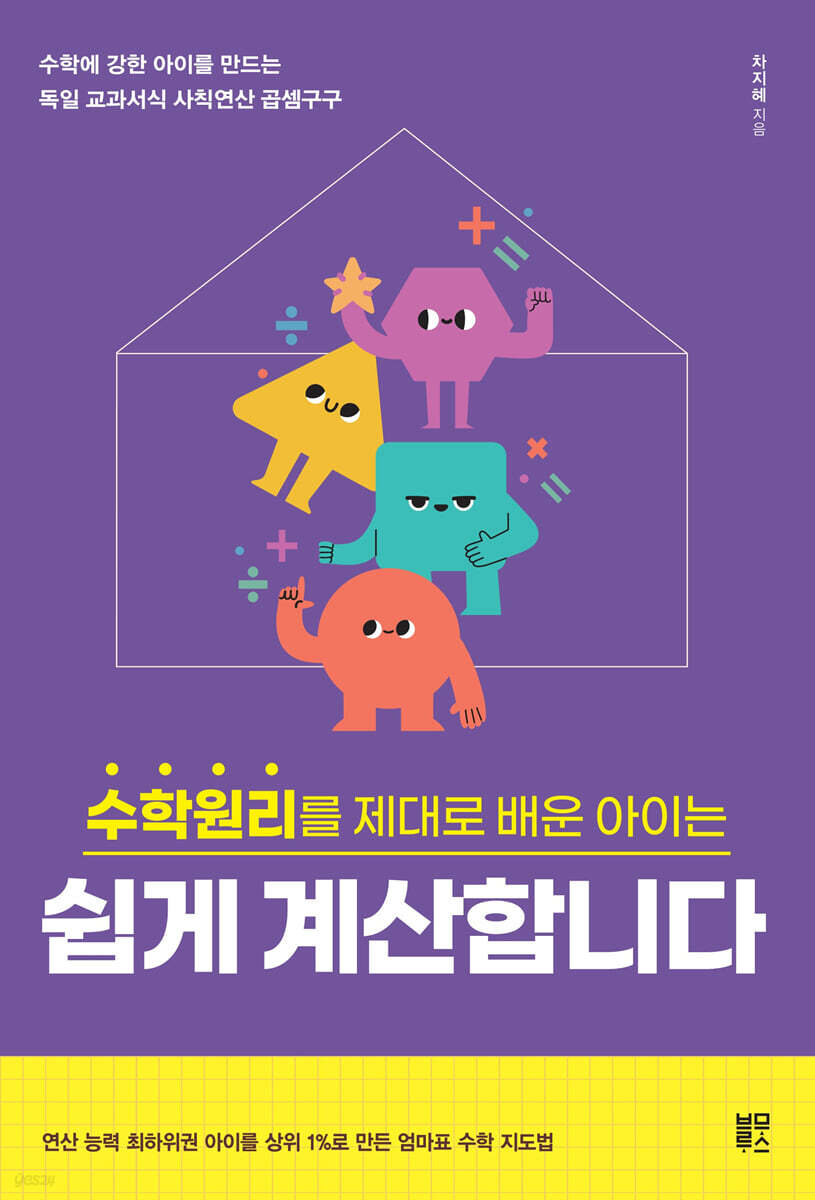
A child who has properly learned mathematical principles can calculate easily.
 |
Description
Book Introduction
The child with the lowest computational ability
Mom's Math Teaching Method Created for the Top 1%!
Contains 'German textbook-style number recognition process'
Special Revised Edition Published in 2023!
“Why on earth can’t you understand something so simple?”
Isn't the most difficult thing about mom's math that it's hard to explain?
Because it is too easy and natural for adults.
I often find myself at a loss as to how to explain these obvious things.
I know the principles are important, but even if I explain it to my child, he doesn't understand, so I have no choice but to force him to memorize it the way I learned it when I was young.
As the progress progresses, both mother and child become bored and exhausted.
Most parents now know that their children need to learn principles slowly rather than relying on old-fashioned, repetitive calculations.
But it's not as easy as it sounds.
How does Germany, a math powerhouse, teach children basic arithmetic? German math textbooks are based on a thorough understanding of how a child's brain understands arithmetic. Therefore, simply by following the textbook, children can naturally learn arithmetic concepts and develop mathematical thinking skills.
This book is a friendly guide to teaching the four basic arithmetic operations in German.
The author, a mother, analyzed German math textbooks that are faithful to mathematical principles, and the father, a neuroscientist, verified the neuroscientific principles of the German textbooks by scientifically examining the minds of children who understand calculations.
Based on this, the couple joined forces to create a new teaching method for the four basic arithmetic operations, and they taught it to their children with great success.
The book "Children Who Learn Math Principles Properly Calculate Easily", which covers all of these processes, was published, and numerous readers testified that they saw the effectiveness of the German textbook-style arithmetic operation instruction.
This special revised edition includes the addition of 'German textbook-style number recognition', an important concept that precedes the four basic arithmetic operations.
In particular, the process of clearly recognizing the number '0' provides an important foundation for dealing with the decimal system and place values later on.
Even if your child has passed the number recognition stage, this content can be of great help.
Mom's Math Teaching Method Created for the Top 1%!
Contains 'German textbook-style number recognition process'
Special Revised Edition Published in 2023!
“Why on earth can’t you understand something so simple?”
Isn't the most difficult thing about mom's math that it's hard to explain?
Because it is too easy and natural for adults.
I often find myself at a loss as to how to explain these obvious things.
I know the principles are important, but even if I explain it to my child, he doesn't understand, so I have no choice but to force him to memorize it the way I learned it when I was young.
As the progress progresses, both mother and child become bored and exhausted.
Most parents now know that their children need to learn principles slowly rather than relying on old-fashioned, repetitive calculations.
But it's not as easy as it sounds.
How does Germany, a math powerhouse, teach children basic arithmetic? German math textbooks are based on a thorough understanding of how a child's brain understands arithmetic. Therefore, simply by following the textbook, children can naturally learn arithmetic concepts and develop mathematical thinking skills.
This book is a friendly guide to teaching the four basic arithmetic operations in German.
The author, a mother, analyzed German math textbooks that are faithful to mathematical principles, and the father, a neuroscientist, verified the neuroscientific principles of the German textbooks by scientifically examining the minds of children who understand calculations.
Based on this, the couple joined forces to create a new teaching method for the four basic arithmetic operations, and they taught it to their children with great success.
The book "Children Who Learn Math Principles Properly Calculate Easily", which covers all of these processes, was published, and numerous readers testified that they saw the effectiveness of the German textbook-style arithmetic operation instruction.
This special revised edition includes the addition of 'German textbook-style number recognition', an important concept that precedes the four basic arithmetic operations.
In particular, the process of clearly recognizing the number '0' provides an important foundation for dealing with the decimal system and place values later on.
Even if your child has passed the number recognition stage, this content can be of great help.
- You can preview some of the book's contents.
Preview
index
Adding German textbook-style numeracy to the revised edition
Introduction: Please lay a solid foundation for mathematical thinking.
Chapter 1: How are they taught the four basic operations in Germany?
We are missing the operation now
Our child, who was at the bottom of the calculation scale, is learning math in Germany.
Germany, a math powerhouse, teaches calculations like this.
Why Parents Should Teach Elementary School Math
Chapter 2: Learning the Basics of Addition
Let's learn the numbers from 0 to 10
The first steps of addition: 'Adding 5' and 'Adding 10'
Let's learn the concept of addition
Numbers up to 20 and their place values
Add 20
Let's learn the meaning and use of the equal sign.
Chapter 3: Learning addition and subtraction using 10
Calculating numbers that add up to more than 10
The first step to subtraction
Subtraction using 10
Learn the relationship between addition and subtraction
Comparing the magnitude of addition and subtraction
Chapter 4: Let's start with two-digit operations.
Review addition and subtraction of numbers within 20
Let's add and subtract up to 100, breaking it down into units of 10.
Recognize numbers up to 100
Add 100
Jump and count
Addition of two-digit numbers under 100
Subtraction of two-digit numbers under 100
Chapter 5: Let's learn multiplication tables
Let's understand the basic concept of multiplication.
Learn the basic multiplication tables
The world of full-fledged multiplication tables
Teach and collect multiplication tables
Chapter 6: Overcoming the Mountain of Division
Understanding the basic concepts of division
Understanding Division Based on Default Multiplication Tables
Comparing the magnitude of multiplication and division
Division with remainder
If you know the direction of the operation map after the second year, you will be able to 'get through'.
The concept of writing is problem-solving ability.
A Word from a Neuroscientist Dad: Why a Neuroscientist Dad Recommends German Textbook-Style Arithmetic
Introduction: Please lay a solid foundation for mathematical thinking.
Chapter 1: How are they taught the four basic operations in Germany?
We are missing the operation now
Our child, who was at the bottom of the calculation scale, is learning math in Germany.
Germany, a math powerhouse, teaches calculations like this.
Why Parents Should Teach Elementary School Math
Chapter 2: Learning the Basics of Addition
Let's learn the numbers from 0 to 10
The first steps of addition: 'Adding 5' and 'Adding 10'
Let's learn the concept of addition
Numbers up to 20 and their place values
Add 20
Let's learn the meaning and use of the equal sign.
Chapter 3: Learning addition and subtraction using 10
Calculating numbers that add up to more than 10
The first step to subtraction
Subtraction using 10
Learn the relationship between addition and subtraction
Comparing the magnitude of addition and subtraction
Chapter 4: Let's start with two-digit operations.
Review addition and subtraction of numbers within 20
Let's add and subtract up to 100, breaking it down into units of 10.
Recognize numbers up to 100
Add 100
Jump and count
Addition of two-digit numbers under 100
Subtraction of two-digit numbers under 100
Chapter 5: Let's learn multiplication tables
Let's understand the basic concept of multiplication.
Learn the basic multiplication tables
The world of full-fledged multiplication tables
Teach and collect multiplication tables
Chapter 6: Overcoming the Mountain of Division
Understanding the basic concepts of division
Understanding Division Based on Default Multiplication Tables
Comparing the magnitude of multiplication and division
Division with remainder
If you know the direction of the operation map after the second year, you will be able to 'get through'.
The concept of writing is problem-solving ability.
A Word from a Neuroscientist Dad: Why a Neuroscientist Dad Recommends German Textbook-Style Arithmetic
Detailed image

Into the book
This is why adults have difficulty teaching arithmetic to young children.
Because you don't know that the operation is not natural.
The abstract thinking skills necessary for mathematics begin to develop in earnest around the third or fourth grade of elementary school.
However, many parents make the mistake of teaching elementary school children based on the assumption that they are capable of abstract thinking.
It means treating a child like an adult without considering the child's cognitive development.
Concepts are taught as if speaking to an adult, workbooks are pushed in, and children are made to solve problems without even understanding the meaning. When the child solves the problem, they are mistaken in thinking that they really understand the concept.
Can a child who starts math so wrong be good at or likes math?
---p.7 From "Please lay a solid foundation for mathematical thinking"
Children who study arithmetic the German way gain time to review problems again by calculating quickly and accurately.
Since you have more time to think about problems than others, you naturally make fewer mistakes and get better grades.
---pp.18~19 From "We Are Missing the Calculation Now"
The realization that you can do math with your child without difficulty, without effort, without struggling with them.
The insight that one can think deeply and broadly about the concepts of numbers and operations by solving systematically structured problems, without having to explain complex concepts or solve difficult problems.
This is what I learned from studying German textbooks with my older child.
---p.29 From "Our child, who was at the bottom of the calculations, opened his eyes to calculations in Germany"
Looking at German math textbooks, I get the feeling that they approach teaching new things very cautiously.
There are many traces of efforts to ensure that the first impression of a new concept is not one of 'dislike', but at least perceived as 'something worth doing'.
Just as we put a lot of thought into making baby food for the first time, in case the baby dislikes it, in Germany, we do the same when introducing a new concept in mathematics.
We present familiar concepts that we have learned before and connect them to present new concepts.
It's like saying this:
“This is something you understood before.
The concept we will learn this time is similar to this.
“How about it, worth a try?”
---pp.35~36 From "Germany, a Mathematical Powerhouse, Teaches Arithmetic This Way"
In Mom's Math, it is often called 'Suyang Ilchi', but it is also called 'rational number counting'.
The reason it's important is because it's difficult.
It was only a few thousand years ago that we recognized the abstract concept of 5 from five apples and five pebbles and recognized that they were 'equal numbers'.
This means that working with numbers is a more difficult task than you might think, requiring more brain power.
Mathematics is a discipline that deals with the abstract world.
Humans have difficulty understanding the abstract world.
In German classrooms, we guide students through the process of starting from the concrete world and reaching the abstract world.
The first step is the current study of understanding numbers from 0 to 10.
---p.54 From “Let’s learn the numbers from 0 to 10”
The equal sign means that the left and right sides of the equal sign are equal.
But what happens when, due to incorrect learning of operations, we learn the equals sign as a "question mark" that demands an answer to a problem? This makes reading word problems and formulating equations difficult, and even learning equations in middle school becomes a challenge.
So in Germany, equals and addition are not taught together, but rather taught at different times.
So that you can clearly understand the meaning of each.
---p.101 From “Let’s learn the meaning and use of the equal sign”
In our country, we learn numbers in multiples of 10, and then learn to count and compare numbers up to 21, 22… 50.
Then we learn again up to 100 and learn double-digit addition and subtraction.
However, in Germany, they first teach numbers up to 100 in multiples of 10, and then teach addition and subtraction in multiples of 10.
Why? The reason is simple.
If you cut it into units of 10, you can compare and calculate because the positions and shapes of the units are similar.
It's easier to understand from a child's perspective.
This is a characteristic of German textbook-style arithmetic operations that actively utilizes easy concepts learned previously.
---pp.162~163 From "Let's add and subtract up to 100, in units of 10"
The default value of the multiplication table is the value obtained by multiplying 1, 2, 5, and 10 in each step.
These numbers are divisors of 10.
The basic multiplication tables you learn at this stage play a key role in multiplication and division calculations.
It helps to solidify the basic concepts of multiplication and connect the relationships between each level.
It also makes multiplication tables easy.
When children are exposed to the entire second level from the beginning, they think, 'Oh, it's difficult.
It's easy to feel like, 'There's too much!'
On the other hand, if you first learn the values of 1, 2, 5, and 10 in each stage, you will accept it and think, 'It's more doable than I thought. It's not that difficult.'
Lastly, the default multiplication table serves as a guide to help you find the value without having to memorize the value multiplied by 1 when you cannot remember the multiplication table during a test.
---p.215 From "Learning the Basic Multiplication Tables"
Ask a child who has just learned division the following question:
“If you divide 1 by 4, what will the quotient be?”
If you have trouble understanding this question, try rephrasing it.
It's the same question, but if you just help your child imagine it in their head, they'll be able to come up with the answer much more easily.
“How can we divide one Choco Pie equally among four people?”
However, if the concept of division is not well-defined, you will feel confused even with such an easily changed question.
On the other hand, if the concept of division is well-imaged in the child's head, the child will hear this question and try to cut the Choco Pie to divide it 'equally'.
That's the first concept a child encounters with fractions.
---pp.263~264 From "Understanding Division Based on Default Multiplication Tables"
When a child solves a problem, what is important is not whether the answer is correct, but whether the concept is written accurately when solving the problem.
Ask your child how he or she solved this problem and check that he or she understands the concept correctly.
(Note that German elementary schools have presentation and discussion time, so this process happens naturally.)
The same applies to studying areas that children find difficult, such as shapes and measurements, as well as operations like fractions and decimals.
Help them understand the concepts clearly enough to explain them to their parents.
That's much more important than getting things done quickly or solving a lot of problems.
---pp.287~288 From "If you know it accurately, you will 'get through'"
As a neuroscientist and a father, I studied and reviewed German textbooks and thought that the brains of children who learned from German textbooks would also be very different.
Children who are accustomed to memorizing and calculating in pieces use only a small part of their brain needed for those functions.
On the other hand, German textbooks, which emphasize understanding the whole, encourage the use of the whole brain, so children who study this way become accustomed to comprehensive thinking that uses the whole brain.
The 'comprehensive thinking skills' that are so emphasized can be developed through textbooks.
Because you don't know that the operation is not natural.
The abstract thinking skills necessary for mathematics begin to develop in earnest around the third or fourth grade of elementary school.
However, many parents make the mistake of teaching elementary school children based on the assumption that they are capable of abstract thinking.
It means treating a child like an adult without considering the child's cognitive development.
Concepts are taught as if speaking to an adult, workbooks are pushed in, and children are made to solve problems without even understanding the meaning. When the child solves the problem, they are mistaken in thinking that they really understand the concept.
Can a child who starts math so wrong be good at or likes math?
---p.7 From "Please lay a solid foundation for mathematical thinking"
Children who study arithmetic the German way gain time to review problems again by calculating quickly and accurately.
Since you have more time to think about problems than others, you naturally make fewer mistakes and get better grades.
---pp.18~19 From "We Are Missing the Calculation Now"
The realization that you can do math with your child without difficulty, without effort, without struggling with them.
The insight that one can think deeply and broadly about the concepts of numbers and operations by solving systematically structured problems, without having to explain complex concepts or solve difficult problems.
This is what I learned from studying German textbooks with my older child.
---p.29 From "Our child, who was at the bottom of the calculations, opened his eyes to calculations in Germany"
Looking at German math textbooks, I get the feeling that they approach teaching new things very cautiously.
There are many traces of efforts to ensure that the first impression of a new concept is not one of 'dislike', but at least perceived as 'something worth doing'.
Just as we put a lot of thought into making baby food for the first time, in case the baby dislikes it, in Germany, we do the same when introducing a new concept in mathematics.
We present familiar concepts that we have learned before and connect them to present new concepts.
It's like saying this:
“This is something you understood before.
The concept we will learn this time is similar to this.
“How about it, worth a try?”
---pp.35~36 From "Germany, a Mathematical Powerhouse, Teaches Arithmetic This Way"
In Mom's Math, it is often called 'Suyang Ilchi', but it is also called 'rational number counting'.
The reason it's important is because it's difficult.
It was only a few thousand years ago that we recognized the abstract concept of 5 from five apples and five pebbles and recognized that they were 'equal numbers'.
This means that working with numbers is a more difficult task than you might think, requiring more brain power.
Mathematics is a discipline that deals with the abstract world.
Humans have difficulty understanding the abstract world.
In German classrooms, we guide students through the process of starting from the concrete world and reaching the abstract world.
The first step is the current study of understanding numbers from 0 to 10.
---p.54 From “Let’s learn the numbers from 0 to 10”
The equal sign means that the left and right sides of the equal sign are equal.
But what happens when, due to incorrect learning of operations, we learn the equals sign as a "question mark" that demands an answer to a problem? This makes reading word problems and formulating equations difficult, and even learning equations in middle school becomes a challenge.
So in Germany, equals and addition are not taught together, but rather taught at different times.
So that you can clearly understand the meaning of each.
---p.101 From “Let’s learn the meaning and use of the equal sign”
In our country, we learn numbers in multiples of 10, and then learn to count and compare numbers up to 21, 22… 50.
Then we learn again up to 100 and learn double-digit addition and subtraction.
However, in Germany, they first teach numbers up to 100 in multiples of 10, and then teach addition and subtraction in multiples of 10.
Why? The reason is simple.
If you cut it into units of 10, you can compare and calculate because the positions and shapes of the units are similar.
It's easier to understand from a child's perspective.
This is a characteristic of German textbook-style arithmetic operations that actively utilizes easy concepts learned previously.
---pp.162~163 From "Let's add and subtract up to 100, in units of 10"
The default value of the multiplication table is the value obtained by multiplying 1, 2, 5, and 10 in each step.
These numbers are divisors of 10.
The basic multiplication tables you learn at this stage play a key role in multiplication and division calculations.
It helps to solidify the basic concepts of multiplication and connect the relationships between each level.
It also makes multiplication tables easy.
When children are exposed to the entire second level from the beginning, they think, 'Oh, it's difficult.
It's easy to feel like, 'There's too much!'
On the other hand, if you first learn the values of 1, 2, 5, and 10 in each stage, you will accept it and think, 'It's more doable than I thought. It's not that difficult.'
Lastly, the default multiplication table serves as a guide to help you find the value without having to memorize the value multiplied by 1 when you cannot remember the multiplication table during a test.
---p.215 From "Learning the Basic Multiplication Tables"
Ask a child who has just learned division the following question:
“If you divide 1 by 4, what will the quotient be?”
If you have trouble understanding this question, try rephrasing it.
It's the same question, but if you just help your child imagine it in their head, they'll be able to come up with the answer much more easily.
“How can we divide one Choco Pie equally among four people?”
However, if the concept of division is not well-defined, you will feel confused even with such an easily changed question.
On the other hand, if the concept of division is well-imaged in the child's head, the child will hear this question and try to cut the Choco Pie to divide it 'equally'.
That's the first concept a child encounters with fractions.
---pp.263~264 From "Understanding Division Based on Default Multiplication Tables"
When a child solves a problem, what is important is not whether the answer is correct, but whether the concept is written accurately when solving the problem.
Ask your child how he or she solved this problem and check that he or she understands the concept correctly.
(Note that German elementary schools have presentation and discussion time, so this process happens naturally.)
The same applies to studying areas that children find difficult, such as shapes and measurements, as well as operations like fractions and decimals.
Help them understand the concepts clearly enough to explain them to their parents.
That's much more important than getting things done quickly or solving a lot of problems.
---pp.287~288 From "If you know it accurately, you will 'get through'"
As a neuroscientist and a father, I studied and reviewed German textbooks and thought that the brains of children who learned from German textbooks would also be very different.
Children who are accustomed to memorizing and calculating in pieces use only a small part of their brain needed for those functions.
On the other hand, German textbooks, which emphasize understanding the whole, encourage the use of the whole brain, so children who study this way become accustomed to comprehensive thinking that uses the whole brain.
The 'comprehensive thinking skills' that are so emphasized can be developed through textbooks.
---p.294 From “Why My Neuroscientist Dad Recommends German Textbook-Style Arithmetic”
Publisher's Review
Math education in Germany, a math powerhouse, is different!
Add fun to math with easy-to-follow explanations related to everyday life.
Germany is a country that has produced many talented people in the fields of mathematics and mathematics education, including Euler, Gauss, Hilbert, and Courant, from the modern era to the present day.
German students are generally confident and comfortable with mathematics, and they achieve excellent results in mathematics at university and in business.
On the other hand, Korean students, despite their high math scores, showed low confidence in their mathematical abilities and low interest in math.
This research supports the numerous students who do well in elementary school but then suddenly fall into the trap of failing.
German education is fundamentally different from Korean education, which is characterized by repetitive problem-solving without the process of understanding, and is a type of education that produces many dropouts.
This book is a detailed introduction to the German textbook-style arithmetic learning method, and is a guide that kindly explains how to teach arithmetic to children using the German textbook style.
Parents seeking an alternative to Korea's mass-producing math education system should definitely consider this book! By following the German textbook method, students learn concepts accurately, not just tricks, thereby building solid math skills. And because it's easy and fun to learn, their interest in math will inevitably improve.
Children who experience the fun of learning, the joy of solving problems, and the sense of accomplishment in mathematics itself from the time they begin to learn arithmetic perceive mathematics as easy, fun, and worth doing.
Moreover, mothers who teach their children with this book can fully enjoy the fun and joy of knowledge itself by learning the true concepts and principles of operations that they were previously unaware of.
Understanding concepts and solving problems, not explanations and calculations
A child who does only two pages of workbook worksheets a day and repeatedly calculates will just do whatever he is told.
I don't know why I'm solving this problem, what the hidden principles are, or what I can do by solving this problem.
This typical learning method is turning children into math idiots.
This book combines the two goals of "improving mathematical thinking skills" and "forming numerical concepts" into a single process based on brain science.
After familiarizing children with the various methods and principles of operations that touch on the essence of operations, from addition to division, we guide them to solve given problems by approaching them in various ways.
Furthermore, we create problems ourselves, apply them to real life situations, and let students 'play with' math.
In the process, the child's mathematical thinking ability deepens and broadens.
Thorough principles, light teaching methods
The children of these authors, who received this German-style arithmetic education, not only learned the concepts that children of their age should be able to achieve, but also easily understood concepts such as factoring and equations that ordinary elementary school students in our country would not even dream of.
However, the methods taught in this book are by no means something that only a 'gifted' person can digest.
Rather, because it teaches the principles first, children can learn it easily.
Based on the concept of 'complete learning', it is easy to explain from the mother's perspective because new concepts are taught based on previously learned concepts.
Here, various real-life analogies and fun practice problems that can be learned with hands and feet help wash away the aversion to math in the minds of children and mothers and help them enjoy math as a game.
So, it's easy and fun for both mom and child!
Reading this book will change you in the following ways:
First, both the child and the mother develop the perception that "arithmetic? Easy, fun, and worth doing!"
Second, it can develop children's mathematical thinking skills and build a solid foundation for middle and high school mathematics that they will learn later.
Third, mothers can understand the mind of their children learning operations through brain science.
Fourth, mothers also get to experience the fun and joy of mathematics by looking at operations they had previously learned mechanically in a new way.
Add fun to math with easy-to-follow explanations related to everyday life.
Germany is a country that has produced many talented people in the fields of mathematics and mathematics education, including Euler, Gauss, Hilbert, and Courant, from the modern era to the present day.
German students are generally confident and comfortable with mathematics, and they achieve excellent results in mathematics at university and in business.
On the other hand, Korean students, despite their high math scores, showed low confidence in their mathematical abilities and low interest in math.
This research supports the numerous students who do well in elementary school but then suddenly fall into the trap of failing.
German education is fundamentally different from Korean education, which is characterized by repetitive problem-solving without the process of understanding, and is a type of education that produces many dropouts.
This book is a detailed introduction to the German textbook-style arithmetic learning method, and is a guide that kindly explains how to teach arithmetic to children using the German textbook style.
Parents seeking an alternative to Korea's mass-producing math education system should definitely consider this book! By following the German textbook method, students learn concepts accurately, not just tricks, thereby building solid math skills. And because it's easy and fun to learn, their interest in math will inevitably improve.
Children who experience the fun of learning, the joy of solving problems, and the sense of accomplishment in mathematics itself from the time they begin to learn arithmetic perceive mathematics as easy, fun, and worth doing.
Moreover, mothers who teach their children with this book can fully enjoy the fun and joy of knowledge itself by learning the true concepts and principles of operations that they were previously unaware of.
Understanding concepts and solving problems, not explanations and calculations
A child who does only two pages of workbook worksheets a day and repeatedly calculates will just do whatever he is told.
I don't know why I'm solving this problem, what the hidden principles are, or what I can do by solving this problem.
This typical learning method is turning children into math idiots.
This book combines the two goals of "improving mathematical thinking skills" and "forming numerical concepts" into a single process based on brain science.
After familiarizing children with the various methods and principles of operations that touch on the essence of operations, from addition to division, we guide them to solve given problems by approaching them in various ways.
Furthermore, we create problems ourselves, apply them to real life situations, and let students 'play with' math.
In the process, the child's mathematical thinking ability deepens and broadens.
Thorough principles, light teaching methods
The children of these authors, who received this German-style arithmetic education, not only learned the concepts that children of their age should be able to achieve, but also easily understood concepts such as factoring and equations that ordinary elementary school students in our country would not even dream of.
However, the methods taught in this book are by no means something that only a 'gifted' person can digest.
Rather, because it teaches the principles first, children can learn it easily.
Based on the concept of 'complete learning', it is easy to explain from the mother's perspective because new concepts are taught based on previously learned concepts.
Here, various real-life analogies and fun practice problems that can be learned with hands and feet help wash away the aversion to math in the minds of children and mothers and help them enjoy math as a game.
So, it's easy and fun for both mom and child!
Reading this book will change you in the following ways:
First, both the child and the mother develop the perception that "arithmetic? Easy, fun, and worth doing!"
Second, it can develop children's mathematical thinking skills and build a solid foundation for middle and high school mathematics that they will learn later.
Third, mothers can understand the mind of their children learning operations through brain science.
Fourth, mothers also get to experience the fun and joy of mathematics by looking at operations they had previously learned mechanically in a new way.
GOODS SPECIFICS
- Date of issue: May 25, 2023
- Page count, weight, size: 296 pages | 500g | 160*235*18mm
- ISBN13: 9791191426847
- ISBN10: 119142684X
You may also like
카테고리
korean


korean

![GQ KOREA Mark (Monthly): December [2025]](http://librairie.coreenne.fr/cdn/shop/files/8ef265dbbfbf186523ed75ba7319009d.jpg?v=1765340328&width=3840)


