

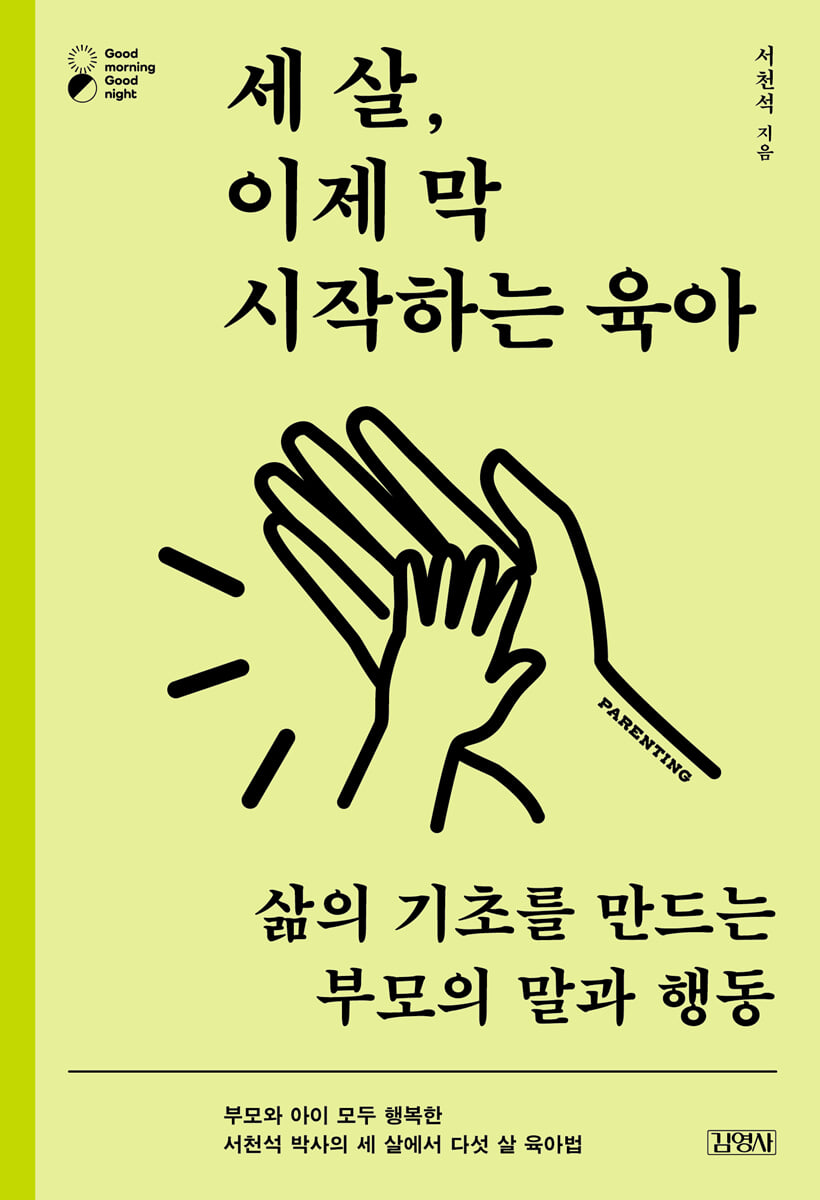
Three years old, just starting out in parenting
 |
Description
Book Introduction
Parenting at age three determines a child's life.
Dr. Seo Cheon-seok's parenting method for three- to five-year-olds that makes both parents and children happy
Knowledge Library "Good Morning, Good Night" "Parenting"
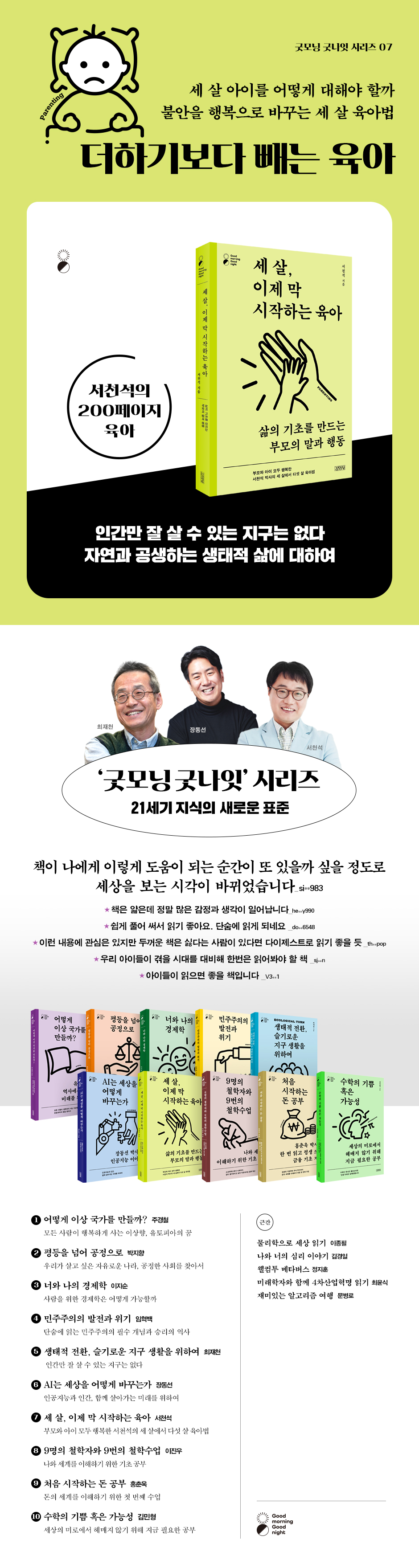
The "Good Morning, Good Night" series, created by leading scholars and researchers in each field for future generations.
The seventh book, "Three Year Olds, Just Starting Parenting," specifically contains parenting methods for children aged three to five who will grow up to be the next generation.
Dr. Seo Cheon-seok, a parenting mentor who empathizes with the difficulties faced by all parents in Korea and teaches children how to love more easily and deeply.
From understanding developmental stages to the mindset for raising a child, essential play methods, and unwavering discipline principles, we share tips for raising a three-year-old that will transform parents' anxiety into happiness.
This is a must-read for raising three-year-olds, as it lays the foundation for a self-directed attitude that guides life.
Dr. Seo Cheon-seok's parenting method for three- to five-year-olds that makes both parents and children happy
Knowledge Library "Good Morning, Good Night" "Parenting"
The "Good Morning, Good Night" series, created by leading scholars and researchers in each field for future generations.
The seventh book, "Three Year Olds, Just Starting Parenting," specifically contains parenting methods for children aged three to five who will grow up to be the next generation.
Dr. Seo Cheon-seok, a parenting mentor who empathizes with the difficulties faced by all parents in Korea and teaches children how to love more easily and deeply.
From understanding developmental stages to the mindset for raising a child, essential play methods, and unwavering discipline principles, we share tips for raising a three-year-old that will transform parents' anxiety into happiness.
This is a must-read for raising three-year-olds, as it lays the foundation for a self-directed attitude that guides life.
- You can preview some of the book's contents.
Preview
index
Introduction
Chapter 1: What kind of time is three years old in life?
1.
Physical and motor development
2.
language development
3.
Development of cognition and thinking
4.
Emotional and social development
Chapter 2: Attitude toward raising children
1.
Raising children is so hard
2.
How to overcome anxiety?
3.
The essence of parenting is care.
4.
Parenting that subtracts rather than adds
Chapter 3: The One Thing Children Need: Play
1.
From care to play
2.
Why is play necessary?
3.
How should I play with my child?
4.
How should we use media?
Chapter 4 How to help your child?
1.
Are parents who are like friends good parents?
2.
How to properly instruct your child
3.
Misconceptions and Truths Surrounding Discipline
4.
Precious values to teach children
Outgoing post
Read more
Chapter 1: What kind of time is three years old in life?
1.
Physical and motor development
2.
language development
3.
Development of cognition and thinking
4.
Emotional and social development
Chapter 2: Attitude toward raising children
1.
Raising children is so hard
2.
How to overcome anxiety?
3.
The essence of parenting is care.
4.
Parenting that subtracts rather than adds
Chapter 3: The One Thing Children Need: Play
1.
From care to play
2.
Why is play necessary?
3.
How should I play with my child?
4.
How should we use media?
Chapter 4 How to help your child?
1.
Are parents who are like friends good parents?
2.
How to properly instruct your child
3.
Misconceptions and Truths Surrounding Discipline
4.
Precious values to teach children
Outgoing post
Read more
Detailed image
Into the book
This is the time when the foundation for self-directed learning, which is a hot topic among parents these days, is formed, along with self-directed attitudes that involve setting goals and leading one's own life.
Children who spend this time well develop an attitude of confidently leading their own lives, whereas children who fail repeatedly during this period may not be able to assert themselves and feel guilty when they have to set their own goals.
This is a crucial time, as it depends on whether you believe in yourself or not and always hesitate.
--- pp.
From 10-11 “Introductory Notes”
Time from three to five stones.
During this time, the child re-experiences himself and the world.
A child who believed that the world revolved around him or herself and viewed everything as connected to himself or herself now feels that he or she is a part of the world.
You come to realize that other people, even your own caring parents, feel, think, and want different things from you.
--- p.
41 Chapter 1.
From "What kind of time is three years old in life?"
Perfectionism upsets me and my child.
It pushes childcare into a burden.
You're so busy thinking about and checking off your to-do list that you don't even notice the child in front of you.
The joys and shining moments of parenting are not obtained.
We fail to give our children the moment they need most: a moment of comfort and love, right next to them.
When you stay with your child with the mindset of, 'I'm so happy that you came to me,' your child's self-esteem is built.
The heart of a parent who fully acknowledges, accepts, and welcomes their child as he or she is.
That mind does not provide a solid foundation for the child's self-esteem.
--- pp.
53~54 「Chapter 2.
From “Attitude toward Raising Children”
Children repeat the same games.
When adults watch, they wonder if it's fun to do it over and over again, but children keep doing it.
Repetition is the process of creating a neural network.
If there is no repetition, the neural network does not form.
It's not just repetition.
If you look closely, you will see that it transforms and expands over time.
Children learn by gradually expanding what they already know and are familiar with, just like a tree branches out.
If changes are too much or too fast, the child becomes anxious.
So, we keep the existing framework and mix in changes little by little.
A child's interest in the outside world can be expanded only when psychological stability is maintained.
--- p.
90 Chapter 3.
From "The Only Thing a Child Needs: Play"
In order to discipline a child, you must observe him or her closely on a regular basis.
This will help you understand why your child is behaving poorly and how he or she is causing problems.
You have to understand to help your child.
Even if you ask the child, the child doesn't know why he or she did that.
Parents have to find out, but if they don't observe, they won't find the answer.
It's a cliché, but it takes time to observe a child.
Children who spend this time well develop an attitude of confidently leading their own lives, whereas children who fail repeatedly during this period may not be able to assert themselves and feel guilty when they have to set their own goals.
This is a crucial time, as it depends on whether you believe in yourself or not and always hesitate.
--- pp.
From 10-11 “Introductory Notes”
Time from three to five stones.
During this time, the child re-experiences himself and the world.
A child who believed that the world revolved around him or herself and viewed everything as connected to himself or herself now feels that he or she is a part of the world.
You come to realize that other people, even your own caring parents, feel, think, and want different things from you.
--- p.
41 Chapter 1.
From "What kind of time is three years old in life?"
Perfectionism upsets me and my child.
It pushes childcare into a burden.
You're so busy thinking about and checking off your to-do list that you don't even notice the child in front of you.
The joys and shining moments of parenting are not obtained.
We fail to give our children the moment they need most: a moment of comfort and love, right next to them.
When you stay with your child with the mindset of, 'I'm so happy that you came to me,' your child's self-esteem is built.
The heart of a parent who fully acknowledges, accepts, and welcomes their child as he or she is.
That mind does not provide a solid foundation for the child's self-esteem.
--- pp.
53~54 「Chapter 2.
From “Attitude toward Raising Children”
Children repeat the same games.
When adults watch, they wonder if it's fun to do it over and over again, but children keep doing it.
Repetition is the process of creating a neural network.
If there is no repetition, the neural network does not form.
It's not just repetition.
If you look closely, you will see that it transforms and expands over time.
Children learn by gradually expanding what they already know and are familiar with, just like a tree branches out.
If changes are too much or too fast, the child becomes anxious.
So, we keep the existing framework and mix in changes little by little.
A child's interest in the outside world can be expanded only when psychological stability is maintained.
--- p.
90 Chapter 3.
From "The Only Thing a Child Needs: Play"
In order to discipline a child, you must observe him or her closely on a regular basis.
This will help you understand why your child is behaving poorly and how he or she is causing problems.
You have to understand to help your child.
Even if you ask the child, the child doesn't know why he or she did that.
Parents have to find out, but if they don't observe, they won't find the answer.
It's a cliché, but it takes time to observe a child.
--- pp.
174~175 「Chapter 4.
How to help a child?
174~175 「Chapter 4.
How to help a child?
Publisher's Review
How to treat a three-year-old child
How to Transform Anxiety into Happiness: Parenting Tips for a Three-Year-Old
At the age of three, the time when children need full parental care has passed.
What do children need at this age? What should parents not miss? Children express their wishes clearly and act as they please.
However, the child's words and actions still lack logic and the ability to think from other people's perspectives is lacking.
Real childcare begins at the age of three.
Dr. Seo Cheon-seok, a parenting mentor for all parents in Korea, helps children understand the three-year-old's cognitive and emotional development and the foundation for self-directed behavior. He guides them through play-based parenting, which is essential during this period, and disciplinary parenting that teaches them the precious values of life.
Rather than holding parents accountable, we sympathize with their difficulties and put together a book of parenting tips for parents of children aged three to five.
This book helps you escape the burden of parenting and focus on happiness.
Parenting that subtracts rather than adds
Defeating Perfectionism, Parenting's Greatest Enemy
As industry becomes more sophisticated and society demands higher levels of education, childcare has become a project.
Parents worry about their children's future and try to raise them to be perfect children who are not only good at studying but also good at sports, and have good character and social skills.
Parents themselves also try to raise their children without being lacking anything because they want to give them everything.
If you push yourself too hard, you will get tired, and if you get tired, love will disappear.
The author warns that parents' perfectionism is actually the biggest enemy of parenting.
You're so caught up in thinking about and checking off your to-do list that you miss out on what really matters: your relationship with your child.
We need to empty our minds of the desire to do more, save our energy and time as parents, and focus on what will be most helpful to our children.
Parents raising children between the ages of three and five, in particular, should pay close attention to whether their children are growing appropriately according to their developmental stage, and prioritize helping their children play well and disciplining them to behave properly.
Child-led play, parent-led discipline
Parenting at age three determines a child's life.
Many parents mistakenly believe that play is education and that discipline means scolding children for misbehaving.
Dr. Seo Cheon-seok emphasizes that play should be led by the child himself, and says that discipline is a larger concept that teaches important values in life.
Through self-directed play, children develop self-direction and self-regulation skills and learn to understand their own and others' emotions.
When playing, instead of saying “no,” you should actively respond to the child’s play and follow the child’s lead.
The author explains how a child's play style changes according to developmental stages and guides parents on how to support their child's play.
A three-year-old child does not yet have a concept of what is wrong.
To instill standards of right and wrong in a child who cannot be persuaded with logic, parents must clearly and authoritatively give instructions.
Furthermore, discipline teaches valuable life values such as responsibility, gratitude, and the ability to control emotions and impulses.
Discipline cannot be achieved by scolding a child alone.
You need to build a close relationship with your child to be able to discipline them properly.
The process of raising a child is difficult and overwhelming.
The rapidly changing childcare environment is making parents more anxious.
Three to five years old.
This is the time when you are just starting out in life and are developing the skills that will become the foundation of your life.
This book will guide you to love your child more easily and more deeply.
· Why are three years important in life?
· Four things to do and four things not to do when playing
· How should I show media to my child?
· Are parents who are like friends good parents?
· Misconceptions and truths surrounding discipline
Today's culture, future wisdom, every day
The 'Good Morning, Good Night' series, a knowledge library that starts in the morning and ends in the evening.
'Good Morning, Good Night' sets a new standard for knowledge in the 21st century.
Written by the best writers, we share wisdom on how to view the world.
We take a look at where we are, what changes we are facing, and what we need to prepare for.
The world is changing.
The paradigm is shifting in all fields.
These are uncertain times, where we don't know what will happen tomorrow.
What choices will you make in the face of the great tide of change?
Will you fall into crisis because you can't read the changes, or will you actively respond to the changes and create opportunities?
Where do we stand, what changes are we facing, and what should we prepare for?
Leading scholars and researchers from each field have come together to create a comprehensive collection of knowledge and culture for future generations.
This knowledge library historically examines the changes and issues facing us in this era of transition across all fields, including the humanities, social sciences, economics, natural sciences, and the arts, and comprehensively examines phenomena and their essence to seek solutions and alternatives.
It is a paperback book that can be read by all generations, from middle school students to college students and the general public, and contains core knowledge and culture in one volume, so you can keep it close by and refer to it every day.
The 'Good Morning, Good Night' library will present a new standard for 21st century knowledge and serve as a guide to providing wisdom for viewing the world.
We await you, seeking wisdom and insight.
How to Transform Anxiety into Happiness: Parenting Tips for a Three-Year-Old
At the age of three, the time when children need full parental care has passed.
What do children need at this age? What should parents not miss? Children express their wishes clearly and act as they please.
However, the child's words and actions still lack logic and the ability to think from other people's perspectives is lacking.
Real childcare begins at the age of three.
Dr. Seo Cheon-seok, a parenting mentor for all parents in Korea, helps children understand the three-year-old's cognitive and emotional development and the foundation for self-directed behavior. He guides them through play-based parenting, which is essential during this period, and disciplinary parenting that teaches them the precious values of life.
Rather than holding parents accountable, we sympathize with their difficulties and put together a book of parenting tips for parents of children aged three to five.
This book helps you escape the burden of parenting and focus on happiness.
Parenting that subtracts rather than adds
Defeating Perfectionism, Parenting's Greatest Enemy
As industry becomes more sophisticated and society demands higher levels of education, childcare has become a project.
Parents worry about their children's future and try to raise them to be perfect children who are not only good at studying but also good at sports, and have good character and social skills.
Parents themselves also try to raise their children without being lacking anything because they want to give them everything.
If you push yourself too hard, you will get tired, and if you get tired, love will disappear.
The author warns that parents' perfectionism is actually the biggest enemy of parenting.
You're so caught up in thinking about and checking off your to-do list that you miss out on what really matters: your relationship with your child.
We need to empty our minds of the desire to do more, save our energy and time as parents, and focus on what will be most helpful to our children.
Parents raising children between the ages of three and five, in particular, should pay close attention to whether their children are growing appropriately according to their developmental stage, and prioritize helping their children play well and disciplining them to behave properly.
Child-led play, parent-led discipline
Parenting at age three determines a child's life.
Many parents mistakenly believe that play is education and that discipline means scolding children for misbehaving.
Dr. Seo Cheon-seok emphasizes that play should be led by the child himself, and says that discipline is a larger concept that teaches important values in life.
Through self-directed play, children develop self-direction and self-regulation skills and learn to understand their own and others' emotions.
When playing, instead of saying “no,” you should actively respond to the child’s play and follow the child’s lead.
The author explains how a child's play style changes according to developmental stages and guides parents on how to support their child's play.
A three-year-old child does not yet have a concept of what is wrong.
To instill standards of right and wrong in a child who cannot be persuaded with logic, parents must clearly and authoritatively give instructions.
Furthermore, discipline teaches valuable life values such as responsibility, gratitude, and the ability to control emotions and impulses.
Discipline cannot be achieved by scolding a child alone.
You need to build a close relationship with your child to be able to discipline them properly.
The process of raising a child is difficult and overwhelming.
The rapidly changing childcare environment is making parents more anxious.
Three to five years old.
This is the time when you are just starting out in life and are developing the skills that will become the foundation of your life.
This book will guide you to love your child more easily and more deeply.
· Why are three years important in life?
· Four things to do and four things not to do when playing
· How should I show media to my child?
· Are parents who are like friends good parents?
· Misconceptions and truths surrounding discipline
Today's culture, future wisdom, every day
The 'Good Morning, Good Night' series, a knowledge library that starts in the morning and ends in the evening.
'Good Morning, Good Night' sets a new standard for knowledge in the 21st century.
Written by the best writers, we share wisdom on how to view the world.
We take a look at where we are, what changes we are facing, and what we need to prepare for.
The world is changing.
The paradigm is shifting in all fields.
These are uncertain times, where we don't know what will happen tomorrow.
What choices will you make in the face of the great tide of change?
Will you fall into crisis because you can't read the changes, or will you actively respond to the changes and create opportunities?
Where do we stand, what changes are we facing, and what should we prepare for?
Leading scholars and researchers from each field have come together to create a comprehensive collection of knowledge and culture for future generations.
This knowledge library historically examines the changes and issues facing us in this era of transition across all fields, including the humanities, social sciences, economics, natural sciences, and the arts, and comprehensively examines phenomena and their essence to seek solutions and alternatives.
It is a paperback book that can be read by all generations, from middle school students to college students and the general public, and contains core knowledge and culture in one volume, so you can keep it close by and refer to it every day.
The 'Good Morning, Good Night' library will present a new standard for 21st century knowledge and serve as a guide to providing wisdom for viewing the world.
We await you, seeking wisdom and insight.
GOODS SPECIFICS
- Date of issue: April 11, 2022
- Page count, weight, size: 204 pages | 234g | 132*193*13mm
- ISBN13: 9788934961543
- ISBN10: 8934961546
You may also like
카테고리
korean


korean

![GQ KOREA Mark (Monthly): December [2025]](http://librairie.coreenne.fr/cdn/shop/files/8ef265dbbfbf186523ed75ba7319009d.jpg?v=1765340328&width=3840)


